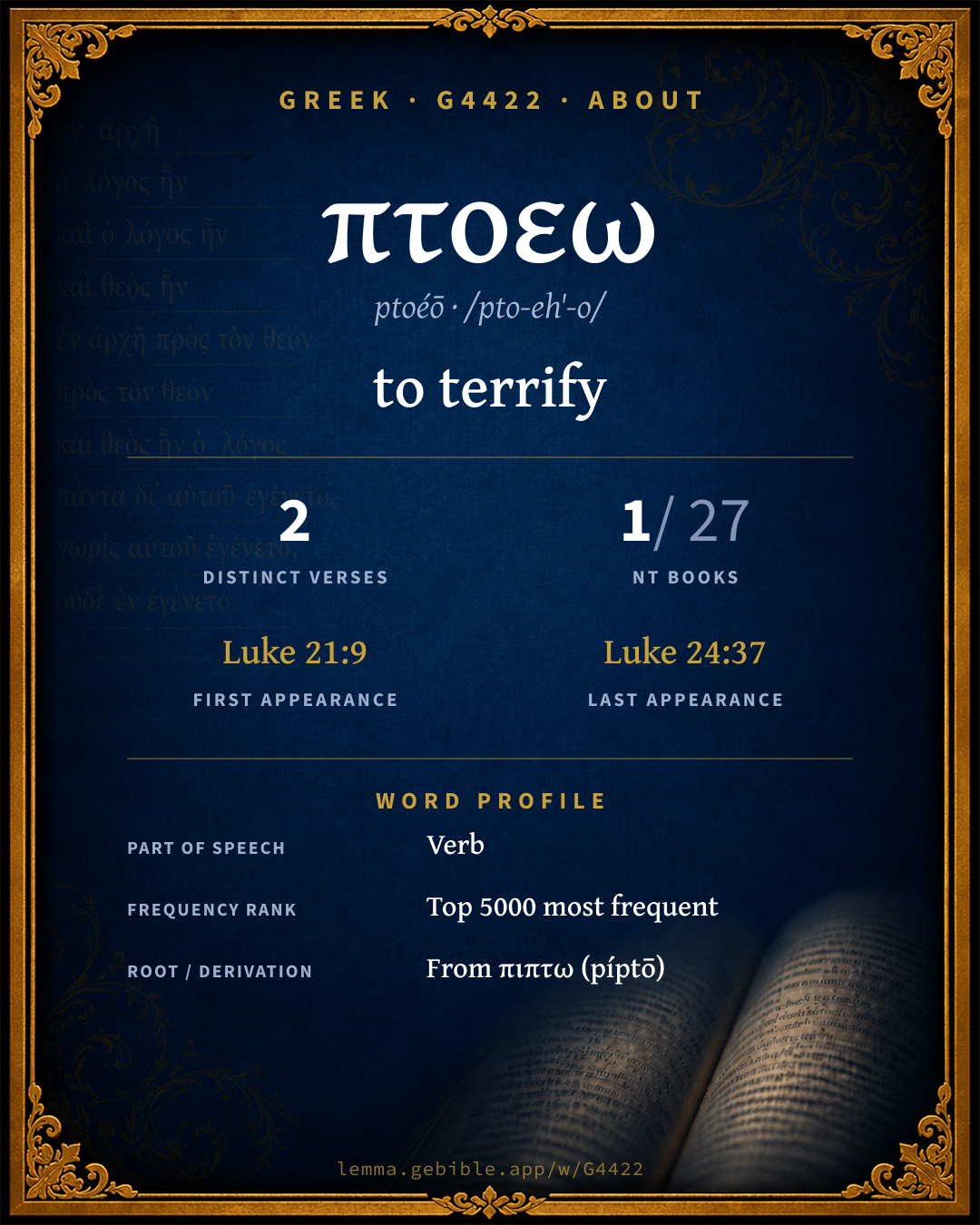
πτοέω
to terrify
‘to terrify’ is one of 2 main senses fuller range ↓
Full lexicon entry — Thayer's Greek Lexicon
From Thayer's Greek Lexicon
Where this word appears
Grammar key — what these labels mean
Part of speech
- Verb
- An action or state-of-being word.
Tense
- Aorist
- Action viewed as a simple whole, without regard to duration — often past (perfective aspect).
Voice
- Passive
- The subject receives the action.
Mood
- Participle
- A verbal adjective (“writing,” “having written”).
- Subjunctive
- Expresses probability, purpose, or possibility (the mood of contingency).
Case
- Nominative
- The case of the subject (and the predicate nominative).
Person
- 2nd person
- The one addressed (“you”).
Gender
- Masculine
- Grammatically masculine.
Number
- Plural
- More than one.
Grammatical forms
- Verb, Aorist, Passive, Participle, Nominative, Plural, Masculine 1 time (50%)
- Verb, Aorist, Passive, Subjunctive, 2nd person, Plural 1 time (50%)
Parsed forms decoded from the imported morphology (Robinson–Tischendorf, public domain), counted across 2 parsed occurrences — not distinct verses.
Every verse where G4422 appears — 2 distinct verses across 1 book. Click any verse to open its interlinear word-by-word view. Verse text shown in the World English Bible for context — . Each verse’s Greek form is shown with its reference; the English is not keyword-highlighted, since the data carries no word-level English alignment. Use “Compare translations” on any verse to read it across multiple English versions. This concordance covers the Greek New Testament; Septuagint (Greek Old Testament) occurrences of this word are not indexed here.
Luke 2 verses
- Luke 21:9 πτοηθῆτε aor pass subj 2pl When you hear of wars and disturbances, don't be terrified, for these things must happen first, but the end won't come immediately."
- Luke 24:37 πτοηθέντες aor pass ptcp nom pl masc But they were terrified and filled with fear, and supposed that they had seen a spirit.
About this entry
At a glance — auto-summarized from this page’s data, not written by a person. Every figure links to its source below. This summary describes the numbers; it doesn’t interpret them.
πτοεω (ptoéō) is a Greek verb most often rendered “to terrify.” A scarce word — 2 verses in all of the Greek New Testament. Luke dominates its distribution — 2 of 2 verses. Scripture first uses it in Luke 21:9. Ranging over 2 senses, it is not a single-sense word. The sections below give every sense, occurrence, and version rendering.
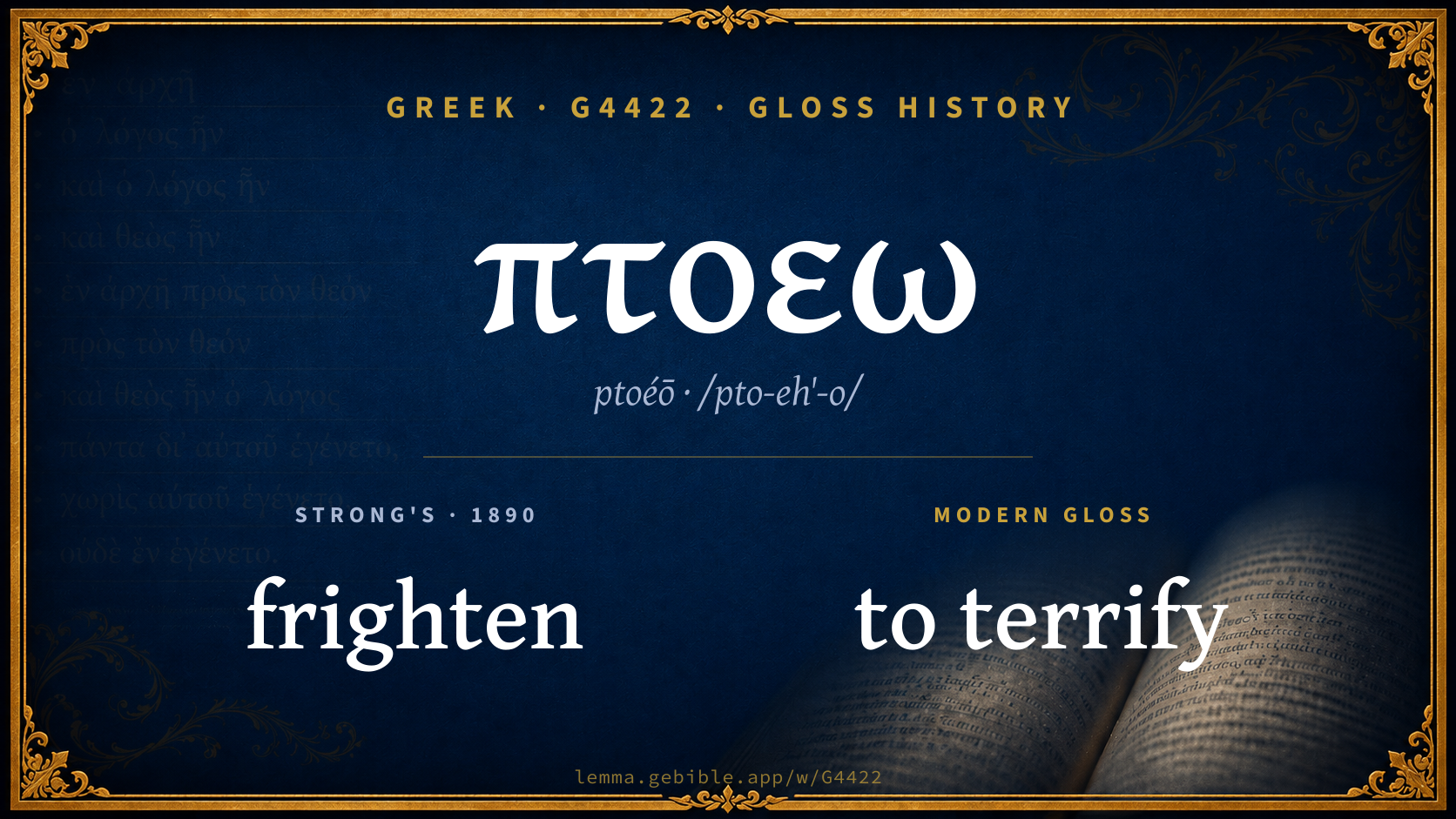
Gloss history
Strong's 1890 vs modern scholarship
About this word
Strong's G4422 catalogs a Greek word from the Greek New Testament.
These counts are not copied from any lexicon or concordance. They are computed here, from the morphology-tagged Greek New Testament. What Lemma adds →
- 2
- distinct verses
- The word appears in 2 distinct verses.
- 1 / 27
- NT books
- The word appears in 1 of 27 New Testament books.
- #2,678
- by frequency
- Top 5000 most frequent Greek words (rank 2,678 of 5,347 Greek words by occurrence).
View all 2 occurrences in the concordance →
Most concentrated in
- Luke 2 verses 100%
By section of the New Testament
By traditional corpus
Conventional, traditional groupings — biblical authorship is debated, so this is a traditional corpus grouping, not an authorship claim. Some books belong to more than one corpus (Luke is in both the Gospels and the Lukan corpus, and so on), so these shares overlap and need not total 100%. Each figure is a share of the word’s 2 distinct verses.
- Gospels 2 verses · 100%
- Lukan (Luke–Acts) 2 verses · 100%
How translations render this word
Counts come from each version’s own published word-to-Strong’s tagging or interlinear alignment — an approximate guide to how each version renders this word, not a word-level alignment the data otherwise carries. Because each total is that version’s own tagged count, the per-version totals vary from one another and need not match the appearance or distinct-verse counts above. These counts may also differ from a printed concordance because Lemma counts each distinctly tagged rendering and does not collapse phrase taggings into a single head-word total. This is a fixed set of word-tagged versions (KJV, ASV, BSB, ULT) and does not change with the reading translation you choose elsewhere. Each version’s license is shown beside its name below (and on Sources).
- King James Version: Be 1×, Terrified 1×, They were terrified 1×
- American Standard Version: Be 1×, Terrified 1×, They were terrified 1×
- Berean Standard Bible: Be alarmed 1×, They were startled 1×
- unfoldingWord Literal Text: Be terrified 1×, Do 1×, Having been frightened 1×
King James Version Public Domain
Renders G4422 across 3 tagged occurrences — most commonly:
American Standard Version Public Domain
Renders G4422 across 3 tagged occurrences — most commonly:
Berean Standard Bible Public Domain
Renders G4422 across 2 tagged occurrences — most commonly:
unfoldingWord Literal Text CC BY-SA 4.0
Renders G4422 across 3 tagged occurrences — most commonly:
Senses in Thayer's
The 2 senses Thayer's distinguishes for this word, in lexicon order (not ranked by frequency or importance). The full entry — with sub-senses — is in the Lexicon Entry tab.
- to terrify
- be terrified
Word origin
Derived from πιπτω (píptō) (G4098) — to fall.
Forms in the corpus
The 2 distinct written forms G4422 takes in the Greek New Testament, most frequent first — each parse links to that tense’s occurrences in the concordance.
| Form | Parsing | Example | Uses |
|---|---|---|---|
| πτοηθέντες ptoēthéntes | Verb, Aorist, Passive, Participle, Nominative, Plural, Masculine | Luke 24:37 | 1 |
| πτοηθῆτε ptoēthē̂te | Verb, Aorist, Passive, Subjunctive, 2nd person, Plural | Luke 21:9 | 1 |
Same root — word family
Other Thayer's entries built from the same root as G4422, grouped by Strong’s listed origin. These share a root / origin per the lexicon — not necessarily a shared meaning. Each links to that word’s own entry.
Derives from
Shares the same root
Derived from this word
Compare all same-root words → Showing 4 of 7 — not the complete family. They share a root, not necessarily a meaning.
Septuagint usage
The same Greek word πτοεω appears 32 times in the Greek Old Testament (Septuagint), across 31 verses in 13 books.
- 32
- LXX occurrences
- Tagged occurrences of this Greek word in the Septuagint.
- 31
- verses
- Distinct Septuagint verses containing this word.
- 13 / 39
- OT books
- The word appears in 13 of the 39 Old Testament books.
Sample Septuagint occurrences
- Exodus 19:16 πτοέω
- Deuteronomy 31:6 πτοέω
- Joshua 7:5 πτοέω
- 1 Chronicles 22:13 πτοέω
- 2 Chronicles 20:15 πτοέω
- Job 11:16 πτοέω
- Proverbs 13:3 πτοέω
- Isaiah 31:4 πτοέω
- Jeremiah 1:17 πτοέω
- Ezekiel 2:5 πτοέω
- Amos 3:6 πτοέω
- Obadiah 1:9 πτοέω
Septuagint occurrences (same lexeme)
Every verse where the same Strong’s number (G4422) appears in the Greek Septuagint. Verse text shown in the World English Bible for context; the Greek form is the matched word — the English is not keyword-highlighted.
- Exodus 19:16 πτοέω It happened on the third day, when it was morning, that there were thunders and lightnings, and a thick cloud on the mountain, and the sound of an exceedingly loud trumpet; and all the people who were in the camp trembled.
- Deuteronomy 31:6 πτοέω Be strong and of good courage, don't be afraid, nor be scared of them: for Yahweh your God, he it is who does go with you; he will not fail you, nor forsake you.
- Joshua 7:5 πτοέω The men of Ai struck of them about thirty-six men; and they chased them [from] before the gate even to Shebarim, and struck them at the descent; and the hearts of the people melted, and became as water.
- 1 Chronicles 22:13 πτοέω Then shall you prosper, if you observe to do the statutes and the ordinances which Yahweh gave Moses concerning Israel. Be strong, and of good courage. Don't be afraid, neither be dismayed.
- 1 Chronicles 28:20 πτοέω David said to Solomon his son, Be strong and of good courage, and do it: don't be afraid, nor be dismayed; for Yahweh God, even my God, is with you; he will not fail you, nor forsake you, until all the work for the service of the house of Yahweh is finished.
- 2 Chronicles 20:15 πτοέω and he said, Listen you, all Judah, and you inhabitants of Jerusalem, and you king Jehoshaphat: Thus says Yahweh to you, Don't be afraid you, neither be dismayed by reason of this great multitude; for the battle is not yours, but God's.
- 2 Chronicles 20:17 πτοέω You shall not need to fight in this [battle]: set yourselves, stand you still, and see the salvation of Yahweh with you, O Judah and Jerusalem; don't be afraid, nor be dismayed: tomorrow go out against them: for Yahweh is with you.
- 2 Chronicles 32:7 πτοέω Be strong and of good courage, don't be afraid nor dismayed for the king of Assyria, nor for all the multitude who is with him; for there is a greater with us than with him:
- Job 11:16 πτοέω For you shall forget your misery; You shall remember it as waters that are passed away,
- Job 23:15 πτοέω Therefore I am terrified at his presence. When I consider, I am afraid of him.
- Job 32:15 πτοέω "They are amazed. They answer no more. They don't have a word to say.
- Proverbs 13:3 πτοέω He who guards his mouth guards his soul. One who opens wide his lips comes to ruin.
- Isaiah 31:4 πτοέω For thus says Yahweh to me, As the lion and the young lion growling over his prey, if a multitude of shepherds are called forth against him, will not be dismayed at their voice, nor abase himself for the noise of them: so will Yahweh of Hosts come down to fight on Mount Zion, and on the hill of it.
- Jeremiah 1:17 πτοέω You therefore gird up your loins, and arise, and speak to them all that I command you: don't be dismayed at them, lest I dismay you before them.
- Jeremiah 4:25 πτοέω I saw, and, behold, there was no man, and all the birds of the sky were fled.
- Jeremiah 8:9 πτοέω The wise men are disappointed, they are dismayed and taken: behold, they have rejected the word of Yahweh; and what manner of wisdom is in them?
- Jeremiah 17:18 πτοέω Let them be disappointed who persecute me, but let not me be disappointed; let them be dismayed, but don't let me be dismayed; bring on them the day of evil, and destroy them with double destruction.
- Jeremiah 21:13 πτοέω Behold, I am against you, O inhabitant of the valley, [and] of the rock of the plain, says Yahweh; you that say, Who shall come down against us? or who shall enter into our habitations?
- Jeremiah 23:4 πτοέω I will set up shepherds over them, who shall feed them; and they shall fear no more, nor be dismayed, neither shall any be lacking, says Yahweh.
- Jeremiah 25:17 πτοέω Then took I the cup at Yahweh's hand, and made all the nations to drink, to whom Yahweh had sent me:
- Jeremiah 26:5 πτοέω to listen to the words of my servants the prophets, whom I send to you, even rising up early and sending them, but you have not listened;
- Jeremiah 26:27 πτοέω
- Jeremiah 28:56 πτοέω
- Ezekiel 2:5 πτοέω They, whether they will hear, or whether they will forbear, (for they are a rebellious house), yet shall know that there has been a prophet among them.
- Ezekiel 2:7 πτοέω You shall speak my words to them, whether they will hear, or whether they will forbear; for they are most rebellious.
- Ezekiel 3:9 πτοέω As an adamant harder than flint have I made your forehead: don't be afraid of them, neither be dismayed at their looks, though they are a rebellious house.
- Amos 3:6 πτοέω Does the trumpet alarm sound in a city, Without the people being afraid? Does evil happen to a city, And Yahweh hasn't done it?
- Obadiah 1:9 πτοέω Your mighty men, Teman, will be dismayed, to the end that everyone may be cut off from the mountain of Esau by slaughter.
- Habakkuk 2:17 πτοέω For the violence done to Lebanon will overwhelm you, and the destruction of the animals, which made them afraid; because of men's blood, and for the violence done to the land, to every city and to those who dwell in them.
- Habakkuk 3:7 πτοέω I saw the tents of Cushan in affliction. The dwellings of the land of Midian trembled.
- Habakkuk 3:16 πτοέω I heard, and my body trembled. My lips quivered at the voice. Rottenness enters into my bones, and I tremble in my place, Because I must wait quietly for the day of trouble, For the coming up of the people who invade us.
These are occurrences of the same Greek lexeme (G4422) in the Septuagint — not a translation of any one Hebrew word. The store carries no word-level Hebrew↔Greek alignment, so no Hebrew original is asserted here. Counts come from the recovered LXX Strong's tagging — high-frequency vocabulary is well covered, while rare or late forms may be untagged — so they reflect tagged occurrences and may slightly undercount.