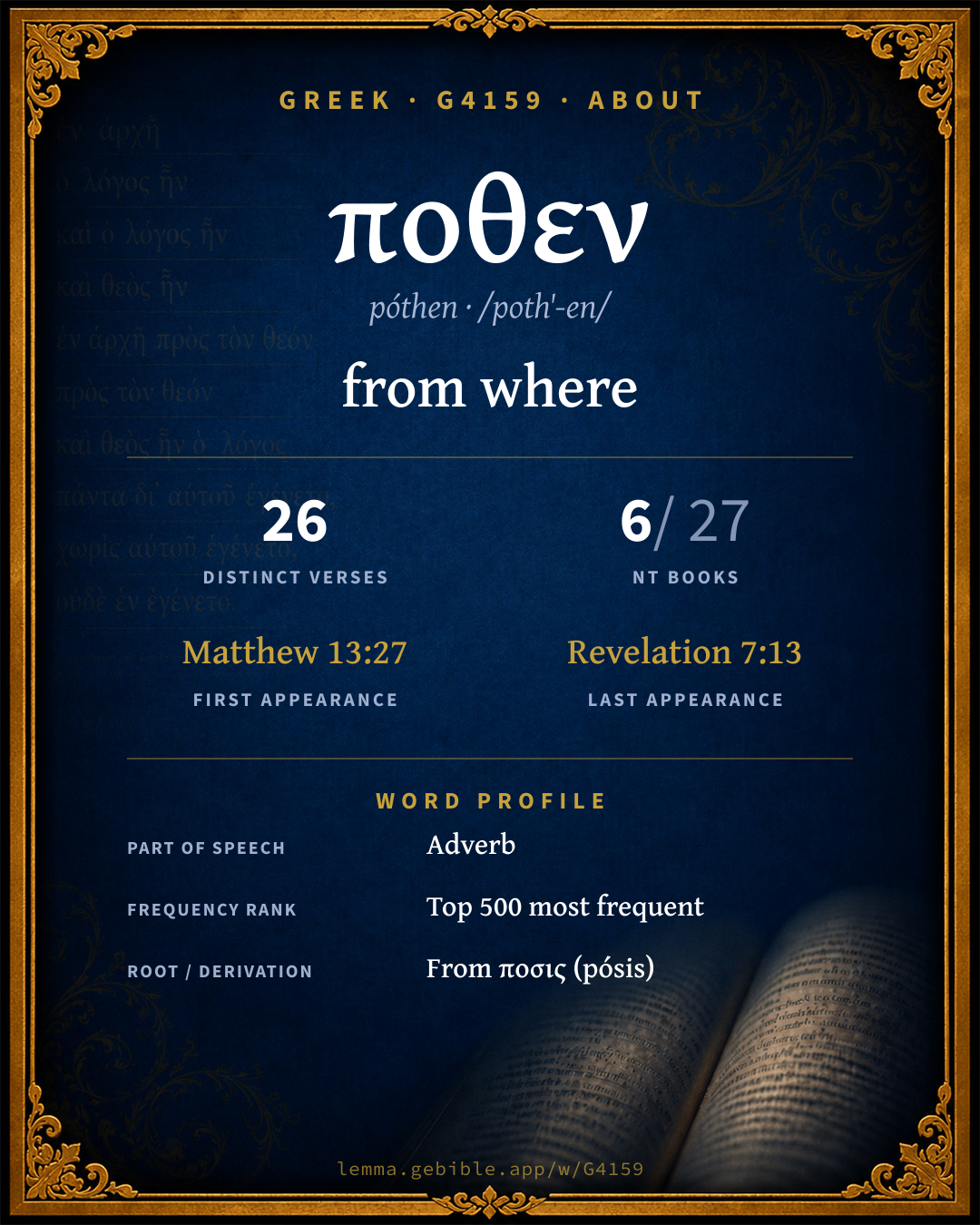
πόθεν
from where
‘from where’ is one of 3 main senses fuller range ↓
Full lexicon entry — Thayer's Greek Lexicon
From Thayer's Greek Lexicon
Where this word appears
Grammar key — what these labels mean
Part of speech
- Adverb
- A word that modifies a verb, adjective, or other adverb.
Degree
- Interrogative
- Marks an interrogative form.
Every verse where G4159 appears in the Book of Revelation — 2 distinct verses. Click any verse to open its interlinear word-by-word view. Verse text shown in the World English Bible for context — . Each verse’s Greek form is shown with its reference; the English is not keyword-highlighted, since the data carries no word-level English alignment. Use “Compare translations” on any verse to read it across multiple English versions. This concordance covers the Greek New Testament; Septuagint (Greek Old Testament) occurrences of this word are not indexed here.
Revelation
- Revelation 2:5 πόθεν adv interrog Remember therefore from where you have fallen, and repent and do the first works; or else I am coming to you swiftly, and will move your lampstand out of its place, unless you repent.
- Revelation 7:13 πόθεν adv interrog One of the elders answered, saying to me, "These who are arrayed in white robes, who are they, and from where did they come?"
About this entry
At a glance — auto-summarized from this page’s data, not written by a person. Every figure links to its source below. This summary describes the numbers; it doesn’t interpret them.
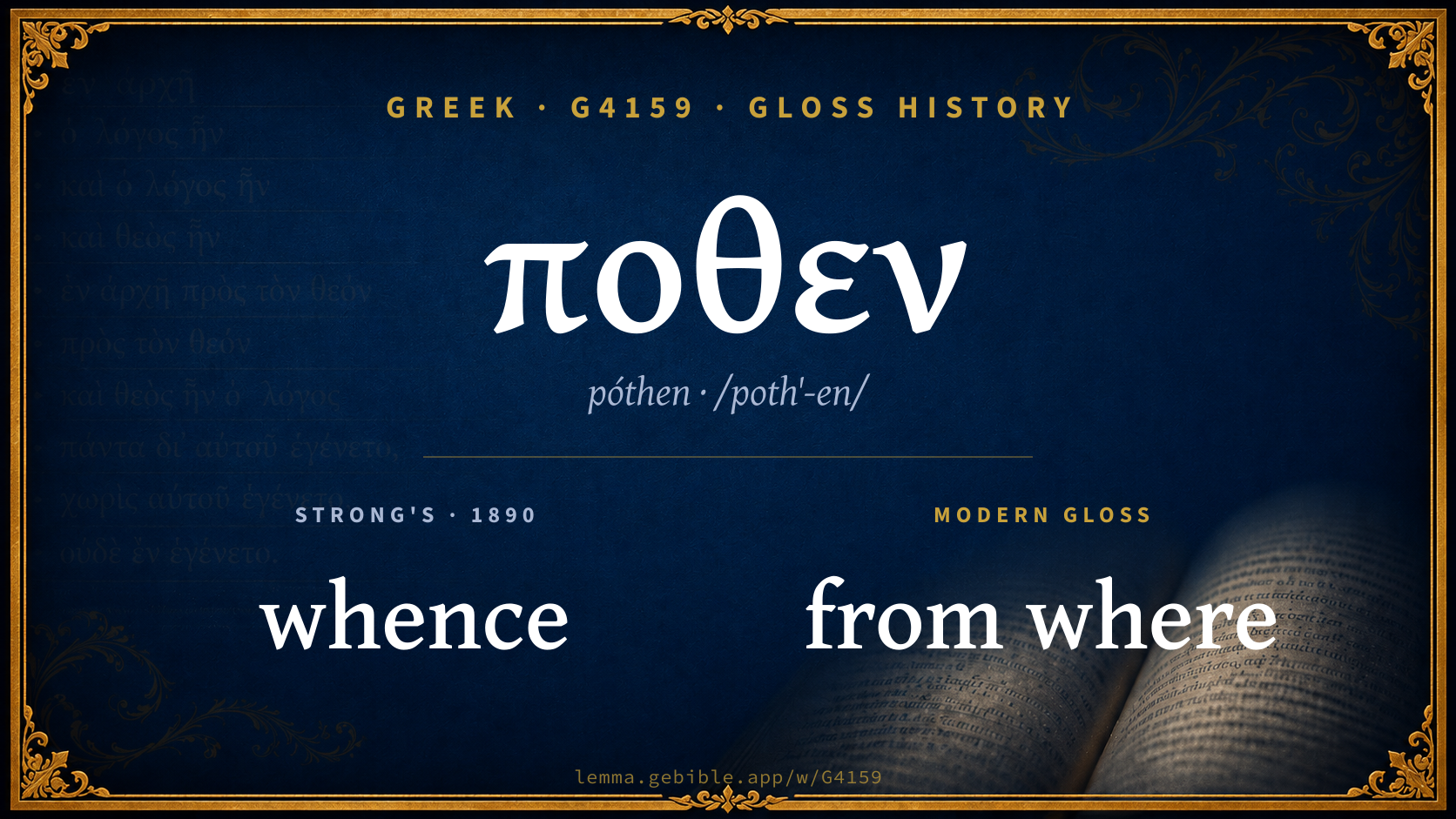
ποθεν (póthen) is a Greek verb most often rendered “from where.” Translators differ — “whence” in the King James Version, then “where” (Berean Standard Bible), as the renderings breakdown shows. With 26 verses in 6 books, it is a moderately common word in the Greek New Testament. It concentrates in John, which alone accounts for 42% of its uses. Ranging over 3 senses, it is not a single-sense word. The sections below give every sense, occurrence, and version rendering.
Gloss history
Strong's 1890 vs modern scholarship
About this word
Strong's G4159 catalogs a Greek word from the Greek New Testament.
These counts are not copied from any lexicon or concordance. They are computed here, from the morphology-tagged Greek New Testament. What Lemma adds →
- 26
- distinct verses
- The word appears in 26 distinct verses.
- 6 / 27
- NT books
- The word appears in 6 of 27 New Testament books.
- #471
- by frequency
- Top 500 most frequent Greek words (rank 471 of 5,347 Greek words by occurrence).
View all 26 occurrences in the concordance →
By section of the New Testament
By traditional corpus
Conventional, traditional groupings — biblical authorship is debated, so this is a traditional corpus grouping, not an authorship claim. Some books belong to more than one corpus (Luke is in both the Gospels and the Lukan corpus, and so on), so these shares overlap and need not total 100%. Each figure is a share of the word’s 26 distinct verses.
- Gospels 23 verses · 88%
- Johannine 13 verses · 50%
- Lukan (Luke–Acts) 4 verses · 15%
- Revelation 2 verses · 8%
- General (Catholic) Epistles 1 verse · 4%
How translations render this word
Counts come from each version’s own published word-to-Strong’s tagging or interlinear alignment — an approximate guide to how each version renders this word, not a word-level alignment the data otherwise carries. Because each total is that version’s own tagged count, the per-version totals vary from one another and need not match the appearance or distinct-verse counts above. These counts may also differ from a printed concordance because Lemma counts each distinctly tagged rendering and does not collapse phrase taggings into a single head-word total. This is a fixed set of word-tagged versions (KJV, ASV, BSB, ULT) and does not change with the reading translation you choose elsewhere. Each version’s license is shown beside its name below (and on Sources).
- King James Version: Whence 28×
- American Standard Version: Whence 26×
- Berean Standard Bible: Where 20×, How 2×
- unfoldingWord Literal Text: Where 27×, From 13×, Are 2×
King James Version Public Domain
Renders G4159 across 28 tagged occurrences — most commonly:
American Standard Version Public Domain
Renders G4159 across 28 tagged occurrences — most commonly:
Plus 2 renderings that appear only once — usually multi-word phrases or single function words the recovered tagging swept in, not distinct renderings.
Berean Standard Bible Public Domain
Renders G4159 across 28 tagged occurrences — most commonly:
Plus 6 renderings that appear only once — usually multi-word phrases or single function words the recovered tagging swept in, not distinct renderings. Not rendered by a distinct English word in 1 further occurrence.
unfoldingWord Literal Text CC BY-SA 4.0
Renders G4159 across 46 tagged occurrences — most commonly:
Plus 2 renderings that appear only once — usually multi-word phrases or single function words the recovered tagging swept in, not distinct renderings.
Senses in Thayer's
The 3 senses Thayer's distinguishes for this word, in lexicon order (not ranked by frequency or importance). The full entry — with sub-senses — is in the Lexicon Entry tab.
- of place: from where, from what condition
- of origin or source: from what author or giver
- of cause: how is that?, how can that be?
Word origin
Derived from ποσις (pósis) (G4213) — drink.
From the base of G4213 with enclitic adverb of origin; from which (as interrogitive) or what (as relative) place state source or cause : - whence.
— Strong’s Exhaustive Concordance (1890), public domain.
Forms in the corpus
The 2 distinct written forms G4159 takes in the Greek New Testament, most frequent first — each parse links to that case’s occurrences in the concordance.
| Form | Parsing | Example | Uses |
|---|---|---|---|
| πόθεν póthen | Adverb, Interrogative | Matthew 13:27 | 28 |
| Πόθεν Póthen | Adverb, Interrogative | James 4:1 | 1 |
Septuagint usage
The same Greek word ποθεν appears 32 times in the Greek Old Testament (Septuagint), across 30 verses in 14 books.
- 32
- LXX occurrences
- Tagged occurrences of this Greek word in the Septuagint.
- 30
- verses
- Distinct Septuagint verses containing this word.
- 14 / 39
- OT books
- The word appears in 14 of the 39 Old Testament books.
Sample Septuagint occurrences
- Genesis 16:8 πόθεν
- Numbers 11:13 πόθεν
- Joshua 9:8 πόθεν
- Judges 13:6 πόθεν
- 1 Samuel 25:11 πόθεν
- 2 Samuel 1:3 πόθεν
- 2 Kings 5:25 πόθεν
- Job 1:7 πόθεν
- Psalms 120:1 πόθεν
- Proverbs 22:27 πόθεν
- Isaiah 39:3 πόθεν
- Jeremiah 15:18 πόθεν
Septuagint occurrences (same lexeme)
Every verse where the same Strong’s number (G4159) appears in the Greek Septuagint. Verse text shown in the World English Bible for context; the Greek form is the matched word — the English is not keyword-highlighted.
- Genesis 16:8 πόθεν He said, "Hagar, Sarai's handmaid, where did you come from? Where are you going?" She said, "I am fleeing from the face of my mistress Sarai."
- Genesis 29:4 πόθεν Jacob said to them, "My relatives, where are you from?" They said, "We are from Haran."
- Genesis 42:7 πόθεν Joseph saw his brothers, and he recognized them, but acted like a stranger to them, and spoke roughly with them. He said to them, "Where did you come from?" They said, "From the land of Canaan to buy food."
- Numbers 11:13 πόθεν Whence should I have flesh to give to all this people? for they weep to me, saying, Give us flesh, that we may eat.
- Joshua 9:8 πόθεν They said to Joshua, We are your servants. Joshua said to them, Who are you? and from whence come you?
- Judges 13:6 πόθεν Then the woman came and told her husband, saying, A man of God came to me, and his face was like the face of the angel of God, very awesome; and I didn't ask him whence he was, neither did he tell me his name:
- Judges 17:9 πόθεν Micah said to him, Whence come you? He said to him, I am a Levite of Bethlehem Judah, and I go to sojourn where I may find [a place].
- Judges 19:17 πόθεν He lifted up his eyes, and saw the wayfaring man in the street of the city; and the old man said, Where go you? and whence come you?
- 1 Samuel 25:11 πόθεν Shall I then take my bread, and my water, and my meat that I have killed for my shearers, and give it to men who I don't know where they come from?
- 1 Samuel 30:13 πόθεν David said to him, To whom belong you? and whence are you? He said, I am a young man of Egypt, servant to an Amalekite; and my master left me, because three days ago I fell sick.
- 2 Samuel 1:3 πόθεν David said to him, From whence come you? He said to him, Out of the camp of Israel am I escaped.
- 2 Samuel 1:13 πόθεν David said to the young man who told him, Whence are you? He answered, I am the son of a foreigner, an Amalekite.
- 2 Kings 5:25 πόθεν But he went in, and stood before his master. Elisha said to him, Whence come you, Gehazi? He said, Your servant went no where.
- 2 Kings 6:27 πόθεν He said, If Yahweh doesn't help you, whence shall I help you? out of the threshing floor, or out of the winepress?
- 2 Kings 20:14 πόθεν Then came Isaiah the prophet to king Hezekiah, and said to him, What said these men? and from whence came they to you? Hezekiah said, They are come from a far country, even from Babylon.
- Job 1:7 πόθεν Yahweh said to Satan, "Where have you come from?" Then Satan answered Yahweh, and said, "From going back and forth in the earth, and from walking up and down in it."
- Job 2:2 πόθεν Yahweh said to Satan, "Where have you come from?" Satan answered Yahweh, and said, "From going back and forth in the earth, and from walking up and down in it."
- Job 28:12 πόθεν "But where shall wisdom be found? Where is the place of understanding?
- Job 28:20 πόθεν Whence then comes wisdom? Where is the place of understanding?
- Job 38:24 πόθεν By what way is the lightning distributed, Or the east wind scattered on the earth?
- Psalms 120:1 πόθεν In my distress, I cried to Yahweh. He answered me.
- Proverbs 22:27 πόθεν If you don't have means to pay, Why should he take away your bed from under you?
- Isaiah 39:3 πόθεν Then came Isaiah the prophet to king Hezekiah, and said to him, What said these men? and from whence came they to you? Hezekiah said, They are come from a far country to me, even from Babylon.
- Isaiah 41:24 πόθεν Behold, you are of nothing, and your work is of nothing; an abomination is he who chooses you.
- Isaiah 41:28 πόθεν When I look, there is no man: even among them there is no counselor who, when I ask of them, can answer a word.
- Jeremiah 15:18 πόθεν Why is my pain perpetual, and my wound incurable, which refuses to be healed? will you indeed be to me as a deceitful [brook], as waters that fail?
- Jeremiah 31:9 πόθεν They shall come with weeping; and with petitions will I lead them: I will cause them to walk by rivers of waters, in a straight way in which they shall not stumble; for I am a father to Israel, and Ephraim is my firstborn.
- Jeremiah 43:17 πόθεν
- Jonah 1:8 πόθεν Then they asked him, "Tell us, please, for whose cause this evil is on us. What is your occupation? Where do you come from? What is your country? Of what people are you?"
- Nahum 3:7 πόθεν It will happen that all those who look at you will flee from you, and say, 'Nineveh is laid waste Who will mourn for her?' Where will I seek comforters for you?"
These are occurrences of the same Greek lexeme (G4159) in the Septuagint — not a translation of any one Hebrew word. The store carries no word-level Hebrew↔Greek alignment, so no Hebrew original is asserted here. Counts come from the recovered LXX Strong's tagging — high-frequency vocabulary is well covered, while rare or late forms may be untagged — so they reflect tagged occurrences and may slightly undercount.