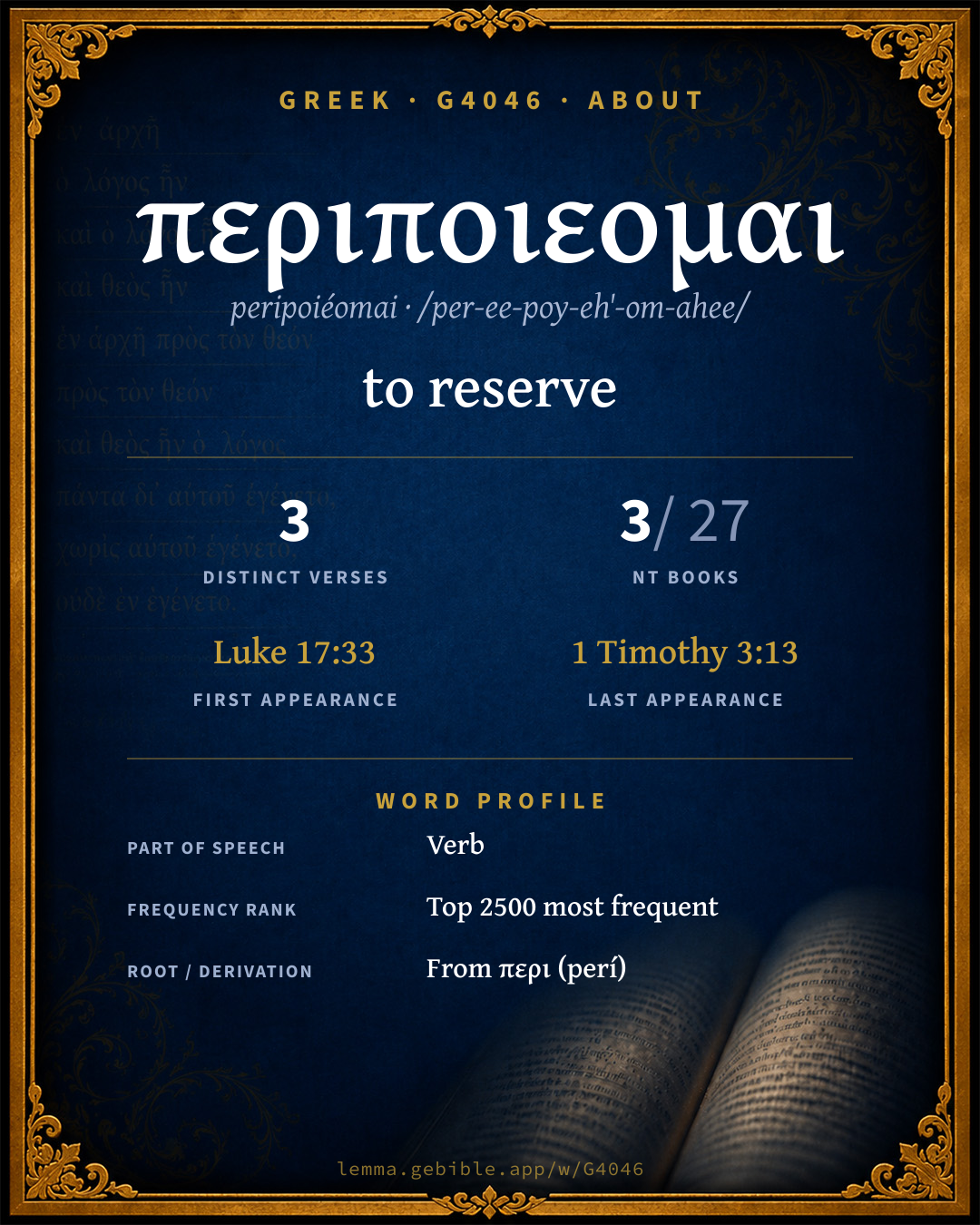
περιποιέομαι
to reserve
‘to reserve’ is one of 5 main senses fuller range ↓
Full lexicon entry — Thayer's Greek Lexicon
From Thayer's Greek Lexicon
Where this word appears
See every Aorist-tense verb in the Greek New Testament →
Grammar key — what these labels mean
Part of speech
- Verb
- An action or state-of-being word.
Tense
- Aorist
- Action viewed as a simple whole, without regard to duration — often past (perfective aspect).
- Present
- Ongoing or general action in present time (imperfective aspect).
Voice
- Middle
- The subject acts on or for itself, or with special interest in the action.
Mood
- Indicative
- States a fact or asks a factual question (the mood of reality).
- Infinitive
- A verbal noun (“to write”), unmarked for person or number.
Person
- 3rd person
- The one spoken about (“he / she / it / they”).
Number
- Singular
- One.
- Plural
- More than one.
Grammatical forms
- Verb, Aorist, Middle, Indicative, 3rd person, Singular 1 time (33%)
- Verb, Aorist, Middle, Infinitive 1 time (33%)
- Verb, Present, Middle, Indicative, 3rd person, Plural 1 time (33%)
Parsed forms decoded from the imported morphology (Robinson–Tischendorf, public domain), counted across 3 parsed occurrences — not distinct verses.
Every verse where G4046 appears — 3 distinct verses across 3 books. Click any verse to open its interlinear word-by-word view. Verse text shown in the World English Bible for context — . Each verse’s Greek form is shown with its reference; the English is not keyword-highlighted, since the data carries no word-level English alignment. Use “Compare translations” on any verse to read it across multiple English versions. This concordance covers the Greek New Testament; Septuagint (Greek Old Testament) occurrences of this word are not indexed here.
Luke 1 verse
Acts 1 verse
1 Timothy 1 verse
About this entry
At a glance — auto-summarized from this page’s data, not written by a person. Every figure links to its source below. This summary describes the numbers; it doesn’t interpret them.
At its core, περιποιεομαι (peripoiéomai) means “to reserve.” With only 3 verses it sits in the long tail of Greek New Testament vocabulary. The word gravitates to Luke (33%), then Acts and 1 Timothy. First canonically at Luke 17:33, it enters the text early. Catalogued under 5 senses, its meaning is not single-sense. Dig into 3-verse concordance and the renderings breakdown below.
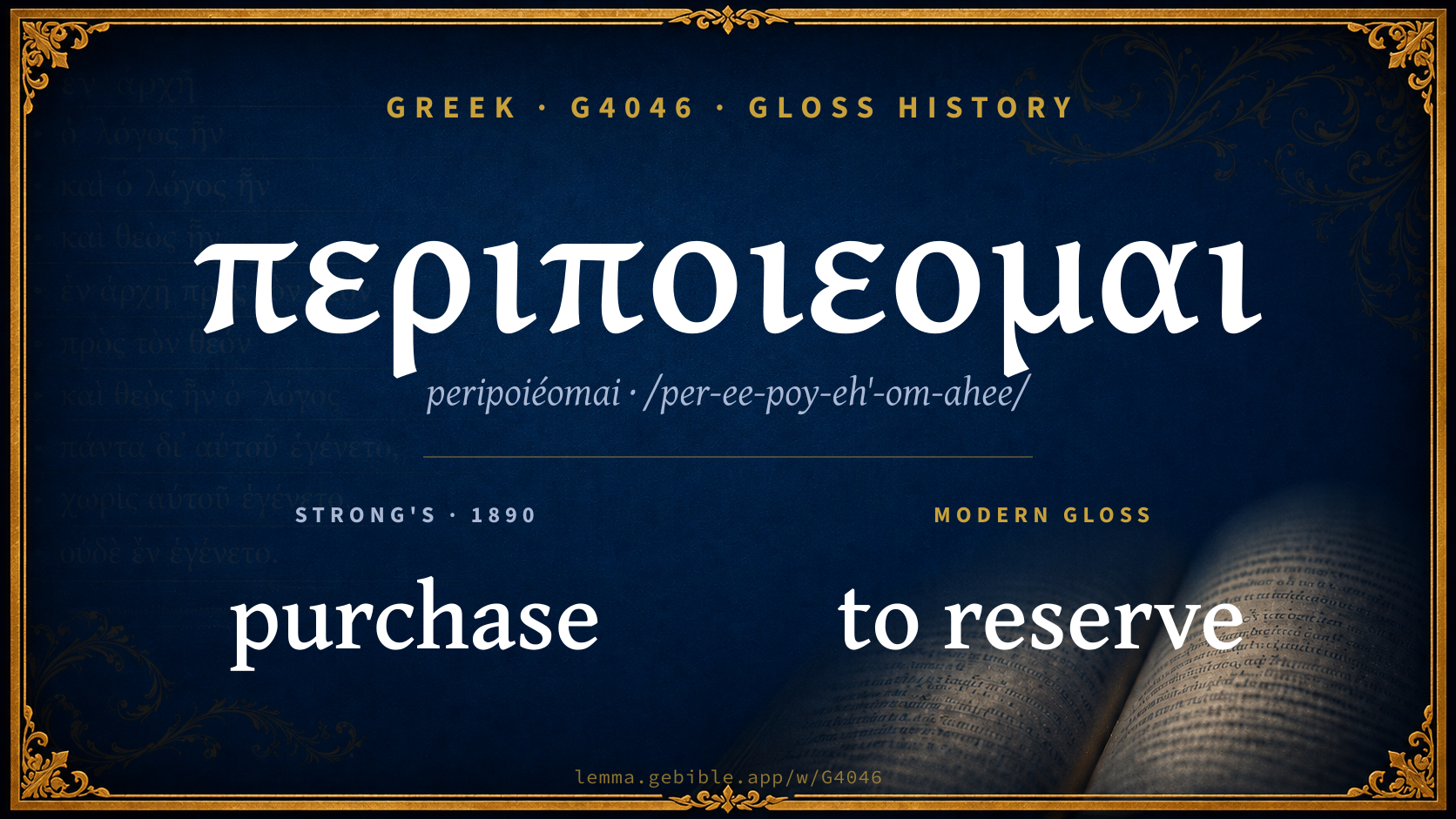
Gloss history
Strong's 1890 vs modern scholarship
About this word
Strong's G4046 catalogs a Greek word from the Greek New Testament.
These counts are not copied from any lexicon or concordance. They are computed here, from the morphology-tagged Greek New Testament. What Lemma adds →
- 3
- distinct verses
- The word appears in 3 distinct verses.
- 3 / 27
- NT books
- The word appears in 3 of 27 New Testament books.
- #2,203
- by frequency
- Top 2500 most frequent Greek words (rank 2,203 of 5,347 Greek words by occurrence).
View all 3 occurrences in the concordance →
By section of the New Testament
By traditional corpus
Conventional, traditional groupings — biblical authorship is debated, so this is a traditional corpus grouping, not an authorship claim. Some books belong to more than one corpus (Luke is in both the Gospels and the Lukan corpus, and so on), so these shares overlap and need not total 100%. Each figure is a share of the word’s 3 distinct verses.
- Lukan (Luke–Acts) 2 verses · 67%
- Gospels 1 verse · 33%
- Pauline corpus 1 verse · 33%
How translations render this word
Counts come from each version’s own published word-to-Strong’s tagging or interlinear alignment — an approximate guide to how each version renders this word, not a word-level alignment the data otherwise carries. Because each total is that version’s own tagged count, the per-version totals vary from one another and need not match the appearance or distinct-verse counts above. These counts may also differ from a printed concordance because Lemma counts each distinctly tagged rendering and does not collapse phrase taggings into a single head-word total. This is a fixed set of word-tagged versions (KJV, ASV, BSB, ULT) and does not change with the reading translation you choose elsewhere. Each version’s license is shown beside its name below (and on Sources).
- King James Version: He hath purchased 1×, Purchase 1×
- American Standard Version: Gain 1×, He purchased 1×
- Berean Standard Bible: Acquire 1×, He purchased 1×, Save 1×
- unfoldingWord Literal Text: Acquire 1×, He obtained 1×, Keep 1×
King James Version Public Domain
Renders G4046 across 2 tagged occurrences — most commonly:
American Standard Version Public Domain
Renders G4046 across 2 tagged occurrences — most commonly:
Berean Standard Bible Public Domain
Renders G4046 across 3 tagged occurrences — most commonly:
unfoldingWord Literal Text CC BY-SA 4.0
Renders G4046 across 3 tagged occurrences — most commonly:
Senses in Thayer's
The 5 senses Thayer's distinguishes for this word, in lexicon order (not ranked by frequency or importance). The full entry — with sub-senses — is in the Lexicon Entry tab.
- to make to remain over
- to reserve, to leave or keep safe, lay by
- to make to remain for one's self
- to preserve for one's self
- to get for one's self, purchase
Word origin
Derived from περι (perí) (G4012) — about.
Forms in the corpus
The 3 distinct written forms G4046 takes in the Greek New Testament, most frequent first — each parse links to that tense’s occurrences in the concordance.
| Form | Parsing | Example | Uses |
|---|---|---|---|
| περιεποιήσατο periepoiḗsato | Verb, Aorist, Middle, Indicative, 3rd person, Singular | Acts 20:28 | 1 |
| περιποιήσασθαι peripoiḗsasthai | Verb, Aorist, Middle, Infinitive | Luke 17:33 | 1 |
| περιποιοῦνται peripoioûntai | Verb, Present, Middle, Indicative, 3rd person, Plural | 1 Timothy 3:13 | 1 |
Same root — word family
Other Thayer's entries built from the same root as G4046, grouped by Strong’s listed origin. These share a root / origin per the lexicon — not necessarily a shared meaning. Each links to that word’s own entry.
Derives from
Shares the same root
- περιαγω periágō G4013 to lead around
- περιαιρεω periairéō G4014 to take away
- περιαστραπτω periastráptō G4015 to shine around
- περιβαλλω peribállō G4016 to throw around
- περιβλεπω periblépō G4017 to look around
- περιδεω peridéō G4019 to bind around
- περιεργαζομαι periergázomai G4020 to bustle about
- περιεργος períergos G4021 busybody
- περιερχομαι periérchomai G4022 to go about
- περιεχω periéchō G4023 to surround
- περιζωννυμι perizṓnnymi G4024 to gird
- περιΐστημι periḯstēmi G4026 to stand around
- περικαθαρμα perikátharma G4027 scum
- περικαλυπτω perikalýptō G4028 to cover up
- περικειμαι períkeimai G4029 to lie around
- περικεφαλαια perikephalaía G4030 helmet
- περικρατης perikratḗs G4031 to have power over
- περικρυπτω perikrýptō G4032 to hide
- περικυκλοω perikyklóō G4033 to encircle
- περιλαμπω perilámpō G4034 to shine around
- περιλειπω perileípō G4035 to remain over
- περιλυπος perílypos G4036 deeply sorrowful
- περιμενω periménō G4037 to wait for
- περιξ périx G4038 round about
+17 more words share this root (not shown).
Derived from this word
Compare all same-root words → Showing 4 of 44 — not the complete family. They share a root, not necessarily a meaning.
Septuagint usage
The same Greek word περιποιεομαι appears 26 times in the Greek Old Testament (Septuagint), across 26 verses in 15 books.
- 26
- LXX occurrences
- Tagged occurrences of this Greek word in the Septuagint.
- 26
- verses
- Distinct Septuagint verses containing this word.
- 15 / 39
- OT books
- The word appears in 15 of the 39 Old Testament books.
Sample Septuagint occurrences
- Genesis 12:12 περιποιέω
- Exodus 1:16 περιποιέω
- Numbers 22:33 περιποιέω
- Joshua 6:17 περιποιέω
- Judges 21:11 περιποιέω
- 1 Samuel 15:3 περιποιέω
- 2 Samuel 12:3 περιποιέω
- 1 Kings 18:5 περιποιέω
- 1 Chronicles 29:3 περιποιέω
- Job 27:17 περιποιέω
- Psalms 78:11 περιποιέω
- Proverbs 6:32 περιποιέω
Septuagint occurrences (same lexeme)
Every verse where the same Strong’s number (G4046) appears in the Greek Septuagint. Verse text shown in the World English Bible for context; the Greek form is the matched word — the English is not keyword-highlighted.
- Genesis 12:12 περιποιέω It will happen, when the Egyptians will see you, that they will say, 'This is his wife.' They will kill me, but they will save you alive.
- Genesis 31:18 περιποιέω and he carried away all his cattle, and all his substance which he had gathered, the cattle of his getting, which he had gathered in Paddan Aram, to go to Isaac his father to the land of Canaan.
- Genesis 36:6 περιποιέω Esau took his wives, his sons, his daughters, and all the members of his household, with his cattle, all his animals, and all his possessions, which he had gathered in the land of Canaan, and went into a land away from his brother Jacob.
- Exodus 1:16 περιποιέω and he said, "When you perform the duty of a midwife to the Hebrew women, and see them on the birth stool; if it is a son, then you shall kill him; but if it is a daughter, then she shall live."
- Exodus 22:17 περιποιέω If her father utterly refuses to give her to him, he shall pay money according to the dowry of virgins.
- Numbers 22:33 περιποιέω and the donkey saw me, and turned aside before me these three times: unless she had turned aside from me, surely now I had even slain you, and saved her alive.
- Joshua 6:17 περιποιέω The city shall be devoted, even it and all that is therein, to Yahweh: only Rahab the prostitute shall live, she and all who are with her in the house, because she hid the messengers that we sent.
- Joshua 9:20 περιποιέω This we will do to them, and let them live; lest wrath be on us, because of the oath which we swore to them.
- Judges 21:11 περιποιέω This is the thing that you shall do: you shall utterly destroy every male, and every woman who has lain by man.
- 1 Samuel 15:3 περιποιέω Now go and strike Amalek, and utterly destroy all that they have, and don't spare them; but kill both man and woman, infant and suckling, ox and sheep, camel and donkey.
- 1 Samuel 15:9 περιποιέω But Saul and the people spared Agag, and the best of the sheep, and of the oxen, and of the fatlings, and the lambs, and all that was good, and wouldn't utterly destroy them: but everything that was vile and refuse, that they destroyed utterly.
- 1 Samuel 15:15 περιποιέω Saul said, They have brought them from the Amalekites: for the people spared the best of the sheep and of the oxen, to sacrifice to Yahweh your God; and the rest we have utterly destroyed.
- 1 Samuel 25:39 περιποιέω When David heard that Nabal was dead, he said, Blessed be Yahweh, who has pleaded the cause of my reproach from the hand of Nabal, and has kept back his servant from evil: and the evil-doing of Nabal has Yahweh returned on his own head. David sent and spoke concerning Abigail, to take her to him as wife.
- 2 Samuel 12:3 περιποιέω but the poor man had nothing, except one little ewe lamb, which he had bought and raised. It grew up together with him, and with his children. It ate of his own food, drank of his own cup, and lay in his bosom, and was to him like a daughter.
- 1 Kings 18:5 περιποιέω Ahab said to Obadiah, Go through the land, to all the springs of water, and to all the brooks: peradventure we may find grass and save the horses and mules alive, that we not lose all the animals.
- 1 Chronicles 29:3 περιποιέω In addition, because I have set my affection on the house of my God, seeing that I have a treasure of my own of gold and silver, I give it to the house of my God, over and above all that I have prepared for the holy house,
- Job 27:17 περιποιέω He may prepare it, but the just shall put it on, And the innocent shall divide the silver.
- Psalms 78:11 περιποιέω They forgot his doings, His wondrous works that he had shown them.
- Proverbs 6:32 περιποιέω He who commits adultery with a woman is void of understanding. He who does it destroys his own soul.
- Proverbs 7:4 περιποιέω Tell wisdom, "You are my sister." Call understanding your relative,
- Proverbs 22:9 περιποιέω He who has a generous eye will be blessed; For he shares his food with the poor.
- Isaiah 31:5 περιποιέω As birds hovering, so will Yahweh of Hosts protect Jerusalem; he will protect and deliver [it], he will pass over and preserve [it].
- Isaiah 43:21 περιποιέω the people which I formed for myself, that they might set forth my praise.
- Jeremiah 31:36 περιποιέω If these ordinances depart from before me, says Yahweh, then the seed of Israel also shall cease from being a nation before me forever.
- Ezekiel 13:18 περιποιέω and say, Thus says the Lord Yahweh: Woe to the women who sew pillows on all elbows, and make kerchiefs for the head of [persons of] every stature to hunt souls! Will you hunt the souls of my people, and save souls alive for yourselves?
- Ezekiel 13:19 περιποιέω You have profaned me among my people for handfuls of barley and for pieces of bread, to kill the souls who should not die, and to save the souls alive who should not live, by your lying to my people who listen to lies.
These are occurrences of the same Greek lexeme (G4046) in the Septuagint — not a translation of any one Hebrew word. The store carries no word-level Hebrew↔Greek alignment, so no Hebrew original is asserted here. Counts come from the recovered LXX Strong's tagging — high-frequency vocabulary is well covered, while rare or late forms may be untagged — so they reflect tagged occurrences and may slightly undercount.