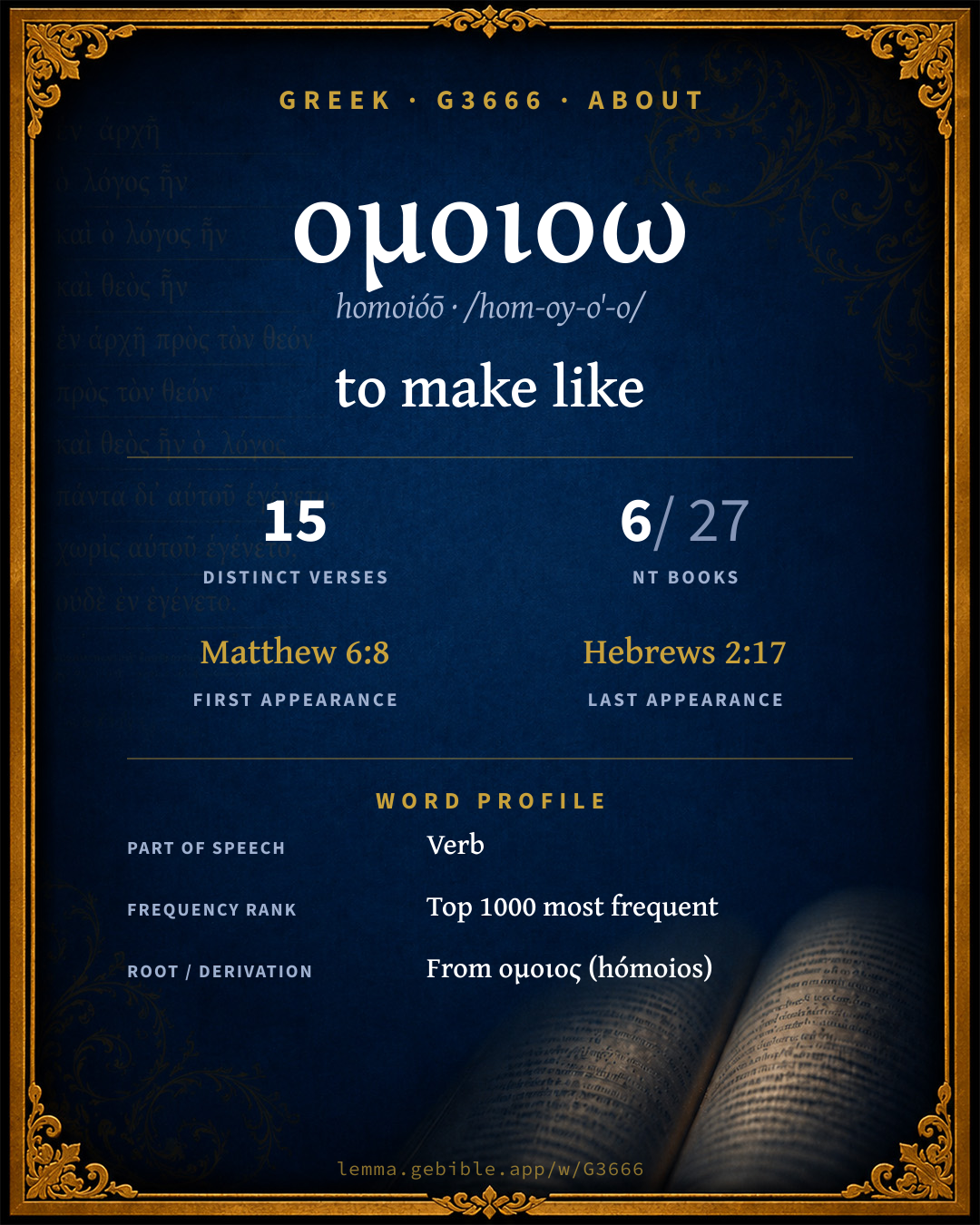
ὁμοιόω
to make like
‘to make like’ is one of 2 main senses fuller range ↓
Full lexicon entry — Thayer's Greek Lexicon
From Thayer's Greek Lexicon
Where this word appears
See every Aorist-tense verb in the Greek New Testament →
Grammar key — what these labels mean
Part of speech
- Verb
- An action or state-of-being word.
Tense
- Future
- Action expected in future time.
- Aorist
- Action viewed as a simple whole, without regard to duration — often past (perfective aspect).
Voice
- Active
- The subject performs the action.
- Passive
- The subject receives the action.
Mood
- Indicative
- States a fact or asks a factual question (the mood of reality).
- Subjunctive
- Expresses probability, purpose, or possibility (the mood of contingency).
- Infinitive
- A verbal noun (“to write”), unmarked for person or number.
- Participle
- A verbal adjective (“writing,” “having written”).
Case
- Nominative
- The case of the subject (and the predicate nominative).
Person
- 1st person
- The speaker (“I / we”).
- 3rd person
- The one spoken about (“he / she / it / they”).
- 2nd person
- The one addressed (“you”).
Gender
- Masculine
- Grammatically masculine.
Number
- Singular
- One.
- Plural
- More than one.
Every verse where G3666 appears in the Book of Matthew — 8 distinct verses. Click any verse to open its interlinear word-by-word view. Verse text shown in the World English Bible for context — . Each verse’s Greek form is shown with its reference; the English is not keyword-highlighted, since the data carries no word-level English alignment. Use “Compare translations” on any verse to read it across multiple English versions. This concordance covers the Greek New Testament; Septuagint (Greek Old Testament) occurrences of this word are not indexed here.
Matthew
- Matthew 6:8 ὁμοιωθῆτε aor pass subj 2pl Therefore don't be like them, for your Father knows what things you need, before you ask him.
- Matthew 7:24 ὁμοιωθήσεται fut pass ind 3sg "Everyone therefore who hears these words of mine, and does them, I will liken him to a wise man, who built his house on a rock.
- Matthew 7:26 ὁμοιωθήσεται fut pass ind 3sg Everyone who hears these words of mine, and doesn't do them will be like a foolish man, who built his house on the sand.
- Matthew 11:16 ὁμοιώσω fut act ind 1sg "But to what shall I compare this generation? It is like children sitting in the marketplaces, who call to their companions
- Matthew 13:24 ὡμοιώθη aor pass ind 3sg He set another parable before them, saying, "The Kingdom of Heaven is like a man who sowed good seed in his field,
- Matthew 18:23 ὡμοιώθη aor pass ind 3sg Therefore the Kingdom of Heaven is like a certain king, who wanted to reconcile accounts with his servants.
- Matthew 22:2 ὡμοιώθη aor pass ind 3sg "The Kingdom of Heaven is like a certain king, who made a marriage feast for his son,
- Matthew 25:1 ὁμοιωθήσεται fut pass ind 3sg "Then the Kingdom of Heaven will be like ten virgins, who took their lamps, and went out to meet the bridegroom.
About this entry
At a glance — auto-summarized from this page’s data, not written by a person. Every figure links to its source below. This summary describes the numbers; it doesn’t interpret them.
ομοιοω (homoióō) is a Greek verb most often rendered “to make like.” It clusters heavily in Matthew, which alone accounts for 53% of its uses. With 15 verses in 6 books, it is an uncommon word in the Greek New Testament. It first appears in Matthew 6:8. Ranging over 2 senses, it is not a single-sense word. For the data behind this summary, explore the sense tree and the renderings breakdown below.
Gloss history
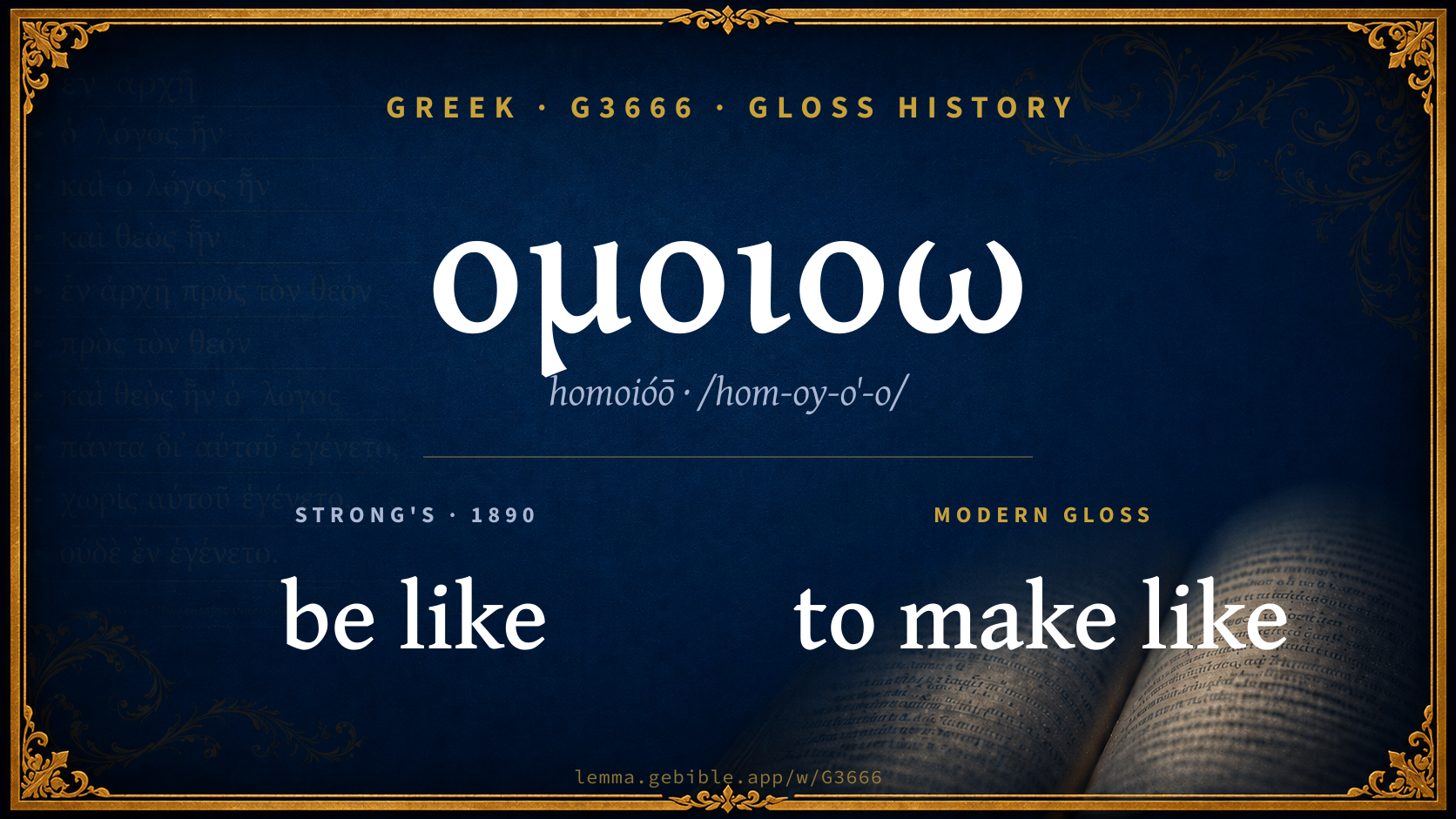
Strong's 1890 vs modern scholarship
About this word
Strong's G3666 catalogs a Greek word from the Greek New Testament.
These counts are not copied from any lexicon or concordance. They are computed here, from the morphology-tagged Greek New Testament. What Lemma adds →
- 15
- distinct verses
- The word appears in 15 distinct verses.
- 6 / 27
- NT books
- The word appears in 6 of 27 New Testament books.
- #768
- by frequency
- Top 1000 most frequent Greek words (rank 768 of 5,347 Greek words by occurrence).
View all 15 occurrences in the concordance →
By section of the New Testament
By traditional corpus
Conventional, traditional groupings — biblical authorship is debated, so this is a traditional corpus grouping, not an authorship claim. Some books belong to more than one corpus (Luke is in both the Gospels and the Lukan corpus, and so on), so these shares overlap and need not total 100%. Each figure is a share of the word’s 15 distinct verses.
- Gospels 12 verses · 80%
- Lukan (Luke–Acts) 4 verses · 27%
- Pauline corpus 1 verse · 7%
- Hebrews 1 verse · 7%
How translations render this word
Counts come from each version’s own published word-to-Strong’s tagging or interlinear alignment — an approximate guide to how each version renders this word, not a word-level alignment the data otherwise carries. Because each total is that version’s own tagged count, the per-version totals vary from one another and need not match the appearance or distinct-verse counts above. These counts may also differ from a printed concordance because Lemma counts each distinctly tagged rendering and does not collapse phrase taggings into a single head-word total. This is a fixed set of word-tagged versions (KJV, ASV, BSB, ULT) and does not change with the reading translation you choose elsewhere. Each version’s license is shown beside its name below (and on Sources).
- King James Version: Shall i liken 3×
- American Standard Version: Shall i liken 3×, Is likened unto 2×, Likened 2×
- Berean Standard Bible: Is like 5×, Can i compare 4×
- unfoldingWord Literal Text: Will i compare 4×, Is compared to 3×, Will be compared to 3×
King James Version Public Domain
Renders G3666 across 16 tagged occurrences — most commonly:
Plus 13 renderings that appear only once — usually multi-word phrases or single function words the recovered tagging swept in, not distinct renderings. Not rendered by a distinct English word in 1 further occurrence.
American Standard Version Public Domain
Renders G3666 across 17 tagged occurrences — most commonly:
Plus 10 renderings that appear only once — usually multi-word phrases or single function words the recovered tagging swept in, not distinct renderings.
Berean Standard Bible Public Domain
Renders G3666 across 15 tagged occurrences — most commonly:
Plus 6 renderings that appear only once — usually multi-word phrases or single function words the recovered tagging swept in, not distinct renderings.
unfoldingWord Literal Text CC BY-SA 4.0
Renders G3666 across 16 tagged occurrences — most commonly:
Plus 6 renderings that appear only once — usually multi-word phrases or single function words the recovered tagging swept in, not distinct renderings.
Senses in Thayer's
The 2 senses Thayer's distinguishes for this word, in lexicon order (not ranked by frequency or importance). The full entry — with sub-senses — is in the Lexicon Entry tab.
- to be made like
- illustrate by comparisons
Word origin
Derived from ομοιος (hómoios) (G3664) — like.
From G3664 ; to assimilate that is compare ; passively to become similar : - be (make) like (in the) liken (-ess) resemble.
— Strong’s Exhaustive Concordance (1890), public domain.
Forms in the corpus
The 8 distinct written forms G3666 takes in the Greek New Testament, most frequent first — each parse links to that tense’s occurrences in the concordance.
| Form | Parsing | Example | Uses |
|---|---|---|---|
| ὁμοιώσω homoiṓsō | Verb, Future, Active, Indicative, 1st person, Singular | Matthew 11:16 | 4 |
| ὁμοιωθήσεται homoiōthḗsetai | Verb, Future, Passive, Indicative, 3rd person, Singular | Matthew 7:24 | 3 |
| ὡμοιώθη hōmoiṓthē | Verb, Aorist, Passive, Indicative, 3rd person, Singular | Matthew 13:24 | 3 |
| ὁμοιωθέντες homoiōthéntes | Verb, Aorist, Passive, Participle, Nominative, Plural, Masculine | Acts 14:11 | 1 |
| ὁμοιωθῆναι homoiōthē̂nai | Verb, Aorist, Passive, Infinitive | Hebrews 2:17 | 1 |
| ὁμοιωθῆτε homoiōthē̂te | Verb, Aorist, Passive, Subjunctive, 2nd person, Plural | Matthew 6:8 | 1 |
| ὁμοιώσωμεν homoiṓsōmen | Verb, Aorist, Active, Subjunctive, 1st person, Plural | Mark 4:30 | 1 |
| ὡμοιώθημεν hōmoiṓthēmen | Verb, Aorist, Passive, Indicative, 1st person, Plural | Romans 9:29 | 1 |
Same root — word family
Other Thayer's entries built from the same root as G3666, grouped by Strong’s listed origin. These share a root / origin per the lexicon — not necessarily a shared meaning. Each links to that word’s own entry.
Derives from
Shares the same root
- ομοιαζω homoiázō G3662 to be like
- ομοιοπαθης homoiopathḗs G3663 having like feelings
- ομοιοτης homoiótēs G3665 likeness
- ομοιως homoíōs G3668 likewise
Derived from this word
Compare all same-root words → Showing 4 of 8 — not the complete family. They share a root, not necessarily a meaning.
Septuagint usage
The same Greek word ομοιοω appears 30 times in the Greek Old Testament (Septuagint), across 29 verses in 8 books.
- 30
- LXX occurrences
- Tagged occurrences of this Greek word in the Septuagint.
- 29
- verses
- Distinct Septuagint verses containing this word.
- 8 / 39
- OT books
- The word appears in 8 of the 39 Old Testament books.
Sample Septuagint occurrences
- Genesis 34:15 ὁμοιόω
- Psalms 27:1 ὁμοιόω
- Song of Solomon 1:9 ὁμοιόω
- Isaiah 1:9 ὁμοιόω
- Lamentations 2:13 ὁμοιόω
- Ezekiel 31:2 ὁμοιόω
- Hosea 4:5 ὁμοιόω
- Zephaniah 1:11 ὁμοιόω
Septuagint occurrences (same lexeme)
Every verse where the same Strong’s number (G3666) appears in the Greek Septuagint. Verse text shown in the World English Bible for context; the Greek form is the matched word — the English is not keyword-highlighted.
- Genesis 34:15 ὁμοιόω Only on this condition will we consent to you. If you will be as we are, that every male of you be circumcised;
- Genesis 34:22 ὁμοιόω Only on this condition will the men consent to us to dwell with us, to become one people, if every male among us be circumcised, as they are circumcised.
- Genesis 34:23 ὁμοιόω Won't their cattle and their substance and all their animals be ours? Only let us give our consent to them, and they will dwell with us."
- Psalms 27:1 ὁμοιόω Yahweh is my light and my salvation. Whom shall I fear? Yahweh is the strength of my life. Of whom shall I be afraid?
- Psalms 39:6 ὁμοιόω "Surely every man walks like a shadow. Surely they busy themselves in vain. He heaps up, and doesn't know who shall gather.
- Psalms 48:13 ὁμοιόω Mark well her bulwarks. Consider her palaces, That you may tell it to the next generation.
- Psalms 48:21 ὁμοιόω
- Psalms 82:2 ὁμοιόω "How long will you judge unjustly, And show partiality to the wicked?" Selah.
- Psalms 88:7 ὁμοιόω Your wrath lies heavily on me. You have afflicted me with all your waves. Selah.
- Psalms 101:7 ὁμοιόω He who practices deceit won't dwell within my house. He who speaks falsehood won't be established before my eyes.
- Psalms 142:7 ὁμοιόω Bring my soul out of prison, That I may give thanks to your name. The righteous will surround me, For you will be good to me.
- Psalms 143:4 ὁμοιόω Therefore my spirit is overwhelmed within me. My heart within me is desolate.
- Song of Solomon 1:9 ὁμοιόω I have compared you, my love, To a steed in Pharaoh's chariots.
- Song of Solomon 2:17 ὁμοιόω Until the day is cool, and the shadows flee away, Turn, my beloved, And be like a roe or a young hart on the mountains of Bether.
- Song of Solomon 7:8 ὁμοιόω I said, "I will climb up into the palm tree. I will take hold of its fruit." Let your breasts be like clusters of the vine, The smell of your breath like apples, Beloved
- Song of Solomon 8:14 ὁμοιόω Come away, my beloved! Be like a gazelle or a young stag on the mountains of spices!
- Isaiah 1:9 ὁμοιόω Unless Yahweh of hosts had left to us a very small remnant, We would have been as Sodom; We would have been like Gomorrah.
- Isaiah 40:18 ὁμοιόω To whom then will you liken God? or what likeness will you compare to him?
- Isaiah 40:25 ὁμοιόω To whom then will you liken me, that I should be equal [to him]? says the Holy One.
- Isaiah 46:5 ὁμοιόω To whom will you liken me, and make me equal, and compare me, that we may be like?
- Lamentations 2:13 ὁμοιόω What shall I testify to you? what shall I liken to you, daughter of Jerusalem? What shall I compare to you, that I may comfort you, virgin daughter of Zion? For your breach is great like the sea: who can heal you?
- Ezekiel 31:2 ὁμοιόω Son of man, tell Pharaoh king of Egypt, and to his multitude: Whom are you like in your greatness?
- Ezekiel 31:8 ὁμοιόω The cedars in the garden of God could not hide it; the fir trees were not like its boughs, and the plane trees were not as its branches; nor was any tree in the garden of God like it in its beauty.
- Ezekiel 31:18 ὁμοιόω To whom are you thus like in glory and in greatness among the trees of Eden? yet shall you be brought down with the trees of Eden to the lower parts of the earth: you shall lie in the midst of the uncircumcised, with those who are slain by the sword. This is Pharaoh and all his multitude, says the Lord Yahweh.
- Ezekiel 32:2 ὁμοιόω Son of man, take up a lamentation over Pharaoh king of Egypt, and tell him, You were likened to a young lion of the nations: yet are you as a monster in the seas; and you did break forth with your rivers, and troubled the waters with your feet, and fouled their rivers.
- Hosea 4:5 ὁμοιόω You will stumble in the day, And the prophet will also stumble with you in the night; And I will destroy your mother.
- Hosea 4:6 ὁμοιόω My people are destroyed for lack of knowledge. Because you have rejected knowledge, I will also reject you, That you may be no priest to me. Because you have your God's law, I will also forget your children.
- Hosea 12:11 ὁμοιόω If Gilead is wicked, Surely they are worthless. In Gilgal they sacrifice bulls. Indeed, their altars are like heaps in the furrows of the field.
- Zephaniah 1:11 ὁμοιόω Wail, you inhabitants of Maktesh, for all the people of Canaan are undone! All those who were loaded with silver are cut off.
These are occurrences of the same Greek lexeme (G3666) in the Septuagint — not a translation of any one Hebrew word. The store carries no word-level Hebrew↔Greek alignment, so no Hebrew original is asserted here. Counts come from the recovered LXX Strong's tagging — high-frequency vocabulary is well covered, while rare or late forms may be untagged — so they reflect tagged occurrences and may slightly undercount.