Zephaniah 1:11

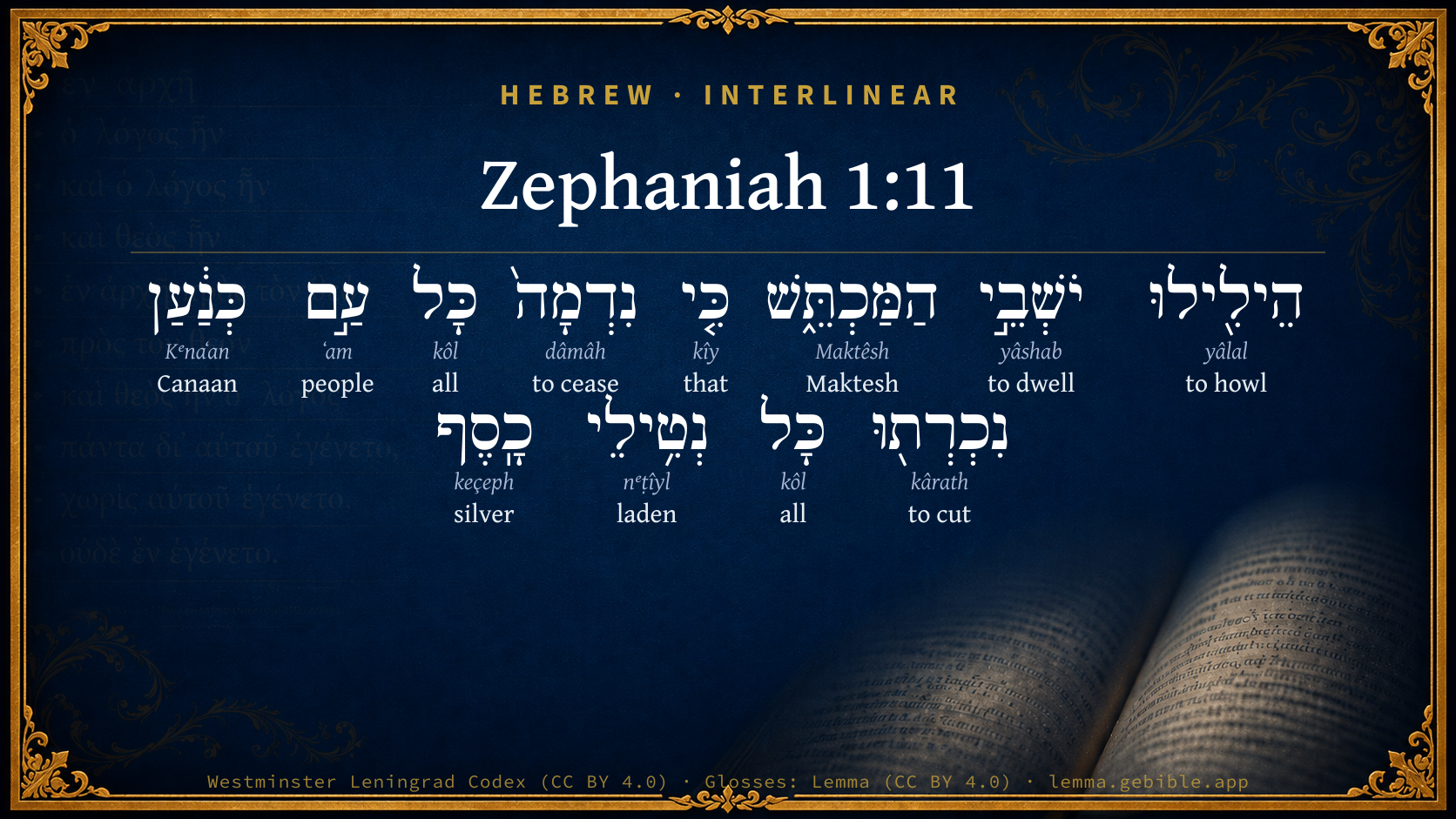
Hebrew (Westminster Leningrad Codex) Zephaniah 1:11 appears in the Hebrew Old Testament. The text above is from the Westminster Leningrad Codex. Each word links to its Strong’s number, a concise gloss, and parsing drawn from the Open Scriptures Hebrew Bible morphology. Click any word for its full Brown-Driver-Briggs (BDB) entry.
Download image
Cite this verse

Zephaniah 1:11 (World English Bible). Public Domain. Lemma interlinear Bible study tool, https://lemma.gebible.app/v/zephaniah/1/11.

Show BibTeX & RIS
BibTeX
RIS
English Translation
Wail, you inhabitants of Maktesh, for all the people of Canaan are undone! All those who were loaded with silver are cut off.
World English Bible · Public Domain
Highlights
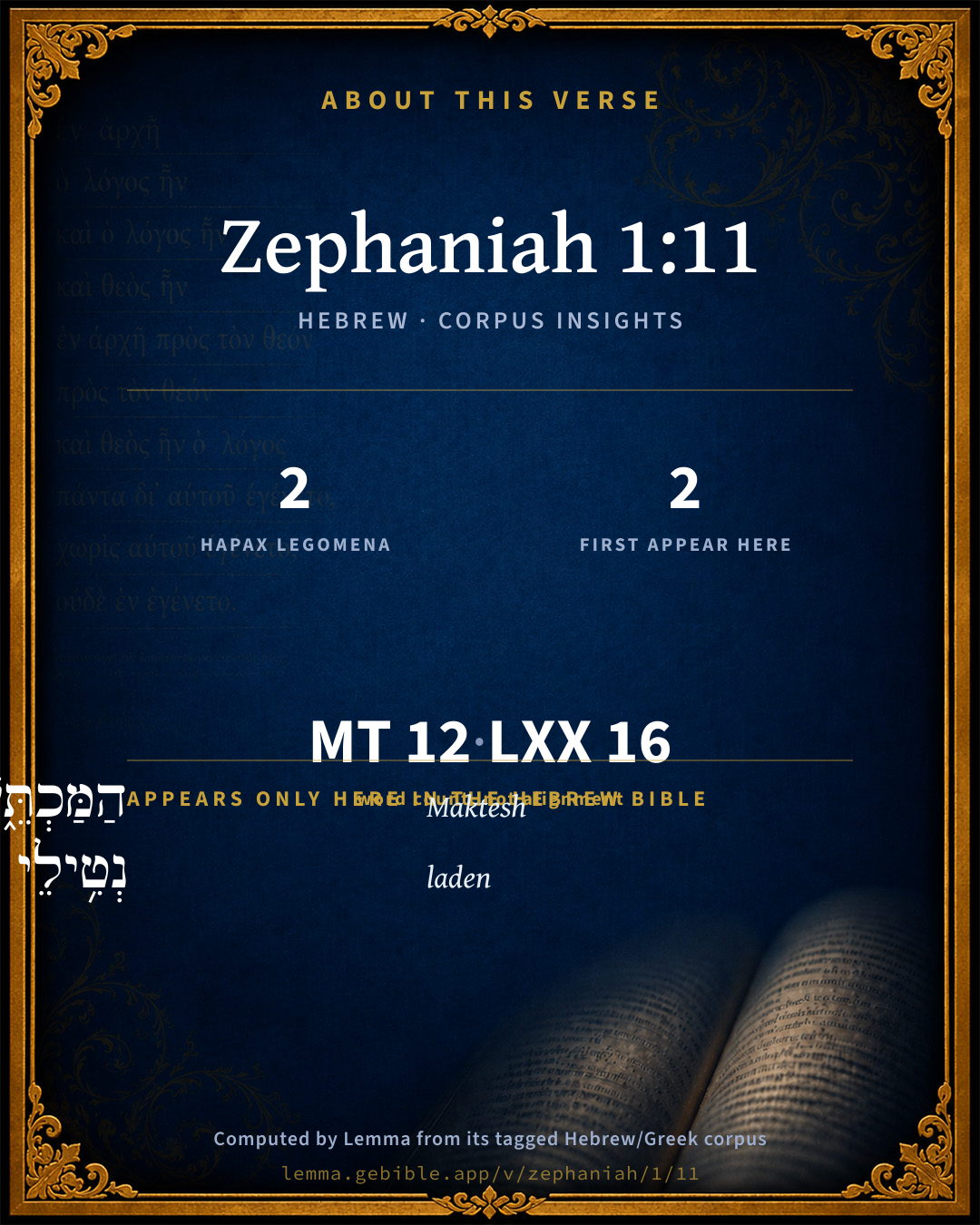
  • 2 hapax legomena — only here in the Hebrew Bible
  • 2 first appearances in the Hebrew Bible
Full analysis ↓
Download a study sheet

One document with this verse’s original text, its word-by-word gloss line, the meaning frame, cross-references with their text, attributed commentary, and full source and license credits — printable, and it pastes into notes with its structure intact.

This verse Autodidact and up

Study sheet (.html) Plain text (.txt)

A passage Seminary Student

Up to 50 verses in one chapter. A passage sheet keeps up to 6 commentary sources and 12 cross-references per verse, in the order this page ranks them, and says so on the sheet whenever that leaves anything out. Ask for a single verse and you get the Autodidact verse sheet above.

Everything on this page stays free to read, with no account — the sheet is a download of what is already on screen, not access to it.

Want to remove ads? Support Godless Engineer
Compare translations 3

The same verse in 3 English versions, stacked beneath the original-language interlinear above. Click any original word for its lexicon entry.

Each is an independent rendering of the whole verse — the interlinear is not word-aligned to these translations.

Highlighted words mark where these versions differ — a whole-verse word diff, not a word-by-word alignment.

  • World English Bible Public Domain
    Wail, you inhabitants of Maktesh, for all the people of Canaan are undone! All those who were loaded with silver are cut off.
  • King James Version Public Domain
    Howl, ye inhabitants of Maktesh, for all the merchant people are cut down; all they that bear silver are cut off.
  • unfoldingWord Literal Text CC BY-SA 4.0
    Wail, inhabitants of the Maktesh, for all of the people of Canaan will be destroyed, all of the ones weighing silver will be cut off.

unfoldingWord Literal Text — © unfoldingWord, licensed CC BY-SA 4.0. Word-aligned USFM3 via Door43 (git.door43.org/unfoldingWord/en_ult).

Versions to compare (up to 4)

3 of 4 selected

Show all 18 translations

Every available English version of this verse, each an independent rendering of the whole verse.

  • World English Bible Public Domain
    Wail, you inhabitants of Maktesh, for all the people of Canaan are undone! All those who were loaded with silver are cut off.
  • Berean Standard Bible Public Domain
    Wail, O dwellers of the Hollow, for all your merchants will be silenced; all who weigh out silver will be cut off.
  • Majority Standard Bible Public Domain
    Wail, O dwellers of the Hollow, for all your merchants will be silenced; all who weigh out silver will be cut off.
  • King James Version Public Domain
    Howl, ye inhabitants of Maktesh, for all the merchant people are cut down; all they that bear silver are cut off.
  • American Standard Version (1901) Public Domain
    Wail, ye inhabitants of Maktesh; for all the people of Canaan are undone; all they that were laden with silver are cut off.
  • Revised Version (1885) Public Domain
    Howl, ye inhabitants of Maktesh, for all the people of Canaan are undone: all they that were laden with sliver are cut off.
  • Geneva Bible (1599) Public Domain
    Howle ye inhabitants of the lowe place: for the companie of the marchants is destroyed: all they that beare siluer, are cut off.
  • Douay-Rheims (1899) Public Domain
    Howl, ye inhabitants of the Morter. All the people of Chanaan is hush, all are cut off that were wrapped up in silver.
  • Young's Literal Translation Public Domain
    Howl, ye inhabitants of the hollow place, For cut off hath been all the merchant people, Cut off have been all bearing silver.
  • Literal Standard Version CC BY-SA 4.0
    Howl, you inhabitants of the hollow place, || For all the merchant people have been cut off, || All carrying silver have been cut off.
  • Unlocked Literal Bible CC BY-SA 4.0
    Wail, inhabitants of the Market District, for all the merchants will be ruined; all those who weigh out silver will be cut off.
  • unfoldingWord Literal Text CC BY-SA 4.0
    Wail, inhabitants of the Maktesh, for all of the people of Canaan will be destroyed, all of the ones weighing silver will be cut off.
  • Darby Bible Public Domain
    Howl, ye inhabitants of Maktesh; for all the people of Canaan are cut down, all they that are laden with silver are cut off.
  • World Messianic Bible Public Domain
    Wail, you inhabitants of Maktesh, for all the people of Canaan are undone! All those who were loaded with silver are cut off.
  • Webster's Bible Public Domain
    Howl, ye inhabitants of Maktesh, for all the merchant people are cut down; all they that bear silver are cut off.
  • Free Bible Version CC BY-SA 4.0
    Those who live in the Market District will wail in sorrow, for all the merchants are destroyed, along with those who trade in silver.
  • Bible in Basic English Public Domain
    Because of the downfall of all the people of Canaan: all those who were weighted down with silver have been cut off.
  • JPS Tanakh (1917) Public Domain
    Wail, ye inhabitants of Maktesh, for all the merchant people are undone; all they that were laden with silver are cut off.

Literal Standard Version (2020), Covenant Press — licensed CC BY-SA 4.0. Text via the HelloAO Bible API (eBible.org). Unlocked Literal Bible (unfoldingWord) — licensed CC BY-SA 4.0. Text via the HelloAO Bible API (eBible.org). unfoldingWord Literal Text — © unfoldingWord, licensed CC BY-SA 4.0. Word-aligned USFM3 via Door43 (git.door43.org/unfoldingWord/en_ult). Free Bible Version, Dr. Jonathan Gallagher — licensed CC BY-SA 4.0. Text via the HelloAO Bible API (eBible.org).

Word by word

More ways to search: Search by grammar → Find every occurrence → Compare this word →

Practice this passage: Drill this verse → Learn its vocabulary →

הַמַּכְתֵּ֑שׁ
Maktêsh
H4389
“the · Maktesh”
Particle, Definite Article + Noun, Common, Masculine, Singular, Absolute
Part of Speech
Particle + Noun
Type
Common
Gender
Masculine
Number
Singular
State
Absolute
Full BDB Definition

Origin: the same as H4388

TWOT: None

Maktesh = "a mortar" or " deep hollow" - a hollow or valley evidently in the greater Jerusalem area
  1. הֵילִ֖ילוּ yâlal H3213 “howl” Verb, Hiphil, Imperative, 2nd Person, Masculine, Plural
  2. יֹשְׁבֵ֣י yâshab H3427 “dwelling” Verb, Qal, Participle Active, Masculine, Plural, Construct
  3. כִּ֤י kîy H3588 “that” Conjunction
  4. נִדְמָה֙ dâmâh H1820 “to cease” Verb, Niphal, Perfect, 3rd Person, Masculine, Singular
  5. כָּל kôl H3605 “all of” Noun, Common, Masculine, Singular, Construct
  6. עַ֣ם ʻam H5971 “people of” Noun, Common, Masculine, Singular, Construct
  7. כְּנַ֔עַן Kᵉnaʻan H3667 “Canaan” Noun, Proper
  8. נִכְרְת֖וּ kârath H3772 “to cut” Verb, Niphal, Perfect, 3rd Person, Common, Plural
  9. כָּל kôl H3605 “all of” Noun, Common, Masculine, Singular, Construct
  10. נְטִ֥ילֵי nᵉṭîyl H5187 “laden ones of” Noun, Common, Masculine, Plural, Construct
  11. כָֽסֶף keçeph H3701 “silver” Noun, Common, Masculine, Singular, Absolute

About this verse

These counts appear in no published source. They are computed here, from the morphology-tagged text and Lemma’s own curated glosses. What Lemma adds →

12
words
11
distinct lemmas
Prophets
section

Notable vocabulary

2 hapax legomena — words that appear only here in the entire Hebrew Bible:

  • הַמַּכְתֵּ֑שׁ Maktesh H4389
  • נְטִ֥ילֵי laden H5187

First appearance in Scripture

These words make their first canonical appearance in the Hebrew Bible here:

  • הַמַּכְתֵּ֑שׁ Maktesh H4389
  • נְטִ֥ילֵי laden H5187

Shared distinctive vocabulary

נִדְמָה֙ to cease H1820 occurs in 14 verses of the Hebrew Bible. Also found in:

Grammatical profile

  • 4 verbs
  • 7 nouns
  • 1 conjunction

Verb forms

  • הֵילִ֖ילוּ Hiphil · Imperative
  • יֹשְׁבֵ֣י Qal · Participle Active
  • נִדְמָה֙ Niphal · Perfect
  • נִכְרְת֖וּ Niphal · Perfect

Repetition

A word recurs within this verse — often emphatic in Hebrew:

Hebrew & Septuagint length

In English translation the verse runs 23 words from the Hebrew and 30 from the Septuagint (LXX English) — closely comparable.

A rough comparison of the two English renderings, which tokenize alike — not a word-level alignment.

Word counts can differ between the Hebrew and the Greek without any difference in meaning — e.g. the Hebrew direct-object marker אֵת has no separate Greek word, and Greek often adds the article ὁ.

In the original languages it is 12 Hebrew tokens and 16 Greek tokens — but the two are counted differently (Hebrew bundles its prefixes and suffixes into one token; the Greek is in lemma form), so that isn’t a like-for-like length.

Cross-references

12

Topical passages linked to Zephaniah 1:11 in the Treasury of Scripture Knowledge — connected by theme and wording, ordered by reader-vote popularity; previews shown in the World English Bible.

  • James 5:1 Come now, you rich, weep and howl for your miseries that are coming on you.
  • Jeremiah 25:34 Wail, you shepherds, and cry; and wallow [in ashes], you principal of the flock; for the days of your slaughter and of your dispersions are fully come, and you shall fall like a goodly vessel.
  • Ezekiel 21:12 Cry and wail, son of man; for it is on my people, it is on all the princes of Israel: they are delivered over to the sword with my people; strike therefore on your thigh.
  • Hosea 12:7–8 A merchant has dishonest scales in his hand. He loves to defraud.
  • Nehemiah 3:31–32 After him repaired Malchijah one of the goldsmiths to the house of the Nethinim, and of the merchants, over against the gate of Hammiphkad, and to the ascent of the corner.
  • Jeremiah 4:8 For this gird you with sackcloth, lament and wail; for the fierce anger of Yahweh hasn't turned back from us.
  • Hosea 9:6 For, behold, they have gone away from destruction. Egypt will gather them up. Memphis will bury them. Nettles will possess their pleasant things of silver. Thorns will be in their tents.
  • Joel 1:5 Wake up, you drunkards, and weep! Wail, all you drinkers of wine, because of the sweet wine; For it is cut off from your mouth.
  • Joel 1:13 Put on sackcloth and mourn, you priests! Wail, you ministers of the altar. Come, lie all night in sackcloth, you ministers of my God, For the meal offering and the drink offering are withheld from your God's house.
  • Zechariah 11:2–3 Wail, fir tree, for the cedar has fallen, Because the stately ones are destroyed. Wail, you oaks of Bashan, For the strong forest has come down.
  • John 2:16 To those who sold the doves, he said, "Take these things out of here! Don't make my Father's house a marketplace!"
  • Revelation 18:11–18 The merchants of the earth weep and mourn over her, for no one buys their merchandise any more;

Cross-references courtesy of OpenBible.info (CC BY 4.0).

Hebrew and Greek witnesses Masoretic Hebrew ↔ Greek Septuagint

The same verse in the two great witnesses to the Old Testament, shown verse-for-verse.

These are two independent witnesses, not word-aligned to each other, and the Septuagint is shown in lemma (dictionary) form.

Hebrew Zephaniah 1:11 Masoretic · Westminster Leningrad Codex

הֵילִ֖ילוּ יֹשְׁבֵ֣י הַמַּכְתֵּ֑שׁ כִּ֤י נִדְמָה֙ כָּל עַ֣ם כְּנַ֔עַן נִכְרְת֖וּ כָּל נְטִ֥ילֵי כָֽסֶף

Wail, you inhabitants of Maktesh, for all the people of Canaan are undone! All those who were loaded with silver are cut off.

World English Bible · Public Domain

Greek LXX Zephaniah 1:11 Septuagint · lemma form

θρηνέω ὁ καταοἰκέω ὁ κατακόπτω ὅτι ὁμοιόω πᾶς ὁ λαός χανααν ἐκὀλεθρεύω πᾶς ὁ ἐπιαἵρω ἀργύριον

Lament, you⌃ that inhabit the city that has been broken down, for all the people has become like Chanaan; and all that were exalted by silver have been utterly destroyed.

LXX2012 (modern English Septuagint) · Public Domain

On this verse, Haydock's Catholic Bible Commentary discusses the Septuagint’s reading. Read the note in Commentary ↓

Hebrew: Westminster Leningrad Codex (CC BY 4.0). Greek: Septuagint (public domain); English from LXX2012 (modern English Septuagint) (Public Domain). How the Septuagint differs from the Hebrew →

Targum (Aramaic paraphrase)

1

The Targum is the ancient Jewish Aramaic paraphrase of the Hebrew Scriptures — an interpretive translation, not the Hebrew text itself. Onkelos (literal) and Pseudo-Jonathan (expansive) render the Torah, and Jonathan the Prophets. Coverage is partial: where no permissively-licensed English translation exists for a verse, only the Aramaic is shown. This is verse-level text, not a word-by-word alignment to the Hebrew.

  1. Targum Jonathan Prophets (Joshua–Malachi)
    אַיְלִילוּ כָּל דְיָתְבִין בְּנַחֲלָא דְקִדְרוֹן אֲרֵי אִתְּבַר כָּל עַמָא דְדָמָן עוֹבָדֵיהוֹן לְעוֹבָדֵי עַמָא דְאַרְעָא דִכְנָעַן אִשְׁתֵּיצִיאוּ כָּל עֲתִּירֵי נִכְסַיָא:

    (no public-domain English translation for this verse)

    Targum Jonathan — Aramaic: “Mikraot Gedolot” (public domain). English: “Sefaria Community Translation” (CC0 1.0 (public-domain dedication)); “London "Chaldee Paraphrase," 1871” (public domain). Text via Sefaria.

Commentary

Notes on Zephaniah 1:11 from classic Christian and Jewish commentators (each source and its license shown beneath its notes). The classic Christian expositions comment on the surrounding passage and are grouped to its opening verse, so a note may address several verses; the Jewish commentaries on the Tanakh (Rashi and others) are per-verse, so they appear only where the commentator wrote on this verse.

Lemma curates 59 commentaries, every one of them public domain or Creative Commons licensed, each selected and text-cleaned for this edition rather than reprinted as found. About our sources →

Trapp's Complete Commentary

John Trapp

Zep 1:11 Howl, ye inhabitants of Maktesh, for all the merchant people are cut down; all they that bear silver are cut off.

Ver. 11. Howl, ye inhabitants of Maktesh] Or, of the mortar, or of the low and hollow place, of the base town, where grain was ground in mortars, before mills were in use. These are here called upon to "turn their laughter to mourning, and their joy into heaviness, to weep and howl for the evils that shall come upon them," Jas 4:9; Jas 5:1, but especially for their sins, the cause of those miseries; for God’s judgments upon sinners are feathered from themselves: as a fowl shot with an arrow feathered from her own body.

For all the merchant people are cut down] The merchant men were wont to furnish the mortar men, such as dealt in grain, spicery, and the like. These shall be cut down, as being more like Canaanites (a people devoted to destruction) than Israelites, a people saved by the Lord, the shield of their help, and the sword of their excellency, Deu 33:29. See Hos 12:13. {See Trapp on "Hos 12:13"} He is a merchant, the balances of deceit are in his hand, he loveth to oppress, see Amo 8:5-6 Mic 6:10-12. Merchandise well managed is of great use to kingdoms and states, for many reasons. 1. For determining the counsels and strength of other nations. 2. For procuring the love and friendship of foreign princes and people. 3. For exchanging of commodities; for non omnis fert omnia tellus. not everything is born from all ground. 4. For gaining experience of many and great matters; this caused Thales, Hippocrates, and Solon to exercise merchandise. 5. It occasioned the building of many famous cities: Massilia for one, as Plutarch writeth. Nevertheless this honourable profession is much abused by those whom Nahum calleth cankerworms, Nah 3:16, for their covetousness, luxury, oppression, bringing in unnecessary wars (that emasculate and dissolve men’s spirits), and heretical books that undo their souls; and, lastly, for their carrying out the wealth of their country to strangers, yea, to enemies sometimes. Hence they are justly cut down by God, and are to be ordered by the magistrates according to Lev 19:35-36 Deu 25:15 Eze 45:9-12.

All they that bear silver are cut off] The rich traders, that had marsupia plena full purse, and carried money in great burdens, these shall be also cut off or silenced, have nothing to say for themselves why they should not be destroyed with the rest, as those that have been involuti argento, as the Vulgate translation hath it here, so wrapped up in their money, and affected to it, as that it hath rather possessed them than they it. Cor habent in aere non in aethere, "their heart goeth after their covetousness," Eze 33:31. Here they are called portatores argenti, silver carriers, sumpter horses, laden with thick clay. Silver is that which the basest element yieldeth, the most savage Indians get, servile apprentices work, Midianitish camels carry, miserable muck worms admire, covetous Jews swallow, unthirsty ruffians spend. It is to be wondered (saith one) that treading upon these minerals we cannot condemn them. They lie furthest from heaven; and the best of them are in India, furthest from the Church; and yet how many doth money make to run quick to the devil on an errand, and pays them home for their pains?

John Trapp, A Commentary or Exposition upon All the Books of the Old and New Testament (1647–1656) — public domain. Text from a community e-Sword module.

Geneva Bible (1599)

Geneva Bible translators

This is meant of the street of the merchants which was lower than the rest of the place about it.

Geneva Bible (1599) marginal notes — public domain. Text via Bolls.life.

Jamieson, Fausset & Brown

Robert Jamieson, A. R. Fausset & David Brown

Maktesh--rather, "the mortar," a name applied to the valley of Siloam from its hollow shape [JEROME]. The valley between Zion and Mount Olivet, at the eastern extremity of Mount Moriah, where the merchants dwelt. Zac 14:21, "The Canaanite," namely, merchant [Chaldee Version]. The Tyropœon (that is, cheese-makers') valley below Mount Akra [ROSENMULLER]. Better Jerusalem itself, so called as lying in the midst of hills (Isa 22:1; Jer 21:13) and as doomed to be the scene of its people being destroyed as corn or drugs are pounded in a mortar (Pro 27:22) [MAURER]. Compare the similar image of a "pot" (Eze 24:3, Eze 24:6). The reason for the destruction is subjoined, namely, its merchant people's greediness of gain.

all the merchant people--literally, the "Canaanite people": irony: all the merchant people of Jerusalem are very Canaanites in greed for gain and in idolatries (see on Hos 12:7).

all . . . that bear silver--loading themselves with that which will prove but a burden (Hab 2:6).

Jamieson, Fausset & Brown — Commentary Critical and Explanatory on the Whole Bible (1871) — public domain (CC PDM 1.0). Text via the HelloAO Bible API.

Adam Clarke's Commentary

Verse 11. Maktesh] Calmet says this signifies a mortar, or a rock in form of a mortar, and was the name of a quarter of Jerusalem where they hulled rice, corn, &c., according to St. Jerome. Some think the city of Jerusalem is meant, where the inhabitants should be beat and pounded to death as grain is pounded in a mortar.

Newcome translates it, the lower city, and considers it the valley in Jerusalem, which divided the upper from the lower city.

They that bear silver] The merchants, moneychangers, usurers, rich men.

Adam Clarke's Commentary on the Bible (1810–1826) — public domain. Text from a community e-Sword/MySword module.

John Calvin's Commentaries

The Prophet addresses the merchants here who inhabited the middle part of the city, and hence thought themselves farther off from all danger and trouble. As then they were concealed as it were in their hiding-places, they thought that no danger was nigh them; and thus security blinded them the more. After having spoken of the king’s palace and of the princes and their servants, Zephaniah now turns his discourse to the merchants.

And he calls them the inhabitants of the hollow place, מכתש, mecatesh. The verb כתש, catash, means to be hollow; hence the Hebrews call a hollow place מכתש, mecatesh. So Solomon calls a mortar by this name, because it is hollow: and we learn also from other parts of scripture that the word means sometimes either a cavern or some low place. But we know that merchants have for the most part their streets on level ground, and it is for their advantage, as they have goods to carry. It may then have been, that at Jerusalem there was a large company of merchants in that part of the city, which was in its situation low. But they who regard it as a proper name, bring nothing either of reason or probability to confirm their opinion: and it is also evident from the context that merchants are here addressed, for cut off, he says, is the mercantile people. The word כנען, canon, means a merchant. Some think that the Jews are here, as often elsewhere, called Canaan, because they were become degenerate, and more like the Canaanites than the holy fathers, from whom they descended. But the Prophet speaks here no doubt of merchants, for an explanation immediately follows, all who are laden with money. And he says that merchants were laden with money, because they would not transact business without making payments and counting money, and also, because merchants for the most part engrossed by their gainful arts a great portion of the wealth of the world.

We now then understand what the Prophet means: He threatens howling to the merchants, who were concealed in their hidden places, for they occupied that part of the city, as I have already said, which was below the hills; and he then makes use of the word כנען, canon, a trafficker; and lastly he speaks of their wealth, as it is probable that they became rich through frauds and most dishonest means, and shows that their money would be useless to them, for they would find in it no defense, when the Lord extended his hand to punish them. It now follows—

John Calvin's Commentaries (1540-1563) — public domain. Text from the Calvin Translation Society English edition (1840s-50s) via the Christian Classics Ethereal Library (ccel.org). Calvin's coverage is partial (roughly two-thirds of the Bible); uncommented books and verses are honest gaps, never fabricated. The 19th-century editor's footnotes and remarks are omitted so the notes are faithfully Calvin's own voice.

Ellicott's Commentary for English Readers

(11) Maktesh.—Better, the mortar, a term indicating probably some part of the city lying in a hollow: perhaps that part which was in the valley of Tyropœon. This quarter is described by Josephus as “full of houses” (B.J. V. iv. § 1). Hence some detect in the name “mortar” an allusion to the noisy din of the commerce here conducted. The name occurs here only. Some suppose that it is a term coined by Zephaniah, to signify how everything in Jerusalem should be bruised to pieces as in a mortar.

Merchant people.—Literally, people of Canaan, a phrase used elsewhere for traders and merchants, and therefore not to be restricted to its original signification here.

All they that bear silver.—Literally, all they that are laden with silver. Another mode of designating this commercial class.

A Bible Commentary for English Readers, edited by Charles John Ellicott (1878–1897) — public domain. Text from a community e-Sword module.

The Cambridge Bible for Schools and Colleges

gen. ed. J. J. S. Perowne

11. ye inhabitants of Maktesh] The term Maktesh is rendered “hollow-place,” Jdg_15:19, and mortar, Pro_27:22. Some depression or valley in the city is referred to: Hitzig thinks of that between Acra and the Temple area, and others of the valley of the Tyropœon or cheese-makers, a depression, now filled up with the rubbish of many centuries, which ran from north to south, dividing the city into two parts. The probability is that the Maktesh lay in the northern part of the city. It was on this side that Jerusalem was most liable to attack, and the prophet has in view throughout an invasion by a foe from the north.

all the merchant people] lit. the people of Canaan. The Canaanites or Phenicians were the chief traders in Palestine, and the name Canaan came to be used for merchant. It is scarcely actual Canaanites that are referred to here; already in Hos_12:7 the term Canaan is applied figuratively to Ephraim, and in Eze_16:29; Eze_17:4, Chaldea is called the “land of Canaan,” i.e. the merchant land. In Isa_23:8 the word Canaan seems to be used in the plur., and certainly in a figurative sense: “her (Tyre’s) traffickers are the honourable of the earth.” In Pro_31:24 the form Canaanite is used for merchant, and so perhaps Job_41:6 (Heb. 40:30).

are cut down] R.V. are undone, as Isa_6:5; the word is usually rendered cut off, Hos_10:7; Hos_10:15.

All they that bear silver] Or, money. The reference is not to the trade of silversmiths, but rather to merchants in general.

The Cambridge Bible for Schools and Colleges (gen. ed. J. J. S. Perowne; Cambridge University Press, 1878–1918) — public domain. Text from a community e-Sword module.

John Gill's Exposition

Howl, ye inhabitants of Maktesh The name of a street in Jerusalem, as Aben Ezra; perhaps it lay low in the hollow of the city, and in the form of a mortar, from whence it might have its name, as the word F17 signifies; which is used both for a hollow place and for a mortar, ( Judges 15:19 ) ( Proverbs 27:22 ) unless it might be so called from such persons dwelling in it, that used mortars for spice, and other things. The Targum is, ``howl, all ye that dwell in the valley of Kidron;'' and Jerom thinks the valley of Siloah is intended, which is the same; which, Adrichomius F18 says, was broad, deep, and dark, and surrounded the temple in manner of a foss, or ditch; and was disposed in the form of a mortar, called in Hebrew "machtes"; in Latin, "pila"; in which merchants and tradesmen of all kinds dwelt. It is thought by others to be the same which Josephus F19 calls "the valley of the cheese mongers", which lay between the two hills Zion and Acra. The reason of their howling is, for all the merchant people are cut down; either cut to pieces by the sword of the enemy, and become silent, as the word F20 sometimes signifies, and the Vulgate Latin version here renders it; become so by death, and laid in the silent grave, and no more concerned in merchandise; or else stripped of all their wealth and goods by the enemy, and so cut down, broke, and become bankrupt, and could trade no more. The word for merchant signifies a Canaanite; and the Targum paraphrases it thus, ``for all the people are broken, whose works are like the works of the people of the land of Canaan:'' all they that bear silver are cut off; that have large quantities of it, and carry it to market to buy goods with it as merchants; these shall be cut off, and so a great loss to trade, and a cause of howling and lamentation; or such that wear it in their garments, embroidered with it; or rather in their purses, who are loaded with this thick clay, abound with it. The Targum is, ``all that are rich in substance shall be destroyed.'' FOOTNOTES: F17 (vtkmh) "mortarii", Vatablus, Tigurine version; "cavi", Junius & Tremellius, Piscator; "loci concavi", Calvin. F18 Theatrum Terrae Sanctae, p. 163. F19 De Bello Jud. l. 5. c. 4. sect. 1. F20 (hmdn) "conticuit", V. L. "in silentium redactus est", Drusius.

John Gill's Exposition of the Whole Bible (1746–1763) — public domain (CC PDM 1.0). Text via the HelloAO Bible API.

Albert Barnes' Notes on the Bible

Howl, ye inhabitants of Maktesh - Literally, “Mortar” , “in which,” Jerome says, “corn is pounded; a hollow vessel, and fit for the use of medical men, in which properly ptisans are wont to be beaten (or made). Striking is it, that Scripture saith not, ‘who dwell in the valley or in the alley,’ but who “dwell in the mortar,” because as corn, when the pestle striketh, is bruised, so the army of the enemy shall rush down upon you” (Jerome). The place intended is probably so much of the valley of the Tyropoeon, which intersected Jerusalem from north to south, as was enclosed by the second wall, on the north, and the first wall on the south. The valley “extended as far as the fountain of Siloam,” and united with the valley of Jehoshaphat a little below Ophel. It was “full of houses,” and, from its name as well as from its situation, it was probably the scene of petty merchandise, where the occasions in which men could and did break the law and offend God, were the more continual, because they entered into their daily life, and were a part of it. The sound of the pestle was continually heard there; another sound should thereafter be heard, when they should not bruise, but be themselves bruised. The name “Maktesh” was probably chosen to express how their false hopes, grounded on the presence of God’s temple among them while by their sins they profaned it, should be turned into true fears. They had been and thought themselves “Mikdash,” “a holy place,. sanctuary;” they should be Maktesh , wherein all should be utterly bruised in pieces.

Jerome: “Whoso considereth the calamities of that siege, and how the city was pressed and hemmed in, will feel how aptly he calls them “the inhabitants of a mortar;” for, as grains of corn are brought together into a mortar, to the end that, when the pestle descendeth, being unable to fly off, they may be bruised, so the people flowing together, out of all the countries of Judaea, was narrowed in by a sudden siege, and through the savage cruelty of the above leaders of the sedition, was unutterably tortured from within, more than by the enemy without.”

For all the merchant people are cut down - (Literally, “the people of Canaan”) that is Ch.: “they who in deeds are like the people of Canaan,” according to that , “Thou art of Canaan and not of Judah,” and, “Thy father is an Amorite and thy mother a Hittite” . So our Lord says to the reprobate Jews, “Ye are of your father the devil” Joh 8:44.

All they that bear silver are cut off - (Literally, “all laden with”). The silver, wherewith they lade themselves, being gotten amiss, is a load upon them, weighing them down until they are destroyed.

Albert Barnes' Notes on the Bible (1834–1885) — public domain. Text from a community e-Sword/MySword module.

Haydock's Catholic Bible Commentary

The Morter: (Maktesh) a valley in or near Jerusalem. (Challoner) --- All the people shall suffer in the city. (Sanctius) (Tirinus) --- Mactes was rendered famous by Samson, (Judges xv. 19.) and was in or near the country of the Philistines, who seem to be designated. The original is variously interpreted. (Calmet) --- Septuagint, "of the city cut in pieces, because all the people resemble Chanaan." (Haydock) Chanaan. So he calls the Jews, from their following the wicked ways of the Chanaanites. (Challoner) --- The merchants (Grotius) are confounded, or (Haydock) the Philistines are still meant. (Calmet)

George Leo Haydock (1774–1849), Haydock's Catholic Family Bible and Commentary, 1859 edition — public domain. Excludes Psalms (Douay-Rheims chapter numbering differs from Protestant) and Deuterocanonical books (Catholic canon only).

Matthew Poole's English Annotations

Howl, cry aloud, and bitterly,

ye inhabitants of Maktesh: some read it appellatively: the mortar in which of old, before the corn-mill was known and used, they did pound and beat their corn for bread; they also pounded spices. Others say it is the lower town, or valley of Cedron in Jerusalem, a deep valley that surrounded the mountain of the temple, to which, fancied like a deep mortar, they gave the name Maktesh.

All the merchant people; who were wont either to lodge in this place when they came to trade, or, if Jewish merchants, dwelt there, which was much to the advantage of the place; but now, by the invasion of the land, and by the siege, all trade is cut off, and many merchants either slain or made slaves.

All they that bear silver, that brought it with them to pay for what they bought up, and so enriched the inhabitants of this Maktesh, all that traded and paid ready money,

are cut off. Others say the money-changers or bankers are here meant by them that bear silver, persons that furnished all sorts of people with silver for goods laid to pledge or bartered.

Are cut off, i.e. shall be as surely as if it were already done.

Matthew Poole's English Annotations on the Holy Bible (1683–1685) — public domain. Text from a community e-Sword/MySword module.

Whedon's Commentary on the Bible

Daniel D. Whedon

11. Maktesh — This must be another portion of the city. The context suggests that it was the quarter of the merchants, but its location is uncertain; it is not improbable, however, that it also should be looked for in the northern part of Jerusalem. Targum reads “in the ravines of the Kidron,” but that is purely a guess. The noun means “depression” (Jdg_15:19) or “mortar” (Pro_27:22); hence it is probable that some valley or depression in the city is referred to. Most writers think of the northern end of the Tyropoeon valley. The name may have been selected because of its suggestiveness; the inhabitants are to be crushed as in a mortar.

The merchant people — Literally, the people of Canaan; but the interpretation embodied in the translation of A.V. is correct (see on Hos_12:7).

They that bear silver — R.V., “they that were laden with silver,” that is, possessed silver in large quantities. The reference is to the rich merchants.

Daniel D. Whedon (gen. ed.), Commentary on the Old and New Testaments (1874–1909) — public domain. Text from a community e-Sword module.

The Pulpit Commentary

Maktesh; the Mortar; Septuagint, thnhn , "her that is broken down." The word is found in Jud_1:15:19 of a hollow place in a rock, and it is here used in the sense of "valley," and probably refers to the Tyropoeum, or part of it, the depression that ran down the city, having Aera and Zion on its west side, and Moriah and Ophel on its east, and extended south as far as the pool of Siloam. It does not seem a very appropriate appellation for a lengthy valley like the Tyropceum, nor is there any trace of such a name being applied to it elsewhere. It may have been a name affixed to a certain locality where a bazaar was situated or certain special industries had their seat; or it may have been invented by Zephaniah to intimate the fate that awaited the evil merchants, that they should be, as it were, brayed in a mortar by their enemies. The merchant people; literally, people of Canaan. So Septuagint and Vulgate. (comp. Hos_12:7; Hist. of Susannah 56; Zec_14:21) The iniquitous traders are called "people of Canaan," because they acted like the heathens around them, especially the Phoenicians, who were unscrupulous and dishonest in their transactions. Are cut down; are silenced; Vulgate, conticuit. (Isa_6:5 Hos_10:7) They that bear (are laden with) silver. Those who have amassed wealth by trade and usury. The LXX has, oi ehrmenoi arguriw "those who are elated with silver;" St. Jerome, involuti argento.

The Pulpit Commentary (1880–1919), ed. H.D.M. Spence-Jones & Joseph S. Exell — public domain. Text from a community e-Sword module.

John Wesley's Explanatory Notes

Howl - Cry aloud, and bitterly. Maktesh - The lower town. Merchant people - Who were wont to lodge in this place. That bear silver - That brought it with them to pay for what they bought.

John Wesley, Explanatory Notes Upon the Whole Bible (1754–1765) — public domain. Text via the GEBible commentary corpus.

Scofield Reference Notes

C. I. Scofield

Maktesh

Lit. The Mortar, a depression in Jerusalem where the bazaars were.

The Scofield Reference Bible (1917 edition), notes by C. I. Scofield — public domain. Text from a community e-Sword module.

Kretzmann's Popular Commentary

Paul E. Kretzmann

The Extent of the Judgment

v. 11. Howl, ye inhabitants of Maktesh, meaning the mortar, a small section of Jerusalem, so called because it presented a depression or hollow, for all the merchant people are cut down, entirely destroyed; all they that bear silver, the traders laden with silver, who occupied that part of the lower city, are cut off.

v. 12. And it shall come to pass at that time that I will search Jerusalem with candles, investigating even the dark and hidden corners, so that not one of the wrong-doers is overlooked, and punish the men that are settled on their lees, like old wine which is not drawn off, a fit picture of moral and religious indifference, Jer 48:11, that say in their heart, The Lord will not do good, neither will He do evil, that is, there is no need of worry, matters will go on as they always have been.

v. 13. Therefore their goods shall become a booty, to be robbed by the enemies, and their houses a desolation, in the overthrow of the city; they shall also build houses, but not Inhabit them, the destruction taking place before they can move into them, and they shall plant vineyards, but not drink the wine thereof. Cf Amo 5:11; Mic 6:15.

v. 14. The great day of the Lord, the day of His mighty judgment, is near, it is near, and hasteth greatly, there will be no further delay, even the voice of the day of the Lord, or, "Hark! the day of Jehovah"; the mighty man shall cry there bitterly, the hero crying in bitter lamentation, because he cannot save himself, and must yield to the power of the foe.

v. 15. That day is a day of wrath, Cf Isa 19:18, a day of trouble and distress, of anguish and pressure, Job 15:24, a day of wasteness and desolation, of the greatest devastation, a day of darkness and gloominess, Joe 2:2, a day of clouds and thick darkness, Deu 4:11,

v. 16. a day of the trumpet and alarm against the fenced cities, in proclaiming God’s power upon a sinful people, in the war-signal of desolation, and against the high towers, the battlements of the forts.

v. 17. And I will bring distress upon men, that they shall walk like blind men, groping about in a futile effort to escape from existing evils, because they have sinned against the Lord; and their blood shall be poured out as dust, in endless quantities, and their flesh as the dung, which is not regarded.

v. 18. Neither their silver nor their gold shall be able to deliver them In the day of the Lord’s wrath, they would not be able to buy themselves off when His fury is once set in motion; but the whole land shall be devoured by the fire of His jealousy, His indignation jealous for His honor; for He shall make even a speedy riddance of all them that dwell in the land, consuming them with a suddenness which they had not anticipated. Even so will the Day of Judgment come upon a world which, as a whole, is not prepared for the Lord’s last advent. Cf Mat 24:44

Paul E. Kretzmann, Popular Commentary of the Bible (1921–1924) — public domain. Text from a community e-Sword module.

Rashi

Rabbi Shlomo Yitzchaki (Rashi)

you inhabitants of Maktesh The Kidron Valley, which is as deep as a mortar. This is according to Targum Jonathan. from the fish gate This is Acre, situated in the bosom of the sea, where many fish are caught.

from the Mishneh This is Lod, which is second to Jerusalem.

from the hills This is Sepphoris, which is situated at the tops of the mountains like a bird.

inhabitants of Maktesh This is Tiberias, which is deeper than all of [the rest of] the land of Israel.

for the entire people of Canaan is cut off Jonathan renders: For the entire nation, whose deeds resemble the deeds of the people of the land of Canaan, has been broken.

all those laden with silver Jonathan renders: All those wealthy with property, laden with a burden of silver and gold; as in (Prov. 27:3) “The weight of stone, the burden of sand” an expression of a burden.

Rashi on the Tanakh — English translations: “The Judaica Press complete Tanach with Rashi, translated by A. J. Rosenberg” (CC BY 4.0); “Pentateuch with Rashi's commentary by M. Rosenbaum and A.M. Silbermann, 1929-1934” (public domain); “The Metsudah Tanach series, Lakewood, N.J” (CC BY 4.0); and “The Book of Joshua, Metsudah Publications, 1997” (CC BY 4.0). Text via Sefaria.

Lesson kit

Teaching starters — assembled from the data on this page, not authored interpretation. Every prompt links to the verse data it draws on. Edit before teaching.

Zephaniah, in the Prophets, opens this verse with 12 words (11 distinct Hebrew lemmas). Its most distinctive word is Maktêsh (“Maktesh”). A historical commentator’s framing appears above. Read the whole chapter for the surrounding context.

Discussion questions

  1. The word Maktêsh carries the sense “Maktesh.” How does it shape the verse?
  2. 2 words here appear nowhere else in the Hebrew Bible. Why might the author reach for such rare wording?
  3. 2 words make their first appearance in Scripture here. What does this debut establish?
  4. How does Psalms 49:12, which shares the word «to cease», read alongside this verse?
  5. What does the repetition of “all” (2× in this one verse) do in this verse?
  6. The translations on this page render this verse differently — a whole-verse word diff, not a word-by-word alignment. What might account for the different wordings?
  7. «הֵילִ֖ילוּ» is a Hiphil Imperative verb. How does that grammatical form shape the action described?
  8. Compare how Trapp's Complete Commentary and Geneva Bible (1599) read this verse. Where do they agree or differ?

Things to notice

  • 2 words in this verse appear nowhere else in the Hebrew Bible.
  • 2 words make their first canonical appearance in Scripture here.
  • This verse counts 12 Hebrew ↔ 16 Greek words.
  • These translations choose different wording for 14 words in this verse.
  • “all” occurs 2× in this single verse.

Reading settings

Reading text

Shown beneath each verse's original-language words.

Old Testament
Old Testament edition

Read the OT as the Masoretic Hebrew (MT) or the Greek Septuagint (LXX).

English shown for the Greek Septuagint (in the Hebrew ↔ Greek comparison).

Comparing translations? Open the Compare panel on any verse page to stack up to four side by side.