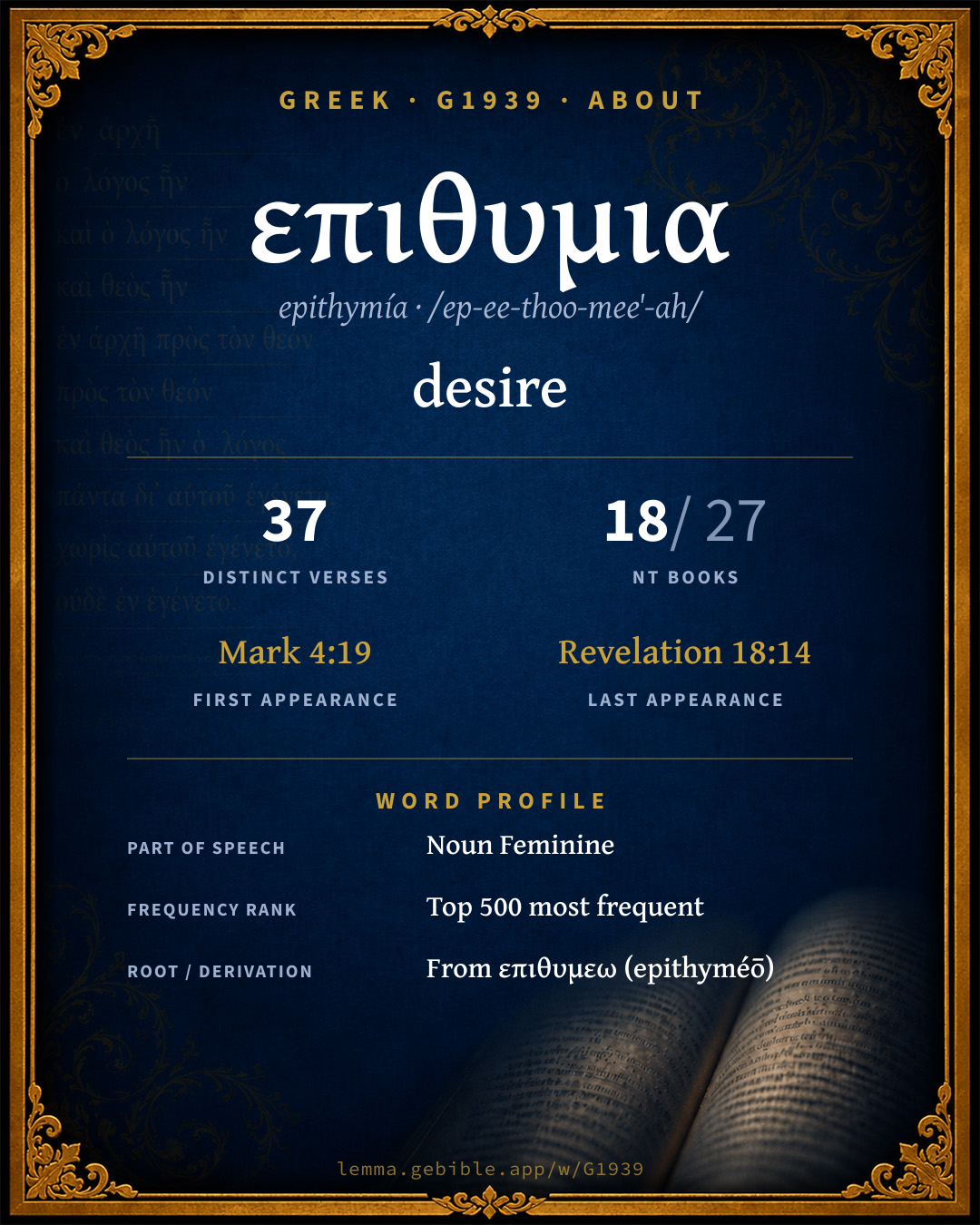
ἐπιθυμία
desire
Full lexicon entry — Thayer's Greek Lexicon
From Thayer's Greek Lexicon
Where this word appears
See every Dative-case word in the Greek New Testament →
Grammar key — what these labels mean
Part of speech
- Noun
- A naming word — a person, place, thing, or idea.
Case
- Accusative
- The case of the direct object and of extent.
- Dative
- The case of the indirect object, means, or location — “to / for / with / in.”
- Nominative
- The case of the subject (and the predicate nominative).
- Genitive
- The case of source, possession, or “of” — answers “whose / from what.”
Gender
- Feminine
- Grammatically feminine.
Number
- Plural
- More than one.
- Singular
- One.
3 verses where G1939 appears in the Dative case in the Book of 2 Peter. Filtered view — show all forms. Click any verse to open its interlinear word-by-word view. Verse text shown in the World English Bible for context — . Each verse’s Greek form is shown with its reference; the English is not keyword-highlighted, since the data carries no word-level English alignment. Use “Compare translations” on any verse to read it across multiple English versions. This concordance covers the Greek New Testament; Septuagint (Greek Old Testament) occurrences of this word are not indexed here.
2 Peter
- 2 Peter 1:4 ἐπιθυμίᾳ n dat sg fem by which he has granted to us his precious and exceedingly great promises; that through these you may become partakers of the divine nature, having escaped from the corruption that is in the world by lust.
- 2 Peter 2:10 ἐπιθυμίᾳ n dat sg fem but chiefly those who walk after the flesh in the lust of defilement, and despise authority. Daring, self-willed, they are not afraid to speak evil of dignitaries;
- 2 Peter 2:18 ἐπιθυμίαις n dat pl fem For, uttering great swelling words of emptiness, they entice in the lusts of the flesh, by licentiousness, those who are indeed escaping from those who live in error;
About this entry
At a glance — auto-summarized from this page’s data, not written by a person. Every figure links to its source below. This summary describes the numbers; it doesn’t interpret them.
At its core, επιθυμια (epithymía) means “desire.” Where the King James Version says “lusts,” newer translations reach for “desires” (Berean Standard Bible); the renderings breakdown has the detail. It appears 37 verses across 18 books of the Greek New Testament, among its moderately common vocabulary. First canonically at Mark 4:19, it enters the text early. It shares a root with επιθυμεω and επιθυμητης. Each statement above links to its evidence; the full detail follows below.
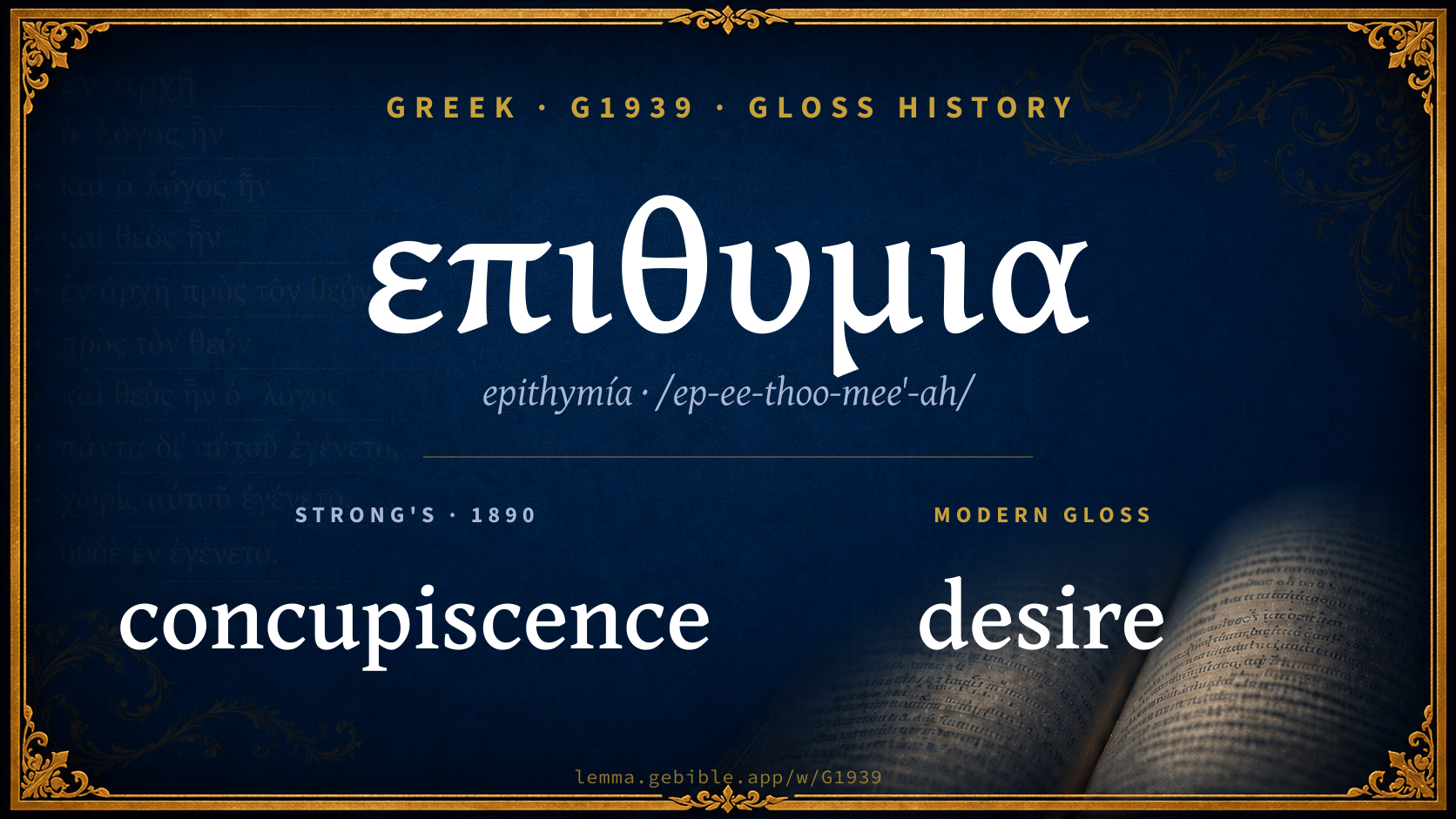
Gloss history
Strong's 1890 vs modern scholarship
About this word
Strong's G1939 catalogs a Greek word from the Greek New Testament.
These counts are not copied from any lexicon or concordance. They are computed here, from the morphology-tagged Greek New Testament. What Lemma adds →
- 37
- distinct verses
- The word appears in 37 distinct verses.
- 18 / 27
- NT books
- The word appears in 18 of 27 New Testament books.
- #392
- by frequency
- Top 500 most frequent Greek words (rank 392 of 5,347 Greek words by occurrence).
View all 37 occurrences in the concordance →
By section of the New Testament
By traditional corpus
Conventional, traditional groupings — biblical authorship is debated, so this is a traditional corpus grouping, not an authorship claim. Some books belong to more than one corpus (Luke is in both the Gospels and the Lukan corpus, and so on), so these shares overlap and need not total 100%. Each figure is a share of the word’s 37 distinct verses.
- Pauline corpus 19 verses · 51%
- General (Catholic) Epistles 14 verses · 38%
- Johannine 4 verses · 11%
- Gospels 3 verses · 8%
- Lukan (Luke–Acts) 1 verse · 3%
- Revelation 1 verse · 3%
How translations render this word
Counts come from each version’s own published word-to-Strong’s tagging or interlinear alignment — an approximate guide to how each version renders this word, not a word-level alignment the data otherwise carries. Because each total is that version’s own tagged count, the per-version totals vary from one another and need not match the appearance or distinct-verse counts above. These counts may also differ from a printed concordance because Lemma counts each distinctly tagged rendering and does not collapse phrase taggings into a single head-word total. This is a fixed set of word-tagged versions (KJV, ASV, BSB, ULT) and does not change with the reading translation you choose elsewhere. Each version’s license is shown beside its name below (and on Sources).
- King James Version: Lusts 21×, Lust 9×, Concupiscence 3×
- American Standard Version: Lusts 18×, Lust 9×, Desire 3×
- Berean Standard Bible: Desires 17×, Passions 6×, Desire 4×
- unfoldingWord Literal Text: Desires 12×, Lusts 9×, Desire 8×
King James Version Public Domain
Renders G1939 across 38 tagged occurrences — most commonly:
Plus 2 renderings that appear only once — usually multi-word phrases or single function words the recovered tagging swept in, not distinct renderings.
American Standard Version Public Domain
Renders G1939 across 35 tagged occurrences — most commonly:
Plus 5 renderings that appear only once — usually multi-word phrases or single function words the recovered tagging swept in, not distinct renderings.
Berean Standard Bible Public Domain
Renders G1939 across 37 tagged occurrences — most commonly:
Plus 7 renderings that appear only once — usually multi-word phrases or single function words the recovered tagging swept in, not distinct renderings.
unfoldingWord Literal Text CC BY-SA 4.0
Renders G1939 across 41 tagged occurrences — most commonly:
Plus 4 renderings that appear only once — usually multi-word phrases or single function words the recovered tagging swept in, not distinct renderings.
Senses in Thayer's
The 1 sense Thayer's distinguishes for this word, in lexicon order (not ranked by frequency or importance). The full entry — with sub-senses — is in the Lexicon Entry tab.
- desire, craving, longing, desire for what is forbidden, lust
Word origin
Derived from επιθυμεω (epithyméō) (G1937) — to desire.
From G1937 ; a longing (especially for what is forbidden): - concupiscence desire lust (after).
— Strong’s Exhaustive Concordance (1890), public domain.
Forms in the corpus
The 7 distinct written forms G1939 takes in the Greek New Testament, most frequent first — each parse links to that case’s occurrences in the concordance.
| Form | Parsing | Example | Uses |
|---|---|---|---|
| ἐπιθυμίας epithymías | Noun, Accusative, Plural, Feminine | John 8:44 | 13 |
| ἐπιθυμίαις epithymíais | Noun, Dative, Plural, Feminine | Romans 1:24 | 10 |
| ἐπιθυμίαν epithymían | Noun, Accusative, Singular, Feminine | Romans 7:7 | 5 |
| ἐπιθυμία epithymía | Noun, Nominative, Singular, Feminine | James 1:15 | 4 |
| ἐπιθυμίᾳ epithymía | Noun, Dative, Singular, Feminine | Luke 22:15 | 4 |
| ἐπιθυμίαι epithymíai | Noun, Nominative, Plural, Feminine | Mark 4:19 | 1 |
| ἐπιθυμιῶν epithymiō̂n | Noun, Genitive, Plural, Feminine | 1 Peter 2:11 | 1 |
Same root — word family
Other Thayer's entries built from the same root as G1939, grouped by Strong’s listed origin. These share a root / origin per the lexicon — not necessarily a shared meaning. Each links to that word’s own entry.
Derives from
Shares the same root
Compare all same-root words → They share a root, not necessarily a meaning.
Septuagint usage
The same Greek word επιθυμια appears 38 times in the Greek Old Testament (Septuagint), across 38 verses in 10 books.
- 38
- LXX occurrences
- Tagged occurrences of this Greek word in the Septuagint.
- 38
- verses
- Distinct Septuagint verses containing this word.
- 10 / 39
- OT books
- The word appears in 10 of the 39 Old Testament books.
Sample Septuagint occurrences
- Genesis 31:30 ἐπιθυμία
- Numbers 11:4 ἐπιθυμία
- Deuteronomy 9:22 ἐπιθυμία
- 2 Chronicles 8:6 ἐπιθυμία
- Job 20:20 ἐπιθυμία
- Psalms 9:24 ἐπιθυμία
- Proverbs 6:25 ἐπιθυμία
- Song of Solomon 5:16 ἐπιθυμία
- Jeremiah 2:24 ἐπιθυμία
- Daniel 10:3 ἐπιθυμία
Septuagint occurrences (same lexeme)
Every verse where the same Strong’s number (G1939) appears in the Greek Septuagint. Verse text shown in the World English Bible for context; the Greek form is the matched word — the English is not keyword-highlighted.
- Genesis 31:30 ἐπιθυμία Now, you want to be gone, because you sore longed after your father's house, but why have you stolen my gods?"
- Genesis 49:6 ἐπιθυμία My soul, don't come into their council; My glory, don't be united to their assembly; For in their anger they killed a man, In their self-will they hamstrung an ox.
- Numbers 11:4 ἐπιθυμία The mixed multitude that was among them lusted exceedingly: and the children of Israel also wept again, and said, Who shall give us flesh to eat?
- Numbers 11:34 ἐπιθυμία The name of that place was called Kibrothhattaavah, because there they buried the people who lusted.
- Numbers 11:35 ἐπιθυμία From Kibrothhattaavah the people traveled to Hazeroth; and they abode at Hazeroth.
- Numbers 33:16 ἐπιθυμία They traveled from the wilderness of Sinai, and encamped in Kibroth-hattaavah.
- Numbers 33:17 ἐπιθυμία They traveled from Kibroth-hattaavah, and encamped in Hazeroth.
- Deuteronomy 9:22 ἐπιθυμία At Taberah, and at Massah, and at Kibroth-hattaavah, you provoked Yahweh to wrath.
- Deuteronomy 12:15 ἐπιθυμία Notwithstanding, you may kill and eat flesh within all your gates, after all the desire of your soul, according to the blessing of Yahweh your God which he has given you: the unclean and the clean may eat of it, as of the gazelle, and as of the hart.
- Deuteronomy 12:20 ἐπιθυμία When Yahweh your God shall enlarge your border, as he has promised you, and you shall say, I will eat flesh, because your soul desires to eat flesh; you may eat flesh, after all the desire of your soul.
- Deuteronomy 12:21 ἐπιθυμία If the place which Yahweh your God shall choose, to put his name there, be too far from you, then you shall kill of your herd and of your flock, which Yahweh has given you, as I have commanded you; and you may eat within your gates, after all the desire of your soul.
- 2 Chronicles 8:6 ἐπιθυμία and Baalath, and all the store-cities that Solomon had, and all the cities for his chariots, and the cities for his horsemen, and all that Solomon desired to build for his pleasure in Jerusalem, and in Lebanon, and in all the land of his dominion.
- Job 20:20 ἐπιθυμία "Because he knew no quietness within him, He shall not save anything of that in which he delights.
- Psalms 9:24 ἐπιθυμία
- Psalms 9:38 ἐπιθυμία
- Psalms 20:3 ἐπιθυμία Remember all your offerings, And accept your burnt sacrifice. Selah.
- Psalms 37:10 ἐπιθυμία For yet a little while, and the wicked will be no more. Yes, though you look for his place, he isn't there.
- Psalms 77:29 ἐπιθυμία
- Psalms 77:30 ἐπιθυμία
- Psalms 102:5 ἐπιθυμία By reason of the voice of my groaning, My bones stick to my skin.
- Psalms 105:14 ἐπιθυμία He allowed no one to do them wrong. Yes, he reproved kings for their sakes,
- Psalms 111:10 ἐπιθυμία The fear of Yahweh is the beginning of wisdom. All those who do his work have a good understanding. His praise endures forever!
- Psalms 126:5 ἐπιθυμία Those who sow in tears will reap in joy.
- Psalms 139:9 ἐπιθυμία If I take the wings of the dawn, And settle in the uttermost parts of the sea;
- Proverbs 6:25 ἐπιθυμία Don't lust after her beauty in your heart, Neither let her captivate you with her eyelids.
- Proverbs 10:24 ἐπιθυμία What the wicked fear, will overtake them, But the desire of the righteous will be granted.
- Proverbs 11:23 ἐπιθυμία The desire of the righteous is only good. The expectation of the wicked is wrath.
- Proverbs 12:12 ἐπιθυμία The wicked desires the plunder of evil men, But the root of the righteous flourishes.
- Proverbs 13:4 ἐπιθυμία The soul of the sluggard desires, and has nothing, But the desire of the diligent shall be fully satisfied.
- Proverbs 13:12 ἐπιθυμία Hope deferred makes the heart sick, But when longing is fulfilled, it is a tree of life.
- Proverbs 13:19 ἐπιθυμία Longing fulfilled is sweet to the soul, But fools detest turning from evil.
- Proverbs 21:25 ἐπιθυμία The desire of the sluggard kills him, For his hands refuse to labor.
- Proverbs 21:26 ἐπιθυμία There are those who covet greedily all the day long; But the righteous give and don't withhold.
- Song of Solomon 5:16 ἐπιθυμία His mouth is sweetness; Yes, he is altogether lovely. This is my beloved, and this is my friend, Daughters of Jerusalem. Friends
- Jeremiah 2:24 ἐπιθυμία a wild donkey used to the wilderness, that snuffs up the wind in her desire; in her occasion who can turn her away? all those who seek her will not weary themselves; in her month they shall find her.
- Daniel 10:3 ἐπιθυμία I ate no pleasant bread, neither came flesh nor wine into my mouth, neither did I anoint myself at all, until three whole weeks were fulfilled.
- Daniel 11:37 ἐπιθυμία Neither shall he regard the gods of his fathers, nor the desire of women, nor regard any god; for he shall magnify himself above all.
- Daniel 11:43 ἐπιθυμία But he shall have power over the treasures of gold and of silver, and over all the precious things of Egypt; and the Libyans and the Ethiopians shall be at his steps.
These are occurrences of the same Greek lexeme (G1939) in the Septuagint — not a translation of any one Hebrew word. The store carries no word-level Hebrew↔Greek alignment, so no Hebrew original is asserted here. Counts come from the recovered LXX Strong's tagging — high-frequency vocabulary is well covered, while rare or late forms may be untagged — so they reflect tagged occurrences and may slightly undercount.