
Psalms 102:5

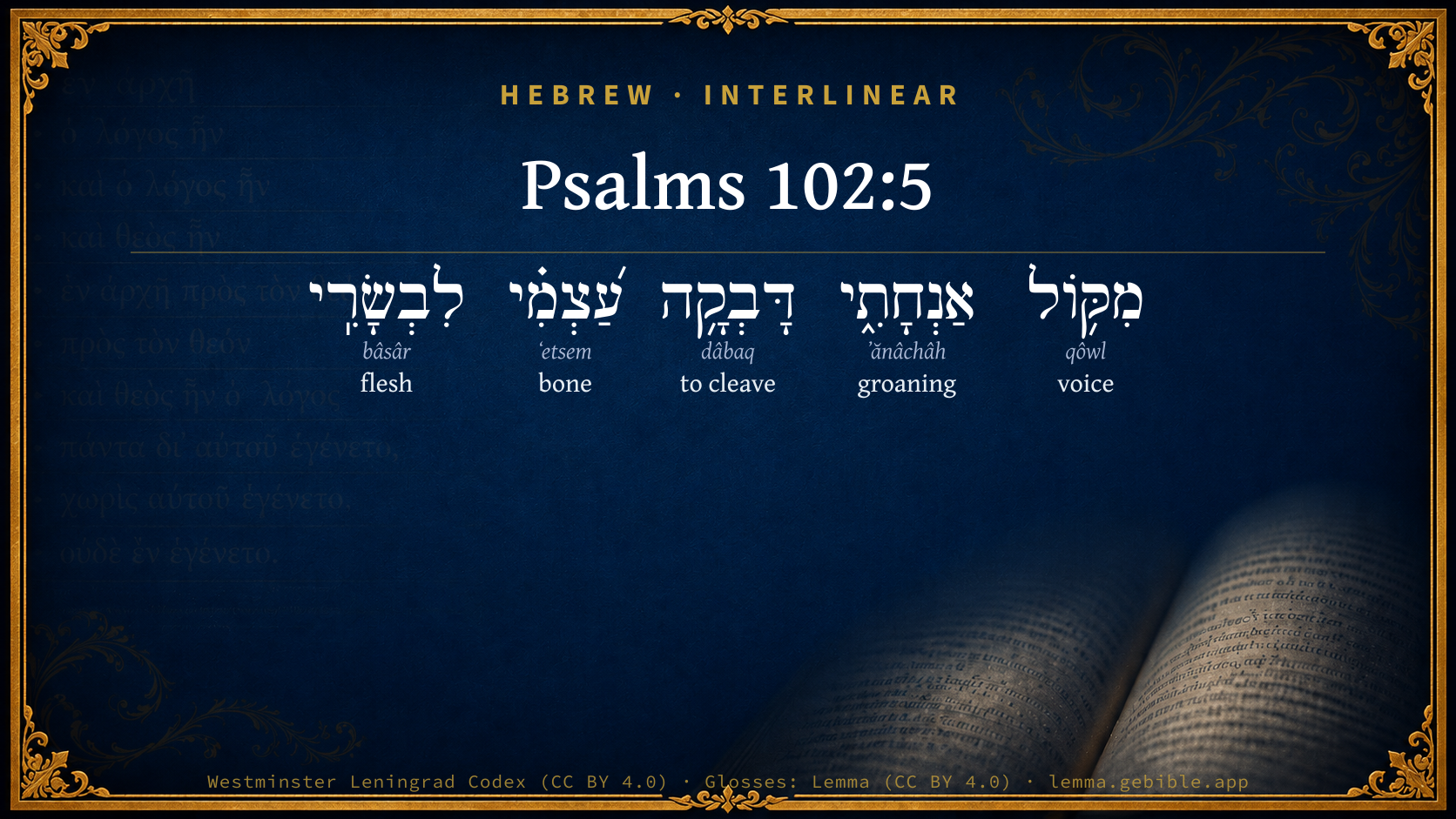
Hebrew (Westminster Leningrad Codex) Psalms 102:5 appears in the Hebrew Old Testament. The text above is from the Westminster Leningrad Codex. Each word links to its Strong’s number, a concise gloss, and parsing drawn from the Open Scriptures Hebrew Bible morphology. Click any word for its full Brown-Driver-Briggs (BDB) entry.
Download image
Cite this verse

Psalms 102:5 (World English Bible). Public Domain. Lemma interlinear Bible study tool, https://lemma.gebible.app/v/psalms/102/5.

Show BibTeX & RIS
BibTeX
RIS
English Translation
By reason of the voice of my groaning, My bones stick to my skin.
World English Bible · Public Domain
Download a study sheet

One document with this verse’s original text, its word-by-word gloss line, the meaning frame, cross-references with their text, attributed commentary, and full source and license credits — printable, and it pastes into notes with its structure intact.

This verse Autodidact and up

Study sheet (.html) Plain text (.txt)

A passage Seminary Student

Up to 50 verses in one chapter. A passage sheet keeps up to 6 commentary sources and 12 cross-references per verse, in the order this page ranks them, and says so on the sheet whenever that leaves anything out. Ask for a single verse and you get the Autodidact verse sheet above.

Everything on this page stays free to read, with no account — the sheet is a download of what is already on screen, not access to it.

Want to remove ads? Support Godless Engineer
Compare translations 3

The same verse in 3 English versions, stacked beneath the original-language interlinear above. Click any original word for its lexicon entry.

Each is an independent rendering of the whole verse — the interlinear is not word-aligned to these translations.

Highlighted words mark where these versions differ — a whole-verse word diff, not a word-by-word alignment.

  • World English Bible Public Domain
    By reason of the voice of my groaning, My bones stick to my skin.
  • King James Version Public Domain
    By reason of the voice of my groaning my bones cleave to my skin.
  • unfoldingWord Literal Text CC BY-SA 4.0
    From the voice of my groaning, my bone clings to my flesh.

unfoldingWord Literal Text — © unfoldingWord, licensed CC BY-SA 4.0. Word-aligned USFM3 via Door43 (git.door43.org/unfoldingWord/en_ult).

Versions to compare (up to 4)

3 of 4 selected

Show all 18 translations

Every available English version of this verse, each an independent rendering of the whole verse.

  • World English Bible Public Domain
    By reason of the voice of my groaning, My bones stick to my skin.
  • Berean Standard Bible Public Domain
    Through my loud groaning my flesh clings to my bones.
  • Majority Standard Bible Public Domain
    Through my loud groaning my skin hangs on my bones.
  • King James Version Public Domain
    By reason of the voice of my groaning my bones cleave to my skin.
  • American Standard Version (1901) Public Domain
    By reason of the voice of my groaning My bones cleave to my flesh.
  • Revised Version (1885) Public Domain
    By reason of the voice of my groaning my bones cleave to my flesh.
  • Geneva Bible (1599) Public Domain
    For the voyce of my groning my bones doe cleaue to my skinne.
  • Douay-Rheims (1899) Public Domain
    I am smitten as grass, and my heart is withered: because I forgot to eat my bread.
  • Young's Literal Translation Public Domain
    From the voice of my sighing Hath my bone cleaved to my flesh.
  • Literal Standard Version CC BY-SA 4.0
    From the voice of my sighing || My bone has cleaved to my flesh.
  • Unlocked Literal Bible CC BY-SA 4.0
    With my continual groaning, I have become very thin.
  • unfoldingWord Literal Text CC BY-SA 4.0
    From the voice of my groaning, my bone clings to my flesh.
  • Darby Bible Public Domain
    By reason of the voice of my groaning, my bones cleave to my flesh.
  • World Messianic Bible Public Domain
    By reason of the voice of my groaning, my bones stick to my skin.
  • Webster's Bible Public Domain
    \\102:4\\My heart is smitten, and withered like grass; so that I forget to eat my bread.
  • Free Bible Version CC BY-SA 4.0
    All my groaning has worn me out; my bones show through my skin.
  • Bible in Basic English Public Domain
    Because of the voice of my sorrow, my flesh is wasted to the bone.
  • JPS Tanakh (1917) Public Domain
    (102-6) By reason of the voice of my sighing my bones cleave to my flesh.

Literal Standard Version (2020), Covenant Press — licensed CC BY-SA 4.0. Text via the HelloAO Bible API (eBible.org). Unlocked Literal Bible (unfoldingWord) — licensed CC BY-SA 4.0. Text via the HelloAO Bible API (eBible.org). unfoldingWord Literal Text — © unfoldingWord, licensed CC BY-SA 4.0. Word-aligned USFM3 via Door43 (git.door43.org/unfoldingWord/en_ult). Free Bible Version, Dr. Jonathan Gallagher — licensed CC BY-SA 4.0. Text via the HelloAO Bible API (eBible.org).

Word by word

More ways to search: Search by grammar → Find every occurrence → Compare this word →

Practice this passage: Drill this verse → Learn its vocabulary →

About this verse

These counts appear in no published source. They are computed here, from the morphology-tagged text and Lemma’s own curated glosses. What Lemma adds →

5
words
5
distinct lemmas
Wisdom
section

Notable vocabulary

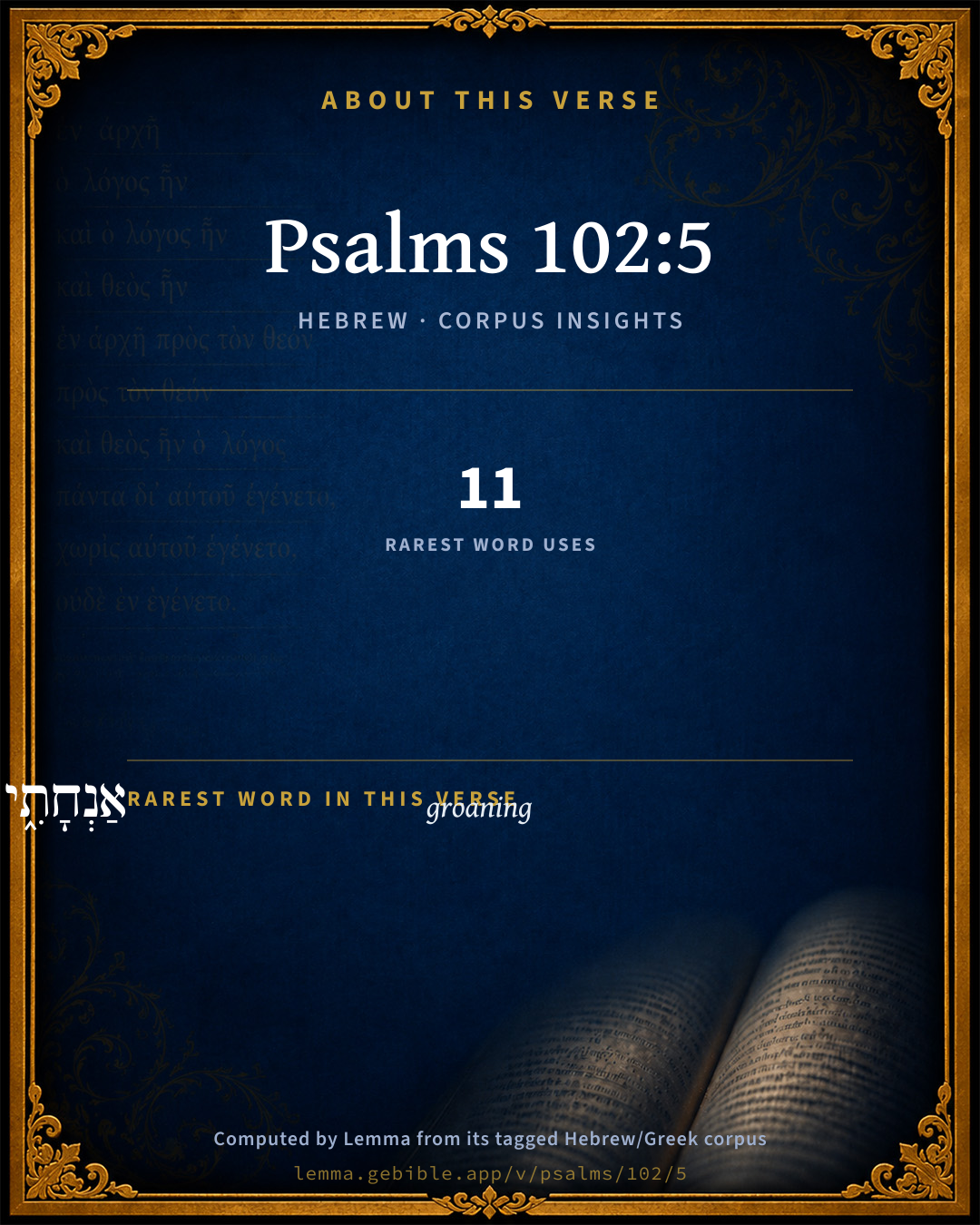
The rarest word here is אַנְחָתִ֑י groaning H585 — appearing just 11 times in the whole Hebrew Bible.

Shared distinctive vocabulary

אַנְחָתִ֑י groaning H585 occurs in 11 verses of the Hebrew Bible. Also found in:

Grammatical profile

  • 1 verb
  • 4 nouns

Verb forms

  • דָּבְקָ֥ה Qal · Perfect

Hebrew & Septuagint length

In English translation the verse runs 14 words from the Hebrew and 15 from the Septuagint (LXX English) — closely comparable.

A rough comparison of the two English renderings, which tokenize alike — not a word-level alignment.

Word counts can differ between the Hebrew and the Greek without any difference in meaning — e.g. the Hebrew direct-object marker אֵת has no separate Greek word, and Greek often adds the article ὁ.

Cross-references

7

Topical passages linked to Psalms 102:5 in the Treasury of Scripture Knowledge — connected by theme and wording, ordered by reader-vote popularity; previews shown in the World English Bible.

  • Job 19:20 My bones stick to my skin and to my flesh. I have escaped by the skin of my teeth.
  • Proverbs 17:22 A cheerful heart makes good medicine, But a crushed spirit dries up the bones.
  • Lamentations 4:8 Their visage is blacker than a coal; they are not known in the streets: Their skin cleaves to their bones; it is withered, it is become like a stick.
  • Psalms 6:8 Depart from me, all you workers of iniquity, For Yahweh has heard the voice of my weeping.
  • Psalms 32:3–4 When I kept silence, my bones wasted away through my groaning all day long.
  • Psalms 6:6 I am weary with my groaning; Every night I flood my bed; I drench my couch with my tears.
  • Psalms 38:8–10 I am faint and severely bruised. I have groaned by reason of the anguish of my heart.

Cross-references courtesy of OpenBible.info (CC BY 4.0).

Hebrew and Greek witnesses Masoretic Hebrew ↔ Greek Septuagint

The same verse in the two great witnesses to the Old Testament, shown verse-for-verse.

You’re reading Greek Psalm 101 (Hebrew Psalm 102). The Septuagint counts the superscription, so verse numbers can differ from the Hebrew — chapter-level alignment, not verse-by-verse. Numbering follows Rahlfs.

These are two independent witnesses, not word-aligned to each other, and the Septuagint is shown in lemma (dictionary) form.

Hebrew Psalms 102:5 Masoretic · Westminster Leningrad Codex

מִקּ֥וֹל אַנְחָתִ֑י דָּבְקָ֥ה עַ֝צְמִ֗י לִבְשָׂרִֽי

By reason of the voice of my groaning, My bones stick to my skin.

World English Bible · Public Domain

Greek LXX Greek Psalm 101:5 Septuagint · lemma form

πληγή ὡσεί χόρτος καί ξηραίνω ὁ καρδία ἐγώ ὅτι ἐπιλανθάνω ὁ ἐσθίω ὁ ἄρτος ἐγώ

By reason of the voice of my groaning, my bone has cleaved to my flesh.

LXX2012 (modern English Septuagint) · Public Domain

Hebrew: Westminster Leningrad Codex (CC BY 4.0). Greek: Septuagint (public domain); English from LXX2012 (modern English Septuagint) (Public Domain). How the Septuagint differs from the Hebrew →

Commentary

Notes on Psalms 102:5 from classic Christian and Jewish commentators (each source and its license shown beneath its notes). The classic Christian expositions comment on the surrounding passage and are grouped to its opening verse, so a note may address several verses; the Jewish commentaries on the Tanakh (Rashi and others) are per-verse, so they appear only where the commentator wrote on this verse.

Lemma curates 59 commentaries, every one of them public domain or Creative Commons licensed, each selected and text-cleaned for this edition rather than reprinted as found. About our sources →

John Gill's Exposition

I am like a pelican of the wilderness,.... It may be so called, to distinguish it from another of the same name that lives upon the waters; which has the name of "pelican" in the Greek tongue, as is said, from its smiting and piercing its breast, and letting out blood for the reviving of its young; and in the Hebrew language, from its vomiting shell fish it has swallowed down; See Gill on Lev 11:18 where the word is rendered a "pelican" as here, and in Deu 14:17, the same we call the "shovelard"; but a "cormorant" in Isa 34:11, however, it seems to be a bird of solitude, and therefore the psalmist compares himself to it. According to Isidore (g), it is an Egyptian bird, that inhabits the desert of the river Nile, from whence it has the name of Canopus Aegyptus:

I am like an owl of the desert; or "of desert places"; so the Tigurine version; it is translated "the little owl" in Lev 11:17. It delights to be on old walls, and in ruined houses, and cares not to consort with other birds, and it makes a hideous sorrowful noise (h). Jarchi renders it the hawk, but that, as Kimchi (i) observes, is found in habitable places. Bochart (k) thinks the "onocrotalos" is meant, a bird so much of the same kind with the pelican, that they are promiscuously used by learned men; and which is a creature, as Jerom (l) says, that is used to dwell in desert places; and Isidore (m) observes, that there are two sorts of them, one that lives in the water, and another in the desert; it has its name from its braying like an ass; and Aelianus (n) speaks of a bird of this sort in India, which has a large crop like a sack; and the Hebrew word "cos" here used signifies a cup or vessel, from whence it may have its name; and which he says makes a very disagreeable noise, to which the psalmist may compare the voice of his groaning, Psa 102:5.

(g) Origin. l. 12. c. 7. (h) "Solaque culminibus ferali carmine Bubo, saepe queri----", Virgil. Aeneid. 4. (i) Sepher Shorash. rad. (k) Hierozoic. par. 2. l. 2. c. 20. col. 275, 276. (l) Comment. in Esaiam, c. 34. fol. 64. A. (m) Ut supra. (Origin. l. 12. c. 7.) (n) De Animal. l. 16. c. 4.

John Gill's Exposition of the Whole Bible (1746–1763) — public domain (CC PDM 1.0). Text via the HelloAO Bible API.

Trapp's Complete Commentary

John Trapp

Psa 102:5 By reason of the voice of my groaning my bones cleave to my skin.

Ver. 5. By reason of the voice of my groaning] A broken spirit drieth the bones, Pro 17:22, and, by drinking up the marrow and radical moisture, casteth all into a consumption.

John Trapp, A Commentary or Exposition upon All the Books of the Old and New Testament (1647–1656) — public domain. Text from a community e-Sword module.

J. A. Alexander on Psalms

Joseph Addison Alexander

6. (Psa 102:5) From the voice of my groaning, my hone cleaves to my flesh. The word voice implies an audible and loud expression of distress. The first clause means, in consequence of the agony which makes me groan. My bone may signify each of my bones, or be used collectively for the whole skeleton or framework of the body. The only natural explanation of this clause is that it describes emaciation, as a consequence and symptom of extreme distress. See above, on Psa 22:14; Psa 22:17.

Joseph Addison Alexander, The Psalms Translated and Explained (1850) — public domain. Text from a community e-Sword module.

Tyndale Open Study Notes

Tyndale Open Resources

102:5 skin and bones: The psalmist has wasted away because of his anguish (see 102:9; 109:24).

Tyndale Open Study Notes — © Tyndale Open Resources, licensed CC BY-SA 4.0. Text via the HelloAO Bible API.

Ellicott's Commentary for English Readers

(5) Skin.—See margin. In Lam_4:8, more correctly, “my skin cleaveth to my bones;” a picture of emaciation, the result of fasting.

A Bible Commentary for English Readers, edited by Charles John Ellicott (1878–1897) — public domain. Text from a community e-Sword module.

The Cambridge Bible for Schools and Colleges

gen. ed. J. J. S. Perowne

5. If the A.V. is retained, the verse will describe the state of emaciation to which he has been reduced by continued sorrow. Cp. Lam_4:8. But though the cognate Arabic word means skin, it is doubtful whether the Heb. word bâsâr can bear this sense. Usage requires the rendering of R.V., ‘my bones cleave to my flesh,’ which means apparently that his limbs are swollen and stiff. The phrase seems to be borrowed from Job_19:20, “my bone cleaveth to my skin and to my flesh,” where Job describes his limbs as partly emaciated, partly abnormally swollen, and stiff with disease. The curious rendering of the P.B.V. “my bones [Coverdale, bone] will scarce cleave to my flesh,” comes from the Zürich Version:—“Vor geschrey mines seufftzens mag mein gebeyn kum an meinem fleysch hangen.”

The Cambridge Bible for Schools and Colleges (gen. ed. J. J. S. Perowne; Cambridge University Press, 1878–1918) — public domain. Text from a community e-Sword module.

Albert Barnes' Notes on the Bible

By reason of the voice of my groaning - By suffering and trouble, so great as to produce groaning, my flesh is wasted away.

My bones cleave to my skin - Margin, “flesh.” The Hebrew word means “flesh.” The effect described is that of a wasting away or an emaciation of flesh from deep distress, so that the bones became prominent, and had nothing to hide them from view; so that they seemed to adhere fast to the flesh itself. See the notes at Job 19:20.

Albert Barnes' Notes on the Bible (1834–1885) — public domain. Text from a community e-Sword/MySword module.

Matthew Poole's English Annotations

My flesh being quite consumed with excessive sorrows.

Matthew Poole's English Annotations on the Holy Bible (1683–1685) — public domain. Text from a community e-Sword/MySword module.

The Treasury of David

Charles H. Spurgeon

Ver. 5. By reason of the voice of my groaning my bones cleave to my skin. He became emaciated with sorrow. He had groaned himself down to a living skeleton, and so in his bodily appearance was the more like the smoke-dried, withered, burnt-up things to which he had previously compared himself. It will be a very long time before the distresses of the church of God make some Christians shrivel into anatomies, but this good man was so moved with sympathy for Zion's ills that he was wasted down to skin and bone.

Ver. 5. My bones cleave to my skin. When the bones cleave to the skin, both are near cleaving to the dust. Joseph Caryl.

Ver. 5. That grief readily causes the body to pine away is very well known. It is related of Cardinal Wolsey, by an eye-witness, that when he heard that his master's favour was turned from him, he was wrung with such an agony of grief, which continued a whole night, that in the morning his face was dwindled away into half its usual dimensions.

Psalms 102:6*

Charles H. Spurgeon's The Treasury of David (1869–1885) — public domain. Psalms only. Text from a community e-Sword/MySword module.

Whedon's Commentary on the Bible

Daniel D. Whedon

5. Bones cleave to my skin—From emaciation. Job_19:2; Lam_4:8.

Daniel D. Whedon (gen. ed.), Commentary on the Old and New Testaments (1874–1909) — public domain. Text from a community e-Sword module.

The Pulpit Commentary

By reason of the voice of my groaning; i.e. "by reason of the affliction which causes my groaning." My bones cleave to my skin; literally, to my flesh, but the Authorized Version rightly expresses the meaning. (comp. Job_19:20 Lam_4:8)

The Pulpit Commentary (1880–1919), ed. H.D.M. Spence-Jones & Joseph S. Exell — public domain. Text from a community e-Sword module.

John Wesley's Explanatory Notes

Skin - My flesh being quite consumed.

John Wesley, Explanatory Notes Upon the Whole Bible (1754–1765) — public domain. Text via the GEBible commentary corpus.

unfoldingWord translationNotes

Door43 World Missions Community

I am like a pelican of the wilderness

He compares his loneliness to that of a pelican, which is often seem alone instead of with other birds. AT: "I am lonely and despised like a pelican in the wilderness" (See: Simile)

a pelican

a large fish-eating bird

I have become like an owl in the ruins

The author continues to describe loneliness by comparing himself to an owl in abandoned ruins. AT: "I have become alone like an owl in abandoned ruins" (See: Simile)

an owl

This is a bird that is awake at night. AT: "a night bird"

translationWords

groan

desert

ruin

unfoldingWord translationNotes — © Distant Shores Media and the Door43 World Missions Community, licensed CC BY-SA 4.0. Source: git.door43.org/Door43/en_tn.

Lesson kit

Teaching starters — assembled from the data on this page, not authored interpretation. Every prompt links to the verse data it draws on. Edit before teaching.

Psalms, in the Wisdom, opens this verse with 5 words (5 distinct Hebrew lemmas). Its most distinctive word is ʼănâchâh (“groaning”). A historical commentator’s framing appears above. Read the whole chapter for the surrounding context.

Discussion questions

  1. What does “groaning” (ʼănâchâh) contribute to the verse as a whole?
  2. Job 3:24 shares the word «groaning» with this verse. How do the two illuminate each other?
  3. The translations on this page render this verse differently — a whole-verse word diff, not a word-by-word alignment. What might account for the different wordings?
  4. The verb «דָּבְקָ֥ה» is Qal Perfect. How does its form color the action?
  5. Reading how John Gill's Exposition and Trapp's Complete Commentary read this verse, where do the two commentators agree and where do they part?

Things to notice

Reading settings

Reading text

Shown beneath each verse's original-language words.

Old Testament
Old Testament edition

Read the OT as the Masoretic Hebrew (MT) or the Greek Septuagint (LXX).

English shown for the Greek Septuagint (in the Hebrew ↔ Greek comparison).

Comparing translations? Open the Compare panel on any verse page to stack up to four side by side.