

Proverbs 21:26

Hebrew (Westminster Leningrad Codex) Proverbs 21:26 appears in the Hebrew Old Testament. The text above is from the Westminster Leningrad Codex. Each word links to its Strong’s number, a concise gloss, and parsing drawn from the Open Scriptures Hebrew Bible morphology. Click any word for its full Brown-Driver-Briggs (BDB) entry.
Download image
Cite this verse

Proverbs 21:26 (World English Bible). Public Domain. Lemma interlinear Bible study tool, https://lemma.gebible.app/v/proverbs/21/26.

Show BibTeX & RIS
BibTeX
RIS
English Translation
There are those who covet greedily all the day long; But the righteous give and don't withhold.
World English Bible · Public Domain
Download a study sheet

One document with this verse’s original text, its word-by-word gloss line, the meaning frame, cross-references with their text, attributed commentary, and full source and license credits — printable, and it pastes into notes with its structure intact.

This verse Autodidact and up

Study sheet (.html) Plain text (.txt)

A passage Seminary Student

Up to 50 verses in one chapter. A passage sheet keeps up to 6 commentary sources and 12 cross-references per verse, in the order this page ranks them, and says so on the sheet whenever that leaves anything out. Ask for a single verse and you get the Autodidact verse sheet above.

Everything on this page stays free to read, with no account — the sheet is a download of what is already on screen, not access to it.

Want to remove ads? Support Godless Engineer
Compare translations 3

The same verse in 3 English versions, stacked beneath the original-language interlinear above. Click any original word for its lexicon entry.

Each is an independent rendering of the whole verse — the interlinear is not word-aligned to these translations.

Highlighted words mark where these versions differ — a whole-verse word diff, not a word-by-word alignment.

  • World English Bible Public Domain
    There are those who covet greedily all the day long; But the righteous give and don't withhold.
  • King James Version Public Domain
    He coveteth greedily all the day long: but the righteous giveth and spareth not.
  • unfoldingWord Literal Text CC BY-SA 4.0
    All the day he desires desire for himself, but a righteous gives and does not withhold.

unfoldingWord Literal Text — © unfoldingWord, licensed CC BY-SA 4.0. Word-aligned USFM3 via Door43 (git.door43.org/unfoldingWord/en_ult).

Versions to compare (up to 4)

3 of 4 selected

Show all 18 translations

Every available English version of this verse, each an independent rendering of the whole verse.

  • World English Bible Public Domain
    There are those who covet greedily all the day long; But the righteous give and don't withhold.
  • Berean Standard Bible Public Domain
    All day long he covets more, but the righteous give without restraint.
  • Majority Standard Bible Public Domain
    All day long he covets more, but the righteous give without restraint.
  • King James Version Public Domain
    He coveteth greedily all the day long: but the righteous giveth and spareth not.
  • American Standard Version (1901) Public Domain
    There is that coveteth greedily all the day long; But the righteous giveth and withholdeth not.
  • Revised Version (1885) Public Domain
    There is that coveteth greedily all the day long: but the righteous giveth and withholdeth not.
  • Geneva Bible (1599) Public Domain
    He coueteth euermore greedily, but the righteous giueth and spareth not.
  • Douay-Rheims (1899) Public Domain
    He longeth and desireth all the day: but he that is just, will give, and will not cease.
  • Young's Literal Translation Public Domain
    All the day desiring he hath desired, And the righteous giveth and withholdeth not.
  • Literal Standard Version CC BY-SA 4.0
    All the day desiring he has desired, || And the righteous gives and does not withhold.
  • Unlocked Literal Bible CC BY-SA 4.0
    All day long he craves and craves more, but the righteous person gives and does not hold back.
  • unfoldingWord Literal Text CC BY-SA 4.0
    All the day he desires desire for himself, but a righteous gives and does not withhold.
  • Darby Bible Public Domain
    He coveteth greedily all the day long; but the righteous giveth and spareth not.
  • World Messianic Bible Public Domain
    There are those who covet greedily all day long; but the righteous give and don’t withhold.
  • Webster's Bible Public Domain
    He coveteth greedily all the day long: but the righteous giveth and spareth not.
  • Free Bible Version CC BY-SA 4.0
    Some people only want more and more all the time, but the good give generously.
  • Bible in Basic English Public Domain
    All the day the sinner goes after his desire: but the upright man gives freely, keeping nothing back.
  • JPS Tanakh (1917) Public Domain
    There is that coveteth greedily all the day long; but the righteous giveth and spareth not.

Literal Standard Version (2020), Covenant Press — licensed CC BY-SA 4.0. Text via the HelloAO Bible API (eBible.org). Unlocked Literal Bible (unfoldingWord) — licensed CC BY-SA 4.0. Text via the HelloAO Bible API (eBible.org). unfoldingWord Literal Text — © unfoldingWord, licensed CC BY-SA 4.0. Word-aligned USFM3 via Door43 (git.door43.org/unfoldingWord/en_ult). Free Bible Version, Dr. Jonathan Gallagher — licensed CC BY-SA 4.0. Text via the HelloAO Bible API (eBible.org).

Word by word

More ways to search: Search by grammar → Find every occurrence → Compare this word →

Practice this passage: Drill this verse → Learn its vocabulary →

About this verse

These counts appear in no published source. They are computed here, from the morphology-tagged text and Lemma’s own curated glosses. What Lemma adds →

8
words
8
distinct lemmas
Wisdom
section

Notable vocabulary

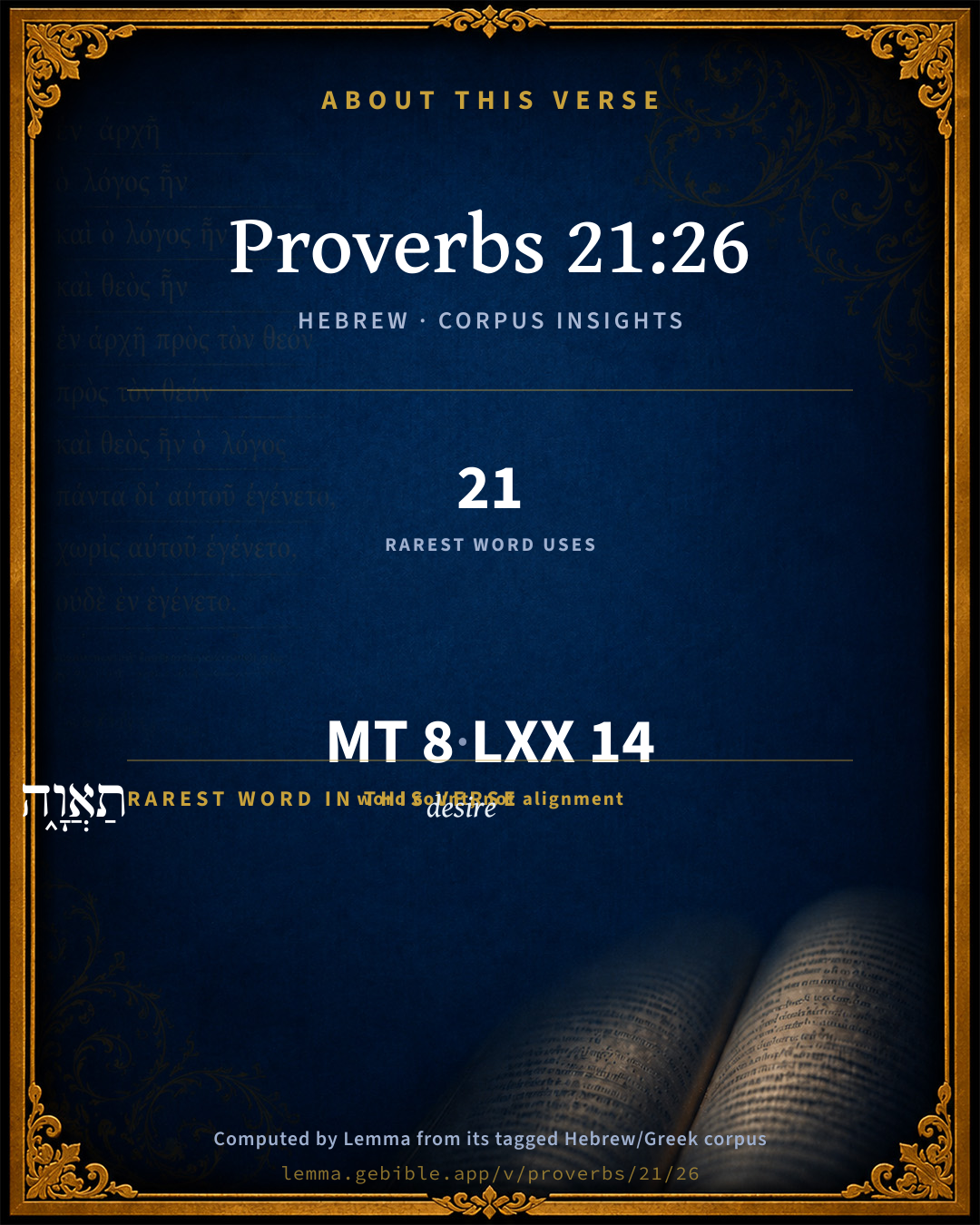
The rarest word here is תַאֲוָ֑ה desire H8378 — appearing just 21 times in the whole Hebrew Bible.

Shared distinctive vocabulary

תַאֲוָ֑ה desire H8378 occurs in 21 verses of the Hebrew Bible. Also found in:

Grammatical profile

  • 3 verbs
  • 3 nouns
  • 1 adjective
  • 1 particle

Verb forms

  • הִתְאַוָּ֣ה Hithpael · Perfect
  • יִ֝תֵּ֗ן Qal · Imperfect
  • יַחְשֹֽׂךְ Qal · Imperfect

Hebrew & Septuagint length

In English translation the verse runs 17 words from the Hebrew and 17 from the Septuagint (LXX English) — the same length.

A rough comparison of the two English renderings, which tokenize alike — not a word-level alignment.

Word counts can differ between the Hebrew and the Greek without any difference in meaning — e.g. the Hebrew direct-object marker אֵת has no separate Greek word, and Greek often adds the article ὁ.

In the original languages it is 8 Hebrew tokens and 14 Greek tokens — but the two are counted differently (Hebrew bundles its prefixes and suffixes into one token; the Greek is in lemma form), so that isn’t a like-for-like length.

Cross-references

9

Topical passages linked to Proverbs 21:26 in the Treasury of Scripture Knowledge — connected by theme and wording, ordered by reader-vote popularity; previews shown in the World English Bible.

  • Psalms 37:26 All day long he deals graciously, and lends. His seed is blessed.
  • Psalms 112:9 He has dispersed, he has given to the poor. His righteousness endures forever. His horn will be exalted with honor.
  • Acts 20:33–35 I coveted no one's silver, or gold, or clothing.
  • Ephesians 4:28 Let him who stole steal no more; but rather let him labor, working with his hands the thing that is good, that he may have something to give to him who has need.
  • Matthew 5:42 Give to him who asks you, and don't turn away him who desires to borrow from you.
  • Luke 6:30–36 Give to everyone who asks you, and don't ask him who takes away your goods to give them back again.
  • 2 Corinthians 8:7–9 But as you abound in everything, in faith, utterance, knowledge, all earnestness, and in your love to us, see that you also abound in this grace.
  • 1 Thessalonians 2:5–9 For neither were we at any time found using words of flattery, as you know, nor a cloak of covetousness (God is witness),
  • 2 Corinthians 9:9–14 As it is written, "He has scattered abroad, he has given to the poor. His righteousness remains forever."

Cross-references courtesy of OpenBible.info (CC BY 4.0).

Hebrew and Greek witnesses Masoretic Hebrew ↔ Greek Septuagint

The same verse in the two great witnesses to the Old Testament, shown verse-for-verse.

These are two independent witnesses, not word-aligned to each other, and the Septuagint is shown in lemma (dictionary) form.

Hebrew Proverbs 21:26 Masoretic · Westminster Leningrad Codex

כָּל הַ֭יּוֹם הִתְאַוָּ֣ה תַאֲוָ֑ה וְצַדִּ֥יק יִ֝תֵּ֗ן וְלֹ֣א יַחְשֹֽׂךְ

There are those who covet greedily all the day long; But the righteous give and don't withhold.

World English Bible · Public Domain

Greek LXX Proverbs 21:26 Septuagint · lemma form

ἀσεβής ἐπιθυμέω ὅλος ὁ ἡμέρα ἐπιθυμία κακός ὁ δέ δίκαιος ἐλεάω καί οἰκτείρω ἀφειδῶς

An ungodly man entertains evil desires all the day: but the righteous is unsparingly merciful and compassionate.

LXX2012 (modern English Septuagint) · Public Domain

On this verse, The Cambridge Bible for Schools and Colleges discusses the Septuagint’s reading. Read the note in Commentary ↓

Hebrew: Westminster Leningrad Codex (CC BY 4.0). Greek: Septuagint (public domain); English from LXX2012 (modern English Septuagint) (Public Domain). How the Septuagint differs from the Hebrew →

Commentary

Notes on Proverbs 21:26 from classic Christian and Jewish commentators (each source and its license shown beneath its notes). The classic Christian expositions comment on the surrounding passage and are grouped to its opening verse, so a note may address several verses; the Jewish commentaries on the Tanakh (Rashi and others) are per-verse, so they appear only where the commentator wrote on this verse.

Lemma curates 59 commentaries, every one of them public domain or Creative Commons licensed, each selected and text-cleaned for this edition rather than reprinted as found. About our sources →

Trapp's Complete Commentary

John Trapp

Pro 21:26 He coveteth greedily all the day long: but the righteous giveth and spareth not.

Ver. 26. He coveteth greedily all day long.] But these greedy constant coverings come to nothing he makes nothing of them. Meteors have matter enough in the vapours themselves to carry them above the earth, but not enough to unite them to the element of fire, therefore they fall and return to their first principles. So it is with our wishers and woulders. Many came out of Egypt, that never came into Canaan; and why? The land they liked well, but complained, with those spies, of the strength of the Anakims, and the impossibility of the conquest, therefore their carcases fell in the wilderness; their sluggishness slew them. "They lusted and had not, they killed" themselves with coveting, as in the former verse, and "desired to have," as here, "but could not obtain." {Jas 4:2}

But the righteous giveth and spareth not.] Neither necessity nor niggardice hindereth him; he hath it, and he holds that he hath no more than he giveth. He is both painful and pitiful, and what he cannot do for the poor himself, he stirs up others to do; so far is he from forbidding, or hindering any from showing mercy. Some render the words thus: The righteous giveth, and forbiddeth not. "Give a portion," saith he to his richer friend, "to seven, and also to eight, for thou knowest not what evil shall be upon the earth." {Ecc 11:2} {See Trapp on "Ecc 11:2"}

John Trapp, A Commentary or Exposition upon All the Books of the Old and New Testament (1647–1656) — public domain. Text from a community e-Sword module.

Tyndale Open Study Notes

Tyndale Open Resources

21:26 Generosity is a trait of the godly, while stinginess is characteristic of fools (29:7, 14). Paradoxically, the more you give, the more you get (11:24).

Tyndale Open Study Notes — © Tyndale Open Resources, licensed CC BY-SA 4.0. Text via the HelloAO Bible API.

Jamieson, Fausset & Brown

Robert Jamieson, A. R. Fausset & David Brown

The sin of covetousness marks the sluggard, as the virtue of benevolence the righteous.

Jamieson, Fausset & Brown — Commentary Critical and Explanatory on the Whole Bible (1871) — public domain (CC PDM 1.0). Text via the HelloAO Bible API.

Ellicott's Commentary for English Readers

(26) He coveteth greedily all the day long, that he may “consume it on his lusts” (Jas_4:3), while the righteous (Pro_21:21) gives to all who need, remembering that he is a steward (Luk_16:9), not an owner, and that blessing will attend upon him for so doing (Act_20:35).

A Bible Commentary for English Readers, edited by Charles John Ellicott (1878–1897) — public domain. Text from a community e-Sword module.

The Cambridge Bible for Schools and Colleges

gen. ed. J. J. S. Perowne

26. He coveteth] We may thus with A.V., Vulg., and others supply the subject of this clause from the preceding verse, or introduce a new subject, suggested perhaps by the preceding proverb and by contrast with the succeeding clause of this verse (ἀσεβὴς, LXX.), and so make the verse a complete proverb: There is that coveteth greedily &c.

giveth] Unlike the parched ground that covets ever, he resembles the perennial spring that gives forth unceasingly.

The Cambridge Bible for Schools and Colleges (gen. ed. J. J. S. Perowne; Cambridge University Press, 1878–1918) — public domain. Text from a community e-Sword module.

John Gill's Exposition

He coveteth greedily all the day long,.... The slothful man does, as he has nothing to do to employ his time and his thoughts with; he is always craving something to eat and drink, or wishing he had such an estate, or so much wealth and riches, that he might live as such and such persons do; and this is what his head runs upon all the day long;

but the righteous giveth and spareth not; not gives to the slothful, which does not restrain his desire, as Aben Ezra interprets it; but to the poor and necessitous, to proper objects; a good man will work with his hands, that he may have a sufficiency for himself and his family, and may have something to give to others that are in want; and "he spares not", or withholds not his hands, neither from working nor from giving.

John Gill's Exposition of the Whole Bible (1746–1763) — public domain (CC PDM 1.0). Text via the HelloAO Bible API.

Albert Barnes' Notes on the Bible

All the day long - Better, every day. The wish of the slothful man passes into restless, covetous, dissatisfied desire; the righteous, free from that desire, gives without grudging.

Albert Barnes' Notes on the Bible (1834–1885) — public domain. Text from a community e-Sword/MySword module.

Matthew Poole's English Annotations

He coveteth; the slothful man, mentioned in the last verse. But because the verses in this book are for the most part independent one upon another, this clause is and may be otherwise rendered, There is that coveteth, &c.; or, the wicked (which may be understood from the opposition of the righteous in the next clause) coveteth, &c.

All the day long; spends his whole time in vain and lazy desires, but will not labour to get any thing, either to use himself, or to give to others.

The righteous giveth and spareth not; by God’s blessing upon his industry he procures enough, not only for his own support, but also for the liberal relief of others.

Matthew Poole's English Annotations on the Holy Bible (1683–1685) — public domain. Text from a community e-Sword/MySword module.

Whedon's Commentary on the Bible

Daniel D. Whedon

26. Coveteth greedily — Literally, he desireth a desire; a common Hebrew idiom expressive of intensity. This verse is supposed to refer to the preceding, the subject of the verb being the “slothful” of Pro_21:25. All the day long — Or, every day. The language seems to suggest that he is nothing and does nothing but desire. He spends his life in wishing and longing. The righteous is the opposite. He acts on his desires so effectually that he has enough for himself and some to spare for others. As he does not stop at wishing for himself, so he does not put others off with mere good wishes. On second clause compare Psa_112:9.

Daniel D. Whedon (gen. ed.), Commentary on the Old and New Testaments (1874–1909) — public domain. Text from a community e-Sword module.

The Pulpit Commentary

St. Jerome and many commentators connect this verse with the preceding, considering the two to form a tetrastich, thus: The desire of the slothful... he coveteth greedily all the day long, but the righteous giveth and spareth not. But in this division of our book there are only pure distichs; and, as Delitzsch observes, to make the contrast, one requires in the first hemistich an expression like, "and hath nothing". (Pro_13:4; comp. Pro_20:4) So it is correct to consider this distich independent, and to translate, There is that (or one) desireth greedily always, but the righteous giveth and withholdeth not. There are claims made on all sides, demands for help, importunate prayers, such as one would think no man could satisfy; but the righteous has means enough and to spare, he is generous and charitable, he is industrious, and uses his stewardship well, (Luk_16:9) and so arranges his expenditure that he has to give to him that needeth. (Eph_4:28) Septuagint, "An ungodly man devises evil devices all the day long, but the righteous pitieth and showeth compassion unsparingly."

The Pulpit Commentary (1880–1919), ed. H.D.M. Spence-Jones & Joseph S. Exell — public domain. Text from a community e-Sword module.

John Wesley's Explanatory Notes

Coveteth - Spends his whole time in vain and lazy desires. Giveth - By God's blessing upon his industry he procures enough, not only for his own support, but for the relief of others.

John Wesley, Explanatory Notes Upon the Whole Bible (1754–1765) — public domain. Text via the GEBible commentary corpus.

Keil & Delitzsch

C. F. Keil & F. Delitzsch

26 One always desireth eagerly;

But the righteous giveth and holdeth not back.

Otherwise Fleischer: per totum diem avet avidus, i.e., avarus; but that in התאוּה תּאוה the verb is connected with its inner obj. is manifest from Num 11:4; it is the mode of expression which is called in the Greek syntax schema etymologicum, and which is also possible without an adj. joined to the obj., as in the ὕβριν θ ̓ ὑβρίζεις (Eurip. Herc. fur. 706), the Arab. mârâhu miryatn: he had a strife with him. Euchel impossibly: necessities will continually be appeased, which would have required תּתאוּה or מתאוּה. The explanation also cannot be: each day presents its special demand, for כּל־היּום does not mean each day, but the whole day, i.e., continually. Thus we render התאוה with the most general subject (in which case the national grammarians supply המּתאוּה): continually one longs longing, i.e., there are demands, solicitations, wishes, importunate petitions; but still the righteous is not embarrassed in his generosity, he gives as unceasingly (cf. Isa 14:6; Isa 58:1) as one asks. Thus the perf. is explained, which is related hypothetically to the fut. following: though one, etc.

Keil & Delitzsch — Biblical Commentary on the Old Testament (1861–1891) — public domain (CC PDM 1.0). Text via the HelloAO Bible API. (Old Testament only.)

Kretzmann's Popular Commentary

Paul E. Kretzmann

v. 26. He coveteth greedily all the day long, his needs clamor to be met; but the righteous giveth and spareth not, his industry providing not only for his own needs, but for those in actual need as well.

Paul E. Kretzmann, Popular Commentary of the Bible (1921–1924) — public domain. Text from a community e-Sword module.

Rashi

Rabbi Shlomo Yitzchaki (Rashi)

but the righteous gives all the necessities of his house, for the Holy One, blessed be He, prepares them for him.

Rashi on the Tanakh — English translations: “The Judaica Press complete Tanach with Rashi, translated by A. J. Rosenberg” (CC BY 4.0); “Pentateuch with Rashi's commentary by M. Rosenbaum and A.M. Silbermann, 1929-1934” (public domain); “The Metsudah Tanach series, Lakewood, N.J” (CC BY 4.0); and “The Book of Joshua, Metsudah Publications, 1997” (CC BY 4.0). Text via Sefaria.

Lesson kit

Teaching starters — assembled from the data on this page, not authored interpretation. Every prompt links to the verse data it draws on. Edit before teaching.

Proverbs, in the Wisdom, opens this verse with 8 words (8 distinct Hebrew lemmas). Its most distinctive word is taʼăvâh (“desire”). A historical commentator’s framing appears above. Read the whole chapter for the surrounding context.

Discussion questions

  1. The word taʼăvâh carries the sense “desire.” How does it shape the verse?
  2. Genesis 3:6 shares the word «desire» with this verse. How do the two illuminate each other?
  3. The translations on this page render this verse differently — a whole-verse word diff, not a word-by-word alignment. What might account for the different wordings?
  4. The verb «הִתְאַוָּ֣ה» is Hithpael Perfect. How does its form color the action?
  5. Reading how Trapp's Complete Commentary and Tyndale Open Study Notes read this verse, where do the two commentators agree and where do they part?

Things to notice

Reading settings

Reading text

Shown beneath each verse's original-language words.

Old Testament
Old Testament edition

Read the OT as the Masoretic Hebrew (MT) or the Greek Septuagint (LXX).

English shown for the Greek Septuagint (in the Hebrew ↔ Greek comparison).

Comparing translations? Open the Compare panel on any verse page to stack up to four side by side.