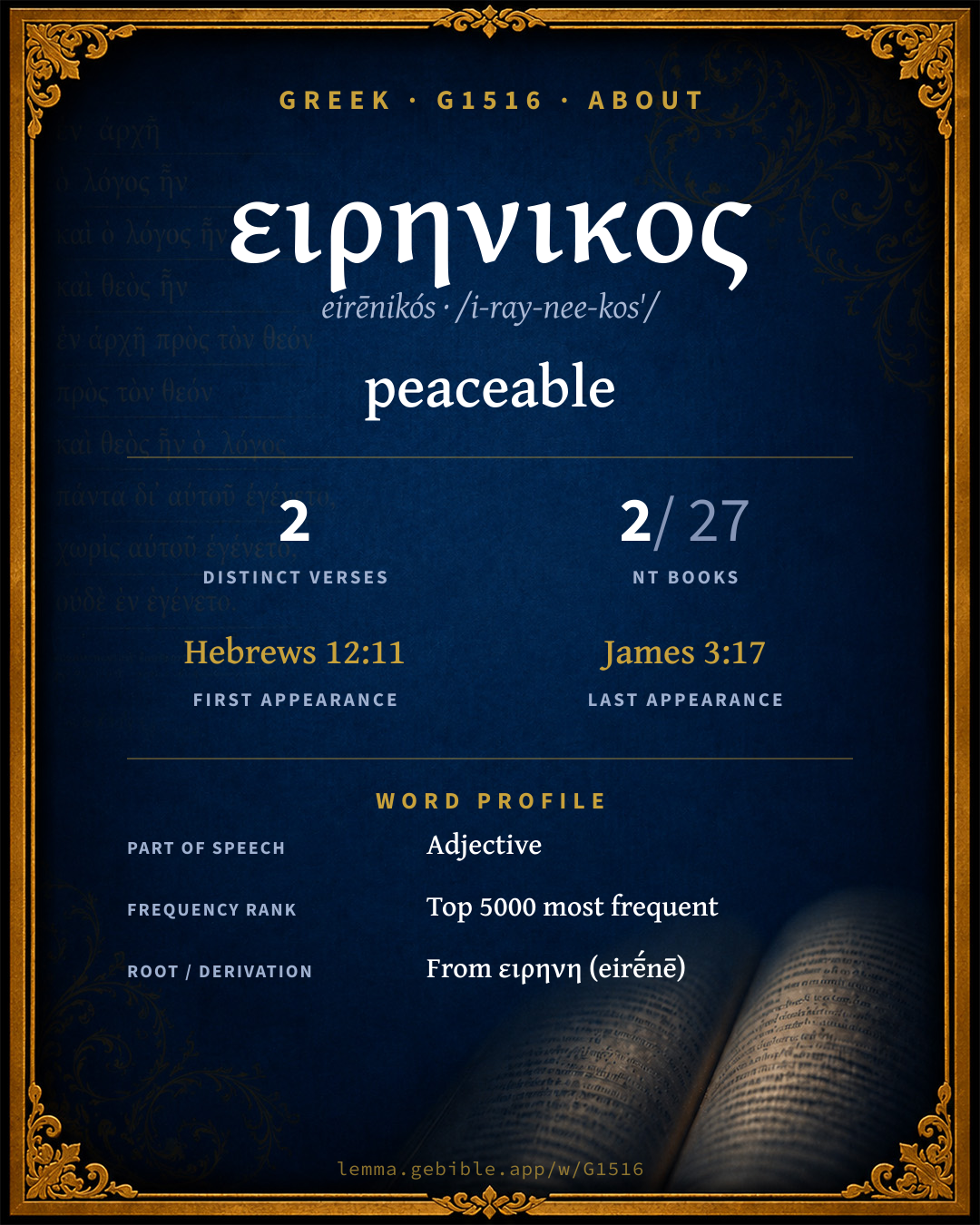
εἰρηνικός
peaceable
‘peaceable’ is one of 3 main senses fuller range ↓
Full lexicon entry — Thayer's Greek Lexicon
From Thayer's Greek Lexicon
Where this word appears
See every Accusative-case word in the Greek New Testament →
Grammar key — what these labels mean
Part of speech
- Adjective
- A word that describes or qualifies a noun.
Case
- Accusative
- The case of the direct object and of extent.
- Nominative
- The case of the subject (and the predicate nominative).
Gender
- Masculine
- Grammatically masculine.
- Feminine
- Grammatically feminine.
Number
- Singular
- One.
1 distinct verse where G1516 appears in the Accusative case, across 1 book. Filtered view — show all forms. Click any verse to open its interlinear word-by-word view. Verse text shown in the World English Bible for context — . Each verse’s Greek form is shown with its reference; the English is not keyword-highlighted, since the data carries no word-level English alignment. Use “Compare translations” on any verse to read it across multiple English versions. This concordance covers the Greek New Testament; Septuagint (Greek Old Testament) occurrences of this word are not indexed here.
Hebrews 1 verse
About this entry
At a glance — auto-summarized from this page’s data, not written by a person. Every figure links to its source below. This summary describes the numbers; it doesn’t interpret them.
ειρηνικος (eirēnikós) is a Greek adjective most often rendered “peaceable.” It occurs a mere 2 verses across Scripture. It clusters heavily in Hebrews, which alone accounts for 50% of its uses. Debuting at Hebrews 12:11, it then recurs through the corpus. Its lexical range runs to 3 senses. For the data behind this summary, explore the sense tree and the renderings breakdown below.
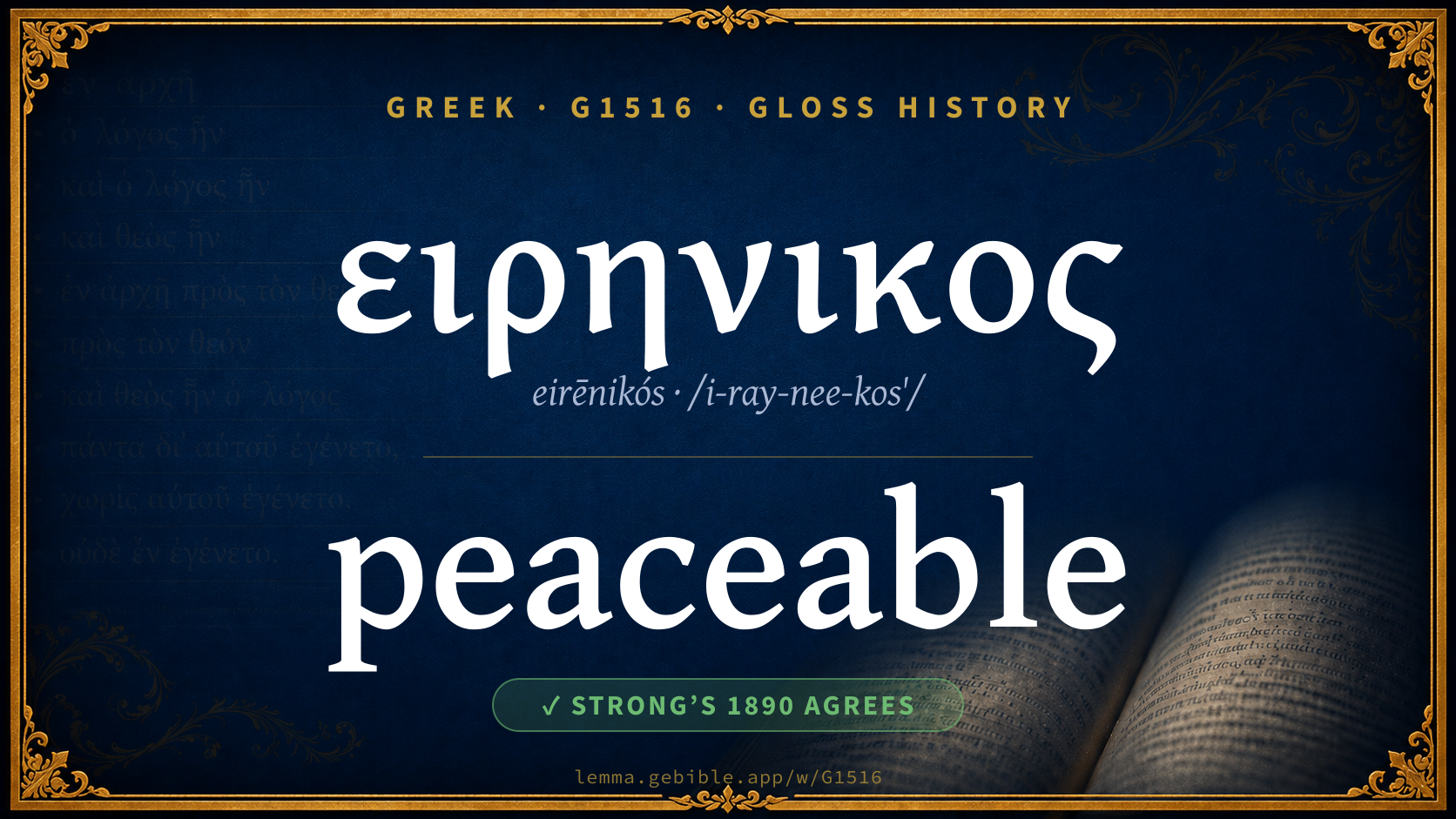
Gloss history
Strong's 1890 vs modern scholarship
About this word
Strong's G1516 catalogs a Greek word from the Greek New Testament.
These counts are not copied from any lexicon or concordance. They are computed here, from the morphology-tagged Greek New Testament. What Lemma adds →
- 2
- distinct verses
- The word appears in 2 distinct verses.
- 2 / 27
- NT books
- The word appears in 2 of 27 New Testament books.
- #2,678
- by frequency
- Top 5000 most frequent Greek words (rank 2,678 of 5,347 Greek words by occurrence).
View all 2 occurrences in the concordance →
By traditional corpus
Conventional, traditional groupings — biblical authorship is debated, so this is a traditional corpus grouping, not an authorship claim. Some books belong to more than one corpus (Luke is in both the Gospels and the Lukan corpus, and so on), so these shares overlap and need not total 100%. Each figure is a share of the word’s 2 distinct verses.
- Hebrews 1 verse · 50%
- General (Catholic) Epistles 1 verse · 50%
How translations render this word
Counts come from each version’s own published word-to-Strong’s tagging or interlinear alignment — an approximate guide to how each version renders this word, not a word-level alignment the data otherwise carries. Because each total is that version’s own tagged count, the per-version totals vary from one another and need not match the appearance or distinct-verse counts above. These counts may also differ from a printed concordance because Lemma counts each distinctly tagged rendering and does not collapse phrase taggings into a single head-word total. This is a fixed set of word-tagged versions (KJV, ASV, BSB, ULT) and does not change with the reading translation you choose elsewhere. Each version’s license is shown beside its name below (and on Sources).
- King James Version: Peaceable 2×
- American Standard Version: Peaceable 2×
- Berean Standard Bible: Peace 1×, Peace-loving 1×
- unfoldingWord Literal Text: Peaceable 1×, Peaceful 1×
King James Version Public Domain
Renders G1516 across 2 tagged occurrences — most commonly:
American Standard Version Public Domain
Renders G1516 across 2 tagged occurrences — most commonly:
Berean Standard Bible Public Domain
Renders G1516 across 2 tagged occurrences — most commonly:
unfoldingWord Literal Text CC BY-SA 4.0
Renders G1516 across 2 tagged occurrences — most commonly:
Senses in Thayer's
The 3 senses Thayer's distinguishes for this word, in lexicon order (not ranked by frequency or importance). The full entry — with sub-senses — is in the Lexicon Entry tab.
- relating to peace
- peaceable, pacific, loving peace
- bring peace with it, peaceful, salutary
Word origin
Derived from ειρηνη (eirḗnē) (G1515) — peace.
From G1515 ; pacific ; by implication salutary : - peaceable.
— Strong’s Exhaustive Concordance (1890), public domain.
Forms in the corpus
The 2 distinct written forms G1516 takes in the Greek New Testament, most frequent first — each parse links to that case’s occurrences in the concordance.
| Form | Parsing | Example | Uses |
|---|---|---|---|
| εἰρηνική eirēnikḗ | Adjective, Nominative, Singular, Feminine | James 3:17 | 1 |
| εἰρηνικὸν eirēnikòn | Adjective, Accusative, Singular, Masculine | Hebrews 12:11 | 1 |
Same root — word family
Other Thayer's entries built from the same root as G1516, grouped by Strong’s listed origin. These share a root / origin per the lexicon — not necessarily a shared meaning. Each links to that word’s own entry.
Derives from
Shares the same root
Compare all same-root words → They share a root, not necessarily a meaning.
Septuagint usage
The same Greek word ειρηνικος appears 35 times in the Greek Old Testament (Septuagint), across 34 verses in 14 books.
- 35
- LXX occurrences
- Tagged occurrences of this Greek word in the Septuagint.
- 34
- verses
- Distinct Septuagint verses containing this word.
- 14 / 39
- OT books
- The word appears in 14 of the 39 Old Testament books.
Sample Septuagint occurrences
- Genesis 34:21 εἰρηνικός
- Numbers 21:21 εἰρηνικός
- Deuteronomy 2:26 εἰρηνικός
- 1 Samuel 10:8 εἰρηνικός
- 2 Samuel 6:17 εἰρηνικός
- 1 Kings 2:35 εἰρηνικός
- 2 Kings 16:13 εἰρηνικός
- 1 Chronicles 12:39 εἰρηνικός
- Psalms 34:20 εἰρηνικός
- Proverbs 7:14 εἰρηνικός
- Jeremiah 9:7 εἰρηνικός
- Obadiah 1:7 εἰρηνικός
Septuagint occurrences (same lexeme)
Every verse where the same Strong’s number (G1516) appears in the Greek Septuagint. Verse text shown in the World English Bible for context; the Greek form is the matched word — the English is not keyword-highlighted.
- Genesis 34:21 εἰρηνικός "These men are peaceful with us. Therefore let them live in the land and trade in it. For, behold, the land is large enough for them. Let us take their daughters to us for wives, and let us give them our daughters.
- Genesis 37:4 εἰρηνικός His brothers saw that their father loved him more than all his brothers, and they hated him, and couldn't speak peaceably to him.
- Genesis 42:11 εἰρηνικός We are all one man's sons; we are honest men. Your servants are not spies."
- Genesis 42:19 εἰρηνικός If you are honest men, then let one of your brothers be bound in your prison-house; but you go, carry grain for the famine of your houses.
- Genesis 42:31 εἰρηνικός We said to him, 'We are honest men. We are no spies.
- Genesis 42:33 εἰρηνικός The man, the lord of the land, said to us, 'Hereby will I know that you are honest men. Leave one of your brothers with me, and take grain for the famine of your houses, and go your way.
- Genesis 42:34 εἰρηνικός Bring your youngest brother to me. Then I will know that you are not spies, but that you are honest men. So I will deliver your brother to you, and you shall trade in the land.'"
- Numbers 21:21 εἰρηνικός Israel sent messengers to Sihon king of the Amorites, saying,
- Deuteronomy 2:26 εἰρηνικός I sent messengers out of the wilderness of Kedemoth to Sihon king of Heshbon with words of peace, saying,
- Deuteronomy 20:11 εἰρηνικός It shall be, if it make you answer of peace, and open to you, then it shall be, that all the people who are found therein shall become tributary to you, and shall serve you.
- Deuteronomy 23:7 εἰρηνικός You shall not abhor an Edomite; for he is your brother: you shall not abhor an Egyptian, because you lived as a foreigner in his land.
- 1 Samuel 10:8 εἰρηνικός You shall go down before me to Gilgal; and, behold, I will come down to you, to offer burnt offerings, and to sacrifice sacrifices of peace-offerings: seven days shall you wait, until I come to you, and show you what you shall do.
- 1 Samuel 11:15 εἰρηνικός All the people went to Gilgal; and there they made Saul king before Yahweh in Gilgal; and there they offered sacrifices of peace-offerings before Yahweh; and there Saul and all the men of Israel rejoiced greatly.
- 1 Samuel 13:9 εἰρηνικός Saul said, Bring here the burnt offering to me, and the peace-offerings. He offered the burnt offering.
- 2 Samuel 6:17 εἰρηνικός They brought in the ark of Yahweh, and set it in its place, in the midst of the tent that David had pitched for it; and David offered burnt offerings and peace-offerings before Yahweh.
- 2 Samuel 6:18 εἰρηνικός When David had made an end of offering the burnt offering and the peace-offerings, he blessed the people in the name of Yahweh of Hosts.
- 2 Samuel 20:19 εἰρηνικός I am of those who are peaceable and faithful in Israel: you seek to destroy a city and a mother in Israel: why will you swallow up the inheritance of Yahweh?
- 2 Samuel 24:25 εἰρηνικός David built there an altar to Yahweh, and offered burnt offerings and peace-offerings. So Yahweh was entreated for the land, and the plague was stayed from Israel.
- 1 Kings 2:35 εἰρηνικός The king put Benaiah the son of Jehoiada in his room over the host; and Zadok the priest did the king put in the room of Abiathar.
- 1 Kings 3:15 εἰρηνικός Solomon awoke; and, behold, it was a dream: and he came to Jerusalem, and stood before the ark of the covenant of Yahweh, and offered up burnt offerings, and offered peace-offerings, and made a feast to all his servants.
- 1 Kings 8:63 εἰρηνικός Solomon offered for the sacrifice of peace-offerings, which he offered to Yahweh, two and twenty thousand oxen, and one hundred twenty thousand sheep. So the king and all the children of Israel dedicated the house of Yahweh.
- 1 Kings 8:64 εἰρηνικός The same day did the king make the middle of the court holy that was before the house of Yahweh; for there he offered the burnt offering, and the meal-offering, and the fat of the peace-offerings, because the brazen altar that was before Yahweh was too little to receive the burnt offering, and the meal-offering, and the fat of the peace-offerings.
- 2 Kings 16:13 εἰρηνικός He burnt his burnt offering and his meal-offering, and poured his drink-offering, and sprinkled the blood of his peace-offerings, on the altar.
- 1 Chronicles 12:39 εἰρηνικός They were there with David three days, eating and drinking; for their brothers had made preparation for them.
- Psalms 34:20 εἰρηνικός He protects all of his bones. Not one of them is broken.
- Psalms 36:37 εἰρηνικός
- Psalms 119:7 εἰρηνικός I will give thanks to you with uprightness of heart, When I learn your righteous judgments.
- Proverbs 7:14 εἰρηνικός "Sacrifices of peace-offerings are with me. This day I have paid my vows.
- Jeremiah 9:7 εἰρηνικός Therefore thus says Yahweh of Hosts, Behold, I will melt them, and try them; for how [else] should I do, because of the daughter of my people?
- Jeremiah 45:22 εἰρηνικός
- Obadiah 1:7 εἰρηνικός All the men of your alliance have brought you on your way, even to the border. The men who were at peace with you have deceived you, and prevailed against you. Friends who eat your bread lay a snare under you. There is no understanding in him.
- Micah 7:3 εἰρηνικός Their hands are on that which is evil to do it diligently. The ruler and judge ask for a bribe; And the powerful man dictates the evil desire of his soul. Thus they conspire together.
- Zechariah 6:13 εἰρηνικός even he shall build the temple of Yahweh; and he shall bear the glory, and shall sit and rule on his throne; and he shall be a priest on his throne; and the counsel of peace shall be between them both.
- Zechariah 8:16 εἰρηνικός These are the things that you shall do: speak every man the truth with his neighbor. Execute the judgment of truth and peace in your gates,
These are occurrences of the same Greek lexeme (G1516) in the Septuagint — not a translation of any one Hebrew word. The store carries no word-level Hebrew↔Greek alignment, so no Hebrew original is asserted here. Counts come from the recovered LXX Strong's tagging — high-frequency vocabulary is well covered, while rare or late forms may be untagged — so they reflect tagged occurrences and may slightly undercount.