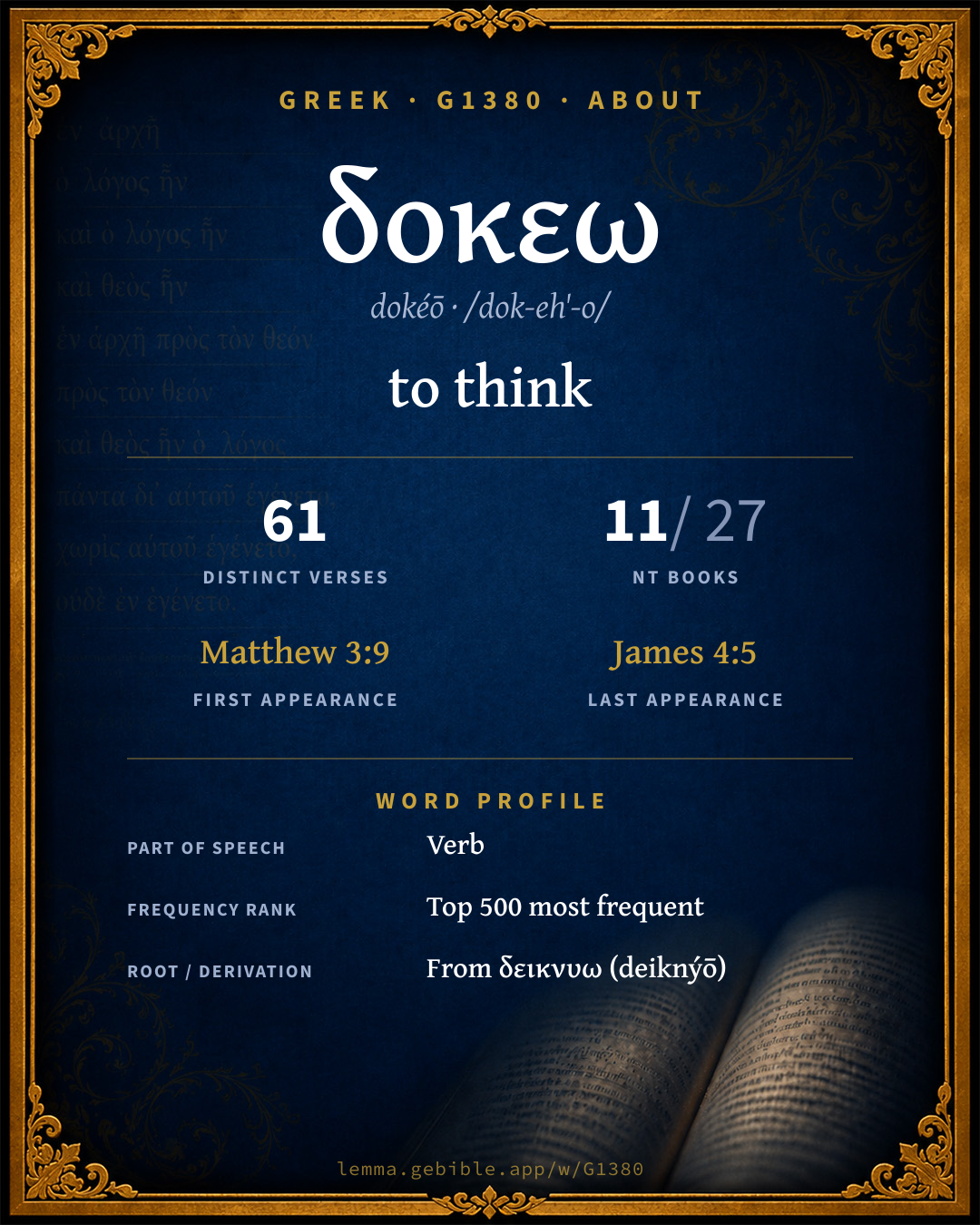
δοκέω
to think
‘to think’ is one of 3 main senses fuller range ↓
Full lexicon entry — Thayer's Greek Lexicon
From Thayer's Greek Lexicon
Where this word appears
See every Present-tense verb in the Greek New Testament →
Grammar key — what these labels mean
Part of speech
- Verb
- An action or state-of-being word.
Tense
- Present
- Ongoing or general action in present time (imperfective aspect).
- Aorist
- Action viewed as a simple whole, without regard to duration — often past (perfective aspect).
- Imperfect
- Continuous or repeated action in past time (“was writing”).
Voice
- Active
- The subject performs the action.
Mood
- Indicative
- States a fact or asks a factual question (the mood of reality).
- Participle
- A verbal adjective (“writing,” “having written”).
- Subjunctive
- Expresses probability, purpose, or possibility (the mood of contingency).
- Imperative
- Expresses a command or request.
- Infinitive
- A verbal noun (“to write”), unmarked for person or number.
Case
- Nominative
- The case of the subject (and the predicate nominative).
- Accusative
- The case of the direct object and of extent.
- Dative
- The case of the indirect object, means, or location — “to / for / with / in.”
- Genitive
- The case of source, possession, or “of” — answers “whose / from what.”
Person
- 3rd person
- The one spoken about (“he / she / it / they”).
- 2nd person
- The one addressed (“you”).
- 1st person
- The speaker (“I / we”).
Gender
- Masculine
- Grammatically masculine.
- Neuter
- Grammatically neuter.
- Feminine
- Grammatically feminine.
Number
- Singular
- One.
- Plural
- More than one.
8 verses where G1380 appears in the Present tense in the Book of Luke. Filtered view — show all forms. Click any verse to open its interlinear word-by-word view. Verse text shown in the World English Bible for context — . Each verse’s Greek form is shown with its reference; the English is not keyword-highlighted, since the data carries no word-level English alignment. Use “Compare translations” on any verse to read it across multiple English versions. This concordance covers the Greek New Testament; Septuagint (Greek Old Testament) occurrences of this word are not indexed here.
Luke
- Luke 8:18 δοκεῖ pres act ind 3sg Be careful therefore how you hear. For whoever has, to him will be given; and whoever doesn't have, from him will be taken away even that which he thinks he has."
- Luke 10:36 δοκεῖ pres act ind 3sg Now which of these three do you think seemed to be a neighbor to him who fell among the robbers?"
- Luke 12:40 δοκεῖτε pres act ind 2pl Therefore be ready also, for the Son of Man is coming in an hour that you don't expect him."
- Luke 12:51 δοκεῖτε pres act ind 2pl Do you think that I have come to give peace in the earth? I tell you, no, but rather division.
- Luke 13:2 δοκεῖτε pres act ind 2pl Jesus answered them, "Do you think that these Galileans were worse sinners than all the other Galileans, because they suffered such things?
- Luke 13:4 δοκεῖτε pres act ind 2pl Or those eighteen, on whom the tower in Siloam fell, and killed them; do you think that they were worse offenders than all the men who dwell in Jerusalem?
- Luke 19:11 δοκεῖν pres act inf As they heard these things, he went on and told a parable, because he was near Jerusalem, and they supposed that the Kingdom of God would be revealed immediately.
- Luke 22:24 δοκεῖ pres act ind 3sg There arose also a contention among them, which of them was considered to be greatest.
About this entry
At a glance — auto-summarized from this page’s data, not written by a person. Every figure links to its source below. This summary describes the numbers; it doesn’t interpret them.
The Greek verb δοκεω centers on the idea of “to think.” Where the King James Version says “think,” newer translations reach for “do you think” (Berean Standard Bible); the renderings breakdown has the detail. It appears 61 verses across 11 books of the Greek New Testament, among its moderately common vocabulary. Debuting at Matthew 3:9, it then recurs through the corpus. Thayer's distinguishes 3 senses for it. For the data behind this summary, explore the sense tree and the renderings breakdown below.
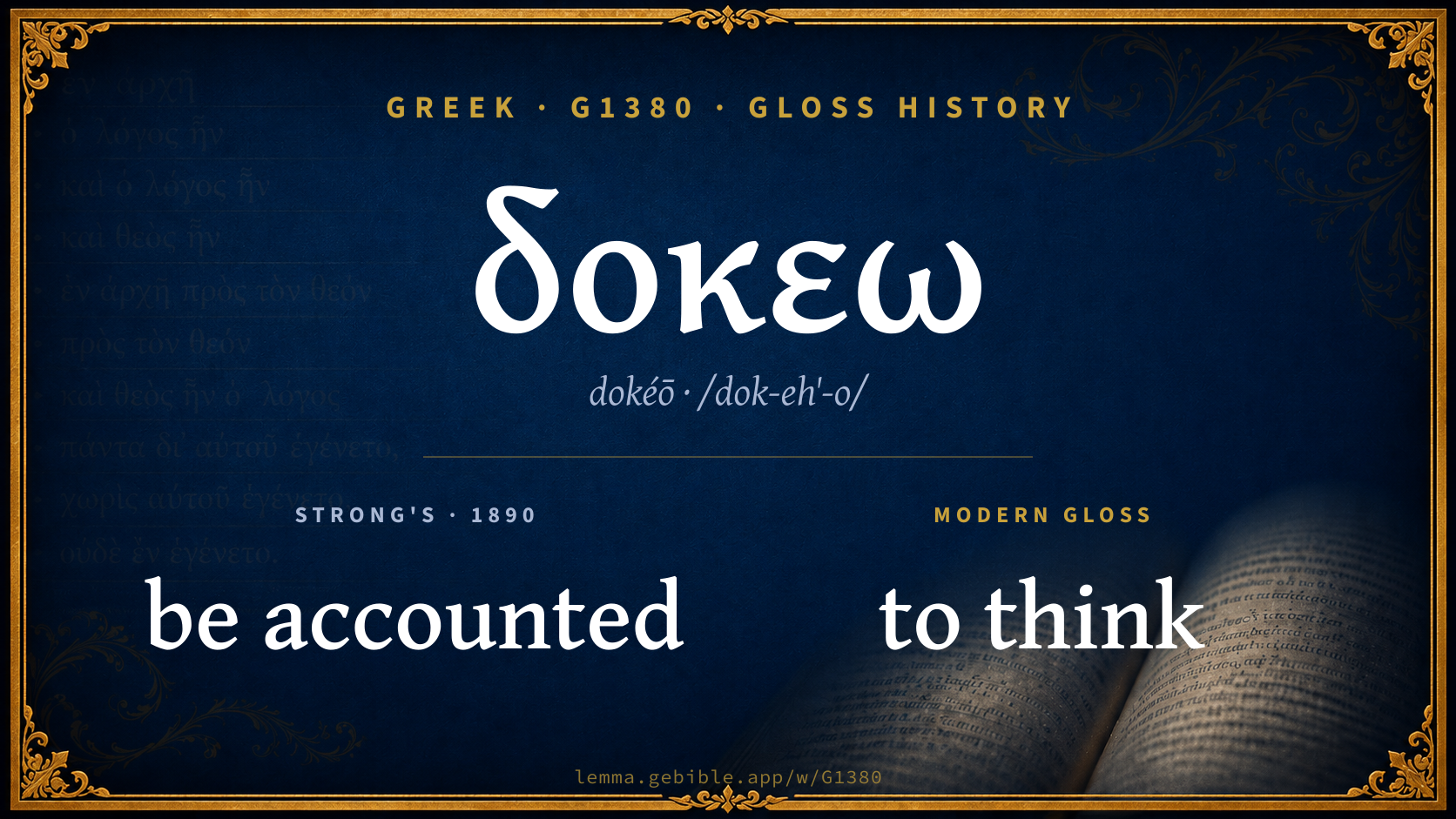
Gloss history
Strong's 1890 vs modern scholarship
About this word
Strong's G1380 catalogs a Greek word from the Greek New Testament.
These counts are not copied from any lexicon or concordance. They are computed here, from the morphology-tagged Greek New Testament. What Lemma adds →
- 61
- distinct verses
- The word appears in 61 distinct verses.
- 11 / 27
- NT books
- The word appears in 11 of 27 New Testament books.
- #262
- by frequency
- Top 500 most frequent Greek words (rank 262 of 5,347 Greek words by occurrence).
View all 61 occurrences in the concordance →
Most concentrated in
- Matthew 10 verses 16%
- Luke 10 verses 16%
- 1 Corinthians 9 verses 15%
By section of the New Testament
By traditional corpus
Conventional, traditional groupings — biblical authorship is debated, so this is a traditional corpus grouping, not an authorship claim. Some books belong to more than one corpus (Luke is in both the Gospels and the Lukan corpus, and so on), so these shares overlap and need not total 100%. Each figure is a share of the word’s 61 distinct verses.
- Gospels 30 verses · 49%
- Lukan (Luke–Acts) 18 verses · 30%
- Pauline corpus 17 verses · 28%
- Johannine 8 verses · 13%
- Hebrews 4 verses · 7%
- General (Catholic) Epistles 2 verses · 3%
How translations render this word
Counts come from each version’s own published word-to-Strong’s tagging or interlinear alignment — an approximate guide to how each version renders this word, not a word-level alignment the data otherwise carries. Because each total is that version’s own tagged count, the per-version totals vary from one another and need not match the appearance or distinct-verse counts above. These counts may also differ from a printed concordance because Lemma counts each distinctly tagged rendering and does not collapse phrase taggings into a single head-word total. This is a fixed set of word-tagged versions (KJV, ASV, BSB, ULT) and does not change with the reading translation you choose elsewhere. Each version’s license is shown beside its name below (and on Sources).
- King James Version: Think 10×, Thought 5×, Seem 4×
- American Standard Version: Think 10×, Think ye 4×, Thinketh 4×
- Berean Standard Bible: Do you think 7×, Think 6×, Thinks 5×
- unfoldingWord Literal Text: Think 13×, Do 8×, Do you think 7×
King James Version Public Domain
Renders G1380 across 66 tagged occurrences — most commonly:
Plus other, less common renderings. Plus 21 renderings that appear only once — usually multi-word phrases or single function words the recovered tagging swept in, not distinct renderings.
American Standard Version Public Domain
Renders G1380 across 63 tagged occurrences — most commonly:
Plus 25 renderings that appear only once — usually multi-word phrases or single function words the recovered tagging swept in, not distinct renderings. Not rendered by a distinct English word in 1 further occurrence.
Berean Standard Bible Public Domain
Renders G1380 across 62 tagged occurrences — most commonly:
Plus 32 renderings that appear only once — usually multi-word phrases or single function words the recovered tagging swept in, not distinct renderings.
unfoldingWord Literal Text CC BY-SA 4.0
Renders G1380 across 79 tagged occurrences — most commonly:
Plus 24 renderings that appear only once — usually multi-word phrases or single function words the recovered tagging swept in, not distinct renderings.
Senses in Thayer's
The 3 senses Thayer's distinguishes for this word, in lexicon order (not ranked by frequency or importance). The full entry — with sub-senses — is in the Lexicon Entry tab.
- to be of opinion, think, suppose
- to seem, to be accounted, reputed
- it seems to me
Word origin
Derived from δεικνυω (deiknýō) (G1166) — to show.
A prolonged form of a primary verb δόκω dokō (used only as an alternate in certain tenses; compare the base of G1166 ); of the same meaning; to think ; by implication to seem (truthfully or uncertainly): - be accounted (of own) please (-ure) be of reputation seem (good) suppose think trow.
— Strong’s Exhaustive Concordance (1890), public domain.
Forms in the corpus
The 24 distinct written forms G1380 takes in the Greek New Testament, most frequent first — each parse links to that tense’s occurrences in the concordance.
Same root — word family
Other Thayer's entries built from the same root as G1380, grouped by Strong’s listed origin. These share a root / origin per the lexicon — not necessarily a shared meaning. Each links to that word’s own entry.
Derives from
Shares the same root
Derived from this word
Compare all same-root words → Showing 4 of 7 — not the complete family. They share a root, not necessarily a meaning.
Septuagint usage
The same Greek word δοκεω appears 25 times in the Greek Old Testament (Septuagint), across 25 verses in 8 books.
- 25
- LXX occurrences
- Tagged occurrences of this Greek word in the Septuagint.
- 25
- verses
- Distinct Septuagint verses containing this word.
- 8 / 39
- OT books
- The word appears in 8 of the 39 Old Testament books.
Sample Septuagint occurrences
- Genesis 19:14 δοκέω
- Exodus 25:2 δοκέω
- Joshua 9:25 δοκέω
- Esther 1:19 δοκέω
- Job 1:21 δοκέω
- Proverbs 2:10 δοκέω
- Isaiah 4:2 δοκέω
- Daniel 4:29 δοκέω
Septuagint occurrences (same lexeme)
Every verse where the same Strong’s number (G1380) appears in the Greek Septuagint. Verse text shown in the World English Bible for context; the Greek form is the matched word — the English is not keyword-highlighted.
- Genesis 19:14 δοκέω Lot went out, and spoke to his sons-in-law, who were pledged to marry his daughters, and said, "Get up! Get out of this place, for Yahweh will destroy the city." But he seemed to his sons-in-law to be joking.
- Genesis 38:15 δοκέω When Judah saw her, he thought that she was a prostitute, for she had covered her face.
- Exodus 25:2 δοκέω "Speak to the children of Israel, that they take an offering for me. From everyone whose heart makes him willing you shall take my offering.
- Exodus 35:21 δοκέω They came, everyone whose heart stirred him up, and everyone whom his spirit made willing, and brought Yahweh's offering, for the work of the tent of meeting, and for all of its service, and for the holy garments.
- Exodus 35:22 δοκέω They came, both men and women, as many as were willing-hearted, and brought brooches, ear-rings, signet-rings, and armlets, all jewels of gold; even every man who offered an offering of gold to Yahweh.
- Exodus 35:26 δοκέω All the women whose heart stirred them up in wisdom spun the goats' hair.
- Joshua 9:25 δοκέω Now, behold, we are in your hand: as it seems good and right to you to do to us, do.
- Esther 1:19 δοκέω If it please the king, let there go forth a royal commandment from him, and let it be written among the laws of the Persians and the Medes, that it not be altered, that Vashti come no more before king Ahasuerus; and let the king give her royal estate to another who is better than she.
- Esther 3:9 δοκέω If it please the king, let it be written that they be destroyed: and I will pay ten thousand talents of silver into the hands of those who have the charge of the [king's] business, to bring it into the king's treasuries.
- Esther 5:2 δοκέω It was so, when the king saw Esther the queen standing in the court, that she obtained favor in his sight; and the king held out to Esther the golden scepter that was in his hand. So Esther drew near, and touched the top of the scepter.
- Esther 8:5 δοκέω She said, If it please the king, and if I have found favor in his sight, and the thing seem right before the king, and I be pleasing in his eyes, let it be written to reverse the letters devised by Haman, the son of Hammedatha the Agagite, which he wrote to destroy the Jews who are in all the king's provinces:
- Esther 8:8 δοκέω Write you also to the Jews, as it pleases you, in the king's name, and seal it with the king's ring; for the writing which is written in the king's name, and sealed with the king's ring, may no man reverse.
- Job 1:21 δοκέω He said, "Naked I came out of my mother's womb, and naked shall I return there. Yahweh gave, and Yahweh has taken away. Blessed be the name of Yahweh."
- Job 15:21 δοκέω A sound of terrors is in his ears; In prosperity the destroyer shall come on him.
- Job 20:7 δοκέω Yet he shall perish forever like his own dung, Those who have seen him shall say, 'Where is he?'
- Job 20:22 δοκέω In the fullness of his sufficiency, distress shall overtake him: The hand of everyone who is in misery shall come on him.
- Proverbs 2:10 δοκέω For wisdom will enter into your heart. Knowledge will be pleasant to your soul.
- Proverbs 14:12 δοκέω There is a way which seems right to a man, But in the end it leads to death.
- Proverbs 16:21 δοκέω The wise in heart shall be called prudent. Pleasantness of the lips promotes instruction.
- Proverbs 17:28 δοκέω Even a fool, when he keeps silent, is counted wise. When he shuts his lips, he is thought to be discerning.
- Proverbs 26:12 δοκέω Do you see a man wise in his own eyes? There is more hope for a fool than for him.
- Proverbs 27:14 δοκέω He who blesses his neighbor with a loud voice early in the morning, It will be taken as a curse by him.
- Proverbs 28:24 δοκέω Whoever robs his father or his mother, and says, "It's not wrong." He is a partner with a destroyer.
- Isaiah 4:2 δοκέω In that day, Yahweh's branch will be beautiful and glorious, and the fruit of the land will be the beauty and glory of the survivors of Israel.
- Daniel 4:29 δοκέω At the end of twelve months he was walking in the royal palace of Babylon.
These are occurrences of the same Greek lexeme (G1380) in the Septuagint — not a translation of any one Hebrew word. The store carries no word-level Hebrew↔Greek alignment, so no Hebrew original is asserted here. Counts come from the recovered LXX Strong's tagging — high-frequency vocabulary is well covered, while rare or late forms may be untagged — so they reflect tagged occurrences and may slightly undercount.