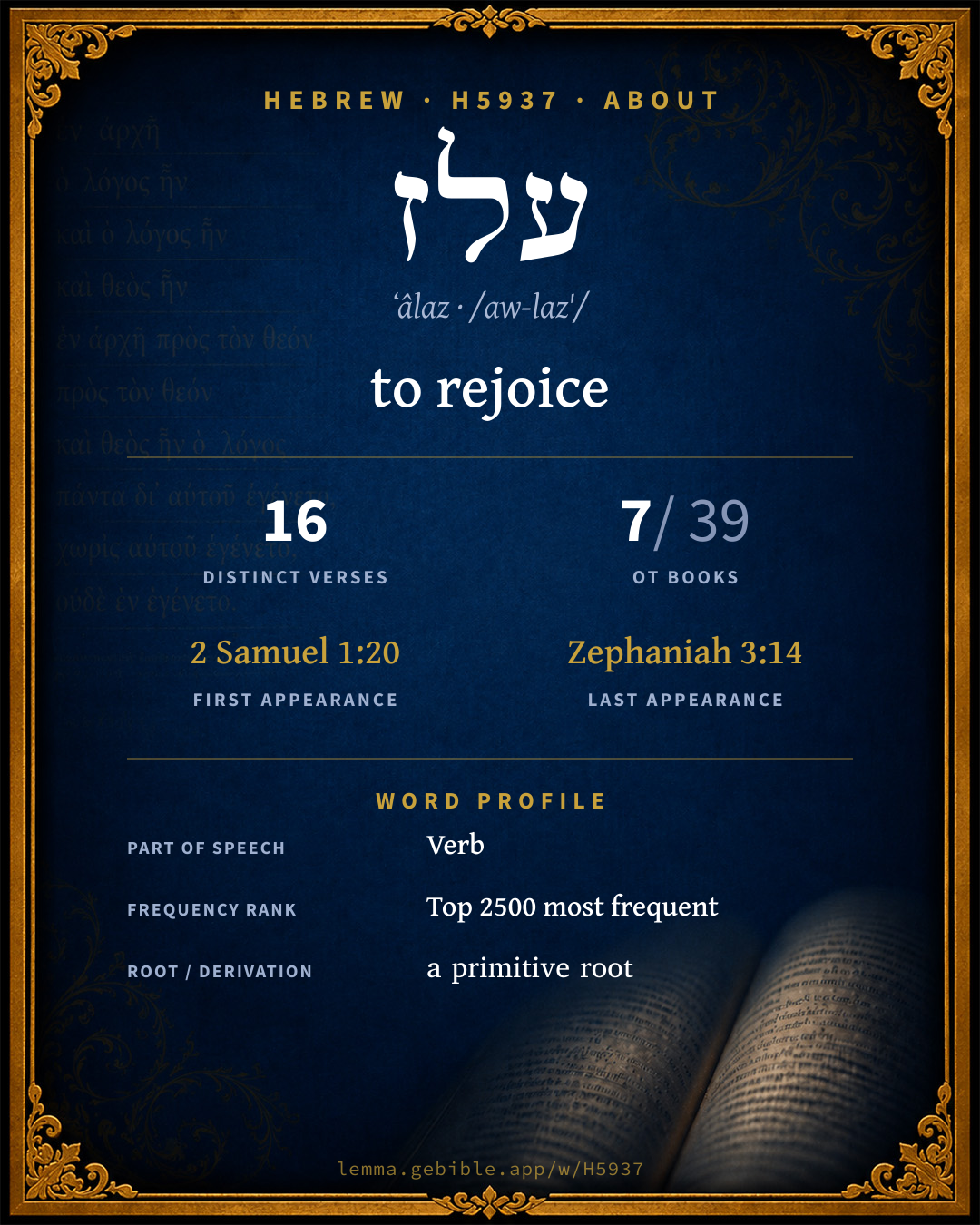
עָלַז
to rejoice
Full lexicon entry — Brown-Driver-Briggs (BDB)
From Brown-Driver-Briggs (BDB)
Where this word appears
Grammar key — what these labels mean
Part of speech
- Verb
- An action or state-of-being word.
Stem
- Qal
- The basic, simple active stem — the plain form of the verb (“he wrote”).
Form
- Cohortative
- A first-person volitional form expressing wish or resolve (“let me / let us write”).
- Imperfect
- An incomplete, ongoing, or future action (“he will / would write”).
- Imperative
- A direct command (“write!”).
- Sequential Imperfect
- An imperfect with prefixed waw — the standard past-narrative form (waw-consecutive imperfect).
- Infinitive Construct
- A bound verbal noun, frequently with prepositions (“to write / in writing”).
Person
- 1st Person
- The speaker (“I / we”).
- 3rd Person
- The one spoken about (“he / she / it / they”).
- 2nd Person
- The one addressed (“you”).
Gender
- Common
- Either gender — not distinguished for this form.
- Masculine
- Grammatically masculine.
- Feminine
- Grammatically feminine.
Number
- Singular
- One.
- Plural
- More than one (in Hebrew, generally three or more).
Grammatical forms 11 distinct
- Verb, Qal, Cohortative, 1st Person, Common, Singular 3 times (18%)
- Verb, Qal, Imperfect, 3rd Person, Masculine, Plural 3 times (18%)
- Verb, Qal, Imperfect, 2nd Person, Feminine, Singular 2 times (12%)
- Verb, Qal, Imperfect, 3rd Person, Feminine, Plural 2 times (12%)
- Verb, Qal, Imperative, 2nd Person, Feminine, Singular 1 time (6%)
- Verb, Qal, Imperative, 2nd Person, Masculine, Plural 1 time (6%)
- Verb, Qal, Sequential Imperfect, 1st Person, Common, Singular 1 time (6%)
- Verb, Qal, Sequential Imperfect, 3rd Person, Masculine, Singular 1 time (6%)
+3 more forms (3 occurrences)
Parsed forms decoded from the imported morphology (morphhb / Westminster Leningrad Codex — WLC text public domain, morphhb tagging CC BY 4.0), counted across 17 parsed occurrences — not distinct verses.
Every verse where H5937 appears — 16 distinct verses across 7 books. Click any verse to open its interlinear word-by-word view. Verse text shown in the World English Bible for context — . Each verse’s Hebrew form is shown with its reference; the English is not keyword-highlighted, since the data carries no word-level English alignment. Use “Compare translations” on any verse to read it across multiple English versions. This concordance covers the Hebrew Bible; Septuagint (Greek Old Testament) occurrences are not indexed here.
2 Samuel 1 verse
Psalms 7 verses
- Psalms 28:7 וַ/יַּעֲלֹ֥ז conj + Qal wimpf 3ms Yahweh is my strength and my shield. My heart has trusted in him, and I am helped. Therefore my heart greatly rejoices. With my song I will thank him.
- Psalms 60:6 אֶ֫עְלֹ֥זָה Qal coh 1cs God has spoken from his sanctuary: "I will triumph. I will divide Shechem, And measure out the valley of Succoth.
- Psalms 68:4 וְ/עִלְז֥וּ conj + Qal impv 2mp Sing to God! Sing praises to his name! Extol him who rides on the clouds: To Yah, his name! Rejoice before him!
- Psalms 94:3 יַעֲלֹֽזוּ Qal impf 3mp Yahweh, how long will the wicked, How long will the wicked triumph?
- Psalms 96:12 יַעֲלֹ֣ז Qal impf 3ms Let the field and all that is in it exult! Then all the trees of the woods shall sing for joy
- Psalms 108:7 אֶעְלֹ֥זָה Qal coh 1cs God has spoken from his sanctuary: "In triumph, I will divide Shechem, and measure out the valley of Succoth.
- Psalms 149:5 יַעְלְז֣וּ Qal impf 3mp Let the saints rejoice in honor. Let them sing for joy on their beds.
Proverbs 1 verse
Isaiah 1 verse
Jeremiah 4 verses
- Jeremiah 11:15 תַּעֲלֹֽזִי Qal impf 2fs What has my beloved to do in my house, seeing she has worked lewdness [with] many, and the holy flesh is passed from you? when you do evil, then you rejoice.
- Jeremiah 15:17 וָֽ/אֶעְלֹ֑ז conj + Qal wimpf 1cs I didn't sit in the assembly of those who make merry, nor rejoiced; I sat alone because of your hand; for you have filled me with indignation.
- Jeremiah 50:11 תעלזי תַֽעֲלְז֔וּ Qal impf 2fs Qal impf 2mp Because you are glad, because you rejoice, O you who plunder my heritage, because you are wanton as a heifer that treads out [the grain], and neigh as strong horses;
- Jeremiah 51:39 יַעֲלֹ֔זוּ Qal impf 3mp When they are heated, I will make their feast, and I will make them drunken, that they may rejoice, and sleep a perpetual sleep, and not wake, says Yahweh.
Habakkuk 1 verse
Zephaniah 1 verse
About this entry
At a glance — auto-summarized from this page’s data, not written by a person. Every figure links to its source below. This summary describes the numbers; it doesn’t interpret them.
עלז — transliterated ʻâlaz — is a Hebrew verb carrying the sense “to rejoice.” Its earliest occurrence is 2 Samuel 1:20. Spanning 16 verses in 7 books, it ranks among the uncommon words of the Hebrew Bible. Its uses concentrate in Psalms (44% of all occurrences). Sharing its root, it stands alongside עלז and עליז. Each statement above links to its evidence; the full detail follows below.
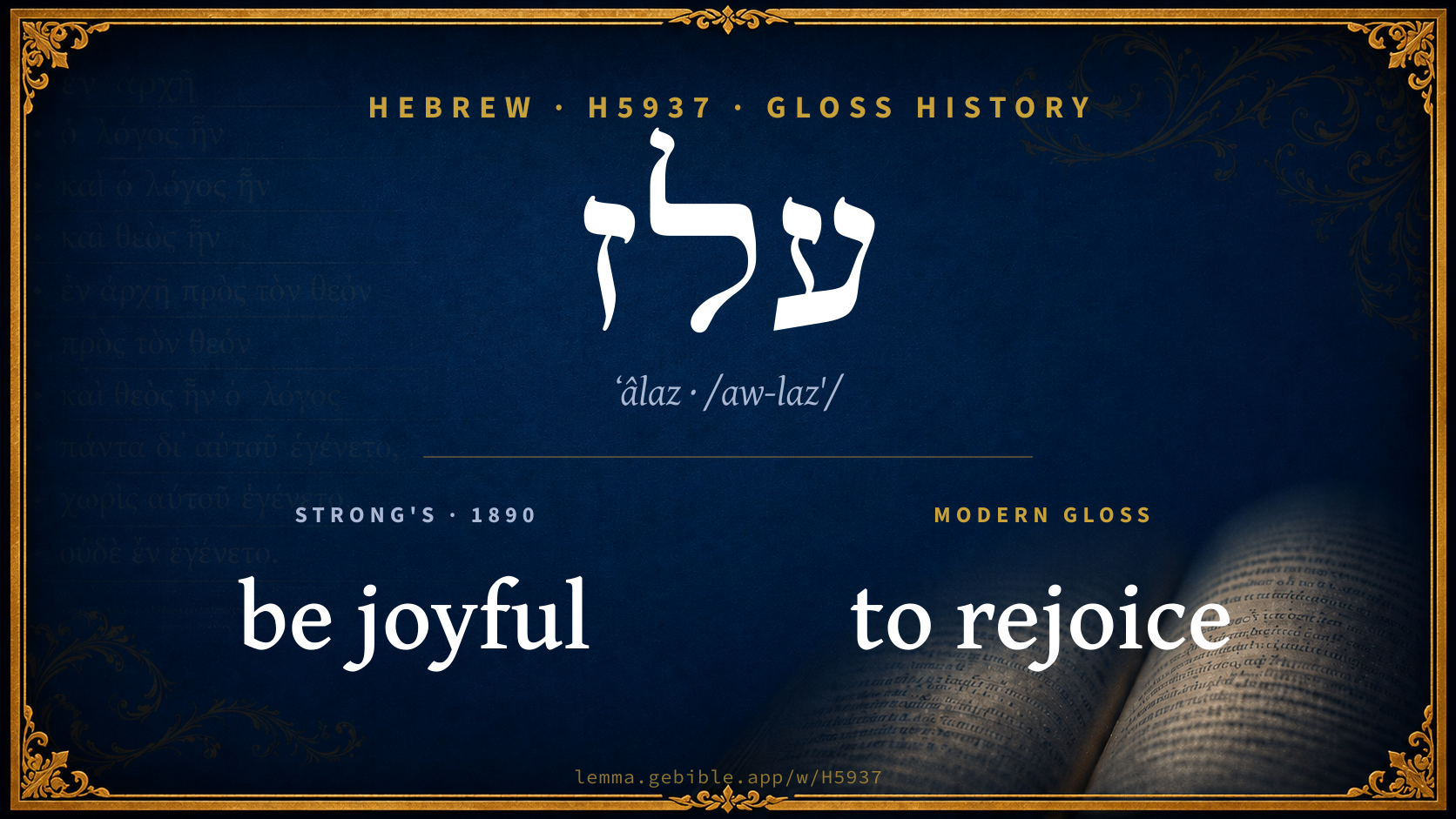
Gloss history
Strong's 1890 vs modern scholarship
About this word
Strong's H5937 catalogs a Hebrew word from the Hebrew Old Testament.
These counts are not copied from any lexicon or concordance. They are computed here, from the morphology-tagged Hebrew Old Testament. What Lemma adds →
- 16
- distinct verses
- The word appears in 16 distinct verses.
- 7 / 39
- OT books
- The word appears in 7 of 39 Old Testament books.
- #1,671
- by frequency
- Top 2500 most frequent Hebrew words (rank 1,671 of 8,640 Hebrew words by occurrence).
View all 16 occurrences in the concordance →
By section of the Old Testament
By traditional corpus
Conventional, traditional groupings — biblical authorship is debated, so this is a traditional corpus grouping, not an authorship claim. Each share is this word’s portion of its verses in that division of the Hebrew canon. Each figure is a share of the word’s 16 distinct verses.
- Prophets (Nevi'im) 8 verses · 50%
- Writings (Ketuvim) 8 verses · 50%
How translations render this word
Counts come from each version’s own published word-to-Strong’s tagging or interlinear alignment — an approximate guide to how each version renders this word, not a word-level alignment the data otherwise carries. Because each total is that version’s own tagged count, the per-version totals vary from one another and need not match the appearance or distinct-verse counts above. These counts may also differ from a printed concordance because Lemma counts each distinctly tagged rendering and does not collapse phrase taggings into a single head-word total. This is a fixed set of word-tagged versions (KJV, ASV, BSB, ULT) and does not change with the reading translation you choose elsewhere. Each version’s license is shown beside its name below (and on Sources).
- King James Version: I will rejoice 3×, Rejoice 3×, Be joyful 2×
- American Standard Version: Exult 3×, I will exult 2×, Rejoice 2×
- Berean Standard Bible: Exult 4×, I will triumph 2×, Rejoice 2×
- unfoldingWord Literal Text: Exult 3×, Rejoice 3×
King James Version Public Domain
Renders H5937 across 16 tagged occurrences — most commonly:
Plus 6 renderings that appear only once — usually multi-word phrases or single function words the recovered tagging swept in, not distinct renderings.
American Standard Version Public Domain
Renders H5937 across 16 tagged occurrences — most commonly:
Plus 7 renderings that appear only once — usually multi-word phrases or single function words the recovered tagging swept in, not distinct renderings.
Berean Standard Bible Public Domain
Renders H5937 across 16 tagged occurrences — most commonly:
Plus 8 renderings that appear only once — usually multi-word phrases or single function words the recovered tagging swept in, not distinct renderings.
unfoldingWord Literal Text CC BY-SA 4.0
Renders H5937 across 18 tagged occurrences — most commonly:
Plus 12 renderings that appear only once — usually multi-word phrases or single function words the recovered tagging swept in, not distinct renderings.
Senses in BDB
The 1 sense BDB distinguishes for this word, in lexicon order (not ranked by frequency or importance). The full entry — with sub-senses — is in the Lexicon Entry tab.
- (Qal) to exult, rejoice, triumph
Word origin
Origin: a primitive root
Forms in the corpus
The 17 distinct written forms H5937 takes in the Hebrew Bible, most frequent first — each parse links to that stem’s occurrences in the concordance. Hebrew forms include their vowel points and cantillation, so a single lemma takes many written forms.
| Form | Parsing | Example | Uses |
|---|---|---|---|
| אֶ֫עְלֹ֥זָה | Verb, Qal, Cohortative, 1st Person, Common, Singular | Psalms 60:6 | 1 |
| אֶעְל֑וֹזָה | Verb, Qal, Cohortative, 1st Person, Common, Singular | Habakkuk 3:18 | 1 |
| אֶעְלֹ֥זָה | Verb, Qal, Cohortative, 1st Person, Common, Singular | Psalms 108:7 | 1 |
| וְ/עִלְז֥וּ | Verb, Qal, Imperative, 2nd Person, Masculine, Plural | Psalms 68:4 | 1 |
| וְ/עָלְזִי֙ | Verb, Qal, Imperative, 2nd Person, Feminine, Singular | Zephaniah 3:14 | 1 |
| וְ/תַעְלֹ֥זְנָה | Verb, Qal, Imperfect, 3rd Person, Feminine, Plural | Proverbs 23:16 | 1 |
| וַ/יַּעֲלֹ֥ז | Verb, Qal, Sequential Imperfect, 3rd Person, Masculine, Singular | Psalms 28:7 | 1 |
| וָֽ/אֶעְלֹ֑ז | Verb, Qal, Sequential Imperfect, 1st Person, Common, Singular | Jeremiah 15:17 | 1 |
| יַעְלְז֣וּ | Verb, Qal, Imperfect, 3rd Person, Masculine, Plural | Psalms 149:5 | 1 |
| יַעֲלֹ֔זוּ | Verb, Qal, Imperfect, 3rd Person, Masculine, Plural | Jeremiah 51:39 | 1 |
| יַעֲלֹ֣ז | Verb, Qal, Imperfect, 3rd Person, Masculine, Singular | Psalms 96:12 | 1 |
| יַעֲלֹֽזוּ | Verb, Qal, Imperfect, 3rd Person, Masculine, Plural | Psalms 94:3 | 1 |
| לַ/עְל֑וֹז | Verb, Qal, Infinitive Construct | Isaiah 23:12 | 1 |
| תַֽעֲלְז֔וּ | Verb, Qal, Imperfect, 2nd Person, Masculine, Plural | Jeremiah 50:11 | 1 |
| תַּעֲלֹ֖זְנָה | Verb, Qal, Imperfect, 3rd Person, Feminine, Plural | 2 Samuel 1:20 | 1 |
| תַּעֲלֹֽזִי | Verb, Qal, Imperfect, 2nd Person, Feminine, Singular | Jeremiah 11:15 | 1 |
| תעלזי | Verb, Qal, Imperfect, 2nd Person, Feminine, Singular | Jeremiah 50:11 | 1 |
Same root — word family
Other BDB entries built from the same root as H5937, grouped by Strong’s listed origin. These share a root / origin per the lexicon — not necessarily a shared meaning. Each links to that word’s own entry.
Derived from this word
Compare all same-root words → They share a root, not necessarily a meaning.
Septuagint verse parallels
This word appears in 15 verses that also exist in the Greek Old Testament (Septuagint), out of the 16 Hebrew verses it occurs in. You can read those verses in Greek by switching the Old Testament edition to the Septuagint.
Read these verses in the Septuagint
This is a verse-level parallel only — the same verses exist in both the Hebrew and Greek Old Testaments. No word-level Hebrew↔Greek correspondence is claimed: the data carries no such alignment, so no Greek word is shown as this Hebrew word’s translation. Coverage is not total — the Septuagint omits the deuterocanon and renumbers the Psalms, so some Hebrew verses have no direct Greek parallel.