
Zechariah 9:6

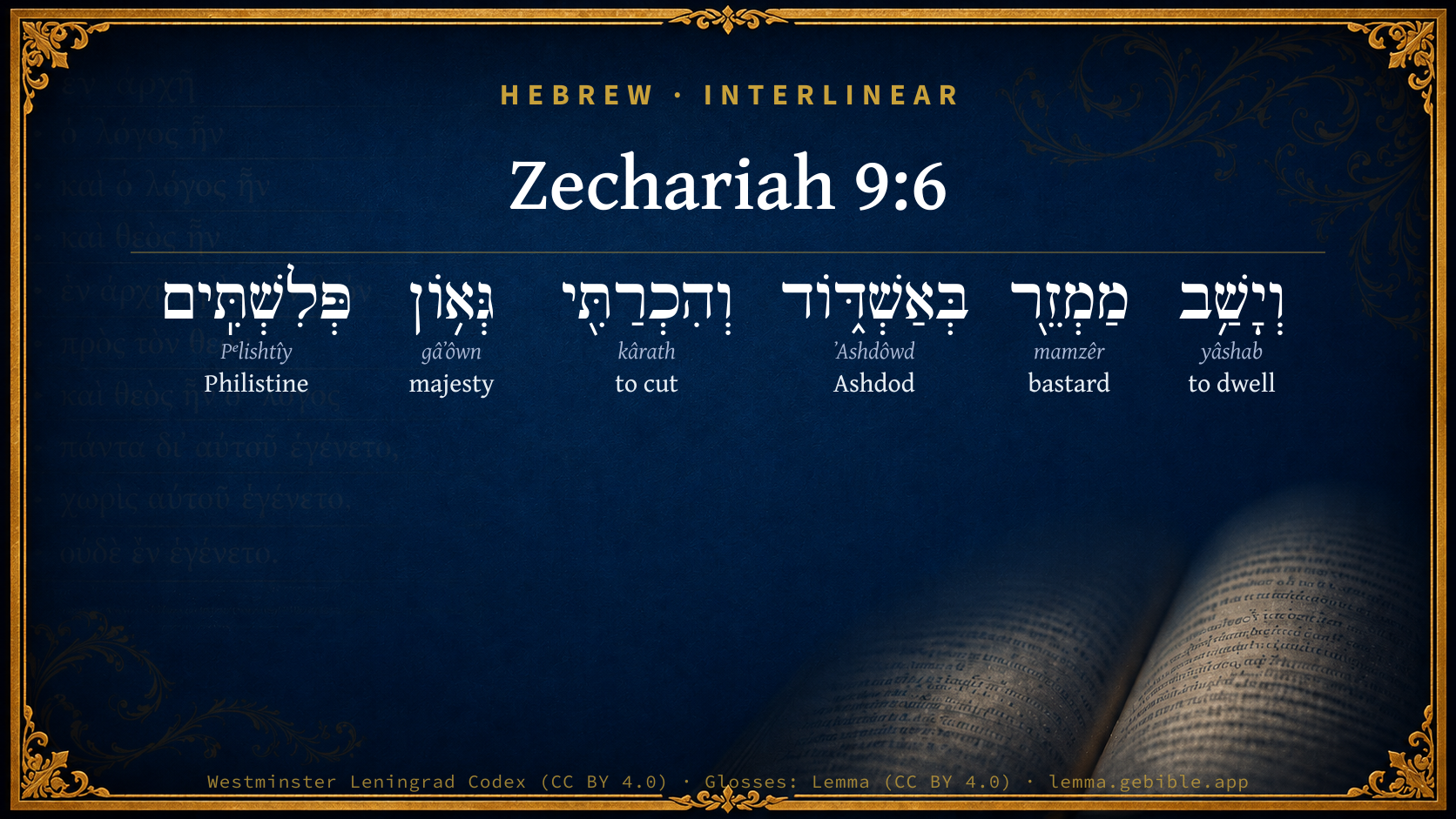
Hebrew (Westminster Leningrad Codex) Zechariah 9:6 appears in the Hebrew Old Testament. The text above is from the Westminster Leningrad Codex. Each word links to its Strong’s number, a concise gloss, and parsing drawn from the Open Scriptures Hebrew Bible morphology. Click any word for its full Brown-Driver-Briggs (BDB) entry.
Download image
Cite this verse

Zechariah 9:6 (World English Bible). Public Domain. Lemma interlinear Bible study tool, https://lemma.gebible.app/v/zechariah/9/6.

Show BibTeX & RIS
BibTeX
RIS
English Translation
Foriegners will dwell in Ashdod, And I will cut off the pride of the Philistines.
World English Bible · Public Domain
Download a study sheet

One document with this verse’s original text, its word-by-word gloss line, the meaning frame, cross-references with their text, attributed commentary, and full source and license credits — printable, and it pastes into notes with its structure intact.

This verse Autodidact and up

Study sheet (.html) Plain text (.txt)

A passage Seminary Student

Up to 50 verses in one chapter. A passage sheet keeps up to 6 commentary sources and 12 cross-references per verse, in the order this page ranks them, and says so on the sheet whenever that leaves anything out. Ask for a single verse and you get the Autodidact verse sheet above.

Everything on this page stays free to read, with no account — the sheet is a download of what is already on screen, not access to it.

Want to remove ads? Support Godless Engineer
Compare translations 3

The same verse in 3 English versions, stacked beneath the original-language interlinear above. Click any original word for its lexicon entry.

Each is an independent rendering of the whole verse — the interlinear is not word-aligned to these translations.

Highlighted words mark where these versions differ — a whole-verse word diff, not a word-by-word alignment.

  • World English Bible Public Domain
    Foriegners will dwell in Ashdod, And I will cut off the pride of the Philistines.
  • King James Version Public Domain
    And a bastard shall dwell in Ashdod, and I will cut off the pride of the Philistines.
  • unfoldingWord Literal Text CC BY-SA 4.0
    Strangers will make their homes in Ashdod, and I will cut off the pride of the Philistines.

unfoldingWord Literal Text — © unfoldingWord, licensed CC BY-SA 4.0. Word-aligned USFM3 via Door43 (git.door43.org/unfoldingWord/en_ult).

Versions to compare (up to 4)

3 of 4 selected

Show all 18 translations

Every available English version of this verse, each an independent rendering of the whole verse.

  • World English Bible Public Domain
    Foriegners will dwell in Ashdod, And I will cut off the pride of the Philistines.
  • Berean Standard Bible Public Domain
    A mixed race will occupy Ashdod, and I will cut off the pride of the Philistines.
  • Majority Standard Bible Public Domain
    A mixed race will occupy Ashdod, and I will cut off the pride of the Philistines.
  • King James Version Public Domain
    And a bastard shall dwell in Ashdod, and I will cut off the pride of the Philistines.
  • American Standard Version (1901) Public Domain
    And a bastard shall dwell in Ashdod, and I will cut off the pride of the Philistines.
  • Revised Version (1885) Public Domain
    And a bastard shall dwell in Ashdod, and I will cut off the pride of the Philistines.
  • Geneva Bible (1599) Public Domain
    And the stranger shall dwell in Ashdod, and I wil cut off the pride of the Philistims.
  • Douay-Rheims (1899) Public Domain
    And the divider shall sit in Azotus, and I will destroy the pride of the Philistines.
  • Young's Literal Translation Public Domain
    And dwelt hath a foreigner in Ashdod, And I have cut off the excellency of the Philistines.
  • Literal Standard Version CC BY-SA 4.0
    “And a foreigner has dwelt in Ashdod, || And I have cut off the excellence of the Philistines.
  • Unlocked Literal Bible CC BY-SA 4.0
    Strangers will make their homes in Ashdod, and I will cut off the pride of the Philistines.
  • unfoldingWord Literal Text CC BY-SA 4.0
    Strangers will make their homes in Ashdod, and I will cut off the pride of the Philistines.
  • Darby Bible Public Domain
    And a bastard shall dwell in Ashdod, and I will cut off the pride of the Philistines;
  • World Messianic Bible Public Domain
    Foreigners will dwell in Ashdod, and I will cut off the pride of the Philistines.
  • Webster's Bible Public Domain
    And a bastard shall dwell in Ashdod, and I will cut off the pride of the Philistines.
  • Free Bible Version CC BY-SA 4.0
    Mixed-race people will live in Ashdod, and I will wipe out the Philistine's pride.
  • Bible in Basic English Public Domain
    And a mixed people will be living in Ashdod, and I will have the pride of the Philistines cut off.
  • JPS Tanakh (1917) Public Domain
    And a bastard shall dwell in Ashdod, and I will cut off the pride of the Philistines.

Literal Standard Version (2020), Covenant Press — licensed CC BY-SA 4.0. Text via the HelloAO Bible API (eBible.org). Unlocked Literal Bible (unfoldingWord) — licensed CC BY-SA 4.0. Text via the HelloAO Bible API (eBible.org). unfoldingWord Literal Text — © unfoldingWord, licensed CC BY-SA 4.0. Word-aligned USFM3 via Door43 (git.door43.org/unfoldingWord/en_ult). Free Bible Version, Dr. Jonathan Gallagher — licensed CC BY-SA 4.0. Text via the HelloAO Bible API (eBible.org).

Word by word

More ways to search: Search by grammar → Find every occurrence → Compare this word →

Practice this passage: Drill this verse → Learn its vocabulary →

About this verse

These counts appear in no published source. They are computed here, from the morphology-tagged text and Lemma’s own curated glosses. What Lemma adds →

6
words
6
distinct lemmas
Prophets
section

Notable vocabulary

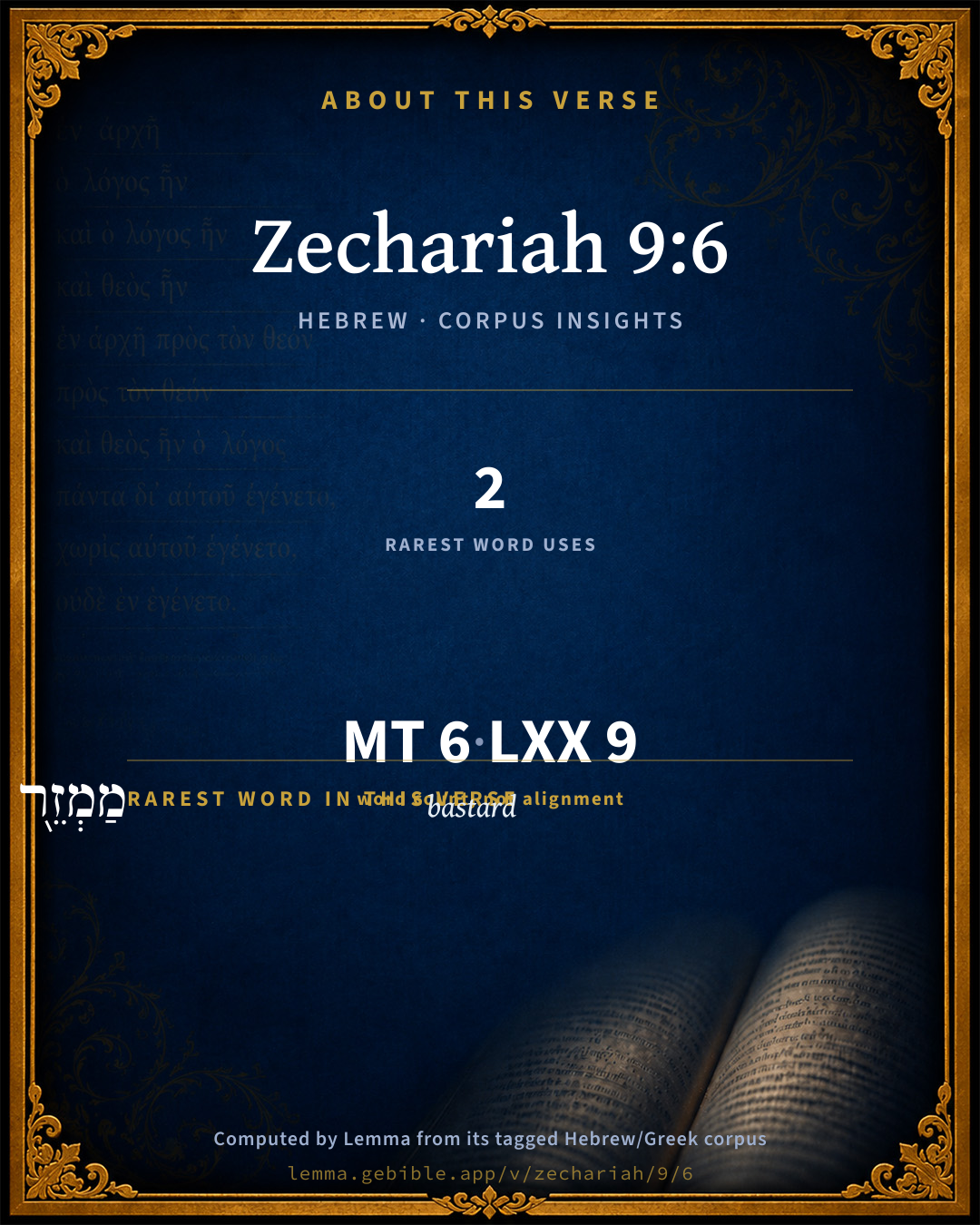
The rarest word here is מַמְזֵ֖ר bastard H4464 — appearing just 2 times in the whole Hebrew Bible.

Shared distinctive vocabulary

מַמְזֵ֖ר bastard H4464 occurs in 2 verses of the Hebrew Bible. Also found in:

Grammatical profile

  • 2 verbs
  • 4 nouns

Verb forms

  • וְיָשַׁ֥ב Qal · Perfect
  • וְהִכְרַתִּ֖י Hiphil · Perfect

Hebrew & Septuagint length

In English translation the verse runs 15 words from the Hebrew and 16 from the Septuagint (LXX English) — closely comparable.

A rough comparison of the two English renderings, which tokenize alike — not a word-level alignment.

Word counts can differ between the Hebrew and the Greek without any difference in meaning — e.g. the Hebrew direct-object marker אֵת has no separate Greek word, and Greek often adds the article ὁ.

In the original languages it is 6 Hebrew tokens and 9 Greek tokens — but the two are counted differently (Hebrew bundles its prefixes and suffixes into one token; the Greek is in lemma form), so that isn’t a like-for-like length.

Cross-references

9

Topical passages linked to Zechariah 9:6 in the Treasury of Scripture Knowledge — connected by theme and wording, ordered by reader-vote popularity; previews shown in the World English Bible.

  • Amos 1:8 I will cut off the inhabitant from Ashdod, And him who holds the scepter from Ashkelon; And I will turn my hand against Ekron; And the remnant of the Philistines will perish," says the Lord Yahweh.
  • Zephaniah 2:10 This they will have for their pride, because they have reproached and magnified themselves against the people of Yahweh of Hosts.
  • 1 Peter 5:5 Likewise, you younger ones, be subject to the elder. Yes, all of you gird yourselves with humility, to subject yourselves to one another; for "God resists the proud, but gives grace to the humble."
  • Ecclesiastes 2:18–21 I hated all my labor in which I labored under the sun, seeing that I must leave it to the man who comes after me.
  • Ecclesiastes 6:2 a man to whom God gives riches, wealth, and honor, so that he lacks nothing for his soul of all that he desires, yet God gives him no power to eat of it, but an alien eats it. This is vanity, and it is an evil disease.
  • Isaiah 2:12–17 For there will be a day of Yahweh of Hosts for all that is proud and haughty, And for all that is lifted up; And it shall be brought low:
  • Isaiah 23:9 Yahweh of hosts has purposed it, to stain the pride of all glory, to bring into contempt all the honorable of the earth.
  • Isaiah 28:1 Woe to the crown of pride of the drunkards of Ephraim, and to the fading flower of his glorious beauty, which is on the head of the fat valley of those who are overcome with wine!
  • Daniel 4:37 Now I, Nebuchadnezzar, praise and extol and honor the King of heaven; for all his works are truth, and his ways justice; and those who walk in pride he is able to abase.

Cross-references courtesy of OpenBible.info (CC BY 4.0).

Hebrew and Greek witnesses Masoretic Hebrew ↔ Greek Septuagint

The same verse in the two great witnesses to the Old Testament, shown verse-for-verse.

These are two independent witnesses, not word-aligned to each other, and the Septuagint is shown in lemma (dictionary) form.

Hebrew Zechariah 9:6 Masoretic · Westminster Leningrad Codex

וְיָשַׁ֥ב מַמְזֵ֖ר בְּאַשְׁדּ֑וֹד וְהִכְרַתִּ֖י גְּא֥וֹן פְּלִשְׁתִּֽים

Foriegners will dwell in Ashdod, And I will cut off the pride of the Philistines.

World English Bible · Public Domain

Greek LXX Zechariah 9:6 Septuagint · lemma form

καί καταοἰκέω ἀλλογενής ἐν ἄζωτος καί κατααἱρέω ὕβρις ἀλλόφυλος

And aliens shall dwell in Azotus, and I will bring down the pride of the Philistines.

LXX2012 (modern English Septuagint) · Public Domain

On this verse, Joseph Benson's Commentary discusses the Septuagint’s reading. Read the note in Commentary ↓

Hebrew: Westminster Leningrad Codex (CC BY 4.0). Greek: Septuagint (public domain); English from LXX2012 (modern English Septuagint) (Public Domain). How the Septuagint differs from the Hebrew →

Targum (Aramaic paraphrase)

1

The Targum is the ancient Jewish Aramaic paraphrase of the Hebrew Scriptures — an interpretive translation, not the Hebrew text itself. Onkelos (literal) and Pseudo-Jonathan (expansive) render the Torah, and Jonathan the Prophets. Coverage is partial: where no permissively-licensed English translation exists for a verse, only the Aramaic is shown. This is verse-level text, not a word-by-word alignment to the Hebrew.

  1. Targum Jonathan Prophets (Joshua–Malachi)
    וִיתוּבוּן בֵּית יִשְׂרָאֵל בְּאַשְׁדוֹד דַהֲווֹ בָּה כְּנוּכְרָאִין וַאֲבַטֵיל רְבוּת פְּלִשְׁתָּאֵי:

    (no public-domain English translation for this verse)

    Targum Jonathan — Aramaic: “Mikraot Gedolot” (public domain). English: “Sefaria Community Translation” (CC0 1.0 (public-domain dedication)); “London "Chaldee Paraphrase," 1871” (public domain). Text via Sefaria.

Commentary

Notes on Zechariah 9:6 from classic Christian and Jewish commentators (each source and its license shown beneath its notes). The classic Christian expositions comment on the surrounding passage and are grouped to its opening verse, so a note may address several verses; the Jewish commentaries on the Tanakh (Rashi and others) are per-verse, so they appear only where the commentator wrote on this verse.

Lemma curates 59 commentaries, every one of them public domain or Creative Commons licensed, each selected and text-cleaned for this edition rather than reprinted as found. About our sources →

Trapp's Complete Commentary

John Trapp

Zec 9:6 And a bastard shall dwell in Ashdod, and I will cut off the pride of the Philistines.

Ver. 6. But a bastard shall dwell at Ashdod] Perhaps he meaneth Alexander; who was a bastard, by his mother Olympia’s confession. The Greek here hath αλλογενης, a stranger, an alien, or one of another generation, as the Greeks under Alexander, and afterwards the Jews under the Maccabees. Whence the Chaldee turns this text thus; The house of Israel shall dwell in Ashdod, and shall be there as strangers which have no father. In the Acts we find that the Jews were scattered up and down Palestine, and some found at Azotus, or Ashdod, Act 8:40.

And I will cut off the pride of the Philistines] That is, their wealth, strength, and whatsoever else they gloried in, and grew insolent, and injurious to the Church.

John Trapp, A Commentary or Exposition upon All the Books of the Old and New Testament (1647–1656) — public domain. Text from a community e-Sword module.

Joseph Benson's Commentary

Zec 9:6-7. And a bastard shall dwell in Ashdod — Newcome reads, strangers, understanding by the expression, “a strange and spurious race; a despicable race; born of harlots.” But Blayney, who reads, a stranger, observes, that the Hebrew word, ממזרhere used, does not imply an illegitimate offspring. In proof of which he quotes Psa 69:8, where מוזר, a word from which the above is derived, is translated a stranger, so that he supposes the sense of this clause to be, that the city of Ashdod should be peopled with strangers, not descended from its present possessors. The LXX. and Chaldee understand the expression in the same sense. And I will cut off the pride of the Philistines — Ashdod, or Azotus, was burned and destroyed by Jonathan, brother of Judas Maccabeus, and eight thousand of its men burned or slain, 1Ma 10:84-85. These were probably intended here by the pride of the Philistines, that is, the pride, or excellence, of the ancient inhabitants, in whose room the strangers were introduced. And I will take away his blood out of his mouth — The Philistine shall be brought down so low, that he shall not be in a condition to molest or threaten slaughter to his neighbours, as he did formerly. And his abominations from between his teeth — He shall be reduced to such poverty, that he shall no more make banquets in honour of his idols, and feast upon them. “The idolatrous and abominable practices of the Philistines shall cease. The metaphor is taken from beasts of prey, who gorge themselves with blood.” Ashdod is mentioned by Josephus among the cities of the Phenicians which were under the dominion of the Jews; and it is well known that they exacted of all who were under their authority, a conformity, in a certain degree, to their religious rites and ceremonies. This will explain what is meant by taking his blood, &c. The stranger was required to abstain from eating blood, and from such things as were held in abomination by the Jewish law. But he that remaineth, even he shall be for our God — This was fulfilled in the times of the Maccabees, and also in the times of Alexander Jannæus, who subdued their principal cities, as Josephus relates, (Antiq., lib. 13. cap. 23,) and made them part of the Jewish dominions, the inhabitants of several of which embraced the Jewish religion. And he shall be as a governor in Judah — Shall be regarded and honoured. Blayney renders it, Shall be as a citizen in Judah, considering the expression as being used in contrast to the word which he renders stranger, Zec 9:6; and signifying that the stranger who should come to dwell in Ashdod, would, after renouncing all his heathenish practices, become a convert to the true God, and, as a governor in Judah, entitled to all the same privileges in that city, as a prime citizen enjoyed among the Jews: terms these which exactly correspond with those used by St. Paul, who, having called the unconverted Gentiles, ξενοι και παροικοι, strangers and foreigners, entitles them, after their conversion, συμπολιται των αγιων και οικειοι του Θεου, fellow-citizens with the saints, and of the household of God, Eph 2:19. And Ekron as a Jebusite — And the Philistines shall have the same privileges allowed them, and be put on the same footing, as the Jebusites, the ancient inhabitants of Jerusalem were, when the Israelites conquered them: see Jdg 1:21.

Joseph Benson's Commentary on the Old and New Testaments (1811–1818) — public domain. Text from a community e-Sword module.

Tyndale Open Study Notes

Tyndale Open Resources

9:6 Foreigners: This Hebrew word occurs elsewhere only in Deut 23:2, where it refers to illegitimate children. Zechariah uses it to signify the Philistines’ eventual loss of political and social identity.

Tyndale Open Study Notes — © Tyndale Open Resources, licensed CC BY-SA 4.0. Text via the HelloAO Bible API.

Geneva Bible (1599)

Geneva Bible translators

Meaning, that all should be destroyed, save a very few, that should remain as strangers.

Geneva Bible (1599) marginal notes — public domain. Text via Bolls.life.

Jamieson, Fausset & Brown

Robert Jamieson, A. R. Fausset & David Brown

bastard--not the rightful heir; vile and low men, such as are bastards (Deu 23:2) [GROTIUS]. An alien; so the Septuagint; implying the desolation of the region wherein men shall not settle, but sojourn in only as aliens passing through [CALVIN].

Jamieson, Fausset & Brown — Commentary Critical and Explanatory on the Whole Bible (1871) — public domain (CC PDM 1.0). Text via the HelloAO Bible API.

Adam Clarke's Commentary

Verse 6. A bastard shall dwell in Ashdod] This character would suit Alexander very well, who most certainly was a bastard; for his mother Olympia said that Jupiter Ammon entered her apartment in the shape of a dragon, and begat Alexander! Could her husband Philip believe this? The word signifies a stranger.

Adam Clarke's Commentary on the Bible (1810–1826) — public domain. Text from a community e-Sword/MySword module.

John Calvin's Commentaries

In this verse the Prophet denounces a similar ruin on Azotus, and the whole land of the Philistines, or on the whole land of Palestine. For what interpreters say, that the Jews would dwell at Azotus as strangers, that is, though they had previously been counted aliens, is to reach neither heaven nor earth. The Prophet on the contrary means, that after the destruction of these cities, if any inhabitants remained, they would be like strangers, without any certain habitation. The Prophet then mentions the effect, in order to show that the country would be waste and desolate, so as to contain no safe or fixed dwellings for its inhabitants. Some render it spurious, as it is rendered in some other places; and they understand it of the Jews, because they had been before in a mean condition, as though they were like a spurious race. But their opinion is probable, who derive ממזר, memezar, from זור, zur, which means to peregrinate; and they quote other instances, in which the double ממ, mem, is used in the formations of a noun; and it is easy to prove, from many passages of scripture, that ממזר, memezar, means a stranger. And if any one carefully considers the design of the Prophet, he will see the truth of what I have said — that is, that his object is to show, that all the inhabitants of Azotus, and of the land of the Philistine, would be like lodgers, because all places would be desolate through the slaughter and devastations of enemies. As then Ashdod and Palestine had been before noted for the number of their people, the Prophet says that all the cities of Palestine, and the city Ashdod, would be deserted, except that there would be there a few scattered and wandering inhabitants, like those who sojourn in a strange land. It follows —

John Calvin's Commentaries (1540-1563) — public domain. Text from the Calvin Translation Society English edition (1840s-50s) via the Christian Classics Ethereal Library (ccel.org). Calvin's coverage is partial (roughly two-thirds of the Bible); uncommented books and verses are honest gaps, never fabricated. The 19th-century editor's footnotes and remarks are omitted so the notes are faithfully Calvin's own voice.

Ellicott's Commentary for English Readers

(6) A bastard.—i.e., a mixed race. It was a special point in Alexander’s policy to break up nationalities, and to fuse different peoples.

A Bible Commentary for English Readers, edited by Charles John Ellicott (1878–1897) — public domain. Text from a community e-Sword module.

The Cambridge Bible for Schools and Colleges

gen. ed. J. J. S. Perowne

6. a bastard] The word only occurs here and in Deu_23:2 (3, Heb.). There it is probably used of one born of incest or adultery. (Speaker’s Commentary, Vol. I. pt. ii. p. 884.) Here perhaps it is employed rather as a term of contempt, “a mixed and ignoble race” (a bastard race, R. V. margin), than in its strictly literal sense. The LXX. who render ἐκ πορνῆς in Deut. have here ἀλλογενής.

The Cambridge Bible for Schools and Colleges (gen. ed. J. J. S. Perowne; Cambridge University Press, 1878–1918) — public domain. Text from a community e-Sword module.

John Gill's Exposition

And a bastard shall dwell in Ashdod,.... Some (p) take "mamzer", the word for "bastard", to be the name of a people that should dwell in Ashdod; this is the same place with Azotus, Act 8:40 and was also one of the five lordships of the Philistines, Jos 13:3 some, by the "bastard" here, understand Alexander the great, who gave out that he was not the son of Philip, but of Jupiter Ammon: others think Jonathan the Maccabee is intended, who took this place and burnt it with fire, and the temple of Dagon in it,

"83 The horsemen also, being scattered in the field, fled to Azotus, and went into Bethdagon, their idol's temple, for safety. 84 But Jonathan set fire on Azotus, and the cities round about it, and took their spoils; and the temple of Dagon, with them that were fled into it, he burned with fire.'' (1 Maccabees 10)

and though he was not a bastard, yet was a stranger to the Philistines; in which sense the Jewish commentators, Jarchi and Kimchi, interpret the word, and understand it of the Israelites who should dwell in this place; even those, as Aben Ezra says, who were abject, mean, and despised among the Israelites; which would be a great mortification to the proud Philistines, as is suggested in the next clause: and to this sense the Targum paraphrases the words,

"and the house of Israel shall dwell in Ashdod, who shall be in it as strangers:''

but it is best to understand this of Israelites indeed, of true Christians, who are accounted spurious, not the children of God, but aliens and strangers, the filth of the world, and the offscouring of all things; who should dwell here when the Gospel was preached in it, as doubtless it was by Philip, Act 8:40 and so the Septuagint, Syriac, and Arabic versions render the words, "and strangers shall dwell in Ashdod"; men of another religion, and despised and not owned even by their relations, as if they were bastards.

And I will cut off the pride of the Philistines; by Alexander, and by the Jews in the times of the Maccabees, bringing them into subjection, which their haughty spirits could not well bear; or through the abolition of their old Heathenish religion, in which they prided themselves. It may be observed, that all along the conversion of these various people to Christianity is expressed in terms which seem to signify the destruction of them; and that partly because, in the literal sense, reference is had to the conquest of them by Alexander, by which means the Greek language obtained in Syria and Phoenicia, into which, a little after, the Bible was translated, which paved the way for the bringing of these people to the knowledge of Christ, through the preaching of the Gospel; and partly because Paganism was abolished in these places when Christianity prevailed.

(p) R. Judah ben Bileam apud Aben Ezram in loc.

John Gill's Exposition of the Whole Bible (1746–1763) — public domain (CC PDM 1.0). Text via the HelloAO Bible API.

Albert Barnes' Notes on the Bible

And a bastard shall dwell at Ashdod - o The “mamzer” was one born unlawfully, whether out of marriage, or in forbidden marriage, or in adultery . Here it is, probably, like our “spurious brood” ; whether it was so itself or in the eyes of the Ashdodites; whence he adds.

I will cut off the pride of the Philistines - Pride would survive the ruin of their country, the capture of their cities, the less of independence. It would not survive the loss of their nationality; for they themselves would not be the same people, who were proud of their long descent and their victories over Israel. The breaking down of nationalities, which was the policy of Alexander, was an instrument in God’s hands in cutting off their pride.

Albert Barnes' Notes on the Bible (1834–1885) — public domain. Text from a community e-Sword/MySword module.

Haydock's Catholic Bible Commentary

Divider. Hebrew mamzer; "bastard," or rather "stranger." It is reported that Alexander was the illegitimate son of Nestabanes, whom Olympius took for Jupiter. (Plut.[Plutarch]; Just. xi.) --- But these might be popular reports. The sequel seems to shew that the Jews, &c., occupied the towns of the Philistines under the Machabees. (Chaldean) (Grotius) (Calmet) --- The divider may denote any conqueror. (Menochius)

George Leo Haydock (1774–1849), Haydock's Catholic Family Bible and Commentary, 1859 edition — public domain. Excludes Psalms (Douay-Rheims chapter numbering differs from Protestant) and Deuterocanonical books (Catholic canon only).

Matthew Poole's English Annotations

A bastard; some say Alexander the Great was by Olympia’s confession declared to be a bastard, and that he is here pointed at; but I think rather strangers, who have no right of inheritance, yet did dwell here, are meant, called bastards because not the rightful heirs, but intruders.

Ashdod; Azotus, now a strong town, a city of the Philistines, but still of the same temper with the rest against the Jews, and now, as before, Zep 2:4, must suffer with them.

I will cut off the pride of the Philistines, in these strong cities did the Philistines glory, and boast themselves as having been too hard for the Jews, even at their first coming to Canaan, who could not take their cities from them; but now the fatal change is foretold, God will cut off this pride of theirs, as he did in the times of the Grecians, the Seleucidae, and the Maccabees.

Matthew Poole's English Annotations on the Holy Bible (1683–1685) — public domain. Text from a community e-Sword/MySword module.

Whedon's Commentary on the Bible

Daniel D. Whedon

6. The full-blooded Philistines will be displaced by a mixed race.

A bastard — Margin R.V., “a bastard race.” An obscure phrase. In Deu_23:2, the word denotes one who is not a full-blooded citizen, one with whose birth a blemish of some sort is connected. Here it seems to denote a race which, from the view point of the Philistines, is not full-blooded, a foreign or mixed race. The term implies nothing concerning the moral character of the new population.

Ashdod — What is true of one city is true of the whole land.

The pride of the Philistines — The judgment implied in 6a will be sufficient to bring to an end the pride and haughtiness of the Philistines; they will be completely humiliated.

Daniel D. Whedon (gen. ed.), Commentary on the Old and New Testaments (1874–1909) — public domain. Text from a community e-Sword module.

The Pulpit Commentary

A Bastard. The word (mamzer) occurs in Deu_23:2 (3, Hebrew), where it may possibly mean "a stranger." It is generally considered to signify one whose birth has a blemish in it one born of incest or adultery. In Deuteronomy the LXX renders, ek porhv , "one of harlot birth;" here, allogenhv , "foreigner." The Vulgate has separator, which is explained as meaning either the Lord, who as Judge divides the just from the unjust, or the Conqueror, who divides the spoil and assigns to captives their fate. Here it doubtless signifies "a bastard race" (as the Revised Version margin translates); a rabble of aliens shall inhabit Ashdod, which shall lose its own native population. The Targum explains it differently, considering that by the expression is meant that Ashdod shall be inhabited by Israelites, who are deemed "strangers" by the Philistines. Ashdod. (see note on Amo_1:8) The pride. All in which they prided themselves. This sums up the prophecy against the several Philistine cities. Their very nationality shall be lost.

The Pulpit Commentary (1880–1919), ed. H.D.M. Spence-Jones & Joseph S. Exell — public domain. Text from a community e-Sword module.

John Wesley's Explanatory Notes

A bastard - Strangers, who have no right of inheritance.

John Wesley, Explanatory Notes Upon the Whole Bible (1754–1765) — public domain. Text via the GEBible commentary corpus.

Rashi

Rabbi Shlomo Yitzchaki (Rashi)

And the strangers shall dwell in Ashdod And a strange people shall dwell in Ashdod. Those are the Israelites, who were strange in it.

Rashi on the Tanakh — English translations: “The Judaica Press complete Tanach with Rashi, translated by A. J. Rosenberg” (CC BY 4.0); “Pentateuch with Rashi's commentary by M. Rosenbaum and A.M. Silbermann, 1929-1934” (public domain); “The Metsudah Tanach series, Lakewood, N.J” (CC BY 4.0); and “The Book of Joshua, Metsudah Publications, 1997” (CC BY 4.0). Text via Sefaria.

Lesson kit

Teaching starters — assembled from the data on this page, not authored interpretation. Every prompt links to the verse data it draws on. Edit before teaching.

Zechariah, in the Prophets, opens this verse with 6 words (6 distinct Hebrew lemmas). Its most distinctive word is mamzêr (“bastard”). A historical commentator’s framing appears above. Read the whole chapter for the surrounding context.

Discussion questions

  1. What does “bastard” (mamzêr) contribute to the verse as a whole?
  2. Deuteronomy 23:2 shares the word «bastard» with this verse. How do the two illuminate each other?
  3. These translations render this verse differently; the difference is in the English rendering, not the original. What questions does that raise?
  4. The verb «וְיָשַׁ֥ב» is Qal Perfect. How does its form color the action?
  5. Reading how Trapp's Complete Commentary and Joseph Benson's Commentary read this verse, where do the two commentators agree and where do they part?

Things to notice

Reading settings

Reading text

Shown beneath each verse's original-language words.

Old Testament
Old Testament edition

Read the OT as the Masoretic Hebrew (MT) or the Greek Septuagint (LXX).

English shown for the Greek Septuagint (in the Hebrew ↔ Greek comparison).

Comparing translations? Open the Compare panel on any verse page to stack up to four side by side.