
Zechariah 7:4

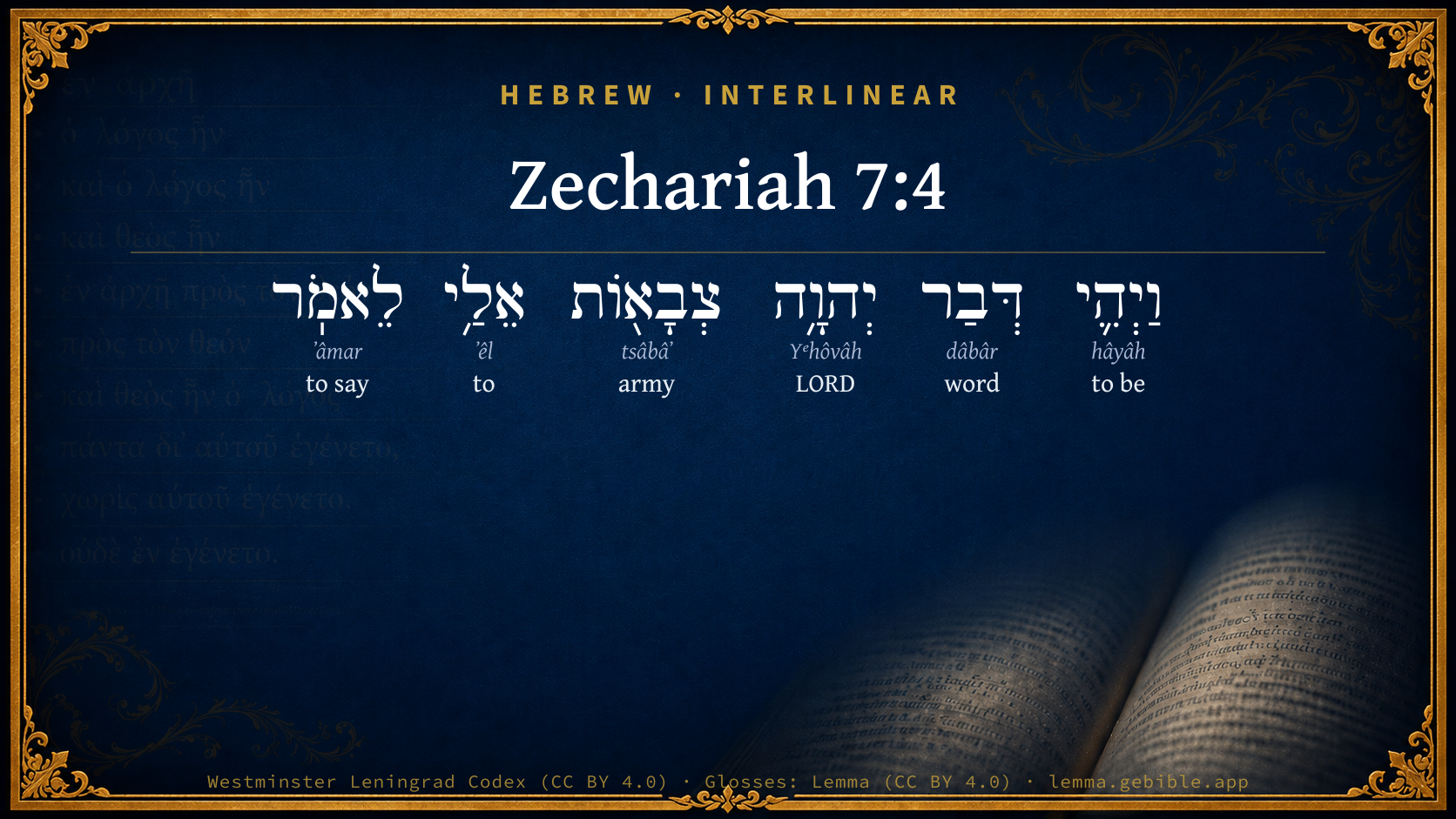
Hebrew (Westminster Leningrad Codex) Zechariah 7:4 appears in the Hebrew Old Testament. The text above is from the Westminster Leningrad Codex. Each word links to its Strong’s number, a concise gloss, and parsing drawn from the Open Scriptures Hebrew Bible morphology. Click any word for its full Brown-Driver-Briggs (BDB) entry.
Download image
Cite this verse

Zechariah 7:4 (World English Bible). Public Domain. Lemma interlinear Bible study tool, https://lemma.gebible.app/v/zechariah/7/4.

Show BibTeX & RIS
BibTeX
RIS
English Translation
Then the word of Yahweh of Hosts came to me, saying,
World English Bible · Public Domain
Download a study sheet

One document with this verse’s original text, its word-by-word gloss line, the meaning frame, cross-references with their text, attributed commentary, and full source and license credits — printable, and it pastes into notes with its structure intact.

This verse Autodidact and up

Study sheet (.html) Plain text (.txt)

A passage Seminary Student

Up to 50 verses in one chapter. A passage sheet keeps up to 6 commentary sources and 12 cross-references per verse, in the order this page ranks them, and says so on the sheet whenever that leaves anything out. Ask for a single verse and you get the Autodidact verse sheet above.

Everything on this page stays free to read, with no account — the sheet is a download of what is already on screen, not access to it.

Want to remove ads? Support Godless Engineer
Compare translations 3

The same verse in 3 English versions, stacked beneath the original-language interlinear above. Click any original word for its lexicon entry.

Each is an independent rendering of the whole verse — the interlinear is not word-aligned to these translations.

Highlighted words mark where these versions differ — a whole-verse word diff, not a word-by-word alignment.

  • World English Bible Public Domain
    Then the word of Yahweh of Hosts came to me, saying,
  • King James Version Public Domain
    Then came the word of the LORD of hosts unto me, saying,
  • unfoldingWord Literal Text CC BY-SA 4.0
    And the word of Yahweh of Armies came to me, saying,

unfoldingWord Literal Text — © unfoldingWord, licensed CC BY-SA 4.0. Word-aligned USFM3 via Door43 (git.door43.org/unfoldingWord/en_ult).

Versions to compare (up to 4)

3 of 4 selected

Show all 18 translations

Every available English version of this verse, each an independent rendering of the whole verse.

  • World English Bible Public Domain
    Then the word of Yahweh of Hosts came to me, saying,
  • Berean Standard Bible Public Domain
    Then the word of the LORD of Hosts came to me, saying,
  • Majority Standard Bible Public Domain
    Then the word of the LORD of Hosts came to me, saying,
  • King James Version Public Domain
    Then came the word of the LORD of hosts unto me, saying,
  • American Standard Version (1901) Public Domain
    Then came the word of Jehovah of hosts unto me, saying,
  • Revised Version (1885) Public Domain
    Then came the word of the LORD of hosts unto me, saying,
  • Geneva Bible (1599) Public Domain
    Then came the word of the Lord of hostes vnto me, saying,
  • Douay-Rheims (1899) Public Domain
    And the word of the Lord of hosts came to me, saying:
  • Young's Literal Translation Public Domain
    And there is a word of Jehovah of Hosts unto me, saying:
  • Literal Standard Version CC BY-SA 4.0
    And there is a word of YHWH of Hosts to me, saying,
  • Unlocked Literal Bible CC BY-SA 4.0
    So the word of Yahweh of hosts came to me, saying,
  • unfoldingWord Literal Text CC BY-SA 4.0
    And the word of Yahweh of Armies came to me, saying,
  • Darby Bible Public Domain
    And the word of Jehovah of hosts came unto me, saying,
  • World Messianic Bible Public Domain
    Then the word of the LORD of Hosts came to me, saying,
  • Webster's Bible Public Domain
    Then came the word of the LORD of hosts to me, saying,
  • Free Bible Version CC BY-SA 4.0
    The Lord Almighty sent a message to me saying,
  • Bible in Basic English Public Domain
    Then the word of the Lord of armies came to me, saying
  • JPS Tanakh (1917) Public Domain
    Then came the word of the LORD of hosts unto me, saying:

Literal Standard Version (2020), Covenant Press — licensed CC BY-SA 4.0. Text via the HelloAO Bible API (eBible.org). Unlocked Literal Bible (unfoldingWord) — licensed CC BY-SA 4.0. Text via the HelloAO Bible API (eBible.org). unfoldingWord Literal Text — © unfoldingWord, licensed CC BY-SA 4.0. Word-aligned USFM3 via Door43 (git.door43.org/unfoldingWord/en_ult). Free Bible Version, Dr. Jonathan Gallagher — licensed CC BY-SA 4.0. Text via the HelloAO Bible API (eBible.org).

Word by word

More ways to search: Search by grammar → Find every occurrence → Compare this word →

Practice this passage: Drill this verse → Learn its vocabulary →

About this verse

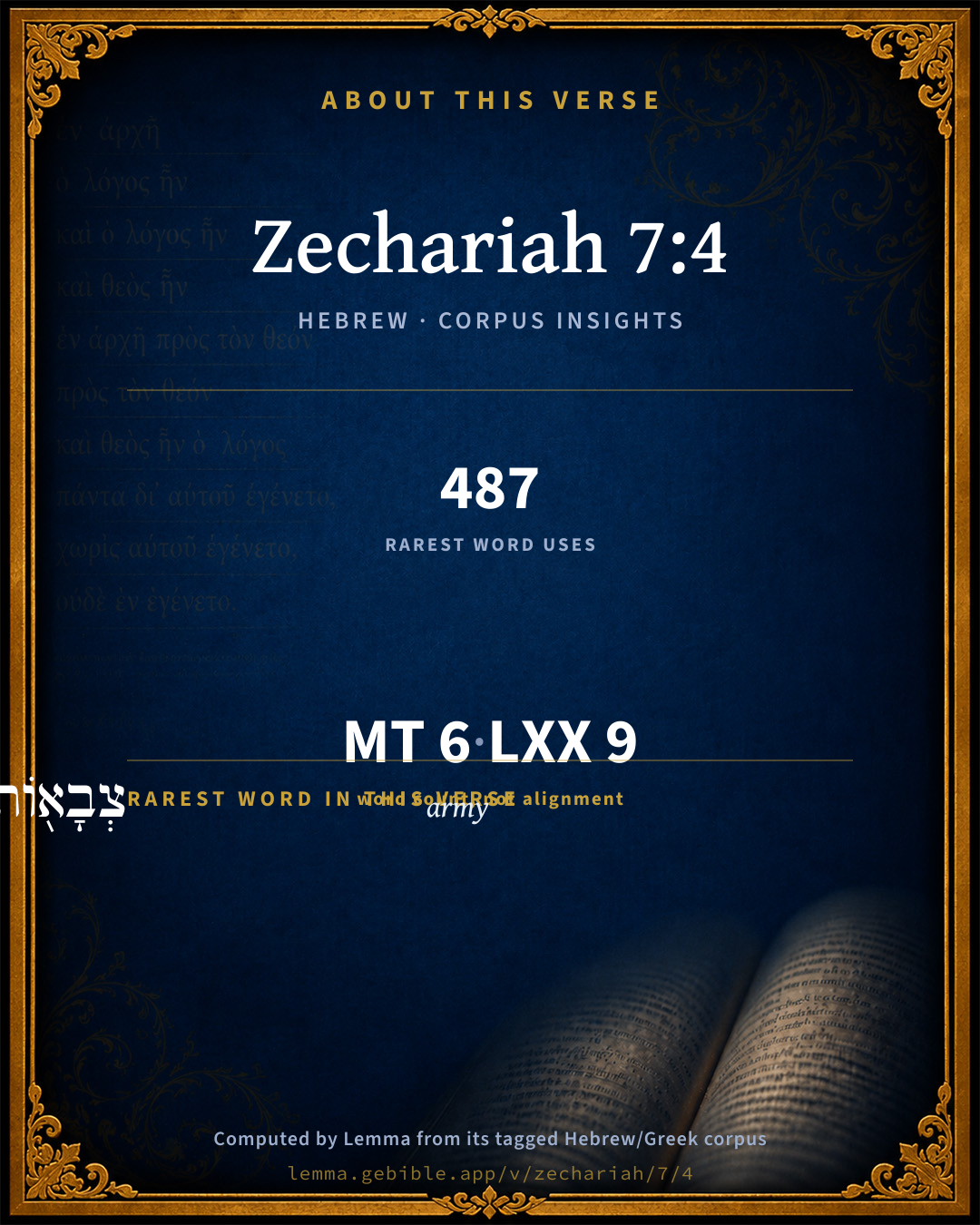
These counts appear in no published source. They are computed here, from the morphology-tagged text and Lemma’s own curated glosses. What Lemma adds →

6
words
6
distinct lemmas
Prophets
section

Grammatical profile

  • 2 verbs
  • 3 nouns
  • 1 preposition

Verb forms

  • וַיְהִ֛י Qal · Sequential Imperfect
  • לֵאמֹֽר Qal · Infinitive Construct

Hebrew & Septuagint length

In English translation the verse runs 11 words from the Hebrew and 12 from the Septuagint (LXX English) — closely comparable.

A rough comparison of the two English renderings, which tokenize alike — not a word-level alignment.

Word counts can differ between the Hebrew and the Greek without any difference in meaning — e.g. the Hebrew direct-object marker אֵת has no separate Greek word, and Greek often adds the article ὁ.

In the original languages it is 6 Hebrew tokens and 9 Greek tokens — but the two are counted differently (Hebrew bundles its prefixes and suffixes into one token; the Greek is in lemma form), so that isn’t a like-for-like length.

Cross-references

1

Topical passages linked to Zechariah 7:4 in the Treasury of Scripture Knowledge — connected by theme and wording, ordered by reader-vote popularity; previews shown in the World English Bible.

  • Isaiah 10:16 Therefore will the Lord, Yahweh of Hosts, send among his fat ones leanness; and under his glory there shall be kindled a burning like the burning of fire.

Cross-references courtesy of OpenBible.info (CC BY 4.0).

Hebrew and Greek witnesses Masoretic Hebrew ↔ Greek Septuagint

The same verse in the two great witnesses to the Old Testament, shown verse-for-verse.

These are two independent witnesses, not word-aligned to each other, and the Septuagint is shown in lemma (dictionary) form.

Hebrew Zechariah 7:4 Masoretic · Westminster Leningrad Codex

וַיְהִ֛י דְּבַר יְהוָ֥ה צְבָא֖וֹת אֵלַ֥י לֵאמֹֽר

Then the word of Yahweh of Hosts came to me, saying,

World English Bible · Public Domain

Greek LXX Zechariah 7:4 Septuagint · lemma form

καί γίγνομαι λόγος κύριος ὁ δύναμις πρός ἐγώ λέγω

And the word of the Lord of hosts came to me, saying,

LXX2012 (modern English Septuagint) · Public Domain

On this verse, Keil & Delitzsch discusses the Septuagint’s reading. Read the note in Commentary ↓

Hebrew: Westminster Leningrad Codex (CC BY 4.0). Greek: Septuagint (public domain); English from LXX2012 (modern English Septuagint) (Public Domain). How the Septuagint differs from the Hebrew →

Targum (Aramaic paraphrase)

1

The Targum is the ancient Jewish Aramaic paraphrase of the Hebrew Scriptures — an interpretive translation, not the Hebrew text itself. Onkelos (literal) and Pseudo-Jonathan (expansive) render the Torah, and Jonathan the Prophets. Coverage is partial: where no permissively-licensed English translation exists for a verse, only the Aramaic is shown. This is verse-level text, not a word-by-word alignment to the Hebrew.

  1. Targum Jonathan Prophets (Joshua–Malachi)
    וַהֲוָה פִּתְגַם נְבוּאָה מִן קֳדָם יְיָ עִמִי לְמֵימָר:

    (no public-domain English translation for this verse)

    Targum Jonathan — Aramaic: “Mikraot Gedolot” (public domain). English: “Sefaria Community Translation” (CC0 1.0 (public-domain dedication)); “London "Chaldee Paraphrase," 1871” (public domain). Text via Sefaria.

Commentary

Notes on Zechariah 7:4 from classic Christian and Jewish commentators (each source and its license shown beneath its notes). The classic Christian expositions comment on the surrounding passage and are grouped to its opening verse, so a note may address several verses; the Jewish commentaries on the Tanakh (Rashi and others) are per-verse, so they appear only where the commentator wrote on this verse.

Lemma curates 59 commentaries, every one of them public domain or Creative Commons licensed, each selected and text-cleaned for this edition rather than reprinted as found. About our sources →

Trapp's Complete Commentary

John Trapp

Zec 7:4 Then came the word of the LORD of hosts unto me, saying,

Ver. 4. Then came the word of the Lord of hosts] This is often prefaced, for authority’s sake; and to procure audience and reverence. The Lord God hath spoken, who can but be affected? See that ye despise not him that speaketh from heaven. The angel, Mat 28:7, useth no other argument to assure the women of the truth of what he had told them but this, "Lo, I have told you."

John Trapp, A Commentary or Exposition upon All the Books of the Old and New Testament (1647–1656) — public domain. Text from a community e-Sword module.

The Biblical Illustrator

Joseph S. Exell

Zec_7:4-9

Did ye at all fast unto Me, even to Me?

Rebuke of mere ceremonies

God had, through successive ages, exhorted the Jews to true repentance, and condemned their dissimulation, that they might not think that true religion was made up of fasting and of similar things. Fastings being of themselves of no moment, a beginning ought to be made with true religion and spiritual worship. When this question about the fast was raised by the captives, much disputing prevailed among the people. The Jews ever reverted to their old ways, being blindly attached to their frigid ceremonies, and thinking in this manner to propitiate God, so the prophet derides their preposterous labour and toil. See, he says, the only question now is, whether there should be fasting, as though this were the principal thing before God; in the meantime, godliness is neglected, and real calling on God; the whole of spiritual worship is also esteemed by you as nothing, and no integrity of life prevails: for ye bite one another, plunder one another, wrong one another, and are guilty of lying; ye heedlessly close your eyes to such vices as these; and at the same time, when fasting is neglected, ye think that the whole of religion falls to the ground. These are your old ways, and such were commonly the thoughts and doings of your fathers; and it appears evident that ye trifle with God, and that ye are full of deceits, and that there is not in you a particle of true religion. For God formerly spoke loudly in your ears, and His words were not obscure when He exhorted you by His prophets; He showed to you what true repentance was, but effected nothing. Is it not then quite evident that ye are now acting deceitfully, when ye so carefully inquire about fasting? This reproof was needful, in order more sharply to stimulate them; it was wholly necessary to discover their hypocrisy, that they might not be too much pleased with external performances. (John Calvin.)

Fasting

A question about the propriety of continuing the stated fasts under the altered circumstances of the people brings a delegation to the prophet to solve this doubt. The date of this transaction was two years after the symbolic visions of the preceding portion. But the Jewish people needed something more than information in regard to the continuance of this fast. The whole doctrine of fasting had become overlaid with an incrustation of formalism and superstition that needed to be broken up. Fasting had become not a means but an end, a mere form, as it is in Mohammedan and papal countries at this day, and had attached to it an opus operatum that wholly destroyed its real value. They thought that God must bless them, indeed was bound to bless them, if they rigidly observed these outward rites, whatever was their inward character. Thus formalism acted in the time of the restoration, precisely as it acted in every subsequent period of the Church; and before a mere question of ritual observance could be settled, it was important that their minds should be set right on the deeper questions of their spiritual relations with God. The prophet, instead of answering the question about the fast of the fifth month, proceeds to rebuke them for their selfish and stupid will worship, and their ignorance in regard to the whole subject of fasting, not only as to this, but as to all the stated fasts that they had been observing. (T. V. Moore, D. D.)

The self-centredness of fasting

It is not enough to fast. That may be a trick; there may be a way of doing it which robs it of all its virtue and of all its significance. God takes our ceremonies to pieces and says aloud, What is the meaning of all this--your church going and hymn singing, and apparently decent observance of religious ordinances? Is it in reality unto Me, or it is unto yourselves? Fasting is not postponed feasting. Yet this is what it has been turned into many times. Fasting has become a process by which we have got ready for eating. We have kept at it were on one side all the things we have abstained from, and then, when the fasting day was over, we transferred the whole of them to the table and gorged ourselves with the very things we had fasted from. That is not fasting. When you fast from your bread, you must give your bread away--Is it not to deal thy bread to the hungry? Fasting is not to lock the cupboard where the bread is, and to say, We shall not want you today, but tomorrow about this time we shall be prepared for the feast. No, the loaf must be given away, and there must not be left one crust in the house. When we feast the poor, we truly fast ourselves. God will not have any other fasting. As for church going, what is the meaning of it? Is it to relieve the tedium of a dull night? Is it to hear something that will titillate the senses or momentarily please the fancy? Is it to get rid of something at home? Or does it express the spirit of adoration, the necessity of the souls immortality? Is it a coming to God because He is God? Is it worship, or a form of entertainment? The Lord thus searches into our ceremonies and says, What do they mean? So also with our feasting: the criticism of God is not partial: the judgment of heaven attends our banqueting and asks questions whilst the foaming goblet is in our hands. And when ye did eat, and when ye did drink, did not ye eat for yourselves, and drink for yourselves? (Zec_7:6). But, O Thou loving God, Thou art also our Creator, and are we not so made that we cannot get away from ourselves? The Lord answers, Yes, you are so made: but you forget there is a second creation, a miracle called incarnation, and following upon that a sacrament called Pentecost, the Whit-tide of the Spirits descent, so that a man shall be himself, yet no longer himself, yea another self; God will give him another heart. If any man be in Christ Jesus, he is not his old self one whit, but a new creature, with new aspirations, new necessities, new desires, with the restlessness which leads to contentment, with the ambition that despises the constellations because they are too small for its religious capacity. You are right when you say, you cannot get away from yourselves, your prayers are selfish unless you take great heed to them; but if you be rooted in Christ, living branches in the living Vine, why then you shall perform this miracle of being yourself and yet not yourself; of the earth, yet of the heaven; standing upon the earth, yet having a celestial citizenship and franchise. (Joseph Parker, D. D.)

How to keep a truly religious fast

The inquiry of the text concerns the fast of the fifth month, which was observed as a sad remembrance of the destruction of the city and temple of Jerusalem. The exiles had three other fasts. Did they really serve any religious end and purpose? Did not the people content themselves with a mere external show and performance, without any inward affliction and humiliation of their souls, in order to a real repentance? Did they not still go on in their sins, nay, and add to them on these occasions, fasting for strife and debate and oppression? Were they not worse rather than better for them? And therefore God had no regard to them. Notwithstanding the outward solemnities of fasting and prayer, there was nothing of a religious fast; Did ye at all fast unto Me, even unto Me? The prophet Isaiah calls a true fast, the fast which God hath chosen, and an acceptable day to the Lord.

I. In general, what is it to fast unto God?

1. A truly religious fast consists in the afflicting of our bodies by a strict abstinence.

2. In the humble confession of our sins to God, with shame and confusion of face.

3. In an earnest deprecation of Gods displeasure, and humble supplications to Him that He would avert His judgments, and turn away His anger from us.

4. In intercession with God for such spiritual and temporal blessings upon ourselves and others as are needful and convenient.

5. In alms and charity to the poor, that our humiliation and prayers may find acceptance with God.

II. In particular what is the duty of a day of solemn national repentance and humiliation? Apply the above five essentials of a true fast to the particular circumstances of the day. (J. Tillotson, D. D.)

True and mistaken fasting

The prophet expostulates with the people concerning their monthly fasts, whether they did indeed deserve that name, and were not rather a mere show and pretence of a religious fast. It is necessary to consider the original and occasion of these monthly fasts. When carried into captivity, the Jews appointed four annual fasts. (Zec_8:19.) The question is,--Did these fasts truly serve to any religious end and purpose? Were not the people rather worse than better for them? They were sensible of the judgments of God which were broken in upon them, but they did not turn from their sins, but persisted still in their obstinacy and disobedience. These fasts could not therefore be acceptable to God.

I. What is it to keep a truly religious fast?

1. A truly religious fast consists in the afflicting of our bodies by a strict abstinence that so they may be fit and proper instruments to promote and help forward the grief and trouble of our minds.

2. In the humble confession of our sins to God with shame and confusion of face, and with a hearty contrition and sorrow for them.

3. In an earnest deprecation of Gods displeasure, and humble supplications to Him that He would avert His judgments and turn away His anger from us.

4. In intercession with God for such spiritual and temporal blessings upon ourselves and others as are needful and convenient.

5. In alms and charity to the poor, that our humiliation and prayers may find acceptance with God.

II. What is our duty on a day appointed for solemn humiliation and repentance throughout the nation?

1. We should humble ourselves before God everyone for his own personal sins and miscarriages, whereby he hath provoked God, and increased the public guilt, and done his part to bring down the judgments and vengeance of God upon the nation. There cannot be a general reformation without the reformation of particular persons which do constitute and make up the generality.

2. We should heartily lament and bewail the sins of others, especially the great and crying sins of the nation. This hath been the temper and practice of good men in all ages. Illustrate by Jeremiah, Lot, David, Daniel, Ezra, etc. We should lament and bewail the general prevalence of impiety and vice which has diffused itself through all ranks and degrees of men, magistrates, ministers, and people.

3. We should earnestly deprecate Gods displeasure, and make our humble supplications to Him, that He would be graciously pleased to avert those terrible judgments which hang over us, and which we have just cause to fear may fall on us; and that He would be entreated by us at last to be appeased towards us, and to turn from the fierceness of His anger.

4. We should pour out our most earnest supplications for the preservation of their majesties sacred persons.

5. Our fasting and humiliation should be accompanied with our alms and charity to the poor and needy.

6. We should prosecute our repentance and good resolutions to the actual reformation and amendment of our lives. This is the proper fruit and effect of all our humiliation and good resolutions. Without this, all our fasting will signify nothing. (Archbishop Sharp.)

The Biblical Illustrator, edited by Joseph S. Exell (c. 1880s–1900s) — public domain. Text from a community e-Sword module.

Joseph Benson's Commentary

Zec 7:4-6. Then came the word of the Lord unto me — When these men had proposed their case, and were expecting the priests’ answer, God commissioned his prophet to give them the answer contained in the subsequent part of this and in the following chapter; saying, Speak unto all the people of the land — Let all the people in general, and not only those who have proposed the question, know what I am now about to say to thee, in answer to it. When ye fasted and mourned in the fifth and seventh month — “The Jews not only observed those fasts which were instituted by God himself, but likewise added others, in commemoration of great calamities. The exiled Jews instituted four of these fasts; one in the fourth month, (June 17,) in commemoration of the breach of the wall, mentioned Jer 52:7; one in the fifth month, (July 4,) in commemoration of the burning of the temple, Jer 52:12; one in the seventh month, (September 3,) for the murdering of Gedaliah, Jer 41:2; and one in the tenth month, (December 4,) in commemoration of the beginning of the siege, 2Ki 25:1. These fasts were observed, not only in their captivity, but likewise in Judea, between the reigns of Cyrus and Darius the son of Hystaspes; the Jews therefore, as we have remarked, particularly inquired concerning the observation of the fast on account of the burning of the temple, because that temple was now rebuilding; for they might doubt whether it was not improper to retain it any longer, as the reason had ceased which gave rise to it; or, whether the commemoration of past calamities was not of great utility to the morals of mankind.” See Grotius, and Calmet’s Dictionary on the word FASTS. Did ye fast at all unto me — Blayney renders it, Did ye fast any fastings of mine? Or, Did ye fast my fastings, mine? When ye fasted, were those fastings observed as mine, my ordinances? No: you did not fast with an intention to obey me, or from religious motives, and with sincere purposes of repentance and reformation. You lamented more the losses, inconveniences, and miseries you suffered, than the sinfulness of your conduct which brought these calamities upon you. And when ye did eat, did ye not eat for yourselves? — Did you not seek your own pleasure and convenience, and not my glory? I was as little regarded by you in your fasts as in your feasts.

Joseph Benson's Commentary on the Old and New Testaments (1811–1818) — public domain. Text from a community e-Sword module.

Whedon's Commentary on the Bible

Daniel D. Whedon

Fasting not an essential element of true religion, 4-6.

The new revelation (Zec_7:4 ff.; see on Zec_1:1) has to do with this inquiry. 5.

Unto all the people — All were interested in the fast, hence all would be interested in the prophet’s teaching.

The priests — They were always the conservatives, the prophets the progressives; the former were prone to emphasize the letter of the law, the latter the spirit, and because they were not bound to the letter they were able to lead the people into new and higher truth, though in doing this they frequently encountered the most bitter opposition of the priests. The new message had to do with the spirit of the law; therefore it was only natural that it should pass from the prophet to the priests, who in turn might pass it on to the people. We have here an illustration of a fact noted by Beecher, “The record represents the prophets as the medium through which the torah is given from the deity; the priests as the official custodians and administrators of the torah; and both as the expounders and interpreters of torah.”

The… seventh month — The third day of this month was observed as a day of fasting and mourning in commemoration of the murder of Gedaliah (2Ki_25:25-26; Jer_41:1 ff.).

Fifth — See on Zec_7:3.

Seventy years — In round numbers, seventy years had elapsed since the fall of the city.

Did ye at all fast unto me — Was the fast observed as a means of grace by which the people drew closer to God? Was Jehovah benefited in any way by their fasting? The pronoun is repeated for the sake of emphasis (Hag_1:4). 6.

Did not ye eat for yourselves — Eating is of value only to the eater. Jehovah derives no benefit either from their fasting or their feasting, but they should know whether or not the one or the other is useful to them.

Daniel D. Whedon (gen. ed.), Commentary on the Old and New Testaments (1874–1909) — public domain. Text from a community e-Sword module.

Keil & Delitzsch

C. F. Keil & F. Delitzsch

The first of these four words of God contains an exposure of what might be unwarrantable in the question and its motives, and open to disapproval. Zac 7:4. "And the word of Jehovah of hosts came to me thus, Zac 7:5. Speak to all the people of the land, and to the priests, saying, When ye fasted and mourned in the fifth and in the seventh (month), and that for seventy years, did ye, when fasting, fast to me? Zac 7:6. And when ye eat, and when ye drink, is it not ye who eat, and ye who drink? Zac 7:7. Does it not concern the words, which Jehovah has preached through the former prophets, when Jerusalem was inhabited and satisfied, and her towns round about her, and the south country and the low land were inhabited?" The thought of Zac 7:6 and Zac 7:7 is the following: It is a matter of indifference to God whether the people fast or not. The true fasting, which is well pleasing to God, consists not in a pharisaical abstinence from eating and drinking, but in the fact that men observe the word of God and live thereby, as the prophets before the captivity had already preached to the people. This overthrew the notion that men could acquire the favour of God by fasting, and left it to the people to decide whether they would any longer observe the previous fast-days; it also showed what God would require of them if they wished to obtain the promised blessings. For the inf. absol. see at Hag 1:6. The fasting in the seventh month was not the fast on the day of atonement which was prescribed in the law (Leviticus 23), but, as has been already observed, the fast in commemoration of the murder of Gedaliah. In the form צמתּני the suffix is not a substitute for the dative (Ges. 121, 4), but is to be taken as an accusative, expressive of the fact that the fasting related to God (Ewald, 315, b). The suffix is strengthened by אני for the sake of emphasis (Ges. 121, 3). In Zac 7:7 the form of the sentence is elliptical. The verb is omitted in the clause הלוא את־הדּברים, but not the subject, say זה, which many commentators supply, after the lxx, the Peshito, and the Vulgate ("Are these not the words which Jehovah announced?"), in which case את would have to be taken as nota nominativi. The sentence contains an aposiopesis, and is to be completed by supplying a verb, either "should ye not do or give heed to the words which," etc.? or "do ye not know the words?" ישׁבת, as in Zac 1:11, in the sense of sitting or dwelling; not in a passive sense, "to be inhabited," although it might be so expressed. שׁלוה is synonymous with שׁקטת in Zac 1:11. ישׁב, in the sense indicated at the close of the verse, is construed in the singular masculine, although it refers to a plurality of previous nouns (cf. Ges. 148, 2). In addition to Jerusalem, the following are mentioned as a periphrasis for the land of Judah: (1) her towns round about; these are the towns belonging to Jerusalem as the capital, towns of the mountains of Judah which were more or less dependent upon her: (2) the two rural districts, which also belonged to the kingdom of Judah, viz., the negeb, the south country (which Koehler erroneously identifies with the mountains of Judah; compare Jos 15:21 with Jos 15:48), and the shephēlâh, or lowland along the coast of the Mediterranean (see at Jos 15:33).

Keil & Delitzsch — Biblical Commentary on the Old Testament (1861–1891) — public domain (CC PDM 1.0). Text via the HelloAO Bible API. (Old Testament only.)

Tyndale Open Study Notes

Tyndale Open Resources

7:4-7 Rather than answering the question right away, Zechariah first confronted his hearers with their selfish motives and hypocrisy. The most important issue was whether or not their heart’s desire was really to please God and do his will; if not, it made no difference whether or not they kept a fast.

Tyndale Open Study Notes — © Tyndale Open Resources, licensed CC BY-SA 4.0. Text via the HelloAO Bible API.

John Calvin's Commentaries

Here the Prophet tells us that he was sent to the people and to the priests, not so much to teach the messengers who came from distant lands, as to correct the vices of his own nation; for the Jews had then begun, according to their usual manner, to dissemble with God, and had glided, as it has elsewhere appeared, into many evil practices. And it appears evident, that God did not commit to Zechariah what the messengers might bring back to Chaldea; but that an occasion was taken to remind the Jews, that they were to look to themselves. It may have been the case, that the priests themselves and all the rest had begun to raise a controversy, “How is this? our brethren inquire, whether the fast is to be still observed:” and the opinions might have been various. But as this is doubtful, I leave it as such. We however see that the Prophet does not speak here respecting the captives, nor does he address to their messengers anything which they might convey to Chaldea, but turns his discourse to the priests and to the people. The sum of the whole is, that while the captives gave no mean testimony of their religion, God reproved the Jews, who had returned to their own country, for ingratitude, as they had already begun to pollute themselves.

John Calvin's Commentaries (1540-1563) — public domain. Text from the Calvin Translation Society English edition (1840s-50s) via the Christian Classics Ethereal Library (ccel.org). Calvin's coverage is partial (roughly two-thirds of the Bible); uncommented books and verses are honest gaps, never fabricated. The 19th-century editor's footnotes and remarks are omitted so the notes are faithfully Calvin's own voice.

Ellicott's Commentary for English Readers

(4-7) The people (as in Isa_58:3-8) are rebuked for the hypocritical, or merely formal, nature of their fasts. The prophet does not, even further on, give any direct answer to their inquiry. He seems to have wished to show them that fasting or not fasting was a matter of only secondary consideration. Their fasts were undertaken on account of their sufferings; their sufferings were caused by their sins. So, then, their sins were the origin of their fasts. Let them remove sin from their midst, then fasting would be unnecessary. “All stated fasts tend to degenerate into superstition, unless there is a strong counteracting agency. The original reference to God is lost in the mere outward act. . . . Selfishness is the bane of all true piety, as godliness is its essence” (Moore).

A Bible Commentary for English Readers, edited by Charles John Ellicott (1878–1897) — public domain. Text from a community e-Sword module.

John Gill's Exposition

Then came the word of the Lord of hosts unto me, saying. Upon the sending of this embassy, and upon putting this question.

Then came the word of the Lord of hosts unto me, saying. Upon the sending of this embassy, and upon putting this question.

Zechariah 7:5

zac 7:5

zac 7:5

zac 7:5Speak unto all the people of the land,.... Of Judea, who had sent these men on this errand, and whom they represented, and in whose name they spake:

and to the priests; who were consulted on this occasion:

saying, When ye fasted and mourned in the fifth; on the seventh or tenth day of the fifth month Ab, on account of the temple being burnt by Nebuchadnezzar:

and seventh month; the month Tisri, which answers to September; on the third day of this month a fast was kept on account of the murder of Gedaliah, Jer 41:1 though Kimchi says he was slain on the first day of the month; but, because that was a feast day, keeping a day for a fast on this occasion was fixed on the day following:

even those seventy years; of their captivity, during which they kept the above fasts. The Jews say (w) there was no fast of the congregation, or public fast, kept in Babylon, but on the ninth of Ab, or the fifth month only; and if so, other fasts here, and in Zac 8:19, must be private ones. These seventy years are to be reckoned from the nineteenth of Nebuchadnezzar, when the city was destroyed, to the second or fourth of Darius:

did ye at all fast unto me, even to me? the fast they kept was not according to the command of God, but an appointment of theirs; nor was it directed to his glory; nor was it any profit or advantage to him; and therefore it was nothing to him whether they fasted or not; see Isa 58:3.

(w) T. Bab. Pesachim, fol. 54. 2.

John Gill's Exposition of the Whole Bible (1746–1763) — public domain (CC PDM 1.0). Text via the HelloAO Bible API.

Matthew Poole's English Annotations

Then, when these men had proposed their case, and expected the priests’ answer,

came the word of the Lord; an answer from God, which follows in the 7th and 8th chapters of this book at large.

Matthew Poole's English Annotations on the Holy Bible (1683–1685) — public domain. Text from a community e-Sword/MySword module.

The Pulpit Commentary

Vers. 4-7. In answer to the inquiry, the delegates are told that fasting is in itself an indifferent thing, but is to be estimated by the conduct of those who observe it.

Then came the word of the Lord. This formula marks the several portions of the answer to the inquiry (see ver. 8 Zec_8:1, Zec_8:18). The present verse takes up the sentence in ver. 1, interrupted by the explanation of the object of the deputation (vers. 2, 3).

The Pulpit Commentary (1880–1919), ed. H.D.M. Spence-Jones & Joseph S. Exell — public domain. Text from a community e-Sword module.

unfoldingWord translationNotes

Door43 World Missions Community

the word of Yahweh of hosts came to me, saying, "Speak

This idiom is used to introduce a special message from God. AT: "Yahweh of hosts gave me a message. He said, 'Speak" or "Yahweh of hosts spoke this message to me: 'Speak" (See: Idiom)

in the fifth and in the seventh month

"in months 5 and 7" (See: Ordinal Numbers)

in the fifth

The word "month" can be supplied in translation. AT: "in the fifth month" (See: Ellipsis)

in the seventh month

The assumed knowledge is that the Jews mourned during a part of the seventh month of the Hebrew calendar because in this month the remaining Jews in Jerusalem fled to Egypt after the murder of Gedaliah, whom the king of Babylon appointed as governor over Judah. The seventh month is during the last part of September and the first part of October on Western calendars. (See: Assumed Knowledge and Implicit Information and Hebrew Months)

for these seventy years

The assumed knowledge is that the people of Israel had been slaves in Babylon for 70 years. (See: Assumed Knowledge and Implicit Information and Numbers)

were you truly fasting for me?

This question is asked to make the people think about what their real reason for fasting had been. It can be translated as a statement. AT: "you were not really fasting for me." (See: Rhetorical Question)

When you ate and drank

Possible meanings are 1) when they feasted and drank when celebrating religious festivals or 2) when they ate and drank whenever they were not fasting.

did you not eat and drink for yourselves?

This question is used to make the people think about whether they were honoring Yahweh when they ate and drank. This can be translated as a statement. AT: "it was for yourselves that you ate and drank." (See: Rhetorical Question)

Were these not the same words ... to the west?

Yahweh uses a question to scold the people. This question can be translated as a statement. AT: "These are the same words ... to the west." (See: Rhetorical Question)

by the mouth of the former prophets

Here "mouth" is a metonym for the words spoken by the mouth. AT: "by the words of the former prophets" or "through the former prophets" (See: Metonymy)

you still inhabited Jerusalem

"you still lived in Jerusalem"

foothills

hills at the base of a mountain or mountain range

translationWords

word of God

Yahweh of hosts

priest

fast

mourn

year

word

preach

prophet

Jerusalem

prosper

Negev

unfoldingWord translationNotes — © Distant Shores Media and the Door43 World Missions Community, licensed CC BY-SA 4.0. Source: git.door43.org/Door43/en_tn.

Lesson kit

Teaching starters — assembled from the data on this page, not authored interpretation. Every prompt links to the verse data it draws on. Edit before teaching.

Zechariah, in the Prophets, opens this verse with 6 words (6 distinct Hebrew lemmas). Its most distinctive word is tsâbâʼ (“army”). A historical commentator’s framing appears above. Read the whole chapter for the surrounding context.

Discussion questions

  1. The word tsâbâʼ carries the sense “army.” How does it shape the verse?
  2. Isaiah 10:16 shares this passage’s theme. How do the two illuminate each other?
  3. These translations render this verse differently. What is at stake in choosing one wording over another?
  4. The verb «וַיְהִ֛י» is Qal Sequential Imperfect. How does its form color the action?
  5. Reading how Trapp's Complete Commentary and The Biblical Illustrator read this verse, where do the two commentators agree and where do they part?

Things to notice

Reading settings

Reading text

Shown beneath each verse's original-language words.

Old Testament
Old Testament edition

Read the OT as the Masoretic Hebrew (MT) or the Greek Septuagint (LXX).

English shown for the Greek Septuagint (in the Hebrew ↔ Greek comparison).

Comparing translations? Open the Compare panel on any verse page to stack up to four side by side.