
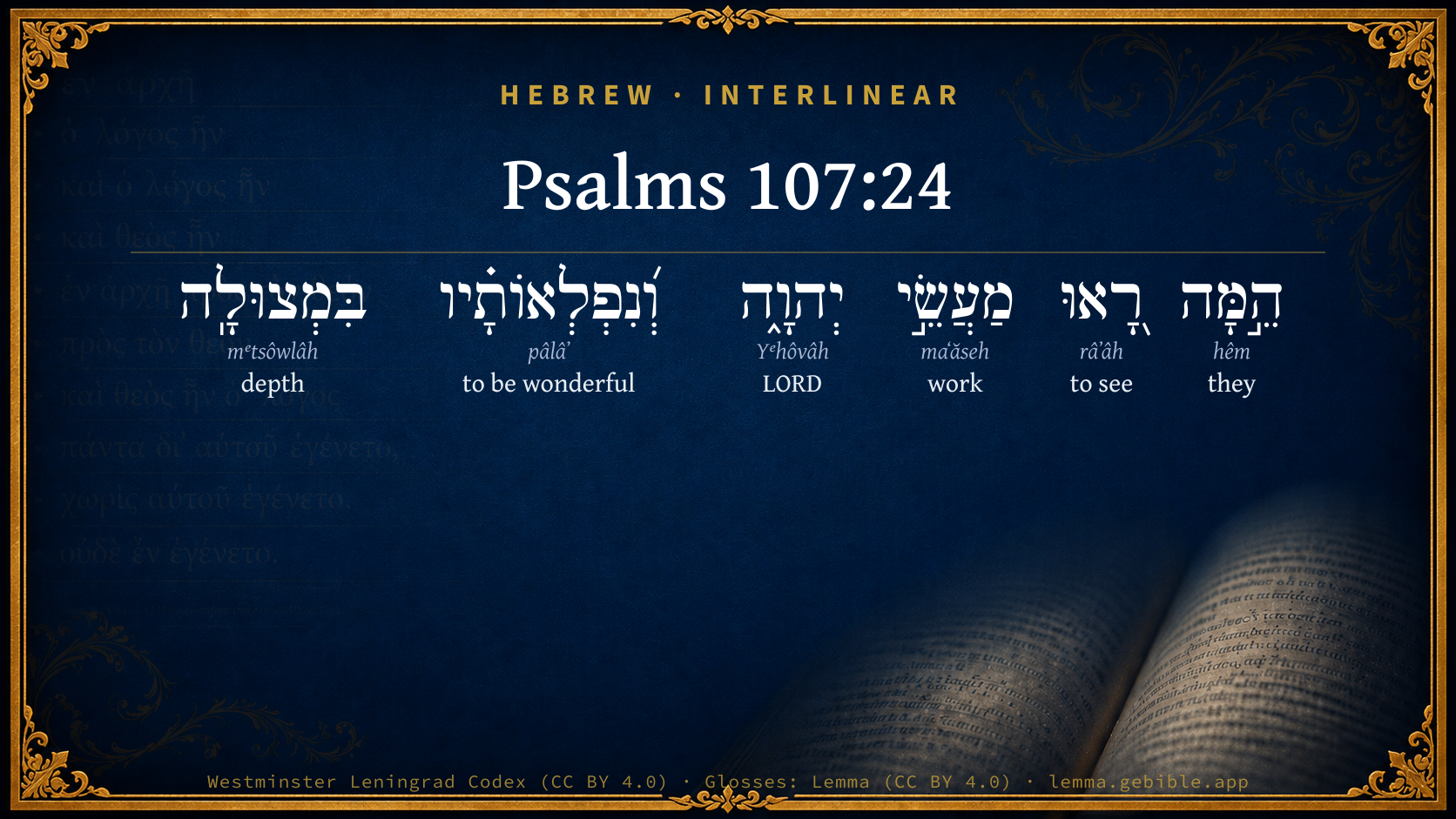
Psalms 107:24

Hebrew (Westminster Leningrad Codex) Psalms 107:24 appears in the Hebrew Old Testament. The text above is from the Westminster Leningrad Codex. Each word links to its Strong’s number, a concise gloss, and parsing drawn from the Open Scriptures Hebrew Bible morphology. Click any word for its full Brown-Driver-Briggs (BDB) entry.
Download image
Cite this verse

Psalms 107:24 (World English Bible). Public Domain. Lemma interlinear Bible study tool, https://lemma.gebible.app/v/psalms/107/24.

Show BibTeX & RIS
BibTeX
RIS
English Translation
These see Yahweh's works, And his wonders in the deep.
World English Bible · Public Domain
Download a study sheet

One document with this verse’s original text, its word-by-word gloss line, the meaning frame, cross-references with their text, attributed commentary, and full source and license credits — printable, and it pastes into notes with its structure intact.

This verse Autodidact and up

Study sheet (.html) Plain text (.txt)

A passage Seminary Student

Up to 50 verses in one chapter. A passage sheet keeps up to 6 commentary sources and 12 cross-references per verse, in the order this page ranks them, and says so on the sheet whenever that leaves anything out. Ask for a single verse and you get the Autodidact verse sheet above.

Everything on this page stays free to read, with no account — the sheet is a download of what is already on screen, not access to it.

Want to remove ads? Support Godless Engineer
Compare translations 3

The same verse in 3 English versions, stacked beneath the original-language interlinear above. Click any original word for its lexicon entry.

Each is an independent rendering of the whole verse — the interlinear is not word-aligned to these translations.

Highlighted words mark where these versions differ — a whole-verse word diff, not a word-by-word alignment.

  • World English Bible Public Domain
    These see Yahweh's works, And his wonders in the deep.
  • King James Version Public Domain
    These see the works of the LORD, and his wonders in the deep.
  • unfoldingWord Literal Text CC BY-SA 4.0
    they, they saw the deeds of Yahweh and his wonders in the deep.

unfoldingWord Literal Text — © unfoldingWord, licensed CC BY-SA 4.0. Word-aligned USFM3 via Door43 (git.door43.org/unfoldingWord/en_ult).

Versions to compare (up to 4)

3 of 4 selected

Show all 18 translations

Every available English version of this verse, each an independent rendering of the whole verse.

  • World English Bible Public Domain
    These see Yahweh's works, And his wonders in the deep.
  • Berean Standard Bible Public Domain
    They saw the works of the LORD, and His wonders in the deep.
  • Majority Standard Bible Public Domain
    They saw the works of the LORD, and His wonders in the deep.
  • King James Version Public Domain
    These see the works of the LORD, and his wonders in the deep.
  • American Standard Version (1901) Public Domain
    These see the works of Jehovah, And his wonders in the deep.
  • Revised Version (1885) Public Domain
    These see the works of the LORD, and his wonders in the deep.
  • Geneva Bible (1599) Public Domain
    They see the woorkes of the Lord, and his wonders in the deepe.
  • Douay-Rheims (1899) Public Domain
    These have seen the works of the Lord, and his wonders in the deep.
  • Young's Literal Translation Public Domain
    They have seen the works of Jehovah, And His wonders in the deep.
  • Literal Standard Version CC BY-SA 4.0
    They have seen the works of YHWH, || And His wonders in the deep.
  • Unlocked Literal Bible CC BY-SA 4.0
    These saw the deeds of Yahweh and his wonders on the seas.
  • unfoldingWord Literal Text CC BY-SA 4.0
    they, they saw the deeds of Yahweh and his wonders in the deep.
  • Darby Bible Public Domain
    These see the works of Jehovah, and his wonders in the deep.
  • World Messianic Bible Public Domain
    these see the LORD’s deeds, and his wonders in the deep.
  • Webster's Bible Public Domain
    These see the works of the LORD, and his wonders in the deep.
  • Free Bible Version CC BY-SA 4.0
    they have seen the Lord's incredible power at work—the wonderful things he did in the deepest oceans.
  • Bible in Basic English Public Domain
    They see the works of the Lord, and his wonders in the deep.
  • JPS Tanakh (1917) Public Domain
    These saw the works of the LORD, and His wonders in the deep;

Literal Standard Version (2020), Covenant Press — licensed CC BY-SA 4.0. Text via the HelloAO Bible API (eBible.org). Unlocked Literal Bible (unfoldingWord) — licensed CC BY-SA 4.0. Text via the HelloAO Bible API (eBible.org). unfoldingWord Literal Text — © unfoldingWord, licensed CC BY-SA 4.0. Word-aligned USFM3 via Door43 (git.door43.org/unfoldingWord/en_ult). Free Bible Version, Dr. Jonathan Gallagher — licensed CC BY-SA 4.0. Text via the HelloAO Bible API (eBible.org).

Word by word

More ways to search: Search by grammar → Find every occurrence → Compare this word →

Practice this passage: Drill this verse → Learn its vocabulary →

About this verse

These counts appear in no published source. They are computed here, from the morphology-tagged text and Lemma’s own curated glosses. What Lemma adds →

6
words
6
distinct lemmas
Wisdom
section

Notable vocabulary

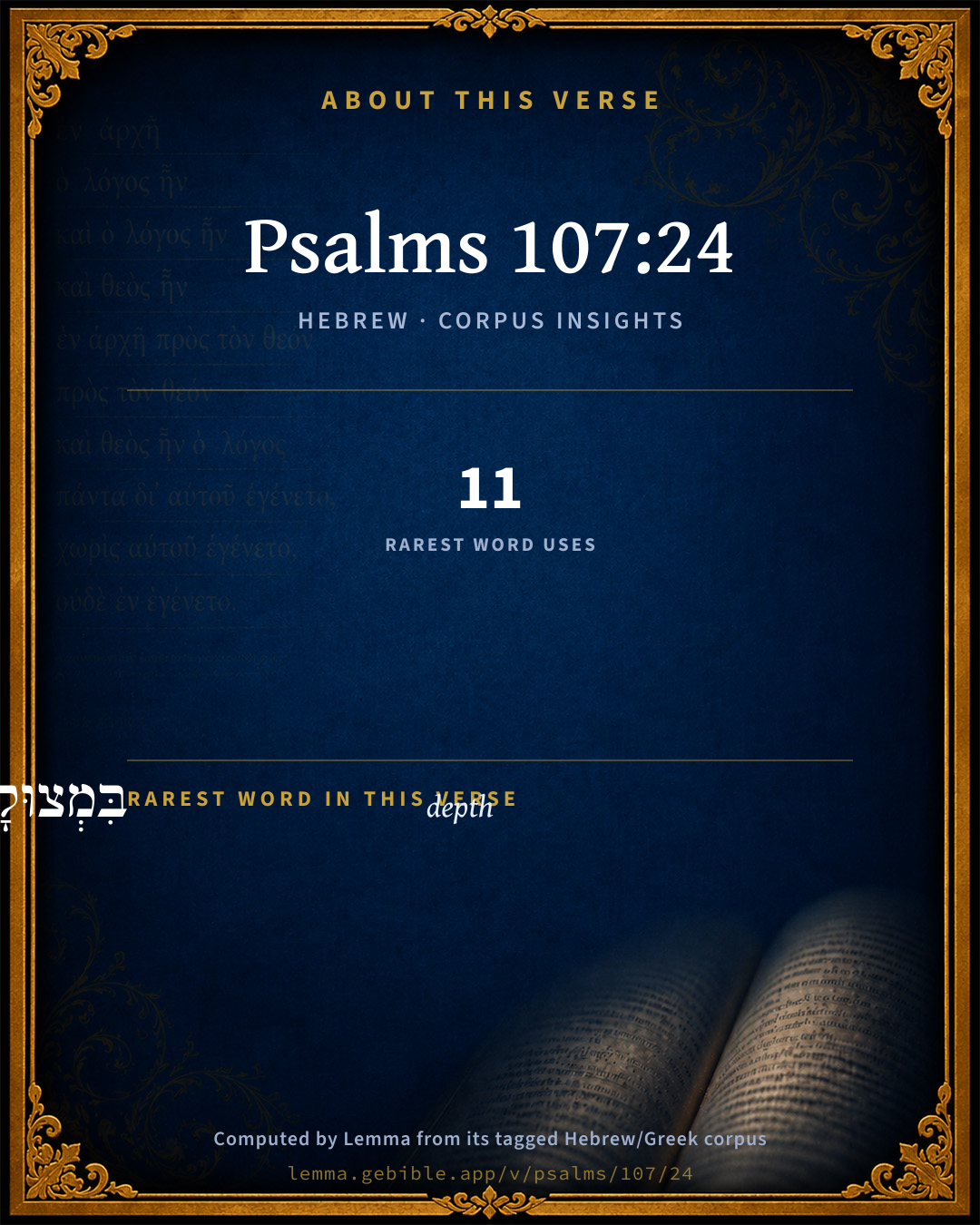
The rarest word here is בִּמְצוּלָֽה depth H4688 — appearing just 11 times in the whole Hebrew Bible.

Shared distinctive vocabulary

בִּמְצוּלָֽה depth H4688 occurs in 11 verses of the Hebrew Bible. Also found in:

Grammatical profile

  • 2 verbs
  • 3 nouns
  • 1 pronoun

Verb forms

  • רָ֭אוּ Qal · Perfect
  • וְ֝נִפְלְאוֹתָ֗יו Niphal · Participle Active

Hebrew & Septuagint length

In English translation the verse runs 10 words from the Hebrew and 15 from the Septuagint (LXX English) — closely comparable.

A rough comparison of the two English renderings, which tokenize alike — not a word-level alignment.

Word counts can differ between the Hebrew and the Greek without any difference in meaning — e.g. the Hebrew direct-object marker אֵת has no separate Greek word, and Greek often adds the article ὁ.

Cross-references

3

Topical passages linked to Psalms 107:24 in the Treasury of Scripture Knowledge — connected by theme and wording, ordered by reader-vote popularity; previews shown in the World English Bible.

  • Job 38:8–11 "Or who shut up the sea with doors, When it broke forth from the womb,
  • Psalms 95:5 The sea is his, and he made it. His hands formed the dry land.
  • Psalms 104:24–27 Yahweh, how many are your works! In wisdom have you made them all. The earth is full of your riches.

Cross-references courtesy of OpenBible.info (CC BY 4.0).

Hebrew and Greek witnesses Masoretic Hebrew ↔ Greek Septuagint

The same verse in the two great witnesses to the Old Testament, shown verse-for-verse.

You’re reading Greek Psalm 106 (Hebrew Psalm 107). The Septuagint counts the superscription, so verse numbers can differ from the Hebrew — chapter-level alignment, not verse-by-verse. Numbering follows Rahlfs.

These are two independent witnesses, not word-aligned to each other, and the Septuagint is shown in lemma (dictionary) form.

Hebrew Psalms 107:24 Masoretic · Westminster Leningrad Codex

הֵ֣מָּה רָ֭אוּ מַעֲשֵׂ֣י יְהוָ֑ה וְ֝נִפְלְאוֹתָ֗יו בִּמְצוּלָֽה

These see Yahweh's works, And his wonders in the deep.

World English Bible · Public Domain

Greek LXX Greek Psalm 106:24 Septuagint · lemma form

αὐτός ὁράω ὁ ἔργον κύριος καί ὁ θαυμάσιος αὐτός ἐν ὁ βυθός

these men have seen the works of the Lord, and his wonders in the deep.

LXX2012 (modern English Septuagint) · Public Domain

Hebrew: Westminster Leningrad Codex (CC BY 4.0). Greek: Septuagint (public domain); English from LXX2012 (modern English Septuagint) (Public Domain). How the Septuagint differs from the Hebrew →

Commentary

Notes on Psalms 107:24 from classic Christian and Jewish commentators (each source and its license shown beneath its notes). The classic Christian expositions comment on the surrounding passage and are grouped to its opening verse, so a note may address several verses; the Jewish commentaries on the Tanakh (Rashi and others) are per-verse, so they appear only where the commentator wrote on this verse.

Lemma curates 59 commentaries, every one of them public domain or Creative Commons licensed, each selected and text-cleaned for this edition rather than reprinted as found. About our sources →

Trapp's Complete Commentary

John Trapp

Psa 107:24 These see the works of the LORD, and his wonders in the deep.

Ver. 24. These see the works of the Lord, &c.] In sea monsters, as whales and whirlpools, and sudden change of weather, and the like, not a few; ebbs and flows, pearls, islands, &c. These are just wonders, and may fully convince the most stubborn atheist that is.

John Trapp, A Commentary or Exposition upon All the Books of the Old and New Testament (1647–1656) — public domain. Text from a community e-Sword module.

J. A. Alexander on Psalms

Joseph Addison Alexander

24. (Psa 107:24) THEY saw the works of Jehovah, and his wonders in the deep. The pronoun at the beginning is emphatic, (it is) they (that) see (or saw) the works of the Lord, as if others could lay claim to no such privilege or honour. Both the senses of the phrase God's works are appropriate in this connection, his works of creation and his works of providence. The last word is another poetical equivalent to sea or ocean. See above, on Psa 69:2.

Joseph Addison Alexander, The Psalms Translated and Explained (1850) — public domain. Text from a community e-Sword module.

Adam Clarke's Commentary

Verse 24. These see the works of the Lord] Splendid, Divinely impressive, and glorious in fine weather.

His wonders in the deep.] Awfully terrible in a tempest.

Adam Clarke's Commentary on the Bible (1810–1826) — public domain. Text from a community e-Sword/MySword module.

The Cambridge Bible for Schools and Colleges

gen. ed. J. J. S. Perowne

24. These see &c.] These men have seen. Jehovah’s works are the storm, viewed as an evidence of His sovereignty over the elements: His wonders (or wonderful works, as in Psa_107:8 &c.) are His miraculous interposition to still the storm and rescue the sailors.

The Cambridge Bible for Schools and Colleges (gen. ed. J. J. S. Perowne; Cambridge University Press, 1878–1918) — public domain. Text from a community e-Sword module.

John Gill's Exposition

They reel to and fro, and stagger like a drunken man,.... Through the agitation of the water, and motion of the ship, not being able to stand upon deck.

And are at their wit's end; or, "all their wisdom is swallowed up" (n); their wisdom in naval affairs, their art of navigation, their skill in managing ships, all nonplussed and baffled; they know not what method to take to save the vessel and themselves; their knowledge fails them, they are quite confounded and almost distracted. So Apollinarius paraphrases it,

"they forget navigation, and their wise art does not appear;''

so Ovid, describing a storm, uses the same phrase, "deficit ars",

"art fails.''

(n) "omnis sapientia eorum absorpta est", Pagninus, Montanus, Vatablus; so Junius & Tremellius, Piscator.

John Gill's Exposition of the Whole Bible (1746–1763) — public domain (CC PDM 1.0). Text via the HelloAO Bible API.

Albert Barnes' Notes on the Bible

These see the works of the Lord - They - sailors - have a special opportunity to see the works of God. They see manifestations of his power which are not seen on the land. They see things which seem to come “directly” from God; which are “immediately” produced by him - not as the things which occur on the land, which are the result of “growth,” and which are slowly developed. They seem in the solitariness and grandeur of the ocean to stand more directly in the presence of the great God.

And his wonders in the deep - In the abyss; in that which is distinguished for its “depth,” as the mountains are for their height. Compare Psa 148:7.

Albert Barnes' Notes on the Bible (1834–1885) — public domain. Text from a community e-Sword/MySword module.

Matthew Poole's English Annotations

His wonderful works, either,

1. Of creation, fishes of various kinds and shapes, and some of prodigious greatness, which are unknown to other men. Or,

2. Of providence, in raising and laying storms, of which he speaks in the following verses

Matthew Poole's English Annotations on the Holy Bible (1683–1685) — public domain. Text from a community e-Sword/MySword module.

The Treasury of David

Charles H. Spurgeon

Ver. 24. These see the works of the LORD. Beyond the dwellers on the land they see the Lord's greatest works, or at least such as stayers at home judge to be so when they hear the report thereof. Instead of the ocean proving to be a watery wilderness, it is full of God's creatures, and if we were to attempt to escape from his presence by flying to the uttermost parts of it, we should only rush into Jehovah's arms, and find ourselves in the very centre of his workshop.

And his wonders in the deep. They see wonders in it and on it. It is in itself a wonder and it swarms with wonders. Seamen, because they have fewer objects around them, are more observant of those they have than landsmen are, and hence they are said to see the wonders in the deep. At the same time, the ocean really does contain many of the more striking of God's creatures, and it is the scene of many of the more tremendous of the physical phenomena by which the power and more majesty of the Lord are revealed among men. The chief wonders alluded to by the Psalmist are a sudden storm and the calm which follows it.

All believers have not the same deep experience; but for wise ends, that they may do business for him, the Lord sends some of his saints to the sea of soul trouble, and there they see, as others do not, the wonders of divine grace. Sailing over the deeps of inward depravity, the waste waters of poverty, the billows of persecution, and the rough waves of temptation, they need God above all others, and they find him.

Ver. 24. These see the works of the LORD. There are sinners who, like Jonah, fleeing from the face of God, go down to the sea, to the cares and pleasures of the world, away from the solid land of humility, quiet, and grace. They occupy themselves in many waters, in needless toils and excessive pleasures, and yet even there God does not leave them, but causes them to see his works and wonders even in the deep of their sins, by giving them timely and sufficient warnings, and alarming them with fear of the abyss. Le Blanc, in Neale and Littledale.

Psalms 107:25*

Charles H. Spurgeon's The Treasury of David (1869–1885) — public domain. Psalms only. Text from a community e-Sword/MySword module.

The Pulpit Commentary

These see the works of the Lord, and his wonders in the deep. Storms, tempests, and sudden deliverances are the "wonders" especially meant. (comp. Act_27:14-44 2Co_11:25)

The Pulpit Commentary (1880–1919), ed. H.D.M. Spence-Jones & Joseph S. Exell — public domain. Text from a community e-Sword module.

Lesson kit

Teaching starters — assembled from the data on this page, not authored interpretation. Every prompt links to the verse data it draws on. Edit before teaching.

Psalms, in the Wisdom, opens this verse with 6 words (6 distinct Hebrew lemmas). Its most distinctive word is mᵉtsôwlâh (“depth”). A historical commentator’s framing appears above. Read the whole chapter for the surrounding context.

Discussion questions

  1. How does “depth” (mᵉtsôwlâh) shape what this verse is saying?
  2. Exodus 15:5 shares the word «depth» with this verse. How do the two illuminate each other?
  3. The translations on this page render this verse differently — a whole-verse word diff, not a word-by-word alignment. What might account for the different wordings?
  4. The verb «רָ֭אוּ» is Qal Perfect. How does its form color the action?
  5. Reading how Trapp's Complete Commentary and J. A. Alexander on Psalms read this verse, where do the two commentators agree and where do they part?

Things to notice

Reading settings

Reading text

Shown beneath each verse's original-language words.

Old Testament
Old Testament edition

Read the OT as the Masoretic Hebrew (MT) or the Greek Septuagint (LXX).

English shown for the Greek Septuagint (in the Hebrew ↔ Greek comparison).

Comparing translations? Open the Compare panel on any verse page to stack up to four side by side.