Zephaniah 2:13

Hebrew (Westminster Leningrad Codex) Zephaniah 2:13 appears in the Hebrew Old Testament. The text above is from the Westminster Leningrad Codex. Each word links to its Strong’s number, a concise gloss, and parsing drawn from the Open Scriptures Hebrew Bible morphology. Click any word for its full Brown-Driver-Briggs (BDB) entry.
Download image
Cite this verse

Zephaniah 2:13 (World English Bible). Public Domain. Lemma interlinear Bible study tool, https://lemma.gebible.app/v/zephaniah/2/13.

Show BibTeX & RIS
BibTeX
RIS
English Translation
He will stretch out his hand against the north, destroy Assyria, and will make Nineveh a desolation, and dry like the wilderness.
World English Bible · Public Domain
Download a study sheet

One document with this verse’s original text, its word-by-word gloss line, the meaning frame, cross-references with their text, attributed commentary, and full source and license credits — printable, and it pastes into notes with its structure intact.

This verse Autodidact and up

Study sheet (.html) Plain text (.txt)

A passage Seminary Student

Up to 50 verses in one chapter. A passage sheet keeps up to 6 commentary sources and 12 cross-references per verse, in the order this page ranks them, and says so on the sheet whenever that leaves anything out. Ask for a single verse and you get the Autodidact verse sheet above.

Everything on this page stays free to read, with no account — the sheet is a download of what is already on screen, not access to it.

Want to remove ads? Support Godless Engineer
Compare translations 3

The same verse in 3 English versions, stacked beneath the original-language interlinear above. Click any original word for its lexicon entry.

Each is an independent rendering of the whole verse — the interlinear is not word-aligned to these translations.

Highlighted words mark where these versions differ — a whole-verse word diff, not a word-by-word alignment.

  • World English Bible Public Domain
    He will stretch out his hand against the north, destroy Assyria, and will make Nineveh a desolation, and dry like the wilderness.
  • King James Version Public Domain
    And he will stretch out his hand against the north, and destroy Assyria; and will make Nineveh a desolation, and dry like a wilderness.
  • unfoldingWord Literal Text CC BY-SA 4.0
    And he will stretch out his hand against the north, and he will destroy Assyria. And he will make Nineveh a ruin, a dry place like the desert.

unfoldingWord Literal Text — © unfoldingWord, licensed CC BY-SA 4.0. Word-aligned USFM3 via Door43 (git.door43.org/unfoldingWord/en_ult).

Versions to compare (up to 4)

3 of 4 selected

Show all 18 translations

Every available English version of this verse, each an independent rendering of the whole verse.

  • World English Bible Public Domain
    He will stretch out his hand against the north, destroy Assyria, and will make Nineveh a desolation, and dry like the wilderness.
  • Berean Standard Bible Public Domain
    And He will stretch out His hand against the north and destroy Assyria; He will make Nineveh a desolation, as dry as a desert.
  • Majority Standard Bible Public Domain
    And He will stretch out His hand against the north and destroy Assyria; He will make Nineveh a desolation, as dry as a desert.
  • King James Version Public Domain
    And he will stretch out his hand against the north, and destroy Assyria; and will make Nineveh a desolation, and dry like a wilderness.
  • American Standard Version (1901) Public Domain
    And he will stretch out his hand against the north, and destroy Assyria, and will make Nineveh a desolation, and dry like the wilderness.
  • Revised Version (1885) Public Domain
    And he will stretch out his hand against the north, and destroy Assyria; and will make Nineveh a desolation, and dry like the wilderness.
  • Geneva Bible (1599) Public Domain
    And he wil stretch out his hand against the North, and destroy Asshur, and will make Nineueh desolate, and waste like a wildernesse.
  • Douay-Rheims (1899) Public Domain
    And he will stretch out his hand upon the north, and will destroy Assyria: and he will make the beautiful city a wilderness, and as a place not passable, and as a desert.
  • Young's Literal Translation Public Domain
    And He stretcheth His hand against the north, And doth destroy Asshur, And he setteth Nineveh for a desolation, A dry land like a wilderness.
  • Literal Standard Version CC BY-SA 4.0
    And He stretches His hand against the north, || And destroys Asshur, || And He sets Nineveh for a desolation, || A dry land like a wilderness.
  • Unlocked Literal Bible CC BY-SA 4.0
    and God's hand will attack the north and destroy Assyria, so that Nineveh will become an abandoned devastation, as dry as the desert.
  • unfoldingWord Literal Text CC BY-SA 4.0
    And he will stretch out his hand against the north, and he will destroy Assyria. And he will make Nineveh a ruin, a dry place like the desert.
  • Darby Bible Public Domain
    And he will stretch out his hand against the north, and destroy Assyria; and will make Nineveh a desolation, a place of drought like the wilderness.
  • World Messianic Bible Public Domain
    He will stretch out his hand against the north, destroy Assyria, and will make Nineveh a desolation, as dry as the wilderness.
  • Webster's Bible Public Domain
    And he will stretch out his hand against the north, and destroy Assyria; and will make Nineveh a desolation, and dry like a wilderness.
  • Free Bible Version CC BY-SA 4.0
    The Lord will strike the Assyrians in the north and destroy them. He will make Nineveh desolate, a dry wasteland like the desert.
  • Bible in Basic English Public Domain
    And his hand will be stretched out against the north, for the destruction of Assyria; and he will make Nineveh unpeopled and dry like the waste land.
  • JPS Tanakh (1917) Public Domain
    And He will stretch out His hand against the north, and destroy Assyria; and will make Nineveh a desolation, and dry like the wilderness.

Literal Standard Version (2020), Covenant Press — licensed CC BY-SA 4.0. Text via the HelloAO Bible API (eBible.org). Unlocked Literal Bible (unfoldingWord) — licensed CC BY-SA 4.0. Text via the HelloAO Bible API (eBible.org). unfoldingWord Literal Text — © unfoldingWord, licensed CC BY-SA 4.0. Word-aligned USFM3 via Door43 (git.door43.org/unfoldingWord/en_ult). Free Bible Version, Dr. Jonathan Gallagher — licensed CC BY-SA 4.0. Text via the HelloAO Bible API (eBible.org).

Word by word

More ways to search: Search by grammar → Find every occurrence → Compare this word →

Practice this passage: Drill this verse → Learn its vocabulary →

צִיָּ֖ה
tsîyâh
H6723
“drought”
Noun, Common, Feminine, Singular, Absolute
Part of Speech
Noun
Type
Common
Gender
Feminine
Number
Singular
State
Absolute
Full BDB Definition

Origin: from an unused root meaning to parch

TWOT: 1909a

dryness, drought, desert
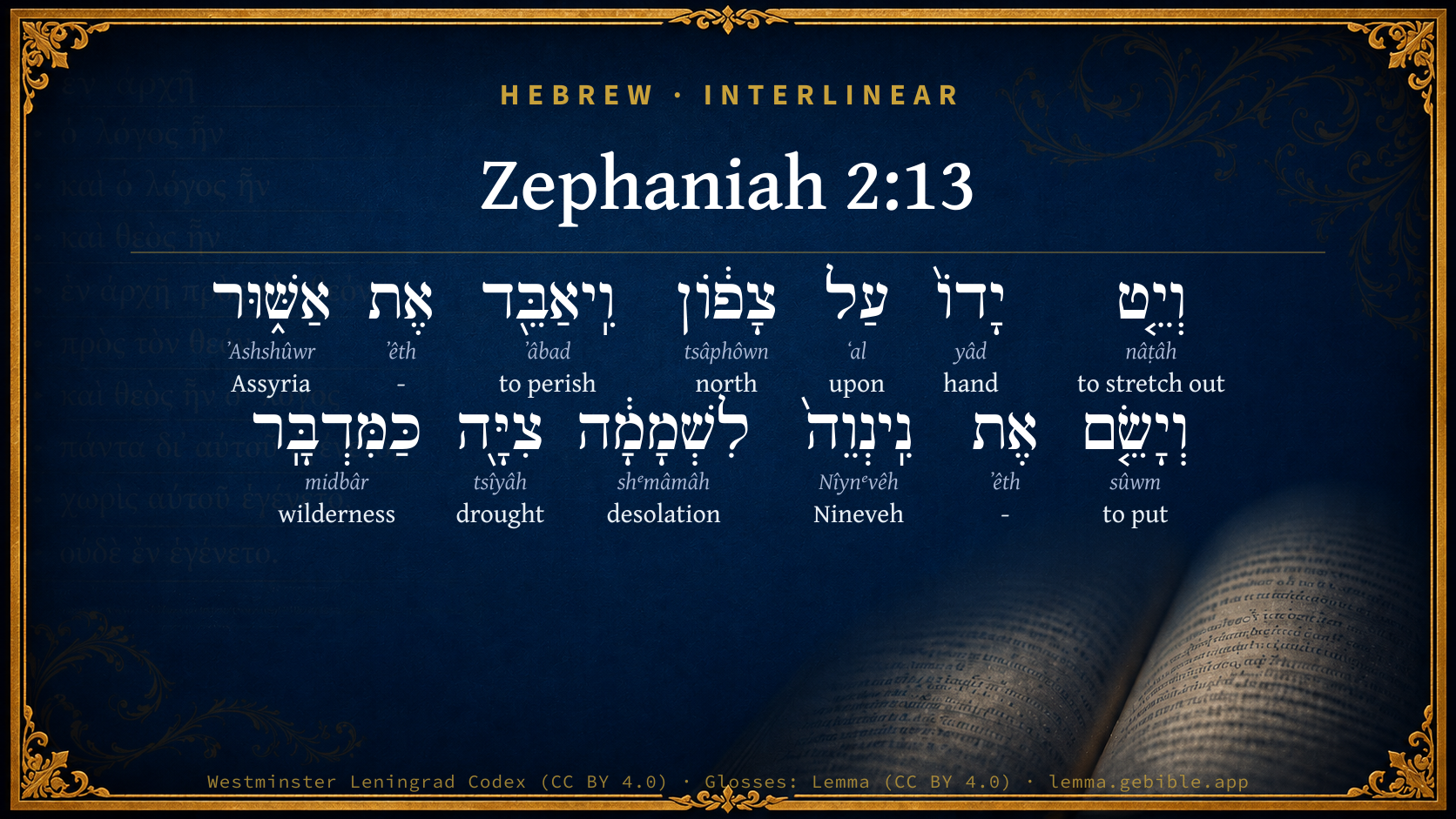
  1. וְיֵ֤ט nâṭâh H5186 “and · to stretch out” Conjunction + Verb, Qal, Jussive, 3rd Person, Masculine, Singular
  2. יָדוֹ֙ yâd H3027 “hand · his” Noun, Common, Both, Singular, Construct + Suffix, Personal, 3rd Person, Masculine, Singular
  3. עַל ʻal H5921 “upon” Preposition
  4. צָפ֔וֹן tsâphôwn H6828 “north” Noun, Common, Feminine, Singular, Absolute
  5. וִֽיאַבֵּ֖ד ʼâbad H6 “and · to perish” Conjunction + Verb, Piel, Imperfect, 3rd Person, Masculine, Singular
  6. אֶת ʼêth H853 “-” Particle, Direct Object
  7. אַשּׁ֑וּר ʼAshshûwr H804 “Assyria” Noun, Proper
  8. וְיָשֵׂ֤ם sûwm H7760 “and · to put” Conjunction + Verb, Qal, Jussive, 3rd Person, Masculine, Singular
  9. אֶת ʼêth H853 “-” Particle, Direct Object
  10. נִֽינְוֵה֙ Nîynᵉvêh H5210 “Nineveh” Noun, Proper
  11. לִשְׁמָמָ֔ה shᵉmâmâh H8077 “to/for · desolation” Preposition + Noun, Common, Feminine, Singular, Absolute
  12. כַּמִּדְבָּֽר midbâr H4057 “like/as the · wilderness” Preposition, Determined + Noun, Common, Masculine, Singular, Absolute

About this verse

These counts appear in no published source. They are computed here, from the morphology-tagged text and Lemma’s own curated glosses. What Lemma adds →

13
words
12
distinct lemmas
Prophets
section

Notable vocabulary

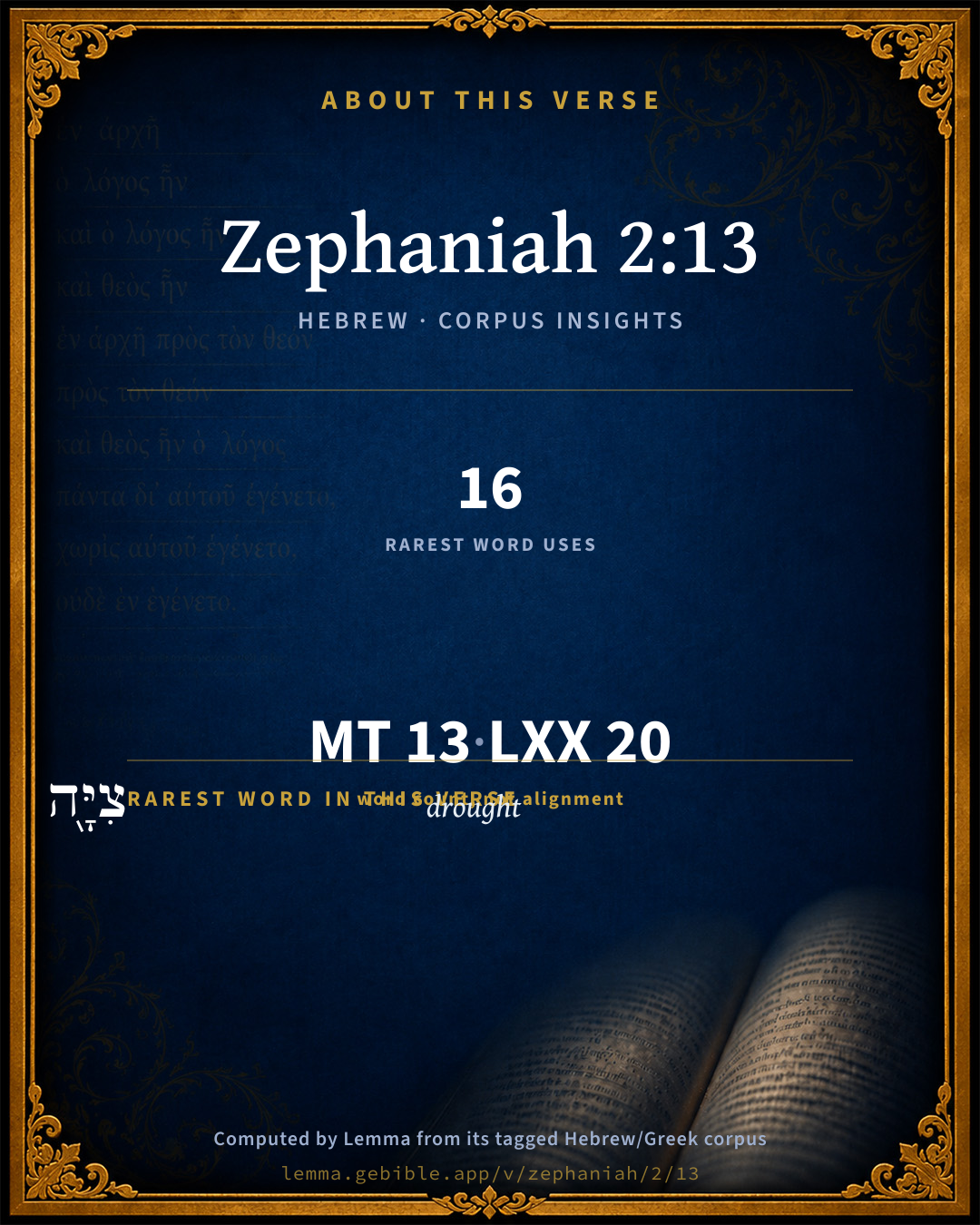
The rarest word here is צִיָּ֖ה drought H6723 — appearing just 16 times in the whole Hebrew Bible.

Shared distinctive vocabulary

צִיָּ֖ה drought H6723 occurs in 16 verses of the Hebrew Bible. Also found in:

Grammatical profile

  • 3 verbs
  • 7 nouns
  • 1 preposition
  • 2 particles

Verb forms

  • וְיֵ֤ט Qal · Jussive
  • וִֽיאַבֵּ֖ד Piel · Imperfect
  • וְיָשֵׂ֤ם Qal · Jussive

Hebrew & Septuagint length

In English translation the verse runs 22 words from the Hebrew and 24 from the Septuagint (LXX English) — closely comparable.

A rough comparison of the two English renderings, which tokenize alike — not a word-level alignment.

Word counts can differ between the Hebrew and the Greek without any difference in meaning — e.g. the Hebrew direct-object marker אֵת has no separate Greek word, and Greek often adds the article ὁ.

In the original languages it is 13 Hebrew tokens and 20 Greek tokens — but the two are counted differently (Hebrew bundles its prefixes and suffixes into one token; the Greek is in lemma form), so that isn’t a like-for-like length.

Cross-references

12

Topical passages linked to Zephaniah 2:13 in the Treasury of Scripture Knowledge — connected by theme and wording, ordered by reader-vote popularity; previews shown in the World English Bible.

  • Nahum 3:7 It will happen that all those who look at you will flee from you, and say, 'Nineveh is laid waste Who will mourn for her?' Where will I seek comforters for you?"
  • Isaiah 10:12 Therefore it shall happen that, when the Lord has performed his whole work on Mount Zion and on Jerusalem, I will punish the fruit of the stout heart of the king of Assyria, and the glory of his high looks.
  • Isaiah 10:16 Therefore will the Lord, Yahweh of Hosts, send among his fat ones leanness; and under his glory there shall be kindled a burning like the burning of fire.
  • Nahum 1:1 An oracle about Nineveh. The book of the vision of Nahum the Elkoshite.
  • Nahum 3:18–19 Your shepherds slumber, king of Assyria. Your nobles lie down. Your people are scattered on the mountains, and there is no one to gather them.
  • Psalms 83:8–9 Assyria also is joined with them. They have helped the children of Lot. Selah.
  • Isaiah 11:11 It shall happen in that day, that the Lord will set his hand again the second time to recover the remnant of his people, who shall remain, from Assyria, and from Egypt, and from Pathros, and from Cush, and from Elam, and from Shinar, and from Hamath, and from the islands of the sea.
  • Ezekiel 31:3–18 Behold, the Assyrian was a cedar in Lebanon with beautiful branches, and with a forest-like shade, and of high stature; and its top was among the thick boughs.
  • Micah 5:6 They will rule the land of Assyria with the sword, And the land of Nimrod in its gates. He will deliver us from the Assyrian, When he invades our land, And when he marches within our border.
  • Nahum 2:10–11 She is empty, void, and waste. The heart melts, the knees knock together, their bodies and faces have grown pale.
  • Nahum 3:15 There the fire will devour you. The sword will cut you off. It will devour you like the grasshopper. Multiply like grasshoppers. Multiply like the locust.
  • Zechariah 10:10–11 I will bring them again also out of the land of Egypt, And gather them out of Assyria; And I will bring them into the land of Gilead and Lebanon; And there won't be room enough for them.

Cross-references courtesy of OpenBible.info (CC BY 4.0).

Hebrew and Greek witnesses Masoretic Hebrew ↔ Greek Septuagint

The same verse in the two great witnesses to the Old Testament, shown verse-for-verse.

These are two independent witnesses, not word-aligned to each other, and the Septuagint is shown in lemma (dictionary) form.

Hebrew Zephaniah 2:13 Masoretic · Westminster Leningrad Codex

וְיֵ֤ט יָדוֹ֙ עַל צָפ֔וֹן וִֽיאַבֵּ֖ד אֶת אַשּׁ֑וּר וְיָשֵׂ֤ם אֶת נִֽינְוֵה֙ לִשְׁמָמָ֔ה צִיָּ֖ה כַּמִּדְבָּֽר

He will stretch out his hand against the north, destroy Assyria, and will make Nineveh a desolation, and dry like the wilderness.

World English Bible · Public Domain

Greek LXX Zephaniah 2:13 Septuagint · lemma form

καί ἐκτείνω ὁ χείρ αὐτός ἐπί βορέας καί ἀποὀλλύω ὁ ἀσσύριος καί τίθημι ὁ νινευη εἰς ἀφανισμός ἄνυδρος ὡς ἔρημος

And he shall stretch forth his hand against the north and destroy the Assyrian, and make Nineve a dry wilderness, even as a desert.

LXX2012 (modern English Septuagint) · Public Domain

Hebrew: Westminster Leningrad Codex (CC BY 4.0). Greek: Septuagint (public domain); English from LXX2012 (modern English Septuagint) (Public Domain). How the Septuagint differs from the Hebrew →

Targum (Aramaic paraphrase)

1

The Targum is the ancient Jewish Aramaic paraphrase of the Hebrew Scriptures — an interpretive translation, not the Hebrew text itself. Onkelos (literal) and Pseudo-Jonathan (expansive) render the Torah, and Jonathan the Prophets. Coverage is partial: where no permissively-licensed English translation exists for a verse, only the Aramaic is shown. This is verse-level text, not a word-by-word alignment to the Hebrew.

  1. Targum Jonathan Prophets (Joshua–Malachi)
    וִירִים מְחַת גְבוּרְתֵּיהּ עַל צִפּוּנָא וִיאַבֵּיד יַת אִתּוּרָאָה וִישַׁוֵי יַת נִינְוֵה לְצָדוּ אִשְׁתְּמָמוּ כְּמַדְבְּרָא:

    (no public-domain English translation for this verse)

    Targum Jonathan — Aramaic: “Mikraot Gedolot” (public domain). English: “Sefaria Community Translation” (CC0 1.0 (public-domain dedication)); “London "Chaldee Paraphrase," 1871” (public domain). Text via Sefaria.

Commentary

Notes on Zephaniah 2:13 from classic Christian and Jewish commentators (each source and its license shown beneath its notes). The classic Christian expositions comment on the surrounding passage and are grouped to its opening verse, so a note may address several verses; the Jewish commentaries on the Tanakh (Rashi and others) are per-verse, so they appear only where the commentator wrote on this verse.

Lemma curates 59 commentaries, every one of them public domain or Creative Commons licensed, each selected and text-cleaned for this edition rather than reprinted as found. About our sources →

Trapp's Complete Commentary

John Trapp

Zep 2:13 And he will stretch out his hand against the north, and destroy Assyria; and will make Nineveh a desolation, [and] dry like a wilderness.

Ver. 13. And he will stretch out his hand against the north] i.e. Against Assyria (which lay north from Judea), as is presently added by way of exposition. The Scripture sometimes hath its own interpretation annexed, as Joh 2:19; Joh 2:21; Joh 7:39. Howsoever, the Rabbis have this saying among them, Nulla est obiectio in lege quae non habet solutionem in latere; i.e. there is not any doubt in the law but may be resolved by the context.

And destroy Assyria] Cast this rod of his wrath into the fire, after that he had worn it to the stump (as that martyr said) upon other nations.

And will make Nineveh a desolation] See Nah 2:1-13, with the notes.

John Trapp, A Commentary or Exposition upon All the Books of the Old and New Testament (1647–1656) — public domain. Text from a community e-Sword module.

The Biblical Illustrator

Joseph S. Exell

Zep_2:13-15

He will stretch out His hand against the north.

National pride and national ruin

Two facts are suggested--

I. That men are often prone to pride themselves on the greatness of their country. The men of the city of Nineveh--the capital of Assyria--were proud of their nation. There was much in the city of Nineveh to account for, if not to justify, the exultant spirit of its population. It was the metropolis of a vast empire; it was a city 60 miles in compass, it had walls 100 feet high, and so thick and strong that three chariots could be driven abreast on them; it had 1500 massive towers. Italy, Austria, Germany, America, England, each says in its spirit, I am, and there is none beside me. This spirit of national boasting is unjustifiable. There is nothing in a nation of which it should be proud, except moral excellence. On the contrary, how much ignorance, sensuality, worldliness, intolerance, impiety, that should humble us in the dust. It is moreover a foolish spirit. It is a check to true national progress, and its haughty swaggerings tend to irritate other countries.

II. That the greatest country must sooner or later fall to ruin. He will stretch out His hand against the north, and destroy Assyria. Flocks shall lie down in the midst of her, etc. Not only a receptacle for beasts, but a derision to travellers. Every one that passeth by her shall hiss, and wag his hand. This is the fate that awaits all the nations under heaven, even the greatest. (Homilist.)

The Biblical Illustrator, edited by Joseph S. Exell (c. 1880s–1900s) — public domain. Text from a community e-Sword module.

Joseph Benson's Commentary

Zep 2:13-14. And he will stretch out his hand against the north — Nor will the southern nations only be punished, but judgments will be executed by the divine justice on the nations lying toward the north; and will make Nineveh a desolation — What is here foretold was fulfilled before the predictions recorded in the foregoing verses. Dr. Prideaux observes, that “Chyniladanus being king of the Assyrian and Babylonian empire, Nabopolassar, his general, took the latter from him, in the sixteenth year of Josiah; fourteen years after which Saraccus the king was slain, and Nineveh destroyed, which completed the fall of Assyria.” And dry like a wilderness — A multitude of people are often compared to, and called waters, in Scripture language; and therefore, figuratively speaking, to make Nineveh dry like a wilderness, may signify depopulating her. Or the words may be taken literally; for “Rauwolff observes, in his Travels, that on this side the river Tigris, in Mesopotamia, the ground is so sandy and dry, that you would think you were in the middle of the deserts of Arabia.” — Prid. Con., Ann. 612 and 626. And flocks shall lie down, &c., all the beasts of the nations — The several kinds of wild beasts that are in the country. What is said in this verse, is descriptive of a place lying in ruins and desolation; for in such a case it soon becomes a haunt of wild beasts and birds of every kind. Both the cormorant and the bittern, &c. — Bishop Newcome reads, Both the pelican and the porcupine shall lodge in the carved lintels thereof; observing of the former, “These birds fed in the Tigris, and made their nests in the deserted ruins of the city.” The next clause he renders, A cry shall resound in the window: the raven shall be in the porch. For he shall uncover — Or lay bare, the cedar-work — God will reduce the houses of Nineveh to such a state of desolation, that the floors and ceilings of cedar shall lie open to the injuries of the weather, and to birds to roost and build their nests there. “This reference” (in mentioning cedar-work) “to the former elegance of the city, is finely introduced; and, in the next verse, the grand and affecting description of her desolate state is beautifully contrasted, by her late festivity and pride.”

Joseph Benson's Commentary on the Old and New Testaments (1811–1818) — public domain. Text from a community e-Sword module.

The Preacher's Complete Homiletical Commentary

Joseph S. Exell (gen. ed.)

CRITICAL NOTES.]

Zep_2:13.) The prophet dwells longer on the heathen power of the north, the Assyrian kingdom with its capital, Nineveh, because Assyria was then the imperial power, seeking to destroy the kingdom of Judah. This explains the announcement, in the form of a wish, as the use of the contracted forms, yet and yâsçm, clearly shows. Assyria was north-east, but invaded Palestine from the north, hence regarded as situated thus [Keil].

Zep_2:14. Cormorant and bittern] or pelican and porcupine (cf. Isa_34:11), from whence the words are adopted [Wordsworth]. Lintels] or knops of pillars (Amo_9:1). “The capitals of the pillars do not lie on the ground, but now stand unattached, after the roofs and doors, which rested upon them, are thrown down” [Hitzig].

Zep_2:15.] This city, proud and haughty, sheltered behind defences of water, would become a lair of beasts, a desolate waste, a hissing to men. All would exult in its ruins, wave the hand, and declare that “she richly deserved her fate.”

THE JUDGMENT UPON ASSYRIA.—Zep_2:13-15

The prophet dwells upon the kingdom of Assyria with its splendid capital, Nineveh. It was the imperial power then seeking to destroy Judah, But the sentence of Jonah and Nahum was to be executed. No opportunity of repentance now. The most populous and ambitious kingdom of Eastern races has to be entirely laid waste.

I. Its capital would become a heap of ruins. God will stretch out his hand “and destroy Assyria, and will make Nineveh a desolation.” Nineveh, strongly built and splendidly adorned, secure in its streams and impregnable in its defences, would become an arid waste. “Dry like a wilderness.”

II. Its ruins would be complete. They would become—

1. A lair of wild beasts. “Herds crouch were once ran broad streets, loud with the wheels of traffic or the tramp of armies. Wild beasts wander and climb about the fallen stones, seeking a prey or finding a covert within its dismantled walls. Pelicans from the neighbouring marshes, and hedgehogs from the adjacent fields, make their homes in the sculptured capitals of her fallen columns.”

2. A home of unclean birds. Birds perch and sing on the lintels of broken windows, joyous in existence amid extensive ruins. The music of the palace, men-singers and women-singers, have ceased to be; but the song of the bird startles the spectator in the lonely scene.

3. A heap of desolation. “Desolation shall be in the thresholds.” On spots where porters watched and multitudes thronged, heaps of rubbish stand. The thresholds of house and temple, mart and palace, are covered with dust. “The sands carried by winds from the desert, have buried the wreck of former grandeur, and hid every trace of its magnificence.”

III. Its ruins would become a derision to travellers. “Every one that passeth by her shall hiss and wag his hand.” He shall hiss with scorn, and motion with the hand in detestation, not in joy (Nah_3:19). The desolation would astonish, and the ruin of the immense and stately city would be a source of joy. “The merchants among the people shall hiss at thee; thou shalt be a terror, and never shalt be any more.”

HOMILETIC HINTS AND OUTLINES

Zep_2:13. Desolation. No desolation is like that of decayed luxury. It preaches the nothingness of man, the fruitlessness of his toils, the fleetingness of his hopes and enjoyments. Grass in a court or on a beaten road, much more in a town, speaks of the passing away of what has been; that man, wont to be there, is not there now. It leaves the feeling of void and forsakenness [Pusey].

Zep_2:15. “I am,” &c. Pride will fall. The more selfish and secure in sin, the greater the human shame and the Divine indignation. This was the language of—

1. Pride. Deification of its own might.

2. Selfishness. I alone, and no other that I care for.

3. Defiance. I am, who dare touch me? No security in worldly strength and prosperity.

4. Self-deception. Judgments from God humble the most haughty, and turn the most mirthful into mourning. Thus Divine retribution

“Falls most sure

On wicked men, when they are most secure.”

ILLUSTRATIONS TO CHAPTER 2

Zep_2:13-15. This doom on Nineveh was carried out to the very letter. It was not simply the largest city of the ancient world. In the mouth of the Hebrew prophets it was the name of a district, 25 miles long, by 15 broad, which included four large cities, besides villages and forts, within its protecting walls. About six centuries B. C., this vast populous district was conquered and destroyed by the Medes (under Cyaxares), and the Chaldeans (under Nabopolassar, father of Nebuchadnezzar). So complete was the destruction, that with startling abruptness the great city vanished from the face of the earth, and its very ruins were hidden from the eyes of men. In A. D. 1766, Niebuhr, the great historian, stood on the eastern bank, which he took to be acclivities wrought by the hand of nature. It was not till A. D. 1842 that Layard, Rawlinson, and Botta dug into these mounds, exhumed and interpreted the remains which tell the story of the city’s greatness, luxury, and culture with a power beyond that of words [S. Cox].

“I am.” Indulged sin thrives and strengthens in character. Germs of evil gather round the accursed root, until judgments from heaven cut it down.

“When we in our viciousness

Grow hard, the wise gods seal our eyes,

In our own slime drop our clear judgments,

Make us adore our errors, and thus

We strut to our destruction.”

The Preacher's Complete Homiletical Commentary (gen. ed. Joseph S. Exell; Funk & Wagnalls, c. 1892) — public domain (pre-1929). A full-Bible homiletical/sermon-outline anthology covering 65 of 66 books (2 John is absent from the source module). Text from a community e-Sword module.

Tyndale Open Study Notes

Tyndale Open Resources

2:13 Zephaniah turns from the south (2:12) to the north. Like Nahum before him, he announces the imminent demise of Assyria.

Tyndale Open Study Notes — © Tyndale Open Resources, licensed CC BY-SA 4.0. Text via the HelloAO Bible API.

Jamieson, Fausset & Brown

Robert Jamieson, A. R. Fausset & David Brown

Here he passes suddenly to the north. Nineveh was destroyed by Cyaxares and Nabopolassar, 625 B.C. The Scythian hordes, by an inroad into Media and thence in the southwest of Asia (thought by many to be the forces described by Zephaniah, as the invaders of Judea, rather than the Chaldeans), for a while interrupted Cyaxares' operations; but he finally succeeded. Arbaces and Belesis previously subverted the Assyrian empire under Sardanapalus (that is, Pul?),877 B.C.

Jamieson, Fausset & Brown — Commentary Critical and Explanatory on the Whole Bible (1871) — public domain (CC PDM 1.0). Text via the HelloAO Bible API.

Adam Clarke's Commentary

Verse 13. He will - destroy Assyria] He will overthrow the empire, and Nineveh, their metropolitan city. See on Jonah and Nahum.

Adam Clarke's Commentary on the Bible (1810–1826) — public domain. Text from a community e-Sword/MySword module.

John Calvin's Commentaries

The Prophet proceeds here to the Assyrians, whom we know to have been special enemies to the Church of God. For the Moabites and the Ammonites were fans only, as we have elsewhere seen, as they could not do much harm by their own strength. Hence they stirred up the Assyrians, they stirred up the Ethiopians and remote nations. The meaning, then, is, that no one of all the enemies of the Church would be left unpunished by God, as every one would receive a reward for his cruelty. He speaks now of God in the third person; but in the last verse God himself said, that the Ethiopians would be slain by his sword. The Prophet adds here, He will extend his hand to the north; that is, God will not complete his judgments on the Ethiopians; but he will go farther, even to Nineveh and to all the Assyrians.

Nineveh, we know, was the metropolis of the empire, before the Assyrians were conquered by the Babylonians. Thus Babylon then recovered the sovereignty which it had lost; and Nineveh, though not wholly demolished, was yet deprived of its ruling power, and gradually lost its name and its wealth, until it was reduced into a waste; for the building of Ctesiphon, as we have elsewhere seen, proved its ruin. But the Prophet, no doubt, proceeds here to administer comfort to the Jews, lest they should despair, while the Lord did not interfere. And the extension of the hand means as though he said, that his own time is known to the Lord, and that he would put forth his power when needful. Assyria was north as to Judea: hence he says, to the north will the Lord extend his hand, and will destroy Assyria; he will make Nineveh a desolation, that it may be like the desert. It follows—

John Calvin's Commentaries (1540-1563) — public domain. Text from the Calvin Translation Society English edition (1840s-50s) via the Christian Classics Ethereal Library (ccel.org). Calvin's coverage is partial (roughly two-thirds of the Bible); uncommented books and verses are honest gaps, never fabricated. The 19th-century editor's footnotes and remarks are omitted so the notes are faithfully Calvin's own voice.

Ellicott's Commentary for English Readers

(13-15) The sentence against Assyria in the north. This was fulfilled as early as B.C. 625, when Nineveh was taken and destroyed by the Medes and Babylonians. It will be remembered that this catastrophe is the theme of Nahum’s prophecy. Its effects are here described in language similar to that of Nahum 3 which Zephaniah doubtless has in mind.

A Bible Commentary for English Readers, edited by Charles John Ellicott (1878–1897) — public domain. Text from a community e-Sword module.

The Cambridge Bible for Schools and Colleges

gen. ed. J. J. S. Perowne

13. stretch out his hand] See on Zep_1:4.

13–15. Threat against Assyria

The passage naturally implies that the Assyrian empire had not yet fallen.

The Cambridge Bible for Schools and Colleges (gen. ed. J. J. S. Perowne; Cambridge University Press, 1878–1918) — public domain. Text from a community e-Sword module.

John Gill's Exposition

And he will stretch out his hand against the north Either the Lord, or Nebuchadnezzar his sword; who, as he would subdue the nations that lay southward, he would lead his army northward against the land of Assyria, which lay to the north of Judea, as next explained: and destroy Assyria; that famous monarchy, which had ruled over the kingdoms of the earth, now should come to an end, and be reduced to subjection to the king of Babylon: and will make Nineveh a desolation; which was the capital city, the metropolis of the Assyrian monarchy: Nahum prophesies at large of the destruction of this city: [and] dry like a wilderness; which before was a very watery place, situated by rivers, particularly the river Tigris; so that it was formerly like a pool of water, ( Nahum 2:6 Nahum 2:8 ) but now should be dry like a heath or desert, Dr. Prideaux places the destruction of Nineveh in the twenty ninth year of Josiah's reign; but Bishop Usher earlier, in the sixteenth year of his reign; and, if so, then Zephaniah, who here prophesies of it, must begin to prophesy in the former part of Josiah's reign.

John Gill's Exposition of the Whole Bible (1746–1763) — public domain (CC PDM 1.0). Text via the HelloAO Bible API.

Albert Barnes' Notes on the Bible

Zephaniah began by singling out Judah amid the general destruction, “I will also stretch out My Hand upon Judah” Zep 1:4; he sums up the judgment of the world in the same way; “He will stretch out, or, Stretch He forth, “His Hand against the north and destroy Asshur, and make Nineveh a desolation.” Judah had, in Zephaniah’s time, nothing to fear from Assyria. Isaiah Isa 39:6 and Micah Mic 4:10 had already foretold, that the captivity would be to Babylon. Yet of Assyria alone the prophet, in his own person, expresses his own conformity with the mind of God. Of others he had said, “the word of the Lord is against you, O Canaan, and I will destroy thee; As I live, saith the Lord, Moab shall be as Sodom. Ye also, O Ethiopians, the, slain of My sword are they.” Of Assyria alone, by a slight inflection of the word, he expresses that he goes along with this, which he announces.

He does not say as an imprecation, “May He stretch forth His hand;” but gently, as continuing his prophecies, “and,” joining on Asshur with the rest; only instead of saying “He will stretch forth,” by a form almost insulated in Hebrew, he says, “And stretch He forth His Hand.” In a way not unlike, David having declared God’s judgments, “The Lord trieth the righteous; and the wicked and the lover of violence doth His soul abhor, subjoineth, On the wicked rain He snares,” signifying that he (as all must be in the Day of judgment), is at one with the judgment of God. This is the last sentence upon Nineveh, enforcing that of Jonah and Nahum, yet without place of repentance now. He accumulates words expressive of desolateness. It should not only be a “desolation” Zep 2:4, Zep 2:9, as he had said of Ashkelon, Moab and Amman, but a dry, parched , unfruitful Isa 53:2 land. As Isaiah, under the same words, prophesies that the dry and desolate land should, by the Gospel, be glad, so the gladness of the world should become dryness and desolation. Asshur is named, as though one individual , implying the entireness of the destruction; all shall perish as one man; or as gathered into one and dependent upon one, its evil King. “The north” is not only Assyria, in that its armies came upon Judah from the north, but it stands for the whole power of evil (see Isa 14:13), as Nineveh for the whole beautiful, evil, world. The world with “the princes of this world” shall perish together.

Albert Barnes' Notes on the Bible (1834–1885) — public domain. Text from a community e-Sword/MySword module.

Haydock's Catholic Bible Commentary

The beautiful city. Ninive, which was destroyed soon after this, viz., in the sixteenth year of the reign of Josias. (Challoner) (the year of the world 3378.) --- Hebrew, "he shall make Ninive desolate." (Haydock) --- This famous and potent city was at last destroyed. (Worthington) See Jonas iii. 4. (Calmet)

George Leo Haydock (1774–1849), Haydock's Catholic Family Bible and Commentary, 1859 edition — public domain. Excludes Psalms (Douay-Rheims chapter numbering differs from Protestant) and Deuterocanonical books (Catholic canon only).

Matthew Poole's English Annotations

And he, the Lord God of Israel, or the Chaldean monarch as God’s servant herein,

will stretch out his hand, engage all his power, and use it to the utmost, against the north, i.e. as follows, Assyria, which lay northward of Judea, but more due north from Babylon, if I mistake not.

Destroy Assyria; overthrow that great and ancient kingdom of Assyria. of which more at large in Nahum. Nineveh; chief city of that kingdom. See Nah 1:1. A desolation; most desolate, Nah 3:10-12.

And dry like a wilderness; will turn those well-watered places into dry, thirsty, and barren land, as a wilderness.

Matthew Poole's English Annotations on the Holy Bible (1683–1685) — public domain. Text from a community e-Sword/MySword module.

Whedon's Commentary on the Bible

Daniel D. Whedon

13-15. The doom of Nineveh.

Stretch out his hand — See on Zep_1:4.

Against the north — From Ethiopia in the far south Jehovah will turn northward to strike Assyria.

Assyria — The beginnings of the Assyrian empire are shrouded in obscurity, but from about the middle of the twelfth century until near the close of the seventh century B.C. it was the great Asiatic world power. Nearly all the prophets, beginning with Amos, look upon it as the divinely appointed agent to execute judgment upon the rebellious Israel; but several of them are convinced that it has gone beyond its commission and that its cruel policy of conquest is contrary to Jehovah’s will; therefore they heap upon Assyria the severest denunciations (for example, Isa_10:5 ff.; Mic_5:6; the entire Book of Nahum).

Nineveh — The capital of Assyria in the days of Zephaniah (see on Jon_3:2-3).

Desolation,… dry like a wilderness — To make Nineveh dry like a wilderness would require a manifestation of extraordinary power, for the city was situated on the banks of one river, the Tigris, while another, the Choser, flowed right through it.

Daniel D. Whedon (gen. ed.), Commentary on the Old and New Testaments (1874–1909) — public domain. Text from a community e-Sword module.

The Pulpit Commentary

The north, represented by Assyria, as yet unconquered, and still apparently flourishing. Though this country lay to the northeast of Palestine, its armies attacked from the north, and it is generally represented as a northern power. Its destruction was foretold. (Isa_10:12 Eze_31:11, etc.; Nah_1:14, etc.) In this verse the Hebrew verbs are not in the simple future, but in the imperative or optative mood, "Let him stretch out his hand," etc., as though the prophet were praying that the enemies of his people might be overthrown. Nineveh. St. Jerome gives speciosam, rendering the proper name according to his notion of its Hebrew etymology. Its proper meaning, in Accadian, would be "Fish house,". i.e. house consecrated to the god of fish. (For a description of Nineveh, see note on Jon_1:2. For the destruction of Nineveh, see the Introduction to Nahum, Dry like a wilderness. The country shall become an and desert. Assyria was greatly indebted for its remarkable fertility to a very successful system of artificial irrigation, and when this was not maintained, great tracts soon relapsed into a wilderness (Layard, "Nineveh," 2:68). "Cultivation," says Professor Rawlinson, "is now the exception instead of the rule. "Instead of the luxuriant fields, the groves and gardens of former times, nothing now meets the eye but an arid waste" (Chesny). Large tracts are covered by unwholesome marshes, producing nothing but enormous reeds; others lie waste and bare, parched up by the fierce heat of the sun, and utterly destitute of water; in some places sand drifts accumulate, and threaten to make the whole region a mere portion of the desert" ("Anc. Men.," 1:41).

Vers. 13-15. The doom of Assyria.

It was very natural that the prophet, in unfolding the Divine judgments upon heathen nations, should turn his thoughts to the north and to the Assyrian empire. That power was, in his day, at the very zenith of its prosperity, and his own nation was peculiarly exposed to its tyranny and oppression. The Hebrew seers frequently referred to this empire and to the ruin which should eventually overtake it; and whilst Zephaniah"s allusion is very brief, limited indeed to three verses, it is nevertheless remarkably graphic and vivid. Observe

I THE STERN SENTENCE. (Vers. 13, 14)

1. It foretold that the prevailing power which was seeking the overthrow of the kingdom of God in Judah should itself be completely destroyed. In a few descriptive touches he set forth the utter ruin which should befall the haughty Assyrian nation. She should be destroyed, and her capital become a dry, desolate waste in the midst of which the beasts of the desert should make their home. Her temples and palaces should lie broken, pelicans and hedgehogs lodging in the fallen capitals, whilst instead of the strains of the men singers and women singers, no more to be heard in her palaces, the notes of some solitary bird sitting in the window of some outer wall should alone sound forth. "Desolation" too "should be on the thresholds," and heaps of sand blown from the desert should mingle with the wreck of the city, until at length every trace of the former magnificence should have disappeared. And the acknowledgment should be made that this ruin was merited; the passer-by should hiss with very scorn, and move his hand in token of supreme contempt (vers. 13-15).

2. It declared this ruin to be the result of the Divine working. "And he will stretch out his hand," etc. (ver. 13).

3. This stern doom thus pronounced has literally come to pass. Modern research has been amply rewarded in the evidence which has thus been supplied of the fulfilment to the very letter of God"s declarations uttered through his holy prophets. "The Word of the Lord endureth forever.

II THE SOLEMN REFLECTION. (Ver. 15)

1. In reading these words we are led to feel that the prophet had a vivid realization of the future, and of the changes which were to take place. He saw "the rejoicing city" full of worldly prosperity, and he saw it likewise in its desolation, and his heart was moved as he reflected upon the instability of mere earthly greatness and might.

2. He traced the coming overthrow of the Assyrian power to its true causes.

(1) Pride. "That said in her heart, I am, and there is none beside me" (ver. 15).

(2) Selfishness. There is none beside me. " Her interests centred in herself. There was no regard for the rights of others. She sought only her own ends, and sought by oppression and cruelty to make all surrounding nations tributary to her own worldly splendour and prosperity. And fostering this unholy spirit, she "dwelt carelessly," crying, "Peace and safety," wrapt in carnal security, until at length "sudden destruction" came upon her, and she was left in her desolation, silently yet emphatically to proclaim to all after ages that true prosperity for nations, as for individuals, lies not in material greatness and worldly aggrandizement, but in the cultivation of the fear of God and in rectitude and righteousness of life.

Vers. 13-15. National pride and national ruin.

"And he will stretch out his hand against the north, and destroy Assyria; and will make Nineveh a desolation, and dry like a wilderness. And flocks shall lie down in the midst of her, all the beasts of the nations," etc. Dr. Henderson"s translation of this passage is not only beautiful, but seems so faithful and clear as scarcely to require any exposition.

"And he will stretch his hand over the north, And destroy Assyria. Idle will also make Nineveh waste, An arid region like the desert. And flocks shall lie down in the midst of her, All the wild beasts of the nations: Both the pelican and the porcupine Shall take up their abode in her capitals: A voice shall sing in the windows, Desolation shall be in the thresholds, For the cedar work is laid bare. This is the exulting city which dwelt securely, Which said in her heart, I am, and beside me there is none. How she is become desolate! A resting place for wild beasts! Every one that passeth by her shall hiss, He shall shake his head.

Two facts are suggested.

I THAT MEN ARE OFTEN PRONE TO PRIDE THEMSELVES ON THE GREATNESS OF THEIR COUNTRY. The men of the city of Nineveh the capital of Assyria were proud of their nation. It is called the "rejoicing city," and represented as saying, "I am, and there is none beside me." This was the voice of the population. There was much in the city of Nineveh to account for, if not to justify, the exultant spirit of its population. It was the metropolis of a vast empire; it was a city sixty miles in compass, it had walls a hundred feet high, and so thick and strong that three chariots could be driven abreast on them; it had twelve hundred massive towers. The boasting spirit of the men of Nineveh concerning the grandeur of their country is by no means uncommon; it beats in the hearts of modern nations. Italy, Austria, Germany, America, England, each says in its spirit, "I am, and there is none beside me." Nations are egotistic, they exult in their own greatness, they sing their own praises. This spirit of national boasting is unjustifiable. There is nothing in a nation of which it should be proud, except moral excellence; and, alas! how little moral excellence there is in the most virtuous kingdom of the earth! On the contrary, how much ignorance, sensuality, worldliness, intolerance, impiety, that should humble us in the dust! It is, moreover, a foolish spirit. It is a check to true national progress, and its haughty swaggerings tend to irritate other countries.

II THAT THE GREATEST COUNTRY MUST SOONER OR LATER FALL TO RUIN. "He will stretch out his hand against the north, and destroy Assyria," etc. This great city, peopled with pompous boasters, became a receptacle for beasts. "Flocks shall lie down in the midst of her," etc. "All the beasts of the nations: both the cormorant the pelican and the bittern the porcupine shall lodge in the upper lintels of it." The wild grim birds that haunt all ruins, Not only a receptacle for beasts, but a derision to travellers. "Every one that passeth by her shall hiss, and wag his hand." Such was the doom that came on this great city when Cyaxares and Nabopolassar, 600 years B.C., struck it down. This is the fate that awaits all the nations under heaven, even the greatest. Egypt, Syria, Babylon, Rome, Greece, have risen, prospered, and decayed. The symptoms of decay are manifest in many of the grandest nations of Europe. The more thoughtful amongst us discover those symptoms in the life of our England. England has nothing more to become, they say; the plum is overripe, and it must rot; the tree has exhausted all its latent vitality, and it must wither; the sun has passed the meridian, and it must go down. Thoughtful men point to the sad lack of capacity in our statesmen, the unscrupulous greed of our traders, the grumbling of our artisans, the weakness of our pulpits, the haughtiness of our ecclesiastics, the hollowness of our religion, the infidelities of our scientists, the diminution of our revenue and the increase of our pauperism, the arrogance of one class and the flunkeyism of another, pampered indolence here and starving toil there, jobbery in politics, swindling in commerce, cant in religion, and strikes in trade, and say these are unmistakable marks of national corruption. D.T.

The Pulpit Commentary (1880–1919), ed. H.D.M. Spence-Jones & Joseph S. Exell — public domain. Text from a community e-Sword module.

John Wesley's Explanatory Notes

He - God. The north - Assyria, which lay northward of Judea, and due north from Babylon.

John Wesley, Explanatory Notes Upon the Whole Bible (1754–1765) — public domain. Text via the GEBible commentary corpus.

Scofield Reference Notes

C. I. Scofield

Nineveh

(See Scofield "Nah 1:1").

The Scofield Reference Bible (1917 edition), notes by C. I. Scofield — public domain. Text from a community e-Sword module.

Rashi

Rabbi Shlomo Yitzchaki (Rashi)

on the north Assyria is on the north, neighboring on Babylon.

Nineveh That is the capital of Assyria.

Rashi on the Tanakh — English translations: “The Judaica Press complete Tanach with Rashi, translated by A. J. Rosenberg” (CC BY 4.0); “Pentateuch with Rashi's commentary by M. Rosenbaum and A.M. Silbermann, 1929-1934” (public domain); “The Metsudah Tanach series, Lakewood, N.J” (CC BY 4.0); and “The Book of Joshua, Metsudah Publications, 1997” (CC BY 4.0). Text via Sefaria.

Lesson kit

Teaching starters — assembled from the data on this page, not authored interpretation. Every prompt links to the verse data it draws on. Edit before teaching.

Zephaniah, in the Prophets, opens this verse with 13 words (12 distinct Hebrew lemmas). Its most distinctive word is tsîyâh (“drought”). A historical commentator’s framing appears above. Read the whole chapter for the surrounding context.

Discussion questions

  1. What does “drought” (tsîyâh) contribute to the verse as a whole?
  2. Job 24:19 shares the word «drought» with this verse. How do the two illuminate each other?
  3. The translations on this page render this verse differently — a whole-verse word diff, not a word-by-word alignment. What might account for the different wordings?
  4. The verb «וְיֵ֤ט» is Qal Jussive. How does its form color the action?
  5. Reading how Trapp's Complete Commentary and The Biblical Illustrator read this verse, where do the two commentators agree and where do they part?

Things to notice

Reading settings

Reading text

Shown beneath each verse's original-language words.

Old Testament
Old Testament edition

Read the OT as the Masoretic Hebrew (MT) or the Greek Septuagint (LXX).

English shown for the Greek Septuagint (in the Hebrew ↔ Greek comparison).

Comparing translations? Open the Compare panel on any verse page to stack up to four side by side.