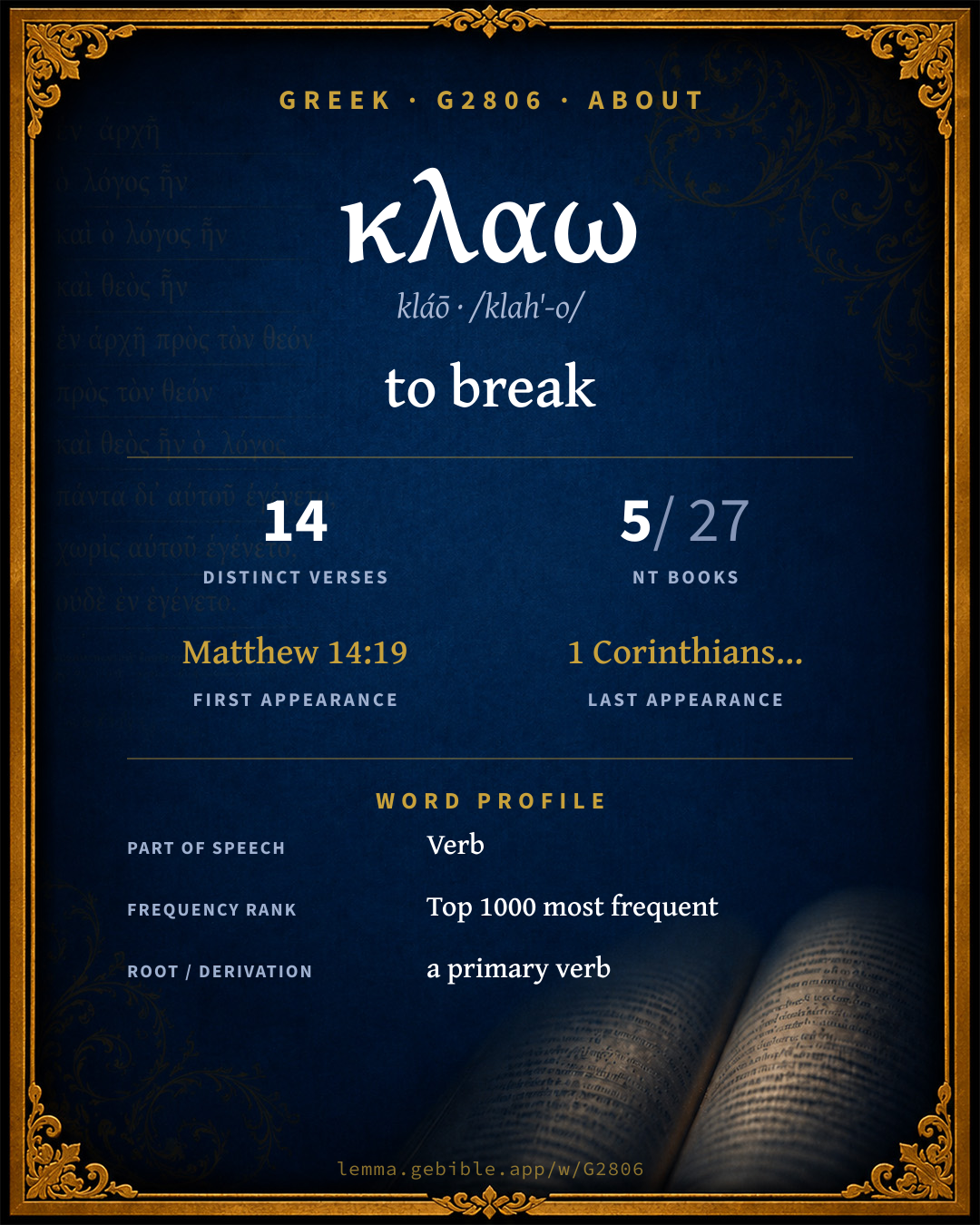
κλάω
to break
Full lexicon entry — Thayer's Greek Lexicon
From Thayer's Greek Lexicon
Where this word appears
See every Aorist-tense verb in the Greek New Testament →
Grammar key — what these labels mean
Part of speech
- Verb
- An action or state-of-being word.
Tense
- Aorist
- Action viewed as a simple whole, without regard to duration — often past (perfective aspect).
- Present
- Ongoing or general action in present time (imperfective aspect).
Voice
- Active
- The subject performs the action.
Mood
- Indicative
- States a fact or asks a factual question (the mood of reality).
- Participle
- A verbal adjective (“writing,” “having written”).
- Infinitive
- A verbal noun (“to write”), unmarked for person or number.
Case
- Nominative
- The case of the subject (and the predicate nominative).
Person
- 3rd person
- The one spoken about (“he / she / it / they”).
- 1st person
- The speaker (“I / we”).
Gender
- Masculine
- Grammatically masculine.
Number
- Singular
- One.
- Plural
- More than one.
Grammatical forms
- Verb, Aorist, Active, Indicative, 3rd person, Singular 6 times (43%)
- Verb, Aorist, Active, Participle, Nominative, Singular, Masculine 4 times (29%)
- Verb, Aorist, Active, Indicative, 1st person, Singular 1 time (7%)
- Verb, Aorist, Active, Infinitive 1 time (7%)
- Verb, Present, Active, Indicative, 1st person, Plural 1 time (7%)
- Verb, Present, Active, Participle, Nominative, Plural, Masculine 1 time (7%)
Parsed forms decoded from the imported morphology (Robinson–Tischendorf, public domain), counted across 14 parsed occurrences — not distinct verses.
Every verse where G2806 appears — 14 distinct verses across 5 books. Click any verse to open its interlinear word-by-word view. Verse text shown in the World English Bible for context — . Each verse’s Greek form is shown with its reference; the English is not keyword-highlighted, since the data carries no word-level English alignment. Use “Compare translations” on any verse to read it across multiple English versions. This concordance covers the Greek New Testament; Septuagint (Greek Old Testament) occurrences of this word are not indexed here.
Matthew 3 verses
- Matthew 14:19 κλάσας aor act ptcp nom sg masc He commanded the multitudes to sit down on the grass; and he took the five loaves and the two fish, and looking up to heaven, he blessed, broke and gave the loaves to the disciples, and the disciples gave to the multitudes.
- Matthew 15:36 ἔκλασεν aor act ind 3sg and he took the seven loaves and the fish. He gave thanks and broke them, and gave to the disciples, and the disciples to the multitudes.
- Matthew 26:26 ἔκλασεν aor act ind 3sg As they were eating, Jesus took bread, gave thanks for it, and broke it. He gave to the disciples, and said, "Take, eat; this is my body."
Mark 3 verses
- Mark 8:6 ἔκλασεν aor act ind 3sg He commanded the multitude to sit down on the ground, and he took the seven loaves. Having given thanks, he broke them, and gave them to his disciples to serve, and they served the multitude.
- Mark 8:19 ἔκλασα aor act ind 1sg When I broke the five loaves among the five thousand, how many baskets full of broken pieces did you take up?" They told him, "Twelve."
- Mark 14:22 ἔκλασεν aor act ind 3sg As they were eating, Jesus took bread, and when he had blessed, he broke it, and gave to them, and said, "Take, eat. This is my body."
Luke 2 verses
- Luke 22:19 ἔκλασεν aor act ind 3sg He took bread, and when he had given thanks, he broke it, and gave to them, saying, "This is my body which is given for you. Do this in memory of me."
- Luke 24:30 κλάσας aor act ptcp nom sg masc It happened, that when he had sat down at the table with them, he took the bread and gave thanks. Breaking it, he gave to them.
Acts 4 verses
- Acts 2:46 κλῶντές pres act ptcp nom pl masc Day by day, continuing steadfastly with one accord in the temple, and breaking bread at home, they took their food with gladness and singleness of heart,
- Acts 20:7 κλάσαι aor act inf On the first day of the week, when the disciples were gathered together to break bread, Paul talked with them, intending to depart on the next day, and continued his speech until midnight.
- Acts 20:11 κλάσας aor act ptcp nom sg masc When he had gone up, and had broken bread, and eaten, and had talked with them a long while, even until break of day, he departed.
- Acts 27:35 κλάσας aor act ptcp nom sg masc When he had said this, and had taken bread, he gave thanks to God in the presence of all, and he broke it, and began to eat.
1 Corinthians 2 verses
- 1 Corinthians 10:16 κλῶμεν pres act ind 1pl The cup of blessing which we bless, isn't it a communion of the blood of Christ? The bread which we break, isn't it a communion of the body of Christ?
- 1 Corinthians 11:24 ἔκλασεν aor act ind 3sg When he had given thanks, he broke it, and said, "Take, eat. This is my body, which is broken for you. Do this in memory of me."
About this entry
At a glance — auto-summarized from this page’s data, not written by a person. Every figure links to its source below. This summary describes the numbers; it doesn’t interpret them.
“to break” is the headline sense of the Greek verb κλαω (kláō). Translators differ — “brake” in the King James Version, then “broke” (Berean Standard Bible) and “he broke” (unfoldingWord Literal Text), as the renderings breakdown shows. It turns up in 14 verses across 5 books, an uncommon footprint. It concentrates in Acts, which alone accounts for 29% of its uses. First canonically at Matthew 14:19, it enters the text early. See the sense tree, 14-verse concordance, and the renderings breakdown below.
Gloss history
Strong's 1890 vs modern scholarship
About this word
Strong's G2806 catalogs a Greek word from the Greek New Testament.
These counts are not copied from any lexicon or concordance. They are computed here, from the morphology-tagged Greek New Testament. What Lemma adds →
- 14
- distinct verses
- The word appears in 14 distinct verses.
- 5 / 27
- NT books
- The word appears in 5 of 27 New Testament books.
- #814
- by frequency
- Top 1000 most frequent Greek words (rank 814 of 5,347 Greek words by occurrence).
View all 14 occurrences in the concordance →
By section of the New Testament
By traditional corpus
Conventional, traditional groupings — biblical authorship is debated, so this is a traditional corpus grouping, not an authorship claim. Some books belong to more than one corpus (Luke is in both the Gospels and the Lukan corpus, and so on), so these shares overlap and need not total 100%. Each figure is a share of the word’s 14 distinct verses.
- Gospels 8 verses · 57%
- Lukan (Luke–Acts) 6 verses · 43%
- Pauline corpus 2 verses · 14%
How translations render this word
Counts come from each version’s own published word-to-Strong’s tagging or interlinear alignment — an approximate guide to how each version renders this word, not a word-level alignment the data otherwise carries. Because each total is that version’s own tagged count, the per-version totals vary from one another and need not match the appearance or distinct-verse counts above. These counts may also differ from a printed concordance because Lemma counts each distinctly tagged rendering and does not collapse phrase taggings into a single head-word total. This is a fixed set of word-tagged versions (KJV, ASV, BSB, ULT) and does not change with the reading translation you choose elsewhere. Each version’s license is shown beside its name below (and on Sources).
- King James Version: Brake 7×
- American Standard Version: He brake 5×, Brake 3×, Breaking 2×
- Berean Standard Bible: Broke 6×, He broke 3×, Break 2×
- unfoldingWord Literal Text: He broke 5×, It 5×, Having broken 3×
King James Version Public Domain
Renders G2806 across 15 tagged occurrences — most commonly:
Plus 8 renderings that appear only once — usually multi-word phrases or single function words the recovered tagging swept in, not distinct renderings.
American Standard Version Public Domain
Renders G2806 across 15 tagged occurrences — most commonly:
Plus 5 renderings that appear only once — usually multi-word phrases or single function words the recovered tagging swept in, not distinct renderings.
Berean Standard Bible Public Domain
Renders G2806 across 14 tagged occurrences — most commonly:
Plus 3 renderings that appear only once — usually multi-word phrases or single function words the recovered tagging swept in, not distinct renderings.
unfoldingWord Literal Text CC BY-SA 4.0
Renders G2806 across 23 tagged occurrences — most commonly:
Plus 7 renderings that appear only once — usually multi-word phrases or single function words the recovered tagging swept in, not distinct renderings.
Senses in Thayer's
The 1 sense Thayer's distinguishes for this word, in lexicon order (not ranked by frequency or importance). The full entry — with sub-senses — is in the Lexicon Entry tab.
- used in the NT of the breaking of bread or communion
Word origin
Origin: a primary verb
A primary verb; to break (specifically of bread): - break.
— Strong’s Exhaustive Concordance (1890), public domain.
Forms in the corpus
The 6 distinct written forms G2806 takes in the Greek New Testament, most frequent first — each parse links to that tense’s occurrences in the concordance.
| Form | Parsing | Example | Uses |
|---|---|---|---|
| ἔκλασεν éklasen | Verb, Aorist, Active, Indicative, 3rd person, Singular | Matthew 15:36 | 6 |
| κλάσας klásas | Verb, Aorist, Active, Participle, Nominative, Singular, Masculine | Matthew 14:19 | 4 |
| κλάσαι klásai | Verb, Aorist, Active, Infinitive | Acts 20:7 | 1 |
| κλῶμεν klō̂men | Verb, Present, Active, Indicative, 1st person, Plural | 1 Corinthians 10:16 | 1 |
| κλῶντές klō̂ntés | Verb, Present, Active, Participle, Nominative, Plural, Masculine | Acts 2:46 | 1 |
| ἔκλασα éklasa | Verb, Aorist, Active, Indicative, 1st person, Singular | Mark 8:19 | 1 |
Same root — word family
Other Thayer's entries built from the same root as G2806, grouped by Strong’s listed origin. These share a root / origin per the lexicon — not necessarily a shared meaning. Each links to that word’s own entry.
Derived from this word
- κλαδος kládos G2798 young shoot
- κλασις klásis G2800 breaking
- κλασμα klásma G2801 fragment
- κλημα klēma G2814 vine branch
- κληρος klēros G2819 lot
Compare all same-root words → Showing 4 of 6 — not the complete family. They share a root, not necessarily a meaning.
Septuagint usage
The same Greek word κλαω appears 1 time in the Greek Old Testament (Septuagint), across 1 verse in 1 book.
- 1
- LXX occurrences
- Tagged occurrences of this Greek word in the Septuagint.
- 1
- verse
- Distinct Septuagint verses containing this word.
- 1 / 39
- OT books
- The word appears in 1 of the 39 Old Testament books.
Sample Septuagint occurrences
- Jeremiah 16:7 κλάω
Septuagint occurrences (same lexeme)
Every verse where the same Strong’s number (G2806) appears in the Greek Septuagint. Verse text shown in the World English Bible for context; the Greek form is the matched word — the English is not keyword-highlighted.
These are occurrences of the same Greek lexeme (G2806) in the Septuagint — not a translation of any one Hebrew word. The store carries no word-level Hebrew↔Greek alignment, so no Hebrew original is asserted here. Counts come from the recovered LXX Strong's tagging — high-frequency vocabulary is well covered, while rare or late forms may be untagged — so they reflect tagged occurrences and may slightly undercount.