Romans 11:19

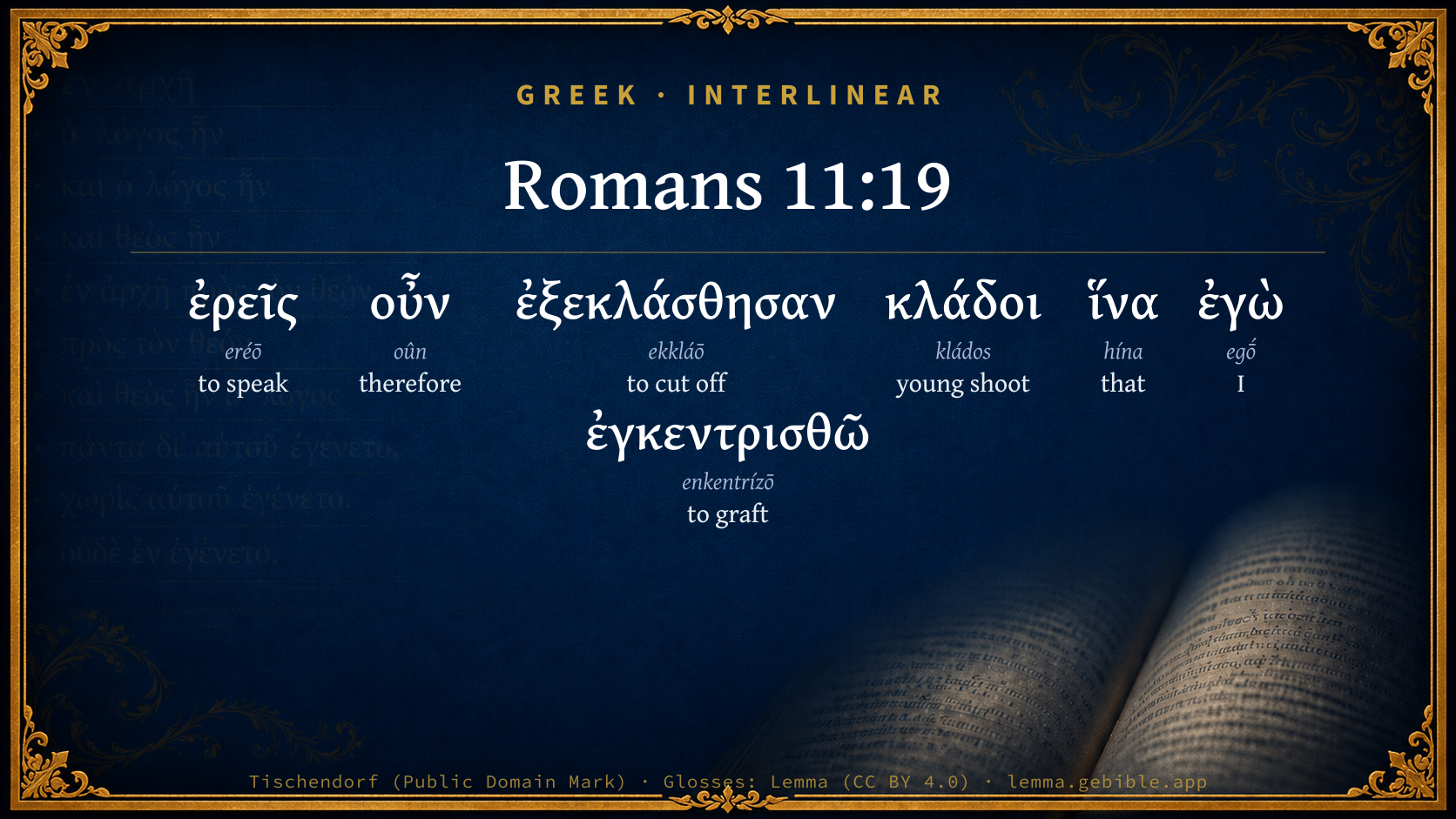
Greek (Tischendorf 8th ed.) Romans 11:19 appears in the Greek New Testament. The text above is from the Tischendorf 8th edition. Each word links to its Strong’s number and a concise gloss. Click any word for its full Thayer’s Greek Lexicon entry.
Download image
Cite this verse

Romans 11:19 (World English Bible). Public Domain. Lemma interlinear Bible study tool, https://lemma.gebible.app/v/romans/11/19.

Show BibTeX & RIS
BibTeX
RIS
English Translation
You will say then, "Branches were broken off, that I might be grafted in."
World English Bible · Public Domain
Download a study sheet

One document with this verse’s original text, its word-by-word gloss line, the meaning frame, cross-references with their text, attributed commentary, and full source and license credits — printable, and it pastes into notes with its structure intact.

This verse Autodidact and up

Study sheet (.html) Plain text (.txt)

A passage Seminary Student

Up to 50 verses in one chapter. A passage sheet keeps up to 6 commentary sources and 12 cross-references per verse, in the order this page ranks them, and says so on the sheet whenever that leaves anything out. Ask for a single verse and you get the Autodidact verse sheet above.

Everything on this page stays free to read, with no account — the sheet is a download of what is already on screen, not access to it.

Want to remove ads? Support Godless Engineer
Compare translations 3

The same verse in 3 English versions, stacked beneath the original-language interlinear above. Click any original word for its lexicon entry.

Each is an independent rendering of the whole verse — the interlinear is not word-aligned to these translations.

Highlighted words mark where these versions differ — a whole-verse word diff, not a word-by-word alignment.

  • World English Bible Public Domain
    You will say then, "Branches were broken off, that I might be grafted in."
  • King James Version Public Domain
    Thou wilt say then, The branches were broken off, that I might be graffed in.
  • unfoldingWord Literal Text CC BY-SA 4.0
    You will say then, “Branches were broken off so that I myself might be grafted in.”

unfoldingWord Literal Text — © unfoldingWord, licensed CC BY-SA 4.0. Word-aligned USFM3 via Door43 (git.door43.org/unfoldingWord/en_ult).

Versions to compare (up to 4)

3 of 4 selected

Show all 19 translations

Every available English version of this verse, each an independent rendering of the whole verse.

  • World English Bible Public Domain
    You will say then, "Branches were broken off, that I might be grafted in."
  • Berean Standard Bible Public Domain
    You will say then, “Branches were broken off so that I could be grafted in.”
  • Majority Standard Bible Public Domain
    You will say then, “Branches were broken off so that I could be grafted in.”
  • King James Version Public Domain
    Thou wilt say then, The branches were broken off, that I might be graffed in.
  • American Standard Version (1901) Public Domain
    Thou wilt say then, Branches were broken off, that I might be grafted in.
  • Revised Version (1885) Public Domain
    Thou wilt say then, Branches were broken off, that I might be grafted in.
  • Geneva Bible (1599) Public Domain
    Thou wilt say then, The branches are broken off, that I might be graft in.
  • Douay-Rheims (1899) Public Domain
    Thou wilt say then: The branches were broken off, that I might be grafted in.
  • Young's Literal Translation Public Domain
    Thou wilt say, then, `The branches were broken off, that I might be graffed in;' right!
  • Literal Standard Version CC BY-SA 4.0
    You will say, then, “The branches were broken off, that I might be grafted in”; right!
  • Unlocked Literal Bible CC BY-SA 4.0
    You will say then, “Branches were broken off so that I might be grafted in.”
  • unfoldingWord Literal Text CC BY-SA 4.0
    You will say then, “Branches were broken off so that I myself might be grafted in.”
  • Darby Bible Public Domain
    Thou wilt say then, The branches have been broken out in order that *I* might be grafted in.
  • World Messianic Bible Public Domain
    You will say then, “Branches were broken off, that I might be grafted in.”
  • Webster's Bible Public Domain
    Thou wilt say then, The branches were broken off, that I might be ingrafted.
  • Free Bible Version CC BY-SA 4.0
    You could make the claim, “Branches were broken off so I could be grafted in.”
  • Bible in Basic English Public Domain
    You will say, Branches were broken off so that I might be put in.
  • Text-Critical English NT CC BY 4.0
    Yoʋ will say then, “Branches were broken off so that I could be grafted in.”
  • Tyndale New Testament (1534) Public Domain
    Thou wilt saye then: the brauches are broken of that I myght be grafte in.

Literal Standard Version (2020), Covenant Press — licensed CC BY-SA 4.0. Text via the HelloAO Bible API (eBible.org). Unlocked Literal Bible (unfoldingWord) — licensed CC BY-SA 4.0. Text via the HelloAO Bible API (eBible.org). unfoldingWord Literal Text — © unfoldingWord, licensed CC BY-SA 4.0. Word-aligned USFM3 via Door43 (git.door43.org/unfoldingWord/en_ult). Free Bible Version, Dr. Jonathan Gallagher — licensed CC BY-SA 4.0. Text via the HelloAO Bible API (eBible.org).

Word by word

More ways to search: Search by grammar → Find every occurrence → Compare this word →

Practice this passage: Drill this verse → Learn its vocabulary →

About this verse

These counts appear in no published source. They are computed here, from the morphology-tagged text and Lemma’s own curated glosses. What Lemma adds →

7
words
7
distinct lemmas
Pauline Epistles
section

Notable vocabulary

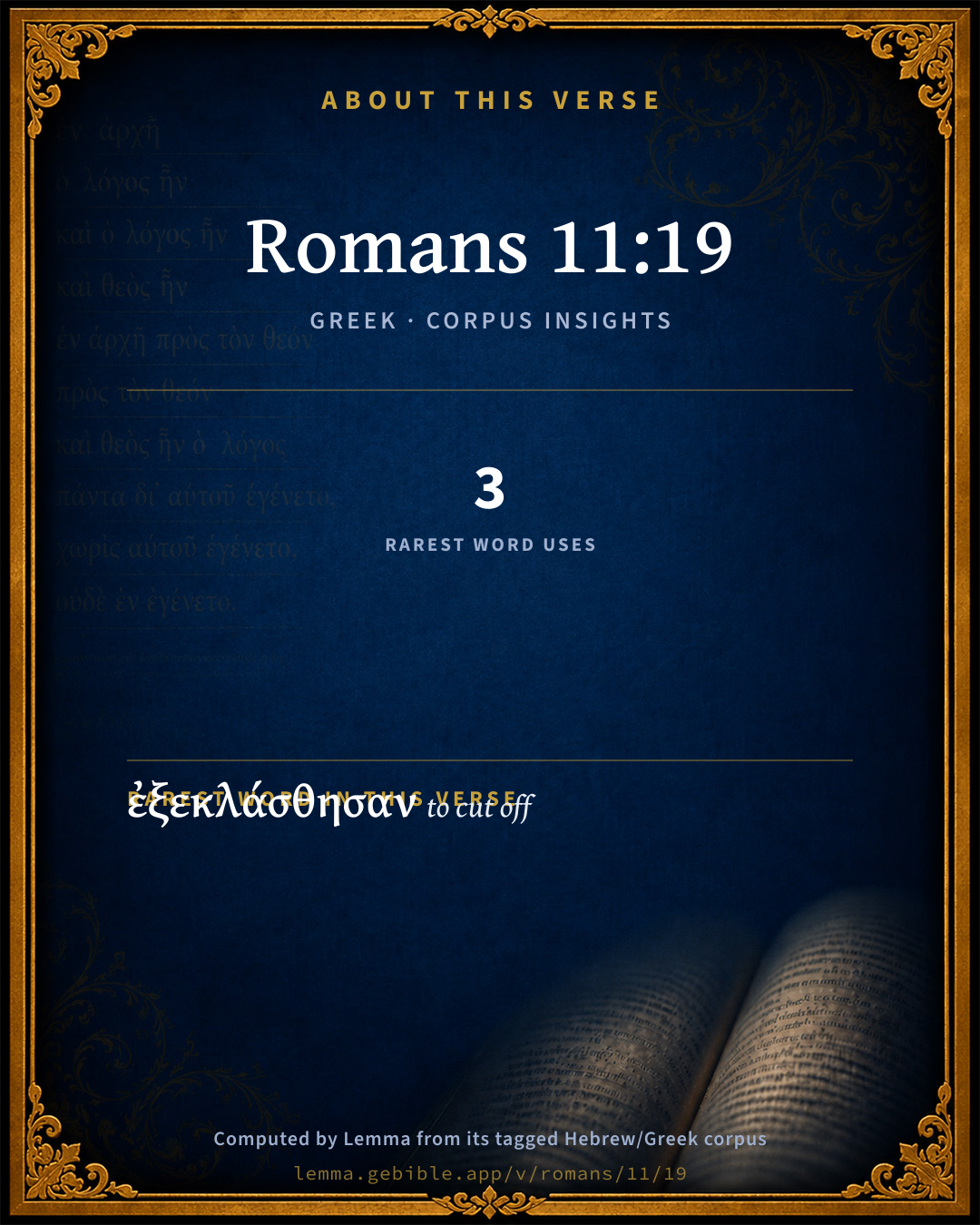
The rarest word here is ἐξεκλάσθησαν to cut off G1575 — appearing just 3 times in the whole Greek New Testament.

Shared distinctive vocabulary

ἐξεκλάσθησαν to cut off G1575 occurs in 3 verses of the Greek New Testament. Also found in:

Cross-references

3

Topical passages linked to Romans 11:19 in the Treasury of Scripture Knowledge — connected by theme and wording, ordered by reader-vote popularity; previews shown in the World English Bible.

  • Romans 11:17 But if some of the branches were broken off, and you, being a wild olive, were grafted in among them, and became partaker with them of the root and of the richness of the olive tree;
  • Romans 11:11–12 I ask then, did they stumble that they might fall? May it never be! But by their fall salvation has come to the Gentiles, to provoke them to jealousy.
  • Romans 11:23–24 They also, if they don't continue in their unbelief, will be grafted in, for God is able to graft them in again.

Cross-references courtesy of OpenBible.info (CC BY 4.0).

Commentary

Notes on Romans 11:19 from classic Christian and Jewish commentators (each source and its license shown beneath its notes). The classic Christian expositions comment on the surrounding passage and are grouped to its opening verse, so a note may address several verses; the Jewish commentaries on the Tanakh (Rashi and others) are per-verse, so they appear only where the commentator wrote on this verse.

Lemma curates 59 commentaries, every one of them public domain or Creative Commons licensed, each selected and text-cleaned for this edition rather than reprinted as found. About our sources →

Joseph Benson's Commentary

Rom 11:19-21. Thou wilt say — Thou wilt object; The branches were broken off — For their infidelity and rejection of Jesus and his gospel; that I might be graffed in — And therefore we may glory over them as they once did over us. Well; take this thought at least along with thee, Because of unbelief they were broken off — It was not undeservedly, by an act of absolute sovereignty and prerogative, but because of unbelief: by which it appears, it is possible for whole churches, as well as individuals, that have long stood by faith, to fall into such a state of infidelity as may prove their ruin. Now thou art liable to the same infirmity and corruption that they fell by. For thou standest — Hast a place in God’s favour and family; by faith — A grace which, in the very nature of it, implies dependance on God, and is itself the free, undeserved gift of God. Thou dost not stand in or by any strength of thy own, of which thou mightest be confident: thou art only what the free grace of God makes thee; and his grace is his own, which he gives or withholds at pleasure. Therefore be not high-minded, but fear — Be not too confident of thy own strength. A holy fear is an excellent preservative against high-mindedness; happy is the man that thus feareth always. We need not fear lest God should not be true to his word; all the danger is, lest we should be false to our own: let us therefore fear, lest a promise being left, to persevering believers, of entering into his rest, we should come short of it, through not continuing in the faith, grounded and settled; but being moved therefrom, and from the hope of the gospel, Col 1:23. If God spared not the natural branches — Of the good olive-tree, namely, the Jews, so called because they sprang from Abraham, the root of that tree, and consequently by their descent from him were naturally members of the Jewish Church; if God proceeded with so much severity against them, take heed lest he spare not thee — Or, as the Syriac translates the clause, perhaps neither will he spare thee. They, observe, were natural branches, and as such had a peculiar interest in Abraham’s covenant, and in the promises, being descended from his loins; and yet, when they sunk into unbelief, neither prescription, nor long usage, nor the faithfulness of their ancestors, could secure them, but God cast them off. Take heed, therefore, lest thy unbelief and barrenness expose thee, who art not a natural branch, but a scion from a foreign stock, to the punishment of excision, after all the great obligations which he hath laid thee under by his unparalleled goodness.

Joseph Benson's Commentary on the Old and New Testaments (1811–1818) — public domain. Text from a community e-Sword module.

Bengel's Gnomon

Johann Albrecht Bengel

Rom 11:19. Ἵνα, in order that) This particle expresses the chief force of the boasting [of the Gentiles]; but in opposition to this boasting compare the, for your sakes, Rom 11:28, and τῷ, Rom 11:31 [sc. ὑμετέρῳ ἐλέει, they disobeyed to the end that through the mercy showed to you they might obtain mercy.]

Bengel's Gnomon of the New Testament — English translation (T&T Clark, Edinburgh, 1860) — public domain. Text from a community e-Sword module.

Meyer's Critical & Exegetical Commentary

Heinrich August Wilhelm Meyer

Rom_11:19. Οὖν] therefore; since this reason (οὐ σὺ τὴν ῥίζαν κ.τ.λ.) forbids thee κατακαυχᾶσθαι, thou wilt have something else to allege.

ἐξεκλ. κ.τ.λ.] branches were broken off (see critical notes), in order that I, etc. This ἵνα ἐγώ has the stress of arrogant self-esteem, which, however, is not to be extended also to κλάδοι forming the simple subject, and not even standing in the first place (Hofmann: branches which were so are broken off).

Meyer — Critical and Exegetical Commentary on the New Testament — English translation by Peter Christie, edited by Frederick Crombie (T&T Clark, 1880) — public domain. Text from a community e-Sword module.

Expositor's Greek Testament

ed. W. Robertson Nicoll

Rom 11:19 . ἐρεῖς οὖν : the presumptuous Gentile persists. “It is not to the root I compare myself, but branches were broken off that I might be engrafted: that surely involves some superiority in me.”

The Expositor's Greek Testament, edited by W. Robertson Nicoll (1897–1910) — public domain. Text from a community e-Sword module.

Hodge's Commentary on Romans, Ephesians & First Corinthians

Charles Hodge

Rom_11:19

You will say then, The branches were broken off, that I might be graffed in. The apostle guards against a further ground of self-complacency on the part of the Gentile. Although forced to admit that the root bore him, and not he the root, yet he might pride himself on the fact that the branches were broken off, and he put in their place. To this it is answered, that the Gentiles are not authorized to infer, from the fact that the Jews were rejected, and they chosen, that this occurred on the ground of their being in themselves better than the Jews. The true reason of this dispensation is assigned in the next verse.

Charles Hodge — Commentary on Romans (1835), First Corinthians (1857), and Ephesians (1856) — public domain. Text from a community e-Sword module.

Jamieson, Fausset & Brown

Robert Jamieson, A. R. Fausset & David Brown

Thou wilt say then--as a plea for boasting.

The branches were broken off, that I might be grafted in.

Jamieson, Fausset & Brown — Commentary Critical and Explanatory on the Whole Bible (1871) — public domain (CC PDM 1.0). Text via the HelloAO Bible API.

Adam Clarke's Commentary

Verse 19. Thou wilt say then, c.] You may think that you have reason to exult over them because it is a fact that God has been displeased with them, and therefore has broken them off; has cast them out of the Church, and taken you into it in their place.

Adam Clarke's Commentary on the Bible (1810–1826) — public domain. Text from a community e-Sword/MySword module.

John Calvin's Commentaries

19. Thou wilt then say, etc. In the person of the Gentiles he brings forward what they might have pleaded for themselves; but that was of such a nature as ought not to have filled them with pride, but, on the contrary, to have made them humble. For if the cutting off of the Jews was through unbelief, and if the ingrafting of the Gentiles was by faith, what was their duty but to acknowledge the favor of God, and also to cherish modesty and humbleness of mind? For it is the nature of faith, and what properly belongs to it, to generate humility and fear. But by fear understand that which is in no way inconsistent with the assurance of faith; for Paul would not have our faith to vacillate or to alternate with doubt, much less would he have us to be frightened or to quake with fear.

Of what kind then is this fear? As the Lord bids us to take into our consideration two things, so two kinds of feeling must thereby be produced. For he would have us ever to bear in mind the miserable condition of our nature; and this can produce nothing but dread, weariness, anxiety, and despair; and it is indeed expedient that we should thus be thoroughly laid prostrate and broken down, that we may at length groan to him; but this dread, derived from the knowledge of ourselves, keeps not our minds while relying on his goodness, from continuing calm; this weariness hinders us not from enjoying full consolation in him; this anxiety, this despair, does not prevent us from obtaining in him real joy and hope. Hence the fear, of which he speaks, is set up as an antidote to proud contempt; for as every one claims for himself more than what is right, and becomes too secure and at length insolent towards others, we ought then so far to fear, that our heart may not swell with pride and elate itself.

But it seems that he throws in a doubt as to salvation, since he reminds them to beware lest they also should not be spared. To this I answer, — that as this exhortation refers to the subduing of the flesh, which is ever insolent even in the children of God, he derogates nothing from the certainty of faith. And we must especially notice and remember what I have before said, — that Paul’s address is not so much to individuals as to the whole body of the Gentiles, among whom there might have been many, who were vainly inflated, professing rather than having faith. On account of these Paul threatens the Gentiles, not without reason, with excision, as we shall hereafter find again.

John Calvin's Commentaries (1540-1563) — public domain. Text from the Calvin Translation Society English edition (1840s-50s) via the Christian Classics Ethereal Library (ccel.org). Calvin's coverage is partial (roughly two-thirds of the Bible); uncommented books and verses are honest gaps, never fabricated. The 19th-century editor's footnotes and remarks are omitted so the notes are faithfully Calvin's own voice.

Ellicott's Commentary for English Readers

(19, 20) It might be possible for the Gentile to claim a special providence in his substitution for the Jew. He should rather be reminded that there is a condition—faith—which is attached to this substitution; this he must be careful to observe, or else he will lose all that he has gained.

A Bible Commentary for English Readers, edited by Charles John Ellicott (1878–1897) — public domain. Text from a community e-Sword module.

The Cambridge Bible for Schools and Colleges

gen. ed. J. J. S. Perowne

19. then] therefore; i.e. in order to meet my reasoning.

The Cambridge Bible for Schools and Colleges (gen. ed. J. J. S. Perowne; Cambridge University Press, 1878–1918) — public domain. Text from a community e-Sword module.

John Gill's Exposition

Thou wilt say then,.... This is an objection which the apostle foresaw the Gentiles would make against what he had said, and in favour of their boasting;

the branches were broken off, that I might be grafted in. The sense of which is, that the Jews were rejected and left out of the Gospel church, on purpose to make way for the Gentiles, that they might be put in their room; and consequently the Jews must be more vile and unworthy, and the Gentiles more deserving of such favours and privileges, or God would never have taken such a step, to leave out one to make room for the other.

John Gill's Exposition of the Whole Bible (1746–1763) — public domain (CC PDM 1.0). Text via the HelloAO Bible API.

Trapp's Complete Commentary

John Trapp

19 Thou wilt say then, The branches were broken off, that I might be graffed in.

Ver. 19. Thou wilt say] Carnal reason will have ever somewhat to say, and is not easily set down. (Greg. Moral.)

John Trapp, A Commentary or Exposition upon All the Books of the Old and New Testament (1647–1656) — public domain. Text from a community e-Sword module.

Albert Barnes' Notes on the Bible

Thou wilt say then - Thou who art a Gentile.

The branches were broken off ... - The Jews were rejected in order that the gospel might be preached to the Gentiles. This would seem to follow from what the apostle had said in Rom 11:11-12. Perhaps it might be said that there was some ground of exultation from the fact that God had rejected his ancient people for the sake of making a way open to admit the Gentiles to the church. The objection is, that the branches were broken off in order that others might be grafted in. To this Paul replies in the next verse, that this was not the reason why they were rejected, but their unbelief was the cause.

Albert Barnes' Notes on the Bible (1834–1885) — public domain. Text from a community e-Sword/MySword module.

Matthew Poole's English Annotations

Ver. 19,20. Here he brings in the Gentiles, alleging a reason for their insulting over the Jews; because the Jews were broken off, that they might give place, or make way, for them; and the less worthy do always give place to the more worthy. To this he answers, first, by way of concession: Well, (saith he), it is true, and I do not deny it, that the Jews

were broken off, that the Gentiles might be grafted in. But then he further adds, by way of correction or negation, that the worthiness of the Gentiles was not the cause why the Jews were broken off; but it was because of their own unbelief; they would not accept of Christ, Joh 1:11; they went about to establish their own righteousness, and would not submit themselves to the righteousness of God, as it is in Rom 10:3. Therefore, if you Gentiles shall reason after this manner, you plainly put a fallacy upon yourselves, and take that for a cause which is none: you do not distinguish between the cause and the event; it fell out, indeed, that the Jews, being cast off, the Gentiles were received in, but this was not the cause of that.

And thou standest by faith: q.d. Neither is thy worthiness the cause of thy present standing in the room of the Jews, or of having thy station in the church of Christ; but it is thy believing in that Christ whom the Jews rejected. By faith thou wast first ingrafted, and still continuest in the good olive tree.

Be not high-minded, but fear: q.d. Be advised, and take heed of being self-conceited and secure; if thou fall into their fault, thou mayst expect the same fate. Therefore stand in awe, and sin not; thou art subject to unbelief and apostacy, as well as they.

Matthew Poole's English Annotations on the Holy Bible (1683–1685) — public domain. Text from a community e-Sword/MySword module.

The Pulpit Commentary

Thou wilt say then, The branches were broken off, that I might be grafted in. Though I might not beast against the original branches that remain, and among whom I have been grafted, yet I may against those which, for their unworthiness, have been broken off to make room for me: though not boasting against the faithful Jews, I surely may against the unfaithful and rejected ones.

The Pulpit Commentary (1880–1919), ed. H.D.M. Spence-Jones & Joseph S. Exell — public domain. Text from a community e-Sword module.

McGarvey & Pendleton's Commentaries

J. W. McGarvey

Thou wilt say then, Branches were broken off, that I might be grafted in . [The apostle here puts in the mouth of a representative Gentile the cause or justification of the pride. Was it not ground for self-esteem and self-gratulation when God cast off his covenanted people to receive strangers? -- Eph_2:19 ]

J. W. McGarvey (with Philip Y. Pendleton), Commentaries on the New Testament (The Fourfold Gospel, 1914; Acts; and the epistles) — public domain. Text from a community e-Sword/MySword module.

The People's New Testament

B. W. Johnson

19. Thou wilt say. Perhaps the Gentile believer might boast over the Jews: “The Jewish branches were broken off, that we Gentiles might be grafted in. Is not this a preference of the Gentile?”

B. W. Johnson's The People's New Testament with Notes (1889–1891) — public domain. Electronic text from the Christian Classics Ethereal Library (CCEL) ThML edition.

unfoldingWord translationNotes

Door43 World Missions Community

Branches were broken off

Here "branches" refers to the Jews who rejected Jesus and whom God has now rejected. You can translate this in an active form. AT: "God broke branches off" (See: Metaphor and Active or Passive)

I might be grafted in

Paul uses this phrase to refer to the Gentile believers whom God has accepted. You can translate this in an active form. AT: "he might attach me in" (See: Metaphor and Active or Passive)

their ... they

The pronouns "their" and "they" refer to the Jewish people who did not believe.

but you stand firm because of your faith

Paul speaks of the Gentile believers remaining faithful as if they were standing firm and no one could move them. AT: "but you remain because of your faith" (See: Metaphor)

For if God did not spare the natural branches, neither will he spare you

Here the "natural branches" refers to the Jewish people who rejected Jesus. AT: "Since God did not spare those unbelieving Jews, who grew up like a tree's natural branches that came from the root, then know, if you do not believe, he will not spare you either (See: Metaphor)

translationWords

true

believe

faith

fear

God

unfoldingWord translationNotes — © Distant Shores Media and the Door43 World Missions Community, licensed CC BY-SA 4.0. Source: git.door43.org/Door43/en_tn.

Cambridge Greek Testament for Schools and Colleges

19. οὖν. The Gentile is represented as justifying his triumph by the fact that his inclusion was the purpose of their rejection.

Cambridge Greek Testament for Schools and Colleges (Cambridge University Press, 1896; 21 vols, various authors incl. Carr, Maclear, Plummer, Farrar, Lumby, Moule, M. R. James, Simcox) — public domain. Text from a community e-Sword module.

Alford’s Greek Testament

Henry Alford

19.] Thou wilt then (posito, that thou boastest, and defendest it) say, Branches (it would look as if the art. had been erased, to square this sentence with ver. 17, where τινὲς τ. κλάδων only were broken off. Or we might think, as Matthäi has remarked (Thol.), that, ‘Gentilis loquitur arrogantius,’ using οἱ κλ. in his pride, to signify that the branches, generically, have now become subject to excision on his account. But the fact, now ascertained by Tischdf., that B omits the art., makes nearly the whole manuscript authority against it) were broken off that I (emphatic) might be grafted in.

Henry Alford, The Greek Testament (1849–1861) — public domain. Text from a community e-Sword module.

International Critical Commentary

19. ἐρεῖς οὖν. The Gentile Christian justifies his feeling of confidence by reminding St. Paul that branches (κλάδοι, not οἱ κλάδοι) had been cut off to let him in: therefore, he might argue, I am of more value than they, and have grounds for my self-confidence and contempt.

International Critical Commentary — older volumes (1896–1929), various authors — public domain. Text from a community e-Sword module.

Godet's Commentaries

Frédéric Louis Godet

Vv. 19-21. “Thou wilt say then, Branches were broken off, that I might be grafted in. Well! because of unbelief they were broken off, and thou standest by faith; be not high-minded, but fear! For if God spared not the natural branches, [it may be] that neither will He spare thee.”

The objection Paul puts in the mouth of his reader is taken from the very answer which he had just made to him in Rom 11:18; hence the then: “Since branches have been cut off the stem to make place for me, who was foreign to it by nature, the preference of God for me appears thereby still more striking than if God had confined Himself to engrafting me on the same stem with them.”

The article οἱ, the, before the word branches, is to be rejected, according to the majority of the documents. Paul means, in reality: “beings who had the character of branches.” The particular emphasis resting on the ἐγώ should be remarked; literally: “that I on my part should be grafted in.” To make place for me, even me, God rejected branches!

Frédéric Louis Godet — Commentaries on Luke, John, Romans, and 1 Corinthians — English translation (T&T Clark, Edinburgh, 1870s–1890s) — public domain. Text from a community e-Sword module.

Lesson kit

Teaching starters — assembled from the data on this page, not authored interpretation. Every prompt links to the verse data it draws on. Edit before teaching.

Romans, in the Pauline Epistles, opens this verse with 7 words (7 distinct Greek lemmas). Its most distinctive word is ekkláō (“to cut off”). A historical commentator’s framing appears above. Read the whole chapter for the surrounding context.

Discussion questions

  1. The word ekkláō carries the sense “to cut off.” How does it shape the verse?
  2. Romans 11:17 shares the word «to cut off» with this verse. How do the two illuminate each other?
  3. These translations render this verse differently; the difference is in the English rendering, not the original. What questions does that raise?
  4. Reading how Joseph Benson's Commentary and Bengel's Gnomon read this verse, where do the two commentators agree and where do they part?

Things to notice

Reading settings

Reading text

Shown beneath each verse's original-language words.

Old Testament
Old Testament edition

Read the OT as the Masoretic Hebrew (MT) or the Greek Septuagint (LXX).

English shown for the Greek Septuagint (in the Hebrew ↔ Greek comparison).

Comparing translations? Open the Compare panel on any verse page to stack up to four side by side.