
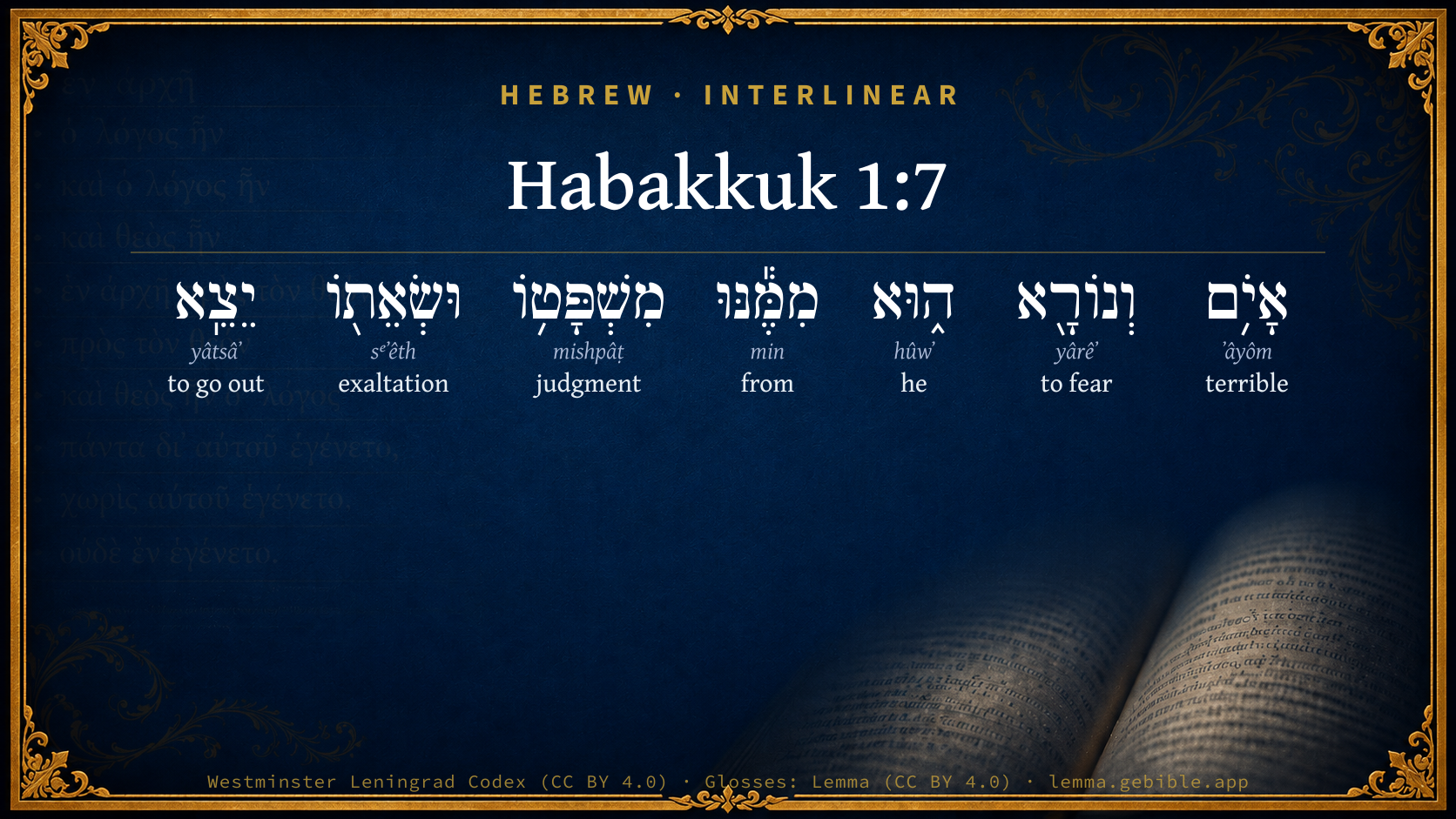
Habakkuk 1:7

Hebrew (Westminster Leningrad Codex) Habakkuk 1:7 appears in the Hebrew Old Testament. The text above is from the Westminster Leningrad Codex. Each word links to its Strong’s number, a concise gloss, and parsing drawn from the Open Scriptures Hebrew Bible morphology. Click any word for its full Brown-Driver-Briggs (BDB) entry.
Download image
Cite this verse

Habakkuk 1:7 (World English Bible). Public Domain. Lemma interlinear Bible study tool, https://lemma.gebible.app/v/habakkuk/1/7.

Show BibTeX & RIS
BibTeX
RIS
English Translation
They are feared and dreaded. Their judgment and their dignity proceed from themselves.
World English Bible · Public Domain
Download a study sheet

One document with this verse’s original text, its word-by-word gloss line, the meaning frame, cross-references with their text, attributed commentary, and full source and license credits — printable, and it pastes into notes with its structure intact.

This verse Autodidact and up

Study sheet (.html) Plain text (.txt)

A passage Seminary Student

Up to 50 verses in one chapter. A passage sheet keeps up to 6 commentary sources and 12 cross-references per verse, in the order this page ranks them, and says so on the sheet whenever that leaves anything out. Ask for a single verse and you get the Autodidact verse sheet above.

Everything on this page stays free to read, with no account — the sheet is a download of what is already on screen, not access to it.

Want to remove ads? Support Godless Engineer
Compare translations 3

The same verse in 3 English versions, stacked beneath the original-language interlinear above. Click any original word for its lexicon entry.

Each is an independent rendering of the whole verse — the interlinear is not word-aligned to these translations.

Highlighted words mark where these versions differ — a whole-verse word diff, not a word-by-word alignment.

  • World English Bible Public Domain
    They are feared and dreaded. Their judgment and their dignity proceed from themselves.
  • King James Version Public Domain
    They are terrible and dreadful: their judgment and their dignity shall proceed of themselves.
  • unfoldingWord Literal Text CC BY-SA 4.0
    He dreadful and terrifying; from him goes forth his justice and his dignity.

unfoldingWord Literal Text — © unfoldingWord, licensed CC BY-SA 4.0. Word-aligned USFM3 via Door43 (git.door43.org/unfoldingWord/en_ult).

Versions to compare (up to 4)

3 of 4 selected

Show all 18 translations

Every available English version of this verse, each an independent rendering of the whole verse.

  • World English Bible Public Domain
    They are feared and dreaded. Their judgment and their dignity proceed from themselves.
  • Berean Standard Bible Public Domain
    They are dreaded and feared; from themselves they derive justice and sovereignty.
  • Majority Standard Bible Public Domain
    They are dreaded and feared; from themselves they derive justice and sovereignty.
  • King James Version Public Domain
    They are terrible and dreadful: their judgment and their dignity shall proceed of themselves.
  • American Standard Version (1901) Public Domain
    They are terrible and dreadful; their judgment and their dignity proceed from themselves.
  • Revised Version (1885) Public Domain
    They are terrible and dreadful: their judgment and their dignity proceed from themselves.
  • Geneva Bible (1599) Public Domain
    They are terrible and fearefull: their iudgement and their dignitie shall proceede of theselues.
  • Douay-Rheims (1899) Public Domain
    They are dreadful, and terrible: from themselves shall their judgment, and their burden proceed.
  • Young's Literal Translation Public Domain
    Terrible and fearful it `is', From itself its judgment and its excellency go forth.
  • Literal Standard Version CC BY-SA 4.0
    He [is] terrible and fearful, || His judgment and his excellence go forth from him.
  • Unlocked Literal Bible CC BY-SA 4.0
    They are terrifying and fearsome; their judgment and splendor proceed from themselves.
  • unfoldingWord Literal Text CC BY-SA 4.0
    He dreadful and terrifying; from him goes forth his justice and his dignity.
  • Darby Bible Public Domain
    They are terrible and dreadful: their judgment and their dignity proceed from themselves.
  • World Messianic Bible Public Domain
    They are feared and dreaded. Their judgment and their dignity proceed from themselves.
  • Webster's Bible Public Domain
    They are terrible and dreadful: their judgment and their dignity shall proceed from themselves.
  • Free Bible Version CC BY-SA 4.0
    They are fearsome and terrifying, and so proud of themselves that they set their own rules.
  • Bible in Basic English Public Domain
    They are greatly to be feared: their right comes from themselves.
  • JPS Tanakh (1917) Public Domain
    They are terrible and dreadful; their law and their majesty proceed from themselves.

Literal Standard Version (2020), Covenant Press — licensed CC BY-SA 4.0. Text via the HelloAO Bible API (eBible.org). Unlocked Literal Bible (unfoldingWord) — licensed CC BY-SA 4.0. Text via the HelloAO Bible API (eBible.org). unfoldingWord Literal Text — © unfoldingWord, licensed CC BY-SA 4.0. Word-aligned USFM3 via Door43 (git.door43.org/unfoldingWord/en_ult). Free Bible Version, Dr. Jonathan Gallagher — licensed CC BY-SA 4.0. Text via the HelloAO Bible API (eBible.org).

Word by word

More ways to search: Search by grammar → Find every occurrence → Compare this word →

Practice this passage: Drill this verse → Learn its vocabulary →

About this verse

These counts appear in no published source. They are computed here, from the morphology-tagged text and Lemma’s own curated glosses. What Lemma adds →

7
words
7
distinct lemmas
Prophets
section

Notable vocabulary

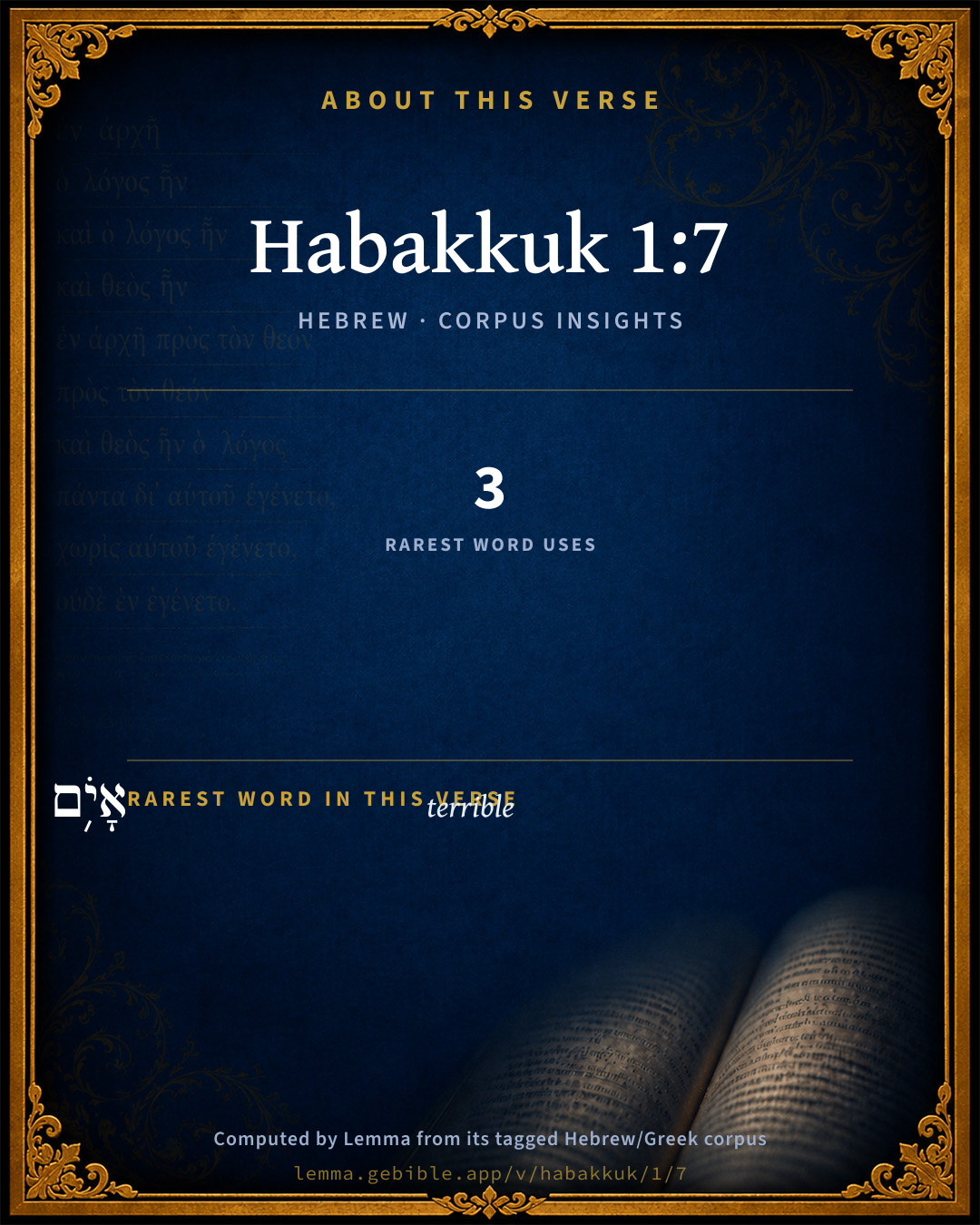
The rarest word here is אָיֹ֥ם terrible H366 — appearing just 3 times in the whole Hebrew Bible.

Shared distinctive vocabulary

אָיֹ֥ם terrible H366 occurs in 3 verses of the Hebrew Bible. Also found in:

Grammatical profile

  • 2 verbs
  • 2 nouns
  • 1 adjective
  • 1 pronoun
  • 1 preposition

Verb forms

  • וְנוֹרָ֖א Niphal · Participle Active
  • יֵצֵֽא Qal · Imperfect

Hebrew & Septuagint length

In English translation the verse runs 13 words from the Hebrew and 19 from the Septuagint (LXX English) — the Septuagint runs noticeably longer here. See the side-by-side →

A rough comparison of the two English renderings, which tokenize alike — not a word-level alignment.

Word counts can differ between the Hebrew and the Greek without any difference in meaning — e.g. the Hebrew direct-object marker אֵת has no separate Greek word, and Greek often adds the article ὁ.

Cross-references

6

Topical passages linked to Habakkuk 1:7 in the Treasury of Scripture Knowledge — connected by theme and wording, ordered by reader-vote popularity; previews shown in the World English Bible.

  • Jeremiah 39:5–9 But the army of the Chaldeans pursued after them, and overtook Zedekiah in the plains of Jericho: and when they had taken him, they brought him up to Nebuchadrezzar king of Babylon to Riblah in the land of Hamath; and he gave judgment on him.
  • Deuteronomy 5:19 "Neither shall you steal.
  • Deuteronomy 5:27 Go you near, and hear all that Yahweh our God shall say: and speak you to us all that Yahweh our God shall speak to you; and we will hear it, and do it.
  • Isaiah 18:7 In that time shall a present be brought to Yahweh of Hosts [from] a people tall and smooth, even from a people awesome from their beginning onward, a nation that measures out and treads down, whose land the rivers divide, to the place of the name of Yahweh of Hosts, Mount Zion.
  • Jeremiah 52:9–11 Then they took the king, and carried him up to the king of Babylon to Riblah in the land of Hamath; and he gave judgment on him.
  • Jeremiah 52:25–27 and out of the city he took an officer who was set over the men of war; and seven men of those who saw the king's face, who were found in the city; and the scribe of the captain of the host, who mustered the people of the land; and sixty men of the people of the land, who were found in the midst of the city.

Cross-references courtesy of OpenBible.info (CC BY 4.0).

Hebrew and Greek witnesses Masoretic Hebrew ↔ Greek Septuagint

The same verse in the two great witnesses to the Old Testament, shown verse-for-verse.

Here the Septuagint runs noticeably longer than the Hebrew — LXX2012 (modern English Septuagint) 19 words vs World English Bible 13. A rough length comparison of the two English translations, not a word-level alignment — read both below.

These are two independent witnesses, not word-aligned to each other, and the Septuagint is shown in lemma (dictionary) form.

Hebrew Habakkuk 1:7 Masoretic · Westminster Leningrad Codex

אָיֹ֥ם וְנוֹרָ֖א ה֑וּא מִמֶּ֕נּוּ מִשְׁפָּט֥וֹ וּשְׂאֵת֖וֹ יֵצֵֽא

They are feared and dreaded. Their judgment and their dignity proceed from themselves.

World English Bible · Public Domain

Greek LXX Habakkuk 1:7 Septuagint · lemma form

φοβερός καί ἐπιφανής εἰμί ἐκ αὐτός ὁ κρίμα αὐτός εἰμί καί ὁ λῆμμα αὐτός ἐκ αὐτός ἐκἔρχομαι

He is terrible and famous; his judgment shall proceed of himself, and his dignity shall come out of himself.

LXX2012 (modern English Septuagint) · Public Domain

On this verse, The Pulpit Commentary discusses the Septuagint’s reading. Read the note in Commentary ↓

Hebrew: Westminster Leningrad Codex (CC BY 4.0). Greek: Septuagint (public domain); English from LXX2012 (modern English Septuagint) (Public Domain). How the Septuagint differs from the Hebrew →

Targum (Aramaic paraphrase)

1

The Targum is the ancient Jewish Aramaic paraphrase of the Hebrew Scriptures — an interpretive translation, not the Hebrew text itself. Onkelos (literal) and Pseudo-Jonathan (expansive) render the Torah, and Jonathan the Prophets. Coverage is partial: where no permissively-licensed English translation exists for a verse, only the Aramaic is shown. This is verse-level text, not a word-by-word alignment to the Hebrew.

  1. Targum Jonathan Prophets (Joshua–Malachi)
    אֵימְתָנִין וּדְחִילִין אִינוּן מִנֵיהּ דִינֵיהּ וּגְזֵרָתֵיהּ נָפְקִין:

    (no public-domain English translation for this verse)

    Targum Jonathan — Aramaic: “Mikraot Gedolot” (public domain). English: “Sefaria Community Translation” (CC0 1.0 (public-domain dedication)); “London "Chaldee Paraphrase," 1871” (public domain). Text via Sefaria.

Commentary

Notes on Habakkuk 1:7 from classic Christian and Jewish commentators (each source and its license shown beneath its notes). The classic Christian expositions comment on the surrounding passage and are grouped to its opening verse, so a note may address several verses; the Jewish commentaries on the Tanakh (Rashi and others) are per-verse, so they appear only where the commentator wrote on this verse.

Lemma curates 59 commentaries, every one of them public domain or Creative Commons licensed, each selected and text-cleaned for this edition rather than reprinted as found. About our sources →

Trapp's Complete Commentary

John Trapp

Hab 1:7 They [are] terrible and dreadful: their judgment and their dignity shall proceed of themselves.

Ver. 7. They are terrible and dreadful] Or horrible, such as were those giants called Emims, Deu 2:10-11 Gen 14:5, and far more formidable than that disputant at Paris, who would needs be styled horribilis Sophista, the horrible Sophister, non minorem eam appellationem ratus (saith Vires) quam Africani aut Asiatici, taking it for as great an honour as to be a conqueror.

Their judgment and their dignity shall proceed of themselves] i.e. They shall do as they list; their lust shall be their law, Pellitur e medio sapientia, vi geritur res. See Psa 12:4-5 Exo 5:2. These Chaldeans will be their own carvers; ministering law according to their own pleasures. The honour also and dignity of this nation (now base and obscure) shall grow up and appear. Ipsa sibi iudicabit, et decretum suum exequetur: vel ex decreto sue exequetur. So Symmachus.

John Trapp, A Commentary or Exposition upon All the Books of the Old and New Testament (1647–1656) — public domain. Text from a community e-Sword module.

Joseph Benson's Commentary

Hab 1:7-9. Their judgment, &c., shall proceed of themselves — They will judge themselves of what they shall do, without paying regard to any thing but their own will, and shall have power to put in execution whatever they resolve upon. Their horses also are swifter than the leopards — “Leopards tamed and taught to hunt are, it is said, made use of [in Palestine] for hunting, and seize the prey with surprising agility. When the leopard leaps, he throws himself seventeen or eighteen feet at a time.” — Harmer, 2:438. And are more fierce than the evening wolves — Which, having fasted in the day, were wont to come forth in the evening fierce and ravenous. And their horsemen shall spread themselves — Namely, all over the land; that is, they shall be very numerous. They shall come all for violence — To enrich themselves by making a prey of all. Their faces shall sup up as the east wind — They shall destroy every thing where they march, as the east wind blasts the fruits of the earth. And they shall gather the captivity [or, captives] as the sand — Not only in Judea, but in all the neighbouring countries which they conquer. Houbigant renders the clause, A burning wind goes before them, and gathers captives as the sand. They shall carry desolation, destruction, and fire, everywhere before them. The winds which blew from Arabia the Desert were extremely hot, and very dangerous, not only on account of their own heat, but on account of the dust and sand which they brought with them.

Joseph Benson's Commentary on the Old and New Testaments (1811–1818) — public domain. Text from a community e-Sword module.

Tyndale Open Study Notes

Tyndale Open Resources

1:7 do whatever they like: No relief from injustice would come from the Babylonians. They were a law unto themselves, which added to the prophet’s perplexity at God’s decision to use them to punish Judah.

Tyndale Open Study Notes — © Tyndale Open Resources, licensed CC BY-SA 4.0. Text via the HelloAO Bible API.

Geneva Bible (1599)

Geneva Bible translators

They themselves shall be your judges in this cause, and none shall have authority over them to control them.

Geneva Bible (1599) marginal notes — public domain. Text via Bolls.life.

Jamieson, Fausset & Brown

Robert Jamieson, A. R. Fausset & David Brown

their judgment and . . . dignity . . . proceed of themselves--that is, they recognize no judge save themselves, and they get for themselves and keep their own "dignity" without needing others' help. It will be vain for the Jews to complain of their tyrannical judgments; for whatever the Chaldeans decree they will do according to their own will, they will not brook anyone attempting to interfere.

Jamieson, Fausset & Brown — Commentary Critical and Explanatory on the Whole Bible (1871) — public domain (CC PDM 1.0). Text via the HelloAO Bible API.

Adam Clarke's Commentary

Verse 7. Their judgment - shall proceed of themselves.] By revolting from the Assyrians, they have become a great nation. Thus, their judgment and excellence were the result of their own valour. Other meanings are given to this passage.

Adam Clarke's Commentary on the Bible (1810–1826) — public domain. Text from a community e-Sword/MySword module.

John Calvin's Commentaries

By saying that the Chaldeans would be terrible and dreadful, he praises not their virtues; but, as I have already reminded you, he shows that they would be prepared to do his service by executing his vengeance: and he so regulated his judgement, that he used their cruelty for a good purpose. Thus we see that the worst of men are in God’s hand, as Satan is, who is their head; and yet that God is not implicated in their wickedness, as some insane men maintain; for they say—That if God governs the world by his providence, he becomes thus the author of sin, and men’s sins are to be ascribed to him. But Scripture teaches us far otherwise,—that the wicked are led here and there by the hidden power of God, and that yet the fault is in them, when they do anything in a deceitful and cruel manner, and that God ever remains just, whatever use he may make of instruments, yea, the very worst.

But when the Prophet adds, that its judgement would be from the nation itself, he means that the Chaldeans would act according to their own will. When any one indeed obeys laws, and willingly submits to them, he will freely allow either judges or umpires in case of a dispute; but he who will have all things done according to his own purpose repudiates all judges. The Prophet therefore means, that the Chaldeans would be their own judges, so that the Jews or others would complain in vain for any wrongs done to them. “They shall be,” he says, “their own judges, and shall execute judgement, for they will not accept any arbitrators.” The word judgement, taken in a good sense, is put here for law (jus); as though he said, “Whatever the Chaldeans will claim for themselves, theirs shall it be; for no one will dare to interfere, and they will not submit to the will of others; but their power shall be for law, and their sword for a tribunal.” We now understand the Prophet’s meaning; and we must ever bear in mind what I have already said,—That God had no participation in these vices; but it was necessary that the stubbornness of an irreclaimable people should be thus corrected, or at least broken down. The Lord in the meantime could use such instruments in such a way as to preserve some moderation in his judgements. It follows—

John Calvin's Commentaries (1540-1563) — public domain. Text from the Calvin Translation Society English edition (1840s-50s) via the Christian Classics Ethereal Library (ccel.org). Calvin's coverage is partial (roughly two-thirds of the Bible); uncommented books and verses are honest gaps, never fabricated. The 19th-century editor's footnotes and remarks are omitted so the notes are faithfully Calvin's own voice.

Ellicott's Commentary for English Readers

(7) Their judgment . . .—Their “judgment” means their claim to adjudge the affairs of mankind. It proceeds from “themselves,” as irresponsible, recognising no Supreme Being as the source of justice.

Their dignity, in like manner, proceeds from “themselves,” because self-sustained, unsanctioned by the King of kings and Lord of lords.

A Bible Commentary for English Readers, edited by Charles John Ellicott (1878–1897) — public domain. Text from a community e-Sword module.

The Cambridge Bible for Schools and Colleges

gen. ed. J. J. S. Perowne

7. terrible and dreadful] The first word occurs again only Son_6:4; Son_6:10 “terrible as an army with banners.” The noun is frequently used of the terror inspired by the sight of an object, Job_39:20; Job_41:14; of the terror caused by the manifestation of the Almighty, Job_9:34; Job_13:21, and of the terrors of death, Psa_55:4. The second word is that usually rendered “terrible” in A.V., meaning, to be feared.

Their judgment and their dignity] from himself proceedeth his Judgment and his dignity. The words carry on the idea of “terrible and dreadful,” and describe the Chaldean’s manner of bearing himself among the nations, though it may be uncertain whether “his judgment” be that which regulates his own conduct or that which he imposes on the nations. The former sense is the more vigorous. The Chaldean’s own sense of himself corresponds to the dread he inspires. He is imperious and autocratic, allows no considerations from without to modify his action, his own haughty mind alone determines his procedure. Similarly his “dignity” or majesty is the supremacy and sovereignty which he assumes and exercises.

The Cambridge Bible for Schools and Colleges (gen. ed. J. J. S. Perowne; Cambridge University Press, 1878–1918) — public domain. Text from a community e-Sword module.

John Gill's Exposition

They are terrible and dreadful,.... For the fierceness of their countenances; the number and valour of their troops; the splendour of their armour; the victories they had obtained, and the cruelty they had exercised; the fame of all which spread terror wherever they came:

their judgment and their dignity shall proceed of themselves; they will not be directed and governed by any laws of God and man, but by their own; they will do according to their will and pleasure, and none will be able to gainsay and resist them; they will hear no reason or argument; their decrees and determinations they make of themselves shall be put into execution, and there will be no opposing their tyrannical measures; they will usurp a power, and take upon them an authority over others of themselves, which all must submit unto; no mercy and pity: no goodness and humanity, are to be expected from such lawless and imperious enemies.

John Gill's Exposition of the Whole Bible (1746–1763) — public domain (CC PDM 1.0). Text via the HelloAO Bible API.

Albert Barnes' Notes on the Bible

They are terrible - איום 'âyôm occurs here only and Son 6:4, Son 6:10, compared with the “bannered host,” but the root is common in אימה 'ēymâh.

And dreadful - He describes them, first in themselves, then in act. They are terrible, and strike fear through their very being, their known character, before they put it forth in act.

Their judgment and their dignity shall proceed of themselves. - Judgment had gone forth in God’s people wrested Hab 1:4; now shall it go forth against them at the mere will of their master, who shall own no other rule or Lord or source of his power. His own will shall be his only law for himself and others. His elevation is too is, in his own thought, from himself. He is self-sufficing; he holds from no other, neither from God nor man. His “dignity” is self-sustained; His “judgment” is irresponsible, as if there were none Ecc 5:8 higher than he. He has, like all great world-powers, a real dignity and majesty. He infuses awe. The dignity is real but faulty, as being held independently of God. This is a character of antichrist Dan 11:36; 2Th 2:4, a lawless insolence, a lifting up of himself.

Albert Barnes' Notes on the Bible (1834–1885) — public domain. Text from a community e-Sword/MySword module.

Haydock's Catholic Bible Commentary

Proceed. They admit no authority but their own. (Calmet) --- This pride will prove their ruin. (Haydock)

George Leo Haydock (1774–1849), Haydock's Catholic Family Bible and Commentary, 1859 edition — public domain. Excludes Psalms (Douay-Rheims chapter numbering differs from Protestant) and Deuterocanonical books (Catholic canon only).

Matthew Poole's English Annotations

They are terrible and dreadful: to affect the incredulous Jews with greater fear, it is doubled, they are of all nations most terrible; in the fierceness wherewith they assault, and cruelty with which they use their captives. Their judgment, the law they observe, is their own will, and what they please you must submit unto, nor complain of wrong done, forasmuch as they do it.

Their dignity; their authority and superiority, for which you must reverence them; the lordliness of their deportment toward you, or the right they assume to send you captives; all is from themselves, without respect to any other law or rule whatever. How miserable are you like to be, when enslaved to such a barbarous cruelty, and unbounded pride!

Matthew Poole's English Annotations on the Holy Bible (1683–1685) — public domain. Text from a community e-Sword/MySword module.

The Pulpit Commentary

They. The Hebrew is singular throughout. The disposition of the people, as of one man, is depicted. Terrible; exciting terror, as Son_6:4, Son_6:10. Their judgment and their dignity shall proceed of themselves; his judgment and his eminence are from himself. The LXX translates the two nouns krima and lhmma: Vulgate, judicium and onus. The meaning is that the Chaldeans own no master, have no rule of right but their own will, attribute their glory and superiority to their own power and skill. (comp. Dan_4:13) They are like Achilles in Horace, "Ep. ad Pison.," 121, etc.

Impiger, iracundus, inexorabilis, acer, Jura neget sibi nata, nihil non arroget armis.

Hitzig quotes Aeschyl. "Prom.," 186, Par eJautw to dikaion ecwn, "Holding as justice what he deemeth so."

The Pulpit Commentary (1880–1919), ed. H.D.M. Spence-Jones & Joseph S. Exell — public domain. Text from a community e-Sword module.

John Wesley's Explanatory Notes

Their judgment - The law they observe, is their own will. Their dignity - Their authority is all from themselves, without respect to any other law or rule whatever. 8. The evening wolves - Which with fasting in the day, came out in the evening, fierce and ravenous. Shall spread - All over the land.

John Wesley, Explanatory Notes Upon the Whole Bible (1754–1765) — public domain. Text via the GEBible commentary corpus.

Rashi

Rabbi Shlomo Yitzchaki (Rashi)

from themselves their judgment and their burden shall emanate From them are judges; from them are kings, who cast a burden and a fear upon all. their judgment joustice in O.F:

Rashi on the Tanakh — English translations: “The Judaica Press complete Tanach with Rashi, translated by A. J. Rosenberg” (CC BY 4.0); “Pentateuch with Rashi's commentary by M. Rosenbaum and A.M. Silbermann, 1929-1934” (public domain); “The Metsudah Tanach series, Lakewood, N.J” (CC BY 4.0); and “The Book of Joshua, Metsudah Publications, 1997” (CC BY 4.0). Text via Sefaria.

Lesson kit

Teaching starters — assembled from the data on this page, not authored interpretation. Every prompt links to the verse data it draws on. Edit before teaching.

Habakkuk, in the Prophets, opens this verse with 7 words (7 distinct Hebrew lemmas). Its most distinctive word is ʼâyôm (“terrible”). The Greek Septuagint runs longer here. A historical commentator’s framing appears above. Read the whole chapter for the surrounding context.

Discussion questions

  1. What does “terrible” (ʼâyôm) contribute to the verse as a whole?
  2. Song of Solomon 6:4 shares the word «terrible» with this verse. How do the two illuminate each other?
  3. Compared with the Hebrew, the Septuagint runs longer here. What questions does that raise?
  4. The translations on this page render this verse differently — a whole-verse word diff, not a word-by-word alignment. What might account for the different wordings?
  5. The verb «וְנוֹרָ֖א» is Niphal Participle Active. How does its form color the action?
  6. Reading how Trapp's Complete Commentary and Joseph Benson's Commentary read this verse, where do the two commentators agree and where do they part?

Things to notice

Reading settings

Reading text

Shown beneath each verse's original-language words.

Old Testament
Old Testament edition

Read the OT as the Masoretic Hebrew (MT) or the Greek Septuagint (LXX).

English shown for the Greek Septuagint (in the Hebrew ↔ Greek comparison).

Comparing translations? Open the Compare panel on any verse page to stack up to four side by side.