Leviticus 13:19

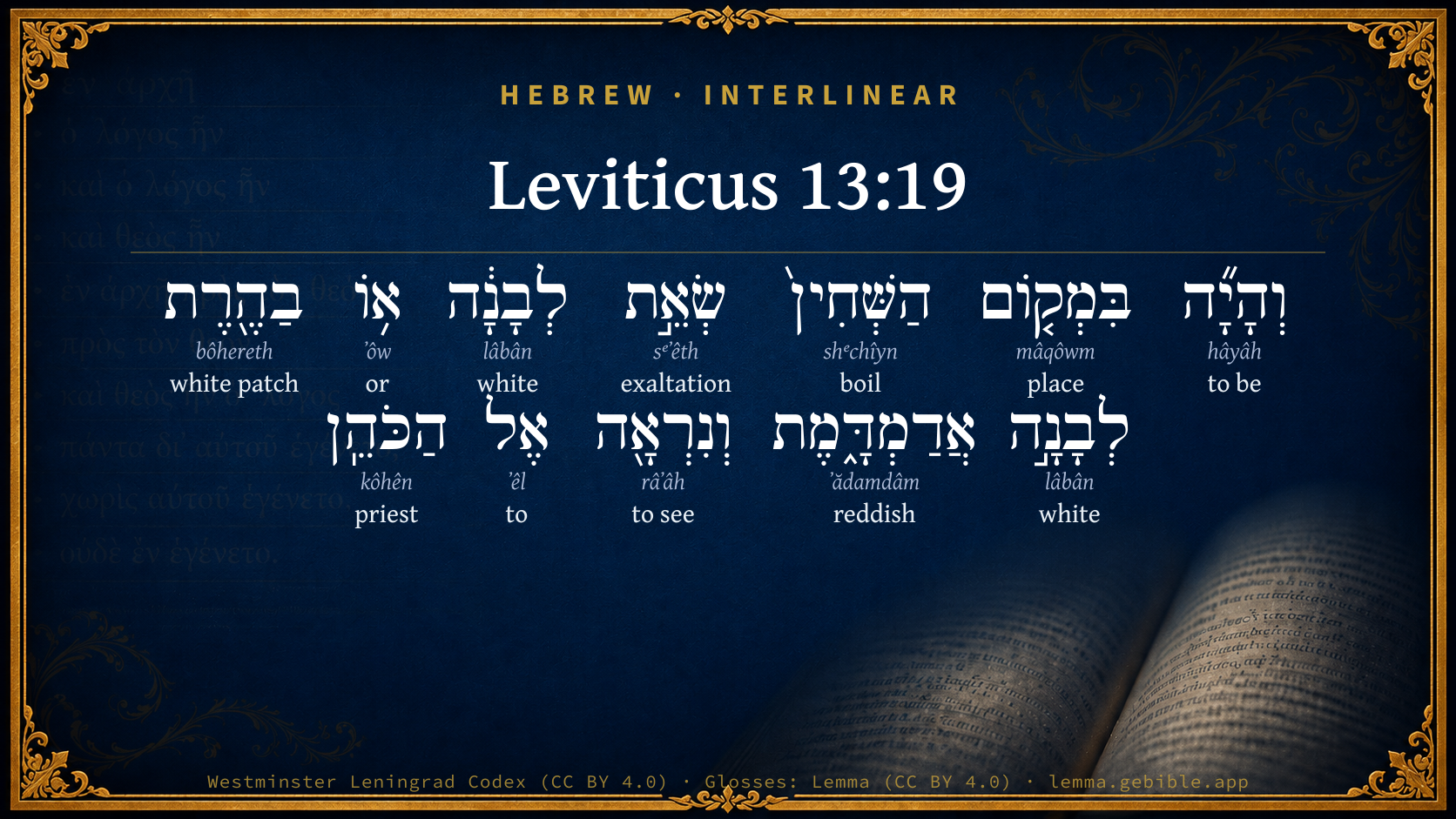
Hebrew (Westminster Leningrad Codex) Leviticus 13:19 appears in the Hebrew Old Testament. The text above is from the Westminster Leningrad Codex. Each word links to its Strong’s number, a concise gloss, and parsing drawn from the Open Scriptures Hebrew Bible morphology. Click any word for its full Brown-Driver-Briggs (BDB) entry.
Download image
Cite this verse

Leviticus 13:19 (World English Bible). Public Domain. Lemma interlinear Bible study tool, https://lemma.gebible.app/v/leviticus/13/19.

Show BibTeX & RIS
BibTeX
RIS
English Translation
and in the place of the boil there is a white rising, or a bright spot, reddish-white, then it shall be shown to the priest;
World English Bible · Public Domain
Highlights
  • 1 first appearance in the Hebrew Bible
Full analysis ↓
Download a study sheet

One document with this verse’s original text, its word-by-word gloss line, the meaning frame, cross-references with their text, attributed commentary, and full source and license credits — printable, and it pastes into notes with its structure intact.

This verse Autodidact and up

Study sheet (.html) Plain text (.txt)

A passage Seminary Student

Up to 50 verses in one chapter. A passage sheet keeps up to 6 commentary sources and 12 cross-references per verse, in the order this page ranks them, and says so on the sheet whenever that leaves anything out. Ask for a single verse and you get the Autodidact verse sheet above.

Everything on this page stays free to read, with no account — the sheet is a download of what is already on screen, not access to it.

Want to remove ads? Support Godless Engineer
Compare translations 3

The same verse in 3 English versions, stacked beneath the original-language interlinear above. Click any original word for its lexicon entry.

Each is an independent rendering of the whole verse — the interlinear is not word-aligned to these translations.

Highlighted words mark where these versions differ — a whole-verse word diff, not a word-by-word alignment.

  • World English Bible Public Domain
    and in the place of the boil there is a white rising, or a bright spot, reddish-white, then it shall be shown to the priest;
  • King James Version Public Domain
    And in the place of the boil there be a white rising, or a bright spot, white, and somewhat reddish, and it be showed to the priest;
  • unfoldingWord Literal Text CC BY-SA 4.0
    and a white swelling or a white-reddish bright spot is in the place of the boil, then he shall show himself to the priest.

unfoldingWord Literal Text — © unfoldingWord, licensed CC BY-SA 4.0. Word-aligned USFM3 via Door43 (git.door43.org/unfoldingWord/en_ult).

Versions to compare (up to 4)

3 of 4 selected

Show all 18 translations

Every available English version of this verse, each an independent rendering of the whole verse.

  • World English Bible Public Domain
    and in the place of the boil there is a white rising, or a bright spot, reddish-white, then it shall be shown to the priest;
  • Berean Standard Bible Public Domain
    and a white swelling or a reddish-white spot develops where the boil was, he must present himself to the priest.
  • Majority Standard Bible Public Domain
    and a white swelling or a reddish-white spot develops where the boil was, he must present himself to the priest.
  • King James Version Public Domain
    And in the place of the boil there be a white rising, or a bright spot, white, and somewhat reddish, and it be showed to the priest;
  • American Standard Version (1901) Public Domain
    and in the place of the boil there is a white rising, or a bright spot, reddish-white, then is shall be showed to the priest;
  • Revised Version (1885) Public Domain
    and in the place of the boil there is a white rising, or a bright spot, reddish-white, then it shall be shewed to the priest;
  • Geneva Bible (1599) Public Domain
    And in ye place of the bile there be a white swelling, or a white spot somewhat reddish, it shall be seene of the Priest.
  • Douay-Rheims (1899) Public Domain
    And in the place of the ulcer, there appeareth a white scar, or somewhat red, the man shall be brought to the priest:
  • Young's Literal Translation Public Domain
    and there hath been in the place of the ulcer a white rising, or a bright white spot, very red, then it hath been seen by the priest,
  • Literal Standard Version CC BY-SA 4.0
    and there has been in the place of the ulcer a white rising, or a bright white spot, reddish, then it has been seen by the priest,
  • Unlocked Literal Bible CC BY-SA 4.0
    and in place of the boil there is white swelling or a bright spot, reddish-white, then it must be shown to the priest.
  • unfoldingWord Literal Text CC BY-SA 4.0
    and a white swelling or a white-reddish bright spot is in the place of the boil, then he shall show himself to the priest.
  • Darby Bible Public Domain
    and there is in the place of the boil a white rising, or a white-reddish bright spot, it shall be shewn to the priest;
  • World Messianic Bible Public Domain
    and in the place of the boil there is a white swelling, or a bright spot, reddish-white, then it shall be shown to the priest.
  • Webster's Bible Public Domain
    And in the place of the boil there shall be a white rising, or a bright spot, white, and somewhat reddish, and it be showed to the priest;
  • Free Bible Version CC BY-SA 4.0
    and a white swelling or a reddish-white spot appears in its place, they must show themselves to the priest.
  • Bible in Basic English Public Domain
    And on the same place there is a white growth of a bright mark, red and white, then let the priest see it;
  • JPS Tanakh (1917) Public Domain
    and in the place of the boil there is a white rising, or a bright spot, reddish-white, then it shall be shown to the priest.

Literal Standard Version (2020), Covenant Press — licensed CC BY-SA 4.0. Text via the HelloAO Bible API (eBible.org). Unlocked Literal Bible (unfoldingWord) — licensed CC BY-SA 4.0. Text via the HelloAO Bible API (eBible.org). unfoldingWord Literal Text — © unfoldingWord, licensed CC BY-SA 4.0. Word-aligned USFM3 via Door43 (git.door43.org/unfoldingWord/en_ult). Free Bible Version, Dr. Jonathan Gallagher — licensed CC BY-SA 4.0. Text via the HelloAO Bible API (eBible.org).

Word by word

More ways to search: Search by grammar → Find every occurrence → Compare this word →

Practice this passage: Drill this verse → Learn its vocabulary →

אֲדַמְדָּ֑מֶת
ʼădamdâm
H125
“reddish”
Adjective, Adjective, Feminine, Singular, Absolute
Part of Speech
Adjective
Type
Adjective
Gender
Feminine
Number
Singular
State
Absolute
Full BDB Definition

Origin: reduplicated from H119

TWOT: 26g

reddish, be reddish
  1. וְהָיָ֞ה hâyâh H1961 “and · to be” Conjunction + Verb, Qal, Sequential Perfect, 3rd Person, Masculine, Singular
  2. בִּמְק֤וֹם mâqôwm H4725 “in/at · place of” Preposition + Noun, Common, Masculine, Singular, Construct
  3. הַשְּׁחִין֙ shᵉchîyn H7822 “the · boil” Particle, Definite Article + Noun, Common, Masculine, Singular, Absolute
  4. שְׂאֵ֣ת sᵉʼêth H7613 “exaltation” Noun, Common, Feminine, Singular, Absolute
  5. לְבָנָ֔ה lâbân H3836 “white” Adjective, Adjective, Feminine, Singular, Absolute
  6. א֥וֹ ʼôw H176 “or” Conjunction
  7. בַהֶ֖רֶת bôhereth H934 “white patch” Noun, Common, Feminine, Singular, Absolute
  8. לְבָנָ֣ה lâbân H3836 “white” Adjective, Adjective, Feminine, Singular, Absolute
  9. וְנִרְאָ֖ה râʼâh H7200 “and · to see” Conjunction + Verb, Niphal, Sequential Perfect, 3rd Person, Masculine, Singular
  10. אֶל ʼêl H413 “to” Preposition
  11. הַכֹּהֵֽן kôhên H3548 “the · priest” Particle, Definite Article + Noun, Common, Masculine, Singular, Absolute

About this verse

These counts appear in no published source. They are computed here, from the morphology-tagged text and Lemma’s own curated glosses. What Lemma adds →

12
words
11
distinct lemmas
Pentateuch
section

Notable vocabulary

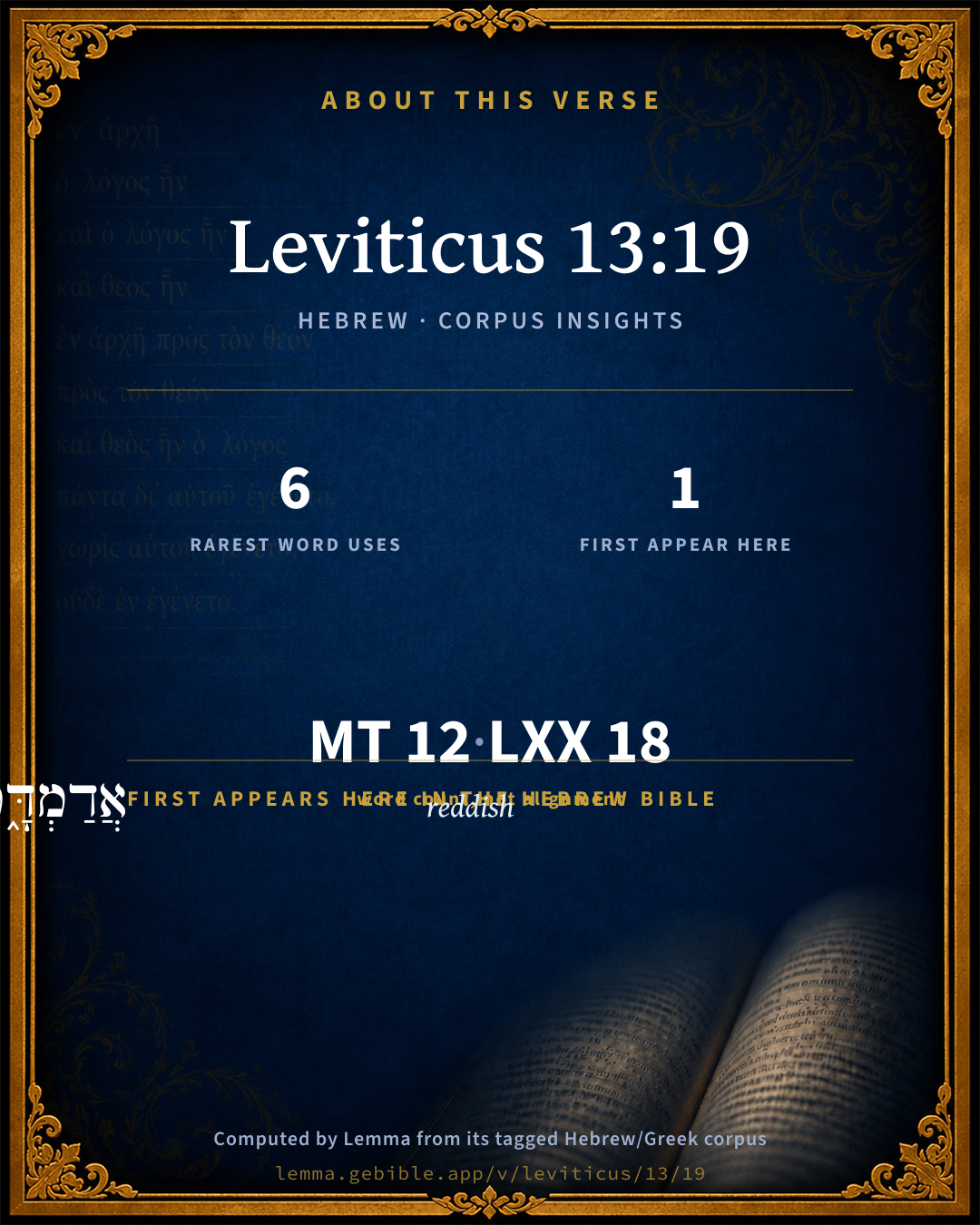
The rarest word here is אֲדַמְדָּ֑מֶת reddish H125 — appearing just 6 times in the whole Hebrew Bible.

First appearance in Scripture

This word makes its first canonical appearance in the Hebrew Bible here:

  • אֲדַמְדָּ֑מֶת reddish H125

Shared distinctive vocabulary

אֲדַמְדָּ֑מֶת reddish H125 occurs in 6 verses of the Hebrew Bible. Also found in:

Grammatical profile

  • 2 verbs
  • 5 nouns
  • 3 adjectives
  • 1 preposition
  • 1 conjunction

Verb forms

  • וְהָיָ֞ה Qal · Sequential Perfect
  • וְנִרְאָ֖ה Niphal · Sequential Perfect

Repetition

A word recurs within this verse — often emphatic in Hebrew:

  • לְבָנָ֔ה white H3836 ×2

Hebrew & Septuagint length

In English translation the verse runs 25 words from the Hebrew and 29 from the Septuagint (LXX English) — closely comparable.

A rough comparison of the two English renderings, which tokenize alike — not a word-level alignment.

Word counts can differ between the Hebrew and the Greek without any difference in meaning — e.g. the Hebrew direct-object marker אֵת has no separate Greek word, and Greek often adds the article ὁ.

In the original languages it is 12 Hebrew tokens and 18 Greek tokens — but the two are counted differently (Hebrew bundles its prefixes and suffixes into one token; the Greek is in lemma form), so that isn’t a like-for-like length.

Cross-references

1

Topical passages linked to Leviticus 13:19 in the Treasury of Scripture Knowledge — connected by theme and wording, ordered by reader-vote popularity; previews shown in the World English Bible.

  • Leviticus 13:24 "Or when the body has a burn from fire on its skin, and the raw flesh of the burn becomes a bright spot, reddish-white, or white,

Cross-references courtesy of OpenBible.info (CC BY 4.0).

Hebrew and Greek witnesses Masoretic Hebrew ↔ Greek Septuagint

The same verse in the two great witnesses to the Old Testament, shown verse-for-verse.

These are two independent witnesses, not word-aligned to each other, and the Septuagint is shown in lemma (dictionary) form.

Hebrew Leviticus 13:19 Masoretic · Westminster Leningrad Codex

וְהָיָ֞ה בִּמְק֤וֹם הַשְּׁחִין֙ שְׂאֵ֣ת לְבָנָ֔ה א֥וֹ בַהֶ֖רֶת לְבָנָ֣ה אֲדַמְדָּ֑מֶת וְנִרְאָ֖ה אֶל הַכֹּהֵֽן

and in the place of the boil there is a white rising, or a bright spot, reddish-white, then it shall be shown to the priest;

World English Bible · Public Domain

Greek LXX Leviticus 13:19 Septuagint · lemma form

καί γίγνομαι ἐν ὁ τόπος ὁ ἕλκος οὐλή λευκός ἤ τηλαυγής λευκαίνω ἤ πυρρίζω καί ὁράω ὁ ἱερεύς

and there should be in the place of the ulcer a white sore, or one looking white and bright, or fiery, and it shall be seen by the priest;

LXX2012 (modern English Septuagint) · Public Domain

Hebrew: Westminster Leningrad Codex (CC BY 4.0). Greek: Septuagint (public domain); English from LXX2012 (modern English Septuagint) (Public Domain). How the Septuagint differs from the Hebrew →

Targum (Aramaic paraphrase)

2

The Targum is the ancient Jewish Aramaic paraphrase of the Hebrew Scriptures — an interpretive translation, not the Hebrew text itself. Onkelos (literal) and Pseudo-Jonathan (expansive) render the Torah, and Jonathan the Prophets. Coverage is partial: where no permissively-licensed English translation exists for a verse, only the Aramaic is shown. This is verse-level text, not a word-by-word alignment to the Hebrew.

  1. Targum Onkelos Torah (Genesis–Deuteronomy)
    וִיהֵי בַאֲתַר שִׁחֲנָא עַמְקָא חַוְרָא אוֹ בַהֲרָא חַוְרָא סַמְקָא וְיִתַּחֲזִי לְכַהֲנָא

    (no public-domain English translation for this verse)

    Targum Onkelos — Aramaic: “Onkelos Genesis” (public domain); “Onkelos Exodus” (public domain); “Onkelos Leviticus” (public domain); “Onkelos Numbers” (public domain); “Onkelos Deuteronomy” (public domain). English: “Sefaria Community Translation” (CC0 1.0 (public-domain dedication)); “J.W. Etheridge. The Targums of Onkelos and Jonathan Ben Uzziel on the Pentateuch. London: Longmans, Green, 1862” (public domain). Text via Sefaria.

  2. Targum Pseudo-Jonathan Torah (Genesis–Deuteronomy)
    וִיהֵי בַּאֲתַר שִׁיחְנָא שׁוּמָא זְקִיפָא חִיוְרָא אוֹ בַּהֲקֵי מִיטַפְלָא חִיוְרָא סַמְקָא מְעַרְבִין וְיִתְחֲמֵי לְוַת כַּהֲנָא

    but in the place of the ulcer there hath come a white rising tumour, or a bright fixed spot, (in colour) white mixed with red; he shall be seen by the priest.

    Targum Pseudo-Jonathan — Aramaic: “Targum Jonathan on Genesis” (public domain); “Targum Jonathan on Exodus” (public domain); “Targum Jonathan on Leviticus” (public domain); “Targum Jonathan on Numbers” (public domain); “Targum Jonathan on Deuteronomy” (public domain). English: “The Targum of Jonathan ben Uzziel, trans. J. W. Etheridge, London, 1862” (public domain). Text via Sefaria.

Commentary

Notes on Leviticus 13:19 from classic Christian and Jewish commentators (each source and its license shown beneath its notes). The classic Christian expositions comment on the surrounding passage and are grouped to its opening verse, so a note may address several verses; the Jewish commentaries on the Tanakh (Rashi and others) are per-verse, so they appear only where the commentator wrote on this verse.

Lemma curates 59 commentaries, every one of them public domain or Creative Commons licensed, each selected and text-cleaned for this edition rather than reprinted as found. About our sources →

Ellicott's Commentary for English Readers

(19) And in the place of the boil.—If the cicatriced sore breaks out again, and exhibits the usual symptoms of leprosy, the patient is to show himself to the priest.

White, and somewhat reddish.—Better, of a white-reddish colour. This symptom is peculiar to re-opened cicatriced sores, and hence has not been mentioned before. The authorities in the time of Christ describe the mixture of red and white as follows :—“It has the appearance of red wine poured into water, and is either a palish white or somewhat darker.”

A Bible Commentary for English Readers, edited by Charles John Ellicott (1878–1897) — public domain. Text from a community e-Sword module.

John Gill's Exposition

And in the place of the boil there be a white rising,.... In the place where the boil was, a white swelling appears:

or a bright spot, white, and somewhat reddish; white and red mixed, as the Targum of Jonathan; and so Aben Ezra interprets the word "reddish", of the bright spot being mixed of two colours, or part of it so; and such a mixed colour of white and red, Gersom observes, is usual in a swelling, and adds, we are taught how to judge of these appearances, according to a tradition from Moses, which is this: take a cup full of milk, and put in it two drops of blood, and the colour of it will be as the colour of the bright spot, white and reddish; and if you put into it four drops, its colour will be as the colour of the rising (or swelling) reddish; and if you put into it eight drops, its colour will be as the colour of the scab of the bright spot, more reddish; and if you put into it sixteen drops, its colour will be as the colour of the scab of the swelling, very red: hence it appears, says he, that the bright spot is whitest with its redness, and after that the swelling, and next the scab of the bright spot, and then the scab of the swelling; but Bochart (p) is of opinion that the word is wrongly rendered "reddish", which, he thinks, contradicts the account of the bright spot being white, and especially as the word for "reddish" has its radicals doubled, which always increase the signification; and therefore if the word bears the sense of redness, it should be rendered "exceeding red", which would be quite contrary to the spot being white at all; wherefore from the use of the word in the Arabic language, which signifies white, bright, and glittering; See Gill on Lam 4:7; he chooses to read the words, "or a bright spot, white and exceeding glittering": but this word we render reddish and white, being read disjunctively, Lev 13:24; seems to contradict this observation of his:

and it be shewed to the priest; to look upon and pass his judgment on it.

(p) Hierozoic. par. 2. l. 5. c. 6. col. 689.

John Gill's Exposition of the Whole Bible (1746–1763) — public domain (CC PDM 1.0). Text via the HelloAO Bible API.

Matthew Poole's English Annotations

Somewhat reddish, i.e. white mixed with red, as when blood and milk are mixed together. A late learned writer renders the words thus, white and very bright, or light, which indeed is the true colour of leprosy, to wit, when it is in its perfection, as Exo 4:6, &c. But here it was only beginning and arising out of a bile, in which together with the white, which was the colour of the leprosy, there might be some mixture of redness arising from the bile, or that part of it which was not yet turned into the nature and colour of leprosy.

Matthew Poole's English Annotations on the Holy Bible (1683–1685) — public domain. Text from a community e-Sword/MySword module.

Whedon's Commentary on the Bible

Daniel D. Whedon

19. Somewhat reddish — The redness is that of the inflamed circumference of the blotch. The two symptoms of white hairs and manifest depth below the skin indicate leprosy.

Daniel D. Whedon (gen. ed.), Commentary on the Old and New Testaments (1874–1909) — public domain. Text from a community e-Sword module.

Rashi

Rabbi Shlomo Yitzchaki (Rashi)

או בהרת לבנה אדמדמת in OR A BRIGHT SPOT REDDISH-WHITE — It means that the plague is not evenly white but it is compounded and intermingled with two colours — white and red.

Rashi on the Tanakh — English translations: “The Judaica Press complete Tanach with Rashi, translated by A. J. Rosenberg” (CC BY 4.0); “Pentateuch with Rashi's commentary by M. Rosenbaum and A.M. Silbermann, 1929-1934” (public domain); “The Metsudah Tanach series, Lakewood, N.J” (CC BY 4.0); and “The Book of Joshua, Metsudah Publications, 1997” (CC BY 4.0). Text via Sefaria.

Lesson kit

Teaching starters — assembled from the data on this page, not authored interpretation. Every prompt links to the verse data it draws on. Edit before teaching.

Leviticus, in the Pentateuch, opens this verse with 12 words (11 distinct Hebrew lemmas). Its most distinctive word is ʼădamdâm (“reddish”). A historical commentator’s framing appears above. Read the whole chapter for the surrounding context.

Discussion questions

  1. The word ʼădamdâm carries the sense “reddish.” How does it shape the verse?
  2. The word “reddish” first appears here in Scripture. What is being introduced at this debut?
  3. Leviticus 13:24 shares the word «reddish» with this verse. How do the two illuminate each other?
  4. “white” occurs 2× in this one verse. What is the effect of the repetition?
  5. The translations on this page render this verse differently — a whole-verse word diff, not a word-by-word alignment. What might account for the different wordings?
  6. The verb «וְהָיָ֞ה» is Qal Sequential Perfect. How does its form color the action?
  7. Reading how Ellicott's Commentary for English Readers and John Gill's Exposition read this verse, where do the two commentators agree and where do they part?

Things to notice

Reading settings

Reading text

Shown beneath each verse's original-language words.

Old Testament
Old Testament edition

Read the OT as the Masoretic Hebrew (MT) or the Greek Septuagint (LXX).

English shown for the Greek Septuagint (in the Hebrew ↔ Greek comparison).

Comparing translations? Open the Compare panel on any verse page to stack up to four side by side.