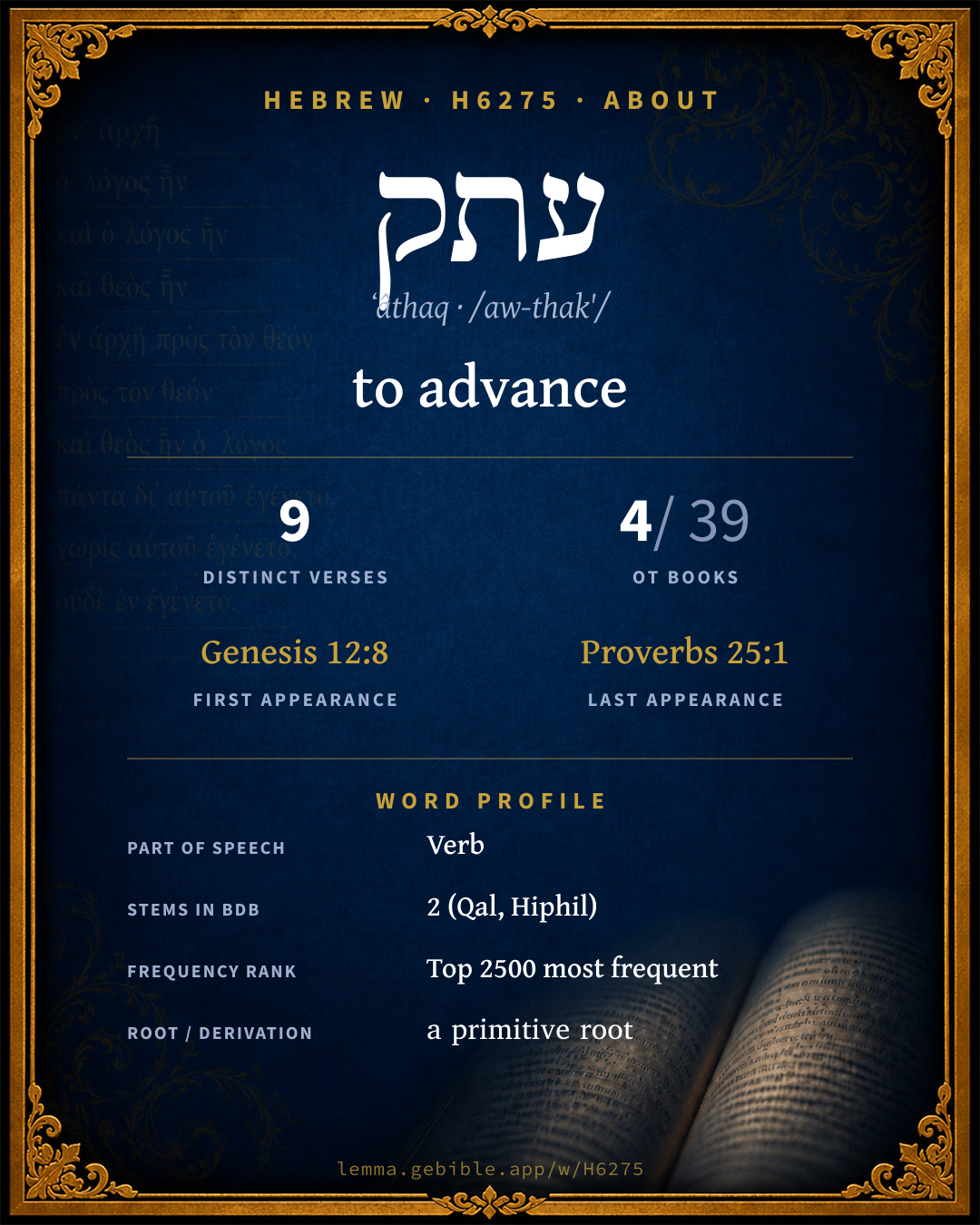
עָתַק
to advance
‘to advance’ is one of 6 main senses fuller range ↓
Full lexicon entry — Brown-Driver-Briggs (BDB)
From Brown-Driver-Briggs (BDB)
Where this word appears
See every Hiphil verb in the Hebrew Bible →
Grammar key — what these labels mean
Part of speech
- Verb
- An action or state-of-being word.
Stem
- Hiphil
- The causative active stem (“he caused / brought about”). Here: ‘move forward’
- Qal
- The basic, simple active stem — the plain form of the verb (“he wrote”). Here: ‘move’
Form
- Sequential Imperfect
- An imperfect with prefixed waw — the standard past-narrative form (waw-consecutive imperfect).
- Perfect
- A completed action or state — Hebrew marks aspect (completeness) more than strict tense (“he wrote”).
- Imperfect
- An incomplete, ongoing, or future action (“he will / would write”).
- Participle Active
- A verbal adjective expressing ongoing or characteristic action (“writing / one who writes”).
State
- Absolute
- The independent form of a noun, not bound to a following word.
Person
- 3rd Person
- The one spoken about (“he / she / it / they”).
Gender
- Masculine
- Grammatically masculine.
- Common
- Either gender — not distinguished for this form.
- Feminine
- Grammatically feminine.
Number
- Singular
- One.
- Plural
- More than one (in Hebrew, generally three or more).
Grammatical forms
- Verb, Hiphil, Sequential Imperfect, 3rd Person, Masculine, Singular 2 times (22%)
- Verb, Hiphil, Perfect, 3rd Person, Common, Plural 2 times (22%)
- Verb, Qal, Imperfect, 3rd Person, Masculine, Singular 2 times (22%)
- Verb, Hiphil, Participle Active, Masculine, Singular, Absolute 1 time (11%)
- Verb, Qal, Perfect, 3rd Person, Common, Plural 1 time (11%)
- Verb, Qal, Perfect, 3rd Person, Feminine, Singular 1 time (11%)
Parsed forms decoded from the imported morphology (morphhb / Westminster Leningrad Codex — WLC text public domain, morphhb tagging CC BY 4.0), counted across 9 parsed occurrences — not distinct verses.
Every verse where H6275 appears — 9 distinct verses across 4 books. Click any verse to open its interlinear word-by-word view. Verse text shown in the World English Bible for context — . Each verse’s Hebrew form is shown with its reference; the English is not keyword-highlighted, since the data carries no word-level English alignment. Use “Compare translations” on any verse to read it across multiple English versions. This concordance covers the Hebrew Bible; Septuagint (Greek Old Testament) occurrences are not indexed here.
Genesis 2 verses
- Genesis 12:8 וַ/יַּעְתֵּ֨ק conj + Hiphil wimpf 3ms He left from there to the mountain on the east of Bethel, and pitched his tent, having Bethel on the west, and Ai on the east. There he built an altar to Yahweh, and called on the name of Yahweh.
- Genesis 26:22 וַ/יַּעְתֵּ֣ק conj + Hiphil wimpf 3ms He left that place, and dug another well. They didn't argue over that one. He called it Rehoboth. He said, "For now Yahweh has made room for us, and we will be fruitful in the land."
Job 5 verses
- Job 9:5 הַ/מַּעְתִּ֣יק ptcl def.art + Hiphil ptcp.act ms Who removes the mountains, and they don't know it, When he overturns them in his anger
- Job 14:18 יֶעְתַּ֥ק Qal impf 3ms "But the mountain falling comes to nothing; The rock is removed out of its place;
- Job 18:4 וְ/יֶעְתַּק conj + Qal impf 3ms You who tear yourself in your anger, Shall the earth be forsaken for you? Or shall the rock be removed out of its place?
- Job 21:7 עָ֝תְק֗וּ Qal pf 3cp "Why do the wicked live, Become old, yes, and grow mighty in power?
- Job 32:15 הֶעְתִּ֖יקוּ Hiphil pf 3cp "They are amazed. They answer no more. They don't have a word to say.
Psalms 1 verse
Proverbs 1 verse
About this entry
At a glance — auto-summarized from this page’s data, not written by a person. Every figure links to its source below. This summary describes the numbers; it doesn’t interpret them.
עתק (ʻâthaq) is a Hebrew verb most often rendered “to advance.” It clusters heavily in Job, which alone accounts for 56% of its uses. With 9 verses in 4 books, it is an uncommon word in the Hebrew Bible. It first appears in Genesis 12:8. Read the stem: it spans 2 stems, including Qal and Hiphil. The sections below give every sense, occurrence, and version rendering.
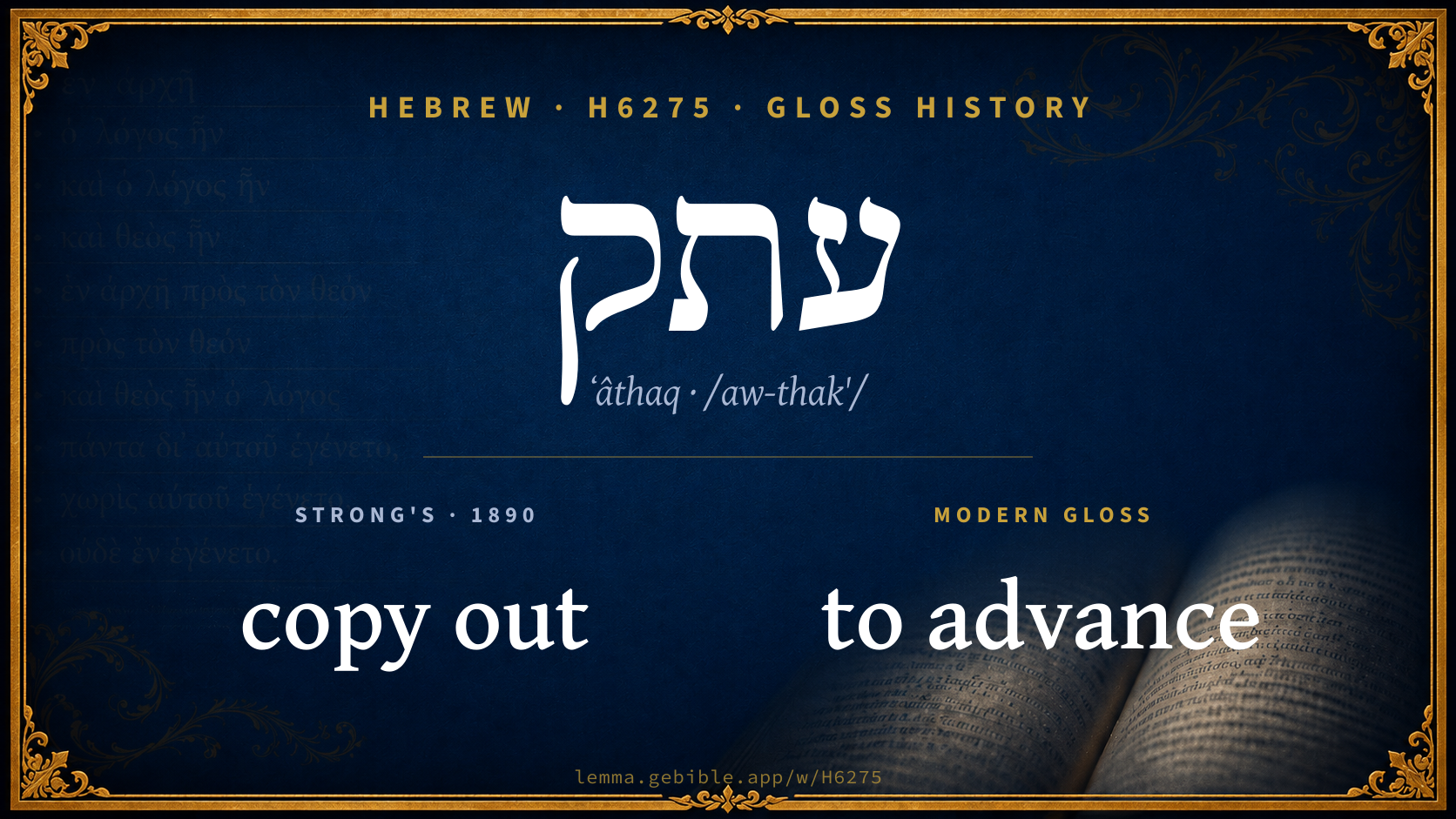
Gloss history
Strong's 1890 vs modern scholarship
About this word
Strong's H6275 catalogs a Hebrew word from the Hebrew Old Testament.
These counts are not copied from any lexicon or concordance. They are computed here, from the morphology-tagged Hebrew Old Testament. What Lemma adds →
- 9
- distinct verses
- The word appears in 9 distinct verses.
- 4 / 39
- OT books
- The word appears in 4 of 39 Old Testament books.
- #2,481
- by frequency
- Top 2500 most frequent Hebrew words (rank 2,481 of 8,640 Hebrew words by occurrence).
View all 9 occurrences in the concordance →
By section of the Old Testament
By traditional corpus
Conventional, traditional groupings — biblical authorship is debated, so this is a traditional corpus grouping, not an authorship claim. Each share is this word’s portion of its verses in that division of the Hebrew canon. Each figure is a share of the word’s 9 distinct verses.
- Writings (Ketuvim) 7 verses · 78%
- Torah (Pentateuch) 2 verses · 22%
How translations render this word
Counts come from each version’s own published word-to-Strong’s tagging or interlinear alignment — an approximate guide to how each version renders this word, not a word-level alignment the data otherwise carries. Because each total is that version’s own tagged count, the per-version totals vary from one another and need not match the appearance or distinct-verse counts above. These counts may also differ from a printed concordance because Lemma counts each distinctly tagged rendering and does not collapse phrase taggings into a single head-word total. This is a fixed set of word-tagged versions (KJV, ASV, BSB, ULT) and does not change with the reading translation you choose elsewhere. Each version’s license is shown beside its name below (and on Sources).
BDB lists this Strong’s number as 2 distinct words (homographs). Each count above pools all of them and is not split by sense — see the Senses section below. A low-frequency rendering may belong to a different one of those words, not the primary meaning.
- King James Version†: He removed 2×
- American Standard Version†: He removed 2×
- Berean Standard Bible†: Be moved 1×, Growing old 1×, Have escaped 1×
- unfoldingWord Literal Text†: Advances 1×, Copied 1×, Grow old 1×
King James Version Public Domain
Renders H6275 across 9† tagged occurrences — most commonly:
Plus 7 renderings that appear only once — usually multi-word phrases or single function words the recovered tagging swept in, not distinct renderings.
American Standard Version Public Domain
Renders H6275 across 9† tagged occurrences — most commonly:
Plus 7 renderings that appear only once — usually multi-word phrases or single function words the recovered tagging swept in, not distinct renderings.
Berean Standard Bible Public Domain
Renders H6275 across 9† tagged occurrences — most commonly:
unfoldingWord Literal Text CC BY-SA 4.0
Renders H6275 across 11† tagged occurrences — most commonly:
7 senses and sub-senses in the full BDB
Hebrew verbs can shift meaning by stem (binyan): Qal is the basic action, Niphal is often passive or reflexive, Piel often intensifies or makes it factitive, and Hiphil is typically causative. The senses below are grouped under the stem BDB assigns to each.
What do BDB’s symbols mean?
BDB uses these scholarly abbreviations:
| Symbol | Meaning |
|---|---|
| 𝔊 | the Septuagint (the ancient Greek translation, LXX) |
| 𝔙 | the Vulgate (the Latin translation) |
| 𝔖 | the Syriac version (the Peshitta) |
| 𝔗 | the Targum (the Aramaic translation) |
| ψ | the Psalms |
| √ | root (the underlying root or stem) |
| ‖ | parallel passage (a synonymous or contrasted parallel) |
| † | the dagger: every passage where the word occurs is cited |
The 7 senses and sub-senses the full Brown-Driver-Briggs lexicon distinguishes for this word, in lexicon order (not ranked by frequency), with BDB’s own verbatim wording and sub-sense lettering. Shown in Hebrew script with BDB’s own scholarly abbreviations. The condensed entry is in the Lexicon Entry tab. See also the Forms in the corpus table below.
עתק I move, proceed, advance (NH Hiph.
Qal
- Pf. 3 fs. עָֽתְקָה ψ 6:8, 3 pl. עָֽתְקוּ Jb 21:7; Impf. 3 ms. יֶעְתַּק Jb 14:18; 18:4;— e.g. Psalms 6:8
- 1. move וְצוּר יֶע׳ מִמְּקֹמוֹ Jb 14:18, so 18:4. e.g. Job 14:18
- 2. advance (in years; Aramaic sense) 21:7 (‖ יִחְיוּ); hence = grow old and weak ψ 6:8 (of eye, ‖ עָֽשְׁשָׁה). e.g. Job 21:7
Hiphil
- Pf. 3 pl. הֶעְתִּיקוּ Jb 32:16 (Gi; van d. H. Baer v 15), Pr 25:1; Impf. 3 ms. וַיַּעְתֵּק Gn 12:8; 26:22; Pt. מַעְתִּיק Jb 9:5;— e.g. Job 32:16
- 1. move forward (sc. tent) = proceed Gn 12:8 (מִשָּׁם, ה loc.), 26:22 (מִשָּׁם); so fig. Jb 32:15 (v. supr.) words have moved away from them (מֵהֶם), but v. prob. gloss (Bu al.). e.g. Genesis 12:8
- 2. Jb 9:5 he who removeth mountains. e.g. Job 9:5
- 3. very late Pr 25:1 transcribe (remove from one book or roll to another; 𝔊 ἐξεγράψαντο, 𝔙 transtulerunt; so in mediaeval Heb.: ZunzZMG xxv (1871), 447 f. = Ges Schr. iii. 66 f.). e.g. Proverbs 25:1
עתק II Thes (ancient and so) valuable
Senses from the full Brown-Driver-Briggs lexicon (Brown, Driver, Briggs; Oxford 1906 — public domain), digitized via Sefaria, supplemented by the OpenScriptures HebrewLexicon (CC BY 4.0). Full attribution on Sources.
Word origin
I. vb. move, proceed, advance (NH Hiph.; Assyrian etêḳu as H., also trans. bring, move; Arabic عَتَقَ, عَتُقَ precede, pass forth, become free, grow old; Aramaic ܥܬܶܩ, עֲתַק grow old, Palm. adj. עתק old);—
II. adj. Thes (ancient and so) valuable; advanced, eminent, surpassing (cf. عتيق preceding, hence surpassing, choice Lane 1947);—הוֹן ע׳ Pr 8:18 eminent wealth.
— Brown-Driver-Briggs (Oxford 1906, public domain), digitized via Sefaria, supplemented by the OpenScriptures HebrewLexicon (CC BY 4.0). See Sources.
Origin: a primitive root
Jastrow Dictionary
A second Hebrew/Aramaic lexicon for comparison, covering Aramaic and post-biblical (Talmudic, Targumic, Midrashic) usage that the biblical-Hebrew BDB does not. Matched by lemma rather than by Strong’s number, so a lemma may carry more than one Jastrow headword (shown separately below), and the entries cover usage well beyond the Bible.
עָתַק I
- (b. h.) to move. Gen. R. s. 52, beg. (expl. יעתק, Job XIV, 18) פנה ממקומו he (Abraham) moved from where he was; Yalk. ib. 87; Yalk. Job 906. e.g. Job 14:18
- to remove, transfer. Y. Ḥag. II, 77ᶜ top (ref. to Ps. XXXI, 19 הדוברות … עתק) הדוברות על צדיקי של עולם דברים שה׳ מבריותיו who speak concerning the Righteous One of the world words which he has withheld from his creatures (esoteric philosophy); Yalk. Ps. 715; Gen. R. s. 1 שה׳ בבריותיו (corr. acc., v. ‘Rashi’ a. l.). Ruth R. to I, 1 (ref. to I Chr. IV, 22) דברים הללו נאמרו ממַעְתִּיקוֹ של עולם וכ׳ these words were spoken by Him who moves the world (by ref. to ויעתק, Gen. XII, 8); (Yalk. Chr. 1074 דברים הללו מעתיקו, v. עַתִּיק). Yalk. Prov. 961 (ref. to העתיקו, Prov. XXV, 1) העתיקו מלמד שגנוזים היו ‘hʿetiḳu’ (they removed), this shows that they were suppressed (v. גָּנַז). Ib. דבר אחר אין העתיקו אלא פירשו וכ׳ another interpretation is, hʿetiḳu means ‘they set aside’ (ref. to Gen. XII, 8), i.e. translated, interpreted (v. פָּרַשׁ, a. cmp. the later use of העתיק to edit, to translate); Ab. d’R. N. ch. I, 2ⁿᵈ Vers. (ed. Schechter, p. 3) אין העתיקו אלא שפרשו; ib. 1ˢᵗ Vers. לא שהמתינו אלא שפירשו, v. next w. e.g. Psalms 31:19
- to be removed. Koh. R. to I, 8 (in enigmatic speech) ואני הוּעְתַּקְתִּי לכאן להחיש מחיה and I have come here to accelerate the growth (of hair).
- to be removed, transferred. Esth. R. to I, 1 הנֶעְתָּקִין, v. קִינְסִין. Yalk. Chr. 1076 (ref. to I Chr. l. c.) אפי׳ … שנִתְעַתְּקוּ מהם החזירם even things which had been removed from them (esoteric thoughts) did he bring back; Ruth R. l. c. (not שנתעסקו).
עָתַק II
- to be substantial, strong; (cmp. יָשִׁישׁ) to be old.—Denom. עַתִּיק.
- (denom. of עַתִּיק; cmp. זָקַן Nithpa.) to be long in deliberating, mature. Ab. d’R. N. ch. I (expl. העתיקו, Prov. XXV, 1) ולא שהעתיקו אלא שהמתינו and hʿetiḳu means, ‘which they considered maturely’; אבא שאול אומר לא שהמתינו אלא שפירשו Abba S. says, it does not mean ‘which they considered maturely’, but ‘which they set aside’, v. preced. e.g. Proverbs 25:1
עֲתַק
- , to be old, worn out. Targ. Lam. III, 4 (h. text בלה).
- 1. to remain long, be settled permanently. Targ. Deut. IV, 25 (h. text ונושנתם). Targ. Ez. XXXIV, 25 (h. text וְיָשְׁנוּ!).
- 2. to grow old. Targ. Y. Lev. XXVI, 10 דמִיעַתַּק (ed. Vien. דמְעַתַּק Part. pass. Pa.).—Targ. Y. Deut. XXVIII, 59 דמִתְעַתְּקִין (inveterate, chronic).
A Dictionary of the Targumim, the Talmud Babli and Yerushalmi, and the Midrashic Literature (Marcus Jastrow; London, Luzac, 1903) — Public Domain. Digitized via Sefaria. Digitized via Sefaria. Full attribution on Sources.
Forms in the corpus
The 9 distinct written forms H6275 takes in the Hebrew Bible, most frequent first — each parse links to that stem’s occurrences in the concordance. Hebrew forms include their vowel points and cantillation, so a single lemma takes many written forms.
| Form | Parsing | Example | Uses |
|---|---|---|---|
| הֶ֝עְתִּ֗יקוּ | Verb, Hiphil, Perfect, 3rd Person, Common, Plural | Proverbs 25:1 | 1 |
| הֶעְתִּ֖יקוּ | Verb, Hiphil, Perfect, 3rd Person, Common, Plural | Job 32:15 | 1 |
| הַ/מַּעְתִּ֣יק | Verb, Hiphil, Participle Active, Masculine, Singular, Absolute | Job 9:5 | 1 |
| וְ/יֶעְתַּק | Verb, Qal, Imperfect, 3rd Person, Masculine, Singular | Job 18:4 | 1 |
| וַ/יַּעְתֵּ֣ק | Verb, Hiphil, Sequential Imperfect, 3rd Person, Masculine, Singular | Genesis 26:22 | 1 |
| וַ/יַּעְתֵּ֨ק | Verb, Hiphil, Sequential Imperfect, 3rd Person, Masculine, Singular | Genesis 12:8 | 1 |
| יֶעְתַּ֥ק | Verb, Qal, Imperfect, 3rd Person, Masculine, Singular | Job 14:18 | 1 |
| עָ֝תְק֗וּ | Verb, Qal, Perfect, 3rd Person, Common, Plural | Job 21:7 | 1 |
| עָֽ֝תְקָ֗ה | Verb, Qal, Perfect, 3rd Person, Feminine, Singular | Psalms 6:7 | 1 |
Same root — word family
Other BDB entries built from the same root as H6275, grouped by Strong’s listed origin. These share a root / origin per the lexicon — not necessarily a shared meaning. Each links to that word’s own entry.
Derived from this word
Compare all same-root words → Showing 4 of 5 — not the complete family. They share a root, not necessarily a meaning.
Septuagint verse parallels
This word appears in 9 verses that also exist in the Greek Old Testament (Septuagint), out of the 9 Hebrew verses it occurs in. You can read those verses in Greek by switching the Old Testament edition to the Septuagint.
Read these verses in the Septuagint
This is a verse-level parallel only — the same verses exist in both the Hebrew and Greek Old Testaments. No word-level Hebrew↔Greek correspondence is claimed: the data carries no such alignment, so no Greek word is shown as this Hebrew word’s translation. Coverage is not total — the Septuagint omits the deuterocanon and renumbers the Psalms, so some Hebrew verses have no direct Greek parallel.