
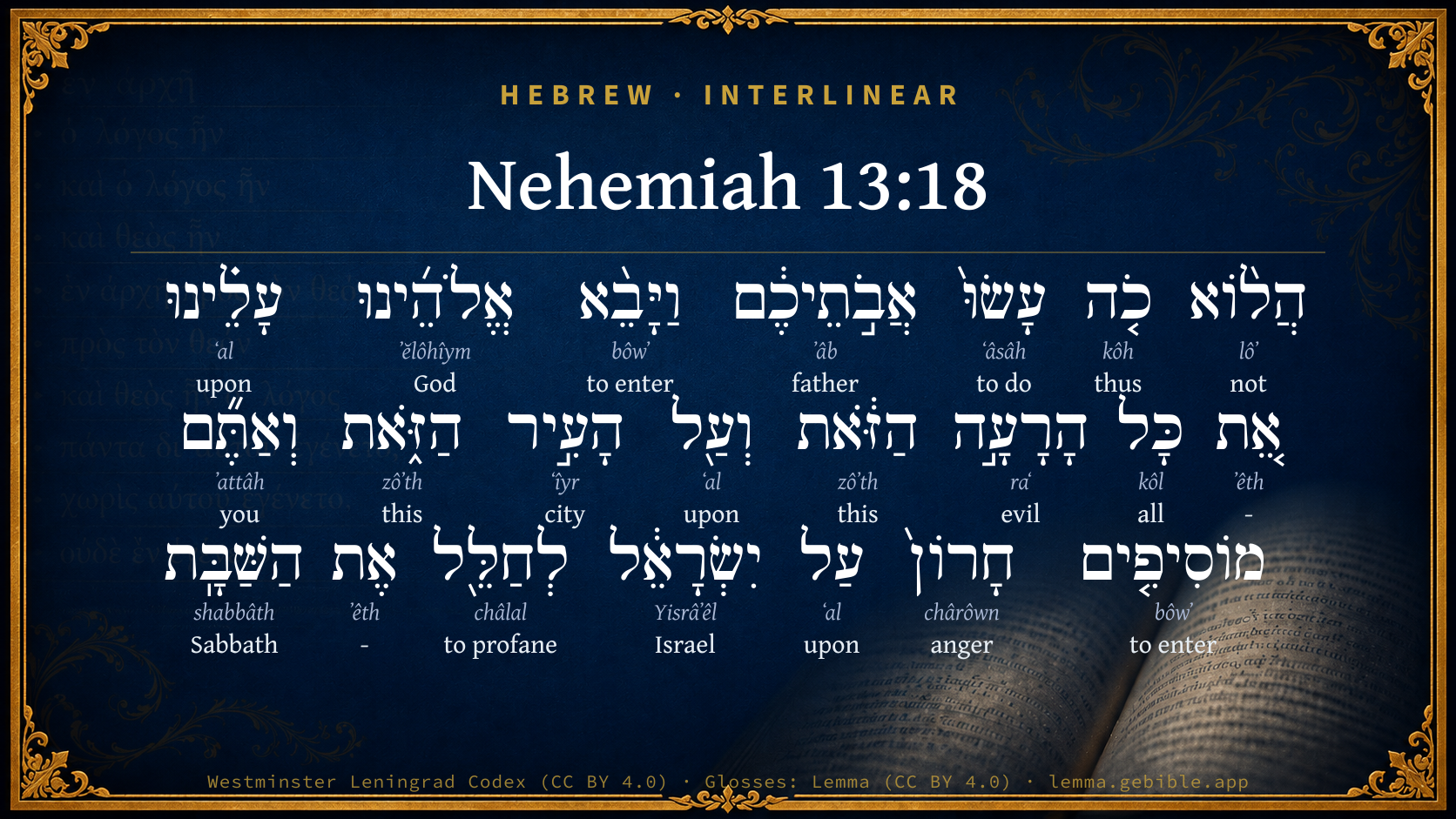
Nehemiah 13:18

Hebrew (Westminster Leningrad Codex) Nehemiah 13:18 appears in the Hebrew Old Testament. The text above is from the Westminster Leningrad Codex. Each word links to its Strong’s number, a concise gloss, and parsing drawn from the Open Scriptures Hebrew Bible morphology. Click any word for its full Brown-Driver-Briggs (BDB) entry.
Download image
Cite this verse

Nehemiah 13:18 (World English Bible). Public Domain. Lemma interlinear Bible study tool, https://lemma.gebible.app/v/nehemiah/13/18.

Show BibTeX & RIS
BibTeX
RIS
English Translation
Didn't your fathers do thus, and did not our God bring all this evil on us, and on this city? yet you bring more wrath on Israel by profaning the Sabbath.
World English Bible · Public Domain
Download a study sheet

One document with this verse’s original text, its word-by-word gloss line, the meaning frame, cross-references with their text, attributed commentary, and full source and license credits — printable, and it pastes into notes with its structure intact.

This verse Autodidact and up

Study sheet (.html) Plain text (.txt)

A passage Seminary Student

Up to 50 verses in one chapter. A passage sheet keeps up to 6 commentary sources and 12 cross-references per verse, in the order this page ranks them, and says so on the sheet whenever that leaves anything out. Ask for a single verse and you get the Autodidact verse sheet above.

Everything on this page stays free to read, with no account — the sheet is a download of what is already on screen, not access to it.

Want to remove ads? Support Godless Engineer
Compare translations 3

The same verse in 3 English versions, stacked beneath the original-language interlinear above. Click any original word for its lexicon entry.

Each is an independent rendering of the whole verse — the interlinear is not word-aligned to these translations.

Highlighted words mark where these versions differ — a whole-verse word diff, not a word-by-word alignment.

  • World English Bible Public Domain
    Didn't your fathers do thus, and did not our God bring all this evil on us, and on this city? yet you bring more wrath on Israel by profaning the Sabbath.
  • King James Version Public Domain
    Did not your fathers thus, and did not our God bring all this evil upon us, and upon this city? yet ye bring more wrath upon Israel by profaning the sabbath.
  • unfoldingWord Literal Text CC BY-SA 4.0
    Did not your fathers do thus, and our God brought all this evil on us and on this city? And you are increasing wrath upon Israel by profaning the sabbath.”

unfoldingWord Literal Text — © unfoldingWord, licensed CC BY-SA 4.0. Word-aligned USFM3 via Door43 (git.door43.org/unfoldingWord/en_ult).

Versions to compare (up to 4)

3 of 4 selected

Show all 18 translations

Every available English version of this verse, each an independent rendering of the whole verse.

  • World English Bible Public Domain
    Didn't your fathers do thus, and did not our God bring all this evil on us, and on this city? yet you bring more wrath on Israel by profaning the Sabbath.
  • Berean Standard Bible Public Domain
    Did not your forefathers do the same things, so that our God brought all this disaster on us and on this city? And now you are rekindling His wrath against Israel by profaning the Sabbath!”
  • Majority Standard Bible Public Domain
    Did not your forefathers do the same things, so that our God brought all this disaster on us and on this city? And now you are rekindling His wrath against Israel by profaning the Sabbath!”
  • King James Version Public Domain
    Did not your fathers thus, and did not our God bring all this evil upon us, and upon this city? yet ye bring more wrath upon Israel by profaning the sabbath.
  • American Standard Version (1901) Public Domain
    Did not your fathers thus, and did not our God bring all this evil upon us, and upon this city? yet ye bring more wrath upon Israel by profaning the sabbath.
  • Revised Version (1885) Public Domain
    Did not your fathers thus, and did not our God bring all this evil upon us, and upon this city? yet ye bring more wrath upon Israel by profaning the sabbath.
  • Geneva Bible (1599) Public Domain
    Did not your fathers thus, and our God brought all this plague vpon vs, and vpon this citie? yet yee increase the wrath vpon Israel, in breaking the Sabbath.
  • Douay-Rheims (1899) Public Domain
    Did not our fathers do these things, and our God brought all this evil upon us, and upon this city? And you bring more wrath upon Israel by violating the sabbath.
  • Young's Literal Translation Public Domain
    Thus did not your fathers do? and our God bringeth in on us all this evil, and on this city, and ye are adding fierceness on Israel, to pollute the sabbath.'
  • Literal Standard Version CC BY-SA 4.0
    Thus did not your fathers do? And our God brings in on us all this evil, and on this city, and you are adding fierceness on Israel, to defile the Sabbath.”
  • Unlocked Literal Bible CC BY-SA 4.0
    Did not your fathers do this? Did not our God bring all this evil on us and on this city? Now you are bringing more wrath on Israel by profaning the Sabbath.”
  • unfoldingWord Literal Text CC BY-SA 4.0
    Did not your fathers do thus, and our God brought all this evil on us and on this city? And you are increasing wrath upon Israel by profaning the sabbath.”
  • Darby Bible Public Domain
    Did not your fathers thus, and did not our God bring all this evil upon us and upon this city? And ye will bring more wrath against Israel by profaning the sabbath.
  • World Messianic Bible Public Domain
    Didn’t your fathers do this, and didn’t our God bring all this evil on us and on this city? Yet you bring more wrath on Israel by profaning the Sabbath.”
  • Webster's Bible Public Domain
    Did not your fathers thus, and did not our God bring all this evil upon us, and upon this city? yet ye bring more wrath upon Israel by profaning the sabbath.
  • Free Bible Version CC BY-SA 4.0
    I confronted the Jewish leaders, asking them, “Why are you are doing such an evil thing? You are violating the Sabbath day! Wasn't this what your forefathers did, bringing our God down on us, causing us and this city such disasters? Now you're bringing even more trouble on us by violating the Sabbath!”
  • Bible in Basic English Public Domain
    Did not your fathers do the same, and did not our God send all this evil on us and on this town? but you are causing more wrath to come on Israel by not keeping the Sabbath holy.
  • JPS Tanakh (1917) Public Domain
    Did not your fathers thus, and did not our God bring all this evil upon us, and upon this city? yet ye bring more wrath upon Israel by profaning the sabbath.'

Literal Standard Version (2020), Covenant Press — licensed CC BY-SA 4.0. Text via the HelloAO Bible API (eBible.org). Unlocked Literal Bible (unfoldingWord) — licensed CC BY-SA 4.0. Text via the HelloAO Bible API (eBible.org). unfoldingWord Literal Text — © unfoldingWord, licensed CC BY-SA 4.0. Word-aligned USFM3 via Door43 (git.door43.org/unfoldingWord/en_ult). Free Bible Version, Dr. Jonathan Gallagher — licensed CC BY-SA 4.0. Text via the HelloAO Bible API (eBible.org).

Word by word

More ways to search: Search by grammar → Find every occurrence → Compare this word →

Practice this passage: Drill this verse → Learn its vocabulary →

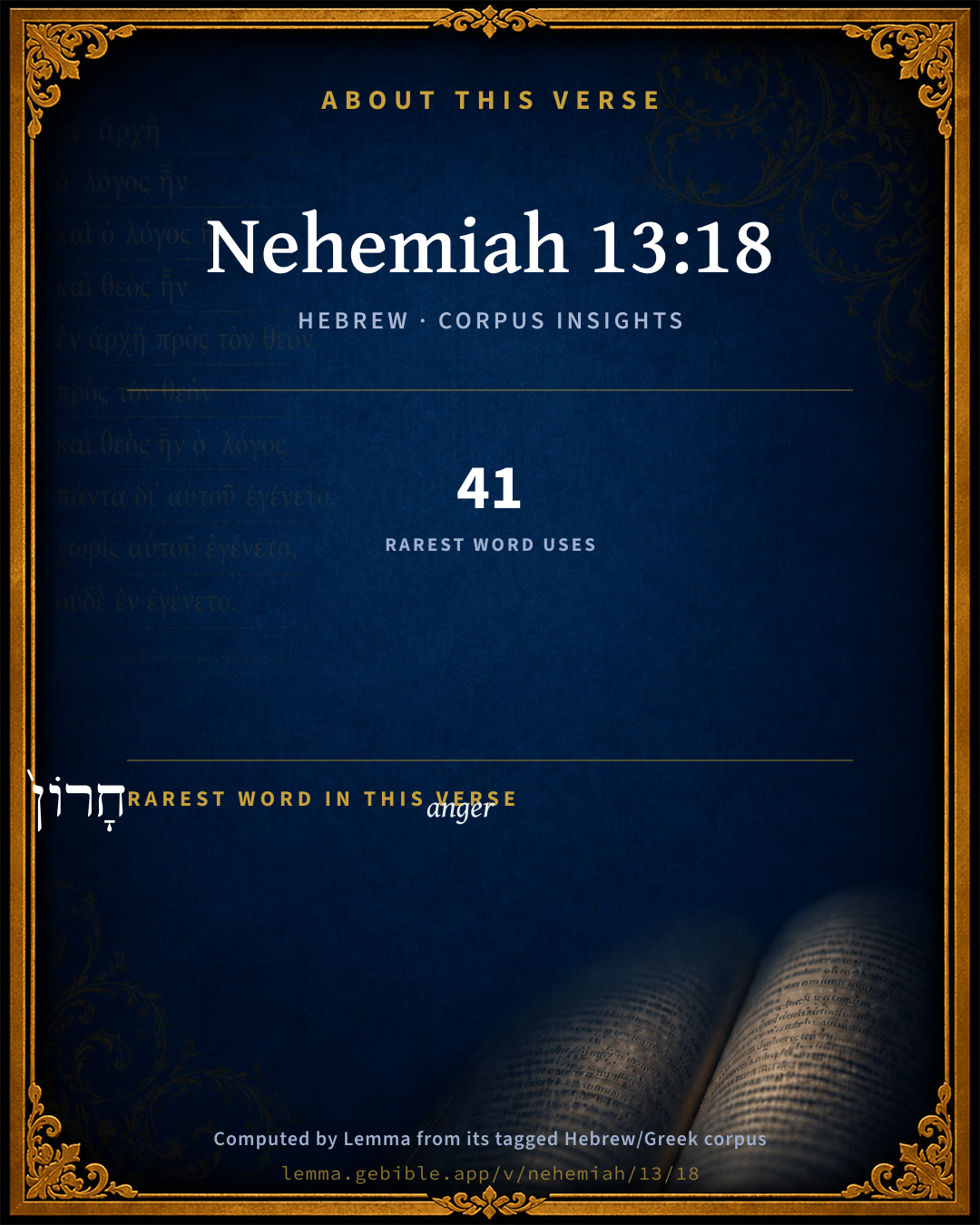
חָרוֹן֙
chârôwn
H2740
“anger”
Noun, Common, Masculine, Singular, Absolute
Part of Speech
Noun
Type
Common
Gender
Masculine
Number
Singular
State
Absolute
Full BDB Definition

Origin: from H2734

TWOT: 736a

anger, heat, burning (of anger) - always used of God's anger
  1. הֲל֨וֹא lôʼ H3808 “not” Particle, Interrogative + Particle, Negative
  2. כֹ֤ה kôh H3541 “thus” Adverb
  3. עָשׂוּ֙ ʻâsâh H6213 “to do” Verb, Qal, Perfect, 3rd Person, Common, Plural
  4. אֲבֹ֣תֵיכֶ֔ם ʼâb H1 “fathers · your” Noun, Common, Masculine, Plural, Construct + Suffix, Personal, 2nd Person, Masculine, Plural
  5. וַיָּבֵ֨א bôwʼ H935 “and · to enter” Conjunction + Verb, Hiphil, Sequential Imperfect, 3rd Person, Masculine, Singular
  6. אֱלֹהֵ֜ינוּ ʼĕlôhîym H430 “God(s) · our” Noun, Common, Masculine, Plural, Construct + Suffix, Personal, 1st Person, Common, Plural
  7. עָלֵ֗ינוּ ʻal H5921 “upon · us” Preposition + Suffix, Personal, 1st Person, Common, Plural
  8. אֵ֚ת ʼêth H853 “-” Particle, Direct Object
  9. כָּל kôl H3605 “all of” Noun, Common, Masculine, Singular, Construct
  10. הָרָעָ֣ה raʻ H7451 “the · evil” Particle, Definite Article + Noun, Common, Feminine, Singular, Absolute
  11. הַזֹּ֔את zôʼth H2063 “the · this” Particle, Definite Article + Pronoun, Demonstrative, Feminine, Singular
  12. וְעַ֖ל ʻal H5921 “and · upon” Conjunction + Preposition
  13. הָעִ֣יר ʻîyr H5892 “the · city” Particle, Definite Article + Noun, Common, Feminine, Singular, Absolute
  14. הַזֹּ֑את zôʼth H2063 “the · this” Particle, Definite Article + Pronoun, Demonstrative, Feminine, Singular
  15. וְאַתֶּ֞ם ʼattâh H859 “and · you” Conjunction + Pronoun, Personal, 2nd Person, Masculine, Plural
  16. מוֹסִיפִ֤ים bôwʼ H935 “entering” Verb, Hiphil, Participle Active, Masculine, Plural, Absolute
  17. עַל ʻal H5921 “upon” Preposition
  18. יִשְׂרָאֵ֔ל Yisrâʼêl H3478 “Israel” Noun, Proper
  19. לְחַלֵּ֖ל châlal H2490 “to profane” Preposition + Verb, Piel, Infinitive Construct
  20. אֶת ʼêth H853 “-” Particle, Direct Object
  21. הַשַּׁבָּֽת shabbâth H7676 “the · Sabbath” Particle, Definite Article + Noun, Common, Both, Singular, Absolute

About this verse

These counts appear in no published source. They are computed here, from the morphology-tagged text and Lemma’s own curated glosses. What Lemma adds →

22
words
17
distinct lemmas
Historical
section

Shared distinctive vocabulary

חָרוֹן֙ anger H2740 occurs in 40 verses of the Hebrew Bible. Also found in:

Grammatical profile

  • 4 verbs
  • 8 nouns
  • 3 pronouns
  • 3 prepositions
  • 1 adverb
  • 3 particles

Verb forms

  • עָשׂוּ֙ Qal · Perfect
  • וַיָּבֵ֨א Hiphil · Sequential Imperfect
  • מוֹסִיפִ֤ים Hiphil · Participle Active
  • לְחַלֵּ֖ל Piel · Infinitive Construct

Repetition

Words recur within this verse — often emphatic in Hebrew:

  • עָלֵ֗ינוּ upon H5921 ×3
  • וַיָּבֵ֨א to enter H935 ×2
  • הַזֹּ֔את this H2063 ×2

Cross-references

12

Topical passages linked to Nehemiah 13:18 in the Treasury of Scripture Knowledge — connected by theme and wording, ordered by reader-vote popularity; previews shown in the World English Bible.

  • Jeremiah 17:21–23 Thus says Yahweh, Take heed to yourselves, and bear no burden on the Sabbath day, nor bring it in by the gates of Jerusalem;
  • Leviticus 26:18 "'If you in spite of these things will not listen to me, then I will chastise you seven times more for your sins.
  • Leviticus 26:28 then I will walk contrary to you in wrath; and I also will chastise you seven times for your sins.
  • Numbers 32:14 Behold, you are risen up in your fathers' place, an increase of sinful men, to augment yet the fierce anger of Yahweh toward Israel.
  • Joshua 22:17–18 Is the iniquity of Peor too little for us, from which we have not cleansed ourselves to this day, although there came a plague on the congregation of Yahweh,
  • Ezra 9:13–15 After all that is come on us for our evil deeds, and for our great guilt, seeing that you our God have punished us less than our iniquities deserve, and have given us such a remnant,
  • Jeremiah 17:27 But if you will not listen to me to make the Sabbath day holy, and not to bear a burden and enter in at the gates of Jerusalem on the Sabbath day; then will I kindle a fire in the gates of it, and it shall devour the palaces of Jerusalem, and it shall not be quenched.
  • Jeremiah 44:9 Have you forgotten the wickedness of your fathers, and the wickedness of the kings of Judah, and the wickedness of their wives, and your own wickedness, and the wickedness of your wives which they committed in the land of Judah, and in the streets of Jerusalem?
  • Ezekiel 23:8 Neither has she left her prostitution since [the days of] Egypt; for in her youth they lay with her, and they handled the bosom of her virginity; and they poured out their prostitution on her.
  • Ezekiel 23:26 They shall also strip you of your clothes, and take away your beautiful jewels.
  • Zechariah 1:4–6 Don't you be like your fathers, to whom the former prophets proclaimed, saying: Thus says Yahweh of hosts, 'Return now from your evil ways, and from your evil doings;' but they did not hear, nor listen to me, says Yahweh.
  • Jeremiah 44:22 so that Yahweh could no longer bear, because of the evil of your doings, and because of the abominations which you have committed; therefore is your land become a desolation, and an astonishment, and a curse, without inhabitant, as it is this day.

Cross-references courtesy of OpenBible.info (CC BY 4.0).

Hebrew and Greek witnesses Masoretic Hebrew ↔ Greek Septuagint

The same verse in the two great witnesses to the Old Testament, shown verse-for-verse.

These are two independent witnesses, not word-aligned to each other, and the Septuagint is shown in lemma (dictionary) form.

Hebrew Nehemiah 13:18 Masoretic · Westminster Leningrad Codex

הֲל֨וֹא כֹ֤ה עָשׂוּ֙ אֲבֹ֣תֵיכֶ֔ם וַיָּבֵ֨א אֱלֹהֵ֜ינוּ עָלֵ֗ינוּ אֵ֚ת כָּל הָרָעָ֣ה הַזֹּ֔את וְעַ֖ל הָעִ֣יר הַזֹּ֑את וְאַתֶּ֞ם מוֹסִיפִ֤ים חָרוֹן֙ עַל יִשְׂרָאֵ֔ל לְחַלֵּ֖ל אֶת הַשַּׁבָּֽת

Didn't your fathers do thus, and did not our God bring all this evil on us, and on this city? yet you bring more wrath on Israel by profaning the Sabbath.

World English Bible · Public Domain

Greek LXX Structure differs

The Septuagint has no separate book of Nehemiah. Its Greek text is the second half of Esdras B (2 Esdras), chapters 11–23; Ezra is the first half (1–10).

A verse-for-verse comparison isn’t shown here because the chapters and verses don’t line up. Switch to the LXX edition with the MT / LXX toggle above to read the Greek directly.

Hebrew: Westminster Leningrad Codex (CC BY 4.0). Greek: Septuagint (public domain); English from a public-domain English Septuagint. How the Septuagint differs from the Hebrew →

Commentary

Notes on Nehemiah 13:18 from classic Christian and Jewish commentators (each source and its license shown beneath its notes). The classic Christian expositions comment on the surrounding passage and are grouped to its opening verse, so a note may address several verses; the Jewish commentaries on the Tanakh (Rashi and others) are per-verse, so they appear only where the commentator wrote on this verse.

Lemma curates 59 commentaries, every one of them public domain or Creative Commons licensed, each selected and text-cleaned for this edition rather than reprinted as found. About our sources →

Trapp's Complete Commentary

John Trapp

Neh 13:18 Did not your fathers thus, and did not our God bring all this evil upon us, and upon this city? yet ye bring more wrath upon Israel by profaning the sabbath.

Ver. 18. Did not your fathers thus] And will ye abet and add to their wicked practices? Will ye needs espouse their sins, as a seed of serpents?

And did not our God bring all this evil upon us?] And that justly, because, Belshazzar like, though we knew all this, yet we rifted up ourselves against the Lord of heaven, as the horse that casteth his rider, and riseth up against him, Dan 5:22-23. Hath ever any waxed fierce against God, and prospered? Job 9:4. Was not he that but gathered sticks upon the Sabbath day paid home with stones? Was there not for this very sin a fire kindled in the gates of Jerusalem, that devoured the palaces thereof? Jer 17:27. Justly is he made an example that will not take example by others; and it is a sure both presage and desert of ruin not to be warned.

Yet ye bring more wrath] As if ye had a mind to wrestle a fall with the Almighty, and to try for mastery. But do ye provoke the Lord to anger? are ye stronger than he?

John Trapp, A Commentary or Exposition upon All the Books of the Old and New Testament (1647–1656) — public domain. Text from a community e-Sword module.

Joseph Benson's Commentary

Neh 13:18-19. Did not your fathers thus? — He bids them reflect, and consider that this was one of the crimes of which their fathers were guilty; and for which God had suffered them to be carried captive out of their land, and their city to be destroyed. Did not God bring all this evil upon us? — Which you so well and sadly remember, that I need not tell you the particulars. When the gates began to be dark — Which was about sun- setting, by reason of the mountains which were round about and near Jerusalem: at which time they who sat at the gates could no longer see to do any thing. I commanded that the gates should be shut — In order that none who came to sell goods might enter in, and that no burden might be brought in on the sabbath day, or late in the evening before it, or early in the morning after. And some of my servants set I at the gates — Out of a diffidence in those to whom the keeping of the gates had been committed.

Joseph Benson's Commentary on the Old and New Testaments (1811–1818) — public domain. Text from a community e-Sword module.

Geneva Bible (1599)

Geneva Bible translators

Was not this a great cause, why God plagued us in times past: meaning, that if they transgressed now in the same again, their plague should be greater.

Geneva Bible (1599) marginal notes — public domain. Text via Bolls.life.

The Cambridge Bible for Schools and Colleges

gen. ed. J. J. S. Perowne

18. did not your fathers thus] Cf. Jer_17:22-23; Jer_17:27, ‘but hallow ye the sabbath day, as I commanded your fathers; but they hearkened not, neither inclined their ear, but made their neck stiff, that they might not hear, and might not receive instruction.… But if ye will not hearken unto me to hallow the sabbath day, and not to bear a burden and enter in at the gates of Jerusalem on the sabbath day; then will I kindle a fire in the gates thereof, and it shall devour the palaces of Jerusalem, and it shall not be quenched.’

our God] Note the change from ‘your fathers’ to ‘our God’ and ‘upon us.’

all this evil] i.e. subjection to a foreign power.

ye bring more wrath upon Israel] Cf. Ezr_10:10, ‘have married strange women, to increase the guilt of Israel.’

The Cambridge Bible for Schools and Colleges (gen. ed. J. J. S. Perowne; Cambridge University Press, 1878–1918) — public domain. Text from a community e-Sword module.

John Gill's Exposition

For the merchants and sellers of all kind of ware,.... The Tyrians particularly, Neh 13:16 lodged without Jerusalem once or twice; one sabbath day or two, not being able to get into the city, such strict watch and care being taken to keep the gates shut; this they did, hoping the Jews would come out to them and buy their goods, though they were not admitted to bring them within the city.

lodged without Jerusalem once or twice; one sabbath day or two, not being able to get into the city, such strict watch and care being taken to keep the gates shut; this they did, hoping the Jews would come out to them and buy their goods, though they were not admitted to bring them within the city.

Nehemiah 13:21

neh 13:21

neh 13:21

neh 13:21Then I testified against them,.... Against their continuance there, and threatened them, and called heaven and earth to witness what he would do to them, if they did not depart:

why lodge ye about the wall? of the city, waiting an opportunity to get in, and tempting the Jews to come out and buy their ware:

if ye do so again, I will lay hands on you; beat them, or slay them, at least imprison them:

from that time forth came they no more on the sabbath; finding there was no likelihood of getting into the city, and that they were liable to be taken up and punished.

John Gill's Exposition of the Whole Bible (1746–1763) — public domain (CC PDM 1.0). Text via the HelloAO Bible API.

Haydock's Catholic Bible Commentary

Fathers. Though warned by Jeremias, xvii. 21. (Menochius)

George Leo Haydock (1774–1849), Haydock's Catholic Family Bible and Commentary, 1859 edition — public domain. Excludes Psalms (Douay-Rheims chapter numbering differs from Protestant) and Deuterocanonical books (Catholic canon only).

Matthew Poole's English Annotations

All this evil upon us; which you so well and sadly remember, that I need not tell you the particulars.

Matthew Poole's English Annotations on the Holy Bible (1683–1685) — public domain. Text from a community e-Sword/MySword module.

Whedon's Commentary on the Bible

Daniel D. Whedon

18. Did not your fathers thus — The prophet Jeremiah had occasion to rebuke his people for this same evil. “Thus saith the Lord; Take heed to yourselves, and bear no burden on the sabbath day, nor bring it in by the gates of Jerusalem; neither carry forth a burden out of your houses on the sabbath day, neither do ye any work, but hallow ye the sabbath day, as I commanded your fathers. But they obeyed not, neither inclined their ear, but made their neck stiff, that they might not hear, nor receive instruction. But if ye will not hearken unto me to hallow the sabbath day, and not to bear a burden, even entering in at the gates of Jerusalem on the sabbath day; then will I kindle a fire in the gates thereof, and it shall devour the palaces of Jerusalem, and it shall not be quenched.”

Daniel D. Whedon (gen. ed.), Commentary on the Old and New Testaments (1874–1909) — public domain. Text from a community e-Sword module.

The Pulpit Commentary

Did not your fathers thus? The desecration of the sabbath is among the sins most strongly denounced by Jeremiah (Jer_17:21-27) and Ezekiel. (Eze_20:13 Eze_22:8, Eze_22:26, etc.) And did not our God bring all this evil upon us and upon this city? God had said by Jeremiah, "If ye will not hearken unto me to hallow the sabbath day, and not to bear a burden, even entering in at the gates of Jerusalem on the sabbath day; then will I kindle a fire in the gates thereof, and it shall devour the palaces of Jerusalem, and it shall not be quenched". (Jer_17:27) The burning of the city by Nebuzaradan was the performance of this threat.

The Pulpit Commentary (1880–1919), ed. H.D.M. Spence-Jones & Joseph S. Exell — public domain. Text from a community e-Sword module.

Lesson kit

Teaching starters — assembled from the data on this page, not authored interpretation. Every prompt links to the verse data it draws on. Edit before teaching.

Nehemiah, in the Historical, opens this verse with 22 words (17 distinct Hebrew lemmas). Its most distinctive word is chârôwn (“anger”). A historical commentator’s framing appears above. Read the whole chapter for the surrounding context.

Discussion questions

  1. The word chârôwn carries the sense “anger.” How does it shape the verse?
  2. Exodus 15:7 shares the word «anger» with this verse. How do the two illuminate each other?
  3. “upon” occurs 3× in this one verse. What is the effect of the repetition?
  4. The translations on this page render this verse differently — a whole-verse word diff, not a word-by-word alignment. What might account for the different wordings?
  5. The verb «עָשׂוּ֙» is Qal Perfect. How does its form color the action?
  6. Reading how Trapp's Complete Commentary and Joseph Benson's Commentary read this verse, where do the two commentators agree and where do they part?

Things to notice

Reading settings

Reading text

Shown beneath each verse's original-language words.

Old Testament
Old Testament edition

Read the OT as the Masoretic Hebrew (MT) or the Greek Septuagint (LXX).

English shown for the Greek Septuagint (in the Hebrew ↔ Greek comparison).

Comparing translations? Open the Compare panel on any verse page to stack up to four side by side.