

Proverbs 12:24

Hebrew (Westminster Leningrad Codex) Proverbs 12:24 appears in the Hebrew Old Testament. The text above is from the Westminster Leningrad Codex. Each word links to its Strong’s number, a concise gloss, and parsing drawn from the Open Scriptures Hebrew Bible morphology. Click any word for its full Brown-Driver-Briggs (BDB) entry.
Download image
Cite this verse

Proverbs 12:24 (World English Bible). Public Domain. Lemma interlinear Bible study tool, https://lemma.gebible.app/v/proverbs/12/24.

Show BibTeX & RIS
BibTeX
RIS
English Translation
The hands of the diligent ones shall rule, But laziness ends in slave labor.
World English Bible · Public Domain
Download a study sheet

One document with this verse’s original text, its word-by-word gloss line, the meaning frame, cross-references with their text, attributed commentary, and full source and license credits — printable, and it pastes into notes with its structure intact.

This verse Autodidact and up

Study sheet (.html) Plain text (.txt)

A passage Seminary Student

Up to 50 verses in one chapter. A passage sheet keeps up to 6 commentary sources and 12 cross-references per verse, in the order this page ranks them, and says so on the sheet whenever that leaves anything out. Ask for a single verse and you get the Autodidact verse sheet above.

Everything on this page stays free to read, with no account — the sheet is a download of what is already on screen, not access to it.

Want to remove ads? Support Godless Engineer
Compare translations 3

The same verse in 3 English versions, stacked beneath the original-language interlinear above. Click any original word for its lexicon entry.

Each is an independent rendering of the whole verse — the interlinear is not word-aligned to these translations.

Highlighted words mark where these versions differ — a whole-verse word diff, not a word-by-word alignment.

  • World English Bible Public Domain
    The hands of the diligent ones shall rule, But laziness ends in slave labor.
  • King James Version Public Domain
    The hand of the diligent shall bear rule: but the slothful shall be under tribute.
  • unfoldingWord Literal Text CC BY-SA 4.0
    The hand of the diligent will rule, but an idle one will become a forced laborer.

unfoldingWord Literal Text — © unfoldingWord, licensed CC BY-SA 4.0. Word-aligned USFM3 via Door43 (git.door43.org/unfoldingWord/en_ult).

Versions to compare (up to 4)

3 of 4 selected

Show all 18 translations

Every available English version of this verse, each an independent rendering of the whole verse.

  • World English Bible Public Domain
    The hands of the diligent ones shall rule, But laziness ends in slave labor.
  • Berean Standard Bible Public Domain
    The hand of the diligent will rule, but laziness ends in forced labor.
  • Majority Standard Bible Public Domain
    The hand of the diligent will rule, but laziness ends in forced labor.
  • King James Version Public Domain
    The hand of the diligent shall bear rule: but the slothful shall be under tribute.
  • American Standard Version (1901) Public Domain
    The hand of the diligent shall bear rule; But the slothful shall be put under taskwork.
  • Revised Version (1885) Public Domain
    The hand of the diligent shall bear rule: but the slothful shall be put under taskwork.
  • Geneva Bible (1599) Public Domain
    The hand of the diligent shall beare rule: but the idle shalbe vnder tribute.
  • Douay-Rheims (1899) Public Domain
    The hand of the valiant shall bear rule: but that which is slothful, shall be under tribute.
  • Young's Literal Translation Public Domain
    The hand of the diligent ruleth, And slothfulness becometh tributary.
  • Literal Standard Version CC BY-SA 4.0
    The hand of the diligent rules, || And slothfulness becomes tributary.
  • Unlocked Literal Bible CC BY-SA 4.0
    The hand of the diligent will rule, but lazy people will be put to forced labor.
  • unfoldingWord Literal Text CC BY-SA 4.0
    The hand of the diligent will rule, but an idle one will become a forced laborer.
  • Darby Bible Public Domain
    The hand of the diligent shall bear rule; but the slothful [hand] shall be under tribute.
  • World Messianic Bible Public Domain
    The hands of the diligent ones shall rule, but laziness ends in slave labor.
  • Webster's Bible Public Domain
    The hand of the diligent shall bear rule: but the slothful shall be under tribute.
  • Free Bible Version CC BY-SA 4.0
    Hard work brings leadership, but laziness brings slavery.
  • Bible in Basic English Public Domain
    The hand of the ready worker will have authority, but he who is slow in his work will be put to forced work.
  • JPS Tanakh (1917) Public Domain
    The hand of the diligent shall bear rule; but the slothful shall be under tribute.

Literal Standard Version (2020), Covenant Press — licensed CC BY-SA 4.0. Text via the HelloAO Bible API (eBible.org). Unlocked Literal Bible (unfoldingWord) — licensed CC BY-SA 4.0. Text via the HelloAO Bible API (eBible.org). unfoldingWord Literal Text — © unfoldingWord, licensed CC BY-SA 4.0. Word-aligned USFM3 via Door43 (git.door43.org/unfoldingWord/en_ult). Free Bible Version, Dr. Jonathan Gallagher — licensed CC BY-SA 4.0. Text via the HelloAO Bible API (eBible.org).

Word by word

More ways to search: Search by grammar → Find every occurrence → Compare this word →

Practice this passage: Drill this verse → Learn its vocabulary →

About this verse

These counts appear in no published source. They are computed here, from the morphology-tagged text and Lemma’s own curated glosses. What Lemma adds →

6
words
6
distinct lemmas
Wisdom
section

Notable vocabulary

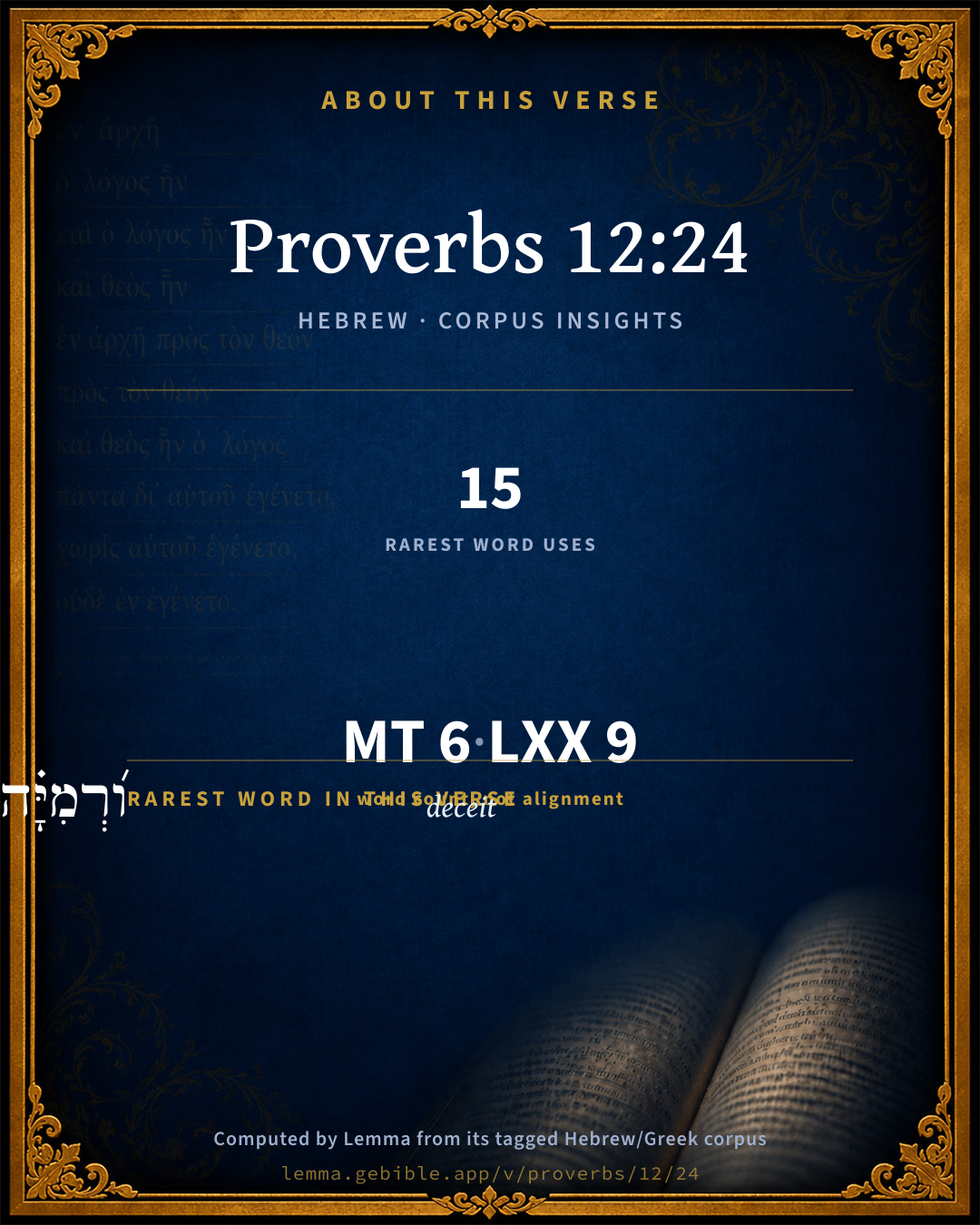
The rarest word here is ו֝רְמִיָּ֗ה deceit H7423 — appearing just 15 times in the whole Hebrew Bible.

Shared distinctive vocabulary

ו֝רְמִיָּ֗ה deceit H7423 occurs in 15 verses of the Hebrew Bible. Also found in:

Grammatical profile

  • 2 verbs
  • 3 nouns
  • 1 adjective

Verb forms

  • תִּמְשׁ֑וֹל Qal · Imperfect
  • תִּהְיֶ֥ה Qal · Imperfect

Hebrew & Septuagint length

In English translation the verse runs 14 words from the Hebrew and 17 from the Septuagint (LXX English) — closely comparable.

A rough comparison of the two English renderings, which tokenize alike — not a word-level alignment.

Word counts can differ between the Hebrew and the Greek without any difference in meaning — e.g. the Hebrew direct-object marker אֵת has no separate Greek word, and Greek often adds the article ὁ.

In the original languages it is 6 Hebrew tokens and 9 Greek tokens — but the two are counted differently (Hebrew bundles its prefixes and suffixes into one token; the Greek is in lemma form), so that isn’t a like-for-like length.

Cross-references

13

Topical passages linked to Proverbs 12:24 in the Treasury of Scripture Knowledge — connected by theme and wording, ordered by reader-vote popularity; previews shown in the World English Bible.

  • Proverbs 12:27 The slothful man doesn't roast his game, But the possessions of diligent men are prized.
  • Proverbs 10:4 He becomes poor who works with a lazy hand, But the hand of the diligent brings wealth.
  • Proverbs 21:25–26 The desire of the sluggard kills him, For his hands refuse to labor.
  • Proverbs 13:4 The soul of the sluggard desires, and has nothing, But the desire of the diligent shall be fully satisfied.
  • Proverbs 19:15 Slothfulness casts into a deep sleep. The idle soul shall suffer hunger.
  • Proverbs 22:29 Do you see a man skilled in his work? He will serve kings; He won't serve obscure men.
  • Genesis 49:15 He saw a resting-place, that it was good, The land, that it was pleasant; He bows his shoulder to the burden, And becomes a servant doing forced labor.
  • 1 Kings 11:28 The man Jeroboam was a mighty man of valor; and Solomon saw the young man that he was industrious, and he gave him charge over all the labor of the house of Joseph.
  • Proverbs 17:2 A servant who deals wisely will rule over a son who causes shame, And shall have a part in the inheritance among the brothers.
  • Proverbs 22:13 The sluggard says, "There is a lion outside! I will be killed in the streets!"
  • 1 Kings 9:21 their children who were left after them in the land, whom the children of Israel were not able utterly to destroy, of them did Solomon raise a levy of bondservants to this day.
  • Proverbs 26:13–16 The sluggard says, "There is a lion in the road! A fierce lion roams the streets!"
  • Proverbs 24:30–34 I went by the field of the sluggard, By the vineyard of the man void of understanding;

Cross-references courtesy of OpenBible.info (CC BY 4.0).

Hebrew and Greek witnesses Masoretic Hebrew ↔ Greek Septuagint

The same verse in the two great witnesses to the Old Testament, shown verse-for-verse.

These are two independent witnesses, not word-aligned to each other, and the Septuagint is shown in lemma (dictionary) form.

Hebrew Proverbs 12:24 Masoretic · Westminster Leningrad Codex

יַד חָרוּצִ֥ים תִּמְשׁ֑וֹל ו֝רְמִיָּ֗ה תִּהְיֶ֥ה לָמַֽס

The hands of the diligent ones shall rule, But laziness ends in slave labor.

World English Bible · Public Domain

Greek LXX Proverbs 12:24 Septuagint · lemma form

χείρ ἐκλεκτός κρατέω εὐχερῶς δόλιος δέ εἰμί εἰς προνομή

The hand of chosen men shall easily obtain rule; but the deceitful shall be for a prey.

LXX2012 (modern English Septuagint) · Public Domain

On this verse, The Pulpit Commentary discusses the Septuagint’s reading. Read the note in Commentary ↓

Hebrew: Westminster Leningrad Codex (CC BY 4.0). Greek: Septuagint (public domain); English from LXX2012 (modern English Septuagint) (Public Domain). How the Septuagint differs from the Hebrew →

Commentary

Notes on Proverbs 12:24 from classic Christian and Jewish commentators (each source and its license shown beneath its notes). The classic Christian expositions comment on the surrounding passage and are grouped to its opening verse, so a note may address several verses; the Jewish commentaries on the Tanakh (Rashi and others) are per-verse, so they appear only where the commentator wrote on this verse.

Lemma curates 59 commentaries, every one of them public domain or Creative Commons licensed, each selected and text-cleaned for this edition rather than reprinted as found. About our sources →

Trapp's Complete Commentary

John Trapp

Pro 12:24 The hand of the diligent shall bear rule: but the slothful shall be under tribute.

Ver. 24. The hand of the diligent shall bear rule,] i.e., It shall make rich, and so get preferment; for, regina pecunia; money bears the mastery, and is a common meddler in most businesses. Agathocles, by his industry, became king of Sicily, Cromwell came to be earl of Essex, Cranmer came to be archbishop of Canterbury, &c.

But the slothful (or deceitful) shall be under tribute.] Cajetan renders it, Dolus erit ad liquefactionem; - Deceitful dealing shall melt to nothing. The same word {a} signifieth both melting and tribute, because too much tribute wastes men’s estates; as when the spleen swells, the rest of the body consumes. King John’s exactors received from his subjects no less sums of curses than of coin. He gathered money, the sinews of war; but lost their affections, the joints of peace. He had a troublesome reign, ill-beloved of his people, and far a less king, only by striving to be more than he was, the just reward of violations; what tribute he paid to the Pope’s legate at his absolution (eight thousand marks, besides other huge sums, insomuch as that John Florentinus, the legate, was nicknamed Ferentinus, for bearing away so much money) I need not here relate. {b} And yet this king was not slothful (for his endless turmoils kept his body still in motion, his mind in passions, and his prowess in use); {c} deceitful, I cannot deny him, in breaking promise with his subjects about their just liberties. But a great part of that blame may well lie upon his court parasites, who suggested, that now he was a king without a kingdom, a lord without a dominion, and a subject to his subjects. Wicked counsellors! as if it were not enough to be above men, but to be above mankind, as those princes would be that would not be under the law.

{a} מס tributum, sic dictum quia paulatim liquescere facit facultates. - Buxtorf.

{b} Mat. Paris.

{c} Speed.

John Trapp, A Commentary or Exposition upon All the Books of the Old and New Testament (1647–1656) — public domain. Text from a community e-Sword module.

The Biblical Illustrator

Joseph S. Exell

Pro_12:24

The hand of the diligent shall bear rule.

The reward of the diligent

The natural estate of man is labour. Toil was the requirement of paradise. Gods Word recognises the universal law of work. Toil is prayer; and the Christian learns from the record of Gods will that honest, faithful, diligent, God-fearing and God-honouring work is itself a worship acceptable to the great All-worker. God enjoins diligence upon us by precept and by example. About us, all things perform their allotment of work, and do it promptly and without a thought of delay. God teaches men by His own ceaseless workings through ten thousand ever-busy forces, and revelation utters the same bidding to unremitting toil. For labour is the tenure of Gods gifts to man. It is thus the requirement of Christian duty that we should not be slothful in business. Promises of reward cluster around the fulfilment of this command. Diligent hands are speedily rendered expert. The diligent hand teaches and trains the wary and observing eye. God works no miracles on behalf of the drones of society. And the hand of the diligent shall bear rule, as Joseph the faithful slave-boy found, and Daniel the captive Hebrew boy. Another reward of the diligent is honour and renown. He shall stand before kings. Illustrate by the cases of Benjamin Franklin and William Carey. Learn that sloth and idleness are expressly forbidden; and so is that undue and overwrought exertion which marks the man greedy of gain. Riches are to be valued as means, not as an end. (Bp. Stevens Perry.)

The hand of the diligent shall bear rule

A young man in a leather store used to feel very impatient with his employer for keeping him year after year, for three years, handling hides. But he saw the use of it in his future career, when, in an establishment of his own, he was able to tell by the touch the exact quality of the goods. It was only by the thousands of repetitions that the lesson was learned; and so it is with everything in which we acquire skill. The half-informed, half-skilled in every business outnumber the others, dozens to one. Daniel Webster once replied to a young man who asked him if there was any room in the legal profession, There is always room at the top. The better you know your business the more you are likely to rise. You can gather much information by making a wise use of your eyes and ears, and perhaps be able to surprise your employer in an emergency by stepping into the next mans place and discharging his duties satisfactorily. So, learn your business, and you will find there is room at the top. (Home Words.)

Diligence and its reward

Mr. Chauncey M. Depew tells the story of his visit to the mechanical department of Cornell University. He found at the head of it Professor Morris, who claimed him as a superior officer, giving as a reason that he was an old-time worker on the New York Central Railway. How did you get here? asked Depew. I was stoker on the New York Central. I stood on the footboard as an engineer on the Central. While a locomotive engineer I made up my mind to get an education. I studied at night, and fitted myself for Union College, running all the time with my locomotive. I procured books, and attended, as far as possible, all lectures and recitations. I kept up with my class, and on the day of graduation I left my locomotive, washed up, put on the gown and cap, delivered my thesis, and received my diplomas, put the gown and cap in the closet, put on my working shirt, got on my engine, and made my usual run that day. Then, says Depew, I knew how he became Professor Morris. That spirit will cause a man to rise anywhere and in any calling.

The Biblical Illustrator, edited by Joseph S. Exell (c. 1880s–1900s) — public domain. Text from a community e-Sword module.

Joseph Benson's Commentary

Pro 12:24. The hand of the diligent shall bear rule — Industry is the way to preferment. An instance of which we have 1Ki 11:28, where we learn that Solomon advanced Jeroboam because he saw he was an industrious young man. Men that take pains in an honest employment, and especially those that labour to be useful to others, will thereby gain such an interest and reputation, as will give them a superiority over all about them. Thus many have risen strangely; and he that has been faithful in a few things has been made ruler over many things. And those who are diligent while they are young, frequently procure that wealth and power which enable them to rule, and so to rest, when they are old; but the slothful shall be under tribute — Or, rather, the deceitful, as רמיהsignifies. He terms the slothful deceitful, because deceit and idleness are generally companions; and such persons seek to gain by fraud, by their shifts and arts of dishonesty, what they either cannot, or will not, get by honest labour.

Joseph Benson's Commentary on the Old and New Testaments (1811–1818) — public domain. Text from a community e-Sword module.

The Preacher's Complete Homiletical Commentary

Joseph S. Exell (gen. ed.)

MAIN HOMILETICS OF Pro_12:24

THE REWARD OF DILIGENCE

I. What is here meant by diligence? It is not being always active, but active in the right direction—active in the right use of talents and opportunities. There is an activity that is worse than idleness, an activity that brings men into contempt and bondage instead of enabling them to rule themselves or others. Men may have great talent and keep it in constant exercise, and yet their diligent use of it may be destroying both themselves and others. A machine that is constructed to work in one direction may be very active in going in the opposite direction—this is worse than if it stood still, for it will certainly work injury to itself, and may do so to other things and to those who have to work it. A thief may be very diligent, but his diligent hand will not bring him to “bear rule.” It will probably, in the end, bring him into a most irksome servitude. There was once a Roman Emperor who was very active in catching flies; this was certainly not the diligence which would enable him to bear rule. If a man who is capable of a high and noble work spends his time in a childish and ignoble manner, he is not diligent although he may be very active. Diligence consists not in being very busy, but in being busy in what will build up our own moral nature and, as a necessity, bless our fellow-creatures. Moreover, diligence is not the right exercise of our talent or the wise use of our time at intervals, by fits and starts, but a constant and steady continuance of that exercise and activity.

II. The consequence of such diligence. He who is thus diligent will bear rule over the slothful man—over the man who wastes his time or his talent.

1. This is right. Even the slothful man himself must, in his conscience, feel that he deserves to be ruled by the diligent. The human conscience will not sanction such waste—such a destruction of character, and, while it is allowed to speak at all, will utter its testimony against it. And all impartial judges must concede that it is the just reward of diligence—that, when a man has rightly used that which the Great Ruler of the universe has committed to his trust, it is right that he should receive the award, “Well done, thou good and faithful servant; thou hast been faithful over a few things, I will make thee ruler over many things” (Mat_25:21).

2. It is necessary. First, for the slothful man himself. When he is under the rule of a diligent man he is doing better with his life than if he were left to himself; he is compelled to act, whether he will or not, and he has the guidance of the wisdom of another when his slothfulness has prevented him from gaining any of his own. His slothfulness grows greater, and therefore his guilt is increased every day that he is his own master. His powers will become more and more incapable of being exercised the longer they are unused, and the only thing that can save him from being entirely buried in the grave of his own sloth is that he become a servant to a diligent man. Secondly, for humanity in general. A slothful man in power is a curse to society. If he is a husband and father he is a curse to his children; if he is a master he is a curse to his servants, and will endanger their characters and industrious habits. Those who rule ought to be wise, and no slothful man can be a wise man.

OUTLINES AND SUGGESTIVE COMMENTS

“Diligent;” from a root meaning to cut. Hence the idea of something incisive or decided. The primary idea is promptness or determination. “Sloth;” primarily remissness or what is indecisive. In this world, diligence puts a man at the head. In the eternal world, it will have made the man a king, and made all hell, and of course, all “sloth, under tribute” to him.—Miller.

This was Joseph’s road to bearing rule (chap. Pro_22:29). But if it does not raise in the world, it will command in its own sphere. The faithful steward is made ruler over his lord’s household (Mat_24:45-47). The active trader bears rule over many cities (Ib. Pro_25:21). Diligence, therefore, is not a moral virtue separate from religion, but rather a component part of it.—Bridges.

The slothful are like Issachar, who saw that the rest was good, and bowed down his shoulder to bear, and became a servant to tribute; by their laziness they expose themselves to want, and reduce themselves to a slavish dependence on those who, through the blessing of God on their own diligence, or on that of their fathers, are in better circumstances. Spiritual sloth weakens men, and exposes them to the spiritual sloth of their spiritual enemies. We must be strong, resolute, and active, if we would escape the tyranny of the rulers of the darkness of this world (Eph_6:10-18).—Lawson.

The comparison is suggested by the contrast common in most ancient monarchies in the east, between the condition of a conquered race, compelled to pay heavy taxes in money or in kind (like the Canaanites in Israel, Jos_16:10; Jdg_1:30-33), and that of the freedom of their conquerors from such burdens. The proverb indicates that beyond all political divisions of this nature there lies an ethical law. The “slothful” descend inevitably to pauperism and servitude. The prominence of this compulsory labour under Solomon (1Ki_9:21), gives a special significance to the illustration.—Plumptre.

The Preacher's Complete Homiletical Commentary (gen. ed. Joseph S. Exell; Funk & Wagnalls, c. 1892) — public domain (pre-1929). A full-Bible homiletical/sermon-outline anthology covering 65 of 66 books (2 John is absent from the source module). Text from a community e-Sword module.

Keil & Delitzsch

C. F. Keil & F. Delitzsch

We take Pro 12:24-28 together as a group. In these verses the subject is the means of rising (in the world), and the two ways, the one of which leads to error, and the other to life.

24 The land of the diligent attains to dominion,

But slothfulness will become tributary.

In Pro 10:4 רמיּה was adj., but to כּף standing beside it; here it is to be regarded as adj. to יד (sluggish hand) supplied from 24a, but may be equally regarded as a subst. (slothfulness) (vid., at Pro 12:27). Regarding חרוּץ, vid., p. 211. מס signifies tribute and service, i.e., tributary service rendered to a master. In Pro 11:29 עבד stands for it. It is still the experience of to-day, as it was of Solomon's time, that slothfulness (indolence) brings down to a state of servitude, if not even deeper, but that vigorous activity raises to dominion or to the position of a master, i.e., to independence, wealth, respect, and power.

Keil & Delitzsch — Biblical Commentary on the Old Testament (1861–1891) — public domain (CC PDM 1.0). Text via the HelloAO Bible API. (Old Testament only.)

Matthew Henry's Commentary

Note, 1. Industry is the way to preferment. Solomon advanced Jeroboam because he saw that he was an industrious young man, and minded his business, Kg1 11:28. Men that take pains in study and serviceableness will thereby gain such an interest and reputation as will give them a dominion over all about them, by which means many have risen strangely. He that has been faithful in a few things shall be made ruler over many things. The elders, that labour in the word and doctrine, are worthy of double honour; and those that are diligent when they are young will get that which will enable them to rule, and so to rest, when they are old. 2. Knavery is the way to slavery: The slothful and careless, or rather the deceitful (for so the word signifies), shall be under tribute. Those that, because they will not take pains in an honest calling, live by their shifts and arts of dishonesty, are paltry and beggarly, and will be kept under. Those that are diligent and honest when they are apprentices will come to be masters; but those that are otherwise are the fools who, all their days, must be servants to the wise in heart.

Matthew Henry's Commentary on the Whole Bible (1708–1710) — public domain (CC PDM 1.0). Text via the HelloAO Bible API.

Jamieson, Fausset & Brown

Robert Jamieson, A. R. Fausset & David Brown

slothful--(Compare Margin), so called because he fails to meet his promises.

under tribute--not denoting legal taxes, but the obligation of dependence.

Jamieson, Fausset & Brown — Commentary Critical and Explanatory on the Whole Bible (1871) — public domain (CC PDM 1.0). Text via the HelloAO Bible API.

Adam Clarke's Commentary

Verse 24. The hand of the diligent shall bear rule] And why? because by his own industry he is independent; and every such person is respected wherever found.

Adam Clarke's Commentary on the Bible (1810–1826) — public domain. Text from a community e-Sword/MySword module.

Ellicott's Commentary for English Readers

(24) Under tribute.—Like the descendants of the Amorites and other former inhabitants of Canaan, by whose forced labour Solomon executed his great works (1Ki_9:20-21). A Hebrew from poverty might be reduced to slavery (Lev. xxv, 39),

A Bible Commentary for English Readers, edited by Charles John Ellicott (1878–1897) — public domain. Text from a community e-Sword module.

The Cambridge Bible for Schools and Colleges

gen. ed. J. J. S. Perowne

24. the slothful] Lit. sloth. See Pro_10:4. Comp. Pro_13:1-2.

shall be under tribute] Rather, shall come, or be put, under task-work, i.e. servile or enforced labour. The phrase occurs frequently (e.g. Deu_20:11; Jdg_1:30; Jdg_1:33; Jdg_1:35), and is rendered, “be, or become tributary,” both in A.V. and R.V., though with the alternative, “be subject to task-work,” in R.V. marg. But in all those places the words, “and shall serve thee” are added, showing that it was not in money but in toil, as with the Israelites in Egypt, that the “tribute” was to be paid. Hence the phrase comes to have the meaning which it has here.

The Cambridge Bible for Schools and Colleges (gen. ed. J. J. S. Perowne; Cambridge University Press, 1878–1918) — public domain. Text from a community e-Sword module.

John Gill's Exposition

The hand of the diligent shall bear rule,.... "Shall become rich", so Jarchi interprets it, according to Pro 10:4; Through diligence men get riches, and through riches they arrive to power and authority over others: from apprentices and journeymen workmen they become masters of their business; diligent men become masters of families, and have servants and workmen under them; become magistrates in cities, and bear rule over their fellow citizens, and are advanced to places of power and authority in the commonwealth; see Pro 22:29;

but the slothful shall be under tribute; the "slothful" or "deceitful hand" (l), for so it may be rendered and supplied; for usually such who are slothful, and do not care for business, get their living by deceitful methods, by tricking and sharping; and such become subject to others, to them that are diligent; hence said to be "under tribute", or tributary; because those that are tributary are in subjection to those to whom they pay tribute.

(l) "Manus fraudulentiae", Michaelis; "dolosa", Montanus, Junius & Tremellius, Mercerus, Gejerus; "fraudulenta", Tigurine version, Vatablus.

John Gill's Exposition of the Whole Bible (1746–1763) — public domain (CC PDM 1.0). Text via the HelloAO Bible API.

Albert Barnes' Notes on the Bible

Under tribute - The comparison is probably suggested by the contrast between the condition of a conquered race (compare Jos 16:10; Jdg 1:30-33), and that of the freedom of their conquerors from such burdens. The proverb indicates that beyond all political divisions of this nature there lies an ethical law. The “slothful” descend inevitably to pauperism and servitude. The prominence of compulsory labor under Solomon 1Ki 9:21 gives a special significance to the illustration.

Albert Barnes' Notes on the Bible (1834–1885) — public domain. Text from a community e-Sword/MySword module.

Matthew Poole's English Annotations

Shall bear rule; shall procure wealth and power.

The slothful, Heb. the deceitful. So he calls the slothful, because deceit and idleness are commonly companions, and such men seek to gain by fraud what they either cannot or will not get by honest labour. Compare Pro 10:4.

Matthew Poole's English Annotations on the Holy Bible (1683–1685) — public domain. Text from a community e-Sword/MySword module.

Whedon's Commentary on the Bible

Daniel D. Whedon

24. Diligent… bear rule — Diligence procures wealth and promotion; idleness brings poverty and dependence. The word rendered “slothful” also means deceitful, or fraudulent. They are often connected — sloth frequently leading to fraud. In the East a conquered race were compelled to pay heavy taxes, while their conquerors were comparatively free from such burdens. Solomon’s familiarity with this fact may have suggested the illustration here.

Under tribute — “Shall be obliged to serve.” — Zockler. Comp. 1Ki_9:21-22; Jos_16:10; Judges 31:30, 33.

Daniel D. Whedon (gen. ed.), Commentary on the Old and New Testaments (1874–1909) — public domain. Text from a community e-Sword module.

The Pulpit Commentary

Vers. 24-28 speak of the means of getting on in life.

The hand of the diligent shall bear rule. (Pro_10:4) For "diligent" the Vulgate has fortium, "the strong and active;" Septuagint, eklektwn , "choice." Such men are sure to rise to the surface, and get the upper hand in a community, as the LXX adds, "with facility," by a natural law. But the slothful (literally, slothfulness) shall be under tribute; or, reduced to compulsory service, like the Gibeonites in Joshua"s time, and the Canaanites under Solomon. (Jos_9:21, 23 1Ki_9:21) So Pro_11:29, "The fool shall be slave to the wise;" and an Israelite reduced to poverty might be made a servant. (Lev_25:39, Lev_25:40) The LXX, taking the word in another sense, translates, "The crafty shall be for plunder;" i.e. they who think to succeed by fraud and trickery shall become the prey of those who are stronger than themselves.

Depression.

This proverb shows us depression of soul in its own distress and gloom, and then gives a hint of the way in which it may be remedied.

I THE STATE OF DEPRESSION. The heart is bowed down with heaviness. This is very different from external adversity and from the natural feelings that are produced by such a condition. It may be quite independent of circumstances. The buoyant soul will face great ca]amities with comparative cheerfulness, while the heavy heart is depressed among sight of unbroken prosperity.

1. Depression is caused by personal conditions. Not being the reflection of circumstance, it must be the expression of internal experience. Frequently it is a result of a man"s bodily state, a merely nervous disorder or a consequence of deranged health. We look for religious remedies when the true cure is in the hands of the physician. But it may be that melancholy thoughts have depressed the soul. Then the gloom within is projected on to the world without, and the sunnier scenes are overclouded.

2. Depression is a deplorable state of mind. It is a source of deep distress to the sufferer. It spreads an atmosphere of gloom among others. It checks enterprise by paralyzing hope. If the joy of the Lord is our strength, sorrow of soul must be a source of weakness. Depressed Christian people discredit the name of religion by making it appear unattractive to the world. Gratitude is scarcely compatible with depression, and the soul that has given way to this deplorable experience is not likely to sing the praises of God. Thus depression tends to check worship. On the other hand, it reveals the soul"s great need of God, who in his long suffering compassion has pity on his distressed children. "He knoweth our frame, he remembereth that we are dust.

II THE CURE OF DEPRESSION. When it is due to physical causes, physical remedies may be needed. In many cases, change of scene and brighter circumstances may help to remove it. But there are also social and moral remedies, among which not the least valuable is a wise expression of brotherly kindness. Pure condolence may do more harm than good by aggravating the painful symptoms, and yet "a good word maketh" the heart "glad.

1. The utterance of the word may be helpful. Isolation and silence are depressing. "It is not good for man to be alone." The heavy heart seeks solitude, and uncongenial society cannot be helpful. But sympathetic society"s healing, even though it be admitted with reluctance. Christ founded a Church. He sought to cheer his people amid the various scenes of their heaven ward pilgrimage by means of Christian companionship.

2. The contents of the word should be helpful. We may not do much good by moralizing. Though advice for the depressed is easy to find, it is not often acceptable. But words of affection are wonderfully healing. Cheerful thoughts should help the depressed.

3. It is our duty to relieve the depressed. To blame, to shun, or to patronize are all no-Christlike methods. But the Christian should endeavour to make the world brighter by his presence. Above all, if it is possible to lead the depressed to hope in God, the surest method of cure is within our reach.

The promotion of the diligent and the subjection of the slothful.

I THE DILIGENT RISE IN LIFE. This is too obvious to need insisting upon. But often, when wonder is expressed at the rise of ordinary men, this solution may be recurred to. As a rule, it is not the greatest wits who fill the high places of the realm, but the greatest workers.

II HE ONLY IS FIT TO GOVERN WHO HAS BEEN WILLING TO SERVE. For in truth the spirit of the true servant and that of the true ruler are alike in principle; it is respect for law, for right beyond and above self-will and self-interest, which animates both. If this has been proved in the trials of an inferior situation, its genuineness has been discovered, and it becomes a title to promotion. Abraham"s servant (Gen_24:2, Gen_24:10) and Joseph (Gen_39:4, Gen_39:22) are illustrations from patriarchal life.

III THE SLOTHFUL DECAY. This too is obvious. But perhaps we often fail to fix the stigma of sloth in the right place. Many busy, energetic, fussy people miscarry because their activity is ill-placed. To neglect one"s proper vocation anal work is idleness, no matter what may be the uncalled for activity in other directions. J.

See homily on Pro_27:23. C.

The Pulpit Commentary (1880–1919), ed. H.D.M. Spence-Jones & Joseph S. Exell — public domain. Text from a community e-Sword module.

Bridges on Proverbs

Charles Bridges

Diligence is the ordinary path to advancement. Pharaoh required men of activity for the charge of his cattle (Gen 47:6 ); Solomon for the administration of his kingdom. (1Ki 11:28 .) This was Joseph’s road to bearing rule. (Pro 22:29 .) But if it does not raise in the world, it will command influence in its own sphere. The faithful steward is made ruler over his Lord’s household. (Mat 24:45-47 .) The active trader bears rule over many cities. (Mat 25:21 .) Diligence therefore is not a moral virtue separate from religion, but rather a component part of it. (Rom 12:11 .)

The slothful spirit brings a man under bondage. ’He is perpetually needing counsel of others, and hanging upon it.’†1 In the grand concern, he is the slave of his own lust; in the worst service, under the most degrading tyranny; "wicked" because "slothful," and "cast out and condemned as an unprofitable servant." (Mat 25:26-30 .) Christian Professor! tremble at this responsibility of doing nothing, of living for thine own indulgence; neglecting the great object of life — the only object that tells upon eternity.

Footnotes:

†1 Dathe in loco. ’The slothful shall become subservient to others.’ — French and Skinner’s Translation of Proverbs. with notes, 1831. Compare Pro 10:4 ; Pro 11:29 .

Charles Bridges, An Exposition of the Book of Proverbs (1846) — public domain. Text from a community e-Sword module.

Kretzmann's Popular Commentary

Paul E. Kretzmann

v. 24. The hand of the diligent shall bear rule, he will reach a position of power and influence; but the slothful shall be under tribute, being obliged to serve, to hold a subordinate position, all his life.

Paul E. Kretzmann, Popular Commentary of the Bible (1921–1924) — public domain. Text from a community e-Sword module.

Rashi

Rabbi Shlomo Yitzchaki (Rashi)

The hand of the diligent The upright.

will rule Will make wealthy.

Rashi on the Tanakh — English translations: “The Judaica Press complete Tanach with Rashi, translated by A. J. Rosenberg” (CC BY 4.0); “Pentateuch with Rashi's commentary by M. Rosenbaum and A.M. Silbermann, 1929-1934” (public domain); “The Metsudah Tanach series, Lakewood, N.J” (CC BY 4.0); and “The Book of Joshua, Metsudah Publications, 1997” (CC BY 4.0). Text via Sefaria.

Lesson kit

Teaching starters — assembled from the data on this page, not authored interpretation. Every prompt links to the verse data it draws on. Edit before teaching.

Proverbs, in the Wisdom, opens this verse with 6 words (6 distinct Hebrew lemmas). Its most distinctive word is rᵉmîyâh (“deceit”). A historical commentator’s framing appears above. Read the whole chapter for the surrounding context.

Discussion questions

  1. The word rᵉmîyâh carries the sense “deceit.” How does it shape the verse?
  2. Job 13:7 shares the word «deceit» with this verse. How do the two illuminate each other?
  3. These translations render this verse differently; the difference is in the English rendering, not the original. What questions does that raise?
  4. The verb «תִּמְשׁ֑וֹל» is Qal Imperfect. How does its form color the action?
  5. Reading how Trapp's Complete Commentary and The Biblical Illustrator read this verse, where do the two commentators agree and where do they part?

Things to notice

Reading settings

Reading text

Shown beneath each verse's original-language words.

Old Testament
Old Testament edition

Read the OT as the Masoretic Hebrew (MT) or the Greek Septuagint (LXX).

English shown for the Greek Septuagint (in the Hebrew ↔ Greek comparison).

Comparing translations? Open the Compare panel on any verse page to stack up to four side by side.