
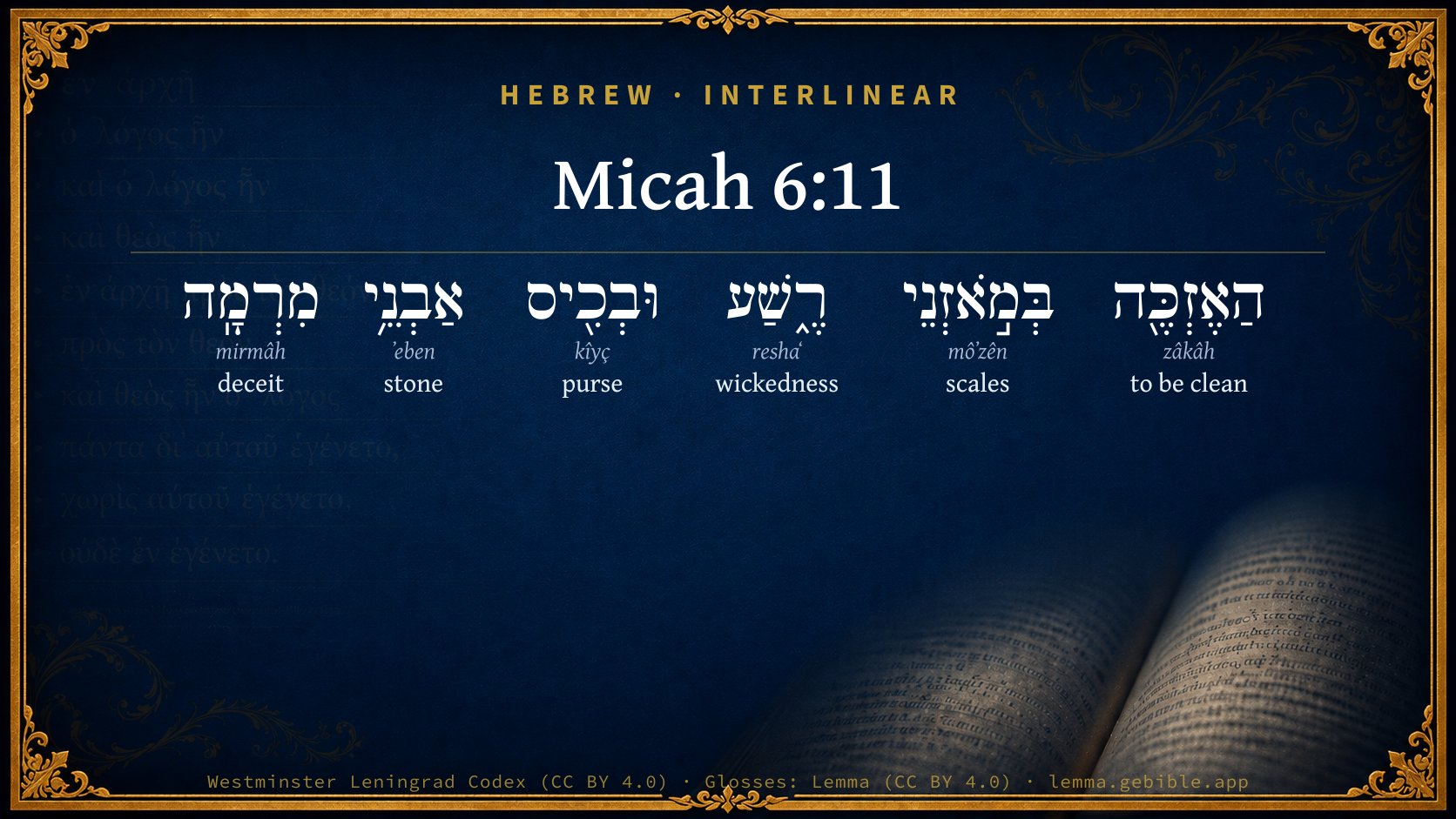
Micah 6:11

Hebrew (Westminster Leningrad Codex) Micah 6:11 appears in the Hebrew Old Testament. The text above is from the Westminster Leningrad Codex. Each word links to its Strong’s number, a concise gloss, and parsing drawn from the Open Scriptures Hebrew Bible morphology. Click any word for its full Brown-Driver-Briggs (BDB) entry.
Download image
Cite this verse

Micah 6:11 (World English Bible). Public Domain. Lemma interlinear Bible study tool, https://lemma.gebible.app/v/micah/6/11.

Show BibTeX & RIS
BibTeX
RIS
English Translation
Shall I be pure with dishonest scales, And with a bag of deceitful weights?
World English Bible · Public Domain
Download a study sheet

One document with this verse’s original text, its word-by-word gloss line, the meaning frame, cross-references with their text, attributed commentary, and full source and license credits — printable, and it pastes into notes with its structure intact.

This verse Autodidact and up

Study sheet (.html) Plain text (.txt)

A passage Seminary Student

Up to 50 verses in one chapter. A passage sheet keeps up to 6 commentary sources and 12 cross-references per verse, in the order this page ranks them, and says so on the sheet whenever that leaves anything out. Ask for a single verse and you get the Autodidact verse sheet above.

Everything on this page stays free to read, with no account — the sheet is a download of what is already on screen, not access to it.

Want to remove ads? Support Godless Engineer
Compare translations 3

The same verse in 3 English versions, stacked beneath the original-language interlinear above. Click any original word for its lexicon entry.

Each is an independent rendering of the whole verse — the interlinear is not word-aligned to these translations.

Highlighted words mark where these versions differ — a whole-verse word diff, not a word-by-word alignment.

  • World English Bible Public Domain
    Shall I be pure with dishonest scales, And with a bag of deceitful weights?
  • King James Version Public Domain
    Shall I count them pure with the wicked balances, and with the bag of deceitful weights?
  • unfoldingWord Literal Text CC BY-SA 4.0
    Shall I be pure with scales of wickedness, and with a bag of stones of deceit?

unfoldingWord Literal Text — © unfoldingWord, licensed CC BY-SA 4.0. Word-aligned USFM3 via Door43 (git.door43.org/unfoldingWord/en_ult).

Versions to compare (up to 4)

3 of 4 selected

Show all 18 translations

Every available English version of this verse, each an independent rendering of the whole verse.

  • World English Bible Public Domain
    Shall I be pure with dishonest scales, And with a bag of deceitful weights?
  • Berean Standard Bible Public Domain
    Can I excuse dishonest scales or bags of false weights?
  • Majority Standard Bible Public Domain
    Can I excuse dishonest scales or bags of false weights?
  • King James Version Public Domain
    Shall I count them pure with the wicked balances, and with the bag of deceitful weights?
  • American Standard Version (1901) Public Domain
    Shall I be pure with wicked balances, and with a bag of deceitful weights?
  • Revised Version (1885) Public Domain
    Shall I be pure with wicked balances, and with a bag of deceitful weights?
  • Geneva Bible (1599) Public Domain
    Shall I iustifie the wicked balances, and the bag of deceitfull weightes?
  • Douay-Rheims (1899) Public Domain
    The voice of the Lord crieth to the city, and salvation shall be to them that fear thy name: hear, O ye tribes, and who shall approve it?
  • Young's Literal Translation Public Domain
    Do I reckon `it' pure with balances of wickedness? And with a bag of deceitful stones?
  • Literal Standard Version CC BY-SA 4.0
    Do I reckon [it] pure with balances of wickedness? And with a bag of deceitful stones?
  • Unlocked Literal Bible CC BY-SA 4.0
    Should I consider a person to be innocent if he uses fraudulent scales, with a bag of deceptive weights?
  • unfoldingWord Literal Text CC BY-SA 4.0
    Shall I be pure with scales of wickedness, and with a bag of stones of deceit?
  • Darby Bible Public Domain
    Shall I be pure with the unjust balances, and with the bag of deceitful weights?
  • World Messianic Bible Public Domain
    Shall I tolerate dishonest scales, and a bag of deceitful weights?
  • Webster's Bible Public Domain
    Shall I count them pure with the wicked balances, and with the bag of deceitful weights?
  • Free Bible Version CC BY-SA 4.0
    How can I accept those who use unfair scales and dishonest weights?
  • Bible in Basic English Public Domain
    Is it possible for me to let wrong scales and the bag of false weights go without punishment?
  • JPS Tanakh (1917) Public Domain
    'Shall I be pure with wicked balances, and with a bag of deceitful weights?'

Literal Standard Version (2020), Covenant Press — licensed CC BY-SA 4.0. Text via the HelloAO Bible API (eBible.org). Unlocked Literal Bible (unfoldingWord) — licensed CC BY-SA 4.0. Text via the HelloAO Bible API (eBible.org). unfoldingWord Literal Text — © unfoldingWord, licensed CC BY-SA 4.0. Word-aligned USFM3 via Door43 (git.door43.org/unfoldingWord/en_ult). Free Bible Version, Dr. Jonathan Gallagher — licensed CC BY-SA 4.0. Text via the HelloAO Bible API (eBible.org).

Word by word

More ways to search: Search by grammar → Find every occurrence → Compare this word →

Practice this passage: Drill this verse → Learn its vocabulary →

About this verse

These counts appear in no published source. They are computed here, from the morphology-tagged text and Lemma’s own curated glosses. What Lemma adds →

6
words
6
distinct lemmas
Prophets
section

Notable vocabulary

The rarest word here is וּבְכִ֖יס purse H3599 — appearing just 6 times in the whole Hebrew Bible.

Shared distinctive vocabulary

וּבְכִ֖יס purse H3599 occurs in 6 verses of the Hebrew Bible. Also found in:

Grammatical profile

  • 1 verb
  • 5 nouns

Verb forms

  • הַאֶזְכֶּ֖ה Qal · Imperfect

Hebrew & Septuagint length

In English translation the verse runs 14 words from the Hebrew and 14 from the Septuagint (LXX English) — the same length.

A rough comparison of the two English renderings, which tokenize alike — not a word-level alignment.

Word counts can differ between the Hebrew and the Greek without any difference in meaning — e.g. the Hebrew direct-object marker אֵת has no separate Greek word, and Greek often adds the article ὁ.

In the original languages it is 6 Hebrew tokens and 10 Greek tokens — but the two are counted differently (Hebrew bundles its prefixes and suffixes into one token; the Greek is in lemma form), so that isn’t a like-for-like length.

Cross-references

3

Topical passages linked to Micah 6:11 in the Treasury of Scripture Knowledge — connected by theme and wording, ordered by reader-vote popularity; previews shown in the World English Bible.

  • Hosea 12:7 A merchant has dishonest scales in his hand. He loves to defraud.
  • Leviticus 19:36 Just balances, just weights, a just ephah, and a just hin, shall you have. I am Yahweh your God, who brought you out of the land of Egypt.
  • Proverbs 16:11 Honest balances and scales are Yahweh's; All the weights in the bag are his work.

Cross-references courtesy of OpenBible.info (CC BY 4.0).

Hebrew and Greek witnesses Masoretic Hebrew ↔ Greek Septuagint

The same verse in the two great witnesses to the Old Testament, shown verse-for-verse.

These are two independent witnesses, not word-aligned to each other, and the Septuagint is shown in lemma (dictionary) form.

Hebrew Micah 6:11 Masoretic · Westminster Leningrad Codex

הַאֶזְכֶּ֖ה בְּמֹ֣אזְנֵי רֶ֑שַׁע וּבְכִ֖יס אַבְנֵ֥י מִרְמָֽה

Shall I be pure with dishonest scales, And with a bag of deceitful weights?

World English Bible · Public Domain

Greek LXX Micah 6:11 Septuagint · lemma form

εἰ δικαιόω ἐν ζυγός ἄνομος καί ἐν μάρσιππος στάθμιον δόλος

Shall the wicked be justified by the balanced, or deceitful weights in the bag,

LXX2012 (modern English Septuagint) · Public Domain

On this verse, The Cambridge Bible for Schools and Colleges discusses the Septuagint’s reading. Read the note in Commentary ↓

Hebrew: Westminster Leningrad Codex (CC BY 4.0). Greek: Septuagint (public domain); English from LXX2012 (modern English Septuagint) (Public Domain). How the Septuagint differs from the Hebrew →

Targum (Aramaic paraphrase)

1

The Targum is the ancient Jewish Aramaic paraphrase of the Hebrew Scriptures — an interpretive translation, not the Hebrew text itself. Onkelos (literal) and Pseudo-Jonathan (expansive) render the Torah, and Jonathan the Prophets. Coverage is partial: where no permissively-licensed English translation exists for a verse, only the Aramaic is shown. This is verse-level text, not a word-by-word alignment to the Hebrew.

  1. Targum Jonathan Prophets (Joshua–Malachi)
    הֲיִזְכּוֹן בְּמָזְנְוָן דִרְשַׁע וּבְכִיס דְבֵיהּ מַתְקְלִין רַבְרְבִין וּדְעַדְקִין:

    (no public-domain English translation for this verse)

    Targum Jonathan — Aramaic: “Mikraot Gedolot” (public domain). English: “Sefaria Community Translation” (CC0 1.0 (public-domain dedication)); “London "Chaldee Paraphrase," 1871” (public domain). Text via Sefaria.

Commentary

Notes on Micah 6:11 from classic Christian and Jewish commentators (each source and its license shown beneath its notes). The classic Christian expositions comment on the surrounding passage and are grouped to its opening verse, so a note may address several verses; the Jewish commentaries on the Tanakh (Rashi and others) are per-verse, so they appear only where the commentator wrote on this verse.

Lemma curates 59 commentaries, every one of them public domain or Creative Commons licensed, each selected and text-cleaned for this edition rather than reprinted as found. About our sources →

Trapp's Complete Commentary

John Trapp

Mic 6:11 Shall I count [them] pure with the wicked balances, and with the bag of deceitful weights?

Ver. 11. Shall I count them pure with the wicked balances?] Shall I clear and acquit such? I that am the righteous judge of heaven and earth, I abhor all injustice; I that have named myself a God that will by no means clear the guilty, nor take the wicked by the hand? Exo 34:7 Job 8:20. Do they think to draw me in as a party; or, that I will bear with their false and fraudulent dealings, which I have so often declared against, and doomed both in the law, and by my servants Solomon, Amos, and others. No: assure yourselves, your sins shall find you out, and I will curse you, smite you, plague you, and so set it on, as no creature shall be able to take it off. Let earthly judges warp as they will, and wink at sin, I neither can nor will; but as men have sowed, so they shall reap; as they have sowed in hardness of heart, so they shah reap in horror of conscience, et quorum oculos culpa clausit, poena aperiet, as they have lived unconscionably, so they shall die uncomfortably; at which times, their treasures of wickedness shall leave them in the lurch; as the devil leaves witches, when they come to prison.

John Trapp, A Commentary or Exposition upon All the Books of the Old and New Testament (1647–1656) — public domain. Text from a community e-Sword module.

Jamieson, Fausset & Brown

Robert Jamieson, A. R. Fausset & David Brown

Shall I count them pure--literally, "Shall I be pure with?" &c. With the pure God shows Himself pure; but with the froward God shows Himself froward (Psa 18:26). Men often are changeable in their judgments. But God, in the case of the impure who use "wicked balances," cannot be pure, that is, cannot deal with them as He would with the pure. VATABLUS and HENDERSON make the "I" to be "any one"; "Can I (that is, one) be innocent with wicked balances?" But as "I," in Mic 6:13, refers to Jehovah, it must refer to Him also here.

the bag--in which weights used to be carried, as well as money (Deu 25:13; Pro 16:11).

Jamieson, Fausset & Brown — Commentary Critical and Explanatory on the Whole Bible (1871) — public domain (CC PDM 1.0). Text via the HelloAO Bible API.

John Calvin's Commentaries

Shall I justify? etc. This verse is connected with the last, and is added as an explanation. For God having come forth as a Judge, now shows what sort of Judge he is, even one who is not biased by favor, who does not change his judgment, who shows no respect of persons. But men, for the most part, greatly deceive themselves, when they transform God according to their own will, and promise to themselves that he will be propitious to them, provided they only make false pretensions to him. God then here declares, that he differs widely from earthly judges, who now incline to one side and then to another, who are changeable, and often deviate from the right course: but, on the contrary, he says here, Shall I justify wicked balances? shall I justify weights of fraud, or deceitful? that is, “Shake off all those delusions by which ye are wont to deceive yourselves; for I do not change either my nature or my purpose; but according to the true teaching of my Law, I will punish all the wicked without any respect of persons: wherever wickedness and iniquity are found, there punishment will be inflicted.”

We now then understand how these two verses harmonize together. God shows that he will be a judge, and then, that he differs from men, who often change, as it has been said, in their decisions.

I will mention another meaning, which will perhaps be preferred by some. The question, after the manner of the Hebrews, may be taken as an affirmation, as though he had said, that within a short time, (for עוד, oud, means sometimes a short time,) the treasures of iniquity would not be found, for they would be taken away: then follows a confirmation, for frauds and robberies by false measures and deceitful weights could not escape God’s judgment. The meaning then would be, that as God must necessarily, according to his own office, punish thefts, it cannot be that he will suffer men, who cheat by false weights to continue always unpunished. It now follows —

John Calvin's Commentaries (1540-1563) — public domain. Text from the Calvin Translation Society English edition (1840s-50s) via the Christian Classics Ethereal Library (ccel.org). Calvin's coverage is partial (roughly two-thirds of the Bible); uncommented books and verses are honest gaps, never fabricated. The 19th-century editor's footnotes and remarks are omitted so the notes are faithfully Calvin's own voice.

Ellicott's Commentary for English Readers

(11) Shall I count them pure?—Rather, Can I be innocent with the deceitful balances? The enactments about weights were very stringently expressed in the Law, both affirmatively and negatively: e.g., in Lev_19:35-36, “Ye shall do no unrighteousness in judgment, in meteyard, in weight, or in measure. Just balances, just weights, a just ephah, and a just hin, shall ye have.” And, “thou shalt not have in thy house divers weights,” . . . and “divers measures, a great and small” (Deu_25:13-14).

A Bible Commentary for English Readers, edited by Charles John Ellicott (1878–1897) — public domain. Text from a community e-Sword module.

The Cambridge Bible for Schools and Colleges

gen. ed. J. J. S. Perowne

11. Shall I count them pure …] This rendering is barely defensible, even if we alter the vowel-points. It was dictated by the very natural feeling that the speaker ought to be the same person as in Mic_6:10. Keil thinks that the reading of the Hebrew text may be justified, if we suppose the speaker to be the prophet speaking as the representative of the human conscience. The text-reading is, Can I be pure, &c., which, according to this commentator, means ‘Can a man be pure?’ It is simpler, however, and in accordance with what we know of the confusions of Hebrew pronunciation, to follow the Septuagint, the Peshito, and the Targum, and restore the third person instead of the first; unless, looking at Mic_6:12, we prefer to read the verb in the second person, ‘Canst thou (O Jerusalem) be pure.’ For the prophet continues, ‘The rich men thereof’ (i.e. of Jerusalem).

The Cambridge Bible for Schools and Colleges (gen. ed. J. J. S. Perowne; Cambridge University Press, 1878–1918) — public domain. Text from a community e-Sword module.

John Gill's Exposition

Shall I count them pure with the wicked balances,.... These are the words either of the prophet, or rather of God, signifying that he could not, and would not, allow, countenance, and approve of persons that used false scales or balances; or justify and reckon them just, as they would be thought to be, but condemn them, and pronounce them very wicked men, and deserving of punishment here and hereafter:

and with the bag of deceitful weights? or "stones" (o); which were used in weighing goods, and which were deceitful, when a heavier was used in buying, and a lighter in selling. So the Targum,

"and with the bag, in which are weights greater and lesser;''

condemned in Deu 25:13.

(o) "lapidum doli", Piscator; "lapidum fraudis", Montanus.

John Gill's Exposition of the Whole Bible (1746–1763) — public domain (CC PDM 1.0). Text via the HelloAO Bible API.

Albert Barnes' Notes on the Bible

Shall I count them pure? - Rather, (as the English margin) “Shall I be pure?” The prophet takes for the time their person and bids them judge themselves in him. If it would defile me, how are ye, with all your other sins, not defiled? All these things were expressly forbidden in the law. “Ye shall do no unrighteousness in judgment, in mete-yard, in weight or in measure. Just balances, just weights, a just ephah and a just him, shall ye have” Lev 19:35-36; and, “Thou shalt not have in thy bag divers weights, a great and a small. Thou shalt not have in thine house divers measures, a great and a small. For all that do such things, and all that do unrighteousness are an abomination unto the Lord thy God” (Deu 25:13, Deu 25:15-16, add Pro 11:1; Pro 16:11; Pro 20:10). Yet are not these things common even now?

Albert Barnes' Notes on the Bible (1834–1885) — public domain. Text from a community e-Sword/MySword module.

Matthew Poole's English Annotations

Shall I? it may have some reference to the prophet, as speaking of himself, appointed of God to be a reprover and impartial censurer of the sins of this people; When I am so to judge of them by their doings, shall I flatter them, and say they are better than they are? but it better refers to God himself.

Count them pure; approve, justify, or acquit them, as if they were righteous, and not worthy to be punished? Shall I let them escape who are such unjust persons? This question implieth a strong negation.

The wicked balances: this kind is put for all the rest, wherewith things bought and sold were apportioned, and by which buyers and sellers were ascertained how much they bought.

The bag; in which they both kept their weights at home, and carried them about with them.

Deceitful weights, Heb. stones of deceit; they did (as in many places with us men do) use stones for weights, and this unjust people did cheat both at home and abroad, both the balance and its weights were deceitful, and condemned, Lev 19:35,36; Deu 25:13-16.

Matthew Poole's English Annotations on the Holy Bible (1683–1685) — public domain. Text from a community e-Sword/MySword module.

Whedon's Commentary on the Bible

Daniel D. Whedon

11. Shall I count them pure — This is an impossible rendering of the Hebrew, but it is supported by Vulgate; the Hebrew reads, “Shall I be pure?” If this is original, the people must be the speaker; but a change in speakers is out of place here. LXX. retains Jehovah as the speaker, and reads, “Can it (Jerusalem) be pure?” The LXX. and Vulgate readings require only slight alterations in the Hebrew, and either is preferable to the present text.

Wicked balances,… deceitful weights — See on Amo_8:5. No one who practices fraud or deceit can expect to be acquitted in the court of Jehovah.

Mic_6:12 continues the description of wrongdoing (compare Hos_4:1 ff.).

Thereof — Of Jerusalem.

Full of violence — See on Mic_2:1-2; Mic_2:8; Mic_3:2-3; Mic_3:9.

Lies — Toward God and man.

Deceitful — Literally, deceit. The noun is used in the place of the adjective for the sake of emphasis (G.-K., 141c); the tongue does nothing but deceive.

Mic_6:13-15 announce the judgment.

Thee — The masculine pronoun which is used in these verses cannot refer to the city. If the alteration suggested in connection with 9b is accepted the masculine pronoun may be explained as referring to “tribe,” a masculine noun; otherwise we must suppose that the prophet uses the masculine form because he has in mind the people of the city rather than the city itself. Smiting [“have smitten”] — If the text is correct this is the so-called prophetic perfect. The punishment is still in the future, but it is so certain that the prophet describes it as already present.

I also — Better, I on my part.

With a grievous wound — An incurable wound (Nah_3:19). The construction of the Hebrew is somewhat unusual. A slight alteration, supported by LXX., would give, “therefore I on my part have begun to smite thee, to make thee desolate because of thy sins.”

Mic_6:14-15 describe the judgment in greater detail; the prophet evidently thinks of a foreign nation as the divinely appointed executioner (Amo_5:11; Deu_28:39-40).

Thou shalt eat, but not be satisfied — The enemy will overrun the land and devastate it; as a result starvation will threaten the people. The meaning of the next clause is uncertain.

Thy casting down shall be in the midst of thee — In the midst of the people. The word translated “casting down” (R.V., “humiliation”) occurs only here; hence its exact meaning is more or less uncertain. Some give to it the meaning “emptiness,” that is, of the stomach (so R.V. margin). With this translation the thought becomes clearer, for it would simply be a repetition of that expressed in the preceding clause; or else the second might be understood as a circumstantial clause, “Thou shalt eat but not be satisfied, while starvation shall be in the midst of thee.” LXX., taking the word from a different root, renders “it will be dark.”

Shalt take hold — Better, R.V., “shalt put away.” On the approach of the enemy they will hasten to hide their families and possessions, but the enemy will be too quick for them; they will not bring them to a place of safety; if, by chance, they should succeed in saving anything, it will fall into the hands of the enemy to be devoured by the sword (compare Isa_5:29; Jer_50:37).

Sow,… reap — The enemy will consume or destroy also the growing crops in fields and vineyards.

Tread the olives — See on Joe_1:10; Joe_2:24. Thomson says that, so far as he knows, olives are not trodden with the feet in modern times, “and it could only be done when the olives have been kept until they are very soft” (The Land and the Book, 1:524). Marti omits “thy casting down” and connects “in the midst of thee” differently; then he rearranges the clauses, and thus he secures what is undoubtedly a smoother reading. Following Mic_6:13 he reads, “Whatever is in the midst of thee thou mayest put away, thou shalt not save it; and that which thou savest will I give up to the sword. Thou shalt eat but not be satisfied; thou shalt sow.… “

Daniel D. Whedon (gen. ed.), Commentary on the Old and New Testaments (1874–1909) — public domain. Text from a community e-Sword module.

The Pulpit Commentary

Shall I count them pure? literally, Shall I be pure? The clause is obscure. The Authorized Version regards the speaker as the same as in ver. 10, and translates with some violence to the text. It may be that the prophet speaks as the representative of the awakened transgressor, "Can I be guiltless with such deceit about me?" But the sudden change of personification and of state of feeling is very harsh. Hence some follow Jerome in regarding God as the speaker, and rendering, "Shall I justify the wicked balance?" others, the Septuagint, Syriac, and Chaldee, Ei dikaiwyhsetai en zugw anomov ; "Shall the wicked be justified by the balance?" Cheyne is inclined to read the verb in the second person, "Canst thou (O Jerusalem) be pure?" since in the next verse the prophet proceeds, "the rich men thereof" (i.e. of Jerusalem). If we retain the present reading, "Can I be innocent?" we must consider the question as put, for effect"s sake, in the mouth of one of the rich oppressors. Jerome"s translation is contrary to the use of the verb, which is always intransitive in kal.

The Pulpit Commentary (1880–1919), ed. H.D.M. Spence-Jones & Joseph S. Exell — public domain. Text from a community e-Sword module.

John Wesley's Explanatory Notes

Count them pure - Approve, or acquit then as if they were righteous.

John Wesley, Explanatory Notes Upon the Whole Bible (1754–1765) — public domain. Text via the GEBible commentary corpus.

unfoldingWord translationNotes

Door43 World Missions Community

Should I consider a person to be innocent ... weights?

This can be translated as a statement. AT: "I certainly will not consider a person innocent ... weights." (See: Rhetorical Question)

deceptive weights

weights with which sellers deceive buyers

The rich men are full of violence

Rich men are spoken of as if they were containers, and people treating each other violently is spoken of as if it were a liquid that could be put into a container. AT: "The rich men act violently toward everyone" or "The rich men act violently all the time" (See: Metaphor)

their tongue in their mouth is deceitful

The tongue is a synecdoche for the person. AT: "Everything they say is a lie" (See: Synecdoche)

translationWords

innocent

deceive

tongue

unfoldingWord translationNotes — © Distant Shores Media and the Door43 World Missions Community, licensed CC BY-SA 4.0. Source: git.door43.org/Door43/en_tn.

Lesson kit

Teaching starters — assembled from the data on this page, not authored interpretation. Every prompt links to the verse data it draws on. Edit before teaching.

Micah, in the Prophets, opens this verse with 6 words (6 distinct Hebrew lemmas). Its most distinctive word is kîyç (“purse”). A historical commentator’s framing appears above. Read the whole chapter for the surrounding context.

Discussion questions

  1. How does “purse” (kîyç) shape what this verse is saying?
  2. Deuteronomy 25:13 shares the word «purse» with this verse. How do the two illuminate each other?
  3. These translations render this verse differently. What is at stake in choosing one wording over another?
  4. The verb «הַאֶזְכֶּ֖ה» is Qal Imperfect. How does its form color the action?
  5. Reading how Trapp's Complete Commentary and Jamieson, Fausset & Brown read this verse, where do the two commentators agree and where do they part?

Things to notice

Reading settings

Reading text

Shown beneath each verse's original-language words.

Old Testament
Old Testament edition

Read the OT as the Masoretic Hebrew (MT) or the Greek Septuagint (LXX).

English shown for the Greek Septuagint (in the Hebrew ↔ Greek comparison).

Comparing translations? Open the Compare panel on any verse page to stack up to four side by side.