
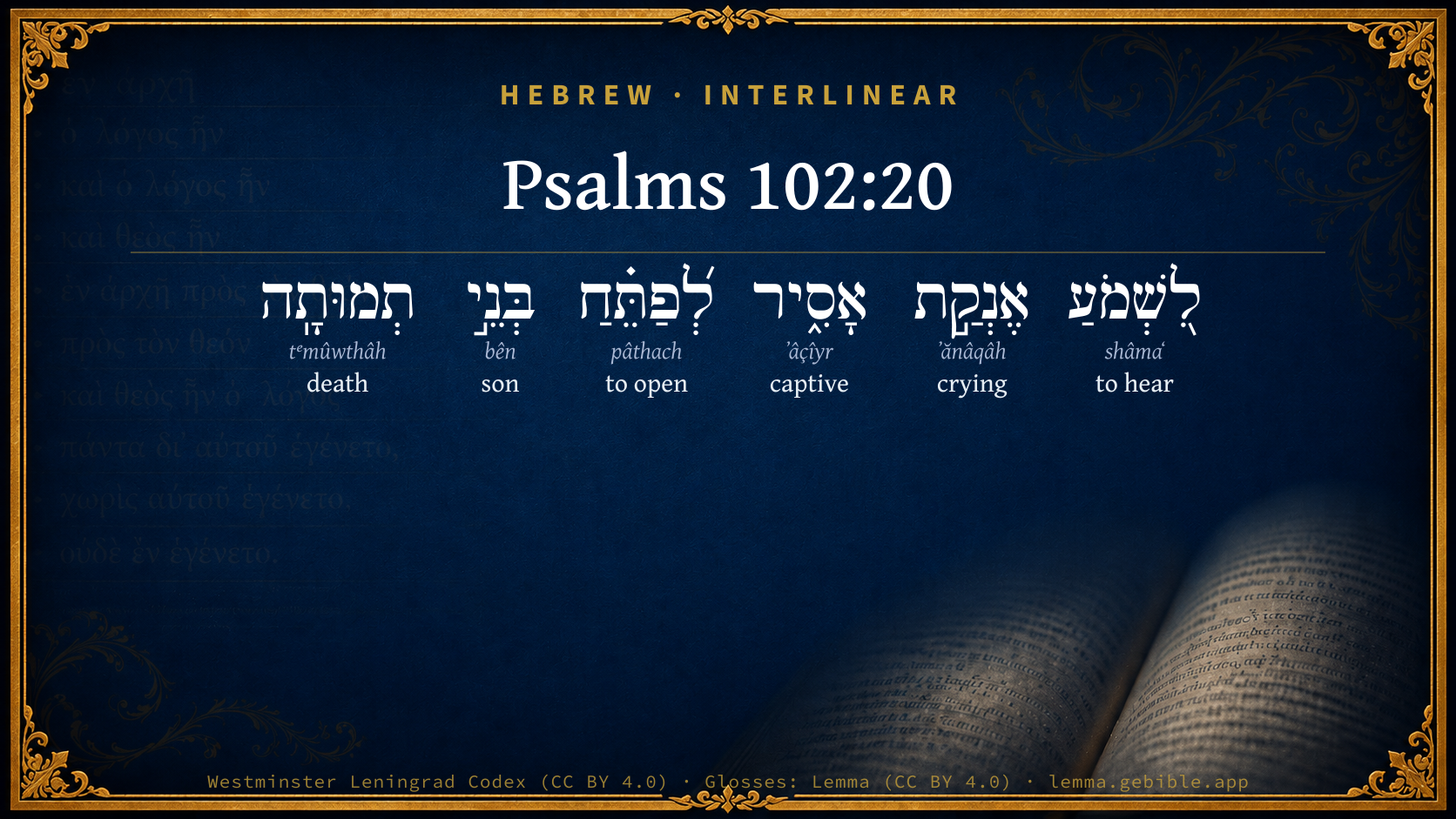
Psalms 102:20

Hebrew (Westminster Leningrad Codex) Psalms 102:20 appears in the Hebrew Old Testament. The text above is from the Westminster Leningrad Codex. Each word links to its Strong’s number, a concise gloss, and parsing drawn from the Open Scriptures Hebrew Bible morphology. Click any word for its full Brown-Driver-Briggs (BDB) entry.
Download image
Cite this verse

Psalms 102:20 (World English Bible). Public Domain. Lemma interlinear Bible study tool, https://lemma.gebible.app/v/psalms/102/20.

Show BibTeX & RIS
BibTeX
RIS
English Translation
To hear the groans of the prisoner; To free those who are condemned to death;
World English Bible · Public Domain
Download a study sheet

One document with this verse’s original text, its word-by-word gloss line, the meaning frame, cross-references with their text, attributed commentary, and full source and license credits — printable, and it pastes into notes with its structure intact.

This verse Autodidact and up

Study sheet (.html) Plain text (.txt)

A passage Seminary Student

Up to 50 verses in one chapter. A passage sheet keeps up to 6 commentary sources and 12 cross-references per verse, in the order this page ranks them, and says so on the sheet whenever that leaves anything out. Ask for a single verse and you get the Autodidact verse sheet above.

Everything on this page stays free to read, with no account — the sheet is a download of what is already on screen, not access to it.

Want to remove ads? Support Godless Engineer
Compare translations 3

The same verse in 3 English versions, stacked beneath the original-language interlinear above. Click any original word for its lexicon entry.

Each is an independent rendering of the whole verse — the interlinear is not word-aligned to these translations.

Highlighted words mark where these versions differ — a whole-verse word diff, not a word-by-word alignment.

  • World English Bible Public Domain
    To hear the groans of the prisoner; To free those who are condemned to death;
  • King James Version Public Domain
    To hear the groaning of the prisoner; to loose those that are appointed to death;
  • unfoldingWord Literal Text CC BY-SA 4.0
    to hear the groaning of the prisoner, to release the sons of execution.

unfoldingWord Literal Text — © unfoldingWord, licensed CC BY-SA 4.0. Word-aligned USFM3 via Door43 (git.door43.org/unfoldingWord/en_ult).

Versions to compare (up to 4)

3 of 4 selected

Show all 18 translations

Every available English version of this verse, each an independent rendering of the whole verse.

  • World English Bible Public Domain
    To hear the groans of the prisoner; To free those who are condemned to death;
  • Berean Standard Bible Public Domain
    to hear a prisoner’s groaning, to release those condemned to death,
  • Majority Standard Bible Public Domain
    to hear a prisoner’s groaning, to release those condemned to death,
  • King James Version Public Domain
    To hear the groaning of the prisoner; to loose those that are appointed to death;
  • American Standard Version (1901) Public Domain
    To hear the sighing of the prisoner; To loose those that are appointed to death;
  • Revised Version (1885) Public Domain
    To hear the sighing of the prisoner; to loose those that are appointed to death;
  • Geneva Bible (1599) Public Domain
    That he might heare the mourning of the prisoner, and deliuer the children of death:
  • Douay-Rheims (1899) Public Domain
    Because he hath looked forth from his high sanctuary: from heaven the Lord hath looked upon the earth.
  • Young's Literal Translation Public Domain
    To hear the groan of the prisoner, To loose sons of death,
  • Literal Standard Version CC BY-SA 4.0
    To hear the groan of the prisoner, || To loose sons of death,
  • Unlocked Literal Bible CC BY-SA 4.0
    to hear the groaning of the prisoners, to release those who were condemned to death.
  • unfoldingWord Literal Text CC BY-SA 4.0
    to hear the groaning of the prisoner, to release the sons of execution.
  • Darby Bible Public Domain
    To hear the groaning of the prisoner, to loose those that are appointed to die;
  • World Messianic Bible Public Domain
    to hear the groans of the prisoner, to free those who are condemned to death,
  • Webster's Bible Public Domain
    \\102:19\\For he hath looked down from the hight of his sanctuary; from heaven hath the LORD beheld the earth;
  • Free Bible Version CC BY-SA 4.0
    to respond to the groans of prisoners, to set free the children of death.
  • Bible in Basic English Public Domain
    Hearing the cry of the prisoner, making free those for whom death is ordered;
  • JPS Tanakh (1917) Public Domain
    (102-21) To hear the groaning of the prisoner; to loose those that are appointed to death;

Literal Standard Version (2020), Covenant Press — licensed CC BY-SA 4.0. Text via the HelloAO Bible API (eBible.org). Unlocked Literal Bible (unfoldingWord) — licensed CC BY-SA 4.0. Text via the HelloAO Bible API (eBible.org). unfoldingWord Literal Text — © unfoldingWord, licensed CC BY-SA 4.0. Word-aligned USFM3 via Door43 (git.door43.org/unfoldingWord/en_ult). Free Bible Version, Dr. Jonathan Gallagher — licensed CC BY-SA 4.0. Text via the HelloAO Bible API (eBible.org).

Word by word

More ways to search: Search by grammar → Find every occurrence → Compare this word →

Practice this passage: Drill this verse → Learn its vocabulary →

About this verse

These counts appear in no published source. They are computed here, from the morphology-tagged text and Lemma’s own curated glosses. What Lemma adds →

6
words
6
distinct lemmas
Wisdom
section

Notable vocabulary

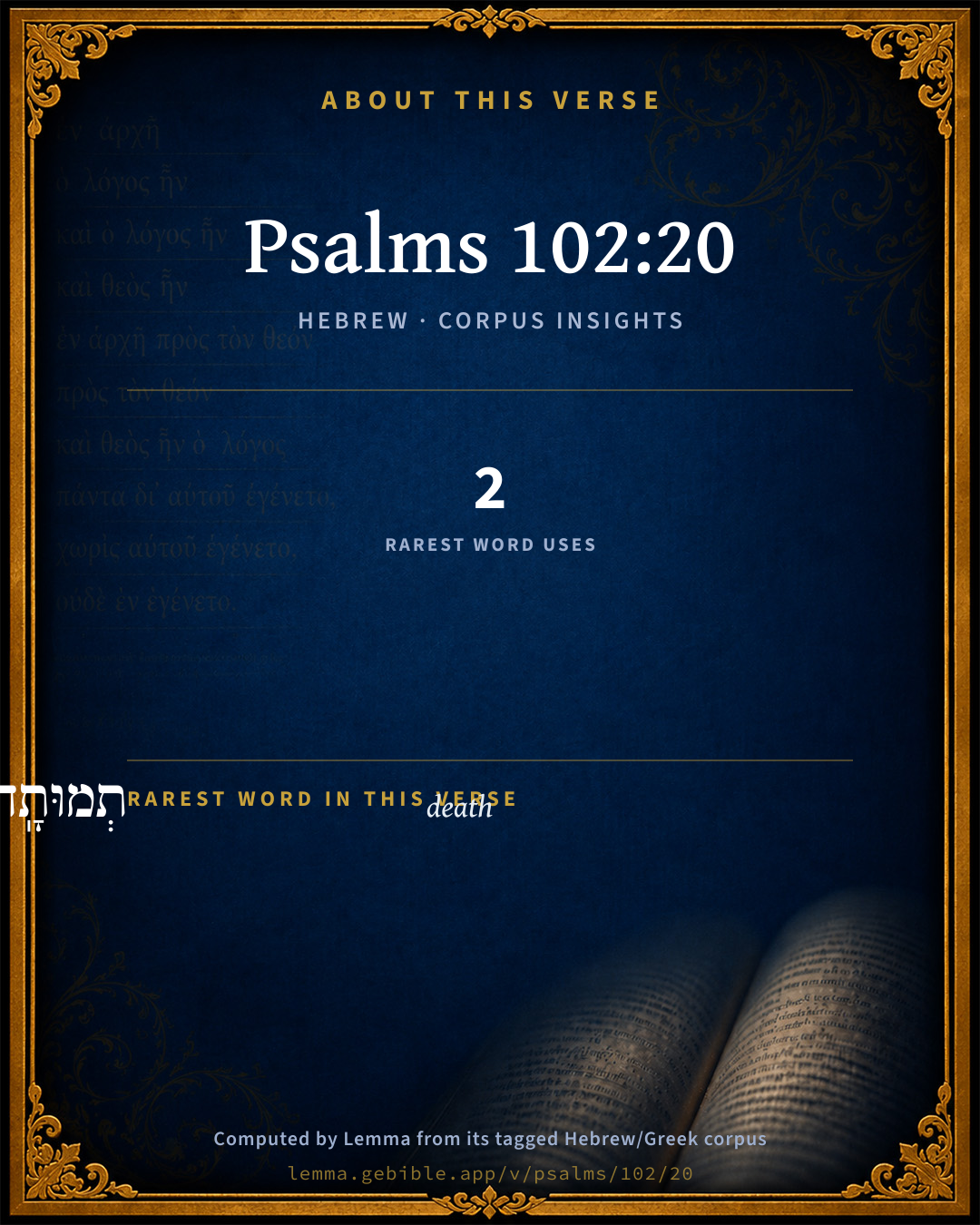
The rarest word here is תְמוּתָֽה death H8546 — appearing just 2 times in the whole Hebrew Bible.

Shared distinctive vocabulary

תְמוּתָֽה death H8546 occurs in 2 verses of the Hebrew Bible. Also found in:

Grammatical profile

  • 2 verbs
  • 4 nouns

Verb forms

  • לִ֭שְׁמֹעַ Qal · Infinitive Construct
  • לְ֝פַתֵּ֗חַ Piel · Infinitive Construct

Hebrew & Septuagint length

In English translation the verse runs 15 words from the Hebrew and 15 from the Septuagint (LXX English) — the same length.

A rough comparison of the two English renderings, which tokenize alike — not a word-level alignment.

Word counts can differ between the Hebrew and the Greek without any difference in meaning — e.g. the Hebrew direct-object marker אֵת has no separate Greek word, and Greek often adds the article ὁ.

Cross-references

14

Topical passages linked to Psalms 102:20 in the Treasury of Scripture Knowledge — connected by theme and wording, ordered by reader-vote popularity; previews shown in the World English Bible.

  • Psalms 79:11 Let the sighing of the prisoner come before you. According to the greatness of your power, preserve those who are sentenced to death;
  • Psalms 146:7 Who executes justice for the oppressed; Who gives food to the hungry. Yahweh frees the prisoners.
  • Exodus 3:7 Yahweh said, "I have surely seen the affliction of my people who are in Egypt, and have heard their cry because of their taskmasters, for I know their sorrows.
  • Isaiah 61:1–3 The Spirit of the Lord Yahweh is on me; because Yahweh has anointed me to preach good news to the humble; he has sent me to bind up the broken-hearted, to proclaim liberty to the captives, and the opening [of the prison] to those who are bound;
  • 2 Kings 13:22–23 Hazael king of Syria oppressed Israel all the days of Jehoahaz.
  • 2 Chronicles 33:11–13 Therefore Yahweh brought on them the captains of the host of the king of Assyria, who took Manasseh in chains, and bound him with fetters, and carried him to Babylon.
  • Isaiah 14:17 who made the world as a wilderness, and overthrew the cities of it; who didn't let loose his prisoners to their home?"
  • Zechariah 9:9–12 Rejoice greatly, daughter of Zion! Shout, daughter of Jerusalem! Behold, your king comes to you! He is righteous, and having salvation; Lowly, and riding on a donkey, Even on a colt, the foal of a donkey.
  • Ephesians 2:2–3 in which you once walked according to the course of this world, according to the prince of the powers of the air, the spirit who now works in the children of disobedience;
  • Exodus 2:23–25 It happened in the course of those many days, that the king of Egypt died, and the children of Israel sighed because of the bondage, and they cried, and their cry came up to God because of the bondage.
  • 2 Kings 13:4 Jehoahaz begged Yahweh, and Yahweh listened to him; for he saw the oppression of Israel, how that the king of Syria oppressed them.
  • Acts 12:6–11 The same night when Herod was about to bring him out, Peter was sleeping between two soldiers, bound with two chains. Guards in front of the door kept the prison.
  • Jeremiah 51:32–35 and the passages are seized, and the reeds they have burned with fire, and the men of war are frightened.
  • Job 24:12 From out of the populous city, men groan. The soul of the wounded cries out, Yet God doesn't regard the folly.

Cross-references courtesy of OpenBible.info (CC BY 4.0).

Hebrew and Greek witnesses Masoretic Hebrew ↔ Greek Septuagint

The same verse in the two great witnesses to the Old Testament, shown verse-for-verse.

You’re reading Greek Psalm 101 (Hebrew Psalm 102). The Septuagint counts the superscription, so verse numbers can differ from the Hebrew — chapter-level alignment, not verse-by-verse. Numbering follows Rahlfs.

These are two independent witnesses, not word-aligned to each other, and the Septuagint is shown in lemma (dictionary) form.

Hebrew Psalms 102:20 Masoretic · Westminster Leningrad Codex

לִ֭שְׁמֹעַ אֶנְקַ֣ת אָסִ֑יר לְ֝פַתֵּ֗חַ בְּנֵ֣י תְמוּתָֽה

To hear the groans of the prisoner; To free those who are condemned to death;

World English Bible · Public Domain

Greek LXX Greek Psalm 101:20 Septuagint · lemma form

ὅτι ἐκκύπτω ἐκ ὕψος ἅγιος αὐτός κύριος ἐκ οὐρανός ἐπί ὁ γῆ ἐπιβλέπω

to hear the groaning of the fettered ones, to loosen the sons of the slain;

LXX2012 (modern English Septuagint) · Public Domain

On this verse, Ellicott's Commentary for English Readers discusses the Septuagint’s reading. Read the note in Commentary ↓

Hebrew: Westminster Leningrad Codex (CC BY 4.0). Greek: Septuagint (public domain); English from LXX2012 (modern English Septuagint) (Public Domain). How the Septuagint differs from the Hebrew →

Commentary

Notes on Psalms 102:20 from classic Christian and Jewish commentators (each source and its license shown beneath its notes). The classic Christian expositions comment on the surrounding passage and are grouped to its opening verse, so a note may address several verses; the Jewish commentaries on the Tanakh (Rashi and others) are per-verse, so they appear only where the commentator wrote on this verse.

Lemma curates 59 commentaries, every one of them public domain or Creative Commons licensed, each selected and text-cleaned for this edition rather than reprinted as found. About our sources →

Trapp's Complete Commentary

John Trapp

Psa 102:20 To hear the groaning of the prisoner; to loose those that are appointed to death;

Ver. 20. To hear the groaning of the prisoner] Those prisoners of hope held so long captive in Babylon, the cruelty whereof is graphically described, Jer 51:34.

John Trapp, A Commentary or Exposition upon All the Books of the Old and New Testament (1647–1656) — public domain. Text from a community e-Sword module.

J. A. Alexander on Psalms

Joseph Addison Alexander

21. (Psa 102:20) To hear the groaning of the prisoner, to loose the sons of mortality. The construction is continued from the foregoing verse, and the design of God's thus looking down is stated. The word translated groaning is almost peculiar to the Psalms of David, and according to its etymology properly denotes suffocation. To loose, literally to open, sometimes applied to the opening of a dress for the purpose of removing it, as in Psa 30:11; then to the loosening of chains, as in Psa 116:16; then to the deliverance of the prisoner himself. Sons of mortality or death, i.e., those doomed to die. See above, on Psa 79:11.

Joseph Addison Alexander, The Psalms Translated and Explained (1850) — public domain. Text from a community e-Sword module.

Geneva Bible (1599)

Geneva Bible translators

Who now in their banishment could look for nothing but death.

Geneva Bible (1599) marginal notes — public domain. Text via Bolls.life.

Adam Clarke's Commentary

Verse 20. To hear the groaning] By sin, all the inhabitants of the earth are miserable. They have broken the Divine laws, are under the arrest of judgment, and all cast into prison. They have been tried, found guilty, and appointed to die; they groan under their chains, are alarmed at the prospect of death, and implore mercy.

Adam Clarke's Commentary on the Bible (1810–1826) — public domain. Text from a community e-Sword/MySword module.

John Calvin's Commentaries

20. To hear the groaning of the prisoner Here the prophet repeats once more what he had previously touched upon concerning prayer, in order again to stir up the hearts of the godly to engage in that exercise, and that after their deliverance they might know it to have been granted to their faith, because, depending on the divine promises, they had sent up their groanings to heaven. He calls them prisoners; for although they were not bound in fetters, their captivity resembled a most rigorous imprisonment. Yea, he affirms a little after that they were devoted to death, to give them to understand that their life and safety would have been altogether hopeless, had they not been delivered from death by the extraordinary power of God.

John Calvin's Commentaries (1540-1563) — public domain. Text from the Calvin Translation Society English edition (1840s-50s) via the Christian Classics Ethereal Library (ccel.org). Calvin's coverage is partial (roughly two-thirds of the Bible); uncommented books and verses are honest gaps, never fabricated. The 19th-century editor's footnotes and remarks are omitted so the notes are faithfully Calvin's own voice.

Ellicott's Commentary for English Readers

(20, 21) Comp. Isa_61:1-2, and generally the whole magnificent cycle of prophetic songs at the close of Isaiah.

Appointed to death.—See margin. LXX. and Vulg., “the sons of the slain.”

A Bible Commentary for English Readers, edited by Charles John Ellicott (1878–1897) — public domain. Text from a community e-Sword module.

The Cambridge Bible for Schools and Colleges

gen. ed. J. J. S. Perowne

20. An echo of the prayer in Psa_79:11. Cp. Isa_42:7; Isa_61:1. Israel in exile is compared to a condemned captive languishing in prison, and doomed to perish if Jehovah does not speedily interpose.

the groaning of the prisoner] R.V. the sighing of the prisoner, as in Psa_79:11.

those that are appointed to death] Lit. the sons of death. Cp. 1Sa_20:31 (marg.). The word for death is a form found only here and in Psa_79:11.

The Cambridge Bible for Schools and Colleges (gen. ed. J. J. S. Perowne; Cambridge University Press, 1878–1918) — public domain. Text from a community e-Sword module.

John Gill's Exposition

To declare the name of the Lord in Zion,.... That is, that the prisoners and persons appointed to death, being loosed, might declare, in the church, what great things the Lord has done for them; and so speak well of his wisdom, power, grace, and goodness, in their deliverance; profess his name, and confess him before men, and express a value for his name, and show forth the honour of it, and seek his glory:

and his praise in Jerusalem; the Gospel church state, the same with Zion; when it shall be the praise of the whole earth; then and there will those, that are delivered from the antichristian yoke, praise the Lord, sing the song of Moses and the Lamb, and glorify God for all that he has done for them.

John Gill's Exposition of the Whole Bible (1746–1763) — public domain (CC PDM 1.0). Text via the HelloAO Bible API.

Albert Barnes' Notes on the Bible

To hear the groaning of the prisoner - Meaning here, probably, the captives in Babylon; those who were held as prisoners there, and who were subjected to such hardships in their long captivity. See the notes at Psa 79:11.

To loose those that are appointed to death - Margin, as in Hebrew, “the children of death.” Compare the notes at Mat 1:1. This may mean either those who were sentenced to death; those who were sick and ready to die; or those who, in their captivity, were in such a state of privation and suffering that death appeared inevitable. The word rendered “loose” means, properly, to “open,” applied to the mouth, for eating, Eze 3:2; or in song, Psa 78:2; or for speaking, Job 3:1; - or the ear, Isa 50:5; or the hand, Deu 15:8; or the gates of a city, a door, etc., Deu 20:11. Them it means to set free, as by opening the doors of a prison, Isa 14:17; Job 12:14. Here it means to “set free,” to deliver. Compare Isa 61:1.

Albert Barnes' Notes on the Bible (1834–1885) — public domain. Text from a community e-Sword/MySword module.

Matthew Poole's English Annotations

To release his poor captives out of Babylon, and, which is more, from the chains and fetters of sin and Satan, and from eternal destruction.

Matthew Poole's English Annotations on the Holy Bible (1683–1685) — public domain. Text from a community e-Sword/MySword module.

The Treasury of David

Charles H. Spurgeon

Ver. 20. Appointed unto death. Who, in their captivity, are experiencing so much affliction, that it is manifest their cruel enemies are desirous of destroying them utterly; or, at least, of bringing them into such a low and pitiable state, as to blot out their name from among the nations of the earth. William Keatinge Clay.

Psalms 102:21*

Charles H. Spurgeon's The Treasury of David (1869–1885) — public domain. Psalms only. Text from a community e-Sword/MySword module.

Whedon's Commentary on the Bible

Daniel D. Whedon

20. To loose those that are appointed to death—Hebrew, the sons of death. They were rescued from under the “death” sentence. Same as Psa_79:11. So imminent was the danger and opportune the help!

Daniel D. Whedon (gen. ed.), Commentary on the Old and New Testaments (1874–1909) — public domain. Text from a community e-Sword module.

The Pulpit Commentary

To hear the groaning of the prisoner. (see Exo_2:24, "God heard their groaning;" and comp. Exo_3:7 Exo_6:5) To loose those that are appointed to death; literally, the sons of death. (comp. Psa_79:11) Captive Israel regarded its life in Babylon as little better than death. (see Eze_37:11)

The Pulpit Commentary (1880–1919), ed. H.D.M. Spence-Jones & Joseph S. Exell — public domain. Text from a community e-Sword module.

John Wesley's Explanatory Notes

To loose - To release his poor captives out of Babylon, and from the chains of sin and eternal destruction.

John Wesley, Explanatory Notes Upon the Whole Bible (1754–1765) — public domain. Text via the GEBible commentary corpus.

Rashi

Rabbi Shlomo Yitzchaki (Rashi)

looked...to earth to see the affliction of His people.

Rashi on the Tanakh — English translations: “The Judaica Press complete Tanach with Rashi, translated by A. J. Rosenberg” (CC BY 4.0); “Pentateuch with Rashi's commentary by M. Rosenbaum and A.M. Silbermann, 1929-1934” (public domain); “The Metsudah Tanach series, Lakewood, N.J” (CC BY 4.0); and “The Book of Joshua, Metsudah Publications, 1997” (CC BY 4.0). Text via Sefaria.

Lesson kit

Teaching starters — assembled from the data on this page, not authored interpretation. Every prompt links to the verse data it draws on. Edit before teaching.

Psalms, in the Wisdom, opens this verse with 6 words (6 distinct Hebrew lemmas). Its most distinctive word is tᵉmûwthâh (“death”). A historical commentator’s framing appears above. Read the whole chapter for the surrounding context.

Discussion questions

  1. How does “death” (tᵉmûwthâh) shape what this verse is saying?
  2. How does Psalms 79:11, which shares the word «death», read alongside this verse?
  3. These translations render this verse differently; the difference is in the English rendering, not the original. What questions does that raise?
  4. «לִ֭שְׁמֹעַ» is a Qal Infinitive Construct verb. How does that grammatical form shape the action described?
  5. Compare how Trapp's Complete Commentary and J. A. Alexander on Psalms read this verse. Where do they agree or differ?

Things to notice

Reading settings

Reading text

Shown beneath each verse's original-language words.

Old Testament
Old Testament edition

Read the OT as the Masoretic Hebrew (MT) or the Greek Septuagint (LXX).

English shown for the Greek Septuagint (in the Hebrew ↔ Greek comparison).

Comparing translations? Open the Compare panel on any verse page to stack up to four side by side.