
Psalms 78:29

Hebrew (Westminster Leningrad Codex) Psalms 78:29 appears in the Hebrew Old Testament. The text above is from the Westminster Leningrad Codex. Each word links to its Strong’s number, a concise gloss, and parsing drawn from the Open Scriptures Hebrew Bible morphology. Click any word for its full Brown-Driver-Briggs (BDB) entry.
Download image
Cite this verse

Psalms 78:29 (World English Bible). Public Domain. Lemma interlinear Bible study tool, https://lemma.gebible.app/v/psalms/78/29.

Show BibTeX & RIS
BibTeX
RIS
English Translation
So they ate, and were well filled. He gave them their own desire.
World English Bible · Public Domain
Download a study sheet

One document with this verse’s original text, its word-by-word gloss line, the meaning frame, cross-references with their text, attributed commentary, and full source and license credits — printable, and it pastes into notes with its structure intact.

This verse Autodidact and up

Study sheet (.html) Plain text (.txt)

A passage Seminary Student

Up to 50 verses in one chapter. A passage sheet keeps up to 6 commentary sources and 12 cross-references per verse, in the order this page ranks them, and says so on the sheet whenever that leaves anything out. Ask for a single verse and you get the Autodidact verse sheet above.

Everything on this page stays free to read, with no account — the sheet is a download of what is already on screen, not access to it.

Want to remove ads? Support Godless Engineer
Compare translations 3

The same verse in 3 English versions, stacked beneath the original-language interlinear above. Click any original word for its lexicon entry.

Each is an independent rendering of the whole verse — the interlinear is not word-aligned to these translations.

Highlighted words mark where these versions differ — a whole-verse word diff, not a word-by-word alignment.

  • World English Bible Public Domain
    So they ate, and were well filled. He gave them their own desire.
  • King James Version Public Domain
    So they did eat, and were well filled: for he gave them their own desire;
  • unfoldingWord Literal Text CC BY-SA 4.0
    And they ate and were very satisfied. And he brought their craving to them.

unfoldingWord Literal Text — © unfoldingWord, licensed CC BY-SA 4.0. Word-aligned USFM3 via Door43 (git.door43.org/unfoldingWord/en_ult).

Versions to compare (up to 4)

3 of 4 selected

Show all 18 translations

Every available English version of this verse, each an independent rendering of the whole verse.

  • World English Bible Public Domain
    So they ate, and were well filled. He gave them their own desire.
  • Berean Standard Bible Public Domain
    So they ate and were well filled, for He gave them what they craved.
  • Majority Standard Bible Public Domain
    So they ate and were well filled, for He gave them what they craved.
  • King James Version Public Domain
    So they did eat, and were well filled: for he gave them their own desire;
  • American Standard Version (1901) Public Domain
    So they did eat, and were well filled; And he gave them their own desire.
  • Revised Version (1885) Public Domain
    So they did eat, and were well filled; and he gave them that they lusted after.
  • Geneva Bible (1599) Public Domain
    So they did eate and were well filled: for he gaue them their desire.
  • Douay-Rheims (1899) Public Domain
    So they did eat, and were filled exceedingly, and he gave them their desire:
  • Young's Literal Translation Public Domain
    And they eat, and are greatly satisfied, And their desire He bringeth to them.
  • Literal Standard Version CC BY-SA 4.0
    And they eat, and are greatly satisfied, || And He brings their desire to them.
  • Unlocked Literal Bible CC BY-SA 4.0
    So they ate and were full. He gave them what they craved.
  • unfoldingWord Literal Text CC BY-SA 4.0
    And they ate and were very satisfied. And he brought their craving to them.
  • Darby Bible Public Domain
    And they did eat, and were well filled; for that they lusted after, he brought to them.
  • World Messianic Bible Public Domain
    So they ate, and were well filled. He gave them their own desire.
  • Webster's Bible Public Domain
    So they ate, and were well filled: for he gave them their own desire;
  • Free Bible Version CC BY-SA 4.0
    They ate until they were full. He gave them the food they longed for.
  • Bible in Basic English Public Domain
    So they had food and were full; for he gave them their desire;
  • JPS Tanakh (1917) Public Domain
    So they did eat, and were well filled; and He gave them that which they craved.

Literal Standard Version (2020), Covenant Press — licensed CC BY-SA 4.0. Text via the HelloAO Bible API (eBible.org). Unlocked Literal Bible (unfoldingWord) — licensed CC BY-SA 4.0. Text via the HelloAO Bible API (eBible.org). unfoldingWord Literal Text — © unfoldingWord, licensed CC BY-SA 4.0. Word-aligned USFM3 via Door43 (git.door43.org/unfoldingWord/en_ult). Free Bible Version, Dr. Jonathan Gallagher — licensed CC BY-SA 4.0. Text via the HelloAO Bible API (eBible.org).

Word by word

More ways to search: Search by grammar → Find every occurrence → Compare this word →

Practice this passage: Drill this verse → Learn its vocabulary →

וְ֝תַֽאֲוָתָ֗ם
taʼăvâh
H8378
“and · desire · their”
Conjunction + Noun, Common, Feminine, Singular, Construct + Suffix, Personal, 3rd Person, Masculine, Plural
Part of Speech
Conjunction + Noun
Type
Common
Gender
Feminine
Number
Singular
State
Construct
Full BDB Definition

Origin: from H183 (abbrev)

TWOT: 40d

desire - desire, wish, longings of one's heart - lust, appetite, covetousness (bad sense) - thing desired, object of desire
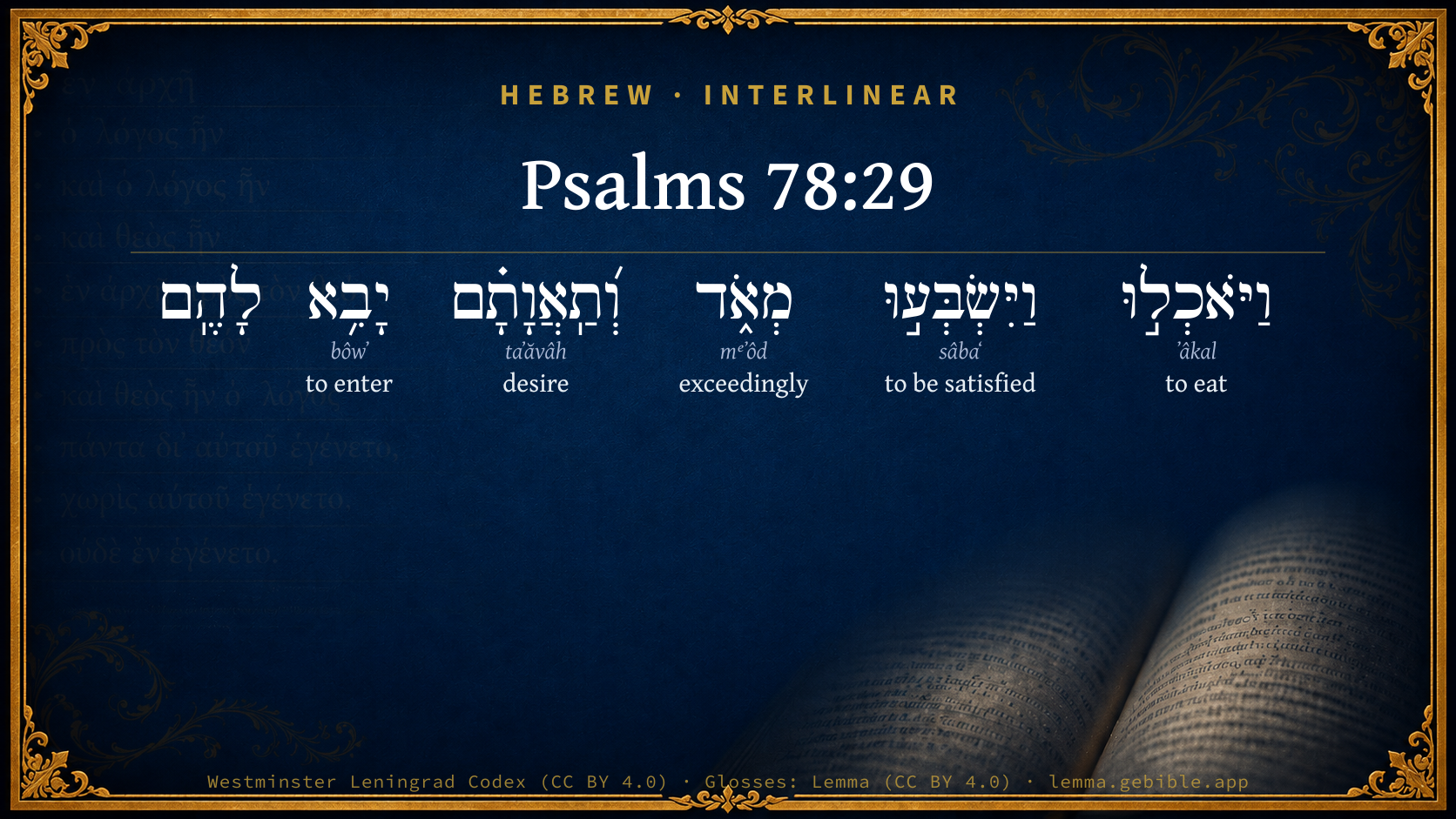
  1. וַיֹּאכְל֣וּ ʼâkal H398 “and · to eat” Conjunction + Verb, Qal, Sequential Imperfect, 3rd Person, Masculine, Plural
  2. וַיִּשְׂבְּע֣וּ sâbaʻ H7646 “and · to be satisfied” Conjunction + Verb, Qal, Sequential Imperfect, 3rd Person, Masculine, Plural
  3. מְאֹ֑ד mᵉʼôd H3966 “exceedingly” Adverb
  4. יָבִ֥א bôwʼ H935 “to enter” Verb, Hiphil, Imperfect, 3rd Person, Masculine, Singular

About this verse

These counts appear in no published source. They are computed here, from the morphology-tagged text and Lemma’s own curated glosses. What Lemma adds →

6
words
5
distinct lemmas
Wisdom
section

Notable vocabulary

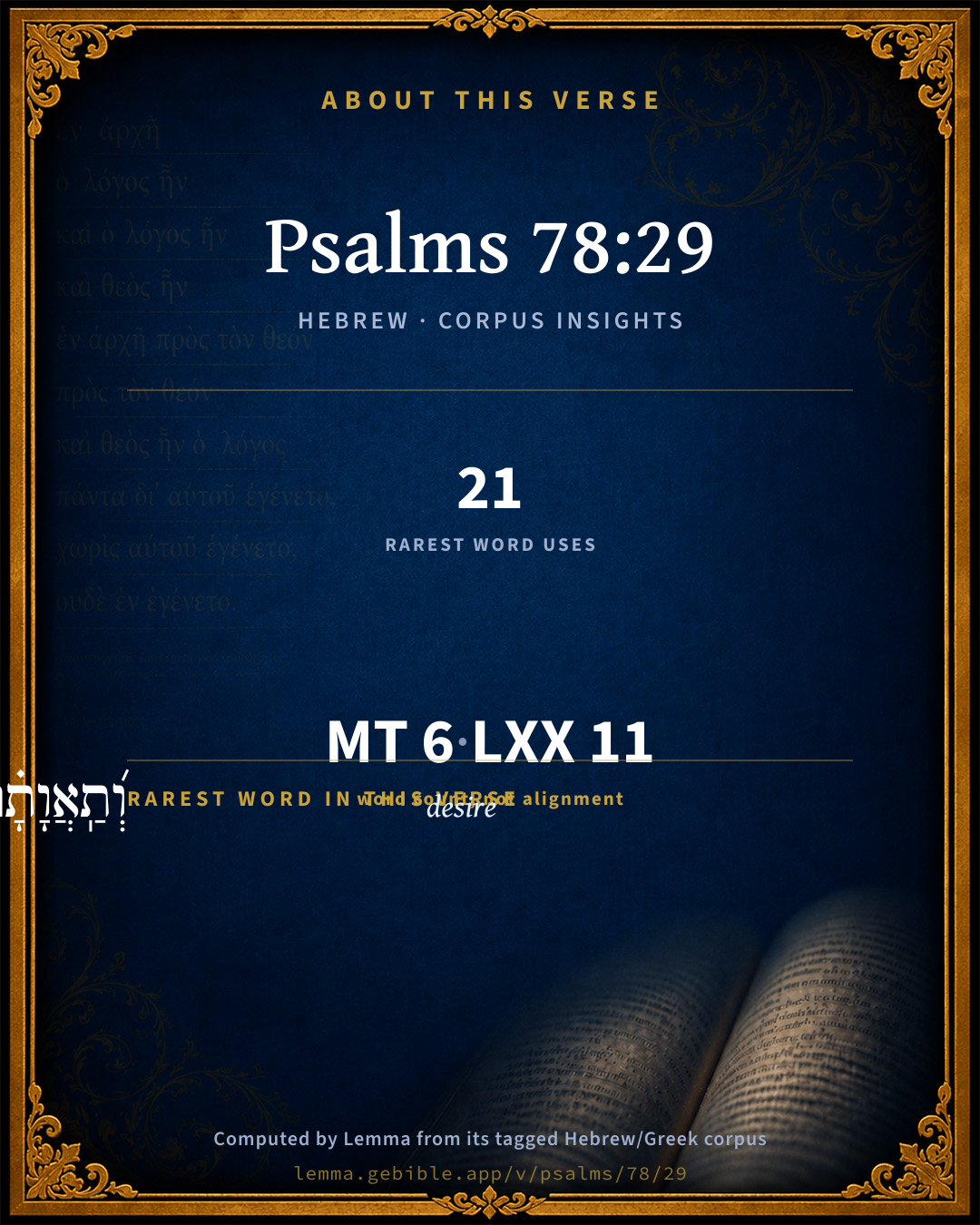
The rarest word here is וְ֝תַֽאֲוָתָ֗ם desire H8378 — appearing just 21 times in the whole Hebrew Bible.

Shared distinctive vocabulary

וְ֝תַֽאֲוָתָ֗ם desire H8378 occurs in 21 verses of the Hebrew Bible. Also found in:

Grammatical profile

  • 3 verbs
  • 1 noun
  • 1 preposition
  • 1 adverb

Verb forms

  • וַיֹּאכְל֣וּ Qal · Sequential Imperfect
  • וַיִּשְׂבְּע֣וּ Qal · Sequential Imperfect
  • יָבִ֥א Hiphil · Imperfect

Hebrew & Septuagint length

In English translation the verse runs 13 words from the Hebrew and 13 from the Septuagint (LXX English) — the same length.

A rough comparison of the two English renderings, which tokenize alike — not a word-level alignment.

Word counts can differ between the Hebrew and the Greek without any difference in meaning — e.g. the Hebrew direct-object marker אֵת has no separate Greek word, and Greek often adds the article ὁ.

In the original languages it is 6 Hebrew tokens and 11 Greek tokens — but the two are counted differently (Hebrew bundles its prefixes and suffixes into one token; the Greek is in lemma form), so that isn’t a like-for-like length.

Cross-references

2

Topical passages linked to Psalms 78:29 in the Treasury of Scripture Knowledge — connected by theme and wording, ordered by reader-vote popularity; previews shown in the World English Bible.

  • Numbers 11:19–20 You shall not eat one day, nor two days, nor five days, neither ten days, nor twenty days,
  • Psalms 106:15 He gave them their request, But sent leanness into their soul.

Cross-references courtesy of OpenBible.info (CC BY 4.0).

Hebrew and Greek witnesses Masoretic Hebrew ↔ Greek Septuagint

The same verse in the two great witnesses to the Old Testament, shown verse-for-verse.

You’re reading Greek Psalm 77 (Hebrew Psalm 78). The Septuagint counts the superscription, so verse numbers can differ from the Hebrew — chapter-level alignment, not verse-by-verse. Numbering follows Rahlfs.

These are two independent witnesses, not word-aligned to each other, and the Septuagint is shown in lemma (dictionary) form.

Hebrew Psalms 78:29 Masoretic · Westminster Leningrad Codex

וַיֹּאכְל֣וּ וַיִּשְׂבְּע֣וּ מְאֹ֑ד וְ֝תַֽאֲוָתָ֗ם יָבִ֥א לָהֶֽם

So they ate, and were well filled. He gave them their own desire.

World English Bible · Public Domain

Greek LXX Greek Psalm 77:29 Septuagint · lemma form

καί ἐσθίω καί ἐνπίμπλημι σφόδρα καί ὁ ἐπιθυμία αὐτός φέρω αὐτός

So they ate, and were completely filled; and he gave them their desire.

LXX2012 (modern English Septuagint) · Public Domain

Hebrew: Westminster Leningrad Codex (CC BY 4.0). Greek: Septuagint (public domain); English from LXX2012 (modern English Septuagint) (Public Domain). How the Septuagint differs from the Hebrew →

Commentary

Notes on Psalms 78:29 from classic Christian and Jewish commentators (each source and its license shown beneath its notes). The classic Christian expositions comment on the surrounding passage and are grouped to its opening verse, so a note may address several verses; the Jewish commentaries on the Tanakh (Rashi and others) are per-verse, so they appear only where the commentator wrote on this verse.

Lemma curates 59 commentaries, every one of them public domain or Creative Commons licensed, each selected and text-cleaned for this edition rather than reprinted as found. About our sources →

Trapp's Complete Commentary

John Trapp

Psa 78:29 So they did eat, and were well filled: for he gave them their own desire;

Ver. 29. So they did eat, and were well filled] But better they had fasted. Many eat that on earth which they must digest in hell; these here were murdering morsels.

He gave them their own desire] They were heard, ad voluntatem, non ad utilitatem. Deus saepe dat iratus quod negat propitius. God’s gifts to a graceless man are giftless gifts; and he had better a great deal be without them.

John Trapp, A Commentary or Exposition upon All the Books of the Old and New Testament (1647–1656) — public domain. Text from a community e-Sword module.

The Treasury of David

Charles H. Spurgeon

Ver. 29. So they did eat, and were well filled. They greedily devoured the birds, even to repletion. The Lord shewed them that he could "provide flesh for his people, "even enough and to spare. He also shewed them that when lust wins its desire it is disappointed, and by the way of satiety arrive at distaste. First the food satiates, then it nauseates.

For he gave them their own desire. They were filled with their own ways. The flesh meat was unhealthy for them, but as they cried for it they had it, and a curse with it. O my God, deny me my most urgent prayers sooner than answer them in displeasure. Better hunger and thirst after righteousness than to be well filled with sin's dainties.

Ver. 29. Note: The prophet in this Psalm institutes, as it were, a conflict between God and man. God contends with blessings, man with sins. God exerts his power for the benefit of undeserving man, Ps 78:12, Marvellous things did he in the sight of their fathers: man repays the divine power with infidelity, Ps 78:17, And they sinned yet more against him. And farther on, in Ps 78:19, Can God furnish a table in the wilderness? Secondly, God showers down his bounty to overwhelm ungrateful sinners with his gifts, Ps 78:23, He commanded the clouds from above, &c., and rained down manna upon them. These less than men (homunciones) oppose their gluttony to the liberality of God, and abuse the gifts conferred, Ps 78:29, They did eat, and were well filled. Thirdly, divine justice renews the conflict to scourge at once stupidity out of them, Ps 78:30-31, While their meat was yet in their mouths, the wrath of God came upon them. Still obdurate they kick against the goad, Ps 78:33, For all this they sinned still. Fourthly, mercy flies down from heaven, to invite them to peace, Ps 78:38, But he being full of compassion. Men are but emboldened by his compassion, and the more easily relapse into sin, Ps 78:40, How oft did they provoke him in the wilderness? Fifthly, and lastly, when all seems lost, love draws nigh, and performs unheard of wonders, to touch their hardness, and to deliver them from the dangers by which they were pressed, Ps 78:43, How he set his signs in Egypt. To these shafts of his love sinners oppose a forgetfulness of all his benefits, Ps 78:42, They remembered not his hand nor the day when he delivered them from the enemy. And all this took place before they entered the land of promise. The conflict that happened between the Hebrews and God in the land of promise is related in the next section of the Psalm. Thomas Le Blanc.

Ver. 29-31. Dangerous prayers. When lust dictates, wrath may answer. Let grace dictate, and mercy will answer. C. D.

Psalms 78:30*

Ver. 29-31. Dangerous prayers. When lust dictates, wrath may answer. Let grace dictate, and mercy will answer. C. D.

Ver. 29-31. Dangerous prayers. When lust dictates, wrath may answer. Let grace dictate, and mercy will answer. C. D.

Psalms 78:31*

Ver. 29-31. Dangerous prayers. When lust dictates, wrath may answer. Let grace dictate, and mercy will answer. C. D.

Ver. 29-31. Dangerous prayers. When lust dictates, wrath may answer. Let grace dictate, and mercy will answer. C. D.

Psalms 78:32*

Charles H. Spurgeon's The Treasury of David (1869–1885) — public domain. Psalms only. Text from a community e-Sword/MySword module.

J. A. Alexander on Psalms

Joseph Addison Alexander

29. (Psa 78:29) And they ate and were sated exceedingly, and (thus) their desire he brings to them. The first clause is an amplification of the phrase to the full in Psa 78:25 above. Compare the history in Num. xi. 18-20. Their desire, i.e. the object of it, that which they had longed for.

Joseph Addison Alexander, The Psalms Translated and Explained (1850) — public domain. Text from a community e-Sword module.

Ellicott's Commentary for English Readers

(29) Desire.—See Num_11:34, margin.

A Bible Commentary for English Readers, edited by Charles John Ellicott (1878–1897) — public domain. Text from a community e-Sword module.

The Cambridge Bible for Schools and Colleges

gen. ed. J. J. S. Perowne

29. for he gave them &c.] For he brought them that for which they lusted. Cp. Psa_106:14; Num_11:4; Num_11:34.

The Cambridge Bible for Schools and Colleges (gen. ed. J. J. S. Perowne; Cambridge University Press, 1878–1918) — public domain. Text from a community e-Sword module.

John Gill's Exposition

They were not estranged from their lust,.... By the goodness and liberality of God unto them, they were not brought to repentance for their sin of lusting; nor did they abstain from their fleshly lusts, or deny themselves of them, which the grace of God teaches to do; or else the sense is, what they lusted after, flesh, was not withheld from them, or they restrained from eating it; they were indulged with it for a whole month together; to which agrees what follows:

but while their meat was yet in their mouths; the meat of the quails, while it was between their teeth, ere it was chewed, and before it was swallowed down, while they were rolling this sweet morsel under their tongues, and were gorging themselves with it, destruction came upon them, as follows; just as Belshazzar, while he was feasting with his nobles, in the midst of his mirth and jollity, was slain by the Persians, Dan 5:1.

John Gill's Exposition of the Whole Bible (1746–1763) — public domain (CC PDM 1.0). Text via the HelloAO Bible API.

Albert Barnes' Notes on the Bible

So they did eat, and were well filled - The word rendered “well” here is intensive. It means that they were abundantly satisfied; that there was no lack; that they had the most ample supply.

For he gave them their own desire - He gave them exactly what they asked. He gave them flesh to eat as they had demanded; and he gave it to them in such quantities that no one could say that he had not enough.

Albert Barnes' Notes on the Bible (1834–1885) — public domain. Text from a community e-Sword/MySword module.

Matthew Poole's English Annotations

What they desired both for quality and quantity.

Matthew Poole's English Annotations on the Holy Bible (1683–1685) — public domain. Text from a community e-Sword/MySword module.

Whedon's Commentary on the Bible

Daniel D. Whedon

29. Were well filled—Hebrews, were satiated greatly. The language indicates excess, gluttony, and it lasted an entire mouth. The place was called Kibroth-hattaavah—the graves of greediness.

Daniel D. Whedon (gen. ed.), Commentary on the Old and New Testaments (1874–1909) — public domain. Text from a community e-Sword module.

The Pulpit Commentary

So they did eat, and were well filled; i.e. sated. (comp. Num_11:19, Num_11:20) For he gave them their own desire; or, their own lust that they lusted after (Revised Version).

The heart"s desire gratified.

"He gave them their own desire." Three days" march from Sinai, at the first halting place, where the tabernacle was first pitched after quitting the plain at the foot of that holy mountain, the wandering Arabs of the desert might gaze on the saddest, most shameful waymarks of Israel"s pilgrimage towards the Land of Promise. A row of dreary mounds marked where thousands of plague-stricken corpses had been hastily buried by the terrified survivors. As the silver trumpets again sounded, and the mourning host, with thinned ranks, marched away from the ghastly spot, they named it "Kibroth-hattaavah of lust." Many centuries afterwards the Holy Spirit in this psalm wrote this epitaph.

I THE HISTORY is told in Nu 11, with that terseness and graphic power which belong to Bible narratives. The grand characteristic of those narratives, however, is not their style (though it may well be called miraculous), but this they let us see behind the scenes; they withdraw the veil and show us God"s guiding and controlling hand in miracle, when miracles are needed, not otherwise; but no less in the ordinary course of nature and human affairs. Thus we are taught that when we cannot see behind the scenes, within the veil, the same hand is always there. This terrible episode in Israel"s history is one of the most signal illustrations of that profound mystery the thwarting of God"s gracious designs by man"s sin and unbelief. "Design not that absolute purpose which must stand, let who will gainsay, but, as in nature and providence, so in the spiritual realm, the lines along which God works; the manifest fitness of things; the blessed and useful results which would certainly come about if men were trustfully obedient. In this sense, the design with which God led Israel forth out of Egypt is clear as day. (Isa_43:21) To form a nation, giving them the two main elements of civilization order and ideas: wise, righteous order; true, noble, fruitful ideas. And this, that they might be as they have been, spite of all their sin and failure the religious leaders and teachers of mankind. They were a rough material with little, perhaps, beyond the patriarchal government of their chiefs of tribes and families, and the strict discipline to which their labour in Egypt inured them, to raise them above the "mixed multitude" of fugitives who joined them in their escape from bondage. Severe training was indispensable to mould them first into an army of hardy warriors, then into a nation of industrious, God-fearing, law-abiding free men. But had they bent to the hand that led them, listened to the voice that spoke to them, it would have been a gracious discipline. Their first lesson was the foundation truth of religion absolute dependence on the power and providence of the Almighty Creator, "not far from every one of us" (vers. 14 16, 23, 24). Then, at the foot of Mount Sinai, even the dullest, most unbelieving, ungodly heart was constrained to feel the actual presence of the living God; and national as well as personal life definitely hung on these two principles obedience to God"s Law, and faith in God"s promise. Stained and maimed as is the history of God"s ancient people, through their incurable, insensate unbelief and rebellion, so faithfully confessed in their own Scriptures, it is yet the source, remote but real, of our own religious life today; supplies our most touching and stirring pictures and parables of the Christian"s life journey to the better land. What would it have been could they have risen to the height of God"s purpose, and, like Caleb, "followed the Lord wholly"? Three conclusions seem so plain that I do not well know how any candid mind can avoid them.

1. That such a history so unlike anything else would never have been invented had it not been real.

2. That Hebrew writers would never have penned such a history of national apostasy, folly, and sin (of which this psalm is an epitome and specimen), unless divinely inspired.

3. The fact that what the Bible records as God"s promises have been fulfilled after the lapse of ages, spite of the unbelief and opposition of those to whom they were given, cannot rationally be accounted for except by the fact that they are in truth God"s word, which cannot be broken. (Num_23:19)

II SOME SPECIAL LESSONS FROM THIS PAGE OF ISRAEL"S HISTORY.

1. God is able to give you your own desire. " Some hidden wish, perhaps, so bold, or selfish, or wrong, or out of all ordinary range of likelihood, you dare not breathe in human ear. Yet if God spoke to you as to Solomon, (2Ch_1:7) that is what would leap to your lips. If God does not grant it, it will not be because he cannot. No need of miracle. "With God all things are possible." Beware, therefore, how you pray!

2. God may (and sometimes does) grant our hearts desire, not approving, but in displeasure and punishment: happy for us if it be only for chastisement; not (as in the case of Israel) for destruction. (Psa_106:15) Not arbitrarily. The body cannot be gorged, unbridled lust satiated, and at the same time the soul fed, the spiritual life nourished. Examples: love of wealth; amusement; success; ease. God and idols cannot both dwell in the soul"s sanctuary. Sin brings its own penalty.

3. Therefore God may refuse and withhold our heart"s desire, not in anger, but in mercy and wisdom. The father will not give the stone, serpent, scorpion, (Luk_11:11, Luk_11:12) even if the child asks for it.

4. The heart"s desire is the test of character. What a man loves both shows what he is and moulds him. "As he thinketh in his heart, so is he". (Heb_4:12) The sinful desire, Christ teaches, is sin. (Psa_19:12 1Jn_1:8, 1Jn_1:9)

5. There are desires which we may be sure God will satisfy: the earnest of their own fulfilment. (Psa_145:19 Isa_26:8)

The Pulpit Commentary (1880–1919), ed. H.D.M. Spence-Jones & Joseph S. Exell — public domain. Text from a community e-Sword module.

unfoldingWord translationNotes

Door43 World Missions Community

craved

strongly desired

unfoldingWord translationNotes — © Distant Shores Media and the Door43 World Missions Community, licensed CC BY-SA 4.0. Source: git.door43.org/Door43/en_tn.

Lesson kit

Teaching starters — assembled from the data on this page, not authored interpretation. Every prompt links to the verse data it draws on. Edit before teaching.

Psalms, in the Wisdom, opens this verse with 6 words (5 distinct Hebrew lemmas). Its most distinctive word is taʼăvâh (“desire”). A historical commentator’s framing appears above. Read the whole chapter for the surrounding context.

Discussion questions

  1. How does “desire” (taʼăvâh) shape what this verse is saying?
  2. Genesis 3:6 shares the word «desire» with this verse. How do the two illuminate each other?
  3. These translations render this verse differently; the difference is in the English rendering, not the original. What questions does that raise?
  4. The verb «וַיֹּאכְל֣וּ» is Qal Sequential Imperfect. How does its form color the action?
  5. Reading how Trapp's Complete Commentary and The Treasury of David read this verse, where do the two commentators agree and where do they part?

Things to notice

Reading settings

Reading text

Shown beneath each verse's original-language words.

Old Testament
Old Testament edition

Read the OT as the Masoretic Hebrew (MT) or the Greek Septuagint (LXX).

English shown for the Greek Septuagint (in the Hebrew ↔ Greek comparison).

Comparing translations? Open the Compare panel on any verse page to stack up to four side by side.