Colossians 1:19

Greek (Tischendorf 8th ed.) Colossians 1:19 appears in the Greek New Testament. The text above is from the Tischendorf 8th edition. Each word links to its Strong’s number and a concise gloss. Click any word for its full Thayer’s Greek Lexicon entry.
Download image
Cite this verse

Colossians 1:19 (World English Bible). Public Domain. Lemma interlinear Bible study tool, https://lemma.gebible.app/v/colossians/1/19.

Show BibTeX & RIS
BibTeX
RIS
English Translation
For all the fullness was pleased to dwell in him;
World English Bible · Public Domain
Download a study sheet

One document with this verse’s original text, its word-by-word gloss line, the meaning frame, cross-references with their text, attributed commentary, and full source and license credits — printable, and it pastes into notes with its structure intact.

This verse Autodidact and up

Study sheet (.html) Plain text (.txt)

A passage Seminary Student

Up to 50 verses in one chapter. A passage sheet keeps up to 6 commentary sources and 12 cross-references per verse, in the order this page ranks them, and says so on the sheet whenever that leaves anything out. Ask for a single verse and you get the Autodidact verse sheet above.

Everything on this page stays free to read, with no account — the sheet is a download of what is already on screen, not access to it.

Want to remove ads? Support Godless Engineer
Compare translations 3

The same verse in 3 English versions, stacked beneath the original-language interlinear above. Click any original word for its lexicon entry.

Each is an independent rendering of the whole verse — the interlinear is not word-aligned to these translations.

Highlighted words mark where these versions differ — a whole-verse word diff, not a word-by-word alignment.

  • World English Bible Public Domain
    For all the fullness was pleased to dwell in him;
  • King James Version Public Domain
    For it pleased the Father that in him should all fulness dwell;
  • unfoldingWord Literal Text CC BY-SA 4.0
    For in him all the fullness was pleased to dwell,

unfoldingWord Literal Text — © unfoldingWord, licensed CC BY-SA 4.0. Word-aligned USFM3 via Door43 (git.door43.org/unfoldingWord/en_ult).

Versions to compare (up to 4)

3 of 4 selected

Show all 19 translations

Every available English version of this verse, each an independent rendering of the whole verse.

  • World English Bible Public Domain
    For all the fullness was pleased to dwell in him;
  • Berean Standard Bible Public Domain
    For God was pleased to have all His fullness dwell in Him,
  • Majority Standard Bible Public Domain
    For God was pleased to have all His fullness dwell in Him,
  • King James Version Public Domain
    For it pleased the Father that in him should all fulness dwell;
  • American Standard Version (1901) Public Domain
    For it was the good pleasure `of the Father' that in him should all the fulness dwell;
  • Revised Version (1885) Public Domain
    For it was the good pleasure of the Father that in him should all the fulness dwell;
  • Geneva Bible (1599) Public Domain
    For it pleased the Father, that in him should all fulnesse dwell,
  • Douay-Rheims (1899) Public Domain
    Because in him, it hath well pleased the Father, that all fullness should dwell;
  • Young's Literal Translation Public Domain
    because in him it did please all the fulness to tabernacle,
  • Literal Standard Version CC BY-SA 4.0
    because all the fullness was pleased to dwell in Him,
  • Unlocked Literal Bible CC BY-SA 4.0
    For God was pleased that all his fullness should live in him,
  • unfoldingWord Literal Text CC BY-SA 4.0
    For in him all the fullness was pleased to dwell,
  • Darby Bible Public Domain
    for in him all the fulness [of the Godhead] was pleased to dwell,
  • World Messianic Bible Public Domain
    For all the fullness was pleased to dwell in him,
  • Webster's Bible Public Domain
    For it pleased the Father that in him should all fullness dwell;
  • Free Bible Version CC BY-SA 4.0
    God was pleased to have his full nature live in him,
  • Bible in Basic English Public Domain
    For God in full measure was pleased to be in him;
  • Text-Critical English NT CC BY 4.0
    For in him all the fullness of God was pleased to dwell,
  • Tyndale New Testament (1534) Public Domain
    For it pleased the father that in him shuld all fulnes dwell

Literal Standard Version (2020), Covenant Press — licensed CC BY-SA 4.0. Text via the HelloAO Bible API (eBible.org). Unlocked Literal Bible (unfoldingWord) — licensed CC BY-SA 4.0. Text via the HelloAO Bible API (eBible.org). unfoldingWord Literal Text — © unfoldingWord, licensed CC BY-SA 4.0. Word-aligned USFM3 via Door43 (git.door43.org/unfoldingWord/en_ult). Free Bible Version, Dr. Jonathan Gallagher — licensed CC BY-SA 4.0. Text via the HelloAO Bible API (eBible.org).

Word by word

More ways to search: Search by grammar → Find every occurrence → Compare this word →

Practice this passage: Drill this verse → Learn its vocabulary →

πλήρωμα
plḗrōma
G4138
“fullness”
Noun, Nominative, Singular, Neuter
Part of Speech
Noun
Case
Nominative
Number
Singular
Gender
Neuter
Full Thayer's Definition

Origin: from G4137

TDNT: 10:58,9

1. that which is (has been) filled a. a ship inasmuch as it is filled (i.e. manned) with sailors, rowers, and soldiers b. in the NT, the body of believers, as that which is filled with the presence, power, agency, riches of God and of Christ 2. that which fills or with which a thing is filled a. of those things which a ship is filled, freight and merchandise, sailors, oarsmen, soldiers b. completeness or fulness of time 3. fulness, abundance 4. a fulfilling, keeping
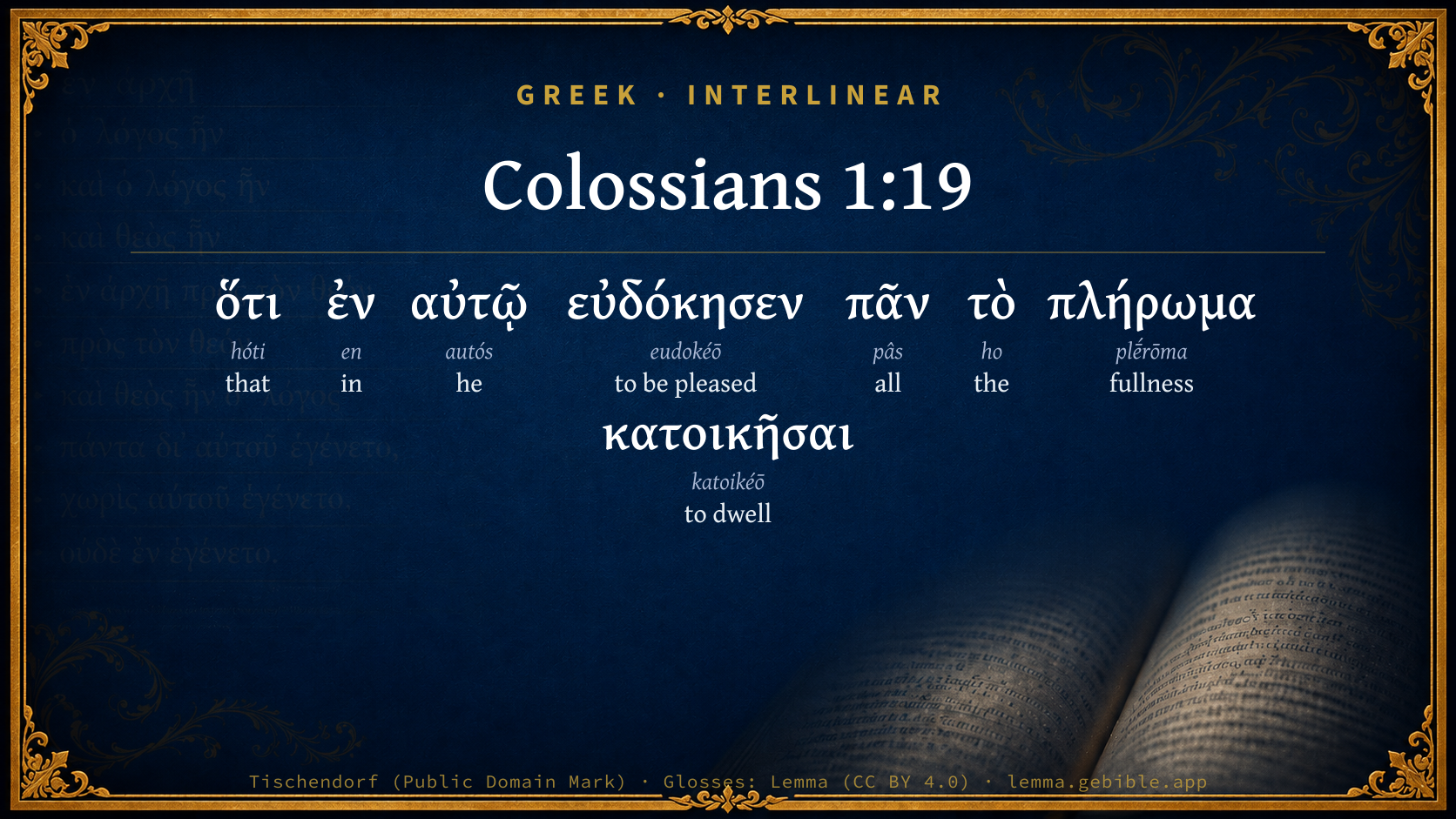
  1. ὅτι hóti G3754 “that” Conjunction
  2. ἐν en G1722 “in” Preposition
  3. αὐτῷ autós G846 “he” Personal pronoun, Dative, Singular, Masculine
  4. εὐδόκησεν eudokéō G2106 “to be pleased” Verb, Aorist, Active, Indicative, 3rd person, Singular
  5. πᾶν pâs G3956 “all” Adjective, Nominative, Singular, Neuter
  6. τὸ ho G3588 “the” Article, Nominative, Singular, Neuter
  7. κατοικῆσαι katoikéō G2730 “to dwell” Verb, Aorist, Active, Infinitive

About this verse

These counts appear in no published source. They are computed here, from the morphology-tagged text and Lemma’s own curated glosses. What Lemma adds →

8
words
8
distinct lemmas
Pauline Epistles
section

Notable vocabulary

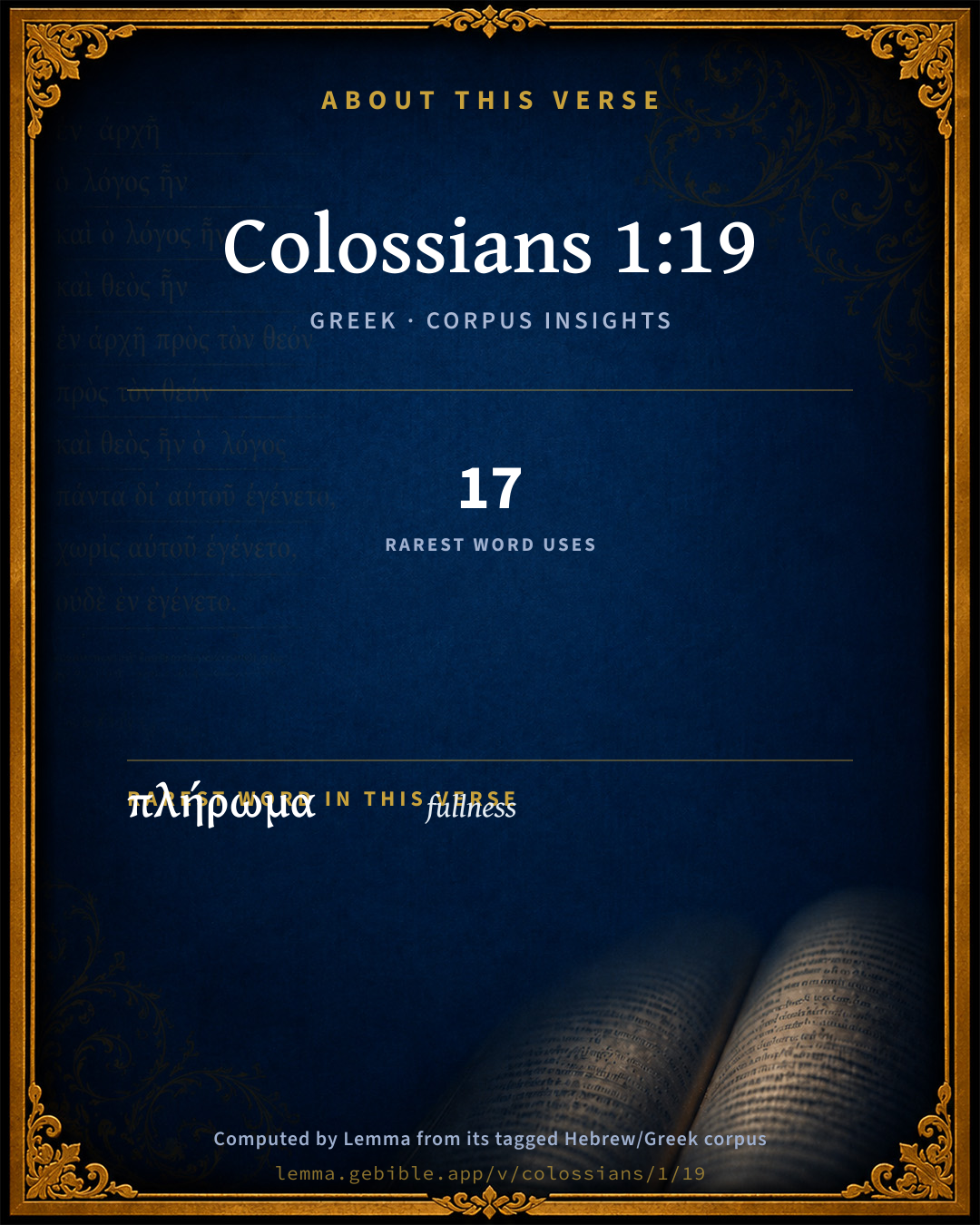
The rarest word here is πλήρωμα fullness G4138 — appearing just 17 times in the whole Greek New Testament.

Shared distinctive vocabulary

πλήρωμα fullness G4138 occurs in 17 verses of the Greek New Testament. Also found in:

Cross-references

11

Topical passages linked to Colossians 1:19 in the Treasury of Scripture Knowledge — connected by theme and wording, ordered by reader-vote popularity; previews shown in the World English Bible.

  • Colossians 2:9 For in him all the fullness of the Godhead dwells bodily,
  • John 1:16 From his fullness we all received grace upon grace.
  • Ephesians 1:23 which is his body, the fullness of him who fills all in all.
  • Colossians 2:3 in whom are all the treasures of wisdom and knowledge hidden.
  • Colossians 3:11 where there can't be Greek and Jew, circumcision and uncircumcision, barbarian, Scythian, bondservant, freeman; but Christ is all, and in all.
  • John 3:34 For he whom God has sent speaks the words of God; for God gives the Spirit without measure.
  • Ephesians 1:3 Blessed be the God and Father of our Lord Jesus Christ, who has blessed us with every spiritual blessing in the heavenly places in Christ;
  • Ephesians 4:10 He who descended is the one who also ascended far above all the heavens, that he might fill all things.
  • Luke 10:21 In that same hour Jesus rejoiced in the Holy Spirit, and said, "I thank you, O Father, Lord of heaven and earth, that you have hidden these things from the wise and understanding, and revealed them to little children. Yes, Father, for so it was well-pleasing in your sight."
  • Ephesians 1:5 having predestined us for adoption as children through Jesus Christ to himself, according to the good pleasure of his desire,
  • Matthew 11:25–27 At that time, Jesus answered, "I thank you, Father, Lord of heaven and earth, that you hid these things from the wise and understanding, and revealed them to infants.

Cross-references courtesy of OpenBible.info (CC BY 4.0).

Commentary

Notes on Colossians 1:19 from classic Christian and Jewish commentators (each source and its license shown beneath its notes). The classic Christian expositions comment on the surrounding passage and are grouped to its opening verse, so a note may address several verses; the Jewish commentaries on the Tanakh (Rashi and others) are per-verse, so they appear only where the commentator wrote on this verse.

Lemma curates 59 commentaries, every one of them public domain or Creative Commons licensed, each selected and text-cleaned for this edition rather than reprinted as found. About our sources →

Jamieson, Fausset & Brown

Robert Jamieson, A. R. Fausset & David Brown

Greek, "(God) was well pleased," &c.

in him--that is, in the Son (Mat 3:17).

all fulness--rather as Greek, "all the fulness," namely, of God, whatever divine excellence is in God the Father (Col 2:9; Eph 3:19; compare Joh 1:16; Joh 3:34). The Gnostics used the term "fulness," for the assemblage of emanations, or angelic powers, coming from God. The Spirit presciently by Paul warns the Church, that the true "fulness" dwells in Christ alone. This assigns the reason why Christ takes precedence of every creature (Col 1:15). For two reasons Christ is Lord of the Church: (1) Because the fulness of the divine attributes (Col 1:19) dwells in Him, and so He has the power to govern the universe; (2) Because (Col 1:20) what He has done for the Church gives Him the right to preside over it.

should . . . dwell--as in a temple (Joh 2:21). This indwelling of the Godhead in Christ is the foundation of the reconciliation by Him [BENGEL]. Hence the "and" (Col 1:20) connects as cause and effect the two things, the Godhead in Christ, and the reconciliation by Christ.

Jamieson, Fausset & Brown — Commentary Critical and Explanatory on the Whole Bible (1871) — public domain (CC PDM 1.0). Text via the HelloAO Bible API.

The Biblical Illustrator

Joseph S. Exell

Col_1:19-22

For it pleased the Father that in Him should all fulness dwell.

The reconciling Son

I. As before we have Christ in relation to God.

1. In the use of the term fulness, which was a very important term in Gnostic speculations, there is a reference to some of the heretical teachers expressions. What fulness? (Col_2:9). The abundance or totality of the Divine attributes. We have no need to look to nature for fragmentary revelations of Gods character--that He has fully and finally declared in His Son.

2. Dwell implies permanent abode, chosen, perhaps, to oppose the view that the union of the Divine and human in Christ was but temporary.

3. This is the result of the Fathers good pleasure. The Father determined the work of the Son, and delighted in it.

II. Again, as before, we have Christ and the universe, Of which He is not only the Maker, Sustainer, and Lord, but through the blood of the Cross reconciles all things to Himself. Probably the false teachers had dreams of reconciling agents. Paul lifts up in opposition the one Sovereign Mediator whose Cross is the bond of peace for the universe.

1. Observe the distinct reference of these words to the former clauses. Through Him was creation; through Him is reconciliation. All things were made, sustained by, and subordinated to Him; the same all things are reconciled. A significant change in the order is noticeable. In the heavens and upon the earth the order of creation; but in reconciliation the order is reversed.

2. The correspondence shows that the reconciliation affects not only rational and responsible creatures, but things. The width of reconciliation is the same as that of the creation. Then these words refer mainly to the restitution of the material universe to its primal obedience, and represent Christ the Creator removing by His Cross the shadow that has passed over nature by reason of sin.

1. Mans sin has made the physical world subject to vanity. Man by sin has compelled dead matter to be his instrument in acts of rebellion against God. He has polluted the world by sin, and laid unnumbered woes on the living creatures. This evil shall be done away by the reconciling power of the blood of the Cross. The universe is one because the Cross pierces its heights and depths.

2. The reference to things in heaven may also be occasioned by the dreams of the heretical teachers. As to reconciliation proper among spiritual beings in that realm, there can be no question of it. There is no enmity among angels. Still, if the reference be to them, then we know that to the principalities and powers in heavenly places the Cross has been the teacher of unlearned depths in the Divine nature and purposes, the knowledge of which has drawn them nearer to the heart of God and made their union with Him more blessed and close.

3. Sublime and great beyond all our dreams shall be the issue. Certain as the throne of God is it that His purposes shall be accomplished. The great sight of the Seer of Patmos is the best commentary on our text (Rev_5:9-13).

III. Christ and His reconciling work in the Church. We have still the parallel kept up. As in Col_1:18 He was representing as giving life to the Church in a higher fashion than to the universe, so, with a similar heightening of the meaning of reconciliation, He is here set forth as its giver to the Church.

1. Observe the solemn description of men before it. Alienated, not aliens, but having become so. The seat of the enmity is in that inner man which thinks and wills, and its sphere of manifestation is in evil works which are religiously acts of hostility to God because morally bad. This is thought nowadays a too harsh description. But the charge is not that of conscious, active hostility, but of practical want of affection as manifested by habitual disobedience or inattention to Gods wishes and by indifference and separation from Him in heart and mind.

2. Here as uniformly God Himself is the Reconciler, it is we who are reconciled. The Divine patience loves on through all our enmity, and though perfect love meeting human sin must ever become wrath, it never becomes hatred.

3. The means of reconcilition.

(1) The body, etc., an exuberance of language to correct, perhaps, the error of that our Lords body was only a phantasm, or to guard against the risk of confounding it with His body the Church, or as showing how full His mind was of the overwhelming wonder of the fact.

(2) But the Incarnation is not the whole gospel; through death Christs death has so met the requirements of the Divine law, that Divine love can come freely forth and forgive sinful men. (A. Maclaren, D. D.)

The reconciling work of the great Mediator

I. The unique qualification of the great Mediator.

1. In Him all fulness dwells.

2. It is the good pleasure of the Father that this fulness should reside in the Son.

II. The reconciling work of the great mediator.

1. The extent of the reconciliation.

(1) Sinful creatures on earth are reconciled to God in Christ.

(2) Sinful and sinless creatures are reconciled.

(3) Sinless and unfallen creatures are brought nearer to God in Christ.

III. The means by which the reconciliation is effected. Lessons:--

1. The great Mediator has every qualification for His stupendous work.

2. The reconciliation of a disorganized universe is beyond the power of any subordinate agent.

3. Rebellious man can be restored to peace with God only as he yields himself up to the great Mediator. (G. Barlow.)

Reconciliation

I. In the person that redeems us we find fulness.

1. And there had need be so.

(1) He found our measure of sin full towards God. When a river swells it will find out all the channels and overflow the whole field; so sin hath found an issue at the ear, eye, tongue, hands, feet, and so overflows all.

(2) Gods measure of anger was full too.

(3) Then it pleased the Father that there should be another fulness to overflow these.

2. This is all fulness, and is only in Christ. Elijah had a great portion of the Spirit; Elisha sees that that will not serve Him, and so asks a double portion; but still but portions. Stephen is full of faith, a blessed fulness where there is no room for doubt; Dorcas is full of good works, a fulness above faith; Mary is full of grace, which is a fulness above both; but yet not all fulness. I shall be as full as Paul in heaven, i.e., have as full a vessel, but not so full a cellar. Christ only hath an infinite content and capacity, and so an infinite fulness.

3. But was Christ God before, and is there a supplementary fulness? Yes. To make Him a competent person to redeem man something was to be added to Christ though He were God; wherein we see the incomprehensibleness of mans sin, that even to God Himself there was required something else than God before we could be redeemed. Perfect God, there is the fulness of the Redeemers dignity; perfect man, there is the fulness of His capacity to suffer and pay our debt. This was a strange fulness, for it was a fulness of emptiness, all humiliation and exinanition by His obedience unto death.

4. How came Christ by all this fulness? It pleased the Father.

II. The pacification. It is much that God would admit any peace; more that for peace He should require blood; more still that it should be the blood of Him who was injured; most of all that is should be the blood of the Cross, i.e., death.

1. Then there was a heavy war before; for the Lord of Hosts was our enemy; and what can all our musters come to when He is against us?

2. But what is the peace, and how are we included in it? A man must not think himself included in it because he feels no effects of this war. Though there be no blow stricken, the war remains in the time of truce. But hero is no truce. All this while that thou enjoyest this imaginary security the enemy undermines thee, and will blow thee up at last more irrevocably than if he had battered thee with outward calamities all the time. But in this text there is true peace, and one already made, and made by Him who lacked nothing for the making of it.

3. Is effusion of blood the way of peace? That may make them from whom it is drawn glad of peace. But here mercy and truth are met together. God would be true to His own justice and be merciful to us. Justice required blood, for without it is no remission. Under the law it was blood of bulls and goats; here it is His blood. Greater love, etc. (Joh_15:13); but He who said so laid down His life shamefully and painfully for His enemies.

III. The application thereof to all to whom that reconciliation appertains. All this was done, and yet the apostle prays us to be reconciled to God. The general peace was made by Christs death, as a general pardon is given at the Kings coming; we have to accept it.

1. There is a reconciliation of things in heaven.

(1) The saints, who reached forth the hand of faith to lay hold of Christ before He came.

(2) Angels, who were confirmed in perfect holiness and blessedness.

2. Things on earth.

(1) The creature who by virtue of it shall be delivered from the bondage of corruption.

(2) Men.

3. But the most proper and literal meaning is that all things in heaven and earth be reconciled to God; i.e., His glory, to a fitter disposition to glorify Him, by being reconciled to one another in Christ; that in Him, as Head of the Church, they in heaven and we on earth be united together as one body in the communion of saints (Eph_1:10).

4. Here there is still reconciliation to be made, not only toward one another on the bond of charity, but on ourselves. In ourselves we find things in heaven and on earth to reconcile. There is heavenly zeal to be reconciled to discretion; heavenly purity to one anothers infirmities; heavenly liberty to a care for the promotion of scandal. Till the flesh and spirit be reconciled this reconciliation is not accomplished; but both are, in Christ, when in all the faculties of soul and body we glorify Him. (J. Donne, D. D.)

The fulness

I. A particular fulness dwelt in Christ. The definitive article the has reference not to fulness in general. It would not be to the honour of Jesus to have all fulness whatsoever. We read of some whose cups and platters were full of extortion and excess; of Elymas, who was full of subtlety, etc.; of men who were full of envy, murder, etc. In Jesus it is some conspicuously glorious fulness.

II. A divine fulness. The apostle refers to it in Col_2:9 --the fulness of the Godhead, not only really and spiritually, but bodily, in an incarnated condition, and thus conspicuously, and in such a way as made it a reasonable thing to ascribe to our Lord the work of creation on the one hand, and the headship of the Church on the other.

1. The Godhead is full of power. Nothing is too hard for the Lord. All that fulness, too, is in Jesus, so that He is able to wheel the worlds in their orbits and to save to the uttermost, etc.

2. The Godhead is full of righteousness. In God is no darkness at all. Our Lord is Jesus Christ the righteous, whom no one can convict of sin; and He is so full that His righteousness is available, not to Himself alone, but unto all and upon all them that believe.

3. The Godhead is full of love. God is love. Jesus said, Greater love than this, etc.

4. Hence, too, there was in Him fulness of grace and truth, of meekness, tenderness, gentleness.

III. A permanent fulness. Dwelt. The Father did not desire that the fulness of Godhead should stream through our Saviour, illuminating and glorifying His nature as it passed, and then vanish. It is the same in glory to-day, yesterday, and for ever. (J. Morison, D. D.)

I. The fulness that is in Christ.

1. All fulness. Ahasuerus promised Esther that her request should be granted though it cost him half his kingdom. Christ offers nothing by halves. It pleased the Father, etc. Transferring Divine wealth to our account in the bank of heaven, and giving us an unlimited credit there, Jesus says: All things whatsoever ye ask in prayer, believing, ye shall receive.

2. All fulness of mercy to pardon sin. The gospel proclaims a universal amnesty. When the last gun is fired, and pardon proclaimed in reconquered provinces, is it not always marked by notable exceptions? But from Christs pardoning mercy none are excepted save those who except themselves. It reaches the vilest sinner. It binds a zone of mercy round the world, and perish the hands that would narrow it by a hairs breadth. None shall be damned but those who damn themselves. One might fancy that now all are certain to be saved. Who will not accept of it? Offer a starving man bread, a poor man money, a sick man health, a lifeboat in the wreck, how gladly will they be accepted! But salvation, the one thing needful, is the one thing man will not accept. He will stoop to pick up a piece of gold out of the mire, but he will not rise out of the mire to receive a crown from heaven. What infatuation!

3. All fulness of grace to sanctify. Why are the best of us no better, holier, happier? Hath God forgotten to be gracious? No. He who justified can sanctify, and with holiness give fulness of joy and pleasures for evermore. There is efficiency and sufficiency in Jesus to complete what He has begun. There are stores of grace which are like the widows barrel that grew no emptier for the meals it furnished. My grace is sufficient for thee. With a well ever flowing our vessels need never be empty. No earthly fortune will stand daily visits to the bank, but this will. You may ask too little, but you cannot ask too much; you may go too seldom, but you cannot go too often to the throne.

II. There is a constant supply of sanctifying and pardoning grace in Christ. Dwell, not come and go, like a wayfaring man, like a shallow, noisy, treacherous brook that fails when most needed, but like the deep-seated spring that, rising silently, though affluently, at the mountains foot, and having unseen communication with its exhaustless supplies, is ever flowing over its grassy margin, equally unaffected by the long droughts that dry the wells and the frosts that pave the neighbouring lake with ice. (T. Guthrie, D. D.)

The fulness of Christ

I. The fulness of Christ.

1. A fulness of all Divine attributes and perfections. Omnipotence in creation; omniscience, wisdom, and goodness in providence; grace in the dispensation of the Spirit; justice in the grand assize, etc., are all His. Hence fulness of worship is offered Him in heaven (Rev_3:2) and earth.

2. A fulness of truth and wisdom for the instruction of man. John tells us that He is full of truth; Christ says, I am the truth; and Paul says, In Him are hid all the treasures of wisdom and knowledge.

(1) All the rays of Divine truth which have ever enlightened prophets and apostles, guided wandering sinners back to God, and blessed the Church with purity and consolation, were emanations from Him, the great Prophet of the Church.

(2) In the Scriptures we have the mind of Christ.

(3) But while the Bible is sufficient, such is the power which prejudice, unbelief, and ignorance exert over the mind, that the influence of Christ is requisite to the reception of the truth. Our prayer, then, before the open Bible should be, Open mine eyes, that I may behold wondrous things, etc.

3. A fulness of merit to justify every believer in His name.

(1) Convinced of sin, our great question is, How can man be just with God? It is evident that we cannot be just in our own righteousness, nor in that of the holiest saints, for they were indebted to another for the robe they wear; nor in that of angels, for no creature, however elevated, can render an obedience exceeding the law of his creation, and consequently can have no works of supererogation which can be disposed of for the benefit of others.

(2) No cheering answer can reach us but that which comes from Calvary. By His obedience unto death, the law broken by us is honoured, its precepts fulfilled, and its penalty endured.

(3) By faith we become interested in Jesus, and thus are justified freely by His grace.

4. A fulness of power to accomplish all the purposes for which the mediatorial office was instituted. He sits upon the throne wielding the omnipotent sceptre of universal dominion, and reigns over all for the benefit of the Church.

5. A fulness of grace and compassion to relieve and comfort His afflicted servants (Heb_4:14).

II. It is the pleasure of the Father that this fulness should dwell in Christ.

1. It is in harmony with the Divine counsels.

2. It meets with the Divine approbation.

Conclusion: The subject--

1. Directs believers to the source of all consolation.

2. Sinners to the source of all salvation. (Congregational Remembrancer.)

Fulness of grace in Christ

I. By fulness of grace we understand all those perfections to which the term grace extends itself.

II. Why was it necessary that this fulness of grace should dwell in Christ?

1. The fitness of things required it, on account of the union of His soul with the Word. For it is proper that in proportion as anything is nearer to the influential cause, so much the more abundantly should it partake of the influence itself. Since, therefore, God Himself is the fountain of grace, the soul of Christ, so near to God, cannot but abound in grace.

2. Necessity requires it, from consideration of the end, on account of the relation between Christ and the race. For grace was to be bestowed on him, not as on a private person, but as the universal fountain from whom it might be transfused into the rest of men. But in this fountain all the parts ought to be full and combined. The evangelist shows that grace is shed abroad from Christ (Joh_1:16; Eph_4:7).

III. This fulness of grace is peculiar to Christ alone. To prove which, notice: In the saints militant there is not a fulness of grace; for it cannot consist with so many remains of the old man: for a fulness of grace leaves no room for sin. But not even in the very saints triumphant. For if one star differeth from another star in light and magnitude, then how much more does it differ from the sun? But an objection is raised, that the Virgin Mary, for instance, is said to be full of grace (Luk_1:28); and Stephen also full of grace and power (Act_6:8); and that therefore a fulness of grace is not peculiar to Christ. I answer, The fulness of grace is twofold: one may be regarded on the part of grace itself, when a man hath it in the greatest extent, both as to every kind of grace, and in the greatest perfection as to degree. This is the fulness of Christ alone. The other regards grace on the part of the possessor when a man hath it as fully and as sufficiently as his state and condition can contain. Hence observe--

1. That God is not accustomed to impose an office upon any one without at the same time conferring upon him all those powers which are necessary for the discharge of it: He lays upon Christ the office of Head of the Church; but He also imparts to Him a fulness of grace. Therefore, whoever thrust themselves into offices, for the administration of which they are altogether incompetent, are not called to them by God, but are impelled either by avarice or ambition.

2. Since there is a fulness of grace in Christ alone, we must expect its streams to flow to us from Him alone: they who seek grace elsewhere commit two evils (Jer_2:13). (Bishop Davenant.)

The fulness of Christ the treasury of the saints

I. There is a glorious fulness in Jesus.

1. Enough to enable a saint to rise to the highest degree of grace. If there be anything lacking for the attainment of the Divine image, it is not a deficiency Christward; it is occasioned by shortcomings in ourselves. If sin is to be overcome, the conquering power dwells in Him in its fulness; if virtue is to be attained, sanctifying energy resides in Him to perfection.

2. Enough for the conquest of the world. The Lord God omnipotent shall reign from shore to shore. We have in Christ all the might that is needed for subduing the nations; let us go into His armoury, and we shall receive invincible weapons and almighty strength.

3. Every fulness for teaching, convincing, converting, sanctifying, and keeping unto the end.

II. The fulness is in Jesus now.

1. The glory of the past exercises a depressing influence over many Christians. Scarcely any Church realizes that it can do what its first promoters did. A people are in an evil case when their heroism is historical. In Jesus all fulness dwells for Paul, Luther, Whitfield, you and me. Christianity has not lost its pristine strength; we have lost our faith. Why should we not have a greater Pentecost than Peter saw? The times have altered, but Jesus is the Eternal.

2. A great many have their eye on the future only. But it doesnt say that the fulness shall dwell. Whatever shall yet be done by His grace may be done to-day. Our laziness puts off the work of conquest; and want of faith makes us dote upon the millennium instead of hearing the Spirits voice to-day.

3. Our churches believe that there is great fulness in Christ, and that sometimes they ought to enjoy it. The progress of Christianity is to be by tides which ebb and flow. There are to be revivals like spring, which must alternate with lethargies like winter. But it is not the Lords pleasure that a fulness should reside in Jesus during revivals, and then withdraw. May we feel that we have not to drink of an intermittent spring, nor to work with an occasional industry!

III. The position of this fulness is encouraging to us in the matter of obtaining it. It is in Him, where you can receive it, in your Brother, who loves to give it. It is yours. Since Christ is yours, all that is in Him is yours. It pleases God for you to partake of it. It is a matter for gratitude that it is not placed in us, for then we should not have to go so often to Christ; nor in an angel, who would not be so attractive as Christ.

IV. We ought to use this fulness.

1. Believe in great things.

2. Expect them.

3. Attempt them.

4. Do not talk about this, but set about it. (C. H. Spurgeon.)

The fulness of Christ

The fulness of power which creation manifests, and the fulness of glory which the Church reveals, and the fulness of grace which the Godhead contains, dwell in Christ. That is His fulness. But oh, how small a portion is heard of Him! (Job_26:14). A little child is led down to our sea-coast, and is told, That is the ocean; a little child is taken to the sea-coast in Canada, and is told, That is the ocean; and a little child is taken to the sea-coast in Australia, and is told, That is the ocean. But the ocean fills the intervening two thousand five hundred miles between the first and second, the fourteen thousand miles between the second and third, and the fifteen thousand miles between the third and the first. They have seen the ocean, but its fulness fills all that lies between them, and all that is beyond the horizon which bounds their vision. (H. Brooke.)

No limit to the fulness in Christ

I have felt it an interesting thing to stand by the grassy edge of a rolling river, and think how it has been rolling on for six thousand years, slaking the thirst and watering the fields of a hundred generations,: and yet there is no sign of waste or want there; and it is an interesting thing to mark the sun rise above the shoulder of a mountain, or where the sky is thick with clouds to see him leap from his ocean bed, and think he has melted the snows of go many winters, revived the verdure of so many springs, painted the flowers of so many summers, and ripened the corn of so many autumns, and yet is as big and as brilliant as ever, his eye not dimmed, his strength not abated, and his floods of glory none the less for centuries of profusion. But what is that rolling river, what is yon bright sun, but images of the blessed fulness that is in Jesus Christ, a fulness that should encourage the most hopeless of you to hope, a fulness that should prevail upon the vilest sinner to come, and a fulness that should animate the efforts of missionaries and of missionary societies to go on in the strength of Him who has all power in earth and heaven, who shall carry on His triumphs till the whole world has been subdued, and all the nations of this world and its kingdoms shall become the kingdoms of our Lord and of His Christ. (T. Guthrie, D. D.)

Fulness of Christ cannot be supplemented

Truly the revelation is by no means scant, for there is vastly more revealed in the person of Christ than we shall be likely to learn in this mortal life, and even eternity will not be too long for the discovery of all the glory of God which shines forth in the person of the Word made flesh. Those who would supplement Christianity had better first add to the brilliance of the sun or the fulness of the sea. (C. H. Spurgeon.)

And having made peace by the blood of His Cross.

It is great to reconcile; greater through Himself; greater, again, through His blood; greatest of all through His Cross. Here are five things to be admired--reconciliation, to God, through Himself, by death, by the Cross. (Chrysostom.)

The Reconciler

I. By nature man is at enmity with God. As God is love, so the carnal mind is enmity; this being so much the nature, essence, element of its existence, that if you took away the enmity it would cease to be. It is not always in activity, but sins, like seeds, lie dormant, and only await circumstances to develop them. This is a doctrine into which the believer does not need to be reasoned. He feels it. The text takes it for granted; for what need can there be to make peace between friends? Not friends require to be reconciled, only foes. But does God appear as reciprocating our enmity, as the enemy of man? No; not even when He condemns him. He does not hate the sinner, though He hates his sins. He hath no pleasure in the death of the wicked.

II. God desires to be reconciled to his enemies.

1. Man stands upon his dignity. The injured says to the injurer--and each generally thinks not himself, but the other such--He is to come to me; I am not to go to him. You may tell him that it is noble to make the first advances. No, he says, he must acknowledge his offence, and I will not refuse my hand. Strange terms for those to stand on who know the grace of God. If God had so dealt with us, we should have gone to hell.

2. Does God stand upon His dignity, the justice of the ease? If ever any might, it was He. No, He takes the humiliation to Himself, and might be supposed to be the injurer, not the injured. Veiling His majesty, and leaving heaven to seek our door, He stands, knocks, waits there, beseeching us as though it were a favour to be reconciled. Salvation has its fountain, not in the Cross, but in the bosom of the Father.

III. To make our peace with God, Jesus Christ laid down His life.

1. The price of pardon was nothing less than the blood of God.

2. Purchasing our peace at such a price, God has done more for us than for all the universe besides. (T. Guthrie, D. D.)

The atonement

I. The influence of the blood of the cross on God. Peace cannot mean the actual reconciliation of man to God, for it is prior to and with the design of afterwards effecting it. It must therefore have been peace that looked toward God, for He is the only other party to the enmity. But this could not have been a change in God Himself or His purposes, for He is immutable; nor any alteration in His feelings towards sin, for that must ever be the abominable thing which He hates; still less the purchase of His love for man, for the whole purpose of reconciliation sprang out of His pleasure. But it is the effect produced by the death of Christ upon Gods moral government, so that it became possible for Him to forgive righteously. It will follow--

1. That they are greatly in error who maintain that the only purpose of Christs death was to reconcile man to God by the simple manifestation of Divine love. The fact is there are two elements in the Cross--love and righteousness--and we must allow neither to overshadow the other. If we do, in one case the gospel will assume the appearance of indifference to evil, in the other it will be made to assume an appearance of terror.

2. That they are greatly in error who make little of the death of Christ. Without shedding of blood is no remission.

II. The blood of the Cross as it respects man. Things on earth may perhaps be taken to mean the whole lower creation which groans and travails in pain, etc.; but as the curse passed on the earth through man, so must the blessing. How, then, are men reconciled to God? More than pardon through the satisfaction of Gods justice was needed; for sin has not only broken the law, but filled the sinners heart with enmity against God. But--

1. The atonement of Christ has also secured the Holy Spirit for the regeneration of human hearts.

2. Then the Spirit uses the story of Christs love and death to remove the enmity. All along the sinner has been misjudging God; but when he, through the Spirit, is led to see that God has given Christ to secure his pardon, he discovers that he has done God the foulest wrong, and returns in penitence and affection to Him.

III. The blood of the Cross As it affects angels. They, of course, cannot be reconciled in the strict sense of the term; but the work of Christ has let them see further into the heart of God, drawn them nearer to Him, and given them a higher degree of blessedness. Conclusion:

1. All obstacles have been taken out of the way of a sinners salvation as far as God is concerned. If they are not saved, it is because they reject Gods overtures of reconciliation.

2. If the sinner passes from earth unreconciled, there is no salvation for him. The text says nothing of things under the earth. (W. M. Taylor, D. D.)

Peace through the blood of the Cross

I. The Father makes this peace. This is noteworthy. A different representation might have been given--has been given elsewhere. Christ is our peace, and through Him we can approach the Father without dismay. But the teaching here is that the great transaction of the Cross was not needed to enlist the interest of the Father, or to render Him willing to rescue us, or to procure our love. It was His love that procured the Cross. The Son can do nothing of Himself, but delights to do the will of the Father.

II. This peace has been made.

1. The idea is not that war has ceased.

(1) Alas! it has not in our world.

(2) Nor in the human heart (verse 21).

(3) Nor in other spheres (Eph_6:12).

2. But it has been made in this sense that, so far as the earths populations are concerned, an armistice has been proclaimed by the Lord Paramount of the universe. A halt has been called to the legions of retribution. All the steps have been taken by the Divine Governor that were needful to render it a fit, safe, and glorious thing on His part to conclude peace, and has sent messengers to proclaim peace to them that are afar off and to them that are nigh.

III. He has made peace through the blood of the cross. The idea is that at a very great cost He has made the peace. The Father while infinitely loving the Son saw it to be a fitting thing to surrender Him to a cruel death. But in the endurance of the crucifixion there was a manifestation of high regard for the law, hatred to sin, and love of the sinner.

IV. He is now laboring to secure the acceptance and effectiveness of this peace. Not only did the Divine Father make peace 1,800 years ago, and then leave sinners to accept it or reject it, indifferent as to the result. My Father worketh hitherto, and I work. Both Father and Son are working together at every point in the world of matter and on every heart in the world of mind. (J. Morison, D. D.)

Peace by the blood of Christ

There is a young girl in heaven now, once a member of our Church. I went with one of my beloved deacons to see her when she was very near her departure. She was in the last stage of consumption. She said to me, It is sad to be so very weak, but I think, if I had my choice, I would rather be here than be in health, for it is very precious to me. I know that my Redeemer liveth, and I am waiting for the moment when He shall send His chariot of fire to take me up to Him. I put the question, Have you not any doubts? No, none, sir; why should I? I clasp my arms around the neck of Christ. And have not you any fear about your sins? No, sir; they are all forgiven. I trust the Saviours precious blood. And do you think you will be as brave as this when you come actually to die? Not if He leaves me, sir; but He will never leave me, for He has said, I will never leave thee nor forsake thee. (C. H. Spurgeon.)

And you, that were sometime alienated and enemies in your mind.--

Reconciliation by Christ

1. There are only two kinds of goodness possible, that of those who have never erred, that of those who have been recovered. It is plain that ours must be the latter.

2. Appointed to these are two kinds of happiness, the blessedness of entire ignorance of guilt, and the blessedness of forgiveness, the latter of which is superior in intensity and fulness.

3. There are two kinds of friendship, that which has never had a shock, and that which, after having been doubted, is at last made sure. The happiness of the last is perhaps the greater, as illustrated by the parable of the Prodigal. This leads us to our subject--Reconciliation.

I. Estrangement.

1. Its cause. Wicked works, voluntary deeds. Sin is not merely a foreign disease introduced into the constitution. You are a responsible individual, have done deeds that are wrong of the mind, hand, tongue.

2. Its result.

(1) Alienation--the feeling that God is our enemy. Alienation was a more forcible expression then. There is now little difference between the alien and the citizen. But the alien from the Jewish commonwealth had no power to share in its religious privileges, and was popularly regarded as a dog. In the Roman commonwealth the word had a still stronger meaning; it was to be separated from the authority and protection of Roman law, and to be subject to degrading penalties. Hence Pauls protest at Philippi against scourging, as he was not an alien. Pauls conception of alienation is given in Eph_2:12 it is to have no place in the universe, to feel God your enemy, to be estranged from Him and banished from His presence. What is this but hell?

(2) Enmity against God. The illustration of the process we have seen in every day life. Strength of attachment settles down to indifference, and at last to hatred.

2. secret sense of wrong intrudes, and we cannot escape, save by throwing the blame somewhere. By degrees a cankered spot begins, you irritate it until the mortification becomes entire, and alienation settles down into animosity. And such is the history of alienation from God. Different characters arrive at it in different ways.

(a) Weak minds throw the blame on circumstances, and regard themselves as victims of a cruel fate, the blame belonging not to them, but God.

(b) In the case of stronger and more vicious characters, humiliation degrades, and degradation produces anger. The outcast turns with defiance on respectability merely because it is respectable. So some sinners stand at bay, as it were, to their Maker.

II. Reconciliation.

1. Christ has reconciled man to God.

(1) By exhibiting the character of God. The sacrifice of Christ was the voice of God proclaiming love.

(2) When the mind has comprehended this, then comes the blessed feeling of reconciliation. The change of feeling within us changes God to us.

2. Christ has reconciled man to man.

(1) Men have tried other methods. Let the political economist come forward with his principle of selfishness and tell us that this is that by which alone the wealth of nations can accrue. He may get a nation in which there are a wealthy few and a miserable many, but not a brotherhood of Christians. Try the principle of moral rule; say that men should love one another--will that make them? You may come forward with the crushing rule of political authority. Papal Rome has tried that and failed. She bound up the masses of the race as a gigantic iceberg; but she could give only a temporary principle of cohesion.

(2) Therefore we come back to the Cross: through this alone we learn that there is one Father, one Elder Brother, in whom all can be brothers. Catch the spirit of that Cross, the spirit of giving, suffering, loving, and man will be reconciled to man.

3. By the Redeemers atonement man becomes reconciled to himself. That is necessary because it is so hard to forgive ourselves. You may obtain remission, but you cannot get back the feeling of self-respect and unity within. The sacrifice of Christ was surrender to the will of God; go and sacrifice yourself for the happiness of others, and the calm feeling will come.

4. Man becomes reconciled to duty. There is no discord more terrible than that between man and duty. There are few of us who fancy we have found our proper places in this world. We think that we are fit for higher things. But study that marvellous Life and you will see that the whole of its details are ungenial, mean, trivial, wretched circumstances. It is not by change of circumstances, but by fitting our spirits to the circumstances in which God has placed us, that we can be reconciled to life and duty. If the duties be not noble, let us ennoble them by doing them in a noble spirit. (F.W. Robertson, M.A.)

The nature and issues of reconciliation

I. The Christians past condition.

1. Alienation. The idea is that of belonging to a different community, morally at a distance from God. Mans spirit formed for God is naturally averse from Him. No sooner was our first father guilty than he fled from the presence of his Maker.

(1) This alienation is spiritual death, for the soul cannot realize its true life away from God.

(2) The spirit of alienation is hostility.

2. The seat of this enmity is in the thought and feeling. It need not be apparent. If we are wilfully separated from one to whom we owe love and allegiance, hard thoughts of him to justify ourselves will arise and then enmity of heart. Men may profess to like an ideal God, but the God of the Bible who claims their affection and service is no object of attraction to the natural mind. Take any gathering of men and you can introduce no subject more forbid ding than that of God.

3. This hostility has an outward embodiment in the practical sphere of wicked works not necessarily into flagrant vice. Every act of disobedience is evil, however compatible with social virtue and refinement, because rebellion against God.

4. This is a melancholy indictment, but a true one. Perhaps the darkest count against humanity is that in regions of civilization and culture there can be so much that is pleasant and elevating without any recognition of God.

II. The Christians present privilege.

1. It is not God who is said to be reconciled. God is reconciled in Christ, and is seeking to reconcile the world unto Himself.

2. In this reconciliation--

(1) Friendship is restored. The alienation and enmity are removed, and the sinner brought nigh. No friendship can be compared with this: that of the world worketh death, this is life and glory.

(2) Fellowship is resumed. Man was formed for this, but sin interrupted it, and now in it man finds his highest enjoyment.

3. But how does it come? In the body of His flesh, etc.

(1) The assumption of a human body brought Jesus into fraternal relationship with men.

(2) His death brings us into relationship.

4. The apostle utterly demolishes these theories which make little of the death of Christ while they profess to make much of His life and teaching.

III. The Christians future prospect (verse 23). (J. Spence, D. D.)

The personal blessings of reconciliation

I. Sin has placed man in antagonism to God.

1. Man is estranged from God. Sin severs the soul from God. The principle of cohesion--the consciousness of rectitude--is gone, and the sinner, breaking away from the centre of all goodness, drifts into the wilderness of alienation. Sin leads man to shun the Divine presence and disregard the Divine overtures. It is a state of danger and spiritual death. How few are conscious of it!

2. Man is hostile to God. Enmity follows estrangement, and both have their seat in the mind. The mind of man opposes the mind of God, sets up a rival kingdom, and organizes an active rebellion against the Divine Ruler (Rom_8:7). If the hostility is not always open, it is in the mind.

3. Mans estrangement and hostility are evident in his actions.

II. Man is reconciled to God in Christ.

1. The distinguished blessing. Now hath He reconciled.

2. The gracious medium of the blessing. In the body of His flesh through death.

III. The Divine purpose in reconciliation is to promote mans highest blessedness.

1. The highest blessedness of man consists in his moral purity. To present you holy.

2. In His personal blamelessness.

3. In His freedom from censure. (G. Barlow.)

The Biblical Illustrator, edited by Joseph S. Exell (c. 1880s–1900s) — public domain. Text from a community e-Sword module.

Whedon's Commentary on the Bible

Daniel D. Whedon

2. Divine plan of a universal reconciliation through Christ, Col_1:19-20.

19. It pleased—Whether we translate, as Ellicott, “Because in him the whole fulness was pleased to dwell;” or, as Alford, “For in him God was pleased that the whole fulness should dwell,” or, as in the text, which on the whole is preferable, supplying God, however, rather than the Father, the doctrinal result is the same. The point in hand is to state the ground upon which the preeminence is given to the Lord Jesus Christ, in whom the human is in union with the divine, making him in so far different from the Son previous to the incarnation. It is explained by the two great facts which it pleased God, not arbitrarily, but as the deliberate outflow of his infinite wisdom and love, to embody in his plan. The first relates to his qualification: that in him the whole fulness should permanently dwell. But fulness of what? Various answers are given, of which we think the true one is the fulness of those attributes which fit him for this supremacy and for his redeeming work, such as power, authority, grace, wisdom, and love. They are not partial or limited in him, but perfect. This is, doubtless, the same as saying that the divine perfections dwell in him, while it is not quite the statement of Col_2:9, where the divine essence is spoken of, which is not in question here.

Daniel D. Whedon (gen. ed.), Commentary on the Old and New Testaments (1874–1909) — public domain. Text from a community e-Sword module.

The Preacher's Complete Homiletical Commentary

Joseph S. Exell (gen. ed.)

CRITICAL AND EXPLANATORY NOTES

Col_1:19. For it pleased the Father that in Him should all fulness dwell.—The great question on this verse is—seeing that “the Father” has been added—what is the nominative to the word rendered “it pleased”? At least three are possible:

(1)“the Father,” as A.V., R.V., and many commentators;

(2) “all the fulness,” etc.; and

(3) “the Son was pleased.” Lightfoot urges that, as

(2) would be an anachronism, and

(3) a hopeless confusion of the theology, “the Father was well pleased” seems to be the best rendering.

Col_1:20. To reconcile all things unto Himself—The word “reconcile” is meant to indicate the restoration of a lost friendship; the re-establishment of peaceful relations. It is a good specimen of the care with which St. Paul’s advanced expressions are selected.

MAIN HOMILETICS OF THE PARAGRAPH.—Col_1:19-20

The Reconciling Work of the Great Mediator.

After showing the grand pre-eminence of Christ in both the natural and moral creation, and thus declaring the inferior and subordinate position of those angelic powers whose nature and office the false teachers in Colossæ unduly extolled, the apostle here proceeds to point out the special fitness of the great Mediator for that lofty relationship. It is grounded on the fact that in Him all fulness dwells. Observe:—

I. The unique qualification of the great Mediator.—

1. In Him, all fulness dwells. The heretical teachers would reduce Christ to the level of an angelic mediator, a simple evolution from the divine nature, and one of the links that bind the finite to the infinite. They admitted there was the manifestation of divine power and glory, but that this was only occasional, and not inherent. The apostle, in refuting this, asserts that the plenitude—the grand totality of Deity—resided in Christ, not as a transient guest, but as a permanent and abiding presence. “All fulness.” Well might the profound and devout Bengel exclaim, “Who can fathom the depth of this subject?” In the marvellous person of Jesus there is combined all the fulness of humanity as well as the fulness of divinity—all the beauty, dignity, and excellency that replenish heaven and earth, and adorn the nature of God and of men. It is a fulness that stands related to all the interests of the universe, and can supply the moral necessities of all. There is a fulness of wisdom to keep us from error, fulness of grace to preserve from apostasy, fulness of joy to keep us from despair, and fulness of power to protect from all evil. It penetrates and fills the vast universe of intelligent beings, and girds it with a radiant circle of glory and felicity.

2. It is the good pleasure of the Father that this fulness should reside in the Son.—“For it pleased the Father” (Col_1:19). It was the will and purpose of God the Father that Christ, as the Mediator, should, in order to accomplish the great work of reconciliation, be filled with the plenitude of all divine and human excellencies; that He should be the grand, living, unfailing reservoir of blessing to the whole intelligent universe. The Father is not only in harmony with the reconciling work of the Son, but the whole merciful arrangement was from the first suggested, planned, and appointed by Him. The moving cause and foundation of all saving grace through the Son is the good pleasure of the Father. It is not His good pleasure that any other than Christ should be the Mediator of the universe. We should never seek or acknowledge any other.

II. The reconciling work of the great Mediator.—

1. The nature of the reconciliation. “To reconcile unto Himself” (Col_1:20). The word “reconcile” imports to restore one to a state of amity and friendship, to change the relations of two parties separated either by one-sided or mutual enmity. Sin places man at enmity with God, and exposes him to the divine opposition and anger. The cross of Christ, by removing the cause of estrangement, opens the way of reconciliation; and the penitent, believing soul is thus restored to the divine favour and friendship. But the word “reconcile” does not always presuppose the existence of open enmity; and, from the general drift of the verse, the term should be interpreted in the most liberal sense, yet with the utmost caution and reverence.

2. The extent of the reconciliation.—“To reconcile all things unto Himself, whether they be things in earth or things in heaven” (Col_1:20). It was on the earth where the enmities first arose; therefore it is put first. The humanity of Christ bringing all creatures around it unites them to God in a bond which never before existed—a bond which has its origin in the mystery of redemption. Thus all things in heaven and earth feel the effect of man’s renovation. In Christ, the great Reconciler, meet and merge the discordant elements which sin had introduced (see Bengel and Eadie). The false teachers aimed at effecting a partial reconciliation between God and man, through the interposition of angelic mediators. The apostle speaks of an absolute and complete reconciliation of universal nature to God, effected through the mediation of the incarnate Word. Their mediators were ineffective because they were neither human nor divine. The true Mediator must be both human and divine. The whole universe of things material, as well as spiritual, shall be restored to harmony with God. How far this restoration of universal nature may be subjective, as involved in the changed perceptions of man thus brought into harmony with God, and how far it may have an objective and independent existence, it were vain to speculate (Lightfoot). With regard to this reconciliation, we may safely say it includes, with much more that is too high for us to understand, the following truths:

(1) Sinful creatures on earth are reconciled to God in Christ. For the degenerate and guilty children of men there is a Reconciler and a way of reconciliation, so that wrath is turned aside and friendship restored.

(2) Sinful and sinless or unfallen creatures are reconciled to each other, and brought together again in Christ. Bengel says: “It is certain that the angels, the friends of God, were the enemies of men when they were in a state of hostility against God.” The discord and disunion introduced into the moral universe by sin are overcome by the Lord Jesus.

(3) Sinless and unfallen creatures are brought nearer to God in Christ, and, through His reconciling work and His infinite fulness of grace, are confirmed for ever in their loyalty and love. In Christ, the Redeemer and Reconciler, they have views of the divine nature, character, and glory they never had before, and which they can nowhere else obtain (Spence). It needed such a Mediator as Jesus, gifted with the highest divine and human powers, to restore the tone and harmony of a discordant universe, and tune every created spirit to the keynote of sweetest celestial music. The true melody of acceptable praise is learned only in the ardent, loving adoration of the Son of God.

III. The means by which the reconciliation is effected.—“And having made peace through the blood of His cross” (Col_1:20). To make peace is the same thing as to reconcile; and the death of Christ—the shedding of His blood on the cross—was the method by which, in the infinite wisdom of God, the peace-producing reconciliation is secured. It was the voluntary self-sacrifice of Himself on the cross that constituted Jesus the grand reconciling Mediator of the universe. “All things are of God, who hath reconciled us to Himself by Jesus Christ” (2Co_5:18). Only by suffering could suffering be assuaged; only by dying could death itself be conquered. The cross is therefore the symbol of peace, of power, of triumph. There the law was fulfilled and magnified, the integrity of the divine perfections vindicated, justice was satisfied, mercy found its most bounteous outlet, and love its crowning joy. The cross is the source of every blessing to the fallen; the centre round which a disordered universe again revolves in beauteous order and rejoicing harmony; the loadstone that draws the trembling sinner to the needed and unutterable repose.

Lessons.—

1. The great Mediator has every qualification for His stupendous work.

2. The reconciliation of a disorganised universe is beyond the power of any subordinate agent.

3. Rebellious man can be restored to peace with God only as he yields himself up to the great Mediator.

GERM NOTES ON THE VERSES

Col_1:19. The Fulness of Christ—

I. Endowed with all divine and human excellencies.

II. Necessary to accomplish His reconciling work.

III. Was required and approved by God the Father.

Col_1:20. Christ the Reconciler—

I. Restored the friendship between God and man broken by sin.

II. Accomplished His work by the voluntary sacrifice of His life.

III. Introduces harmony into a disrupted universe.

The Preacher's Complete Homiletical Commentary (gen. ed. Joseph S. Exell; Funk & Wagnalls, c. 1892) — public domain (pre-1929). A full-Bible homiletical/sermon-outline anthology covering 65 of 66 books (2 John is absent from the source module). Text from a community e-Sword module.

F. W. Grant's Numerical Bible

Division 2. (Col 1:19-29.)

The double sphere of the gospel and the church, with the double ministry entrusted to Paul in connection with these.

Here, then, there is a double sphere marked out for our contemplation. There is the sphere of creation into which Christ in His grace has come, and there is the sphere of the Church through which His love to His creatures is to be most signally manifested. We now find these two spheres specially dwelt upon, and the apostle’s double ministry in God’s wonderful grace to him, answering to these two spheres. He is minister of the gospel in all the world, minister of the Church, the mystery of God now revealed.

1. "In Him," then, "all the fulness was pleased to dwell." The whole Godhead has in Him manifested itself and come forth to bless and to redeem. If we think of Christ, we must not separate from Him the Father’s thought and purpose the Father’s heart told out, and if we think of Him again, He is the One whom the Spirit of God exalts and glorifies, the One in whom, as we see Him here upon earth, the fulness of the Spirit dwelt, The whole activity of the Godhead is manifested thus in our behalf. It is Christ as Man who is still spoken of. His Manhood it is that is the tabernacle of Deity. We must not so think of His humiliation as to forget, for a moment, the glory that was ever His. He has come down, in fact, to fulfil the purpose which none but He could possibly fulfil. Sin has come in. Question has been raised by the presence of it with regard to God Himself. If left to this, God’s whole place with regard to creation is compromised. Thus, as has been said elsewhere, He could not, apart from the cross, from that which has fully displayed His holiness and the judgment of sin, while displaying His love for His creatures, take up even the heavens themselves as that in which He could find delight and display His glory. By Him, therefore, God came to reconcile all things to Himself, not simply individuals, but the whole frame as it were, of the universe. There is not a part of it to which the power of the blood of the cross does not penetrate. Our possession in the heavens is purchased by it. The earth, too, is purchased. Things on the earth or things in the heavens will alike be made once more to be according to God’s mind, objects of complacent delight.

2. But if the heavens and earth are thus reconciled by His blood, there are those also who were once alienated and enemies in mind by wicked works, in whom it manifests its power. Here the reconciliation must, of necessity, include the bringing of enemies out of their enmity; while His work, the work of the cross, was needed in a double sense for this needed as that which has made atonement for iniquity, needed as that which, by the power of divine grace in it, conquers the heart for Him. How great a triumph when we can be thus presented holy and unblamable and irreproachable before God! The apostle puts in here a word of caution needed by those amongst whom there may still be those who, whatever their profession, have not, in fact, received the reconciliation. The test of this will be a faith in which men abide on a firm foundation, not moved away from the hope of the gospel, a gospel which is being proclaimed indeed in the whole creation which is under heaven, and of which Paul himself was, in a special sense, the minister. We must remember here what has been elsewhere shown us, that Paul was not only a minister of the gospel, having his place with the rest who ministered it, but was in a special sense the minister of the gospel, which had with him a fulness of blessing which we find nowhere else.

3. But this was only a part of that which was specially committed to him. He was suffering, manifestly (he says this as writing now from his prison at Rome) on account of the Church, Christ’s body; filling up, as he puts it here, that which remained of the sufferings of Christ for them. Christ had been pleased to link him in a special way with Himself, in labor for this purpose so dear to Him, the having a body, a people in the nearness of that relation to Himself, near as none other could be, and the revelation of which now completed the word of God -filled it out fully, no principle of truth remaining unrevealed. Of this, then, he was minister; of the mystery hidden from ages and generations but now made manifest to His saints, the long pent up secret of the heart that must now disclose itself; the riches of the glory of this mystery being found, not amongst Jews but amongst Gentiles, -Christ among Gentiles, not therefore glory come, as it will be when He takes His place in the midst of Israel, but the hope of glory belonging to another sphere, and as we know, a wonderfully higher one. This, says the apostle, was his aim, then, "admonishing every man and teaching every man in all wisdom, to present every man perfect in Christ." He works according to the full largeness in which the gospel itself goes out. He would have "every man," not merely those who actually are laid hold of by it, but in the thought of his heart, in that for which, if it might be, he works, "every man presented perfect in Christ." This is the character, manifestly, as we have seen, of Paul’s epistles. The position in Christ is what is before him continually. This is what he would bring us up to. His writings are therefore the Leviticus of the New Testament. They open the sanctuary, and that to bring us in there. For this he was toiling. For this he was in conflict; and Christ, as it were, toiling in him, working in the power of His grace in the instrument He had chosen.

F. W. Grant, The Numerical Bible (4th ed., 1903) — public domain. Text from a community e-Sword module.

The Expositor's Bible

Chapter 1 Part 6

THE RECONCILING SON

Col_1:19-22 (R.V.)

These words correspond to those which immediately precede them, inasmuch as they present the same sequence, and deal with Christ in His relation to God, to the universe, and to the Church. The strata of thought are continuous, and lie here in the same order as we found them there. There we had set forth the work of the pre-incarnate Word as well as of the incarnate Christ; here we have mainly the reconciling power of His cross proclaimed as reaching to every corner of the universe, and as culminating in its operations on the believing souls to whom Paul speaks. There we had the fact that He was the image of God laid as basis of His relation to men and creatures; here that fact itself apprehended in somewhat different manner, namely, as the dwelling in Him of all "fulness," is traced to its ground in the "good pleasure" of the Father, and the same Divine purpose is regarded as underlying Christs whole reconciling work. We observe, also, that all this section with which we have now to deal is given as the explanation and reason of Christs preeminence. These are the principal links of connection with the previous words, and having noted them, we may proceed to attempt some imperfect consideration of the overwhelming thoughts here contained.

I. As before, we have Christ in relation to God.

"It was the good pleasure of the Father that in Him should all the fulness dwell."

Now we may well suppose from the use of the word "fulness" here, which we know to have been a very important term in later full blown Gnostic speculations, that there is a reference to some of the heretical teachers expressions, but such a supposition is not needed either to explain the meaning or to account for the use of the word.

"The fulness"-what fulness? I think, although it has been disputed, that the language of the next chapter, {Col_2:9} where we read "In Him dwelleth all the fulness of the Godhead bodily," should settle that.

It seems most improbable that with two out of three significant words the same, the ellipse should be supplied by anything but the third. The meaning then will be-the whole abundance, or totality of Divine powers and attributes. That is, to put it in homelier words, that all that Divine nature in all its sweet greatness, in all its infinite wealth of tenderness and power and wisdom, is embodied in Jesus Christ. We have no need to look to heavens above or to earth beneath for fragmentary revelations of Gods character. We have no need to draw doubtful inferences as to what God is from the questionable teachings of nature, or from the mysteries of human history with its miseries. No doubt these do show something of Him to observant hearts, and most to those who have the key to their meaning by their faith in a clearer revelation. At sundry times and in divers manners, God has spoken to the world by these partial voices, to each of which some syllables of His name have been committed. But He has put His whole name in that messenger of a New Covenant by whom He has finally declared His whole character to us, even His Son, in whom "it was the good pleasure of the Father that all the fulness should dwell."

The word rendered "dwell" implies a permanent abode, and may have been chosen in order to oppose a view which we know to have prevailed later, and may suspect to have been beginning to appear thus early, namely, that the union of the Divine and the human in the person of Christ was but temporary. At all events, emphasis is placed here on the opposite truth that that indwelling does not end with the earthly life of Jesus, and is not like the shadowy and transient incarnations of Eastern mythology or speculation-a mere assumption of a fleshly nature for a moment, which is dropped from the re-ascending Deity, but that, for evermore, manhood is wedded to divinity in the perpetual humanity of Jesus Christ.

And this indwelling is the result of the Fathers good pleasure. Adopting the supplement in the Authorised and Revised Versions, we might read "the Father pleased"-but without making that change, the force of the words remains the same. The Incarnation and whole work of Christ are referred to their deepest ground in the will of the Father. The word rendered "pleased" implies both counsel and complacency; it is both pleasure and good pleasure. The Father determined the work of the Son, and delighted in it. Caricatures intentional or unintentional of New Testament teaching have often represented it as making Christs work the means of pacifying an unloving God and moving Him to mercy. That is no part of the Pauline doctrine. But he, as all his brethren, taught that the love of God is the cause of the mission of Christ, even as Christ Himself had taught that "God so loved the world that He sent His Son." On that Rock foundation of the will- the loving will of the Father, is built the whole work of His Incarnate Son. And as that work was the issue of His eternal purpose, so it is the object of His eternal delight. That is the wonderful meaning of the word which fell gently as the dove descending on His head, and lay on His locks wet from His baptism, like a consecrating oil-"This is My beloved Son, in whom I am well pleased." God willed that so He should be; He delighted that so He was. Through Christ, the Father purposed that His fulness should be communicated to us, and through Christ the Father rejoices to pour His abundance into our emptiness, that we may be filled with all the fulness.

II. Again, we have here, as before, Christ and the Universe, of which He is not only Maker, Sustainer, and Lord, but through "the blood of His cross" reconciles "all things unto Himself." Probably these same false teachers had dreams of reconciling agents among the crowd of shadowy phantoms with which they peopled the void. Paul lifts up in opposition to all these the one Sovereign Mediator, whose cross is the bond of peace for all the universe.

It is important for the understanding of these great words to observe their distinct reference to the former clauses which dealt with our Lords relation to the universe as Creator. The same words are used in order to make the parallelism as close as may be. "Through Him" was creation; "through Him" is reconciliation. "All things"-or as the Greek would rather suggest, "the universe"-all things considered as an aggregate-were made and sustained through Him and subordinated to Him; the same "all things" are reconciled. A significant change in the order of naming the elements of which these are composed is noticeable. When creation is spoken of the order is "in the heavens and upon the earth"-the order of creation; but when reconciliation is the theme the order is reversed, and we read "things upon the earth and things in the heavens"-those coming first which stand nearest to the reconciling cross, and are first to feel the power which streams from it.

This obvious intentional correspondence between these two paragraphs shows us that whatever be the nature of the "reconciliation" spoken of here, it is supposed to affect not only rational and responsible creatures who alone in the full sense of the word can be reconciled, as they only in the full sense of the word can be enemies, but to extend to things, and to send its influence through the universe. The width of the reconciliation is the same as that of the creation; they are conterminous. That being the case, "reconciliation" here must have a different shade of meaning when applied to the sum total of created things from what it has when applied to persons. But not only are inanimate creatures included in the expression; it may even be made a question whether the whole of mankind is not excluded from it, not only by the phrase "all things," but also from the consideration that the effect of Christs death on men is the subject of the following words, which are not an explanation of this clause, but an addition to it, introducing an entirely different department of Christs reconciling work. Nor should we lose sight of the very significant omission in this section of the reference to the angelic beings who were named in the creation section. We hear nothing now about thrones or dominions or principalities or powers. The division into "visible and invisible" is not reproduced. I suggest the possibility that the reason may be the intention to represent this "reconciliation" as taking effect exclusively on the regions of creation below the angelic and below the human, while the "reconciliation," properly so called, which is brought to pass on alienated men is dealt with first in the following words.

If this be so, then these words refer mainly to the restitution of the material universe to its primal obedience, and represent Christ the Creator removing by His cross the shadow which has passed over nature by reason of sin. It has been well said, "How far this restoration of universal nature may be subjective, as involved in the changed perceptions of man thus brought into harmony with God, and how far it may have an objective and independent existence, it were vain to speculate."

Scripture seems to teach that mans sin has made the physical world "subject to vanity"; for, although much of what it says on this matter is unquestionably metaphor only, portraying the Messianic blessings in poetical language never meant for dogmatic truth, and although unquestionably physical death reigned among animals, and storms and catastrophes swept over the earth long before man or sin were here, still-seeing that man by his sin has compelled dead matter to serve his lusts and to be his instrument in acts of rebellion against God, making "a league with the stones of the field" against his and their Master-seeing that he has used earth to hide heaven and to shut himself out from its glories, and so has made it an unwilling antagonist to God and temptress to evil-seeing that he has actually polluted the beauty of the world and has stained many a lovely scene with his sin, making its rivers run red with blood-seeing that he has laid unnumbered woes on the living creatures-we may feel that there is more than poetry in the affirmation that "the whole creation groaneth and travaileth in pain together," and may hear a deep truth, the extent of which we cannot measure, in Miltons majestic lines:

"Disproportioned Sin

Jarred against Natures chime, and with harsh din

Brake the fair music that all creatures made

To their great Lord, whose love their motion swayed."

Here we have held forth in words, the extent of which we can measure as little, the counter hope that wherever and however any such effect has come to pass on the material universe, it shall be done away by the reconciling power of the blood shed on the cross. That reconciling power goes as far as His creative power. The universe is one, not only because all created by the one personal Divine Word, nor because all upheld by Him, but because in ways to us unknown, the power of the cross pierces its heights and depths. As the impalpable influences of the sun bind planets and comets into one great system, so from Him on His cross may stream out attractive Dowers which knit together far off regions, and diverse orders, and bring all in harmonious unity to God, who has made peace by the blood shed on the cross, and has thereby been pleased to reconcile all things to Himself.

"And a Priests hand through creation Waveth calm and consecration."

It may be that the reference to things in heaven is like the similar reference in the previous verses, occasioned by some dreams of the heretical teachers. He may merely mean to say: You speak much about heavenly things, and have filled the whole space between Gods throne and mans earth with creatures thick as the motes in the sunbeam. I know nothing about them; but this I know, that, if they are, Christ made them, and that if among them there be antagonism to God, it can be overcome by the cross. As to reconciliation proper, -in the heavens, meaning by that, among spiritual beings who dwell in that realm, it is clear there can be no question of it. There is no enmity among the angels of heaven, and no place for return to union with God among their untroubled bands, who "hearken to the voice of His word." But still, if the hypothetical form of the clause and the use of the neuter gender permit any reference to intelligent beings in the heavens, we know that to the principalities and powers in heavenly places the cross has been the teacher of before unlearned depths in the Divine nature and purposes, the knowledge of which has drawn them nearer the heart of God, and made even their blessed union with Him more blessed and more close.

On no subject is it more necessary to remember the limitations of our knowledge than on this great theme. On none is confident assertion more out of place. The general truth taught is clear, but the specific application of it to the various regions of the universe is very doubtful. We have no source of knowledge on that subject but the words of Scripture, and we have no means of verifying or checking the conclusions we may draw from them. We are bound, therefore, if we go beyond the general principle, to remember that it is one thing, and our reckoning up of what it includes is quite another. Our inferences have not the certainty of Gods word. It comes to us with "Verily, verily." We have no right to venture on more than Perhaps.

Especially is this the case when we have but one or two texts to build on, and these most general in their language. And still more, when we find other words of Scripture which seem hard to reconcile with them, if pressed to their utmost meaning. In such a case our wisdom is to recognise that God has not been pleased to give us the means of constructing a dogma on the subject, and rather to seek to learn the lessons taught by the obscurity that remains than rashly and confidently to proclaim, our inferences from half of our materials as if they were the very heart of the gospel.

Sublime and great beyond all our dreams, we may be sure, shall be the issue. Certain as the throne of God is it that His purposes shall be accomplished-and at last this shall be the fact for the universe, as it has ever been the will of the Father-"Of Him, and through Him, and to Him are all things, to whom be glory forever." To that highest hope and ultimate vision for the whole creation, who will not say, Amen? The great sight which the seer beheld in Patmos is the best commentary on our text. To him the eternal order of the universe was unveiled-the great white throne, a snowy Alp in the centre; between the throne and the creatures, the Lamb, through Whom blessing and life passed outwards to them, and their incense and praise passed inwards to the throne; and all around the "living creatures," types of the aggregate of creatural life, the "elders," representatives of the Church redeemed from. among men, and myriads of the firstborn of heaven. The eyes of all alike wait upon that slain Lamb. In Him they see God in clearest light of love and gentlest might-and as they look and learn and are fed, each according to his hunger, from the fulness of Christ, "every creature which is in heaven, and on the earth, and under the earth, and such as are in the sea, and all that are in them," will be heard saying, "Blessing, and honour, and glory, and power, be unto Him, that sitteth upon the throne, and unto the Lamb forever."

III. Christ, and His Reconciling Work in the Church. We have still the parallel kept up between the reconciling and the creative work of Christ. As in Col_1:18, He was represented as the giver of life to the Church, in a higher fashion than to the universe, so, and probably with a similar heightening of the meaning of "reconciliation." He is here set forth as its giver to the Church. Now observe the solemn emphasis of the description of the condition of men before that reconciling work has told upon their hearts. They are "alienated"-not "aliens," as if that were their original condition, but "alienated," as having become so. The same thought that mans sin and separation from God is a fall, something abnormal and superinduced on humanity, which is implied in "reconciliation" or restoration to an original concord, is implied in this expression.

"And enemies in your mind"-the seat of the enmity is in that inner man which thinks, reflects, and wills, and its sphere of manifestation is "in evil works" which are religiously acts of hostility to God because morally they are bad. We should not read "by wicked works" as the Authorised Version does, for the evil deeds have not made them enemies, but the enmity has originated the evil deeds, and is witnessed to by them.

That is a severe indictment, a plain, rough, and as it is thought nowadays, a far too harsh description of human nature. Our forefathers no doubt were tempted to paint the "depravity of human nature" in very black colours-but I am very sure that we are tempted just in the opposite direction. It sounds too harsh and rude to press home the old-fashioned truth on cultured, respectable ladies and gentlemen. The charge is not that of conscious, active hostility, but of practical want of affection, as manifested by habitual disobedience or inattention to Gods wishes, and by indifference and separation from Him in heart and mind.

And are these not the habitual temper of multitudes? The signs of love are joy in the company of the beloved, sweet memories and longings if parted, eager fulfilment of their lightest wish, a quick response to the most slender association recalling them to our thoughts. Have we these signs of love to God? If not, it is time to consider what temper of heart and mind towards the most loving of Hearts and the most unwearied of Givers, is indicated by the facts that we scarcely ever think of Him, that we have no delight in His felt presence, that most of our actions have no reference whatever to Him and would be done just the same if there were no God at all. Surely such a condition is liker hostility than love.

Further, here, as uniformly, God Himself is the Reconciler. "He"-that is, God, not Christ, "has reconciled us." Some, indeed, read "ye have been reconciled," but the preponderance of authority is in favour of the text as it stands, which yields a sense accordant with the usual mode of representation. It is we who are reconciled. It is God who reconciles. It is we who are enemies. The Divine patience loves on through all our enmity, and though perfect love meeting human sin must become wrath, which is consistent with love, it never becomes hatred, which is loves opposite.

Observe finally the great means of reconciliation: "In the body of His flesh" that is, of course, Christs flesh-God has reconciled us. Why does the Apostle use this apparently needless exuberance of language-"the body of His flesh"? It may have been in order to correct some erroneous tendencies towards a doctrine which we know was afterwards eagerly embraced in the Eastern Churches, that our Lords body was not truly flesh, but only a phantasm or appearance. It may have been to guard against risk of confounding it with His "body the Church," spoken of in the 18th verse (Col_1:18), though that supposes a scarcely credible dulness in his readers. Or it may more naturally be accounted for as showing how full his own mind was of the overwhelming wonder of the fact that He, Whose majesty he has been setting forth in such deep words, should veil His eternal glories and limit His far-reaching energies within a fleshly body. He would point the contrast between the Divine dignity of the Eternal Word, the Creator and Lord of the universe, and the lowliness of His incarnation. On these two pillars, as on two solid piers, one on either continent, with a great gulf between, the Divinity of Christ on one side, His Manhood on the other, is built the bridge by which we pass over the river into the glory.

But that is not all. The Incarnation is not the whole gospel. The body of His flesh becomes the means of our reconciliation "through death." Christs death has so met the requirements of the Divine law that the Divine love can come freely forth, and embrace and forgive sinful men. That fact is the very centre of the revelation of God in Christ, the very secret of His power. He has died. Voluntarily and of His own love, as well as in obedience to the Fathers loving will, He has borne the consequences of the sin which He had never shared, in that life of sorrow and sympathy, in that separation from God which is sins deepest penalty, and of which the solemn witness comes to us in the cry that rent the darkness, "My God, My God, why hast Thou forsaken Me?" and in that physical death which is the parable in the material sphere of the true death of the spirit. We do not know all the incidents of Christs death. The whole manner of its operation has not been told us, but the fact has been. It does not affect the Divine heart. That we know, for "God so loved the world, that He sent His Son." But it does affect the Divine government. Without it, forgiveness could not have been. Its influence extends to all the years before, as to all after, Calvary, for the fact that Man continued to be after Man had sinned, was because the whole Divine government from the first had respect to the sacrifice that was to be, as now it all is moulded by the merit of the sacrifice that has been. And in this aspect of the case, the previous thoughts as to the blood of the cross having power in the material universe derive a new meaning, if we regard the whole history of the world as shaped by Christs sacrifice, and the very continuance of humanity from the first moment of transgression as possible, because He was "the Lamb slain before the foundation of the world," whose cross, as an eternal fact in the Divine purpose, influenced the Divine government long before it was realised in time.

For us, that wondrous love-mightier than death, and not to be quenched by many waters-is the one power that can change our alienation to glad friendship, and melt the frost and hard-ribbed ice of indifference and dread into love. That, and that alone, is the solvent for stubborn wills, the magnet for distant hearts. The cross of Christ is the keystone of the universe and the conqueror of all enmity.

If religion is to have sovereign power in our lives, it must be the religion built upon faith in the Incarnate Son of God, who reconciles the world to God upon His cross. That is the only faith which makes men love God and binds them to Him with bands which cannot be broken. Other types of Christianity are but tepid; and lukewarm water is an abomination. The one thing that makes us ground our rebellious arms and say, Lord, I surrender, Thou hast conquered, is to see in Christs life the perfect image of God, and in His death the all-sufficient sacrifice for sin. What does it avail for us that the far-reaching power of Christs cross shoots out magnetic forces to the uttermost verge of the heavens, and binds the whole universe by silken blood-red cords to God, if it does not bind me to Him in love and longing? What does it avail that God is in Christ, reconciling the world to Himself, if I am unconscious of the enmity, and careless of the friendship? Each man has to ask Himself, Am I reconciled to God? Has the sight of His great love on the cross won me, body and soul, to His love and service? Have I flung away self-will, pride, and enmity, and yielded myself a glad captive to the loving Christ who died? His cross draws us, His love beckons us. God pleads with all hearts. He who has made peace by so costly means as the sacrifice of His Son, condescends to implore the rebels to come into amity with Him, and "prays us with much entreaty to receive the gift." God beseeches us to be reconciled to Himself.

William Robertson Nicoll, ed., The Expositor's Bible (London: Hodder & Stoughton, 1887–1910) — public domain. 65 of 66 books (1 Corinthians is not separately keyed, as that volume carries no machine-parseable verse references); section-level commentary keyed to the opening verse. Introductory and overview sections not keyed to a specific passage are excluded.

Tyndale Open Study Notes

Tyndale Open Resources

1:19 God in all his fullness emphasizes that God has chosen to reveal himself fully in Jesus Christ. Seeing Jesus and understanding him therefore means seeing and understanding God (see John 14:6-11). The false teachers seemed to be saying that Christians needed to look to other spiritual beings to find out more about God (see Col 1:16, 20). But Christ is sufficient for all our knowledge of God (cp. 2:8-9).

Tyndale Open Study Notes — © Tyndale Open Resources, licensed CC BY-SA 4.0. Text via the HelloAO Bible API.

Bengel's Gnomon

Johann Albrecht Bengel

Col 1:19.[1] Εὐδόκησε, He was well-pleased) viz. God [Engl. Vers. the Father]. This must be supplied, in accordance with the mind of Paul, who, while he mentions the benefit conferred by Christ, never fails to remember the Father. As to the Father’s being well-pleased in the Son, comp. Mat 3:17: For εὐδοκῶ with the accusative and infinitive following, see 2Ma 14:35. Moreover, on ΕὐΔΌΚΗΣΕ, He has been well-pleased, depend to reconcile, and having made peace.—πᾶν τὸ πλήρωμα, all the fulness) ch. Col 2:9-10; Col 2:2, Col 4:12; Col 4:17, Col 1:9; Col 1:25; Eph 1:23, note. Who can fathom the depth of this subject?—κατοικῆσαι, to dwell) constantly, as in a temple, in which it [the fulness] is ready at hand for us. This indwelling is the foundation of the reconciliation.

[1] Ἐν αὐτῷ, in Him) namely, the Son. The words regarding either the Father or the Son must be carefully distinguished both in this and in the following chapter.—V. g.

Bengel's Gnomon of the New Testament — English translation (T&T Clark, Edinburgh, 1860) — public domain. Text from a community e-Sword module.

Meyer's Critical & Exegetical Commentary

Heinrich August Wilhelm Meyer

Col_1:19.[43] ὍΤΙ] Confirmatory of the ἽΝΑ ΓΈΝΗΤΑΙ Κ.Τ.Λ., just said: about which divinely intended ΓΊΓΝΕΣΘΑΙ ἘΝ ΠᾶΣΙΝ ΑὐΤῸΝ ΠΡΩΤΕΎΟΝΤΑ there can be no doubt, for it has pleased, that in Him, etc. How could He, who was thus destined to be possessor of the divine fulness and reconciler of the world, have been destined otherwise than to become ἐν πᾶσιν πρωτεύων! This confirmation, therefore, does not refer to the statement that Christ is the Head of the church (Steiger, Huther, comp. Calovius), which has already its confirmation by means of Ὅς ἘΣΤΙΝ ἈΡΧῊ Κ.Τ.Λ., nor at all to ἘΚ ΤῶΝ ΝΕΚΡῶΝ (Hofmann, following up his incorrect explanation of these words), as if the reason were specified why Christ should have gone to His high dignity as beginner of a new world by the path of deepest abasementa thought which Paul would have known how to express quite differently (comp. Php_2:7 f.) than by the bare ἐκ τῶν νεκρ., which is currently used everywhere of resurrection from death, and without conveying any special significance of humiliation. Nor yet does Paul move in a circle, by putting forward in Col_1:19 as ground of proof that from which in Col_1:15 (ὅς ἐστιν εἰκὼν κ.τ.λ.) he had started (de Wette); for Col_1:19 is a historical statement (observe the aorists), whereas Col_1:15 expressed what Christ is, His habitual being.

ἐν αὐτῷ] although belonging to ΚΑΤΟΙΚ., is prefixed in emphatic transposition (Kühner, II. 2, p. 1101).

ΕὐΔΌΚΗΣΕ] He was pleased, placuit ei, that, etc. As to this use of εὐδοκεῖν in the later Greek (1Co_1:21; Gal_1:15, et al.), for which, in the classical language, δοκεῖν merely was employed, see Fritzsche, ad Rom. II. p. 370. On the accusative with infinitive, comp. 2Ma_14:35; Polyb. i. 8. 4. The subject, whose pleasure it is, is not expressed; but that it is God, is obvious from the context, which in ἵνα γένηται κ.τ.λ. has just stated the divine purpose. Among Greek authors also ὁ Θεός is not unfrequently omitted, where it is self-evident as the subject. See Kühner, II. 1, p. 30 c. According to Ewald and Ellicott (also Weiss, Bibl. Theol. p. 428, ed. 2, and Rich. Schmidt, Paul. Christol. p. 208), πᾶν τὸ πλήρωμα is the subject; and the whole fulness is a new expression for the Godhead, inasmuch as, going as it were out of itself, it fills something separate and thus becomes visible (= כבוד יהוה, ΔΌΞΑ, ΛΌΓΟς, ΠΝΕῦΜΑ). Without support from N. T. usage; ΠᾶΝ, too, would be unsuitable for the subject of εὐδόκησε; and εἰς αὐτόν in Col_1:29 clearly shows that Θεός is conceived as subject, to which εἰρηνοποιήσας then refers. According to Hofmann (comp. also his Schriftbew. II. 1, p. 357 f.), Christ is meant to be the subject of εὐδόκ. Col_1:20 itself, and Eph_1:9, ought to have precluded this error. Throughout the whole of the N. T. it is never Christ, but always the Father, who in respect to the work of redemption to be executed gives the decree, while Christ executes it as obedient to the Father; hence also Paul, beneficium Christi commemorans, nunquam dimittit memoriam Patris, Bengel. Comp. Reiche, Comment. crit. p. 263.

πᾶν τὸ πλήρωμα κατοικ.] that in Him the whole fulness was to take up its abode. The more precise definition of the absolute ΠᾶΝ ΤῸ ΠΛΉΡΩΜΑ is placed beyond doubt by the subject to be mentally supplied with ΕὐΔΌΚΗΣΕ,[44] namely, τὸ πλήρωμα τοῦ Θεοῦ (Eph_3:19; comp. ΤῸ ΠΛΉΡ. Τῆς ΘΕΌΤΗΤΟς, Col_2:9). ΤῸ ΠΛΉΡΩΜΑ, the signification of which is not to be defined actively: id quod rem implet (in opposition to Storr, Opusc. I. p. 144 ff., Bähr, Steiger), but passively: id quo res impletur (see generally on Eph_1:10; Eph_3:19, Fritzsche, ad Rom. II. p. 469), has here, as in Eph_3:9, the derivative general notion of copia, πλοῦτος, like the German Fülle. What is meant, namely, is the whole charismatic riches of God, His whole gracious fulness of εὐλογία πνευματική (Eph_1:3), of which Christ became permanent (ΚΑΤΟΙΚῆΣΑΙ) possessor and bearer, who was thereby capable of fulfilling the divine work of reconciliation (see the following ΚΑῚ ΔΙʼ ΑὐΤΟῦ ἈΠΟΚΑΤΑΛΛΆΞΑΙ Κ.Τ.Λ.). The case is otherwise in Col_2:9, where the divine essence (τῆς θεότητος) is indicated as the contents of the ΠΛΉΡΩΜΑ, and the ΚΑΤΟΙΚΕῖΝ of the same in Christ is affirmed as present and with reference to His state of exaltation. It would be an utterly arbitrary course mentally to supply here the τῆς θεότητος, Col_2:9, and to regard both passages as an echo of Eph_1:23, where the notion of ΠΛΉΡΩΜΑ is a very different one (in opposition to Holtzmann). Inasmuch as the charismatic ΠΛΉΡΩΜΑ of God, meant in our passage, dwelt in Christ, and consequently Christ was the possessor and disposer of it, this divine fulness is not in substance different from the πλήρωμα Χριστοῦ, out of which grace passed over to men (Joh_1:16; Eph_4:13). The thought and expression in 1Co_15:28 are different from our passage, and different also from Eph_1:23. Beza aptly observes: cumulatissima omnium divinarum rerum copia, quam scholastici gratiam habitualem … appellant, ex qua in Christo, tanquam inexhausto fonte, omnes gratiae in nos pro cujusque membri modulo deriventur; comp. also Bleek. Observe, at the same time, the stress lying on the πᾶν, in contrast to a merely partial imparting out of this fulness, which would have been inadequate to the object of reconciling the universe. The ontological interpretation of the fulness of the nature of God (Huther, Dalmer, Weiss; Oecumenius, and Theodoret: the nature of the Θεὸς λόγος; Calovius and others: of the communicatio hypostatica, that is, of the absolute immanence of God in Him, comp. Ernesti, Urspr. d. Sünde, I. p. 222; Rich. Schmidt, Paul. Christol. p. 201) does not correspond to the idea of εὐδόκησεν, for doubtless the sending of the Son, and that with the whole treasure of divine grace, into the world (Joh_3:17) for behoof of its reconciliation and blessedness, was the act of the divine pleasure and resolve; but not so the divine nature in Christ, which was, on the contrary, necessary in Him,[45] although by His incarnation He emptied Himself of the divine mode of appearance (δόξα or μορφή, Php_2:6 ff.). The divine nature is presupposed in what is here said of Christ. Comp. Gess, v. d. Pers. Christi, p. 85. Some (see especially Steiger, Bähr, and Reuss) have regarded τὸ πλήρωμα as derived from the Gnostic terminology of the false teachers, who might perhaps, like Valentinus, have given this name to the aggregate of the Aeons (see Baur, Gnosis, p. 157),[46] and in opposition to whom Paul maintains that in Jesus there dwells the totality of all divine powers of life, and not merely a single emanated spirit; but this view is all the more unwarranted, because Paul himself does not intimate any such polemical destination of the word; on the contrary, in Eph_3:19 also he uses πᾶν τὸ πλήρωμα τ. Θεοῦ evidently without any reference of the kind. And if he had wished to place the whole fulness of the efflux of divine power in contrast to an asserted single emanation, he must have prefixed, not ἐν αὐτῷ (in Him and in none other), but πᾶν (the whole πλήρωμα, not merely a single constituent element of it) with the main emphasis, and have logically said: ὅτι πᾶν τὸ πλήρωμα εὐδόκησεν ἐν αὐτῷ κατοικῆσαι. Hofmann (comp. his Schriftbew. p. 29, 359), who in general has quite misunderstood Col_1:19 f. (comp. above on εὐδόκησεν), takes πᾶν τὸ πλήρωμα as the one-like totality of that which is; and holds that the will of Christ (to which εὐδοκ. applies) can only have been, that that may come to dwell in Him, which otherwise would not be in Him, consequently not what is in God, but what is out of God. This idea of the immanent indwelling of the universe in Christ, repeated by Schenkel in the sense of Christ being the archetype, would be entirely alien to the N. T. view of the relation of Christ to the world, and is not indicated either at Eph_1:10 or here in the context by τὰ πάντα ἐν αὐτῷ συνέστηκεν. Christ is not the place for the world, so that ultimately all comes to dwell in Him, as all has been created in Him and has in Him its subsistence; but the world originated and maintained through Him, which He was to redeem, is the place for Him.[47] If Paul had really entertained the obscure paradoxical conception attributed to him by Hofmann, he would have known how to express it simply by τὸ πᾶν (or τὰ πάντα) κατοικῆσαι, or by τὸ πλήρωμα τοῦ παντὸς (or τῶν πάντων) κατοικῆσ. Lastly, at utter variance with both the word and the context, some have based on Eph_1:22 f. the interpretation of πλήρωμα as the church. So already Theodoret: πλήρ. τὴν ἐκκλησίαν ἐν τῇ πρὸς Ἐφεσίους ἐκάλεσεν, ὡς τῶν θείων χαρισμάτων πεπληρωμένην. Ταύτην ἔφη εὐδοκῆσαι τὸν Θεὸν ἐν τῷ Χριστῷ κατοικῆσαι, τουτέστιν αὐτῷ συνῆφθαι, and recently in substance Heinrichs, Baumgarten-Crusius, and others; comp. also Schleiermacher, who, in accordance with Rom_11:12; Rom_11:25, understands the fulness of the Gentiles and the collective whole of Israel, the dwelling of whom in Christ is the definitive abiding state, which the total reconciliation (see the sequel) must necessarily have preceded, as this reconciliation is conditioned by the fact that both parties must have become peaceful.

κατοικῆσαι] The πλήρωμα is personified, so that the abiding presence, which it was to have according to the divine εὐδοκία in Christ, appears conceived under the form of taking up its abode; in which, however, the idea of the Shechinah would only have to be presupposed, in the event of the πλήρωμα being represented as appearance (כבוד יהוה). See on Rom_9:5. Comp. Joh_1:14. Analogous is the conception of the dwelling of Christ (see on Eph_3:17) or of the Spirit (see Theile on Jam_4:5) in believers. Comp. also 2Pe_3:13. In point of time, the indwelling of the divine fulness of grace according to Gods pleasure in Christ refers to the earthly life of the Incarnate One, who was destined by God to fulfil the divine work of the ἀποκαταλλάξαι τὰ πάντα, and was to be empowered thereto by the dwelling in Him of that whole divine πλήρωμα. Without having completed the performance of this work, He could not become ἐν πᾶσιν πρωτεύων; but of this there could be no doubt, for God has caused it to be completed through Him (ὅτι, Col_1:19). Ernesti, Urspr. d. Sünde, I. p. 215 f. (comp. also Weiss, Bibl. Theol. p. 428, ed. 2), refers εὐδόκησε κ.τ.λ. to the heavenly state of Christ, in which God, by way of reward for the completion of His work, has made Him the organ of His glory (Php_2:9); he also is of opinion that ἈΠΟΚΑΤΑΛΛΆΞΑΙ in Col_1:20 does not apply to the reconciliation through His blood, but to the reunion of all created things through the exalted Lord, as a similar view is indicated in Php_2:10. But this idea of the ἈΠΟΚΑΤΑΛΛΆΞΑΙ is just the point on which this view breaks down. For Col_1:21 clearly shows that ἈΠΟΚΑΤΑΛΛΆΞΑΙ is to be taken in the usual sense of the work of reconciliation completed through the ἹΛΑΣΤΉΡΙΟΝ of Christ. Moreover, that which Christ received through His exaltation was not the divine ΠΛΉΡΩΜΑ, but the divine ΔΌΞΑ.

[43] Holtzmann, after having rejected vv. 1418 entirely as an interpolation, allows to stand as original in vv. 19, 20 only the words: ὅτι ἐν αὐτῷ εὐδόκησεν καταλλάξαι, to which καταλλ. there is then attached in ver. 21, as object, καὶ ὑμᾶς, also you, with reference to ἡμᾶς in ver. 13. How daring and violent, and yet how paltry (rescuing merely the καὶ ὑμᾶς), would the procedure of the author thus have been!

[44] Hence not: la totalité de lêtre qui doit être realisée dans le monde, Sabatier, lapôtre Paul, p. 209.

[45] As in the Son of God in the metaphysical sense; hence the original being of God in Him cannot be conceived merely as ideal, which was to develope itself into reality, and the realization of which, when it at length became perfect, made Him the absolute abode of the fulness of Godhead. So Beyschlag, Christol. p. 232 f., according to whom Christ would be conceived as man drawing down upon himself this indwelling of God. He is conceived as the incarnate Son (comp. ver. 13 ff.), who, in accordance with the Fathers decree, has appeared as bearer ot the whole fulness of salvation. For He was its dwelling not merely in principle, but in fact and reality, when He appeared, and He employed it for the work, which the Father desired to accomplish by Him (ver. 20). Comp. Gal_4:4; Rom_8:3. The indwelling of the πᾶν τὸ πλήρωμα He had not, indeed, to achieve by his own effort; but He had, in obedience towards the Father, to preserve (comp. Heb_4:15), apply, communicate it; and so this indwelling isnot merely in the risen One, but in His very work on the crossthe presupposition of the universal reconciliation, ver. 20.

[46] Baur himself (Paulus, II. p. 12 ff.) likewise explains πλήρωμα from the technical language of the Gnostics, especially of the Valentinian doctrine of Aeons, but finds the Gnosticism to belong to the (post-apostolic) writer of the epistle. According to Baur (see his Neutest. Theol. p. 258), Christ is the πλήρωμα of God as He in whom that which God is in Himself, according to the abstract idea of His nature, is filled with its definite concrete contents. Comp. also Hilgenfeld in his Zeitschr. 1870, p. 247, according to whom our passage is intended to affirm that the Pleroma of divine nature is to be sought not in the prolix series of the Aeons of the Gnostics, but in Christ alone. Holtzmann, with more caution, adheres to the view that the idea of the πλήρωμα forms a first step towards the extended use which the Gnostics make of the word; whereas Hilgen-feld (Zeitschr. 1873, p. 195) finds the idea here already so firmly established, that the πλήρωμα emerges as in a certain measure holding an independent position between God and Christ.

[47] Comp. Rich. Schmidt, l.c. p. 208.

Meyer — Critical and Exegetical Commentary on the New Testament — English translation by Peter Christie, edited by Frederick Crombie (T&T Clark, 1880) — public domain. Text from a community e-Sword module.

Expositor's Greek Testament

ed. W. Robertson Nicoll

Col 1:19 . This verse with Col 1:20 shows how the Son was able to hold the position assigned to Him in Col 1:18 . Further, this verse leads up to Col 1:20 . The thought is then: All the fulness dwelt in the Son, therefore reconciliation could be accomplished through the blood of His cross, and so He became the Head of the body. εὐδόκησεν . Three views are taken as to the subject of the verb. (1) Meyer, Alford, Lightfoot, Oltramare, Haupt and the great majority of commentators supply ὁ Θεός as the subject. (2) Ewald, Ellicott, Weiss, Soden and Abbott make πλήρωμα the subject. (3) Conybeare, Hofmann and Findlay supply ὁ υἱός or Χριστός . In favour of (3) the unique emphasis on the sovereignty of Christ in this passage is urged, also that it prepares the way for the reference of ἀποκαταλλάξαι and εἰρηνοποιήσας to Christ, in accordance with Eph 2:14-16 ; Eph 5:27 . It is also true that the subject from Col 1:15 is, for the most part, the Son. But the usage of Paul leads us to think of the Father, not of the Son, as the One who forms the eternal purpose (Eph 1:9 , 2Co 5:19 ). Nor does Col 1:20 run on naturally. If the Son is the subject of “was well pleased,” the obvious interpretation of διʼ αὐτοῦ ἀποκ . is to reconcile through the fulness, which is highly improbable. We should accordingly have to give to διʼ αὐτοῦ a reflexive sense, and translate “through Himself,” which is grammatically possible, but not natural. There is the further objection which it shares with (1) that a change of subjects to the infinitives is required, πλήρωμα being the subject of κατοικ ., while that to ἀποκατ . is Θεός or υἱός . But it is less awkward in (1) than in (3), for the former does not make the Son at once the originator and the Agent of the plan of reconciliation. Against (1), besides the objection just mentioned, it may be said that the construction with εὐδόκ . is unusual, for its subject is elsewhere in the N.T. the subject of the following infinitive (this tells against (3) also), and that in a passage of such importance the subject could not have been omitted. But for the omission of the subject Lightfoot compares Jas 1:12 ; Jas 4:6 . What, however, is really decisive in its favour is the difficulty of accepting (2). The expression “all the fulness was well pleased” is very strange in itself. But what is much stranger is that the fulness was not only pleased to dwell in Him, but through Him to reconcile all things unto Him. And the only natural course is to refer εἰρνηνοπ . to the subject of εὐδόκ ., but the masculine makes it difficult to regard πλήρ . as that subject. We should therefore translate “God” [or “the Father”] “was well pleased”. πᾶν τὸ πλήρωμα . On πλήρωμα the detached note in Lightfoot, pp. 255 271, should be consulted, with the criticism of it in an article on “The Church as the Fulfilment of the Christ,” by Prof. J. Armitage Robinson ( Expositor , April, 1898), also Oltramare’s note. Lightfoot urges in opposition to Fritzsche that πλήρωμα has always a genuinely passive sense, not the pseudo-passive sense “id quo res impletur” which Fritzsche gave it, and which is really the active “id quod implet,” but that which is completed. The basis of the decision is that substantives in - μα , since they are derived from the perfect passive, must have a passive sense. But, as Prof. Robinson points out, these substantives have their stem not in - μα but in - ματ , and therefore are not to be connected with the perfect passive. He reaches the conclusion that if a general signification is to be sought for, we may say that these nouns represent “the result of the agency of the corresponding verb”. If the verb is intransitive the substantive will be so; if it is transitive and the substantive corresponds to its object the noun is passive, but if the substantive is followed by the object of the verb in the genitive it is active. According to the double use of πληροῦν to “fill” and to “fulfil,” πλήρωμα may mean that which fills or that which fulfils, the fulness, fulfilment or complement. Oltramare comes to the conclusion that the word means perfection, and interprets this passage to mean that ideal perfection dwelt in Christ. Accordingly he escapes the question what genitive should be supplied after it. It does not seem, however, that the word meant moral perfection. Many think that θεότητος should be supplied after πλήρωμα , as is actually done in Col 2:9 . Serious difficulties beset this view. If we think of the eternal indwelling, we make it dependent on the Father’s will, an Arian view, which Paul surely did not hold. Alford’s reply to this (endorsed by Abbott) that all that is the Son’s right “is His Father’s pleasure, and is ever referred to that pleasure by Himself,” is anything but cogent, for εὐδόκησεν refers to a definite decree of the Father, and the obvious meaning of the words is that it lay within the Father’s choice whether the πλήρωμα should dwell in the Son or not. It might refer to the exaltation of Christ, in which the Son resumed that of which He had emptied Himself in the Incarnation. This would follow the reference to the resurrection in Col 1:18 . But the order does not indicate the true logical or chronological sequence. Col 1:19-20 give the ground ( ὅτι ) on which the Son’s universal pre-eminence rests, and Col 1:20 is quite incompatible with this reference to the exalted state, co-ordinated as κατοικ . and ἀποκατ . are by καὶ . But neither does it suit the incarnate state, which was a state of self-emptying and beggary; even if we could attach any very definite meaning to the words that in the Incarnate Son the Father was pleased that all the fulness of the Godhead should dwell. We should, therefore, probably reject the view that τὸ πλήρωμα means the fulness of the Godhead. Since the co-ordinate clause speaks of reconciliation through the blood of the cross, it seems probable that we should regard Col 1:19 as asserting such an indwelling as made this possible. We should therefore with Meyer explain τὸ πλ . as the fulness of grace, “the whole charismatic riches of God ” (so also De W., Eadie, Alf., Findl.). Haupt thinks that the full content of the Divine nature is referred to, but with special reference to the Divine grace, and so far he agrees with Meyer. We should also, with Meyer, interpret the indwelling as having reference to the sending of the Son in the incarnation. The Father was pleased that He should come “with the whole treasure of Divine grace ”. Thus equipped His death procured reconciliation. Gess takes it similarly, though he thinks, on the whole, that a gradual process is referred to. Findlay’s modification of this in favour of a reference to the Ascension (for which he compares Eph 1:20-23 ) must be rejected on the grounds mentioned above. The decree of the Father may be supra-temporal, as Haupt thinks, the aorist being used as in Rom 8:29 , though it is more obvious to take it as referring to the time when He was sent. Two other interpretations of τὸ πλ . may be mentioned. Theodoret and other Fathers, followed by some moderns, have explained it to mean the Church. But the indwelling of the πλ . prepares the way for the reconciliation, in consequence of which the Church first becomes possible. Nor could πλ . by itself mean this; in Eph 1:22 the reference is supplied by the context. More possible is the view that it means the universe = τὰ πάντα , Col 1:16 (Hofm., Cremer, Godet, who compares “the earth is the Lord’s and the fulness of it”). In that case the genitive supplied would be τῶν πάντων from Col 1:20 . But if the reference in this be to the summing up of all things in Christ (Eph 1:10 ), it is excluded by the fact that the indwelling of the fulness is contemporaneous with the incarnate state. A more plausible interpretation would be to regard τὰ πάντα as dwelling in Christ before His death, and by sharing that death, attaining reconciliation with God. This would be an extension of the Pauline thought that all men died when Christ died (2Co 5:14 ). But it would be an extension precisely corresponding to that of the scope of redemption in Col 1:20 , for which, indeed, it would admirably prepare the way, the universe dwelling in the Son that His death might be universal in its effects. That the Son is not only Head of the race, but Head also of the universe, is a familiar thought in these Epistles, and as His acts are valid for the one so also for the other. Nothing more is implied for the relation of the universe to Christ than of the race, and if the main stress be thrown on angels and men, there is nothing incongruous in the idea. Whether Paul would have used it in this sense without fuller explanation is uncertain; but in any case a genitive has to be supplied. A further question must be briefly referred to, that of the origin of the term. Several scholars think it was already in use as a technical term of the false teachers at the time when the letter was written. This is possible, and in its favour is its absolute use here; but, if so, it is strange that Paul should use it with such different applications. It is more probable that its origin is due to him. κατοικῆσαι . The word expresses permanent abode as opposed to a temporary sojourn. Bengel says aptly “Haec inhabitatio est fundamentum reconciliationis”.

The Expositor's Greek Testament, edited by W. Robertson Nicoll (1897–1910) — public domain. Text from a community e-Sword module.

Cambridge Greek Testament for Schools and Colleges

19. εὐδόκησεν. The correction to the older Attic usage ηὐδόκ. is made by ADP. Cf. Blass, Gram. § 15. 4; W.H. Append. p. 162.

19. ὅτι. Stating the reason for His eventually becoming πρωτεύων ἐν πᾶσιν.

ἐν αὐτῷ. In the front for emphasis. Observe that the resulting collocation of words could hardly fail to recall the Baptism (Mar 1:11, ὁ υἱός μου ὁ ἀγαπητός, ἐν σοὶ εὐδόκησα; Mat 3:17, ἐν ᾧ εὐδόκησα) and the Transfiguration (Mat 17:5, ἐν ᾧ εὐδόκησα; cf. 2Pe 1:17, εἰς ὃν ἐγὼ εὐδόκησα), especially as the phrase τοῦ υἱοῦ τῆς ἀγάπης αὐτοῦ (Col 1:13) is lying at the back of all these verses in our Epistle.

εὐδόκησεν, “(the Father) was pleased.” The subject may be (1) Christ, (2) πᾶν τὸ πλήρωμα, (3) God, or the Father.

Grammatically there is but little to choose, save that there is a slight harshness in understanding “God” or “the Father.” Yet cf. Jas 1:12. But theologically the decision is not so hard.

(1) If Christ be the subject (Tertullian, adv. Marc. Col 1:19, Conyb. and Howson), we have the unparalleled statement of His being the finally determining will, even over the πλήρωμα, and we have the improbable statement of His being not only the means by which, but also the object to which, all things are to be reconciled, Col 1:20 (see note there). Contrast 2Co 5:19, θεὸς ἦν ἐν Χριστῷ κόσμον καταλλάσσων ἑαυτῷ.

(2) If πᾶν τὸ πλήρωμα be the subject (R.V.mg., Weiss, Ell., Abb., P. Ewald) more is attributed to what is impersonal than we should expect, Col 2:9 is parallel only in form, for there it is only said that the πλήρωμα dwells in Christ, not that the πλήρωμα exercises pleasure and determination, and even reconciles (Col 1:20).

(3) But if “God” or “the Father” be the subject (A.V., R.V., Lightfoot), there is no such difficulty.

Further, εὐδοκεῖν is used of God thirteen times in the N.T. against seven times of men, and though it is true that these seven are all in St Paul’s writings, yet he also uses εὐδοκεῖν of God three times, 1Co 1:21; 1Co 10:5; Gal 1:15.

The analogy of εὐδοκία in Eph 1:5; Eph 1:9, when St Paul is speaking of God’s purpose, also tends to confirm the reference of εὐδοκεῖν here to God. Compare Mat 11:26 (|| Luk 10:21), and probably Php 2:13.

Observe that although the infinitive after εὐδοκεῖν, in all the other seven times that the construction occurs in the N.T. (Luk 12:32; Rom 15:26; 1Co 1:21; 2Co 5:8; Gal 1:15; 1Th 2:8; 1Th 3:1), refers to the subject of the finite verb, yet in 2Ma 14:35, as in our present passage, it does not do so (Σύ, Κύριε, … ηὐδόκησας ναὸν τῆς σῆς σκηνώσεως ἐν ἡμῖν γένεσθαι). On the tense vide infra, s.v. κατοικῆσαι.

πᾶν τὸ πλήρωμα. (1) On the grammatical meaning of the word see by all means J. A. R. Ephesians, pp. 255–259, against the theories of both Fritzsche and Lightfoot.

(i) He shows that substantives ending in -μα or rather -ματ- are not necessarily passive in meaning, but represent “the result of the agency of the corresponding verb,” and that many words oscillate between two meanings, e.g. βρῶμα may be the food eaten, or the canker that eats.

(ii) He shows that πλήρωμα in particular probably has an active meaning. For instance in reference to manning a ship it = “a crew,” or to lading a ship, its “cargo,” i.e. the result of ναῦν πληροῦν or πληροῦσθαι is in either case πλήρωμα. So too πλήρωμα σπυρίδος (cf. Mar 8:20) = “a basketful,” strictly a “fulness,” in exchange for “emptiness.” Similarly, with reference to Socrates’ statement that six kinds of labourers together with a merchant and a retail dealer are necessary to make up a city, Aristotle says (Polit. IV. 4), “These together form the pleroma of a city in its simplest stage”: ταῦτα πάντα γίνεται πλήρωμα τῆς πρώτης πόλεως. And in this connexion, adds the Dean, we have the phrase in Eph 1:23, where “the Church is spoken of as that without which in a certain sense the Christ Himself is incomplete.”

(2) But although we may accept both his explanation of the grammatical meaning of πλήρωμα, and also his interpretation of it in Eph 1:23 (see particularly his Ephesians, pp. 42 sqq.), the question of its interpretation in our passage is another matter. Light is thrown upon it by Col 2:9, ἐν αὐτῷ κατοικεῖ πᾶν τὸ πλήρωμα τῆς θεότητος σωματικῶς, in so far as this suggests that in our passage τὸ πλήρωμα connotes the longer phrase τὸ πλήρωμα τῆς θεότητος. But this, according to the analogy of the use of πλήρωμα as stated above, seems to mean “that which fills up the deity,” i.e. the sum of the attributes without which God Himself cannot be deemed to be complete[99]. And this suits the context admirably.

[99] Similarly in Eph 3:19, ἵνα πληρωθῆτε εἰς πᾶν τὸ πλήρωμα τοῦ θεοῦ, the sum of God’s attributes (and nothing less) represents the limit of the fulness set before us.

(3) πᾶν must not be overlooked, especially as it might appear to be tautological. But in fact, by its correlation with τὰ πάντα, it implies that if it had been possible for less than all the πλήρωμα to dwell in Christ, then some of τὰ πάντα would not have been reconciled. So too, perhaps, in Col 2:9 πᾶν implies that otherwise not every rule etc. would have been subject to Christ. Possibly the thought in our passage is that different parts of the beings in the universe owe their origin to different parts in the Divine πλήρωμα, and hence the indwelling of all of it in Christ was necessary if He was to reconcile all.

Whether πλήρωμα was a technical term used by the false teachers at Colossae we have no means of knowing, but that St Paul did not derive it from them is evident from the freedom with which he employs it (twelve times). The Gnostics of course employed it in the second century, but may have taken it from this Epistle and that to the Ephesians.

κατοικῆσαι. Son 2:9; compare Eph 3:17, and Jas 4:5; similarly Eph 2:22.

Observe that κατοικεῖν = dwell permanently, St Paul thus rebutting any supposition of the πλήρωμα being only temporarily connected with Christ. Perhaps the false teachers at Colossae taught this error. Compare the opinion of Cerinthus.

An important question arises as to the period to which St Paul attributes the dwelling, or rather the commencement of the dwelling, of the πλήρωμα in Christ. Four answers may be given.

(1) After the Resurrection, when the Son’s redemptive work was completed. But the connexion of the following clauses rather implies that the indwelling is a necessary condition of being able to redeem.

(2) At the Baptism, in which case the collocation of words ἑν αὐτῷ εὐδόκησεν (vide supra) would have still more force. But this seems to limit the πλήρωμα to the pouring out of the Holy Spirit upon our Lord, and πᾶν τὸ πλήρωμα implies a different thought from the power and work of the Holy Spirit.

(3) At the Incarnation, cf. Col 2:9. This is possibly right, but the absence of any limiting word here is against this.

(4) In Eternity, the reference being to the timeless communication of the Godhead from the Father to the Son.

It is because the Son was the recipient of πᾶν τὸ πλήρωμα that He was able to accomplish His redemptive work fully.

(5) κατοικῆσαι here and κατοικεῖ in Col 2:9 seem hardly consistent with any such meaning of πλήρωμα as causes this indwelling to be realised only in the future.

Cambridge Greek Testament for Schools and Colleges (Cambridge University Press, 1896; 21 vols, various authors incl. Carr, Maclear, Plummer, Farrar, Lumby, Moule, M. R. James, Simcox) — public domain. Text from a community e-Sword module.

Vincent's Word Studies in the New Testament

Marvin R. Vincent

It pleased the Father that in Him should all fullness dwell [εν αυτω ευδοκησεν παν το πληρωμα κατοικησαι] . Eujdokew to think it good, to be well pleased is used in the New Testament, both of divine and of human good - pleasure; but, in the former case, always of God the Father. So Mt 3:17; Luk 12:32; 1Co 1:21. The subject of was well pleased, God, is omitted as in Jas 1:12, and must be supplied; so that, literally, the passage would read, God was well pleased that in Him, etc. 189 Rev., it was the good pleasure of the Father. Fullness, Rev, correctly, the fullness. See on Rom 11:12; Joh 1:16. The word must be taken in its passive sense - that with which a thing is filled, not that which fills. The fullness denotes the sum - total of the divine powers and attributes. In Christ dwelt all the fullness of God as deity. The relation of essential deity to creation and redemption alike, is exhibited by John in the very beginning of his gospel, with which this passage should be compared. In John the order is : 1. The essential nature of Christ; 2. Creation; 3. Redemption. Here it is : 1. Redemption (ver. 13); 2. Essential being of the Son (15); 3. The Son as Creator (16); 4. The Church, with Christ as its head (18). Compare 2Co 5:19; Eph 1:19, 20, 23. Paul does not add of the Godhead to the fullness, as in ch Col 2:9 since the word occurs in direct connection with those which describe Christ 's essential nature, and it would seem not to have occurred to the apostle that it could be understood in any other sense than as an expression of the plenitude of the divine attributes and powers.

Thus the phrase in Him should all the fullness dwell gathers into a grand climax the previous statements - image of God, first - born of all creation, Creator, the eternally preexistent, the Head of the Church, the victor over death, first in all things. On this summit we pause, looking, like John, from Christ in His fullness of deity to the exhibition of that divine fullness in redemption consummated in heaven (vers. 20 - 22).

There must also be taken into the account the selection of this word fullness with reference to the false teaching in the Colossian church, the errors which afterward were developed more distinctly in the Gnostic schools. Pleroma fullness was used by the Gnostic teachers in a technical sense, to express the sum - total of the divine powers and attributes. "From the pleroma they supposed that all those agencies issued through which God has at any time exerted His power in creation, or manifested His will through revelation. These mediatorial beings would retain more or less of its influence, according as they claimed direct parentage from it, or traced their descent through successive evolutions. But in all cases this pleroma was distributed, diluted, transformed, and darkened by foreign admixture. They were only partial and blurred images, often deceptive caricatures, of their original, broken lights of the great Central Light" (Lightfoot). Christ may have been ranked with these inferior images of the divine by the Colossian teachers. Hence the significance of the assertion that the totality of the divine dwells in Him. 190 Dwell [κατοικησαι] . Permanently. See on Luk 11:26. Compare the Septuagint usage of katoikein permanent dwelling, and paroikein transient sojourning. Thus Gen 37:1, " Jacob dwelt [περμανεντλψ, κατωκει] in the land where his father sojourned (parwkhsen A. V., was a stranger). Perhaps in contrast with the partial and transient connection of the pleroma with Christ asserted by the false teachers. The word is used of the indwelling of the Father, Eph 2:22 (katoikhthrion tou Qeou habitation of God); of the Son, Eph 3:17; and of the Spirit, Jas 4:5.

Marvin R. Vincent, Word Studies in the New Testament (1887–1900) — public domain. Text from a community e-Sword/MySword module.

Geneva Bible (1599)

Geneva Bible translators

Most plentiful abundance of all things pertaining to God.

Geneva Bible (1599) marginal notes — public domain. Text via Bolls.life.

Adam Clarke's Commentary

Verse 19. For it pleased the Father that in him should all fulness dwell] As the words, the Father are not in the text, some have translated the verse thus: For in him it seemed right that all fulness should dwell; that is, that the majesty, power, and goodness of God should be manifested in and by Christ Jesus, and thus by him the Father reconciles all things to himself. The πληρωμα, or fulness, must refer here to the Divine nature dwelling in the man Christ Jesus.

Adam Clarke's Commentary on the Bible (1810–1826) — public domain. Text from a community e-Sword/MySword module.

John Calvin's Commentaries

19. Because it hath pleased the Father that in him. With the view of confirming what he has declared respecting Christ, he now adds, that it was so arranged in the providence of God. And, unquestionably, in order that we may with reverence adore this mystery, it is necessary that we should be led back to that fountain. “This,” says he, “has been in accordance with the counsel of God, that all fullness may dwell in him.” Now, he means a fullness of righteousness, wisdom, power, and every blessing. For whatever God has he has conferred upon his Son, that he may be glorified in him, as is said in John 5:20. He shews us, however, at the same time, that we must draw from the fullness of Christ everything good that we desire for our salvation, because such is the determination of God — not to communicate himself, or his gifts to men, otherwise than by his Son. “Christ is all things to us: apart from him we have nothing.” Hence it follows, that all that detract from Christ, or that impair his excellence, or rob him of his offices, or, in fine, take away a drop from his fullness, overturn, so far as is in their power, God’s eternal counsel.

John Calvin's Commentaries (1540-1563) — public domain. Text from the Calvin Translation Society English edition (1840s-50s) via the Christian Classics Ethereal Library (ccel.org). Calvin's coverage is partial (roughly two-thirds of the Bible); uncommented books and verses are honest gaps, never fabricated. The 19th-century editor's footnotes and remarks are omitted so the notes are faithfully Calvin's own voice.

Ellicott's Commentary for English Readers

(19) For it pleased the Father.—(1) The construction is doubtful. There is nothing corresponding to “the Father” in the original. Our rendering involves the supply of the nominative God, i.e., “the Father,” or Christ to the verb, so that the sentence may run, the Father or Christ determined of His good pleasure that, &c. The supply of the nominative “Christ” is easier grammatically; but it accords ill with the invariable reference of all things, both by our Lord Himself and His Apostles, ultimately to the good pleasure of the Father. Moreover, the verb is so constantly used of God that the supply of the nominative “God,” though unexampled, is far from inadmissible. The simplest grammatical construction would, indeed, be to take “the fulness” as the nominative, and render for in Him all the fulness (of God) was pleased to dwell. But the personification of “the fulness,” common in Gnostic speculation, is hardly after the manner of St. Paul. Perhaps, on the whole, the rendering of our version (which is usually adopted) is to be preferred; especially as it suits better with the following verse. (2) The sense is, however, quite clear, and is enforced by Col_2:9, “In Him dwelleth all the fulness of the Godhead bodily.” On the word “fulness” (pleroma), see Note on Eph_1:23. The “fulness of the Godhead” is the essential nature, comprising all the attributes, of Godhead. The indwelling of such Deity in the humanity of Christ is the ground of all His exaltation as the “Head,” “the beginning,” the “firstborn from the dead,” and the triumphant King, on which St. Paul had already dwelt. By it alone can He be the true Mediator between God and man.

A Bible Commentary for English Readers, edited by Charles John Ellicott (1878–1897) — public domain. Text from a community e-Sword module.

The Cambridge Bible for Schools and Colleges

gen. ed. J. J. S. Perowne

19. For it pleased the Father, &c.] “The Father” is supplied by the translators (A.V. and R.V., and the older versions from Tyndale (1534) downwards, except the Roman Catholic Rhemish (1582) which reads “in Him it hath well pleased al fulnes to inhabite.” The Old Latin reads in ipso complacuit omnis plenitudo inhabitare; the Vulgate, in ipso complacuit omnem plenitudinem inhabitare.—Grammatically, the Greek admits three possible explanations: (a) “For in Him all the Plenitude was pleased to take up Its abode;” (b) “For He (the Son) was pleased that all the Plenitude should take up Its abode in Him;” (c) “For He (God, the Father) was pleased that all the Plenitude should take up Its abode in Him (the Son).” What decision does the context, or other side-evidence, indicate? The explanation (b) is discredited as assigning to the Son a determining choice which the whole context leads us to assign to the Father. The explanation (a), adopted and ably defended by Ellicott, is that of the Old Latin Version. It is grammatically simple, and it is capable of doctrinal defence; “the Plenitude” of the Divine Nature being taken to include the actings of the Divine Will as the expression of the Nature, and so to signify the Divine Personality (here, of course, that of the Father). But it is in itself a surprising and extremely anomalous expression; and it becomes still more so when we read on, and see what are the actions attributed to the same Subject, and that the Subject appears in the masculine gender in the word rendered “having made peace” (see note below), while the word Plerôma (Plenitude) is neuter. On the whole we believe (c) to be the true explanation, with Alford, and Lightfoot, who compares Jas_1:12; Jas_4:6 (the better supported reading in each case); “the crown which He (unnamed) promised;” “the Spirit which He (unnamed) caused to dwell in us.” He points out also that the noun (eudokia) kindred to the verb here is often, and almost as a habit, used of God’s “good pleasure” where God is not named.

all fulness] Lit. and better all the Fulness, all the Plenitude. Cp. below Col_2:9; “all the Fulness of the Godhead;” a phrase of course explanatory of this which is so nearly connected with it. Lightfoot (pp. 323–339) discusses the word with great care and clearness, and brings out the result that the true notion of it is the filled condition of a thing, as when a rent is mended, an idea realized, a prophecy fulfilled. He shews that the word had acquired a technical meaning in St Paul’s time, in Jewish schools of thought, a meaning connected especially with the eternally realized Ideal of Godhead; the Divine Fulness; “the totality of the Divine Powers and Attributes.”—See further our note on Eph_1:22, where the Church is called “the Plenitude of” the Son.

dwell] The verb denotes permanence; should take up its lasting abode. Does this “taking up the abode” refer to Eternity, or to Time? to the time-less communication of Godhead from the Father to the Son, or to a communication coincident with the completion of the Incarnate Son’s redeeming work? We think the latter, in view of the following context. From eternity, eternally and necessarily, the Plenitude “took up,” “takes up,” Its abode in Him as to His blessed Person. But not till His Work of death and resurrection was accomplished was He, historically, so constituted as that It “took up Its abode” in Him as Head and Treasury for us of “all grace.” This now He is, lastingly, everlastingly.

The Cambridge Bible for Schools and Colleges (gen. ed. J. J. S. Perowne; Cambridge University Press, 1878–1918) — public domain. Text from a community e-Sword module.

John Gill's Exposition

For it pleased the Father,.... The phrase, "the Father", is not in the original text, but is rightly supplied; since he is expressly mentioned in the context, as he who makes the saints meet to be partakers of the heavenly glory; who deliver, them from the power and dominion of sin, and translates them into the kingdom of his dear Son; and who, by Christ, reconciles all things to himself, Col 1:12, and whose sovereign will and pleasure it is,

that in him should all fulness dwell: by which is meant, not the fulness of the deity, though it is read by some the fulness of the Godhead: which seems to be transcribed from Col 2:9; but though all the perfections of God are in Christ, as eternity, omnipotence, omniscience, omnipresence, immutability, independence, and necessary existence, and every other, or he would not be equal with God; nor could all the fulness of the Godhead be said to dwell in him, should anyone be wanting; yet this is a fulness possessed by him, that does not spring from, nor depend upon the Father's good will and pleasure; but what he naturally and necessarily enjoys by a participation of the same undivided nature and essence with the Father and Spirit: nor is the relative fulness of Christ intended, which is his church, so called, Eph 1:23; and will be so when all the elect are gathered in, and filled with all the gifts and graces of his Spirit, and are arrived to the measure of the stature of the fulness of Christ; for though every believer dwells in Christ, and Christ in him, yet the church is not said to dwell in Christ, but Christ in the church; moreover, as yet she is not his fulness, at least in the sense she will be, and much less can she be said to be all fulness: nor is this to be understood of Christ's fulness of fitness and abilities, as God-man and Mediator, to perform his work and office as such; though this may be taken into the sense of the text as a part, yet is not the whole; but rather chiefly that dispensatory communicative fulness, which is, of the Father's good will and pleasure, put into the hands of Christ to be distributed to others, is here designed. There is a fulness of nature in Christ; the light of nature is from him, and communicated by him to mankind; the blessings of nature are the blessings of his left hand, which he distributes to his people as he thinks fit; and all things in nature are subservient to his mediatorial kingdom and glory. There is a fulness of grace in him, out of which saints receive, and grace for grace, or a large abundance of it; the fulness of the spirit of grace, and of all the graces and gifts of the Spirit is in him; and of all the blessings of grace, as a justifying righteousness, pardon of sin, adoption, sanctification, even of all that grace that is implanted in regeneration, that is necessary to carry on and finish the good work upon the soul; there is a fulness of all light and life, of wisdom, and strength, of peace, joy, and comfort, and of all the promises of grace, both with respect to this world and that which is to come; and there is also a fulness of glory in him, not only the grace, but the glory of the saints, is laid up and hid with him, and is safe and secure in him: this is said to dwell in Christ, which implies its being in him; it is not barely in intention, design, and purpose, but it is really and actually in him, nor is it in any other; and hence it comes to be communicated to the saints: and it also denotes the continuance of it with him; it is an abiding fulness, and yields a continual daily supply to the saints, and will endure to the end of time, and be as sufficient for the last as the first believer; it is like the subject of it, the same yesterday, today, and for ever: and it also intends the safety of it: the saints' life both of grace and glory is hid with Christ, and is secure, it is out of the reach of men and devils, and can never be lost, or they deprived of it; and all this is owing not to any merits of men, to their faith and holiness, or good works, which are all the fruits of this fulness, but to the good will of God; "it pleased the Father" to place it here for them; it was owing to his good will to his Son, and therefore he puts all things into his hands; and to his elect in him, for, having loved them with an everlasting love, he takes everlasting care of them, and makes everlasting provision for them; it was his pleasure from all eternity to take such a step as this, well knowing it was not proper to put it into the hands of Adam, nor into the hands of angels, nor into their own at once; he saw none so fit for it as his Son, and therefore it pleased him to commit it unto him; and it is his good will and sovereign pleasure, that all grace should come through Christ, all communion with him here, and all enjoyment of him hereafter; which greatly enhances and sets forth the glory of Christ as Mediator, one considerable branch of which is, that he is full of grace and truth; this qualifies him to be the head of the church, and gives a reason, as these words be, why he has, and ought to have, the preeminence in all things.

John Gill's Exposition of the Whole Bible (1746–1763) — public domain (CC PDM 1.0). Text via the HelloAO Bible API.

Trapp's Complete Commentary

John Trapp

19 For it pleased the Father that in him should all fulness dwell;

Ver. 19. In him should all fulness] In a vessel or treasury an emptiness may follow a fulness: not so here. {See Trapp on "Joh 1:14"}

John Trapp, A Commentary or Exposition upon All the Books of the Old and New Testament (1647–1656) — public domain. Text from a community e-Sword module.

Albert Barnes' Notes on the Bible

For it pleased the Father - The words “the Father” are not in the original, but they are not improperly supplied. Some word must be understood, and as the apostle in Col 1:12 referred to “the Father” as having a claim to the thanks of his people for what he had done, and as the great favor for which they ought to be thankful is that which he immediately specifies - the exaltation of Christ, it is not improper to suppose that this is the word to be understood here. The meaning is, that he chose to confer on his Son such a rank, that in all things he might have the pre-eminence, and that there might be in him “all fulness.” Hence, by his appointment, he was the agent in creation, and hence he is placed over all things as the head of the church.

That in him should all fulness dwell - That in him there should be such dignity, authority, power, and moral excellence as to be fitted to the work of creating the world, redeeming his people, and supplying everything needful for their salvation. On the word “fullness,” see Joh 1:14, note, 16, note; compare Rom 11:12, Rom 11:25; Gal 4:4; Eph 1:23; Eph 3:19; Col 2:9. This is to us a most precious truth. We have a Saviour who is in no respect deficient in wisdom, power, and grace to redeem and save us. There is nothing necessary to be done in our salvation which he is not qualified to do; there is nothing which we need to enable us to perform our duties, to meet temptation, and to bear trial, which he is not able to impart. In no situation of trouble and danger will the church find that there is a deficiency in him; in no enterprise to which she can put her hands will there be a lack of power in her great Head to enable her to accomplish what he calls her to. We may go to him in all our troubles, weaknesses temptations, and needs, and may be supplied from his fullness - just as, if we were thirsty, we might go to an ocean of pure water and drink.

Albert Barnes' Notes on the Bible (1834–1885) — public domain. Text from a community e-Sword/MySword module.

Haydock's Catholic Bible Commentary

In him it was pleasing, that all fulness should dwell.[4] The greatest plenitude of graces was conferred on him as man, and from him, as he was our head, derived to all the members of his Church. The Protestant translation, followed by Mr. N. by way fo explanation adds, it hath pleased the Father; but, as Dr. Wells observes in his paraphrase, there is no reason to restrain it to the Father, seeing the work of the incarnation, and the blessings by it conferred on all mankind, are equally the work of the blessed Trinity, though the Second Person only was joined to our nature. (Witham)

===============================

[BIBLIOGRAPHY]

In ipso complacuit. We may rather understand Deo than Patri. So St. John Chrysostom, p. 105. Greek: ten thelesin tou Theou, touto gar estin oti en auto eudokese.

George Leo Haydock (1774–1849), Haydock's Catholic Family Bible and Commentary, 1859 edition — public domain. Excludes Psalms (Douay-Rheims chapter numbering differs from Protestant) and Deuterocanonical books (Catholic canon only).

Matthew Poole's English Annotations

A learned man reads it: For all fulness pleased to dwell in him. Others: He liked, or approved, that all fulness should dwell in him, bringing instances for that construction of the word

it pleased.

For it pleased the Father; it is true the word Father is not in the Greek text, nor in the oriental versions, but is well understood and supplied from the context, Col 1:12, where the apostle gives thanks to the Father, and then describes his dear Son in the following verses, and here in this adds a cogent reason why he should be the Head of his church, since the Son of his love, (in whom he is well pleased, Mat 3:17), is he alone in whom he likes to dwell with all fulness or all fulness, doth will to abide.

That in him should all fulness; here is another all, and a fulness added to that all; an all for parts, a fulness for degrees; a transcendency in all, above all. It is of the Father’s good pleasure that Christ, not here considered simply, as the Son of God, but respectively, as Head of his church, and Mediator, should be the subject of this all fulness, which is not directly that of his body mystical, Eph 1:23. But:

1. Originally, the fulness of the Godhead, whereby he hath an all-sufficiency of perfections for his mediatory office upon the mystical union, which none other hath or can have, Col 2:9; Joh 1:14; of which more distinctly in the next chapter.

2. Derivatively, a fulness of the Spirit and habitual grace, Luk 1:80, with Joh 1:16,33; 3:34; holiness, wisdom, power, perfectly to finish his work, Joh 17:4; 19:30, and other excellencies for the reconciling (as it follows) and actual influencing of his body, Psa 130:7,8; Mt 28:18; Joh 5:20; Rom 1:4; 1Co 5:4; with 2Co 12:9; Eph 1:20-22; Heb 7:25,26; Re 5:6,12.

Dwell; and this all fulness doth not only lodge in him for a time, but resideth and abideth in him; it is not in him as the Divine glory was awhile in the tabernacle of Moses, and the temple of Solomon, but dwells constantly in him, not as a private person, but a universal principle; as Head of the body, (as well as reconciler), to fill up the emptiness of man with the abundant grace that perpetually resideth in him.

Matthew Poole's English Annotations on the Holy Bible (1683–1685) — public domain. Text from a community e-Sword/MySword module.

The Pulpit Commentary

For in him he was pleased that all the fulness should dwell. (Col_2:9; Eph_1:10; Joh_1:14, Joh_1:16; Heb_7:25; Mat_28:18) Vers. 19, 20 stand to ver. 18 as vers. 16, 17 to ver. 15. The creative work of the Son explains and justifies his supremacy over the natural universe, and his reconciling work accounts for his lordship over the Church, as it establishes his "preeminence in all things." In him dwelt the forces and laws of the first creation; in him, likewise, all the fulness engaged in the new creation. It is hard to say what is the grammatical subject of "was pleased.

(1) The great majority of interpreters, both ancient and modern, understand "the Father" as borrowed from vers. 12, 13, and suggested by the apostle"s use of this verb elsewhere. (see 1Co_1:21; Gal_1:15; Php_2:13; Eph_1:5, Eph_1:9, Eph_1:11) so, recently, De Wette, Meyer, Lightfoot, Alford, Klopper, R.V

(2) Ellicott, Ewald, R. Schmidt, Weiss, R.V margin, adopt the immediately following "all the fulness.

(3) Conybeare, Hofmann, with a few others, prefer "the Son," the exclusive and all-absorbing subject of vers. 15-18. The second interpretation personifies Pleroma in a manner unsupported by Pauline usage, and more suitable to the second century (see note on "fulness," below); but the considerations urged by its supporters against the common view are of great weight. In favour of the third interpretation given above, are the following reasons: that it supplies the nearest subject, that which the Colossian reader, without the usage of other Epistles in his mind, would naturally assume; that it prepares for the reference of the further predicates, "reconcile," "having made peace," "present you holy," etc. (vers. 20-23), to Christ, in agreement with the closely parallel Eph_2:14-16 Eph_5:27; further and especially, that this view best harmonizes with the sustained and unique emphasis with which the writer has dwelt on the sovereignty of Christ in every clause from ver. 14 onwards; and, lastly, that his point of view is historical (note the aorists throughout vers. 18-20), as concerned not with the "eternal purpose" and absolute initiative of the Father, but with the establishment; of his own kingdom by the Son (ver. 13; see note on "unto him, ver. 16). There is nothing in the term "well pleased" (good pleasure") to prevent the apostle applying it to the Son, if he finds occasion to do so. But "this view confuses the theology of the passage hopelessly" (Lightfoot). Just the same is said by Baur and Pfleiderer of the "unto him" of ver. 16, and the "all in all" of Col_3:11, as compared with the language of 1 Corinthians and Romans; and the same answer holds good in each ease, viz. that the apostle speaks concerning Christ add the Church, and his thoughts move within the circle of their mutual relations, grounded as these are in the Christian constitution of the universe itself. God"s good pleasure (Eph_1:5, Eph_1:9) lay within and behind Christ"s choice and action; (Joh_8:29) but it was his own good pleasure too. (Joh_10:30) Joh_10:18 (comp. also Eph_5:2 and Gal_2:20 with Rom_5:8 Rom_8:32) the initiative of Christ in the work of redemption is recognized along with that of the Father. He emptied himself"; (Php_2:7) and again "was pleased" that "all the fulness" should be his: comp. (Eph_4:8-11, (quite consistent with 1Co_12:28) Heb_1:3 b, where Christ appears regally assuming his own glory. "All the fulness" is not precisely "the fulness of the Godhead" of Col_2:9. Had the more definite expression preceded, it would have been fair to interpret this more general one by its aid. Pleroma is a word so varied and elastic in Pauline usage. (see Rom_11:12 Rom_13:10; Gal_4:4; Eph_1:10, 23 3:19 4:13) that it can scarcely have hardened suddenly into "a recognized term in theology, denoting the totality of the Divine Person and attributes" (Lightfoot. No earlier example of such a usage is furnished. To import it here is to make the Epistle speak the language of the second century. "All the fulness" ascribed to "the Son of God"s love" as "Head over all things to the Church," alike "Beginning of the creation of God" and "Firstborn out of the dead," embraces that entire plenitude of nature and of power residing in him since the time that he ascended to the right hand of power (Col_3:1; 1Pe_1:21; Heb_1:3, 4 5:9 7:28) and in virtue of which he "becomes in all things pre-eminent." Katoikew denotes a "fixed dwelling" (Col_2:9; Eph_3:17) but is aorist in tense here (present in Col_2:9) along with eujdokhse (" was pleased") make its dwelling in him", (see Act_7:2, Act_7:4) pointing to a distinct event, viz. in this case the Ascension which consummated the Resurrection set forth in the last clause. Eph_1:20-23 Eph_4:8-10 strongly confirm the correctness of this view; there "the fulness" with which Christ is charged, and wherewith he proceeds to "fill all things," dates from his ascension. (Joh_12:32; Act_2:32-34 Act_5:30, Act_5:31; Rom_8:34) (On the etymology and history of Pleroma, see Lightfoot, pp. 257-273. It is passive in derivation, denoting that wherewith anything is filled or made complete.) "From henceforth" Christ is a complete Christ, and we are "made complete in him". (Col_2:9, Col_2:10; see notes) This plenitude qualifies him as plenipotentiary in his work of reconciliation.

The fulness of the Godhead in Jesus Christ.

it pleased the Father that in him should all fulness dwell." The apostle thus explains the headship alike of the Church and of the universe, for he says the indwelling of Deity was the ground of both.

I THE NATURE OF THIS FULNESS.

1. It is not the mere manifestation of Godhead.

2. It is Godhead itself in the totality of its powers and attributes. It is "the complete fulness and exhaustless perfection of the Divine essence." It is elsewhere described: "In him dwelleth all the fulness of the Godhead bodily" (Col_2:9) Christ is indeed "God manifest in the flesh". (1Ti_3:16) The Jedaeo-Gnostics taught that the fulness of the Godhead was distributed or dispensed among several spiritual agencies dominations, princedoms, virtues, powers so as to introduce grades of angelic mediators between God and man. The apostle declares that the fulness of the Godhead rests, not in them, but in Christ as the Word of God. Thus he is no mere emanation from the Divine Being.

II THERE IS A PERMANENTLY INDWELLING FULNESS IN HIM. "That in him all the fulness should have its permanent abode." This is the force of the original word, which is very suggestive in the light of later Gnostic heresies. The false teachers held that the fulness of the Godhead as dispersed among spiritual agencies was partial like a blurred image, and also temporary. The apostle teaches:

1. That the totality of Divine Towers abides in Christ.

2. That it abides in him permanently and remains for ever, not coming and going like a transient phenomenon. Therefore we have an inexhaustible supply for all the needs of the Church.

III THE PRECIOUSNESS OF THIS INDWELLING FULNESS TO US.

1. It was of the Father"s "good pleasure" that it should abide in his incarnate Son for the welfare of the Church.

2. We are to receive "of his fulness and grace for grace. (Joh_1:16) We are to grow "unto the measure of the stature of the fulness of Christ". (Eph_4:13) The standard is nothing short of the fulness of Christ.

3. The Church is his very fulnessthe fulness of him who filleth all in all," because his fulness is communicated to her. (Eph_1:23)

IV LESSONS TO BE DRAWS FROM THIS TRUTH.

1. Great is the mystery of godliness. (1Ti_3:16)

2. Great is the comfort of the believer in virtue of this infinite fulness.

There is fulness of wisdom to keep us from error, fulness of grace to subdue our sin, fulness of joy to keep us from despair, fulness of mercy and pity to succour us in our distresses. "Therefore let no man take thy crown"; (Rev_3:11) "Cast not away your confidence". (Heb_10:35)

3. Great is the security of the believer. It is a permanent fulness. T. C.

Ver. 19. (See on Col_2:9) W.F.A.

The Pulpit Commentary (1880–1919), ed. H.D.M. Spence-Jones & Joseph S. Exell — public domain. Text from a community e-Sword module.

John Wesley's Explanatory Notes

For it pleased the Father that all fulness - All the fulness of God. Should dwell in him - Constantly, as in a temple; and always ready for our approach to him.

John Wesley, Explanatory Notes Upon the Whole Bible (1754–1765) — public domain. Text via the GEBible commentary corpus.

Burkitt's Expository Notes on the New Testament

William Burkitt

Still our apostle proceeds in describing the person of our Redeemer, and the admirable qualificatons found in him for the work and service of our redemption; he declares here, that there was a perfect and complete fulness of all divine graces and excellencies dwelling in the Mediator, and that by the pleasure and appointment of God the Father; there is in him a fulness of merit for our justification, a fulness of grace for our sanctification, a fulness of wisdom for our direction, a fulness of power for our preservation, a fulness of mercy, pity, and compassion, to relieve and succour us in all our distresses.

And this fulness which is in Christ, is an original and independent fulness, and it is an infinite and inexhaustible fulness; it is a complete and comprehensive fulness, and it is a ministerial fulness; the fulness that is in him of grace and comfort, is on purpose to communicate unto us, to be dispersed and given forth to all his members. No sooner had our apostle said, that he is the Head of the body, the church; but he instantly subjoins, that it pleased the Father, that in him should all fulness dwell, namely, for his church’s benefit and advantage.

Learn hence, That for anyone to be, or to pretend to be the church’s head, it is necessary that he be endued with all the fulness of the God head, and of all ministerial graces; and therefore it is the highest degree of blasphemy in the Pope, and vain sinful man, to assume this title to himself, being destitute of this divine fulness; full indeed he is, but full of pride, full of sin, full of himself; and without repentance for this and his other blasphemies, will, at length be full of wrath.

William Burkitt's Expository Notes on the New Testament (1700–1703) — public domain. Text from a community e-Sword module.

The People's New Testament

B. W. Johnson

19. In him should all fulness dwell. All power and blessing. Completeness in all things. If limitations were placed upon his power to create, to save and to bless, all fulness would not dwell in him.

B. W. Johnson's The People's New Testament with Notes (1889–1891) — public domain. Electronic text from the Christian Classics Ethereal Library (CCEL) ThML edition.

Alford’s Greek Testament

Henry Alford

19.] “Confirmatory of the above-said γίνεσθαι ἐν πᾶσιν αὐτ. πρωτεύοντα—‘of which there can be no doubt, since it pleased &c.’ ” Meyer.—for in Him God was pleased (on the use of εὐδοκέω for δοκέω by the later Greeks, see Fritzsche’s note, on Rom. vol. ii. pp. 369-72.

The subject here is naturally understood to be God, as expressed in 1Co 1:21; Gal 1:15: clearly not Christ, as Conyb., thereby inducing a manifest error in the subsequent clause, ‘by Himself He willed to reconcile all things to Himself,’ for it was not to Christ but to the Father that all things were reconciled by Him, cf. 2Co 5:19. See a full discussion on the construction, and the subject to εὐδόκησεν, in Ellic.’s note. His conclusion, that πλήρωμα is that subject, I cannot accept) that the whole fulness (of God, see ch. 2:9; Eph 3:19, and on πλήρωμα, note, Eph 1:10, Eph 1:23. We must bear in mind here, with Mey., that the meaning is not active, ‘id quod rem implet,’ but passive, ‘id quo res impletur:’ all that fulness of grace which is the complement of the divine character, and which dwells permanently in Christ: ‘cumulatissima omnium divinarum rerum copia,’ Beza,—as in Joh 1:16. The various other interpretations have been,—“the essential fulness of the Godhead;” so Œc., al.; which is manifestly not in question here,—but is not to be set aside, as Eadie, by saying that ‘the divine essence dwelt in Christ unchangeably and not by the Father’s consent or purpose: it is His in His own right, and not by paternal pleasure:’ for all that is His own right, is His Father’s pleasure, and is ever referred to that pleasure by Himself;—“the fulness of the whole universe;” so Conyb., and Castellio in Beza. This latter answers well: “Quorsum mentio universitatis rerum? Nam res ipsa clamat Apostolum de sola ecclesia hic agere, ut etiam 1Co 15:18 (?); Eph 1:10; Eph 4:6, Eph 4:20 (?):”—‘the Church itself,’ as Severianus in Cramer’s Catena, τουτέστιν τὴν ἐκκλησίαν τὴν πεπληρωμένην αὐτοῦ ἐν τῷ χριστῷ,—and Thdrt., πλήρ. τὴν ἐκκλησίαν ἐν τῇ πρὸς Ἐφεσίους ἐκάλεσεν, ὡς τῶν θείων χαρισμάτων πεπληρωμένην, ταύτην ἔφη εὐδοκῆσαι τὸν θεὸν ἐν τῷ χριστῷ κατοικῆσαι, τουτέστιν αὐτῷ συνῆφθαι,—and similarly B.-Crus., al., and Schleierm., understanding the fulness of the Gentiles and the whole of Israel, as Rom 11:12, Rom 11:25, Rom 11:26. But this has no support, either in the absolute usage of πλήρωμα, or in the context here. See others in De W.) should dwell, and (‘hæc inhabitatio est fundamentum reconciliationis,’ Beng.) by Him (as the instrument, in Redemption as in Creation, see above ver. 16 end) to reconcile again (see note on Eph 2:16) all things (= the universe: not to be limited to ‘all intelligent beings,’ or ‘all men,’ or ‘the whole Church:’ these πάντα are broken up below into terms which will admit of no such limitation. On the fact, see below) to Him (viz. to God, Eph 2:16: not αὑτόν; the writer has in his mind two Persons, both expressed by αὐτός, and to be understood from the context. The aspirate should never be placed over αυτ-, unless where there is a manifest necessity for such emphasis. But we are not (as Conyb.,—also Est., Grot., Olsh., De W.) to understand Christ to be meant: see above), having made peace (the subject is not Christ (as in Eph 1:15; so Chrys. (διὰ τοῦ ἰδίου σταυροῦ), Thdrt., Œc., Luth., al.), but the Father: He is the subject in the whole sentence since εὐδόκησεν) by means of the blood of (genitive possessive, belonging to, figuratively, as being shed on: ‘ideo pignus et pretium nostræ cum Deo pacificationis fuit sanguis Christi, quia in cruce fusus,’ Calv.) His Cross,—through Him (emphatic repetition, to bring αὐτός, the Person of Christ, into its place of prominence again, after the interruption occasioned by εἰρην … αὐτοῦ: not meaning, as Castal. (in Mey.), ‘per sanguinem ejus, hoc est, per eum:’ for the former and not the latter is explicative of the other),—whether (τὰ πάντα consist of) the things on the earth, or the things in the heavens. It has been a question, in what sense this reconciliation is predicated of the whole universe. Short of this meaning we cannot stop: we cannot hold with Erasm., al., that it is a reconciliation of the various portions of creation to one another: ‘ut abolitis peccatis, quæ dirimebant concordiam et pacem cœlestium ac terrestrium, jam amicitia jungerentur omnia:’ for this is entirely precluded by the εἴτε … εἴτε: nor, for the same reason, with Schleierm., understand that the elements to be reconciled are the Jews and Gentiles, who were at variance about earthly and heavenly things, and were to be set at one in reference to God (εἰς αὐτόν). The Apostle’s meaning clearly is, that by the blood of Christ’s Cross, reconciliation with God has passed on all creation as a whole, including angelic as well as human beings, unreasoning and lifeless things, as well as organized and intelligent. Now this may be understood in the following ways: 1) creation may be strictly regarded in its entirety, and man’s offence viewed as having, by inducing impurity upon one portion of it, alienated the whole from God: and thus τὰ πάντα may be involved in our fall. Some support may seem to be derived for this by the undeniable fact, that the whole of man’s world is included in these consequences (see Rom 8:19 f.). But on the other side, we never find the angelic beings thus involved: nay, we are taught to regard them as our model in hallowing God’s name, realizing His kingdom, and doing His will (Mat 6:9, Mat 6:10). And again the εἴτε … εἴτε would not suffer this: reconciliation is thus predicated of each portion separately. We are thus driven, there being no question about τὰ ἐπὶ τῆς γῆς, to enquire, how τὰ ἐν τοῖς οὐρρ. can be said to be reconciled by the blood of the Cross. And here again, 2) we may say that angelic, celestial creation was alienated from God because a portion of it fell from its purity: and, though there is no idea of the reconciliation extending to that portion, yet the whole, as a whole, may need thus reconciling, by the final driving into punishment of the fallen, and thus setting the faithful in perfect and undoubted unity with God. But to this I answer, a) that such reconciliation (?) though it might be a result of the coming of the Lord Jesus, yet could not in any way be effected by the blood of His Cross: b) that we have no reason to think that the fall of some angels involved the rest in its consequences, or that angelic being is evolved from any root, as ours is from Adam: nay, in both these particulars, the very contrary is revealed. We must then seek our solution in some meaning which will apply to angelic beings in their essential nature, not as regards the sin of some among them. And as thus applied, no reconciliation must be thought of which shall resemble ours in its process—for Christ took not upon Him the seed of angels, nor paid any propitiatory penalty in the root of their nature, as including it in Himself. But, forasmuch as He is their Head as well as ours,—forasmuch as in Him they, as well as ourselves, live and move and have their being, it cannot be but that the great event in which He was glorified through suffering, should also bring them nearer to God, who subsist in Him in common with all creation. And at some such increase of blessedness does our Apostle seem to hint in Eph 3:10. That such increase might be described as a reconciliation, is manifest: we know from Job 15:15, that “the heavens are not clean in His sight,” and ib. 4:18, “His angels He charged with folly.” In fact, every such nearer approach to Him may without violence to words be so described, in comparison with that previous greater distance which now seems like alienation;—and in this case even more properly, as one of the consequences of that great propitiation whose first and plainest effect was to reconcile to God, in the literal sense, the things upon earth, polluted and hostile in consequence of man’s sin. So that our interpretation may be thus summed up: all creation subsists in Christ: all creation therefore is affected by His act of propitiation: sinful creation is, in the strictest sense, reconciled, from being at enmity: sinless creation, ever at a distance from his unapproachable purity, is lifted into nearer participation and higher glorification of Him, and is thus reconciled, though not in the strictest, yet in a very intelligible and allowable sense. Meyer’s note, taking a different view, that the reconciliation is the great κρίσις at the παρουσία, is well worth reading: Eadie’s, agreeing in the main with the above result, is unfortunately, as so usual with him, overloaded with flowers of rhetoric, never more out of place than in treating lofty subjects of this kind. A good summary of ancient and modern opinions is given in De W.

Henry Alford, The Greek Testament (1849–1861) — public domain. Text from a community e-Sword module.

International Critical Commentary

19. ὅτι. The correspondence with ὅτι in ver. 16, following ὅς ἐστιν of ver. 15, shows that this assigns a reason, not for ἳνα γὲνηται, but for ὅς ἐστιν, ver. 18. The indwelling of the Godhead explains the headship of the Church as well as that of the Universe.

εὐδόκησεν. The subject may be either ὁ Θεός or πᾶν τὸ πλήρωμα. The former view is adopted by most comm., including Meyer, Alford, Lightfoot, De Wette, Winer. In favour of it, the ellipsis of ὁ Θεός in Jas 1:12, Jas 4:6, is quoted, and it is remarked that the omission here is the more easy, because εὐδοκία, εὐδοκεῖν etc. (like θέλημα), are used absolutely of God’s good purpose, e.g. Luk 2:14; Php 2:13.” But the verb εὐδοκεῖν is used by St. Paul even more frequently of men than of God (seven times to three). It cannot, therefore, be said that it was in any sense a technical term for the Divine counsel, so as to render the express mention of ὅ Θεός as the subject unnecessary; nor is there any instance of its being used absolutely in this sense; see 1Co 1:21; Gal 1:15, where ὁ Θεός is expressed with the verb. Indeed, except in Luk 2:14, even the substantive εὐδοκία, when it refers to God, is always defined either by a genitive, (Eph 1:5, Eph 1:9) or by ὁ Θεός being the subject of the sentence, as in Php 2:13, where the article with an abstract noun after a preposition “necessarily brings in a reflexive sense,—to be referred to the subject of the sentence,” Alford.

Here there is nothing in the context from which ὁ Θεός can be supplied, and clearness, especially in such an important passage, would require it to be expressed.

Further, although an example is cited from 2 Macc. 14:35 in which the subject of the infinitive after εὐδοκεῖν is different from the subject of the finite verb (σύ, Κύριε, εὐδόκησας ναὸν τῆς σῆς κατασκηνώσεως ἐν ἡμῖν γενέσθαι), yet in every instance in the N.T. (six) in which εὐδοκεῖν is followed by an infinitive, the subject of both is the same. The assumed change of subject to the two infinitives κατοικ. and ἀποκατ. is also harsh. Lastly, the words seem to be an echo of Psa 68:17, ὁ Θεὸς εὐδόκησε κατοικεῖν ἐν αὐτῷ, while in 2:9 we have a close parallel in ὅτι ἐν αὐτῷ κατοικεῖ τὸ πλήρωμα τῆς θεότητος.

For these reasons it seems best to take πᾶν τὸ πλ. as the subject. So Ewald, Ellicott, Scholefield, Soden, RV. marg.

A third interpretation, which has little to recommend it, is that of Tertullian (adv. Marc. v. 19), according to which the subject of εὐδόκησεν is ὁ Χριστός; and this is adopted by Conybeare and Hofmann. εἰς αὐτόν then would be “to Himself.” But it was not to Christ but to the Father that all things were reconciled by Him; compare 2Co 5:19. As Lightfoot observes, the interpretation “confuses the theology of the passage hopelessly.”

Although the tense is the aorist, “hath been pleased to dwell” represents the sense better than “was pleased to dwell.” For as the good pleasure must accompany the dwelling, instead of being a transient act, antecedent to it, the latter expression would be equivalent to “dwelt,” and so would only refer to past time.

πᾶν τὸ πλήρωμα. If this is the subject of εὐδ. it, of course, means “all the fulness of the Godhead,” τῆς θεότητος, as in 2:9, “omnes divitiae divinae naturae” (Fritz.), πᾶν τὸ πλ. being personified. But even if ὁ Θεός is taken as the subject, it is most natural to interpret this expression by that in 2:9, where κατοικεῖ is also used. It is, indeed, objected by Meyer and Eadie that the Divine essence dwelt in Christ “necessarily” (“nothwendig,” Meyer) and “unchangeably” (Eadie), not by the Father’s good pleasure and purpose. Hence they understand with Beza, “cumulatissima omnium divinarum rerum copia … ex qua in Christo tanquam inexhausto fonte, omnes gratiae in nos … deriventur.” Alford, while adopting the interpretation, rightly sets aside the objection of Meyer and Eadie to the former view, saying that “all that is His own right is His Father’s pleasure, and is ever referred to that pleasure by Himself.”

Severianus and Theodoret interpret πλήρωμα of the Church, following Eph 1:23. The latter says: πληρ. τὴν ἐκκλησίαν ἐν τῇ πρὸσἘφεσίους ἐκάλεσεν ὡς τῶν θείων χαρισμάτων πεπληρωμένην. ταύτην ἔφη εὐδοκῆσαι τὸν Θεὸν ἐν τῷ Χριστῷ κατοικῆσαι, τουτέστιν αὐτῷ συνῆφθαι; and so many moderns. Similarly Schleiermacher, who, referring to πλήρωμα τῶν ἐθνῶν in Rom 11:12, Rom 11:25, Rom 11:26, explains the word here of the fulness of the Gentiles and the whole of Israel, whose indwelling in Christ is the permanent state which is necessarily preceded by the complete reconciliation of which the peacemaking was the condition. But there is nothing to support this either in the absolute use of πλ. or in the context here. It is clear that the κατοικῆσαι is stated as the antecedent, not the consequent of ἀποκατ., “haec inhabitatio est fundamentum reconciliationis,” Bengel. Other interpretations may be found in De Wette and Meyer.

κατοικῆσαι implies permanent, or rather “settled” residence, not a mere παροικία. Cf. Gen. 36:44 (37:1), κατῴκει δὲ Ἰακὼβ ἐν τῇ γῇ οὗ παρῴκησεν ὁ πατὴρ αὐτοῦ ἐν γῇ Χαναάν. That the word of itself does not always imply “permanent residence,” see Act 7:4, κατῴκησεν ἐν Χαρράν· κἀκεῖθεν μετῷκισεν αὐτὸν εἰς τῆν γῆν ταύτην: see on Luk 11:26. The aorist seems to be usually employed in the sense, “take up one’s abode in.” Compare Mat 2:23, Mat 2:4:13; Act 7:2, Act 7:4; Eph 3:17. This, however, cannot be insisted on here, where the infinitive is dependent on an aorist.

It is probable, as Lightfoot remarks, that the false teachers maintained only a partial and transient connexion of the πλήρωμα with the Lord.

International Critical Commentary — older volumes (1896–1929), various authors — public domain. Text from a community e-Sword module.

Lightfoot's Colossians and Philemon

J. B. Lightfoot

ἵνα γένηται κ.τ.λ.] As He is first with respect to the Universe, so it was ordained that He should become first with respect to the Church as well. The γένηται here answers in a manner to the ἔστιν of ver. 17. Thus ἔστιν and γένηται are contrasted as the absolute being and the historical manifestation. The relation between Christ’s headship of the Universe by virtue of His Eternal Godhead and His headship of the Church by virtue of His Incarnation and Passion and Resurrection is somewhat similarly represented in Phil. ii. 6 sq. ἐν μορφῇ Θεοῦ ὕαρχων ... μορφὴν δούλου λαβών ... γενόμενος ὑπήκοος μέχρι θανάτου ... διὸ καὶ ὁ Θεὸς αὐτὸν ὑπερύψωσεν κ.τ.λ.

ἐν πᾶσιν] ‘in all things’ not in the Universe only but in the Church also. Καὶ γάρ, writes Theodoret, ὡς Θεὸς, πρὸ πάντων ἐστὶ καὶ σὺν τῷ πατρί ἐστι, καὶ ὡς ἄνθρωπος, πρωτότοκος ἐκ τῶν νεκρῶν καὶ τοῦ σώματος κεφαλή. Thus ἐν πᾶσιν is neuter and not masculine, as it is sometimes taken. Either construction is grammatically correct, but the context points to the former interpretation here; and this is the common use of ἐν πᾶσιν, e.g. iii. 11, Eph. i. 23, Phil. iv. 12. For the neuter compare Plut. Mor. p. 9 σπεύδοντες τοὺς παῖδας ἐν πᾶσι τάχιον πρωτεῦσαι. On the other hand in [Demosth.] Amat. p. 1416 κράτιστον εἶναι τὸ πρωτεύειν ἐν ἅπασι the context shows that ἅπασι is masculine.

αὐτὸς] ‘He Himself’; see the note on καὶ αὐτὸς above.

19, 20. ‘And this absolute supremacy is His, because it was the Father’s good pleasure that in Him all the plenitude of Deity should have its home; because He willed through Him to reconcile the Universe once more to Himself. It was God’s purpose to effect peace and harmony through the blood of Christ’s cross, and so to restore all things, whatsoever and wheresoever they be, whether on the earth or in the heavens.’

19. ὅτι ἐν αὐτῷ κ.τ.λ.] The eternal indwelling of the Godhead explains the headship of the Church, not less than the headship of the Universe. The resurrection of Christ, whereby He became the ἀρχὴ of the Church, was the result of and the testimony to His deity; Rom. i. 4 τοῦ ὁρισθέντος υἱοῦ Θεοῦ ... ἐξ ἀναστάσεως νεκρῶν.

εὐδόκησεν] sc. ὁ Θεός, the nominative being understood; see Winer § lviii. p. 655 sq., § lxiv. p. 735 sq.; comp. James i. 12 (the right reading), iv. 6. Here the omission is the more easy, because εὐδοκία, εὐδοκεῖν etc. (like θέλημα) are used absolutely of God’s good purpose, e.g. Luke ii. 14 ἐν ἀνθρῶποις εὐδοκίας (or εὐδοκία), Phil. ii. 13 ὑπὲρ τῆς εὐδοκίας, Clem. Rom. § 40 πάντα τὰ γινόμενα ἐν εὐδοκήσει; see the note in Clem. Rom. § 2. For the expression generally comp. 2 Macc. xiv. 35 σύ, Κύριε, εὐδόκησας ναὸν τῆς σῆς κατασκηνώσεως ἐν ἡμῖν γενέσθαι. The alternative is to consider πᾶν τὸ πλήρωμα personified as the nominative; but it is difficult to conceive St Paul so speaking, more especially as with εὐδόκησεν personification would suggest personality. The πλήρωμα indeed is personified in Clem. Alex. Exc. Theod. 43 (p. 979) συναινέσαντος καὶ τοῦ πληρώματος, and in Iren. i. 2. 6 βουλῇ μιᾷ καὶ γνώμῃ τὸ πᾶν πλήρωμα τῶν αἰώνων κ.τ.λ., i. 12. 4 πᾶν τὸ πλήρωμα ηὐδόκησεν [δι’ αὐτοῦ δοξάσαι τὸν πάτερα]; but the phraseology of the Valentinians, to which these passages refer, cannot be taken as an indication of St Paul’s usage, since their view of the πλήρωμα was wholly different. A third interpretation is found in Tertullian adv. Marc. v. 19, who translates ἐν αὐτῷ in semetipso, taking ὁ Χριστὸς as the nominative to εὐδόκησεν: and this construction is followed by some modern critics. But, though grammatically possible, it confuses the theology of the passage hopelessly.

τὸ πλήρωμα] ‘the plenitude,’ a recognised technical term in theology, denoting the totality of the Divine powers and attributes; comp. ii. 9. See the detached note on πλήρωμα. On the relation of this statement to the speculations of the false teachers at Colossæ see the introduction, pp. 102, 112. Another interpretation, which explains τὸ πλήρωμα as referring to the Church (comp. Ephes. i. 22), though adopted by several fathers, is unsuited to the context and has nothing to recommend it.

κατοικῆσαι] ‘should have its permanent abode.’ The word occurs again in the same connexion, ii. 9. The false teachers probably, like their later counterparts, maintained only a partial and transient connexion of the πλήρωμα with the Lord. Hence St Paul declares in these two passages that it is not a παροικία but a κατοικία. The two words κατοικεῖν, παροικεῖν, occur in the LXX as the common renderings of ישב and נור respectively, and are distinguished as the permanent and the transitory; e.g. Gen. xxxvi. 44 (xxxvii. 1) κατῷκει δὲ Ἰακὼβ ἐν τῇ γῇ οὗ παρῴκησεν ὁ πατήρ αὐτοῦ ἐν γῇ Χαναάν (comp. Hos. x. 5), Philo Sacr. Ab. et Ca. 10 (I. p. 170 M) ὁ τοῖς ἐγκυκλίοις μόνοις ἐπανέχων παροικεῖ σοφίᾳ, οὐ κατοικεῖ, Greg. Naz. Orat. xiv. (I. p. 271 ed. Caillau) τίς τὴν κάτω σκηνὴν καὶ τὴν ἄνω πόλιν; τίς παροικίαν καὶ κατοικίαν; comp. Orat. vii. (I. p. 200). See also the notes on Ephes. ii. 19, and on Clem. Rom. § 1.

J. B. Lightfoot, St Paul's Epistles to the Colossians and Philemon: a revised text with introductions, notes and dissertations (London: Macmillan, 1875) — public domain. Electronic text from Project Gutenberg (ebook #50857). Covers Colossians and Philemon only (the verse-by-verse notes; introductions and dissertations are omitted); Lightfoot's companion Galatians and Philippians volumes are not included, as the available public-domain scans carry garbled Greek that cannot be faithfully reproduced.

Lesson kit

Teaching starters — assembled from the data on this page, not authored interpretation. Every prompt links to the verse data it draws on. Edit before teaching.

Colossians, in the Pauline Epistles, opens this verse with 8 words (8 distinct Greek lemmas). Its most distinctive word is plḗrōma (“fullness”). A historical commentator’s framing appears above. Read the whole chapter for the surrounding context.

Discussion questions

  1. The word plḗrōma carries the sense “fullness.” How does it shape the verse?
  2. How does Matthew 9:16, which shares the word «fullness», read alongside this verse?
  3. These translations render this verse differently; the difference is in the English rendering, not the original. What questions does that raise?
  4. Compare how Jamieson, Fausset & Brown and The Biblical Illustrator read this verse. Where do they agree or differ?

Things to notice

Reading settings

Reading text

Shown beneath each verse's original-language words.

Old Testament
Old Testament edition

Read the OT as the Masoretic Hebrew (MT) or the Greek Septuagint (LXX).

English shown for the Greek Septuagint (in the Hebrew ↔ Greek comparison).

Comparing translations? Open the Compare panel on any verse page to stack up to four side by side.