
Psalms 38:6

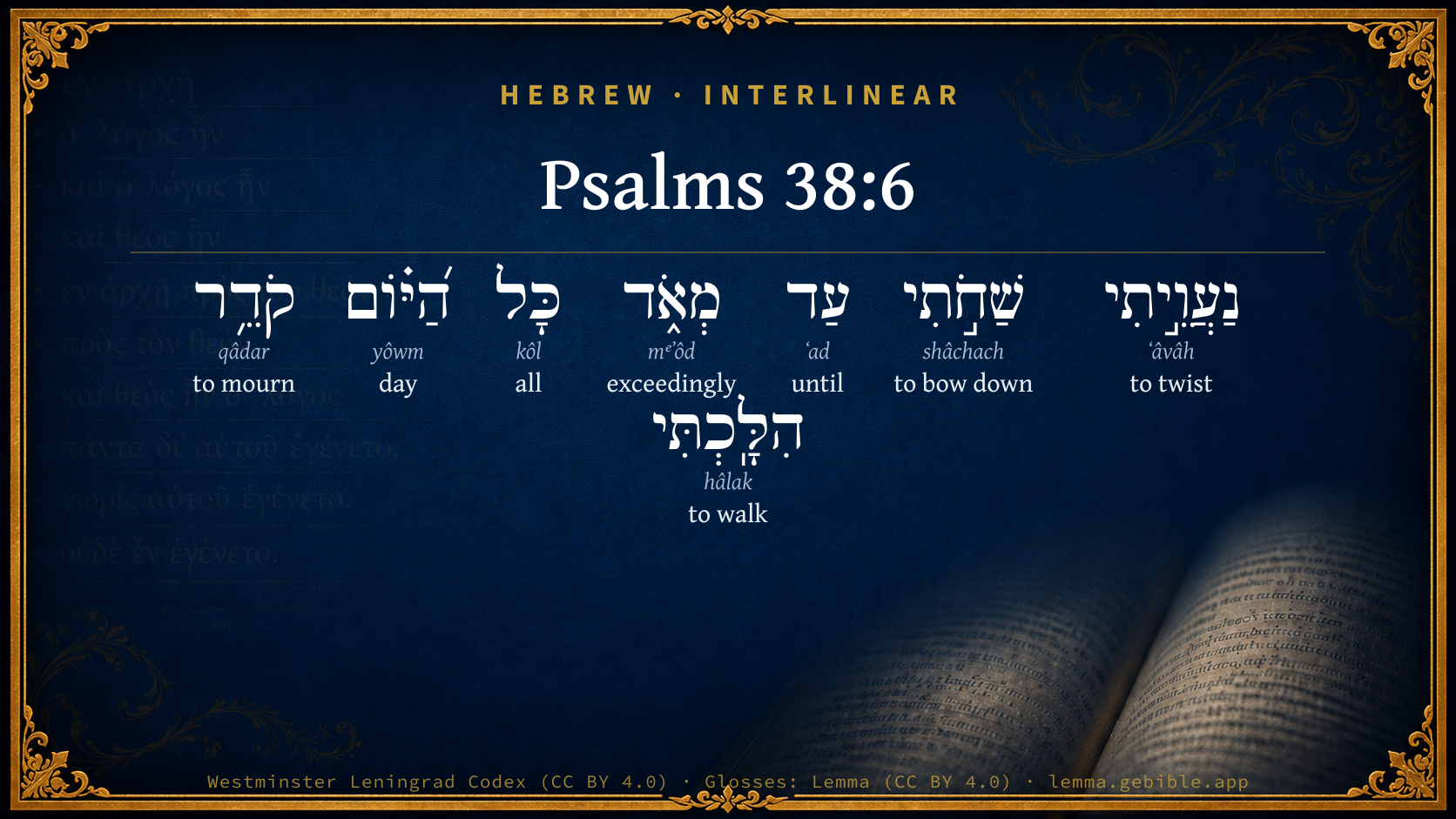
Hebrew (Westminster Leningrad Codex) Psalms 38:6 appears in the Hebrew Old Testament. The text above is from the Westminster Leningrad Codex. Each word links to its Strong’s number, a concise gloss, and parsing drawn from the Open Scriptures Hebrew Bible morphology. Click any word for its full Brown-Driver-Briggs (BDB) entry.
Download image
Cite this verse

Psalms 38:6 (World English Bible). Public Domain. Lemma interlinear Bible study tool, https://lemma.gebible.app/v/psalms/38/6.

Show BibTeX & RIS
BibTeX
RIS
English Translation
I am pained and bowed down greatly. I go mourning all day long.
World English Bible · Public Domain
Download a study sheet

One document with this verse’s original text, its word-by-word gloss line, the meaning frame, cross-references with their text, attributed commentary, and full source and license credits — printable, and it pastes into notes with its structure intact.

This verse Autodidact and up

Study sheet (.html) Plain text (.txt)

A passage Seminary Student

Up to 50 verses in one chapter. A passage sheet keeps up to 6 commentary sources and 12 cross-references per verse, in the order this page ranks them, and says so on the sheet whenever that leaves anything out. Ask for a single verse and you get the Autodidact verse sheet above.

Everything on this page stays free to read, with no account — the sheet is a download of what is already on screen, not access to it.

Want to remove ads? Support Godless Engineer
Compare translations 3

The same verse in 3 English versions, stacked beneath the original-language interlinear above. Click any original word for its lexicon entry.

Each is an independent rendering of the whole verse — the interlinear is not word-aligned to these translations.

Highlighted words mark where these versions differ — a whole-verse word diff, not a word-by-word alignment.

  • World English Bible Public Domain
    I am pained and bowed down greatly. I go mourning all day long.
  • King James Version Public Domain
    I am troubled; I am bowed down greatly; I go mourning all the day long.
  • unfoldingWord Literal Text CC BY-SA 4.0
    I am twisted; I am bowed down exceedingly; all the day I go about mourning.

unfoldingWord Literal Text — © unfoldingWord, licensed CC BY-SA 4.0. Word-aligned USFM3 via Door43 (git.door43.org/unfoldingWord/en_ult).

Versions to compare (up to 4)

3 of 4 selected

Show all 18 translations

Every available English version of this verse, each an independent rendering of the whole verse.

  • World English Bible Public Domain
    I am pained and bowed down greatly. I go mourning all day long.
  • Berean Standard Bible Public Domain
    I am bent and brought low; all day long I go about mourning.
  • Majority Standard Bible Public Domain
    I am bent and brought low; all day long I go about mourning.
  • King James Version Public Domain
    I am troubled; I am bowed down greatly; I go mourning all the day long.
  • American Standard Version (1901) Public Domain
    I am pained and bowed down greatly; I go mourning all the day long.
  • Revised Version (1885) Public Domain
    I am pained and bowed down greatly; I go mourning all the day long.
  • Geneva Bible (1599) Public Domain
    I am bowed, and crooked very sore: I goe mourning all the day.
  • Douay-Rheims (1899) Public Domain
    My sores are putrified and corrupted, because of my foolishness.
  • Young's Literal Translation Public Domain
    I have been bent down, I have been bowed down -- unto excess, All the day I have gone mourning.
  • Literal Standard Version CC BY-SA 4.0
    I have been bent down, || I have been bowed down—to excess, || I have gone mourning all the day.
  • Unlocked Literal Bible CC BY-SA 4.0
    I am stooped over and humiliated every day; I go about mourning all day long.
  • unfoldingWord Literal Text CC BY-SA 4.0
    I am twisted; I am bowed down exceedingly; all the day I go about mourning.
  • Darby Bible Public Domain
    I am depressed; I am bowed down beyond measure; I go mourning all the day.
  • World Messianic Bible Public Domain
    I am in pain and bowed down greatly. I go mourning all day long.
  • Webster's Bible Public Domain
    \\38:5\\My wounds are offensive, and are corrupt because of my foolishness.
  • Free Bible Version CC BY-SA 4.0
    I am bent over, doubled up in pain. The whole day I walk around crying my eyes out.
  • Bible in Basic English Public Domain
    I am troubled, I am made low; I go weeping all the day.
  • JPS Tanakh (1917) Public Domain
    (38-7) I am bent and bowed down greatly; I go mourning all the day.

Literal Standard Version (2020), Covenant Press — licensed CC BY-SA 4.0. Text via the HelloAO Bible API (eBible.org). Unlocked Literal Bible (unfoldingWord) — licensed CC BY-SA 4.0. Text via the HelloAO Bible API (eBible.org). unfoldingWord Literal Text — © unfoldingWord, licensed CC BY-SA 4.0. Word-aligned USFM3 via Door43 (git.door43.org/unfoldingWord/en_ult). Free Bible Version, Dr. Jonathan Gallagher — licensed CC BY-SA 4.0. Text via the HelloAO Bible API (eBible.org).

Word by word

More ways to search: Search by grammar → Find every occurrence → Compare this word →

Practice this passage: Drill this verse → Learn its vocabulary →

About this verse

These counts appear in no published source. They are computed here, from the morphology-tagged text and Lemma’s own curated glosses. What Lemma adds →

8
words
8
distinct lemmas
Wisdom
section

Notable vocabulary

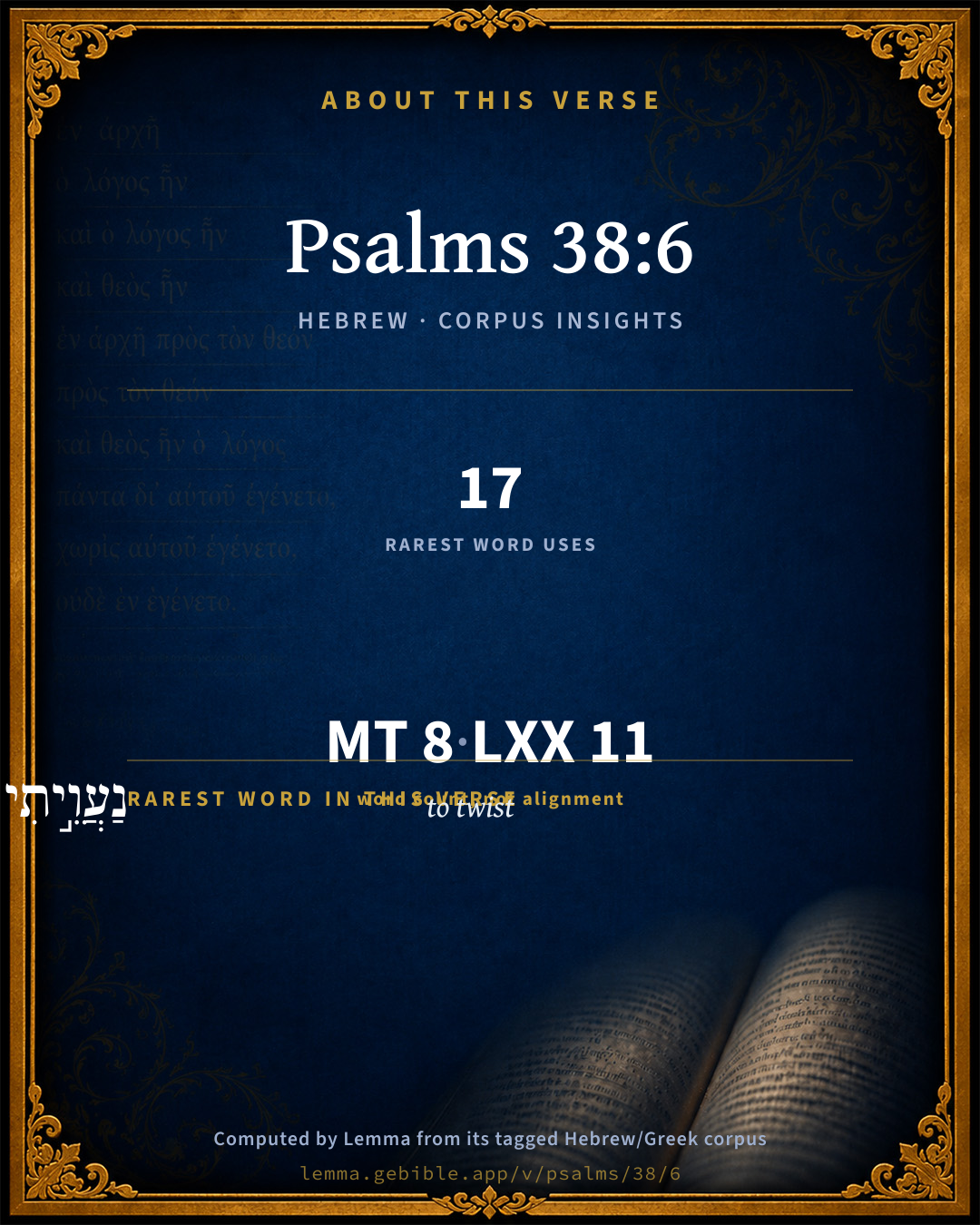
The rarest word here is נַעֲוֵ֣יתִי to twist H5753 — appearing just 17 times in the whole Hebrew Bible.

Shared distinctive vocabulary

נַעֲוֵ֣יתִי to twist H5753 occurs in 17 verses of the Hebrew Bible. Also found in:

Grammatical profile

  • 4 verbs
  • 2 nouns
  • 1 preposition
  • 1 adverb

Verb forms

  • נַעֲוֵ֣יתִי Niphal · Perfect
  • שַׁחֹ֣תִי Qal · Perfect
  • קֹדֵ֥ר Qal · Participle Active
  • הִלָּֽכְתִּי Piel · Perfect

Hebrew & Septuagint length

In English translation the verse runs 13 words from the Hebrew and 17 from the Septuagint (LXX English) — closely comparable.

A rough comparison of the two English renderings, which tokenize alike — not a word-level alignment.

Word counts can differ between the Hebrew and the Greek without any difference in meaning — e.g. the Hebrew direct-object marker אֵת has no separate Greek word, and Greek often adds the article ὁ.

In the original languages it is 8 Hebrew tokens and 11 Greek tokens — but the two are counted differently (Hebrew bundles its prefixes and suffixes into one token; the Greek is in lemma form), so that isn’t a like-for-like length.

Cross-references

11

Topical passages linked to Psalms 38:6 in the Treasury of Scripture Knowledge — connected by theme and wording, ordered by reader-vote popularity; previews shown in the World English Bible.

  • Job 30:28 I go mourning without the sun. I stand up in the assembly, and cry for help.
  • Psalms 35:14 I behaved myself as though it had been my friend or my brother. I bowed down mourning, as one who mourns his mother.
  • Psalms 42:9 I will ask God, my rock, "Why have you forgotten me? Why do I go mourning because of the oppression of the enemy?"
  • Psalms 31:10 For my life is spent with sorrow, My years with sighing. My strength fails because of my iniquity. My bones are wasted away.
  • Psalms 42:5 Why are you in despair, my soul? Why are you disturbed within me? Hope in God! For I shall still praise him for the saving help of his presence.
  • Psalms 43:2 For you are the God of my strength. Why have you rejected me? Why do I go mourning because of the oppression of the enemy?
  • Psalms 145:14 Yahweh upholds all who fall, And raises up all those who are bowed down.
  • Psalms 6:6 I am weary with my groaning; Every night I flood my bed; I drench my couch with my tears.
  • Psalms 57:6 They have prepared a net for my steps. My soul is bowed down. They dig a pit before me. They fall into the midst of it themselves. Selah.
  • Psalms 88:9 My eyes are dim from grief. I have called on you daily, Yahweh. I have spread out my hands to you.
  • Isaiah 38:14 Like a swallow [or] a crane, so did I chatter; I did moan as a dove; my eyes fail [with looking] upward: Lord, I am oppressed, be my collateral.

Cross-references courtesy of OpenBible.info (CC BY 4.0).

Hebrew and Greek witnesses Masoretic Hebrew ↔ Greek Septuagint

The same verse in the two great witnesses to the Old Testament, shown verse-for-verse.

You’re reading Greek Psalm 37 (Hebrew Psalm 38). The Septuagint counts the superscription, so verse numbers can differ from the Hebrew — chapter-level alignment, not verse-by-verse. Numbering follows Rahlfs.

These are two independent witnesses, not word-aligned to each other, and the Septuagint is shown in lemma (dictionary) form.

Hebrew Psalms 38:6 Masoretic · Westminster Leningrad Codex

נַעֲוֵ֣יתִי שַׁחֹ֣תִי עַד מְאֹ֑ד כָּל הַ֝יּ֗וֹם קֹדֵ֥ר הִלָּֽכְתִּי

I am pained and bowed down greatly. I go mourning all day long.

World English Bible · Public Domain

Greek LXX Greek Psalm 37:6 Septuagint · lemma form

προςὄζω καί σήπω ὁ μώλωψ ἐγώ ἀπό πρόσωπον ὁ ἀφροσύνη ἐγώ

I have been wretched and bowed down continually: I went with a mourning countenance all the day.

LXX2012 (modern English Septuagint) · Public Domain

Hebrew: Westminster Leningrad Codex (CC BY 4.0). Greek: Septuagint (public domain); English from LXX2012 (modern English Septuagint) (Public Domain). How the Septuagint differs from the Hebrew →

Commentary

Notes on Psalms 38:6 from classic Christian and Jewish commentators (each source and its license shown beneath its notes). The classic Christian expositions comment on the surrounding passage and are grouped to its opening verse, so a note may address several verses; the Jewish commentaries on the Tanakh (Rashi and others) are per-verse, so they appear only where the commentator wrote on this verse.

Lemma curates 59 commentaries, every one of them public domain or Creative Commons licensed, each selected and text-cleaned for this edition rather than reprinted as found. About our sources →

Trapp's Complete Commentary

John Trapp

Psa 38:6 I am troubled; I am bowed down greatly; I go mourning all the day long.

Ver. 6. I am troubled (Heb. wryed;) I am bowed down, &c.] Incurvus et prorsus obstipus, atroque vultu squallidus, vix corpus traho, I am a pitiful poor creature, and in a most heavy condition, as appeareth by my gait, my gesture, my looks, and habit. See Psa 35:14.

John Trapp, A Commentary or Exposition upon All the Books of the Old and New Testament (1647–1656) — public domain. Text from a community e-Sword module.

The Biblical Illustrator

Joseph S. Exell

Psa_38:6

I am troubled; I am bowed down greatly: I go mourning all the day long.

On religious despondency

Those who have lived without Christ and only unto themselves, whether in greater or less degree, are apt, when brought to serious spiritual concern, to fall into despondency.

I. To describe this despondency. They are under a delusion, they imagine all things are against them; they become restless, nervous, averse to all exertion; agitated in mind, neglect all duty; they sink into listless melancholy. And all this makes them worse. The worldly prescribe dissipation and amusement for them. They themselves attempt by austerities, or religious reading, to get relief. The Bible does not help them. They think themselves to be becoming more and more odious in the sight of God. Some try to turn them from all religious thought; others censure them severely. But all the while the soul only becomes confirmed in its distress,

II. Consider how a cure is to be wrought.

1. By seeing to it that repentance is real.

2. By assurance that God will have mercy upon him.

III. Hindrances to the reception of these truths.

1. Some urge that they have sinned beyond all hope of mercy.

2. Others think that they have committed the sin against the Holy Ghost. But the very fact of their repentance disproves that, for repentance is the gift of the Holy Ghost. He, therefore, cannot have forsaken them.

3. Others despair because they have led others into sin. But so did Aaron, Manasseh, Paul, and in short all great sinners; but yet they found forgiveness.

4. Others conclude that as they have been so long time without comfort and peace, though sincere in seeking it, therefore it cannot be designed for them.

5. Yet others are darkened still more by erroneous doctrine. They deem themselves predestined to wrath.

IV. Practical suggestions to the desponding. Read the Bible as a whole. Regard your sins as reasons for humility and watchfulness, not as preventing forgiveness. If despondency recur, regard it as your trial and temptation, and resist it (Psa_57:7-10). Take care of your bodily health. Keep calm and quiet. Be actively and usefully employed. (Thomas Gisborne, M. A.)

The Biblical Illustrator, edited by Joseph S. Exell (c. 1880s–1900s) — public domain. Text from a community e-Sword module.

J. A. Alexander on Psalms

Joseph Addison Alexander

7. (Psa 38:6). I have writhed, I have bowed down greatly; all the day mourning I have gone. The first word is a passive, meaning strictly to be twisted or distorted, elsewhere metaphorically applied to moral obliquity or perverseness (Pro 12:8, 1Sa 20:30), but here used in its proper sense to signify the distortion of the body by extreme pain, as in Isa 21:3. The bowing or bending down may be from the same cause, or as a customary sign of grief. Indeed, the two ideas of sorrow and bodily pain run into each other throughout this passage. The word translated mourning properly means black, or more specifically, black with dirt, begrimmed, or squalid, in allusion to the ancient oriental custom of sitting in the dust and putting ashes on the head, as signs of mourning. See above, on Psa 35:14. Greatly. The Hebrew phrase means until very much, or unto extremity. With all thy strength, is generally used as an adverb answering to very, greatly, or exceedingly, in English. I have gone. The Hebrew, verb is an intensive form, nearly equivalent to gone about in English. For a still stronger intensive from the same root, see above, on Ps.. 26:3, 35:14, in the last of which places we have also the words here translated bowed down and mourning.

Joseph Addison Alexander, The Psalms Translated and Explained (1850) — public domain. Text from a community e-Sword module.

Geneva Bible (1599)

Geneva Bible translators

Or, black as one that is disfigured and consumed with sickness.

Geneva Bible (1599) marginal notes — public domain. Text via Bolls.life.

Adam Clarke's Commentary

Verse 6. I am troubled] In mind. I am bowed down - in body. I am altogether afflicted, and full of distress.

Adam Clarke's Commentary on the Bible (1810–1826) — public domain. Text from a community e-Sword/MySword module.

John Calvin's Commentaries

6 I am bent This description clearly shows that this holy man was oppressed with extreme grief, so much so, that it is marvellous how, under such a vast accumulation of miseries, his faith was sufficiently strong to bear up his mind. When he says bowed down, he seems tacitly to contrast his humility and dejection with the pride and stubbornness of many, who refuse to be humbled by the many chastisements with which God afflicts them, but rather harden themselves, daring to resist and oppose him. They must, no doubt, of necessity, feel the pain of their afflictions, but they fall into such a state of insensibility, that they are not affected by it. David then, from this circumstance, draws an argument to induce his heavenly Judge to have compassion on him, showing that he was not one of those who obstinately rebel against him, and refuse to bow in humble submission, even while the hand of God is upon them; but that he is abased and humbled, even as the Apostle Peter exhorts all the godly to

“humble themselves under the mighty hand of God.” (1 Peter 5:6)

Let us therefore learn, that there is no other way by which we can obtain consolation under our afflictions, than by laying aside all stubbornness and pride, and humbly submitting to the chastisement of God. The word כודר, koder, which I have translated black, is rendered by others clad in black, and explained as referring to the outward apparel, the black color of which has always been a token of grief. But the opinion of those who understand it of the blackness of the skin is more correct; for we know that grief renders men’s countenances lean, wan, and black. David, therefore, by this token of grief, describes the greatness of his affliction, because the natural color of his face had faded, and he was like a corpse, already withered and shrunk.

John Calvin's Commentaries (1540-1563) — public domain. Text from the Calvin Translation Society English edition (1840s-50s) via the Christian Classics Ethereal Library (ccel.org). Calvin's coverage is partial (roughly two-thirds of the Bible); uncommented books and verses are honest gaps, never fabricated. The 19th-century editor's footnotes and remarks are omitted so the notes are faithfully Calvin's own voice.

Ellicott's Commentary for English Readers

(6) I am troubled.—Better,

I am made to writhe (see margin),

I am bowed down exceedingly,

All day long I go about squalid.

(See Psa_35:14, and comp. Isa_21:3.) The usual Oriental signs of mourning are alluded to in the last clause.

A Bible Commentary for English Readers, edited by Charles John Ellicott (1878–1897) — public domain. Text from a community e-Sword module.

The Cambridge Bible for Schools and Colleges

gen. ed. J. J. S. Perowne

6. I am bent, I am bowed down exceedingly, as one whose frame is contracted and drawn together by pain, or whose gestures indicate mental anguish. Cp. Psa_35:14; Isa_21:3. Notice the vigorous archaism wried in A.V. margin, i.e. twisted.

mourning] In the guise of a mourner. See note on Psa_35:14.

In later times at any rate it was customary for the accused to appear before the court in mourning. “Whosoever comes before this court of the Sanhedrin to take his trial, presents himself in the guise of humility and fear, appealing to your compassion, with hair neglected, and clad in black garments.” (Josephus, Antiq. xiv. 9. 3). If the custom prevailed in earlier times, in mourning garb may suggest that he feels himself, like Job, under the divine accusation. Cp. Zec_3:1 ff.

The Cambridge Bible for Schools and Colleges (gen. ed. J. J. S. Perowne; Cambridge University Press, 1878–1918) — public domain. Text from a community e-Sword module.

John Gill's Exposition

For my loins are filled with a loathsome disease,.... The word here used has the signification of burning (k); and the Targum renders it, "my loins are filled with burning"; a burning fever was upon him, or there was an inflammation in those parts; a hot burning ulcer, which might be nauseous; and so was true in both senses. Aben Ezra interprets it abominable and vile; something not fit to be mentioned; and so Kimchi and Ben Melech. The word is rendered sometimes "lightly esteemed"; as in Sa1 18:23; and Jarchi thinks it has this sense here; and the meaning is, that he was vile in his own eyes, and mean in his own esteem. Doubtless the psalmist has reference to something more than a bodily disease; at least not to that only, but to the disease of his soul also, sin, which has the nature of a disease; it is an hereditary one, which is derived from one to another by propagation; it is universal, and reaches to all men, and to all the parts of the body and powers of the soul; it is a complication of disorders: it is in its own nature mortal, and ever incurable but by Christ; and, as here, it is a loathsome one; it is loathsome to God, and to all sensible sinners: and when the psalmist says his loins were filled with it, it may signify that it was an internal disorder that was in him; sin that dwelt in him, a law in his members; and may denote the aboundings of sin in him, the swarms of corruptions that were in him; as also the pain it gave him, and the quick sense he had of it;

and there is no soundness in my flesh: which is repeated, see Psa 38:3; partly for confirmation's sake, and partly to show the continued sense of it, as persons under a disorder are continually making mention of it.

(k) R. Joseph Kimchi & Abendana "ardore", Pagninus, Vatablus; "ardens ulcus", Musculus, so some in Vatablus; "tostione", Piscator; "adustione", Gejerus; so the Targum; "adusto", Gussetius, Ebr. Comment. p. 742.

John Gill's Exposition of the Whole Bible (1746–1763) — public domain (CC PDM 1.0). Text via the HelloAO Bible API.

Albert Barnes' Notes on the Bible

I am troubled - Margin, “wearied.” The Hebrew word means to bend, to curve; then, to be distorted, to writhe with pain, convulsions, and spasms. In Isa 21:3, the same word is rendered, “I was bowed down at the hearing of it;” that is, Sorrow so took hold of him, that at the intelligence he writhed with pain as a woman in travail. So here it means that he was bent, or bowed down, or that he writhed in pain as the result of his iniquities.

I am bowed down greatly - Compare Psa 35:14. The word means properly to bow down; then, to be brought low; to be depressed with pain, grief, sorrow: Psa 10:10; Isa 2:11.

I go mourning all the day long - Constantly; without any intermission. On the word rendered “go mourning” - קדר qâdar - see the notes at Psa 35:14. The idea here is, that, on account of sin, he was crushed and bowed down as a mourner is with his sorrows, and that he appeared constantly as be walked about with these badges of grief and heavy sorrow. The disease which he had, and which was so offensive to himself Psa 38:5, and to others Psa 38:11, was like the filthy and foul garments which mourners put on as expressive of their sorrow. See Job 1:20, note; Job 2:8, note.

Albert Barnes' Notes on the Bible (1834–1885) — public domain. Text from a community e-Sword/MySword module.

Matthew Poole's English Annotations

Troubled, Heb. distorted, or depressed; or, as it is expressed by another word, signifying the same thing,

bowed down, to wit, in my body, as diseased persons commonly are, and withal dejected in my mind. I go mourning, Heb. in black, the sign of mourning, which may here signify the thing, as signs oft do. When for my ease I rise out of my bed and walk, or rather creep about in my chamber, I do it with a sad heart and dejected countenance. Or if he did walk further, his disease had some intervals and mitigations. Or going may be here meant of his languishing, or going towards the grave, as this same word is used, Gen 15:2, compared with Gen 25:32; Jos 23:14.

Matthew Poole's English Annotations on the Holy Bible (1683–1685) — public domain. Text from a community e-Sword/MySword module.

The Treasury of David

Charles H. Spurgeon

Ver. 6. I am troubled. I am wearied with distress, writhing with pain, in sore travail on account of sin revealed within me. I am bowed down greatly. I am brought very low, grievously weakened and frightfully depressed. Nothing so pulls a man down from all loftiness as a sense of sin and of divine wrath concerning it. I go mourning all the day long. The mourner's soul sorrow knew no intermission, even when he went about such business as he was able to attend, he went forth like a mourner who goes to the tomb, and his words and manners were like the lamentations of those who follow the corpse. The whole verse may be the more clearly understood if we picture the Oriental mourner, covered with sackcloth and ashes, bowed as in a heap, siting amid squalor and dirt, performing contortions and writhings expressive of his grief; such is the awakened sinner, not in outward guise, but in very deed.

Ver. 6. I am troubled. I writhe with pain. This is the proper sense of the original, which means to "turn out of its proper situation, or course; "thence to be "distorted, writhed, "as a person in pain. Our Bible translation, which says in the text, I am troubled, adds in the margin, "wried, "an obsolete word, correctly expressing the Hebrew. Richard Mant.

Ver. 6. I go mourning all the day long. And now was I both a burden and a terror to myself, nor did I ever so know, as now, what it was to be weary of my life, and yet afraid to die. Oh, how gladly now would I have been anybody but myself! Anything but a man! and in any condition but mine own! for there was nothing did pass more frequently over my mind than that it was impossible for me to be forgiven my transgression, and to be saved from wrath to come. John Bunyan, in "Grace Abounding."

Ver. 6. Let a man see and feel himself under the bonds of guilt, in danger of hell, under the power of his lusts, enmity against God, and God a stranger to him; let but the sense of this condition lie upon his heart, and let him go on in his jollity if he can. What a woeful creature doth a man see himself now to be! He envies the happiness of the beasts that are filled, and play in their pastures. We have heard of him who when he saw a toad, stood weeping, because God had made him a man, so excellent a creature, and not a toad, so abominable: the goodness of God, then, it seems, as he apprehended it, made him weep; but this man meets a toad, and he weeps also, but why? because he is a man who thinks his estate infinitely worse than the condition of a toad, and if it were possible to attain it, would change states with the toad, that hath no guilt of sin, fears no wrath of God, is not under power of lusts or creatures; God is not enemy to it, which is his miserable state. Giles Firmin, 1617-1697.

Ver. 6. Conviction of sin. Its grief, its depth, its continuance.

Ver. 6. I go mourning.

1. Unlawful reasons for mourning.

2. Legitimate themes for sorrow.

3. Valuable alleviations of grief.

Psalms 38:7*

Charles H. Spurgeon's The Treasury of David (1869–1885) — public domain. Psalms only. Text from a community e-Sword/MySword module.

Whedon's Commentary on the Bible

Daniel D. Whedon

6. I am troubled—Literally, I was bent, or writhed.

I am bowed down greatly—The writhing pains of his body caused him to bend together, and this was in sympathy with his dejected soul.

Daniel D. Whedon (gen. ed.), Commentary on the Old and New Testaments (1874–1909) — public domain. Text from a community e-Sword module.

The Pulpit Commentary

I am troubled; literally, bent; which some take physically, and explain as "twisted by violent spasms," others, psychically, as "warped in mind," "driven crazy." I am bowed down greatly; i.e. bowed to earth, crooked, as men are in extreme old age, or by such maladies as lumbago and rheumatism. I go mourning all the day long. My gait is that of a mourner I stoop and move slowly.

The Pulpit Commentary (1880–1919), ed. H.D.M. Spence-Jones & Joseph S. Exell — public domain. Text from a community e-Sword module.

Lesson kit

Teaching starters — assembled from the data on this page, not authored interpretation. Every prompt links to the verse data it draws on. Edit before teaching.

Psalms, in the Wisdom, opens this verse with 8 words (8 distinct Hebrew lemmas). Its most distinctive word is ʻâvâh (“to twist”). A historical commentator’s framing appears above. Read the whole chapter for the surrounding context.

Discussion questions

  1. What does “to twist” (ʻâvâh) contribute to the verse as a whole?
  2. How does 1 Samuel 20:30, which shares the word «to twist», read alongside this verse?
  3. These translations render this verse differently. What is at stake in choosing one wording over another?
  4. «נַעֲוֵ֣יתִי» is a Niphal Perfect verb. How does that grammatical form shape the action described?
  5. Compare how Trapp's Complete Commentary and The Biblical Illustrator read this verse. Where do they agree or differ?

Things to notice

Reading settings

Reading text

Shown beneath each verse's original-language words.

Old Testament
Old Testament edition

Read the OT as the Masoretic Hebrew (MT) or the Greek Septuagint (LXX).

English shown for the Greek Septuagint (in the Hebrew ↔ Greek comparison).

Comparing translations? Open the Compare panel on any verse page to stack up to four side by side.