
Jeremiah 50:39

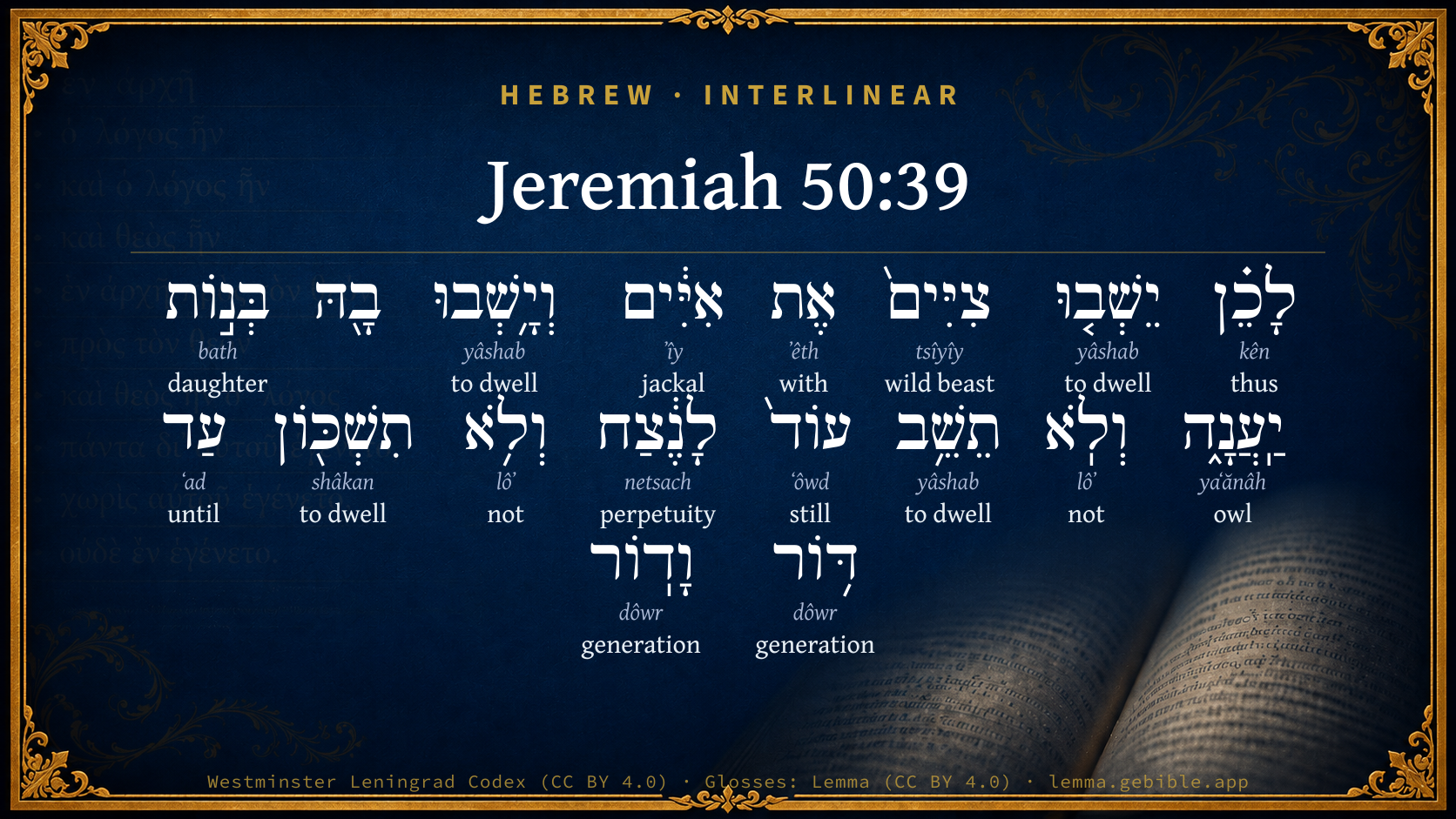
Hebrew (Westminster Leningrad Codex) Jeremiah 50:39 appears in the Hebrew Old Testament. The text above is from the Westminster Leningrad Codex. Each word links to its Strong’s number, a concise gloss, and parsing drawn from the Open Scriptures Hebrew Bible morphology. Click any word for its full Brown-Driver-Briggs (BDB) entry.
Download image
Cite this verse

Jeremiah 50:39 (World English Bible). Public Domain. Lemma interlinear Bible study tool, https://lemma.gebible.app/v/jeremiah/50/39.

Show BibTeX & RIS
BibTeX
RIS
English Translation
Therefore the wild animals of the desert with the wolves shall dwell there, and the ostriches shall dwell therein: and it shall be no more inhabited forever; neither shall it be lived in from generation to generation.
World English Bible · Public Domain
Download a study sheet

One document with this verse’s original text, its word-by-word gloss line, the meaning frame, cross-references with their text, attributed commentary, and full source and license credits — printable, and it pastes into notes with its structure intact.

This verse Autodidact and up

Study sheet (.html) Plain text (.txt)

A passage Seminary Student

Up to 50 verses in one chapter. A passage sheet keeps up to 6 commentary sources and 12 cross-references per verse, in the order this page ranks them, and says so on the sheet whenever that leaves anything out. Ask for a single verse and you get the Autodidact verse sheet above.

Everything on this page stays free to read, with no account — the sheet is a download of what is already on screen, not access to it.

Want to remove ads? Support Godless Engineer
Compare translations 3

The same verse in 3 English versions, stacked beneath the original-language interlinear above. Click any original word for its lexicon entry.

Each is an independent rendering of the whole verse — the interlinear is not word-aligned to these translations.

Highlighted words mark where these versions differ — a whole-verse word diff, not a word-by-word alignment.

  • World English Bible Public Domain
    Therefore the wild animals of the desert with the wolves shall dwell there, and the ostriches shall dwell therein: and it shall be no more inhabited forever; neither shall it be lived in from generation to generation.
  • King James Version Public Domain
    Therefore the wild beasts of the desert with the wild beasts of the islands shall dwell there, and the owls shall dwell therein: and it shall be no more inhabited for ever; neither shall it be dwelt in from generation to generation.
  • unfoldingWord Literal Text CC BY-SA 4.0
    So desert beasts with the jackals will inhabit there, and the young of ostriches will live in her. For all time, she will no longer be inhabited. From generation to generation, she will not be lived in.

unfoldingWord Literal Text — © unfoldingWord, licensed CC BY-SA 4.0. Word-aligned USFM3 via Door43 (git.door43.org/unfoldingWord/en_ult).

Versions to compare (up to 4)

3 of 4 selected

Show all 18 translations

Every available English version of this verse, each an independent rendering of the whole verse.

  • World English Bible Public Domain
    Therefore the wild animals of the desert with the wolves shall dwell there, and the ostriches shall dwell therein: and it shall be no more inhabited forever; neither shall it be lived in from generation to generation.
  • Berean Standard Bible Public Domain
    So the desert creatures and hyenas will live there and ostriches will dwell there. It will never again be inhabited or lived in from generation to generation.
  • Majority Standard Bible Public Domain
    So the desert creatures and hyenas will live there and ostriches will dwell there. It will never again be inhabited or lived in from generation to generation.
  • King James Version Public Domain
    Therefore the wild beasts of the desert with the wild beasts of the islands shall dwell there, and the owls shall dwell therein: and it shall be no more inhabited for ever; neither shall it be dwelt in from generation to generation.
  • American Standard Version (1901) Public Domain
    Therefore the wild beasts of the desert with the wolves shall dwell there, and the ostriches shall dwell therein: and it shall be no more inhabited for ever; neither shall it be dwelt in from generation to generation.
  • Revised Version (1885) Public Domain
    Therefore the wild beasts of the desert with the wolves shall dwell there, and the ostriches shall dwell therein: and it shall be no more inhabited for ever; neither shall it be dwelt in from generation to generation.
  • Geneva Bible (1599) Public Domain
    Therefore the Ziims with the Iims shall dwel there, and the ostriches shall dwel therein: for it shall be no more inhabited, neither shall it be inhabited from generation vnto generation.
  • Douay-Rheims (1899) Public Domain
    Therefore shall dragons dwell there with the fig fauns: and ostriches shall dwell therein, and it shall be no more inhabited for ever, neither shall it be built up from generation to generation.
  • Young's Literal Translation Public Domain
    Therefore dwell do Ziim with Iim, Yea, dwelt in her have daughters of the ostrich, And it is not inhabited any more for ever, Nor dwelt in unto all generations.
  • Literal Standard Version CC BY-SA 4.0
    Therefore desert-dwellers dwell with howlers, || Indeed, daughters of the ostrich have dwelt in her, || And it is not inhabited anymore forever, || Nor dwelt in from generation to generation.
  • Unlocked Literal Bible CC BY-SA 4.0
    So desert beasts with the jackals will inhabit there, and the young of ostriches will live in her. For all time, she will no longer be inhabited. From generation to generation, she will not be lived in.
  • unfoldingWord Literal Text CC BY-SA 4.0
    So desert beasts with the jackals will inhabit there, and the young of ostriches will live in her. For all time, she will no longer be inhabited. From generation to generation, she will not be lived in.
  • Darby Bible Public Domain
    Therefore wild beasts of the desert with jackals shall dwell there, and ostriches shall dwell therein; and it shall be no more inhabited for ever, neither shall it be dwelt in from generation to generation.
  • World Messianic Bible Public Domain
    Therefore the wild animals of the desert with the wolves will dwell there. The ostriches will dwell therein. It will be inhabited no more forever, neither will it be lived in from generation to generation.
  • Webster's Bible Public Domain
    Therefore the wild beasts of the desert with the wild beasts of the isles, shall dwell there, and the owls shall dwell therein: and it shall be no more inhabited for ever; neither shall it be dwelt in from generation to generation.
  • Free Bible Version CC BY-SA 4.0
    Consequently desert animals and hyenas will live there, and it will be a home for owls. It will be uninhabited forever—it won't be lived in from one generation to the next.
  • Bible in Basic English Public Domain
    For this reason the beasts of the waste land with the wolves will make their holes there and the ostriches will be living in it: never again will men be living there, it will be unpeopled from generation to generation.
  • JPS Tanakh (1917) Public Domain
    Therefore the wild-cats with the jackals shall dwell there, and the ostriches shall dwell therein; and it shall be no more inhabited for ever, neither shall it be dwelt in from generation to generation.

Literal Standard Version (2020), Covenant Press — licensed CC BY-SA 4.0. Text via the HelloAO Bible API (eBible.org). Unlocked Literal Bible (unfoldingWord) — licensed CC BY-SA 4.0. Text via the HelloAO Bible API (eBible.org). unfoldingWord Literal Text — © unfoldingWord, licensed CC BY-SA 4.0. Word-aligned USFM3 via Door43 (git.door43.org/unfoldingWord/en_ult). Free Bible Version, Dr. Jonathan Gallagher — licensed CC BY-SA 4.0. Text via the HelloAO Bible API (eBible.org).

Word by word

More ways to search: Search by grammar → Find every occurrence → Compare this word →

Practice this passage: Drill this verse → Learn its vocabulary →

אִיִּ֔ים
ʼîy
H338
“jackals”
Noun, Common, Masculine, Plural, Absolute
Part of Speech
Noun
Type
Common
Gender
Masculine
Number
Plural
State
Absolute
Full BDB Definition

Origin: probably identical with H337 (through the idea of a doleful sound)

TWOT: 43a

howling beast, jackal
  1. לָכֵ֗ן kên H3651 “to/for · thus” Preposition + Adverb
  2. יֵשְׁב֤וּ yâshab H3427 “to dwell” Verb, Qal, Imperfect, 3rd Person, Masculine, Plural
  3. צִיִּים֙ tsîyîy H6728 “wild beasts” Noun, Common, Masculine, Plural, Absolute
  4. אֶת ʼêth H854 “with” Preposition
  5. וְיָ֥שְׁבוּ yâshab H3427 “and · to dwell” Conjunction + Verb, Qal, Sequential Perfect, 3rd Person, Common, Plural
  6. בְּנ֣וֹת bath H1323 “daughters of” Noun, Common, Feminine, Plural, Construct
  7. יַֽעֲנָ֑ה yaʻănâh H3284 “owl” Noun, Common, Feminine, Singular, Absolute
  8. וְלֹֽא lôʼ H3808 “and · not” Conjunction + Particle, Negative
  9. תֵשֵׁ֥ב yâshab H3427 “to dwell” Verb, Qal, Imperfect, 3rd Person, Feminine, Singular
  10. עוֹד֙ ʻôwd H5750 “still” Adverb
  11. לָנֶ֔צַח netsach H5331 “to/for · perpetuity” Preposition + Noun, Common, Masculine, Singular, Absolute
  12. וְלֹ֥א lôʼ H3808 “and · not” Conjunction + Particle, Negative
  13. תִשְׁכּ֖וֹן shâkan H7931 “to dwell” Verb, Qal, Imperfect, 3rd Person, Feminine, Singular
  14. עַד ʻad H5704 “until” Preposition
  15. דּ֥וֹר dôwr H1755 “generation” Noun, Common, Masculine, Singular, Absolute
  16. וָדֽוֹר dôwr H1755 “and · generation” Conjunction + Noun, Common, Masculine, Singular, Absolute

About this verse

These counts appear in no published source. They are computed here, from the morphology-tagged text and Lemma’s own curated glosses. What Lemma adds →

18
words
13
distinct lemmas
Prophets
section

Notable vocabulary

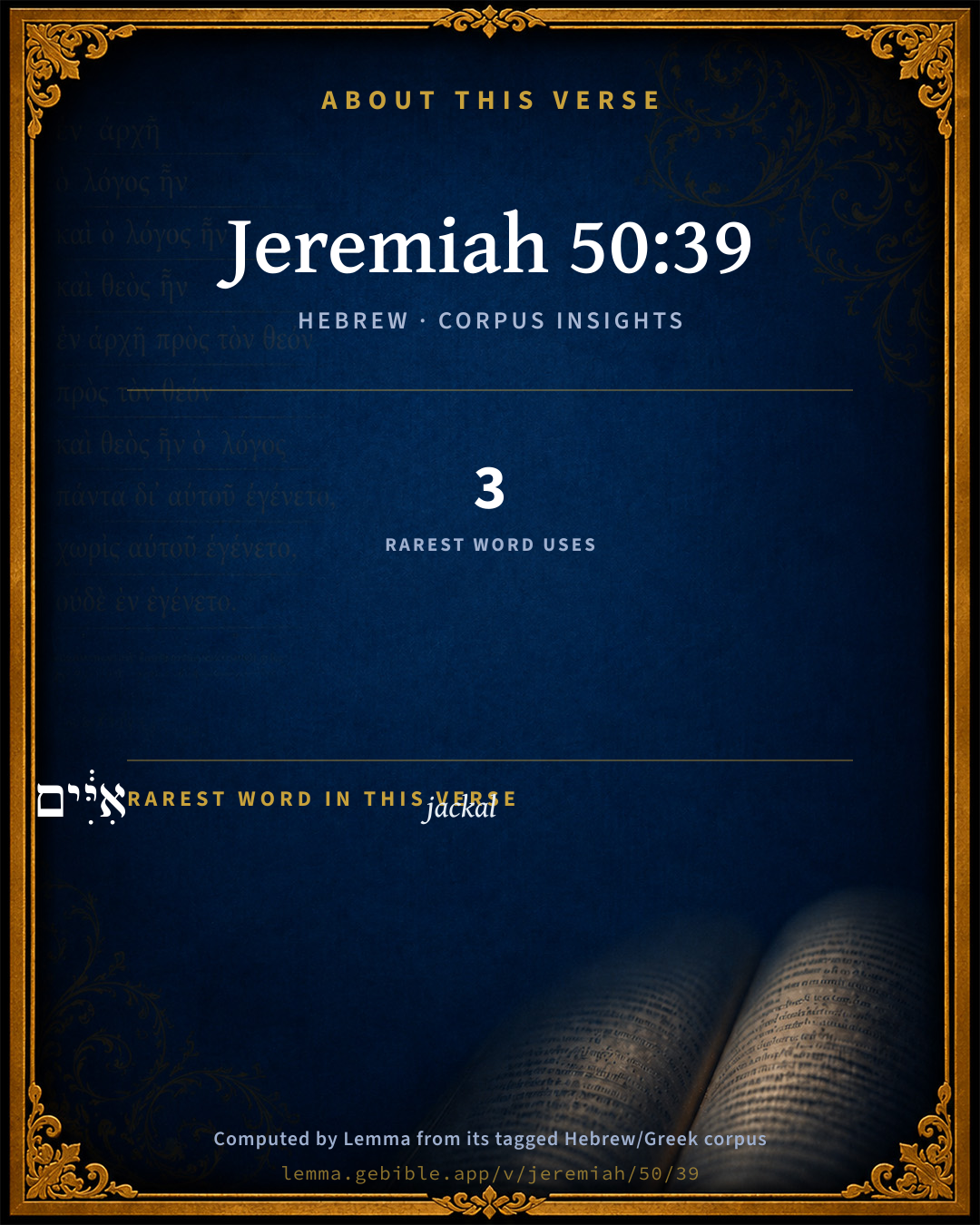
The rarest word here is אִיִּ֔ים jackal H338 — appearing just 3 times in the whole Hebrew Bible.

Shared distinctive vocabulary

אִיִּ֔ים jackal H338 occurs in 3 verses of the Hebrew Bible. Also found in:

Grammatical profile

  • 4 verbs
  • 7 nouns
  • 3 prepositions
  • 2 adverbs
  • 2 particles

Verb forms

  • יֵשְׁב֤וּ Qal · Imperfect
  • וְיָ֥שְׁבוּ Qal · Sequential Perfect
  • תֵשֵׁ֥ב Qal · Imperfect
  • תִשְׁכּ֖וֹן Qal · Imperfect

Repetition

Words recur within this verse — often emphatic in Hebrew:

  • יֵשְׁב֤וּ to dwell H3427 ×3
  • דּ֥וֹר generation H1755 ×2
  • וְלֹֽא not H3808 ×2

Cross-references

11

Topical passages linked to Jeremiah 50:39 in the Treasury of Scripture Knowledge — connected by theme and wording, ordered by reader-vote popularity; previews shown in the World English Bible.

  • Isaiah 13:20–22 It shall never be inhabited, neither shall it be lived in from generation to generation: neither shall the Arabian pitch tent there; neither shall shepherds make their flocks to lie down there.
  • Revelation 18:2 He cried with a mighty voice, saying, "Fallen, fallen is Babylon the great, and she has become a habitation of demons, a prison of every unclean spirit, and a prison of every unclean and hateful bird!
  • Jeremiah 25:12 It shall happen, when seventy years are accomplished, that I will punish the king of Babylon, and that nation, says Yahweh, for their iniquity, and the land of the Chaldeans; and I will make it desolate forever.
  • Isaiah 14:23 I will also make it a possession for the porcupine, and pools of water: and I will sweep it with the broom of destruction, says Yahweh of Hosts.
  • Isaiah 34:11–17 But the pelican and the porcupine shall possess it; and the owl and the raven shall dwell therein: and he will stretch over it the line of confusion, and the plummet of emptiness.
  • Jeremiah 50:12–13 your mother shall be utterly disappointed; she who bore you shall be confounded: behold, she shall be the least of the nations, a wilderness, a dry land, and a desert.
  • Jeremiah 51:26 They shall not take of you a stone for a corner, nor a stone for foundations; but you shall be desolate for ever, says Yahweh.
  • Jeremiah 51:37–38 Babylon shall become heaps, a dwelling-place for jackals, an astonishment, and a hissing, without inhabitant.
  • Jeremiah 51:43 Her cities are become a desolation, a dry land, and a desert, a land in which no man dwells, neither does any son of man pass thereby.
  • Jeremiah 51:62–64 and say, Yahweh, you have spoken concerning this place, to cut it off, that none shall dwell therein, neither man nor animal, but that it shall be desolate forever.
  • Revelation 18:21–24 A mighty angel took up a stone like a great millstone and cast it into the sea, saying, "Thus with violence will Babylon, the great city, be thrown down, and will be found no more at all.

Cross-references courtesy of OpenBible.info (CC BY 4.0).

Hebrew and Greek witnesses Masoretic Hebrew ↔ Greek Septuagint

The same verse in the two great witnesses to the Old Testament, shown verse-for-verse.

These are two independent witnesses, not word-aligned to each other, and the Septuagint is shown in lemma (dictionary) form.

Hebrew Jeremiah 50:39 Masoretic · Westminster Leningrad Codex

לָכֵ֗ן יֵשְׁב֤וּ צִיִּים֙ אֶת אִיִּ֔ים וְיָ֥שְׁבוּ בָ֖הּ בְּנ֣וֹת יַֽעֲנָ֑ה וְלֹֽא תֵשֵׁ֥ב עוֹד֙ לָנֶ֔צַח וְלֹ֥א תִשְׁכּ֖וֹן עַד דּ֥וֹר וָדֽוֹר

Therefore the wild animals of the desert with the wolves shall dwell there, and the ostriches shall dwell therein: and it shall be no more inhabited forever; neither shall it be lived in from generation to generation.

World English Bible · Public Domain

Greek LXX Structure differs

In the Septuagint, Jeremiah is about an eighth shorter than the Hebrew and arranges its material differently — the Oracles Against the Nations (Hebrew chapters 46–51) appear in the middle of the Greek book, after 25:13. Because the chapter and verse boundaries do not line up, a verse-for-verse comparison with the Hebrew is not shown.

A verse-for-verse comparison isn’t shown here because the chapters and verses don’t line up. Switch to the LXX edition with the MT / LXX toggle above to read the Greek directly.

Hebrew: Westminster Leningrad Codex (CC BY 4.0). Greek: Septuagint (public domain); English from a public-domain English Septuagint. How the Septuagint differs from the Hebrew →

Targum (Aramaic paraphrase)

1

The Targum is the ancient Jewish Aramaic paraphrase of the Hebrew Scriptures — an interpretive translation, not the Hebrew text itself. Onkelos (literal) and Pseudo-Jonathan (expansive) render the Torah, and Jonathan the Prophets. Coverage is partial: where no permissively-licensed English translation exists for a verse, only the Aramaic is shown. This is verse-level text, not a word-by-word alignment to the Hebrew.

  1. Targum Jonathan Prophets (Joshua–Malachi)
    בְּכֵן יְעַרְעָן תַּמְוָן בַּחֲתוּלִין וְיִשְׁרוּן בָּה בְּנַת נַעֲמִין וְלָא תִתֵּב עוֹד לַעֲלָם וְלָא תִשְׁרֵי עַד דָר וְדָר:

    (no public-domain English translation for this verse)

    Targum Jonathan — Aramaic: “Mikraot Gedolot” (public domain). English: “Sefaria Community Translation” (CC0 1.0 (public-domain dedication)); “London "Chaldee Paraphrase," 1871” (public domain). Text via Sefaria.

Commentary

Notes on Jeremiah 50:39 from classic Christian and Jewish commentators (each source and its license shown beneath its notes). The classic Christian expositions comment on the surrounding passage and are grouped to its opening verse, so a note may address several verses; the Jewish commentaries on the Tanakh (Rashi and others) are per-verse, so they appear only where the commentator wrote on this verse.

Lemma curates 59 commentaries, every one of them public domain or Creative Commons licensed, each selected and text-cleaned for this edition rather than reprinted as found. About our sources →

Trapp's Complete Commentary

John Trapp

Jer 50:39 Therefore the wild beasts of the desert with the wild beasts of the islands shall dwell [there], and the owls shall dwell therein: and it shall be no more inhabited for ever; neither shall it be dwelt in from generation to generation.

Ver. 39. Therefore the wild beasts of the desert.] See Isa 13:21.

John Trapp, A Commentary or Exposition upon All the Books of the Old and New Testament (1647–1656) — public domain. Text from a community e-Sword module.

Tyndale Open Study Notes

Tyndale Open Resources

50:39-40 The doom of Babylon would be like the utter desolation of Sodom and Gomorrah (Gen 19:24-25).

Tyndale Open Study Notes — © Tyndale Open Resources, licensed CC BY-SA 4.0. Text via the HelloAO Bible API.

Geneva Bible (1599)

Geneva Bible translators

Read Isa. 13:21.

Hebrew, sons of the ostriches, or young.

Geneva Bible (1599) marginal notes — public domain. Text via Bolls.life.

Jamieson, Fausset & Brown

Robert Jamieson, A. R. Fausset & David Brown

wild beasts of the desert--wild cats, remarkable for their howl [BOCHART].

wild beasts of the islands--jackals (See on Isa 13:21).

owls--rather, "female ostriches"; they delight in solitary places. Literally, "daughters of crying." Compare as to spiritual Babylon, Rev 18:2.

no more inhabited for ever--The accumulation of phrases is to express the final and utter extinction of Babylon; fulfilled not immediately, but by degrees; Cyrus took away its supremacy. Darius Hystaspes deprived it, when it had rebelled, of its fortifications. Seleucus Nicanor removed its citizens and wealth to Seleucia, which he founded in the neighborhood; and the Parthians removed all that was left to Ctesiphon. Nothing but its walls was left under the Roman emperor Adrian.

Jamieson, Fausset & Brown — Commentary Critical and Explanatory on the Whole Bible (1871) — public domain (CC PDM 1.0). Text via the HelloAO Bible API.

Adam Clarke's Commentary

Verse 39. The wild beasts of the desert] Dahler translates these various terms, "The wild cats, the jackals, and the ostriches." And Blayney the same. Wicklif, "Dragons, woodewoses, and ostriches." Coverdale, "Wild beestes, apes, and estriches."

Adam Clarke's Commentary on the Bible (1810–1826) — public domain. Text from a community e-Sword/MySword module.

John Calvin's Commentaries

The birds of the forest with the beasts of the forest, are rendered by some, “the satyrs with the fairies;” but איים, aiim, as well as ציים, tsiim, are, on the contrary, birds or beasts of the forest. Some render איים, aiim, “cats ” I hold no controversy as to these words — let there be a free judgment to every one; but, as we have elsewhere seen, the Prophet means birds and beasts of the forest, rather than satyrs and fairies. Then he adds, the daughters of the ostriches, rendered by some “of the owls;” but about this name also I will not contend. Some then render יענה, ione, “owl,” and refinedly explain that “daughters” are mentioned, because these birds forsake their young, when they howl through want or famine; but this is fictitious. I then take the daughters of the ostriches or of the owls, according to the usual manner of the language, to mean the very birds themselves.

The Prophets usually speak thus, when they give no hope. We have said before, that Babylon was not then so laid waste, but that men dwelt there, who afterwards lived in great luxury; for the city, under Cyrus and his son, was always populous; and then, after its revolt, it was again inhabited; and when Alexander subdued Asia, Babylon was full of people, and flourished in luxury and wealth; and when he died there, he left the city very opulent. We hence, then, conclude, that what Jeremiah declares here, was not immediately fulfilled. But as the light or moderate punishments which the unbelieving suffer now are certain preludes of final and eternal destruction; so the Prophets, when speaking of God’s vengeance, ever extend what they say to the last overthrow; and this also appears more clearly from the next verse, where it is said, —

John Calvin's Commentaries (1540-1563) — public domain. Text from the Calvin Translation Society English edition (1840s-50s) via the Christian Classics Ethereal Library (ccel.org). Calvin's coverage is partial (roughly two-thirds of the Bible); uncommented books and verses are honest gaps, never fabricated. The 19th-century editor's footnotes and remarks are omitted so the notes are faithfully Calvin's own voice.

Ellicott's Commentary for English Readers

(39) Wild beasts of the desert . . .—The combination of the two forms of animal life seems taken from Isa_13:21-22. In the original the two words tziyyim and iiyyim have a kind of emphatic assonance. The English word in the first case answers to the etymology, but the animal referred to has been identified by some naturalists with the wild cats, which appear from Bar_6:22 to have abounded in Babylon. In the second word the Authorised version follows a wrong etymology. Strictly the word means “howlers,” and should be translated “jackals.” For “owls” read “ostriches,” as in Isa_13:21.

A Bible Commentary for English Readers, edited by Charles John Ellicott (1878–1897) — public domain. Text from a community e-Sword module.

The Cambridge Bible for Schools and Colleges

gen. ed. J. J. S. Perowne

39. wolves] or perhaps jackals, lit. howling creatures (as mg.).

39, 40. These vv. closely resemble Isa_13:19-22.

The Cambridge Bible for Schools and Colleges (gen. ed. J. J. S. Perowne; Cambridge University Press, 1878–1918) — public domain. Text from a community e-Sword module.

John Gill's Exposition

Therefore the wild beasts of the desert with the wild beasts of the islands shall dwell there,.... Of these creatures See Gill on Isa 13:21; and See Gill on Isa 13:22;

and the owls shall dwell therein; so mystical Babylon when fallen shall become the habitation of devils, the hold of every foul spirit, and a cage of every unclean and hateful bird, Rev 18:2;

and it shall be no more inhabited for ever; neither shall it be dwelt in from generation to generation; interpreters observe that this was gradually accomplished: it was taken by Cyrus, and made tributary to the Persians; the seat of the empire was removed from it; its walls were demolished by Darius; it was drained both of its inhabitants and its riches through Seleucus Nicator building the city Seleucia (r) near it. In Adrian's time there was nothing but an old wall left; and in Jerom's time it was a park for the king of Persia to hunt in; See Gill on Jer 50:13; and See Gill on Isa 13:20;

(r) Plin. Nat. Hist. l. 6. c. 26.

John Gill's Exposition of the Whole Bible (1746–1763) — public domain (CC PDM 1.0). Text via the HelloAO Bible API.

Albert Barnes' Notes on the Bible

Wild beasts of the islands - Jackals.

Owls - Ostriches (marginal reference note).

Albert Barnes' Notes on the Bible (1834–1885) — public domain. Text from a community e-Sword/MySword module.

Haydock's Catholic Bible Commentary

CHAPTER L.

Fig-fauns. Monsters of the desert, or demons in monstrous shapes; such as the ancients called fauns and satyrs: and as they imagined them to live upon wild figs, they called them fauni-ficarii, or fig-fauns. (Challoner) --- Maldonat reads sicariis, "ruffians." Sixtus V and St. Jerome, (in Isaias xiii. 21.) have fatuis, "foolish wild men." Hebrew, "the Tsiim iwth the iim shall dwell there, and the daughters of the Yahana (Haydock; swans) shall there reside," or "fishermen among the rushes shall dwell," &c. --- Ever. Its situation is unknown. There is still a town of the same name, but not in the same place.

George Leo Haydock (1774–1849), Haydock's Catholic Family Bible and Commentary, 1859 edition — public domain. Excludes Psalms (Douay-Rheims chapter numbering differs from Protestant) and Deuterocanonical books (Catholic canon only).

The Pulpit Commentary

Parallel passages: Isa_34:14 Isa_13:20-22. The wild beasts of the desert; rather, wild cats (so Bochart, "Hierozoicon," p. 862). Wild beasts of the islands; rather, jackals. Owls; rather, ostriches.

The Pulpit Commentary (1880–1919), ed. H.D.M. Spence-Jones & Joseph S. Exell — public domain. Text from a community e-Sword module.

Rashi

Rabbi Shlomo Yitzchaki (Rashi)

martens...with cats Jonathan [renders]: And martens shall meet cats. [These are] species of animals found in ruins.

Rashi on the Tanakh — English translations: “The Judaica Press complete Tanach with Rashi, translated by A. J. Rosenberg” (CC BY 4.0); “Pentateuch with Rashi's commentary by M. Rosenbaum and A.M. Silbermann, 1929-1934” (public domain); “The Metsudah Tanach series, Lakewood, N.J” (CC BY 4.0); and “The Book of Joshua, Metsudah Publications, 1997” (CC BY 4.0). Text via Sefaria.

Lesson kit

Teaching starters — assembled from the data on this page, not authored interpretation. Every prompt links to the verse data it draws on. Edit before teaching.

Jeremiah, in the Prophets, opens this verse with 18 words (13 distinct Hebrew lemmas). Its most distinctive word is ʼîy (“jackal”). A historical commentator’s framing appears above. Read the whole chapter for the surrounding context.

Discussion questions

  1. How does “jackal” (ʼîy) shape what this verse is saying?
  2. Isaiah 13:22 shares the word «jackal» with this verse. How do the two illuminate each other?
  3. “to dwell” occurs 3× in this one verse. What is the effect of the repetition?
  4. The translations on this page render this verse differently — a whole-verse word diff, not a word-by-word alignment. What might account for the different wordings?
  5. The verb «יֵשְׁב֤וּ» is Qal Imperfect. How does its form color the action?
  6. Reading how Trapp's Complete Commentary and Tyndale Open Study Notes read this verse, where do the two commentators agree and where do they part?

Things to notice

Reading settings

Reading text

Shown beneath each verse's original-language words.

Old Testament
Old Testament edition

Read the OT as the Masoretic Hebrew (MT) or the Greek Septuagint (LXX).

English shown for the Greek Septuagint (in the Hebrew ↔ Greek comparison).

Comparing translations? Open the Compare panel on any verse page to stack up to four side by side.