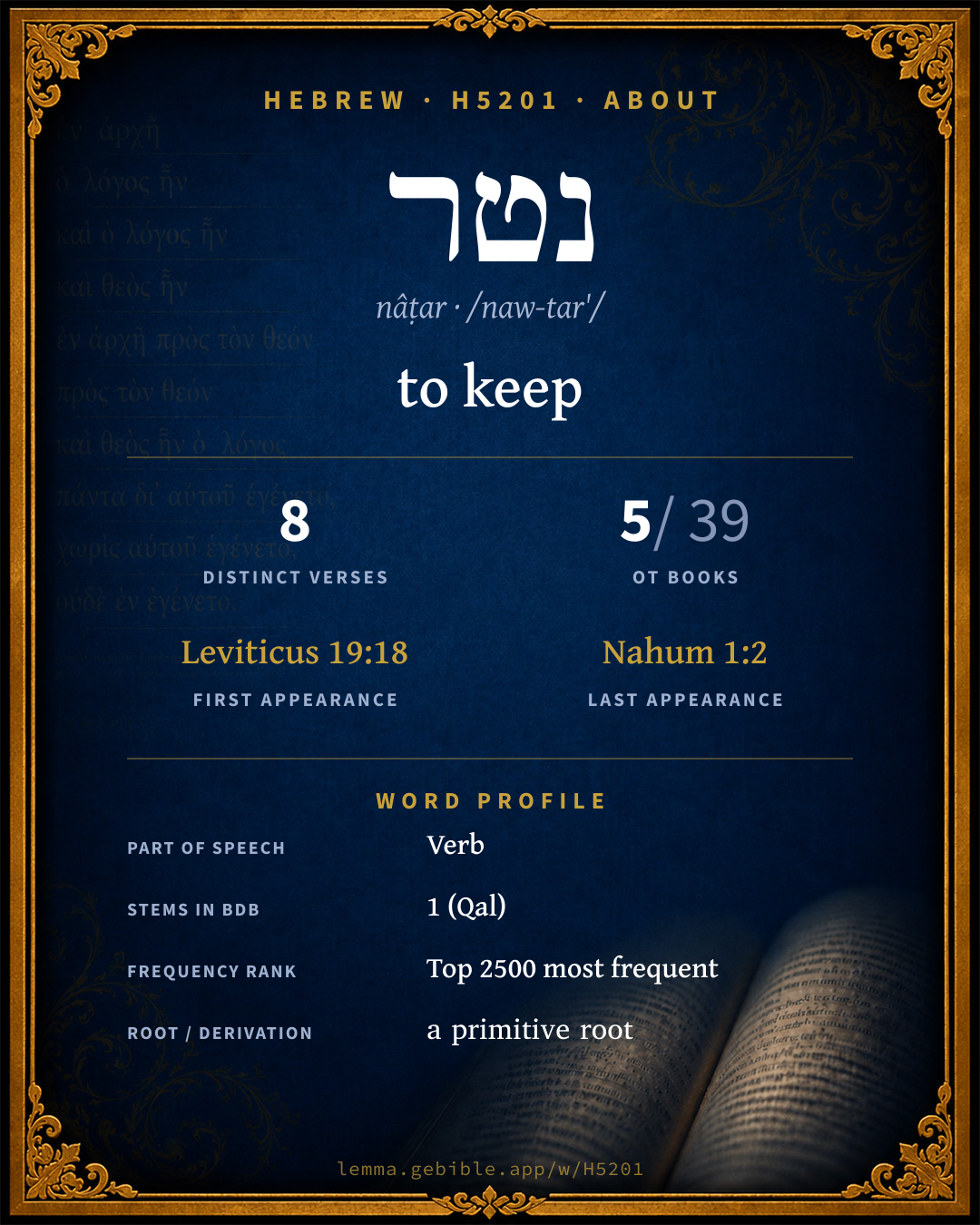
נָטַר
to keep
also: keep guard, reserve, maintain fuller range ↓
Full lexicon entry — Brown-Driver-Briggs (BDB)
From Brown-Driver-Briggs (BDB)
Where this word appears
Grammar key — what these labels mean
Part of speech
- Verb
- An action or state-of-being word.
Stem
- Qal
- The basic, simple active stem — the plain form of the verb (“he wrote”). Here: ‘keep’
Form
- Participle Active
- A verbal adjective expressing ongoing or characteristic action (“writing / one who writes”).
- Imperfect
- An incomplete, ongoing, or future action (“he will / would write”).
- Perfect
- A completed action or state — Hebrew marks aspect (completeness) more than strict tense (“he wrote”).
State
- Absolute
- The independent form of a noun, not bound to a following word.
Person
- 3rd Person
- The one spoken about (“he / she / it / they”).
- 1st Person
- The speaker (“I / we”).
- 2nd Person
- The one addressed (“you”).
Gender
- Masculine
- Grammatically masculine.
- Common
- Either gender — not distinguished for this form.
- Feminine
- Grammatically feminine.
Number
- Singular
- One.
- Plural
- More than one (in Hebrew, generally three or more).
Grammatical forms
- Verb, Qal, Participle Active, Masculine, Plural, Absolute 2 times (22%)
- Verb, Qal, Imperfect, 3rd Person, Masculine, Singular 2 times (22%)
- Verb, Qal, Participle Active, Masculine, Singular, Absolute 1 time (11%)
- Verb, Qal, Imperfect, 1st Person, Common, Singular 1 time (11%)
- Verb, Qal, Imperfect, 2nd Person, Masculine, Singular 1 time (11%)
- Verb, Qal, Perfect, 1st Person, Common, Singular 1 time (11%)
- Verb, Qal, Participle Active, Feminine, Singular, Absolute 1 time (11%)
Parsed forms decoded from the imported morphology (morphhb / Westminster Leningrad Codex — WLC text public domain, morphhb tagging CC BY 4.0), counted across 9 parsed occurrences — not distinct verses.
Every verse where H5201 appears — 8 distinct verses across 5 books. Click any verse to open its interlinear word-by-word view. Verse text shown in the World English Bible for context — . Each verse’s Hebrew form is shown with its reference; the English is not keyword-highlighted, since the data carries no word-level English alignment. Use “Compare translations” on any verse to read it across multiple English versions. This concordance covers the Hebrew Bible; Septuagint (Greek Old Testament) occurrences are not indexed here.
Leviticus 1 verse
Psalms 1 verse
Song of Solomon 3 verses
- Song of Solomon 1:6 נֹטֵרָ֣ה נָטָֽרְתִּי Qal ptcp.act fs Qal pf 1cs Don't stare at me because I am dark, Because the sun has scorched me. My mother's sons were angry with me. They made me keeper of the vineyards. I haven't kept my own vineyard.
- Song of Solomon 8:11 לַ/נֹּטְרִ֑ים prep det + Qal ptcp.act mp Solomon had a vineyard at Baal Hamon. He leased out the vineyard to keepers. Each was to bring a thousand shekels of silver for its fruit.
- Song of Solomon 8:12 לְ/נֹטְרִ֥ים prep + Qal ptcp.act mp My own vineyard is before me. The thousand are for you, Solomon; Two hundred for those who tend its fruit. Lover
Jeremiah 2 verses
- Jeremiah 3:5 הֲ/יִנְטֹ֣ר ptcl inter + Qal impf 3ms Will he retain [his anger] forever? will he keep it to the end? Behold, you have spoken and have done evil things, and have had your way.
- Jeremiah 3:12 אֶטּ֖וֹר Qal impf 1cs Go, and proclaim these words toward the north, and say, Return, you backsliding Israel, says Yahweh; I will not look in anger on you; for I am merciful, says Yahweh, I will not keep [anger] forever.
Nahum 1 verse
About this entry
At a glance — auto-summarized from this page’s data, not written by a person. Every figure links to its source below. This summary describes the numbers; it doesn’t interpret them.
נטר (nâṭar) is a Hebrew verb most often rendered “to keep.” Debuting at Leviticus 19:18, it then recurs through the corpus. With 8 verses in 5 books, it is an uncommon word in the Hebrew Bible. It concentrates in Song of Solomon, which alone accounts for 38% of its uses. It also covers “keep guard”, “reserve”, and “maintain”, alongside “to keep” — see its full sense range. For the data behind this summary, explore the sense tree and the renderings breakdown below.
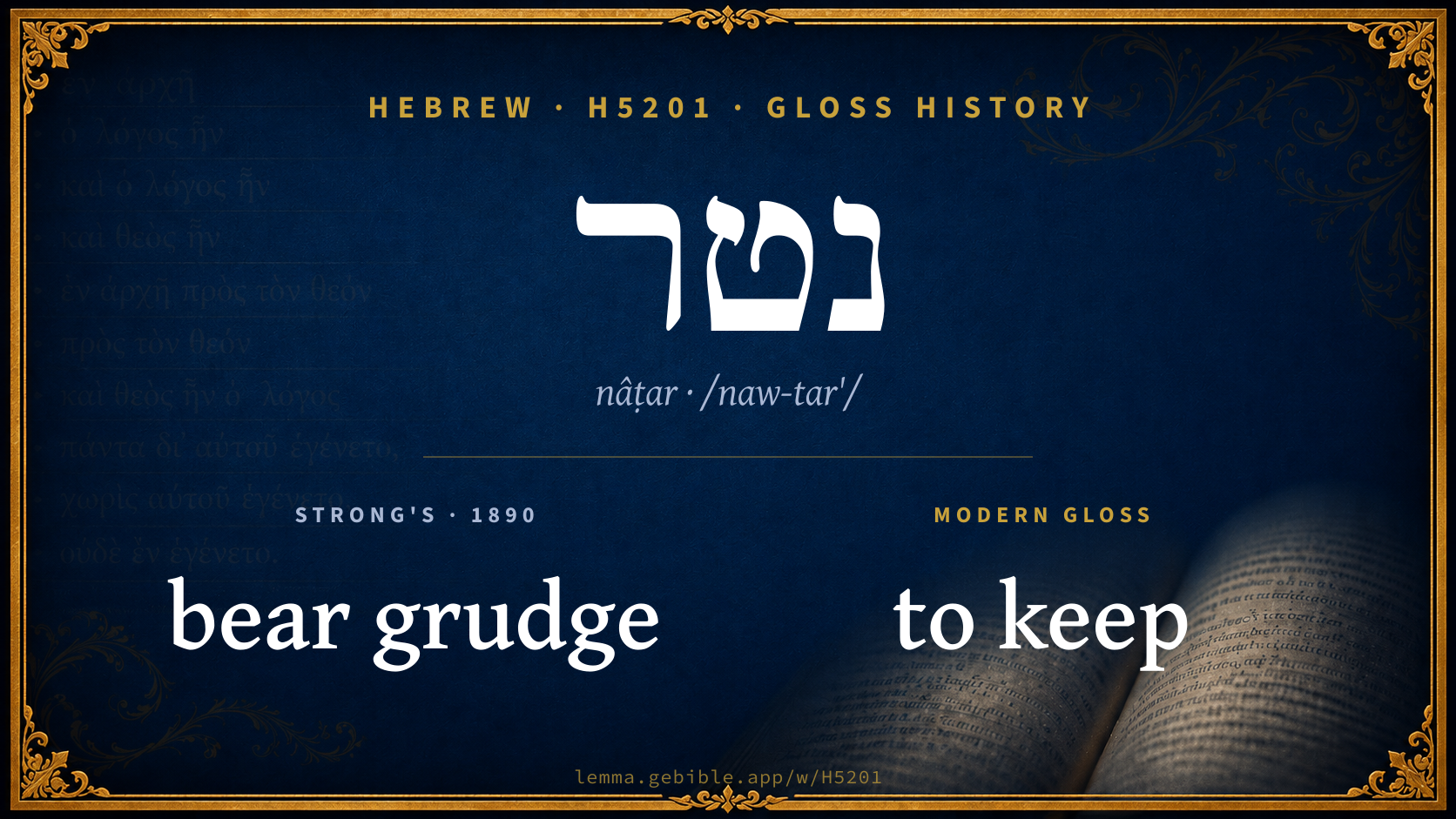
Gloss history
Strong's 1890 vs modern scholarship
About this word
Strong's H5201 catalogs a Hebrew word from the Hebrew Old Testament.
These counts are not copied from any lexicon or concordance. They are computed here, from the morphology-tagged Hebrew Old Testament. What Lemma adds →
- 8
- distinct verses
- The word appears in 8 distinct verses.
- 5 / 39
- OT books
- The word appears in 5 of 39 Old Testament books.
- #2,481
- by frequency
- Top 2500 most frequent Hebrew words (rank 2,481 of 8,640 Hebrew words by occurrence).
View all 8 occurrences in the concordance →
Most concentrated in
- Song of Solomon 3 verses 38%
- Jeremiah 2 verses 25%
- Leviticus 1 verse 13%
By section of the Old Testament
By traditional corpus
Conventional, traditional groupings — biblical authorship is debated, so this is a traditional corpus grouping, not an authorship claim. Each share is this word’s portion of its verses in that division of the Hebrew canon. Each figure is a share of the word’s 8 distinct verses.
- Writings (Ketuvim) 4 verses · 50%
- Prophets (Nevi'im) 3 verses · 38%
- Torah (Pentateuch) 1 verse · 13%
How translations render this word
Counts come from each version’s own published word-to-Strong’s tagging or interlinear alignment — an approximate guide to how each version renders this word, not a word-level alignment the data otherwise carries. Because each total is that version’s own tagged count, the per-version totals vary from one another and need not match the appearance or distinct-verse counts above. These counts may also differ from a printed concordance because Lemma counts each distinctly tagged rendering and does not collapse phrase taggings into a single head-word total. This is a fixed set of word-tagged versions (KJV, ASV, BSB, ULT) and does not change with the reading translation you choose elsewhere. Each version’s license is shown beside its name below (and on Sources).
- King James Version: Bear any grudge 1×, Have i not kept 1×, He reserveth 1×
- American Standard Version: Bear any grudge 1×, Have i not kept 1×, He reserveth 1×
- Berean Standard Bible: Are for those who tend 1×, Be angry 1×, Harbor 1×
- unfoldingWord Literal Text: And 1×, Are keepers of 1×, Belong to the people who 1×
King James Version Public Domain
Renders H5201 across 9 tagged occurrences — most commonly:
American Standard Version Public Domain
Renders H5201 across 9 tagged occurrences — most commonly:
Berean Standard Bible Public Domain
Renders H5201 across 8 tagged occurrences — most commonly:
Not rendered by a distinct English word in 1 further occurrence.
unfoldingWord Literal Text CC BY-SA 4.0
Renders H5201 across 15 tagged occurrences — most commonly:
Plus other, less common renderings.
Senses in the full BDB
What do BDB’s symbols mean?
BDB uses these scholarly abbreviations:
| Symbol | Meaning |
|---|---|
| 𝔊 | the Septuagint (the ancient Greek translation, LXX) |
| 𝔙 | the Vulgate (the Latin translation) |
| 𝔖 | the Syriac version (the Peshitta) |
| 𝔗 | the Targum (the Aramaic translation) |
| ψ | the Psalms |
| √ | root (the underlying root or stem) |
| ‖ | parallel passage (a synonymous or contrasted parallel) |
| † | the dagger: every passage where the word occurs is cited |
The 3 senses and sub-senses the full Brown-Driver-Briggs lexicon distinguishes for this word, in lexicon order (not ranked by frequency), with BDB’s own verbatim wording and sub-sense lettering. Shown in Hebrew script with BDB’s own scholarly abbreviations. The condensed entry is in the Lexicon Entry tab. See also the Forms in the corpus table below.
Qal
- Pf. 1 s. נָטָ֑רְתִּי Ct 1:6; Impf. 3 ms. יִטּוֹר ψ 103:9, יִנְטוֹר Je 3:5; read וַיִּטֹּר also Am 1:11 (for MT יִטְרֹף) Ol ψ 103:9 We Now GASm Dr; 2 ms. תִּטֹּר Lv 19:18; 1 s. אֶטּוֹר Je 3:12; Pt. act. נוֹטֵר Na 1:2; f. נֹטֵרָה Ct 1:6; mpl. נֹטְרִים Ct 8:11, 12;— e.g. Song of Solomon 1:6
- 1. keep, maintain (sc. wrath), of י׳, Je 3:5, 12 Na 1:2 (c. לְ for), ψ 103:9; of Edom Am 1:11 (reading וַיִּטֹּר לָעַד אַפּוֹ and he kept his anger perpetually, v. supr.), Lv 19:18 (c. את with). e.g. Jeremiah 3:5
- 2. keep, guard a vineyard Ct 1:6(×2) (in fig.), abs. 8:11, obj. פִּרְיוֹ v 12. e.g. Song of Solomon 1:6
Senses from the full Brown-Driver-Briggs lexicon (Brown, Driver, Briggs; Oxford 1906 — public domain), digitized via Sefaria, supplemented by the OpenScriptures HebrewLexicon (CC BY 4.0). Full attribution on Sources.
Word origin
vb. keep (less common ‖ of נָצַר) (NH id.; 𝔗 נְטַר, Syriac ܢܛܰܪ id.; Nab. in n.pr. Lzb323 (cf. also infr.), Arabic نَطَرَ id. (obj. garden, etc.));—
— Brown-Driver-Briggs (Oxford 1906, public domain), digitized via Sefaria, supplemented by the OpenScriptures HebrewLexicon (CC BY 4.0). See Sources.
Origin: a primitive root
Jastrow Dictionary
A second Hebrew/Aramaic lexicon for comparison, covering Aramaic and post-biblical (Talmudic, Targumic, Midrashic) usage that the biblical-Hebrew BDB does not. Matched by lemma rather than by Strong’s number, so a lemma may carry more than one Jastrow headword (shown separately below), and the entries cover usage well beyond the Bible.
נָטֵיר
- (preced.)
- 1. part. of נְטַר.
- 2. guardsman. Targ. Ps. CXXVII, 1. Ib. CXXI, 4; a. fr.
נָטַר
- to guard, observe. Sifré Num. 157 (expl. טירתם, Num. XXXI, 10) מקום שהיו נוֹטְרִים ע"ז וכ׳ the place where they guarded their idols; Yalk. ib. 785 שהיו נוטרין בית וכ׳ their idolatrous temple. Yalk. Prov. 964 כשם שהתרנגול … ונוֹטֵר לבני אדם as the cock crows by night and holds guard for men; a. e.—Esp. (with ref. to Lev. XIX, 18) to reserve anger, bear grudge. Gen. R. s. 55 כתבת בתורתך … ואת נוקם ונוטר thou hast written in thy Law (Lev. l. c.) thou shalt not &c., and thou takest revenge and reservest wrath (Nah. I, 2)?; Koh. R. to VIII, 4 לא אֶטּוֹר I will not reserve &c. Yoma 23ᵃ; a. fr.—[Cant. R. to IV, 12 מנטרים, read: מנסכים, v. נָסַךְ.] e.g. Numbers 31:10
נְטַר
- , to guard, wait; to observe; to reserve. Targ. I Sam. XXX, 23, sq. Targ. Deut. V, 10. Targ. Ruth I, 13; a. fr.—Imper. טַר, pl. טְרוּ. Targ. O. Deut. V, 12. Ib. XXVII, 1 (Y. טוּרוּ); a. e.—Part. pass. נְטִיר, f. נְטִירָא; pl. נְטִירִין; נְטִירָן. Targ. I Sam. IX, 24; a. fr.—Targ. Y. Deut. V, 10 נְטִיר read: נָטֵיר.—B. Bath. 74ᵃ נְטַר עד וכ׳ wait here until to-morrow. B. Mets. 63ᵇ; 65ᵃ, v. אַגְרָא I.—Ḥag. 5ᵃ, v. infra.
- same. Keth. 37ᵃ מְנַטְּרָא נפשה (not מינ׳) she guarded herself (her purity).—[Yalk. Job 898 קמנטר תאני, read as Ḥag. l. c. מְנַקֵּיט.]—Part. pass. מְנַטַּר, f. מְנַטְּרָא, v. infra.
- , אִינְּ׳
- 1. to be guarded; to be reserved. Targ. Hos. XII, 14. Targ. Y. Ex. XXIV, 11; a. fr.—Bets. 15ᵃ מִנְּטַר מחמת כלבי ולא מִינְטַר וכ׳ (or מְנַטַּר) Ms. M. (ed. מְנַטְּרָא) it is safe from dogs, but not from thieves.—
- *2. to keep watch. Targ. Prov. VI, 22 (perh. to be read תִּנְטַר Pe.).
- 3. to be preserved. Ḥag. 5ᵃ הני מִינַּטְּרָן והני לא מִינַּטְּרָן Ms. M. a. Rashi (ed. נטרן, corr. acc.) these (the unripe figs) can be kept, but those (the ripe) cannot; Yalk. Job 898 מנטרן.
נָּטֵר
- , v. נָטֵיר
A Dictionary of the Targumim, the Talmud Babli and Yerushalmi, and the Midrashic Literature (Marcus Jastrow; London, Luzac, 1903) — Public Domain. Digitized via Sefaria. Digitized via Sefaria. Full attribution on Sources.
Forms in the corpus
The 9 distinct written forms H5201 takes in the Hebrew Bible, most frequent first — each parse links to that stem’s occurrences in the concordance. Hebrew forms include their vowel points and cantillation, so a single lemma takes many written forms.
| Form | Parsing | Example | Uses |
|---|---|---|---|
| אֶטּ֖וֹר | Verb, Qal, Imperfect, 1st Person, Common, Singular | Jeremiah 3:12 | 1 |
| הֲ/יִנְטֹ֣ר | Verb, Qal, Imperfect, 3rd Person, Masculine, Singular | Jeremiah 3:5 | 1 |
| וְ/נוֹטֵ֥ר | Verb, Qal, Participle Active, Masculine, Singular, Absolute | Nahum 1:2 | 1 |
| יִטּֽוֹר | Verb, Qal, Imperfect, 3rd Person, Masculine, Singular | Psalms 103:9 | 1 |
| לְ/נֹטְרִ֥ים | Verb, Qal, Participle Active, Masculine, Plural, Absolute | Song of Solomon 8:12 | 1 |
| לַ/נֹּטְרִ֑ים | Verb, Qal, Participle Active, Masculine, Plural, Absolute | Song of Solomon 8:11 | 1 |
| נָטָֽרְתִּי | Verb, Qal, Perfect, 1st Person, Common, Singular | Song of Solomon 1:6 | 1 |
| נֹטֵרָ֣ה | Verb, Qal, Participle Active, Feminine, Singular, Absolute | Song of Solomon 1:6 | 1 |
| תִטֹּר֙ | Verb, Qal, Imperfect, 2nd Person, Masculine, Singular | Leviticus 19:18 | 1 |
Same root — word family
Other BDB entries built from the same root as H5201, grouped by Strong’s listed origin. These share a root / origin per the lexicon — not necessarily a shared meaning. Each links to that word’s own entry.
Derived from this word
Compare all same-root words → They share a root, not necessarily a meaning.
Septuagint verse parallels
This word appears in 8 verses that also exist in the Greek Old Testament (Septuagint), out of the 8 Hebrew verses it occurs in. You can read those verses in Greek by switching the Old Testament edition to the Septuagint.
Read these verses in the Septuagint
This is a verse-level parallel only — the same verses exist in both the Hebrew and Greek Old Testaments. No word-level Hebrew↔Greek correspondence is claimed: the data carries no such alignment, so no Greek word is shown as this Hebrew word’s translation. Coverage is not total — the Septuagint omits the deuterocanon and renumbers the Psalms, so some Hebrew verses have no direct Greek parallel.