Micah 3:7

Hebrew (Westminster Leningrad Codex) Micah 3:7 appears in the Hebrew Old Testament. The text above is from the Westminster Leningrad Codex. Each word links to its Strong’s number, a concise gloss, and parsing drawn from the Open Scriptures Hebrew Bible morphology. Click any word for its full Brown-Driver-Briggs (BDB) entry.
Download image
Cite this verse

Micah 3:7 (World English Bible). Public Domain. Lemma interlinear Bible study tool, https://lemma.gebible.app/v/micah/3/7.

Show BibTeX & RIS
BibTeX
RIS
English Translation
The seers shall be disappointed, And the diviners confounded. Yes, they shall all cover their lips; For there is no answer from God."
World English Bible · Public Domain
Download a study sheet

One document with this verse’s original text, its word-by-word gloss line, the meaning frame, cross-references with their text, attributed commentary, and full source and license credits — printable, and it pastes into notes with its structure intact.

This verse Autodidact and up

Study sheet (.html) Plain text (.txt)

A passage Seminary Student

Up to 50 verses in one chapter. A passage sheet keeps up to 6 commentary sources and 12 cross-references per verse, in the order this page ranks them, and says so on the sheet whenever that leaves anything out. Ask for a single verse and you get the Autodidact verse sheet above.

Everything on this page stays free to read, with no account — the sheet is a download of what is already on screen, not access to it.

Want to remove ads? Support Godless Engineer
Compare translations 3

The same verse in 3 English versions, stacked beneath the original-language interlinear above. Click any original word for its lexicon entry.

Each is an independent rendering of the whole verse — the interlinear is not word-aligned to these translations.

Highlighted words mark where these versions differ — a whole-verse word diff, not a word-by-word alignment.

  • World English Bible Public Domain
    The seers shall be disappointed, And the diviners confounded. Yes, they shall all cover their lips; For there is no answer from God."
  • King James Version Public Domain
    Then shall the seers be ashamed, and the diviners confounded: yea, they shall all cover their lips; for there is no answer of God.
  • unfoldingWord Literal Text CC BY-SA 4.0
    And the seers will be ashamed, and the diviners will be disgraced. And all of them will cover over the mustache, for there is no answer of God.

unfoldingWord Literal Text — © unfoldingWord, licensed CC BY-SA 4.0. Word-aligned USFM3 via Door43 (git.door43.org/unfoldingWord/en_ult).

Versions to compare (up to 4)

3 of 4 selected

Show all 18 translations

Every available English version of this verse, each an independent rendering of the whole verse.

  • World English Bible Public Domain
    The seers shall be disappointed, And the diviners confounded. Yes, they shall all cover their lips; For there is no answer from God."
  • Berean Standard Bible Public Domain
    Then the seers will be ashamed and the diviners will be disgraced. They will all cover their mouths because there is no answer from God.”
  • Majority Standard Bible Public Domain
    Then the seers will be ashamed and the diviners will be disgraced. They will all cover their mouths because there is no answer from God.”
  • King James Version Public Domain
    Then shall the seers be ashamed, and the diviners confounded: yea, they shall all cover their lips; for there is no answer of God.
  • American Standard Version (1901) Public Domain
    And the seers shall be put to shame, and the diviners confounded; yea, they shall all cover their lips; for there is no answer of God.
  • Revised Version (1885) Public Domain
    And the seers shall be ashamed, and the diviners confounded; yea, they shall all cover their lips: for there is no answer of God.
  • Geneva Bible (1599) Public Domain
    Then shall the Seers bee ashamed, and the southsayers confounded: yea, they shall all couer their lippes, for they haue none answere of God.
  • Douay-Rheims (1899) Public Domain
    And they shall be confounded that see visions, and the diviners shall be confounded: and they shall all cover their faces, because there is no answer of God.
  • Young's Literal Translation Public Domain
    And ashamed have been the seers, And confounded have been the diviners, And covered their lip have all of them, For their is no answer, O God.
  • Literal Standard Version CC BY-SA 4.0
    And the seers have been ashamed, || And the diviners have been confounded, || And all of them have covered their lip, || For there is no answer, O God.”
  • Unlocked Literal Bible CC BY-SA 4.0
    The seers will be put to shame, and the diviners will be confused. All of them will cover their lips, for there is no answer from me.”
  • unfoldingWord Literal Text CC BY-SA 4.0
    And the seers will be ashamed, and the diviners will be disgraced. And all of them will cover over the mustache, for there is no answer of God.
  • Darby Bible Public Domain
    And the seers shall be ashamed, and the diviners confounded; and they shall all cover their lips, for there will be no answer of God.
  • World Messianic Bible Public Domain
    The seers shall be disappointed, and the diviners confounded. Yes, they shall all cover their lips, for there is no answer from God.”
  • Webster's Bible Public Domain
    Then shall the seers be ashamed, and the diviners confounded: yes, they shall all cover their lips; for there is no answer of God.
  • Free Bible Version CC BY-SA 4.0
    The seers will be disgraced, the fortune-tellers put to shame, and they will cover their faces because none of them receive any answer from God.
  • Bible in Basic English Public Domain
    And the seers will be shamed, and the readers of the future will be at a loss, all of them covering their lips; for there is no answer from God.
  • JPS Tanakh (1917) Public Domain
    And the seers shall be put to shame, and the diviners confounded; yea, they shall all cover their upper lips; for there shall be no answer of God.

Literal Standard Version (2020), Covenant Press — licensed CC BY-SA 4.0. Text via the HelloAO Bible API (eBible.org). Unlocked Literal Bible (unfoldingWord) — licensed CC BY-SA 4.0. Text via the HelloAO Bible API (eBible.org). unfoldingWord Literal Text — © unfoldingWord, licensed CC BY-SA 4.0. Word-aligned USFM3 via Door43 (git.door43.org/unfoldingWord/en_ult). Free Bible Version, Dr. Jonathan Gallagher — licensed CC BY-SA 4.0. Text via the HelloAO Bible API (eBible.org).

Word by word

More ways to search: Search by grammar → Find every occurrence → Compare this word →

Practice this passage: Drill this verse → Learn its vocabulary →

שָׂפָ֖ם
sâphâm
H8222
“mustache”
Noun, Common, Masculine, Singular, Absolute
Part of Speech
Noun
Type
Common
Gender
Masculine
Number
Singular
State
Absolute
Full BDB Definition

Origin: from H8193

TWOT: 2279

moustache
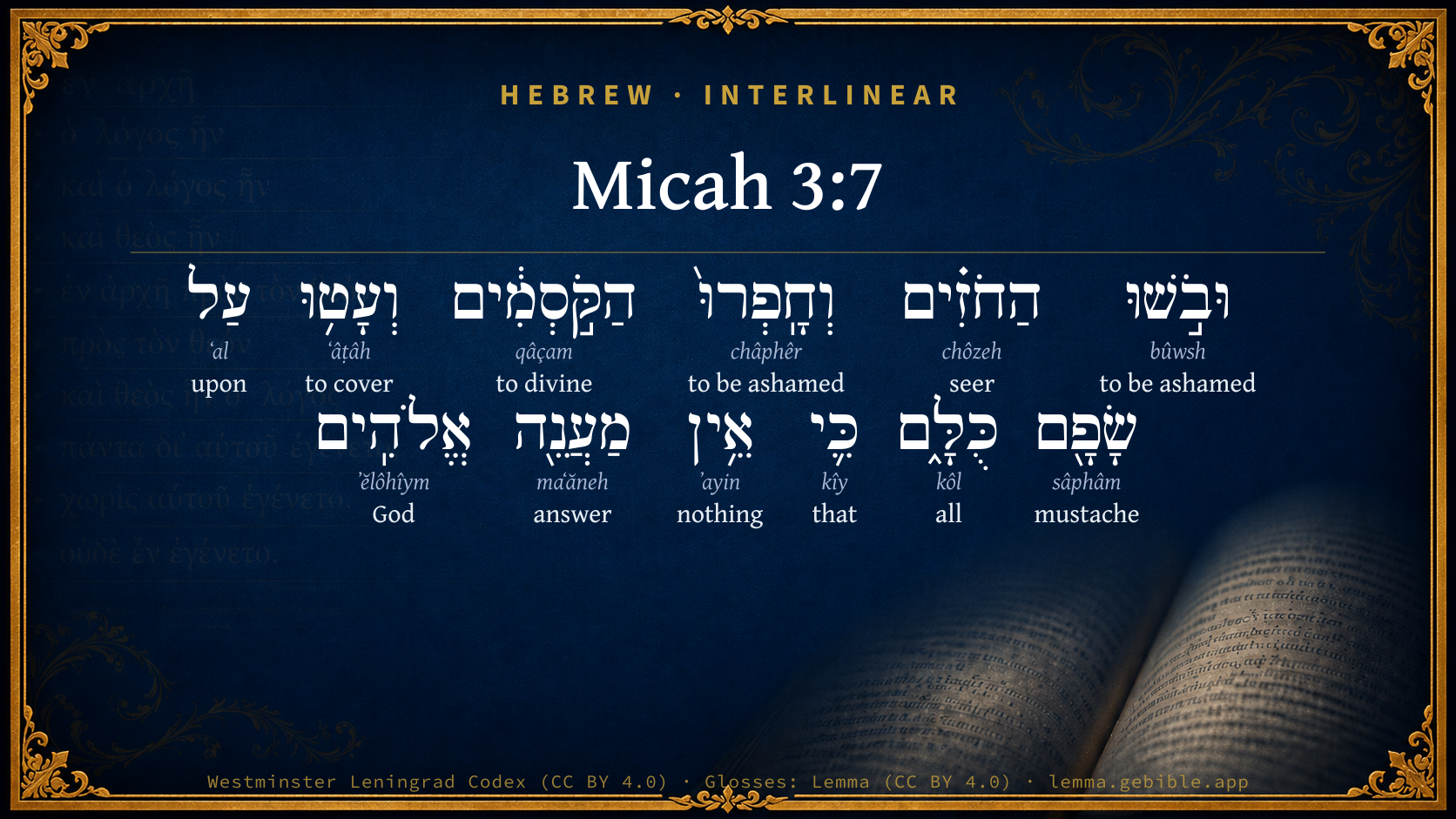
  1. וּבֹ֣שׁוּ bûwsh H954 “and · to be ashamed” Conjunction + Verb, Qal, Sequential Perfect, 3rd Person, Common, Plural
  2. הַחֹזִ֗ים chôzeh H2374 “the · seer” Particle, Definite Article + Verb, Qal, Participle Active, Masculine, Plural, Absolute
  3. וְחָֽפְרוּ֙ châphêr H2659 “and · to be ashamed” Conjunction + Verb, Qal, Sequential Perfect, 3rd Person, Common, Plural
  4. הַקֹּ֣סְמִ֔ים qâçam H7080 “the · divining” Particle, Definite Article + Verb, Qal, Participle Active, Masculine, Plural, Absolute
  5. וְעָט֥וּ ʻâṭâh H5844 “and · to cover” Conjunction + Verb, Qal, Sequential Perfect, 3rd Person, Common, Plural
  6. עַל ʻal H5921 “upon” Preposition
  7. כֻּלָּ֑ם kôl H3605 “all · their” Noun, Common, Masculine, Singular, Construct + Suffix, Personal, 3rd Person, Masculine, Plural
  8. כִּ֛י kîy H3588 “that” Conjunction
  9. אֵ֥ין ʼayin H369 “nothing” Particle, Negative
  10. מַעֲנֵ֖ה maʻăneh H4617 “answer of” Noun, Common, Masculine, Singular, Construct
  11. אֱלֹהִֽים ʼĕlôhîym H430 “God(s)” Noun, Common, Masculine, Plural, Absolute

About this verse

These counts appear in no published source. They are computed here, from the morphology-tagged text and Lemma’s own curated glosses. What Lemma adds →

12
words
12
distinct lemmas
Prophets
section

Notable vocabulary

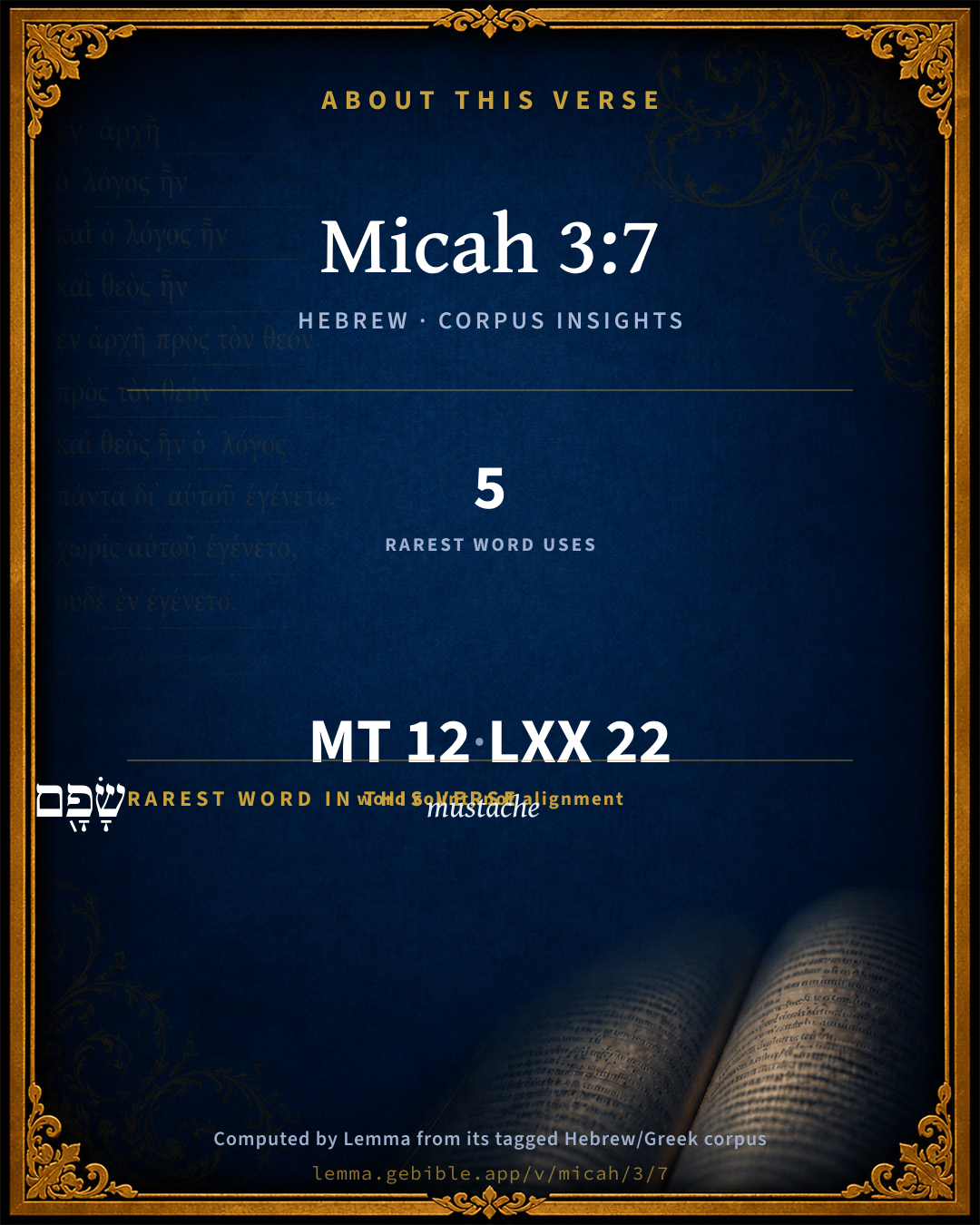
The rarest word here is שָׂפָ֖ם mustache H8222 — appearing just 5 times in the whole Hebrew Bible.

Shared distinctive vocabulary

שָׂפָ֖ם mustache H8222 occurs in 5 verses of the Hebrew Bible. Also found in:

Grammatical profile

  • 5 verbs
  • 4 nouns
  • 1 preposition
  • 1 conjunction
  • 1 particle

Verb forms

  • וּבֹ֣שׁוּ Qal · Sequential Perfect
  • הַחֹזִ֗ים Qal · Participle Active
  • וְחָֽפְרוּ֙ Qal · Sequential Perfect
  • הַקֹּ֣סְמִ֔ים Qal · Participle Active
  • וְעָט֥וּ Qal · Sequential Perfect

Hebrew & Septuagint length

In English translation the verse runs 23 words from the Hebrew and 33 from the Septuagint (LXX English) — the Septuagint runs noticeably longer here. See the side-by-side →

A rough comparison of the two English renderings, which tokenize alike — not a word-level alignment.

Word counts can differ between the Hebrew and the Greek without any difference in meaning — e.g. the Hebrew direct-object marker אֵת has no separate Greek word, and Greek often adds the article ὁ.

In the original languages it is 12 Hebrew tokens and 22 Greek tokens — but the two are counted differently (Hebrew bundles its prefixes and suffixes into one token; the Greek is in lemma form), so that isn’t a like-for-like length.

Cross-references

17

Topical passages linked to Micah 3:7 in the Treasury of Scripture Knowledge — connected by theme and wording, ordered by reader-vote popularity; previews shown in the World English Bible.

  • Isaiah 44:25 who frustrates the signs of the liars, and makes diviners mad; who turns wise men backward, and makes their knowledge foolish;
  • Zechariah 13:4 It will happen in that day, that the prophets will each be ashamed of his vision, when he prophesies; neither will they wear a hairy mantle to deceive:
  • Leviticus 13:45 "The leper in whom the plague is shall wear torn clothes, and the hair of his head shall hang loose. He shall cover his upper lip, and shall cry, 'Unclean! Unclean!'
  • 1 Samuel 28:6 When Saul inquired of Yahweh, Yahweh didn't answer him, neither by dreams, nor by Urim, nor by prophets.
  • Isaiah 47:12–14 Stand now with your enchantments, and with the multitude of your sorceries, in which you have labored from your youth; if so be you shall be able to profit, if so be you may prevail.
  • Ezekiel 24:17 Sigh, but not aloud, make no mourning for the dead; bind your headdress on you, and put your shoes on your feet, and don't cover your lips, and don't eat men's bread.
  • Amos 8:11 Behold, the days come," says the Lord Yahweh, "That I will send a famine in the land, Not a famine of bread, Nor a thirst for water, But of hearing the words of Yahweh.
  • Exodus 8:18–19 The magicians tried with their enchantments to bring forth lice, but they couldn't. There were lice on man, and on animal.
  • Exodus 9:11 The magicians couldn't stand before Moses because of the boils; for the boils were on the magicians, and on all the Egyptians.
  • 1 Samuel 9:9 (In earlier times in Israel, when a man went to inquire of God, thus he said, Come, and let us go to the seer; for he who is now called a Prophet was before called a Seer.)
  • 1 Samuel 14:37 Saul asked counsel of God, Shall I go down after the Philistines? will you deliver them into the hand of Israel? But he didn't answer him that day.
  • 1 Samuel 28:15 Samuel said to Saul, Why have you disquieted me, to bring me up? Saul answered, I am sore distressed; for the Philistines make war against me, and God is departed from me, and answers me no more, neither by prophets, nor by dreams: therefore I have called you, that you may make known to me what I shall do.
  • Psalms 74:9 We see no miraculous signs. There is no longer any prophet, Neither is there among us anyone who knows how long.
  • Ezekiel 24:22 You shall do as I have done: you shall not cover your lips, nor eat the bread of men.
  • Daniel 2:9–11 But if you don't make known to me the dream, there is but one law for you; for you have prepared lying and corrupt words to speak before me, until the time be changed: therefore tell me the dream, and I shall know that you can show me the interpretation of it.
  • Micah 7:16 The nations will see and be ashamed of all their might. They will lay their hand on their mouth. Their ears will be deaf.
  • 2 Timothy 3:8–9 Even as Jannes and Jambres opposed Moses, so do these also oppose the truth; men corrupted in mind, reprobate concerning the faith.

Cross-references courtesy of OpenBible.info (CC BY 4.0).

Hebrew and Greek witnesses Masoretic Hebrew ↔ Greek Septuagint

The same verse in the two great witnesses to the Old Testament, shown verse-for-verse.

Here the Septuagint runs noticeably longer than the Hebrew — LXX2012 (modern English Septuagint) 33 words vs World English Bible 23. A rough length comparison of the two English translations, not a word-level alignment — read both below.

These are two independent witnesses, not word-aligned to each other, and the Septuagint is shown in lemma (dictionary) form.

Hebrew Micah 3:7 Masoretic · Westminster Leningrad Codex

וּבֹ֣שׁוּ הַחֹזִ֗ים וְחָֽפְרוּ֙ הַקֹּ֣סְמִ֔ים וְעָט֥וּ עַל שָׂפָ֖ם כֻּלָּ֑ם כִּ֛י אֵ֥ין מַעֲנֵ֖ה אֱלֹהִֽים

The seers shall be disappointed, And the diviners confounded. Yes, they shall all cover their lips; For there is no answer from God."

World English Bible · Public Domain

Greek LXX Micah 3:7 Septuagint · lemma form

καί κατααἰσχύνω ὁ ὁράω ὁ ἐνύπνιον καί καταγελάω ὁ μάντις καί καταλαλέω κατά αὐτός πᾶς αὐτός διότι οὐ εἰμί ὁ εἰςἀκούω αὐτός

And the seers of night-visions shall be ashamed, and the prophets shall be laughed to scorn: and all the people shall speak against them, because there shall be none to listen to them.

LXX2012 (modern English Septuagint) · Public Domain

On this verse, Trapp's Complete Commentary discusses the Septuagint’s reading. Read the note in Commentary ↓

Hebrew: Westminster Leningrad Codex (CC BY 4.0). Greek: Septuagint (public domain); English from LXX2012 (modern English Septuagint) (Public Domain). How the Septuagint differs from the Hebrew →

Targum (Aramaic paraphrase)

1

The Targum is the ancient Jewish Aramaic paraphrase of the Hebrew Scriptures — an interpretive translation, not the Hebrew text itself. Onkelos (literal) and Pseudo-Jonathan (expansive) render the Torah, and Jonathan the Prophets. Coverage is partial: where no permissively-licensed English translation exists for a verse, only the Aramaic is shown. This is verse-level text, not a word-by-word alignment to the Hebrew.

  1. Targum Jonathan Prophets (Joshua–Malachi)
    וְיִבְהֲתוּן נְבִיֵי שִׁקְרָא וְיִתְכַּנְעוּן מִלְאַלָפָא וְיִתְעַטְפוּן עַל שָׂפָם כְּאֶבְלִין כּוּלְהוֹן אֲרֵי לֵית בְּהוֹן רוּחַ נְבוּאָה מִן קֳדָם יְיָ:

    (no public-domain English translation for this verse)

    Targum Jonathan — Aramaic: “Mikraot Gedolot” (public domain). English: “Sefaria Community Translation” (CC0 1.0 (public-domain dedication)); “London "Chaldee Paraphrase," 1871” (public domain). Text via Sefaria.

Commentary

Notes on Micah 3:7 from classic Christian and Jewish commentators (each source and its license shown beneath its notes). The classic Christian expositions comment on the surrounding passage and are grouped to its opening verse, so a note may address several verses; the Jewish commentaries on the Tanakh (Rashi and others) are per-verse, so they appear only where the commentator wrote on this verse.

Lemma curates 59 commentaries, every one of them public domain or Creative Commons licensed, each selected and text-cleaned for this edition rather than reprinted as found. About our sources →

Trapp's Complete Commentary

John Trapp

Mic 3:7 Then shall the seers be ashamed, and the diviners confounded: yea, they shall all cover their lips; for [there is] no answer of God.

Ver. 7. Then shall the seers be ashamed, and the diviners confounded] They shall be hissed and hooted at for impostors and falsaries; shame shall be the promotion of these fools, as it is at this day of the heathen philosophers, of the Jewish Rabbis, of the Popish doctors and schoolmen, who once carried the hell for most acute and accurate divines, but now appear to be great triflers; a rotten generation of dunghilldivines, as one styleth them: in detestation of whose vain jangling and noting about questions, 1Ti 6:4, Luther saith, Prope est ut iurem, &c., I could swear almost that there was not a schoolman that understood one chapter of the Gospel (Luth. tom. 1, oper. lat. eph 47). Latimer professed that by hearing Bilney’s confession he learned more than before in many years. So from that time forward, saith he, I began to smell the word of God, and forsake the school doctors and such fooleries.

Yea, they shall all cover their lips] And stand aloof, as lepers. See Lev 13:45 Eze 24:17; Eze 24:22. Or they shall leave off their lying; for I will stop their mouths, that they shall not hereafter so much as mute any more, Ego illis os claudam (Calv.). The Septuagint render it, All men shall abhor them, shall open their lips against them. Montanus, involvent mystacem suam, they shall wrap up their moustaches, which (saith a Lapide) the false prophets wore upon their upper lip, et incedebant comptuli, and went neatly trimmed, as do now the Calvinistic ministers. But if some do so, yet this is better than the Popish priests shaving, which is a ceremony so bald, that some priests in France are ashamed of the mark; and few of them have it that can handsomely avoid it.

For there is no answer of God] He comes not at them, as sometimes he did to Abimelech, Laban, Balaam; neither speak they according to his word, for what reaons? "there is no light in them," Isa 8:20. The philosophers "professing themselves to be wise" (but wanting the wisdom from above) "became fools," Rom 1:22. The Pharisees, had they known anything aright and as they ought, they would not have crucified the Lord of glory, 1Co 2:8. Oracles they had, and miracles enough; but they "rejected the counsel of God against themselves, being not baptized," Luk 7:30; or if they were, yet remained they a viperous brood, Mat 3:7, and never attained to that answer of a good conscience toward God, 1Pe 3:21. The schoolmen often cite the philosophers, seldom the apostles; they count the authority of Fathers as good as that of Scriptures: neither doubt they to call the writings of the Fathers by the name of Scripture ( Lombard passim). Was not this to set "men’s threshold by God’s threshold; and their posts by his posts," Eze 43:8. What marvel therefore though they became vain in their imaginations, and their foolish heart was darkened, while they taught for doctrines men’s traditions? What marvel though Popish fopperies, once so admired, be now so much slighted, since the world seeth further into them than formerly? Notable is that passage in King Henry VIII’s protestation against the Pope: England is no more a babe; there is no man here but now he knows that they do foolishly that part with gold for lead. Surely, except God take away our right wits, not only the Pope’s authority shall be driven out for ever, but his name also shortly shall be forgotten in England. We will from henceforth ask counsel of him and his, when we list to be deceived, when we covet to be in error, when we desire to offend God, truth, and honesty.

John Trapp, A Commentary or Exposition upon All the Books of the Old and New Testament (1647–1656) — public domain. Text from a community e-Sword module.

Geneva Bible (1599)

Geneva Bible translators

When God shall discover them to the world, they shall be afraid to speak: for all shall know that they were but false prophets, and did belie the word of God.

Geneva Bible (1599) marginal notes — public domain. Text via Bolls.life.

Jamieson, Fausset & Brown

Robert Jamieson, A. R. Fausset & David Brown

cover their lips--The Orientals prided themselves on the moustache and beard ("upper lip," Margin). To cover it, therefore, was a token of shame and sorrow (Lev 13:45; Eze 24:17, Eze 24:22). "They shall be so ashamed of themselves as not to dare to open their mouths or boast of the name of prophet" [CALVIN].

there is no answer of God--They shall no more profess to have responses from God, being struck dumb with calamities (Mic 3:6).

Jamieson, Fausset & Brown — Commentary Critical and Explanatory on the Whole Bible (1871) — public domain (CC PDM 1.0). Text via the HelloAO Bible API.

Adam Clarke's Commentary

Verse 7. Shall the seers be ashamed] For the false visions of comfort and prosperity which they pretended to see.

And the diviners confounded] Who pretended to foretell future prosperity; for they themselves are now thralled in that very captivity which the true prophets foretold, and which the false prophets said should not happen.

Adam Clarke's Commentary on the Bible (1810–1826) — public domain. Text from a community e-Sword/MySword module.

John Calvin's Commentaries

He confirms the same thing in the next verse, And ashamed shall be the seers and confounded the diviners, and they shall cover their lip; that is they will put veils on their mouths. In short, he means, that they would become a reproach to all, so that they would be ashamed of themselves, and no more dare to boast with so much confidence of their name and of the prophetic office.

As to this form of expression, ועטו על-שפם, uothu ol shephim, some think that the practice of mourners is referred to; but this interpretation is frigid. I have therefore no doubt but that Micah intimates that the mouths of the false teachers would be closed. There is nearly the same denunciation mentioned by Zechariah; for speaking of the restoration of the Church, he says, — They who before went about boasting greatly, and gloried in the name of Prophets, shall cast away their mantle, and will no longer dare to show themselves; yea, when they shall come abroad, they shall be as it were herdsman or private persons, and shall say, “I am not a prophet, nor the son of a prophet, I am chastised by my father;” that is, they shall profess themselves unworthy of being called prophets; but that they are scholars under discipline, (Zechariah 13:5.) So also in this place, “They deceive at this day my people,” saith the Lord; “I will reward them as they deserve; I will fill them with disgrace and contempt. They shall not then dare hereafter to show themselves as they have been wont to do; they shall not presume boastingly to profess themselves to be the pillars of the Church, that the whole world may be made subject to them; they shall not dare with tyrannical force to oppress the common and ignorant portions of society Veil, then, shall they their mouth; that is, “I will cause their mouth to be closed, so that they shall not dare hereafter to utter even a word.”

It follows, For there will be no answer from God. Some so explain this sentence, as though the Prophet upbraided them with their old deceits, which they boasted were the words of God: as then they were not faithful to God, but lied to miserable men, when they said, that they were sent from above, and brought messages from heaven, while they only uttered their own inventions or fables, they should on these accounts be constrained to cover their mouth. But different is the meaning of the Prophet, and it is this, — that they were to be deprived of any answer, so that their want of knowledge might be easily perceived even by the most ignorant: for false teachers, though they possess nothing certain, yet deceive the simple with disguises, and render plausible their absurdities, that they may seem to be the interpreters of God; and they further add great confidence: and then the stupidity of the people concedes to them such great power, according to what is said by Jeremiah 5 where he says that the priests received gifts and that for gifts the Prophets divined, and that the people loved such deprivations. But Micah declares here that such delusions would no longer be allowed, for God would dissipate them. It will then be made evident, that you have no answer from God; that is, “All will perceive that you are void and destitute of every celestial truth, and that you were formerly but gross cheats, when ye passed yourselves as God’s servants, though you had no ground for doing so.”

We now perceive what the Prophet means. But this punishment might have then contributed to the benefit of the people: for as it is a cause of ruin to the world, when there is no difference made between light and darkness; so when the baseness of those is discovered, who abuse God’s name and adulterate his pure truth, there is then a door open to repentance. Rightly then is this combination addressed to false prophets. It now follows —

John Calvin's Commentaries (1540-1563) — public domain. Text from the Calvin Translation Society English edition (1840s-50s) via the Christian Classics Ethereal Library (ccel.org). Calvin's coverage is partial (roughly two-thirds of the Bible); uncommented books and verses are honest gaps, never fabricated. The 19th-century editor's footnotes and remarks are omitted so the notes are faithfully Calvin's own voice.

Ellicott's Commentary for English Readers

(7) They shall all cover their lips.—As the lepers, who were cut off from all communication with men, so also these false prophets, being cut off from all communion with God, were to “put a covering upon the upper lip.” It was also a sign of mourning for one dead, and Ezekiel was commanded to awaken the astonishment of the people by omitting to cover his upper lip when his wife died.

A Bible Commentary for English Readers, edited by Charles John Ellicott (1878–1897) — public domain. Text from a community e-Sword module.

The Cambridge Bible for Schools and Colleges

gen. ed. J. J. S. Perowne

7. their lips] Rather, their beard; the phrase includes the face up to the nose. A sign of mourning, Lev_13:45, Eze_24:17; Eze_24:22.

The Cambridge Bible for Schools and Colleges (gen. ed. J. J. S. Perowne; Cambridge University Press, 1878–1918) — public domain. Text from a community e-Sword module.

John Gill's Exposition

Then shall the seers be ashamed, and the diviners confounded,.... When the events of things will make it most clearly appear to all that their visions, divinations, and prophecies, are false; they will not be able to lift up their heads, or show their faces, but shame and confusion will cover them:

yea, they shall all cover their lips; stop their mouths, hold their tongues, and be entirely and totally silenced; they will not pretend to utter any other vision or prophecy; nor be able to say one word in defence of themselves, and of what they have before prophesied; every thing in providence being contrary to what they had said, and agreeable to the words of the true prophets; or they shall cover their lips as mourners; as the Targum adds, by way of explanation; see Eze 24:17. It is said (e) there were two gates in Solomon's temple; one called the gate of the bridegrooms, the other the gate of mourners; to those that entered the latter, if their lip was covered, it was said, he that dwells in this house comfort thee; and so the lips of the false prophets being covered may signify that they were now sorry for what they had done, at least because of the calamities on them and the people; though the former sense seems best:

for there is no answer of God; not that they shall be ashamed and silenced because they shall now have no answer of God, for they never had any, which this would imply; but that it shall now be most plain and clear to all that the Lord never spoke by them, and they never had any answer from him; all their visions, divinations, and prophecies, were of, themselves, and not of him; what they delivered was not the word of the Lord, but their own; and this now being discovered and manifest to everyone, wilt put them to utter silence and shame. The Targum is,

"for there is not in them a spirit of prophecy from the Lord.''

(e) R. Jacob, Sepher Musar, c. 9. apud Drusii Proverb. class. 2. l. 21. sect. 194.

John Gill's Exposition of the Whole Bible (1746–1763) — public domain (CC PDM 1.0). Text via the HelloAO Bible API.

Albert Barnes' Notes on the Bible

They shall cover their lips - Literally, the hair of the upper lip . This was an action enjoined on lepers Lev 13:45, and a token of mourning Eze 24:17, Eze 24:22; a token then of sorrow and uncleanness. With their lips they had lied, and now they should cover their lips, as men dumb and ashamed. “For there is no answer of God,” as these deceivers had pretended to have. When all things shall come contrary to what they had promised, it shall be clear that God did not send them. And having plainly no answer of God, they shall not dare to feign one then. Jerome: “Then not even the devils shall receive power to deceive them by their craft. The oracles shall be dumb; the unclean spirit shall not dare to delude.” Dionysius: “All this is spoken against those who, in the Church of Christ, flatter the rich, or speak as menpleasers, out of avarice, ambition, or any like longing for temporal good, to whom that of Isaiah Isa 3:12 fitteth; the leaders of this people (they who profess to lead them aright) mislead them, and they that are led of them are destroyed.”

Albert Barnes' Notes on the Bible (1834–1885) — public domain. Text from a community e-Sword/MySword module.

Matthew Poole's English Annotations

Then; in the days of this calamity, which shall confute all the flattering promises of these prophets.

The seers, who called themselves, were accounted by others, and were advised with as men that had visions from God, were prophets in name and repute with the deceived people.

Be ashamed; their impostures being detected, they shall be covered with shame, the people shall talk what they are, and tell them to their faces wherever they meet them that they are false and lying varlets, not worthy to live, and the very consciences of these men shall then fly in their faces and upbraid them.

The diviners confounded; diviners here are seers, slid being confounded the same with ashamed; this ingemination adds to the thing spoken, at least a fuller verification of it.

They shall all cover their lips; so lepers did, Lev 13:45; and men ashamed and mourners did thus, Eze 24:17,22. So these shall mourn and pine in their shame.

For there is no answer of God; God doth not answer them; rather, because the answer they had formerly given and pretended to be from God now appears not to have been from him, they should therefore by the sentence of the law be stoned, Deu 13:10; Zec 13:3; so Elijah dealt with Baal’s prophets, and it is like these false prophets detected might fear the like from those they had deceived.

Matthew Poole's English Annotations on the Holy Bible (1683–1685) — public domain. Text from a community e-Sword/MySword module.

The Pulpit Commentary

Shall the seers be ashamed. The false prophets shall be ashamed because their oracles are proved to be delusive. They shall all cover their lips; the upper lip; i.e. the face up to the nose, in sign of mourning and shame. (see Lev_13:45 Eze_24:17, Eze_24:22) It is equivalent to covering the head for the same reason, as Est_6:12 Jer_14:4. Septuagint, Katalalhsousi kai autwn pantev autoi , taking the verb to mean "shall open" (not "cover") their lips against them. For there is no answer of God. There was no revelation. (Eze_7:26) Septuagint, Dioti ouk estai o epakouwn autwn , "Because there shall be none that hearkeneth unto them."

The Pulpit Commentary (1880–1919), ed. H.D.M. Spence-Jones & Joseph S. Exell — public domain. Text from a community e-Sword module.

John Wesley's Explanatory Notes

The seers - So called by the deceived people. Cover their lips - Mourners did thus, Ezek xxiv, 17, 22. So these shall mourn and pine in their shame. No answer - Because the answer they had formerly, pretended to be from God, now appears not to have been from him.

John Wesley, Explanatory Notes Upon the Whole Bible (1754–1765) — public domain. Text via the GEBible commentary corpus.

Rashi

Rabbi Shlomo Yitzchaki (Rashi)

statement of God Heb. מַעֲנֵה is vowelized with a kamatz [meaning a zeirah] since it is attached to God’s Name.

Rashi on the Tanakh — English translations: “The Judaica Press complete Tanach with Rashi, translated by A. J. Rosenberg” (CC BY 4.0); “Pentateuch with Rashi's commentary by M. Rosenbaum and A.M. Silbermann, 1929-1934” (public domain); “The Metsudah Tanach series, Lakewood, N.J” (CC BY 4.0); and “The Book of Joshua, Metsudah Publications, 1997” (CC BY 4.0). Text via Sefaria.

Lesson kit

Teaching starters — assembled from the data on this page, not authored interpretation. Every prompt links to the verse data it draws on. Edit before teaching.

Micah, in the Prophets, opens this verse with 12 words (12 distinct Hebrew lemmas). Its most distinctive word is sâphâm (“mustache”). The Greek Septuagint runs longer here. A historical commentator’s framing appears above. Read the whole chapter for the surrounding context.

Discussion questions

  1. The word sâphâm carries the sense “mustache.” How does it shape the verse?
  2. Leviticus 13:45 shares the word «mustache» with this verse. How do the two illuminate each other?
  3. Compared with the Hebrew, the Septuagint runs longer here. What questions does that raise?
  4. These translations render this verse differently. What is at stake in choosing one wording over another?
  5. The verb «וּבֹ֣שׁוּ» is Qal Sequential Perfect. How does its form color the action?
  6. Reading how Trapp's Complete Commentary and Geneva Bible (1599) read this verse, where do the two commentators agree and where do they part?

Things to notice

Reading settings

Reading text

Shown beneath each verse's original-language words.

Old Testament
Old Testament edition

Read the OT as the Masoretic Hebrew (MT) or the Greek Septuagint (LXX).

English shown for the Greek Septuagint (in the Hebrew ↔ Greek comparison).

Comparing translations? Open the Compare panel on any verse page to stack up to four side by side.