
Jeremiah 39:16

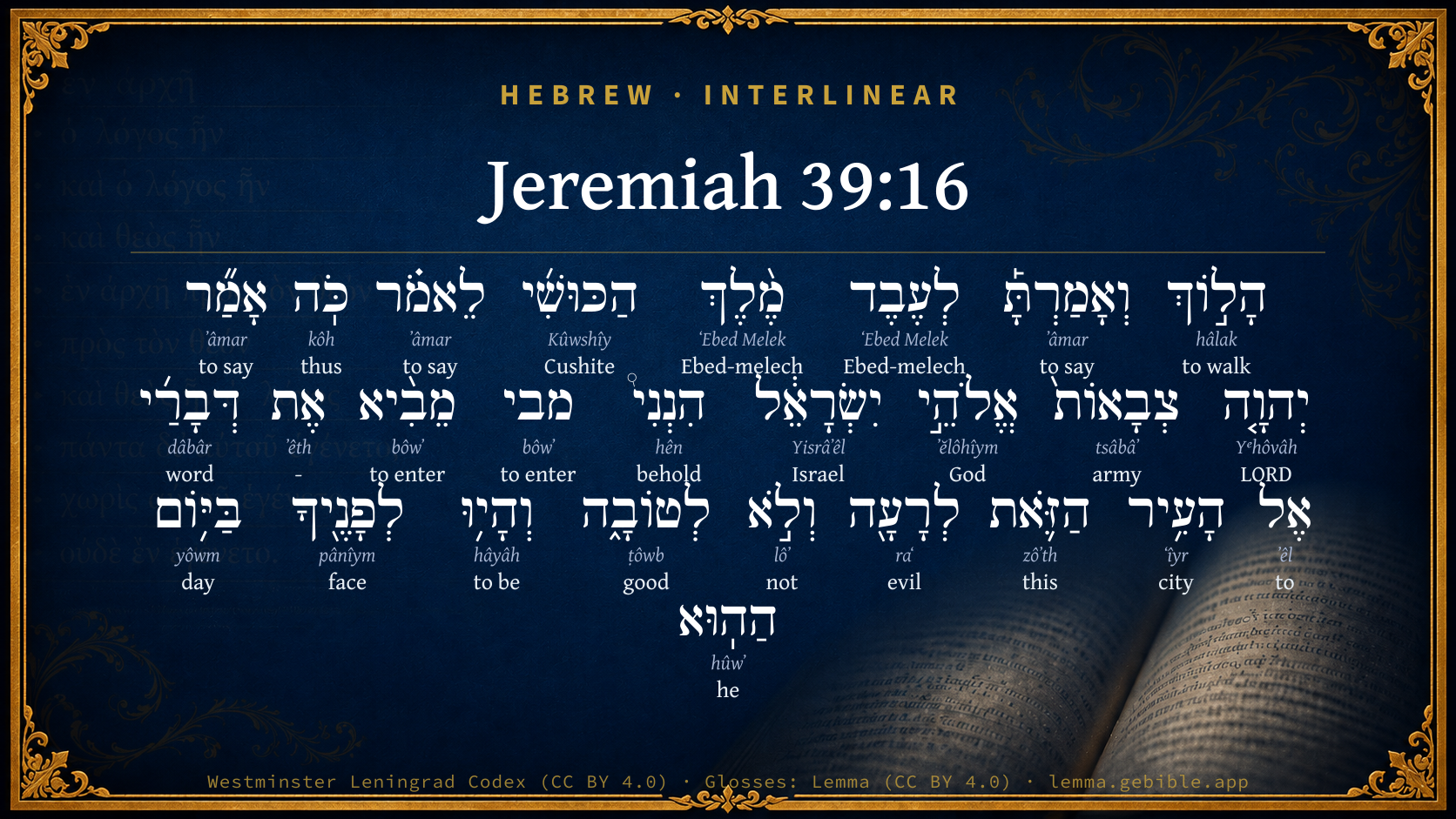
Hebrew (Westminster Leningrad Codex) Jeremiah 39:16 appears in the Hebrew Old Testament. The text above is from the Westminster Leningrad Codex. Each word links to its Strong’s number, a concise gloss, and parsing drawn from the Open Scriptures Hebrew Bible morphology. Click any word for its full Brown-Driver-Briggs (BDB) entry.
Download image
Cite this verse

Jeremiah 39:16 (World English Bible). Public Domain. Lemma interlinear Bible study tool, https://lemma.gebible.app/v/jeremiah/39/16.

Show BibTeX & RIS
BibTeX
RIS
English Translation
Go, and speak to Ebedmelech the Ethiopian, saying, Thus says Yahweh of Hosts, the God of Israel: Behold, I will bring my words on this city for evil, and not for good; and they shall be accomplished before you in that day.
World English Bible · Public Domain
Download a study sheet

One document with this verse’s original text, its word-by-word gloss line, the meaning frame, cross-references with their text, attributed commentary, and full source and license credits — printable, and it pastes into notes with its structure intact.

This verse Autodidact and up

Study sheet (.html) Plain text (.txt)

A passage Seminary Student

Up to 50 verses in one chapter. A passage sheet keeps up to 6 commentary sources and 12 cross-references per verse, in the order this page ranks them, and says so on the sheet whenever that leaves anything out. Ask for a single verse and you get the Autodidact verse sheet above.

Everything on this page stays free to read, with no account — the sheet is a download of what is already on screen, not access to it.

Want to remove ads? Support Godless Engineer
Compare translations 3

The same verse in 3 English versions, stacked beneath the original-language interlinear above. Click any original word for its lexicon entry.

Each is an independent rendering of the whole verse — the interlinear is not word-aligned to these translations.

Highlighted words mark where these versions differ — a whole-verse word diff, not a word-by-word alignment.

  • World English Bible Public Domain
    Go, and speak to Ebedmelech the Ethiopian, saying, Thus says Yahweh of Hosts, the God of Israel: Behold, I will bring my words on this city for evil, and not for good; and they shall be accomplished before you in that day.
  • King James Version Public Domain
    Go and speak to Ebedmelech the Ethiopian, saying, Thus saith the LORD of hosts, the God of Israel; Behold, I will bring my words upon this city for evil, and not for good; and they shall be accomplished in that day before thee.
  • unfoldingWord Literal Text CC BY-SA 4.0
    “Speak to Ebed-Melek the Cushite and say, ‘Yahweh of hosts, God of Israel, says this: See, I am about to carry out my words against this city for disaster and not for good. For they will all come true before you on that day.

unfoldingWord Literal Text — © unfoldingWord, licensed CC BY-SA 4.0. Word-aligned USFM3 via Door43 (git.door43.org/unfoldingWord/en_ult).

Versions to compare (up to 4)

3 of 4 selected

Show all 18 translations

Every available English version of this verse, each an independent rendering of the whole verse.

  • World English Bible Public Domain
    Go, and speak to Ebedmelech the Ethiopian, saying, Thus says Yahweh of Hosts, the God of Israel: Behold, I will bring my words on this city for evil, and not for good; and they shall be accomplished before you in that day.
  • Berean Standard Bible Public Domain
    “Go and tell Ebed-melech the Cushite that this is what the LORD of Hosts, the God of Israel, says: ‘I am about to fulfill My words against this city for harm and not for good, and on that day they will be fulfilled before your eyes.
  • Majority Standard Bible Public Domain
    “Go and tell Ebed-melech the Cushite that this is what the LORD of Hosts, the God of Israel, says: ‘I am about to fulfill My words against this city for harm and not for good, and on that day they will be fulfilled before your eyes.
  • King James Version Public Domain
    Go and speak to Ebedmelech the Ethiopian, saying, Thus saith the LORD of hosts, the God of Israel; Behold, I will bring my words upon this city for evil, and not for good; and they shall be accomplished in that day before thee.
  • American Standard Version (1901) Public Domain
    Go, and speak to Ebed-melech the Ethiopian, saying, Thus saith Jehovah of hosts, the God of Israel: Behold, I will bring my words upon this city for evil, and not for good; and they shall be accomplished before thee in that day.
  • Revised Version (1885) Public Domain
    Go, and speak to Ebed-melech the Ethiopian, saying, Thus saith the LORD of hosts, the God of Israel: Behold, I will bring my words upon this city for evil, and not for good; and they shall be accomplished before thee in that day.
  • Geneva Bible (1599) Public Domain
    Go and speake to Ebed-melech the blacke More, saying, Thus saith the Lord of hostes the God of Israel, Beholde, I wil bring my wordes vpon this citie for euill, and not for good, and they shalbe accomplished in that day before thee.
  • Douay-Rheims (1899) Public Domain
    Thus saith the Lord of hosts the God of Israel: Behold I will bring my words upon this city unto evil, and not unto good: and they shall be accomplished in thy sight in that day.
  • Young's Literal Translation Public Domain
    `Go, and thou hast spoken to Ebed-Melech the Cushite, saying: Thus said Jehovah of Hosts, God of Israel: Lo, I am bringing in My words unto this city for evil, and not for good, and they have been before thee in that day.
  • Literal Standard Version CC BY-SA 4.0
    “Go, and you have spoken to Ebed-Melech the Cushite, saying, Thus said YHWH of Hosts, God of Israel: Behold, I am bringing in My words to this city for calamity, and not for good, and they have been before you in that day.
  • Unlocked Literal Bible CC BY-SA 4.0
    “Speak to Ebed-Melek the Cushite and say, 'Yahweh of hosts, God of Israel, says this: See, I am about to carry out my words against this city for disaster and not for good. For they will all come true before you on that day.
  • unfoldingWord Literal Text CC BY-SA 4.0
    “Speak to Ebed-Melek the Cushite and say, ‘Yahweh of hosts, God of Israel, says this: See, I am about to carry out my words against this city for disaster and not for good. For they will all come true before you on that day.
  • Darby Bible Public Domain
    Go and speak to Ebed-melech the Ethiopian, saying, Thus saith Jehovah of hosts, the God of Israel: Behold, I will bring my words upon this city for evil, and not for good, and they shall come to pass before thy face in that day.
  • World Messianic Bible Public Domain
    “Go, and speak to Ebedmelech the Ethiopian, saying, ‘The LORD of Hosts, the God of Israel, says: “Behold, I will bring my words on this city for evil, and not for good; and they will be accomplished before you in that day.
  • Webster's Bible Public Domain
    Go and speak to Ebed-melech the Cushite, saying, Thus saith the LORD of hosts, the God of Israel; Behold, I will bring my words upon this city for evil, and not for good; and they shall be accomplished in that day before thee.
  • Free Bible Version CC BY-SA 4.0
    “Go and tell Ebed-melech the Cushite that this is what the Lord Almighty, the God of Israel, says: I am about to keep my promise I made against this city—to harm it and not to help it—you'll see it for yourself when it happens.
  • Bible in Basic English Public Domain
    Go and say to Ebed-melech the Ethiopian, This is what the Lord of armies, the God of Israel, has said: See, my words will come true for this town, for evil and not for good: they will come about before your eyes on that day.
  • JPS Tanakh (1917) Public Domain
    'Go, and speak to Ebed-melech the Ethiopian, saying: Thus saith the LORD of hosts, the God of Israel: Behold, I will bring My words upon this city for evil, and not for good; and they shall be accomplished before thee in that day.

Literal Standard Version (2020), Covenant Press — licensed CC BY-SA 4.0. Text via the HelloAO Bible API (eBible.org). Unlocked Literal Bible (unfoldingWord) — licensed CC BY-SA 4.0. Text via the HelloAO Bible API (eBible.org). unfoldingWord Literal Text — © unfoldingWord, licensed CC BY-SA 4.0. Word-aligned USFM3 via Door43 (git.door43.org/unfoldingWord/en_ult). Free Bible Version, Dr. Jonathan Gallagher — licensed CC BY-SA 4.0. Text via the HelloAO Bible API (eBible.org).

Word by word

More ways to search: Search by grammar → Find every occurrence → Compare this word →

Practice this passage: Drill this verse → Learn its vocabulary →

לְעֶבֶד
ʻEbed Melek
H5663
“to/for · Ebed-melech”
Preposition + Noun, Proper
Part of Speech
Preposition + Noun
Type
Proper
Full BDB Definition

Origin: from H5650 and H4428

TWOT: None

Ebed-melech = "servant of the king" - an Ethiopian eunuch in the service of king Zedekiah, through whose interference Jeremiah was released from prison
  1. הָל֣וֹךְ hâlak H1980 “to walk” Verb, Qal, Infinitive Absolute
  2. וְאָמַרְתָּ֡ ʼâmar H559 “and · to say” Conjunction + Verb, Qal, Sequential Perfect, 2nd Person, Masculine, Singular
  3. מֶ֨לֶךְ ʻEbed Melek H5663 “Ebed-melech” Noun, Proper
  4. הַכּוּשִׁ֜י Kûwshîy H3569 “the · Cushite” Particle, Definite Article + Noun, Gentilic, Masculine, Singular, Absolute
  5. לֵאמֹ֗ר ʼâmar H559 “to say” Preposition + Verb, Qal, Infinitive Construct
  6. כֹּֽה kôh H3541 “thus” Adverb
  7. אָמַ֞ר ʼâmar H559 “to say” Verb, Qal, Perfect, 3rd Person, Masculine, Singular
  8. יְהוָ֤ה Yᵉhôvâh H3068 “LORD” Noun, Proper
  9. צְבָאוֹת֙ tsâbâʼ H6635 “armies” Noun, Common, Both, Plural, Absolute
  10. אֱלֹהֵ֣י ʼĕlôhîym H430 “God(s) of” Noun, Common, Masculine, Plural, Construct
  11. יִשְׂרָאֵ֔ל Yisrâʼêl H3478 “Israel” Noun, Proper
  12. הִנְנִי֩ hên H2005 “behold · me” Particle, Demonstrative + Suffix, Personal, 1st Person, Common, Singular
  13. מבי bôwʼ H935 “entering” Verb, Hiphil, Participle Active, Masculine, Singular, Absolute
  14. מֵבִ֨יא bôwʼ H935 “entering” Verb, Hiphil, Participle Active, Masculine, Singular, Absolute
  15. אֶת ʼêth H853 “-” Particle, Direct Object
  16. דְּבָרַ֜י dâbâr H1697 “words · my” Noun, Common, Masculine, Plural, Construct + Suffix, Personal, 1st Person, Common, Singular
  17. אֶל ʼêl H413 “to” Preposition
  18. הָעִ֥יר ʻîyr H5892 “the · city” Particle, Definite Article + Noun, Common, Feminine, Singular, Absolute
  19. הַזֹּ֛את zôʼth H2063 “the · this” Particle, Definite Article + Pronoun, Demonstrative, Feminine, Singular
  20. לְרָעָ֖ה raʻ H7451 “to/for · evil” Preposition + Noun, Common, Feminine, Singular, Absolute
  21. וְלֹ֣א lôʼ H3808 “and · not” Conjunction + Particle, Negative
  22. לְטוֹבָ֑ה ṭôwb H2896 “to/for · good” Preposition + Adjective, Adjective, Feminine, Singular, Absolute
  23. וְהָי֥וּ hâyâh H1961 “and · to be” Conjunction + Verb, Qal, Sequential Perfect, 3rd Person, Common, Plural
  24. לְפָנֶ֖יךָ pânîym H6440 “to/for · face(s) · your” Preposition + Noun, Common, Both, Plural, Construct + Suffix, Personal, 2nd Person, Masculine, Singular
  25. בַּיּ֥וֹם yôwm H3117 “in/at the · day” Preposition, Determined + Noun, Common, Masculine, Singular, Absolute
  26. הַהֽוּא hûwʼ H1931 “the · he” Particle, Definite Article + Pronoun, Personal, 3rd Person, Masculine, Singular

About this verse

These counts appear in no published source. They are computed here, from the morphology-tagged text and Lemma’s own curated glosses. What Lemma adds →

27
words
23
distinct lemmas
Prophets
section

Notable vocabulary

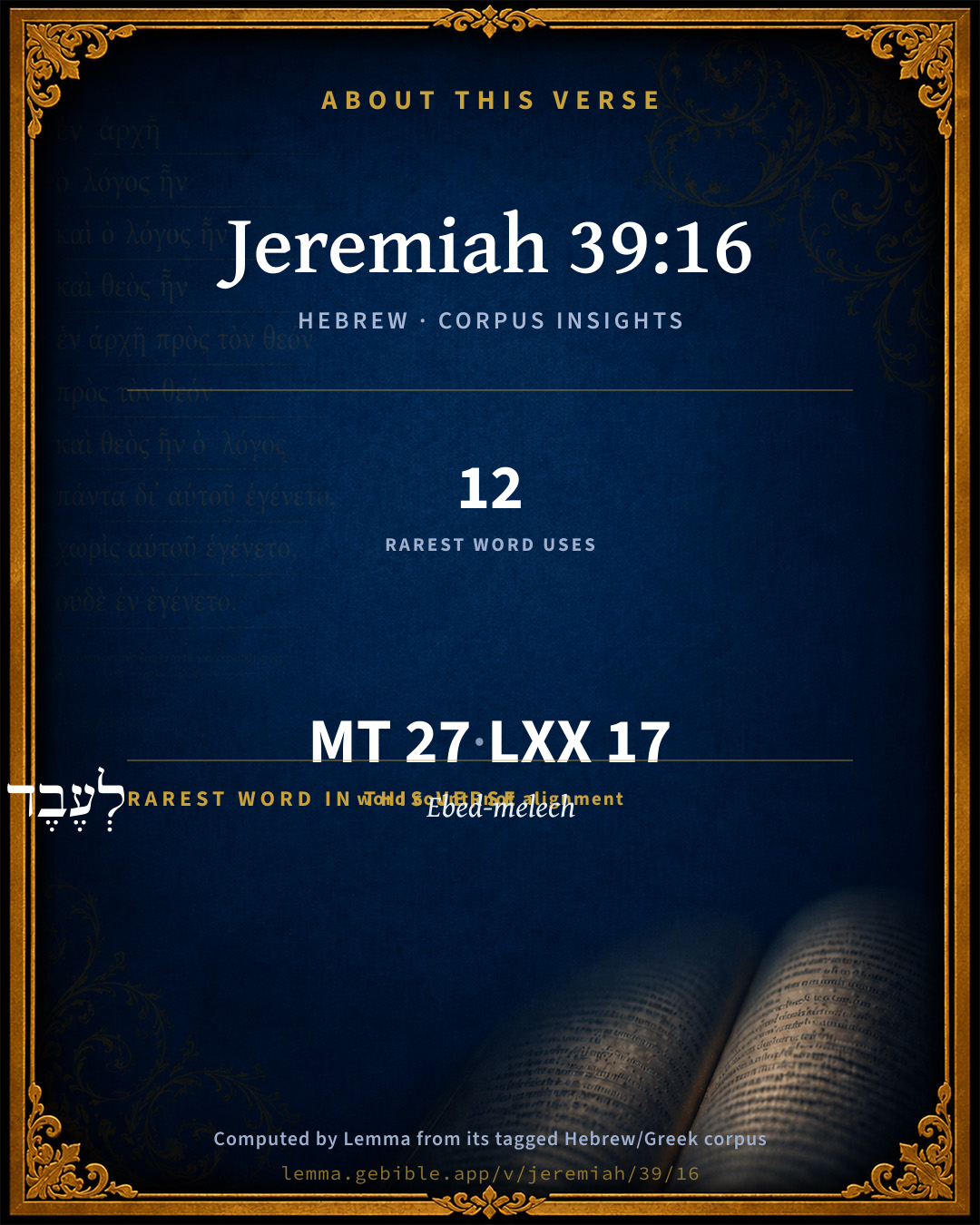
The rarest word here is לְעֶבֶד Ebed-melech H5663 — appearing just 12 times in the whole Hebrew Bible.

Shared distinctive vocabulary

לְעֶבֶד Ebed-melech H5663 occurs in 6 verses of the Hebrew Bible. Also found in:

Grammatical profile

  • 7 verbs
  • 12 nouns
  • 1 adjective
  • 2 pronouns
  • 1 preposition
  • 1 adverb
  • 3 particles

Verb forms

  • הָל֣וֹךְ Qal · Infinitive Absolute
  • וְאָמַרְתָּ֡ Qal · Sequential Perfect
  • לֵאמֹ֗ר Qal · Infinitive Construct
  • אָמַ֞ר Qal · Perfect
  • מבי Hiphil · Participle Active
  • מֵבִ֨יא Hiphil · Participle Active
  • וְהָי֥וּ Qal · Sequential Perfect

Repetition

Words recur within this verse — often emphatic in Hebrew:

  • וְאָמַרְתָּ֡ to say H559 ×3
  • לְעֶבֶד Ebed-melech H5663 ×2
  • מבי to enter H935 ×2

Hebrew & Septuagint length

In the original languages it is 27 Hebrew tokens and 17 Greek tokens — but the two are counted differently (Hebrew bundles its prefixes and suffixes into one token; the Greek is in lemma form), so that isn’t a like-for-like length.

Cross-references

21

Topical passages linked to Jeremiah 39:16 in the Treasury of Scripture Knowledge — connected by theme and wording, ordered by reader-vote popularity; previews shown in the World English Bible.

  • Daniel 9:12 He has confirmed his words, which he spoke against us, and against our judges who judged us, by bringing on us a great evil; for under the whole sky has not been done as has been done on Jerusalem.
  • Zechariah 1:6 But my words and my decrees, which I commanded my servants the prophets, didn't they overtake your fathers? "Then they repented and said, 'Just as Yahweh of Hosts determined to do to us, according to our ways, and according to our practices, so he has dealt with us.'"
  • Joshua 23:14–15 Behold, this day I am going the way of all the earth: and you know in all your hearts and in all your souls, that not one thing has failed of all the good things which Yahweh your God spoke concerning you; all are happen to you, not one thing has failed of it.
  • 2 Chronicles 36:21 to fulfill the word of Yahweh by the mouth of Jeremiah, until the land had enjoyed its Sabbaths: [for] as long as it lay desolate it kept Sabbath, to fulfill seventy years.
  • Psalms 91:8–9 You will only look with your eyes, And see the recompense of the wicked.
  • Psalms 92:11 My eye has also seen my enemies. My ears have heard of the wicked enemies who rise up against me.
  • Jeremiah 5:14 Therefore thus says Yahweh, the God of hosts, Because you speak this word, behold, I will make my words in your mouth fire, and this people wood, and it shall devour them.
  • Jeremiah 19:11–12 and shall tell them, Thus says Yahweh of Hosts: Even so will I break this people and this city, as one breaks a potter's vessel, that can't be made whole again; and they shall bury in Topheth, until there be no place to bury.
  • Jeremiah 21:7–10 Afterward, says Yahweh, I will deliver Zedekiah king of Judah, and his servants, and the people, even such as are left in this city from the pestilence, from the sword, and from the famine, into the hand of Nebuchadrezzar king of Babylon, and into the hand of their enemies, and into the hand of those who seek their life: and he shall strike them with the edge of the sword; he shall not spare them, neither have pity, nor have mercy.
  • Jeremiah 24:8–10 As the bad figs, which can't be eaten, they are so bad, surely thus says Yahweh, So will I give up Zedekiah the king of Judah, and his princes, and the residue of Jerusalem, who remain in this land, and those who dwell in the land of Egypt,
  • Jeremiah 26:15 Only know for certain that, if you put me to death, you will bring innocent blood on yourselves, and on this city, and on the inhabitants of it; for of a truth Yahweh has sent me to you to speak all these words in your ears.
  • Jeremiah 26:18 Micah the Morashtite prophesied in the days of Hezekiah king of Judah; and he spoke to all the people of Judah, saying, Thus says Yahweh of Hosts: Zion shall be plowed as a field, and Jerusalem shall become heaps, and the mountain of the house as the high places of a forest.
  • Jeremiah 26:20 There was also a man who prophesied in the name of Yahweh, Uriah the son of Shemaiah of Kiriath Jearim; and he prophesied against this city and against this land according to all the words of Jeremiah:
  • Jeremiah 32:28–29 Therefore thus says Yahweh: Behold, I will give this city into the hand of the Chaldeans, and into the hand of Nebuchadrezzar king of Babylon, and he shall take it:
  • Jeremiah 34:2–3 Thus says Yahweh, the God of Israel, Go, and speak to Zedekiah king of Judah, and tell him, Thus says Yahweh, Behold, I will give this city into the hand of the king of Babylon, and he shall burn it with fire:
  • Jeremiah 34:22 Behold, I will command, says Yahweh, and cause them to return to this city; and they shall fight against it, and take it, and burn it with fire: and I will make the cities of Judah a desolation, without inhabitant.
  • Jeremiah 35:17 therefore thus says Yahweh, the God of hosts, the God of Israel: Behold, I will bring on Judah and on all the inhabitants of Jerusalem all the evil that I have pronounced against them; because I have spoken to them, but they have not heard; and I have called to them, but they have not answered.
  • Jeremiah 36:31 I will punish him and his seed and his servants for their iniquity; and I will bring on them, and on the inhabitants of Jerusalem, and on the men of Judah, all the evil that I have pronounced against them, but they didn't listen.
  • Jeremiah 38:7–13 Now when Ebedmelech the Ethiopian, a eunuch, who was in the king's house, heard that they had put Jeremiah in the dungeon (the king then sitting in the gate of Benjamin),
  • Jeremiah 44:28–29 Those who escape the sword shall return out of the land of Egypt into the land of Judah, few in number; and all the remnant of Judah, who have gone into the land of Egypt to sojourn there, shall know whose word shall stand, mine, or theirs.
  • Matthew 24:35 Heaven and earth will pass away, but my words will not pass away.

Cross-references courtesy of OpenBible.info (CC BY 4.0).

Hebrew and Greek witnesses Masoretic Hebrew ↔ Greek Septuagint

The same verse in the two great witnesses to the Old Testament, shown verse-for-verse.

These are two independent witnesses, not word-aligned to each other, and the Septuagint is shown in lemma (dictionary) form.

Hebrew Jeremiah 39:16 Masoretic · Westminster Leningrad Codex

הָל֣וֹךְ וְאָמַרְתָּ֡ לְעֶבֶד מֶ֨לֶךְ הַכּוּשִׁ֜י לֵאמֹ֗ר כֹּֽה אָמַ֞ר יְהוָ֤ה צְבָאוֹת֙ אֱלֹהֵ֣י יִשְׂרָאֵ֔ל הִנְנִי֩ מבי מֵבִ֨יא אֶת דְּבָרַ֜י אֶל הָעִ֥יר הַזֹּ֛את לְרָעָ֖ה וְלֹ֣א לְטוֹבָ֑ה וְהָי֥וּ לְפָנֶ֖יךָ בַּיּ֥וֹם הַהֽוּא

Go, and speak to Ebedmelech the Ethiopian, saying, Thus says Yahweh of Hosts, the God of Israel: Behold, I will bring my words on this city for evil, and not for good; and they shall be accomplished before you in that day.

World English Bible · Public Domain

Greek LXX Structure differs

In the Septuagint, Jeremiah is about an eighth shorter than the Hebrew and arranges its material differently — the Oracles Against the Nations (Hebrew chapters 46–51) appear in the middle of the Greek book, after 25:13. Because the chapter and verse boundaries do not line up, a verse-for-verse comparison with the Hebrew is not shown.

A verse-for-verse comparison isn’t shown here because the chapters and verses don’t line up. Switch to the LXX edition with the MT / LXX toggle above to read the Greek directly.

Hebrew: Westminster Leningrad Codex (CC BY 4.0). Greek: Septuagint (public domain); English from a public-domain English Septuagint. How the Septuagint differs from the Hebrew →

Targum (Aramaic paraphrase)

1

The Targum is the ancient Jewish Aramaic paraphrase of the Hebrew Scriptures — an interpretive translation, not the Hebrew text itself. Onkelos (literal) and Pseudo-Jonathan (expansive) render the Torah, and Jonathan the Prophets. Coverage is partial: where no permissively-licensed English translation exists for a verse, only the Aramaic is shown. This is verse-level text, not a word-by-word alignment to the Hebrew.

  1. Targum Jonathan Prophets (Joshua–Malachi)
    אֱזֵיל וְתֵימַר לְעַבְדָא דְמַלְכָּא צִדְקִיָה לְמֵימָר כִּדְנַן אֲמַר יְיָ צְבָאוֹת אֱלָהָא דְיִשְׂרָאֵל הָא אֲנָא מַיְתֵי יַת פִּתְגָמֵי עַל קַרְתָּא הָדָא לְבִישְׁתָא וְלָא לְטָבָא וִיהוֹן קֳדָמָךְ בְּיוֹמָא הַהוּא:

    (no public-domain English translation for this verse)

    Targum Jonathan — Aramaic: “Mikraot Gedolot” (public domain). English: “Sefaria Community Translation” (CC0 1.0 (public-domain dedication)); “London "Chaldee Paraphrase," 1871” (public domain). Text via Sefaria.

Commentary

Notes on Jeremiah 39:16 from classic Christian and Jewish commentators (each source and its license shown beneath its notes). The classic Christian expositions comment on the surrounding passage and are grouped to its opening verse, so a note may address several verses; the Jewish commentaries on the Tanakh (Rashi and others) are per-verse, so they appear only where the commentator wrote on this verse.

Lemma curates 59 commentaries, every one of them public domain or Creative Commons licensed, each selected and text-cleaned for this edition rather than reprinted as found. About our sources →

Trapp's Complete Commentary

John Trapp

Jer 39:16 Go and speak to Ebedmelech the Ethiopian, saying, Thus saith the LORD of hosts, the God of Israel; Behold, I will bring my words upon this city for evil, and not for good; and they shall be [accomplished] in that day before thee.

Ver. 16. Go and speak unto Ebedmelech the Ethiopian.] Who yet was an Israelite indeed by his faith and religion, as was likewise Jether the Ishmaelite. {1Ch 7:17 2Sa 17:25}

Thus saith the Lord of hosts.] Who will not fail to give, unto him who showeth kindness to any prophet of his, a prophet’s reward. {Mat 10:41-42}

Behold, I will bring my words upon this city for evil.] See Jer 20:16; Jer 44:27.

And they shall be accomplished in that day before thee.] Thou shalt see it, but shalt survive it. And this prophecy may be unto us instead of a most certain history.

John Trapp, A Commentary or Exposition upon All the Books of the Old and New Testament (1647–1656) — public domain. Text from a community e-Sword module.

Jamieson, Fausset & Brown

Robert Jamieson, A. R. Fausset & David Brown

Go--not literally, for he was in confinement, but figuratively.

before thee--in thy sight.

Jamieson, Fausset & Brown — Commentary Critical and Explanatory on the Whole Bible (1871) — public domain (CC PDM 1.0). Text via the HelloAO Bible API.

Adam Clarke's Commentary

Verse 16. Go and speak to Ebed-melech] The king's servant, the Cushite.

Adam Clarke's Commentary on the Bible (1810–1826) — public domain. Text from a community e-Sword/MySword module.

John Calvin's Commentaries

The word Ethiopian is now repeated, because God intended, in the person of an alien indirectly to reprove the Jews; for no doubt they despised him, because he was not of the holy seed of Abraham. But God shews that he peculiarly regarded him, while he rejected the masked and hypocritical children of Abraham, who were only born of him according to the flesh, but had, by their impiety, renounced him, so that they were wholly unworthy of so high an honor.

And he says, Go and say, Behold, I am bringing my words on this city for evil and not for good; and they shall be before thee in that day. We conclude, from these words, that this was spoken to Ebedmelech before the city was taken by the Chaldeans, in order that he might remain quietly at home, and not flee away with the king, who, as we have seen, tried to escape. God then intended to strengthen the confidence of Ebedmelech, so that he might not fear and tremble like others, and expose himself to death, in trying to secure his safety. For this is the design of all God’s promises, even to keep us from being disturbed, to give us quietness of mind, and to cause us to look for the help promised to us. For we know that when fear lays hold on our minds, there is no settled purpose, but we are harassed by disquietude, and, as it were, tossed to and fro. It was therefore God’s design to bring aid beforehand, so that Ebedmelech might not, with others, be hurried into despair. He says, Behold, I am bringing, etc. God here confirms Ebedmelech in the truth, that he would be the author of the calamity; for had Jerusalem been taken by chance, Ebedmelech might justly have feared; but when he was taught that it was to happen through God’s just judgment he would feel sure of his safety; for it would be in the power of the same God to save one man and even many, while he was destroying the whole people. This, then, is the reason why God declared that he was bringing his words for evil and not for good; for except Ebedmelech had been convinced that the city and its inhabitants were in God’s hand and power, he could never have been led to entertain good hope; but when he knew that the city would perish through the righteous vengeance of God, he would then be fully confident as to his own safety; for God promised to preserve him in the midst of the common ruin.

He says, Thou shalt see, my words shall be before thee, as though he had said, “Thou shalt be an eye-witness of my power.” It was indeed necessary, as I have said, that Ebedmelech should see God’s hand in the destruction of the city and people; for he would ever have vacillated, and would have known no rest, had he not before his eyes the hand and the vengeance of God, This is one thing. But as to the words, I am bringing my words for evil and not for good, we have explained them elsewhere. The word evil does not mean sin here, but according to a common usage, evil is said to be whatever men regard as adverse to them; so all punishments inflicted by God are called evils, as we find in Isaiah,

“I am God, who create light and darkness, life and death, good and evil.” (Isaiah 45:7)

John Calvin's Commentaries (1540-1563) — public domain. Text from the Calvin Translation Society English edition (1840s-50s) via the Christian Classics Ethereal Library (ccel.org). Calvin's coverage is partial (roughly two-thirds of the Bible); uncommented books and verses are honest gaps, never fabricated. The 19th-century editor's footnotes and remarks are omitted so the notes are faithfully Calvin's own voice.

Ellicott's Commentary for English Readers

(16) Go and speak to Ebed-melech.—It lies in the nature of the case that the prophet, when he put this prediction, given during the progress of the siege, on record, knew that it had been fulfilled. We hear nothing more of the faithful Ethiopian, but we may believe that he was spared by the Chaldæans, probably at the prophet’s intercession. It is not without significance that the promise is given in the same terms as that to Baruch in Jer_45:5. The “men” of whom he was afraid were obviously the princes whom he had irritated by his interference on behalf of Jeremiah.

A Bible Commentary for English Readers, edited by Charles John Ellicott (1878–1897) — public domain. Text from a community e-Sword module.

John Gill's Exposition

Go and speak to Ebedmelech the Ethiopians,.... Not that the prophet was to go, or could go, out of prison, to deliver this message to Ebedmelech; but that he should, as he had opportunity, acquaint him with it; either by writing to him, or by word of mouth, when he should visit him; for no doubt he sometimes did, having so great a respect for the prophet:

saying, thus saith the Lord of hosts, the God of Israel; whom Ebedmelech, though an Ethiopian, served; being a proselyte, and a good man; and therefore would listen unto and believe what came from him:

behold, I will bring my words upon this city for evil, and not for good; meaning the prophecies delivered out by Jeremiah, which Ebedmelech was no stranger to, these should be accomplished; not what promised good, on condition of repentance and amendment; but what threatened evil to the city, and the inhabitants of it, even the destruction of them:

and they shall be accomplished in that day before thee; signifying that he should live till then, and his enemies would not be able to take away his life; and that he should see with his eyes all that was predicted accomplished, and he himself safe amidst all this.

John Gill's Exposition of the Whole Bible (1746–1763) — public domain (CC PDM 1.0). Text via the HelloAO Bible API.

Matthew Poole's English Annotations

Ebed-melech is here again called the

Ethiopian, to the reproach of the Jews, that a stranger should show more kindness to a prophet of the Lord than any of that nation to whom he was specially sent; which was a type of the calling of the Gentiles, and rejection of the Jews. God assures Ebed-melech the city should be taken and burnt, and the people carried into captivity.

Matthew Poole's English Annotations on the Holy Bible (1683–1685) — public domain. Text from a community e-Sword/MySword module.

Whedon's Commentary on the Bible

Daniel D. Whedon

16. Go and speak — This language suggests that Jeremiah was not kept in close confinement, but could, upon special permission, go out at seasonable times.

Daniel D. Whedon (gen. ed.), Commentary on the Old and New Testaments (1874–1909) — public domain. Text from a community e-Sword module.

The Pulpit Commentary

Go and speak. Ebed-melech must be supposed to come into the court of the watch, so that Jeremiah might communicate with him.

The Pulpit Commentary (1880–1919), ed. H.D.M. Spence-Jones & Joseph S. Exell — public domain. Text from a community e-Sword module.

Rashi

Rabbi Shlomo Yitzchaki (Rashi)

and they shall be before you on that day And the words shall be before you, for you shall see them fulfilled.

Rashi on the Tanakh — English translations: “The Judaica Press complete Tanach with Rashi, translated by A. J. Rosenberg” (CC BY 4.0); “Pentateuch with Rashi's commentary by M. Rosenbaum and A.M. Silbermann, 1929-1934” (public domain); “The Metsudah Tanach series, Lakewood, N.J” (CC BY 4.0); and “The Book of Joshua, Metsudah Publications, 1997” (CC BY 4.0). Text via Sefaria.

Lesson kit

Teaching starters — assembled from the data on this page, not authored interpretation. Every prompt links to the verse data it draws on. Edit before teaching.

Jeremiah, in the Prophets, opens this verse with 27 words (23 distinct Hebrew lemmas). Its most distinctive word is ʻEbed Melek (“Ebed-melech”). A historical commentator’s framing appears above. Read the whole chapter for the surrounding context.

Discussion questions

  1. How does “Ebed-melech” (ʻEbed Melek) shape what this verse is saying?
  2. Jeremiah 38:7 shares the word «Ebed-melech» with this verse. How do the two illuminate each other?
  3. “to say” occurs 3× in this one verse. What is the effect of the repetition?
  4. The translations on this page render this verse differently — a whole-verse word diff, not a word-by-word alignment. What might account for the different wordings?
  5. The verb «הָל֣וֹךְ» is Qal Infinitive Absolute. How does its form color the action?
  6. Reading how Trapp's Complete Commentary and Jamieson, Fausset & Brown read this verse, where do the two commentators agree and where do they part?

Things to notice

Reading settings

Reading text

Shown beneath each verse's original-language words.

Old Testament
Old Testament edition

Read the OT as the Masoretic Hebrew (MT) or the Greek Septuagint (LXX).

English shown for the Greek Septuagint (in the Hebrew ↔ Greek comparison).

Comparing translations? Open the Compare panel on any verse page to stack up to four side by side.