
Psalms 107:5

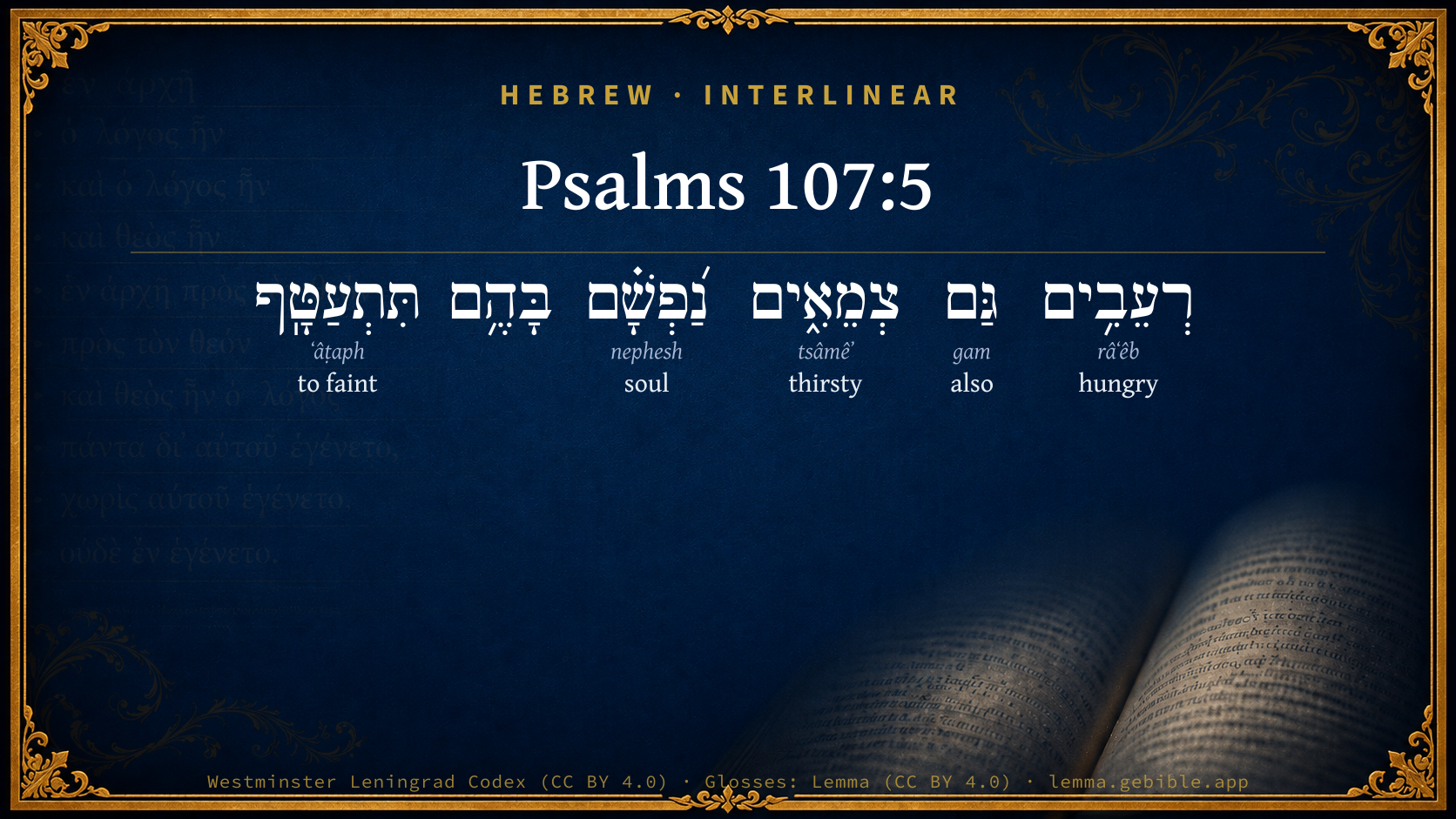
Hebrew (Westminster Leningrad Codex) Psalms 107:5 appears in the Hebrew Old Testament. The text above is from the Westminster Leningrad Codex. Each word links to its Strong’s number, a concise gloss, and parsing drawn from the Open Scriptures Hebrew Bible morphology. Click any word for its full Brown-Driver-Briggs (BDB) entry.
Download image
Cite this verse

Psalms 107:5 (World English Bible). Public Domain. Lemma interlinear Bible study tool, https://lemma.gebible.app/v/psalms/107/5.

Show BibTeX & RIS
BibTeX
RIS
English Translation
Hungry and thirsty, Their soul fainted in them.
World English Bible · Public Domain
Download a study sheet

One document with this verse’s original text, its word-by-word gloss line, the meaning frame, cross-references with their text, attributed commentary, and full source and license credits — printable, and it pastes into notes with its structure intact.

This verse Autodidact and up

Study sheet (.html) Plain text (.txt)

A passage Seminary Student

Up to 50 verses in one chapter. A passage sheet keeps up to 6 commentary sources and 12 cross-references per verse, in the order this page ranks them, and says so on the sheet whenever that leaves anything out. Ask for a single verse and you get the Autodidact verse sheet above.

Everything on this page stays free to read, with no account — the sheet is a download of what is already on screen, not access to it.

Want to remove ads? Support Godless Engineer
Compare translations 3

The same verse in 3 English versions, stacked beneath the original-language interlinear above. Click any original word for its lexicon entry.

Each is an independent rendering of the whole verse — the interlinear is not word-aligned to these translations.

Highlighted words mark where these versions differ — a whole-verse word diff, not a word-by-word alignment.

  • World English Bible Public Domain
    Hungry and thirsty, Their soul fainted in them.
  • King James Version Public Domain
    Hungry and thirsty, their soul fainted in them.
  • unfoldingWord Literal Text CC BY-SA 4.0
    Hungry and thirsty, their soul fainted within them.

unfoldingWord Literal Text — © unfoldingWord, licensed CC BY-SA 4.0. Word-aligned USFM3 via Door43 (git.door43.org/unfoldingWord/en_ult).

Versions to compare (up to 4)

3 of 4 selected

Show all 18 translations

Every available English version of this verse, each an independent rendering of the whole verse.

  • World English Bible Public Domain
    Hungry and thirsty, Their soul fainted in them.
  • Berean Standard Bible Public Domain
    They were hungry and thirsty; their soul fainted within them.
  • Majority Standard Bible Public Domain
    They were hungry and thirsty; their soul fainted within them.
  • King James Version Public Domain
    Hungry and thirsty, their soul fainted in them.
  • American Standard Version (1901) Public Domain
    Hungry and thirsty, Their soul fainted in them.
  • Revised Version (1885) Public Domain
    Hungry and thirsty, their soul fainted in them.
  • Geneva Bible (1599) Public Domain
    Both hungrie and thirstie, their soule fainted in them.
  • Douay-Rheims (1899) Public Domain
    They were hungry and thirsty: their soul fainted in them.
  • Young's Literal Translation Public Domain
    Hungry -- yea -- thirsty, Their soul in them becometh feeble,
  • Literal Standard Version CC BY-SA 4.0
    Hungry—indeed—thirsty, || Their soul becomes feeble in them,
  • Unlocked Literal Bible CC BY-SA 4.0
    Because they were hungry and thirsty, they fainted from exhaustion.
  • unfoldingWord Literal Text CC BY-SA 4.0
    Hungry and thirsty, their soul fainted within them.
  • Darby Bible Public Domain
    Hungry and thirsty, their soul fainted in them:
  • World Messianic Bible Public Domain
    Hungry and thirsty, their soul fainted in them.
  • Webster's Bible Public Domain
    Hungry and thirsty, their soul fainted in them.
  • Free Bible Version CC BY-SA 4.0
    Hungry and thirsty, they became very discouraged.
  • Bible in Basic English Public Domain
    Their souls became feeble for need of food and drink.
  • JPS Tanakh (1917) Public Domain
    Hungry and thirsty, their soul fainted in them.

Literal Standard Version (2020), Covenant Press — licensed CC BY-SA 4.0. Text via the HelloAO Bible API (eBible.org). Unlocked Literal Bible (unfoldingWord) — licensed CC BY-SA 4.0. Text via the HelloAO Bible API (eBible.org). unfoldingWord Literal Text — © unfoldingWord, licensed CC BY-SA 4.0. Word-aligned USFM3 via Door43 (git.door43.org/unfoldingWord/en_ult). Free Bible Version, Dr. Jonathan Gallagher — licensed CC BY-SA 4.0. Text via the HelloAO Bible API (eBible.org).

Word by word

More ways to search: Search by grammar → Find every occurrence → Compare this word →

Practice this passage: Drill this verse → Learn its vocabulary →

About this verse

These counts appear in no published source. They are computed here, from the morphology-tagged text and Lemma’s own curated glosses. What Lemma adds →

6
words
5
distinct lemmas
Wisdom
section

Notable vocabulary

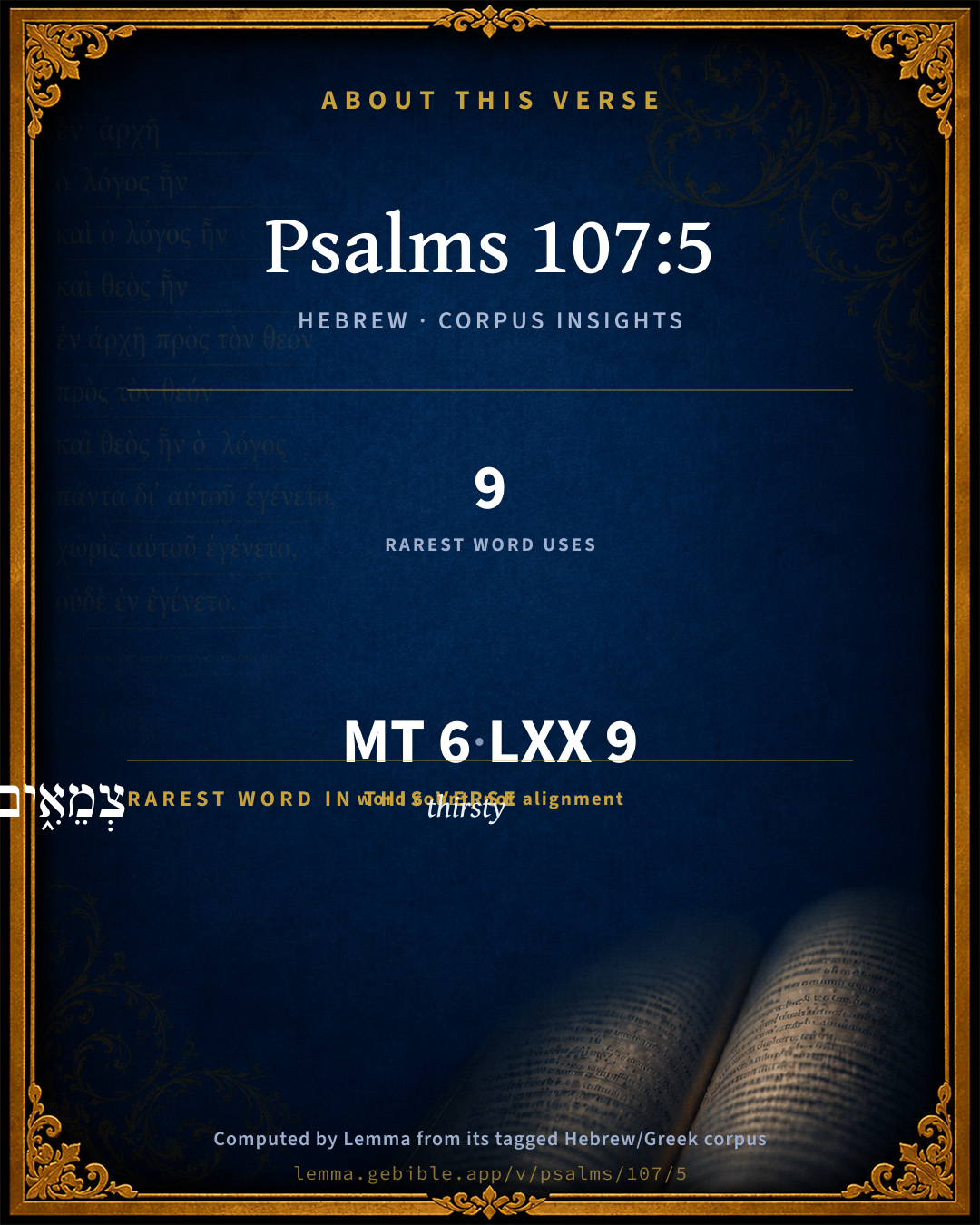
The rarest word here is צְמֵאִ֑ים thirsty H6771 — appearing just 9 times in the whole Hebrew Bible.

Shared distinctive vocabulary

צְמֵאִ֑ים thirsty H6771 occurs in 9 verses of the Hebrew Bible. Also found in:

Grammatical profile

  • 1 verb
  • 1 noun
  • 2 adjectives
  • 1 preposition
  • 1 particle

Verb forms

  • תִּתְעַטָּֽף Hithpael · Imperfect

Hebrew & Septuagint length

In English translation the verse runs 8 words from the Hebrew and 8 from the Septuagint (LXX English) — the same length.

A rough comparison of the two English renderings, which tokenize alike — not a word-level alignment.

Word counts can differ between the Hebrew and the Greek without any difference in meaning — e.g. the Hebrew direct-object marker אֵת has no separate Greek word, and Greek often adds the article ὁ.

In the original languages it is 6 Hebrew tokens and 9 Greek tokens — but the two are counted differently (Hebrew bundles its prefixes and suffixes into one token; the Greek is in lemma form), so that isn’t a like-for-like length.

Cross-references

6

Topical passages linked to Psalms 107:5 in the Treasury of Scripture Knowledge — connected by theme and wording, ordered by reader-vote popularity; previews shown in the World English Bible.

  • Mark 8:2–3 "I have compassion on the multitude, because they have stayed with me now three days, and have nothing to eat.
  • Judges 15:18–19 He was very thirsty, and called on Yahweh, and said, You have given this great deliverance by the hand of your servant; and now shall I die for thirst, and fall into the hand of the uncircumcised.
  • 1 Samuel 30:11–12 They found an Egyptian in the field, and brought him to David, and gave him bread, and he ate; and they gave him water to drink.
  • Isaiah 44:12 The smith [makes] an axe, and works in the coals, and fashions it with hammers, and works it with his strong arm: yes, he is hungry, and his strength fails; he drinks no water, and is faint.
  • Lamentations 2:19 Arise, cry out in the night, at the beginning of the watches; Pour out your heart like water before the face of the Lord: Lift up your hands toward him for the life of your young children, that faint for hunger at the head of every street.
  • Jeremiah 14:18 If I go forth into the field, then, behold, the slain with the sword! and if I enter into the city, then, behold, those who are sick with famine! for both the prophet and the priest go about in the land, and have no knowledge.

Cross-references courtesy of OpenBible.info (CC BY 4.0).

Hebrew and Greek witnesses Masoretic Hebrew ↔ Greek Septuagint

The same verse in the two great witnesses to the Old Testament, shown verse-for-verse.

You’re reading Greek Psalm 106 (Hebrew Psalm 107). The Septuagint counts the superscription, so verse numbers can differ from the Hebrew — chapter-level alignment, not verse-by-verse. Numbering follows Rahlfs.

These are two independent witnesses, not word-aligned to each other, and the Septuagint is shown in lemma (dictionary) form.

Hebrew Psalms 107:5 Masoretic · Westminster Leningrad Codex

רְעֵבִ֥ים גַּם צְמֵאִ֑ים נַ֝פְשָׁ֗ם בָּהֶ֥ם תִּתְעַטָּֽף

Hungry and thirsty, Their soul fainted in them.

World English Bible · Public Domain

Greek LXX Greek Psalm 106:5 Septuagint · lemma form

πεινάω καί διψάω ὁ ψυχή αὐτός ἐν αὐτός ἐκλείπω

Hungry and thirsty, their soul fainted in them.

LXX2012 (modern English Septuagint) · Public Domain

Hebrew: Westminster Leningrad Codex (CC BY 4.0). Greek: Septuagint (public domain); English from LXX2012 (modern English Septuagint) (Public Domain). How the Septuagint differs from the Hebrew →

Commentary

Notes on Psalms 107:5 from classic Christian and Jewish commentators (each source and its license shown beneath its notes). The classic Christian expositions comment on the surrounding passage and are grouped to its opening verse, so a note may address several verses; the Jewish commentaries on the Tanakh (Rashi and others) are per-verse, so they appear only where the commentator wrote on this verse.

Lemma curates 59 commentaries, every one of them public domain or Creative Commons licensed, each selected and text-cleaned for this edition rather than reprinted as found. About our sources →

Trapp's Complete Commentary

John Trapp

Psa 107:5 Hungry and thirsty, their soul fainted in them.

Ver. 5. Hungry and thirsty, &c.] The Lord’s exiles meet many times with the like exigents in the wilderness of this wicked world; but let them be content, and say, We are well for the present, and it will be better with us hereafter (Melancthon).

Exul erat Christus; comites nos exulis huius

Esse decet, cuius nos quoque membra sumus.

John Trapp, A Commentary or Exposition upon All the Books of the Old and New Testament (1647–1656) — public domain. Text from a community e-Sword module.

J. A. Alexander on Psalms

Joseph Addison Alexander

5. (Psa 107:5) Hungry--also thirsty—their soul in them shrouds itself. This verse continues the description of the wanderers in the desert. To avoid the ambiguity of an exact version, in which hungry and thirsty might seem to agree with soul, the substantive verb may be supplied in the first clause, (they are) hungry, also thirsty. The primary sense of the reflexive verb at the end of the sentence seems to be that of covering one's self with darkness, or sinking overwhelmed beneath some great calamity. See above, on Psa 77:3, and compare the cognate forms in Psa 61:2; Psa 65:13; Psa 102:1, Isa 57:16.

Joseph Addison Alexander, The Psalms Translated and Explained (1850) — public domain. Text from a community e-Sword module.

Geneva Bible (1599)

Geneva Bible translators

He showeth that there is none affliction so grievous, out of the which God will not deliver his, and also exhorteth them that are delivered to be mindful of so great a benefit.

Geneva Bible (1599) marginal notes — public domain. Text via Bolls.life.

Ellicott's Commentary for English Readers

(5) Fainted.—Literally, let itself be covered. (See Psa_77:3.)

A Bible Commentary for English Readers, edited by Charles John Ellicott (1878–1897) — public domain. Text from a community e-Sword module.

The Cambridge Bible for Schools and Colleges

gen. ed. J. J. S. Perowne

5. fainted] Was fainting within them; the imperfect tense graphically pictures their plight.

The Cambridge Bible for Schools and Colleges (gen. ed. J. J. S. Perowne; Cambridge University Press, 1878–1918) — public domain. Text from a community e-Sword module.

John Gill's Exposition

Then they cried unto the Lord in their trouble,.... To be directed in their way, and for food and drink, as travellers do when in such distress. Natural men, even the very Heathens, when in distress, will cry unto God for relief, as Jonah's mariners did, Jon 1:5. It is a time of trouble with awakened sinners, when they are convinced of sin by the Spirit of God; when they are pricked to the heart with a sense of it; when the terrors of death and hell get hold of them; when they see themselves lost and undone, and in a wrong way, and know not what to do; when they find themselves starving and ready to perish; and then they cry, that is, pray, unto the Lord, the God of their lives, whose ears are open to their cries.

And he delivered them out of their distresses; by leading them in a right way, and by satisfying and filling their hungry souls with good things, as it is explained, Psa 107:7.

John Gill's Exposition of the Whole Bible (1746–1763) — public domain (CC PDM 1.0). Text via the HelloAO Bible API.

Albert Barnes' Notes on the Bible

Hungry and thirsty - As they would be, when wandering in such a desert. A more literal and expressive rendering would be, “Hungry - also thirsty.”

Their soul fainted in them - The word used here - עטף ‛âṭaph - means properly to cover, to clothe, as with a garment, Psa 73:6; or a field with grain, Psa 65:13; then, to hide oneself, Job 23:9; then, to cover with darkness, Psa 77:3; 102, title; thus it denotes the state of mind when darkness seems to be in the way - a way of calamity, trouble, sorrow; of weakness, faintness, feebleness. Here it would seem from the connection to refer to the exhaustion produced by the want of food and drink.

Albert Barnes' Notes on the Bible (1834–1885) — public domain. Text from a community e-Sword/MySword module.

Matthew Poole's English Annotations

Partly for want of necessary provisions, and partly through anguish of spirit.

Matthew Poole's English Annotations on the Holy Bible (1683–1685) — public domain. Text from a community e-Sword/MySword module.

The Treasury of David

Charles H. Spurgeon

Ver. 5. Hungry and thirsty, their soul fainted in them. The spirits sink when the bodily frame becomes exhausted by long privations. Who can keep his courage up when he is ready to fall to the ground at every step through utter exhaustion? The supply of food is all eaten, the water is spent in the bottles, and there are neither fields nor streams in the desert, the heart therefore sinks in dire despair. Such is the condition of an awakened conscience before it knows the Lord Jesus; it is full of unsatisfied cravings, painful needs, and heavy fears. It is utterly spent and without strength, and there is nothing in the whole creation which can minister to its refreshment.

Ver. 5. Their soul fainted in them. The word here used, pje, ataph, means properly to cover, to clothe, as with a garment, Ps 73:6; or a field with grain, Ps 65:13; then, to hide oneself, Job 23:9; then to cover with darkness, Ps 77:3 and the title of Ps 102:1-28 thus it denotes the state of mind when darkness seems to be in the waya way of calamity, trouble, sorrow; of weakness, faintness, feebleness. Here it would seem from the connexion to refer to the exhaustion produced by the want of food and drink. Albert Barnes.

Ver. 5. Spiritual hunger the cause of faintness. Necessity of feeding the soul.

Psalms 107:6*

Charles H. Spurgeon's The Treasury of David (1869–1885) — public domain. Psalms only. Text from a community e-Sword/MySword module.

The Pulpit Commentary

Hungry and thirsty, their soul fainted in them. Either actual hunger and thirst, or dissatisfaction with life, may be intended.

The Pulpit Commentary (1880–1919), ed. H.D.M. Spence-Jones & Joseph S. Exell — public domain. Text from a community e-Sword module.

Lesson kit

Teaching starters — assembled from the data on this page, not authored interpretation. Every prompt links to the verse data it draws on. Edit before teaching.

Psalms, in the Wisdom, opens this verse with 6 words (5 distinct Hebrew lemmas). Its most distinctive word is tsâmêʼ (“thirsty”). A historical commentator’s framing appears above. Read the whole chapter for the surrounding context.

Discussion questions

  1. How does “thirsty” (tsâmêʼ) shape what this verse is saying?
  2. How does Deuteronomy 29:19, which shares the word «thirsty», read alongside this verse?
  3. The translations on this page render this verse differently — a whole-verse word diff, not a word-by-word alignment. What might account for the different wordings?
  4. «תִּתְעַטָּֽף» is a Hithpael Imperfect verb. How does that grammatical form shape the action described?
  5. Compare how Trapp's Complete Commentary and J. A. Alexander on Psalms read this verse. Where do they agree or differ?

Things to notice

Reading settings

Reading text

Shown beneath each verse's original-language words.

Old Testament
Old Testament edition

Read the OT as the Masoretic Hebrew (MT) or the Greek Septuagint (LXX).

English shown for the Greek Septuagint (in the Hebrew ↔ Greek comparison).

Comparing translations? Open the Compare panel on any verse page to stack up to four side by side.