

Habakkuk 3:5

Hebrew (Westminster Leningrad Codex) Habakkuk 3:5 appears in the Hebrew Old Testament. The text above is from the Westminster Leningrad Codex. Each word links to its Strong’s number, a concise gloss, and parsing drawn from the Open Scriptures Hebrew Bible morphology. Click any word for its full Brown-Driver-Briggs (BDB) entry.
Download image
Cite this verse

Habakkuk 3:5 (World English Bible). Public Domain. Lemma interlinear Bible study tool, https://lemma.gebible.app/v/habakkuk/3/5.

Show BibTeX & RIS
BibTeX
RIS
English Translation
Plague went before him, And pestilence followed his feet.
World English Bible · Public Domain
Download a study sheet

One document with this verse’s original text, its word-by-word gloss line, the meaning frame, cross-references with their text, attributed commentary, and full source and license credits — printable, and it pastes into notes with its structure intact.

This verse Autodidact and up

Study sheet (.html) Plain text (.txt)

A passage Seminary Student

Up to 50 verses in one chapter. A passage sheet keeps up to 6 commentary sources and 12 cross-references per verse, in the order this page ranks them, and says so on the sheet whenever that leaves anything out. Ask for a single verse and you get the Autodidact verse sheet above.

Everything on this page stays free to read, with no account — the sheet is a download of what is already on screen, not access to it.

Want to remove ads? Support Godless Engineer
Compare translations 3

The same verse in 3 English versions, stacked beneath the original-language interlinear above. Click any original word for its lexicon entry.

Each is an independent rendering of the whole verse — the interlinear is not word-aligned to these translations.

Highlighted words mark where these versions differ — a whole-verse word diff, not a word-by-word alignment.

  • World English Bible Public Domain
    Plague went before him, And pestilence followed his feet.
  • King James Version Public Domain
    Before him went the pestilence, and burning coals went forth at his feet.
  • unfoldingWord Literal Text CC BY-SA 4.0
    Before his face plague went, and fiery bolts went out at his feet.

unfoldingWord Literal Text — © unfoldingWord, licensed CC BY-SA 4.0. Word-aligned USFM3 via Door43 (git.door43.org/unfoldingWord/en_ult).

Versions to compare (up to 4)

3 of 4 selected

Show all 18 translations

Every available English version of this verse, each an independent rendering of the whole verse.

  • World English Bible Public Domain
    Plague went before him, And pestilence followed his feet.
  • Berean Standard Bible Public Domain
    Plague went before Him, and fever followed in His steps.
  • Majority Standard Bible Public Domain
    Plague went before Him, and fever followed in His steps.
  • King James Version Public Domain
    Before him went the pestilence, and burning coals went forth at his feet.
  • American Standard Version (1901) Public Domain
    Before him went the pestilence, And fiery bolts went forth at his feet.
  • Revised Version (1885) Public Domain
    Before him went the pestilence, and fiery bolts went forth at his feet.
  • Geneva Bible (1599) Public Domain
    Before him went the pestilence, and burning coales went forth before his feete.
  • Douay-Rheims (1899) Public Domain
    Death shall go before his face. And the devil shall go forth before his feet.
  • Young's Literal Translation Public Domain
    Before Him goeth pestilence, And a burning flame goeth forth at His feet.
  • Literal Standard Version CC BY-SA 4.0
    Before Him goes pestilence, || And a burning flame goes forth at His feet.
  • Unlocked Literal Bible CC BY-SA 4.0
    Deadly disease went before him, and the plague followed him.
  • unfoldingWord Literal Text CC BY-SA 4.0
    Before his face plague went, and fiery bolts went out at his feet.
  • Darby Bible Public Domain
    Before him went the pestilence, And a burning flame went forth at his feet.
  • World Messianic Bible Public Domain
    Plague went before him, and pestilence followed his feet.
  • Webster's Bible Public Domain
    Before him went the pestilence, and burning coals went forth at his feet.
  • Free Bible Version CC BY-SA 4.0
    Plague goes before him, disease follows at his feet.
  • Bible in Basic English Public Domain
    Before him went disease, and flames went out at his feet.
  • JPS Tanakh (1917) Public Domain
    Before him goeth the pestilence, and fiery bolts go forth at His feet.

Literal Standard Version (2020), Covenant Press — licensed CC BY-SA 4.0. Text via the HelloAO Bible API (eBible.org). Unlocked Literal Bible (unfoldingWord) — licensed CC BY-SA 4.0. Text via the HelloAO Bible API (eBible.org). unfoldingWord Literal Text — © unfoldingWord, licensed CC BY-SA 4.0. Word-aligned USFM3 via Door43 (git.door43.org/unfoldingWord/en_ult). Free Bible Version, Dr. Jonathan Gallagher — licensed CC BY-SA 4.0. Text via the HelloAO Bible API (eBible.org).

Word by word

More ways to search: Search by grammar → Find every occurrence → Compare this word →

Practice this passage: Drill this verse → Learn its vocabulary →

About this verse

These counts appear in no published source. They are computed here, from the morphology-tagged text and Lemma’s own curated glosses. What Lemma adds →

6
words
6
distinct lemmas
Prophets
section

Notable vocabulary

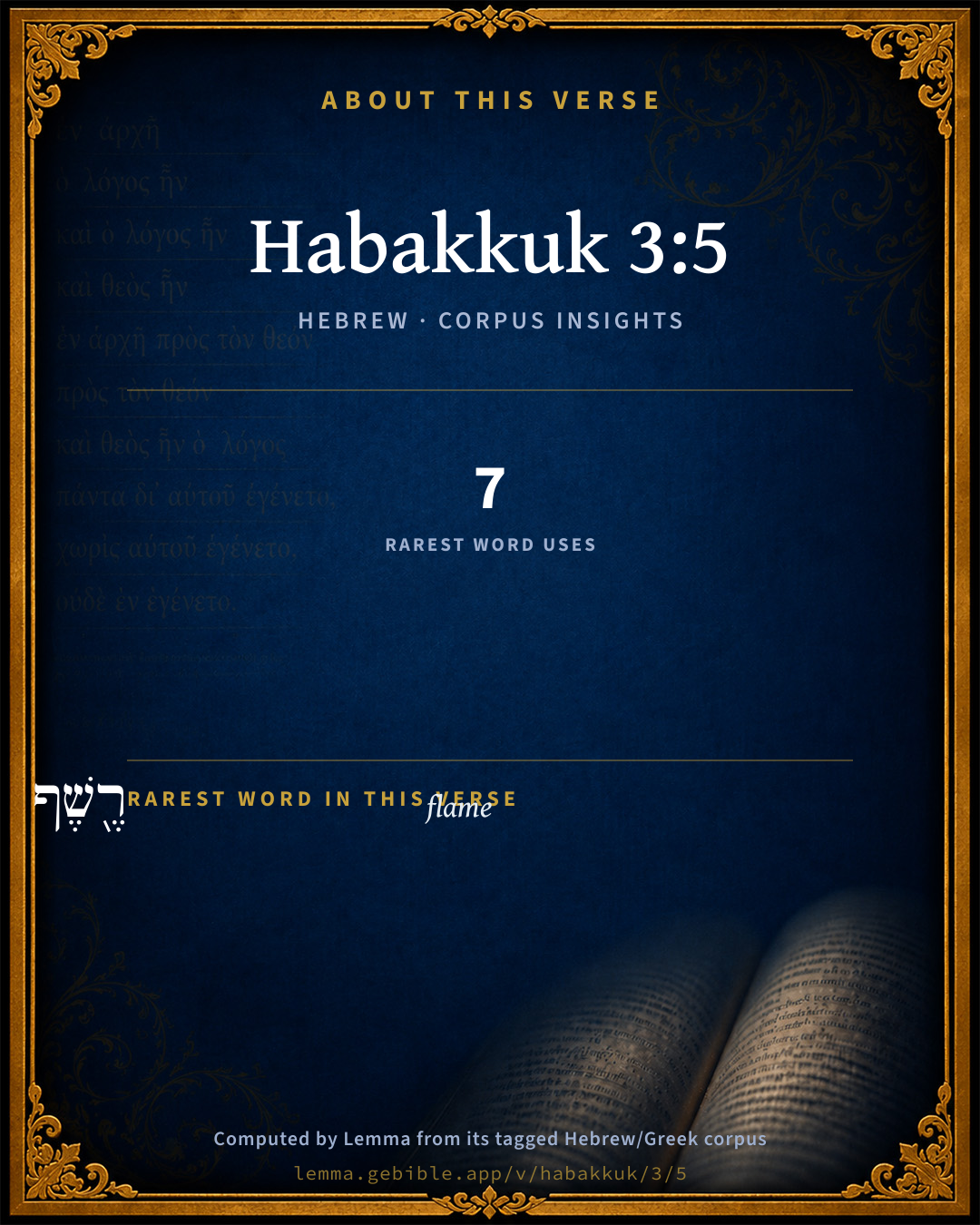
The rarest word here is רֶ֖שֶׁף flame H7565 — appearing just 7 times in the whole Hebrew Bible.

Shared distinctive vocabulary

רֶ֖שֶׁף flame H7565 occurs in 6 verses of the Hebrew Bible. Also found in:

Grammatical profile

  • 2 verbs
  • 4 nouns

Verb forms

  • יֵ֣לֶךְ Qal · Imperfect
  • וְיֵצֵ֥א Qal · Imperfect

Hebrew & Septuagint length

In English translation the verse runs 9 words from the Hebrew and 15 from the Septuagint (LXX English) — the Septuagint runs noticeably longer here. See the side-by-side →

A rough comparison of the two English renderings, which tokenize alike — not a word-level alignment.

Word counts can differ between the Hebrew and the Greek without any difference in meaning — e.g. the Hebrew direct-object marker אֵת has no separate Greek word, and Greek often adds the article ὁ.

Cross-references

7

Topical passages linked to Habakkuk 3:5 in the Treasury of Scripture Knowledge — connected by theme and wording, ordered by reader-vote popularity; previews shown in the World English Bible.

  • Exodus 12:29–30 It happened at midnight, that Yahweh struck all the firstborn in the land of Egypt, from the firstborn of Pharaoh who sat on his throne to the firstborn of the captive who was in the dungeon; and all the firstborn of cattle.
  • Numbers 16:46–49 Moses said to Aaron, Take your censer, and put fire therein from off the altar, and lay incense thereon, and carry it quickly to the congregation, and make atonement for them: for there is wrath gone out from Yahweh; the plague is begun.
  • Numbers 14:12 I will strike them with the pestilence, and disinherit them, and will make of you a nation greater and mightier than they.
  • Deuteronomy 32:24 [They shall be] wasted with hunger, and devoured with burning heat Bitter destruction; The teeth of animals will I send on them, With the poison of crawling things of the dust.
  • Psalms 18:7–13 Then the earth shook and trembled. The foundations also of the mountains quaked and were shaken, Because he was angry.
  • Psalms 78:50–51 He made a path for his anger. He didn't spare their soul from death, But gave their life over to the pestilence,
  • Nahum 1:2–3 Yahweh is a jealous God and avenges. Yahweh avenges and is full of wrath. Yahweh takes vengeance on his adversaries, and he maintains wrath against his enemies.

Cross-references courtesy of OpenBible.info (CC BY 4.0).

Hebrew and Greek witnesses Masoretic Hebrew ↔ Greek Septuagint

The same verse in the two great witnesses to the Old Testament, shown verse-for-verse.

Here the Septuagint runs noticeably longer than the Hebrew — LXX2012 (modern English Septuagint) 15 words vs World English Bible 9. A rough length comparison of the two English translations, not a word-level alignment — read both below.

These are two independent witnesses, not word-aligned to each other, and the Septuagint is shown in lemma (dictionary) form.

Hebrew Habakkuk 3:5 Masoretic · Westminster Leningrad Codex

לְפָנָ֖יו יֵ֣לֶךְ דָּ֑בֶר וְיֵצֵ֥א רֶ֖שֶׁף לְרַגְלָֽיו

Plague went before him, And pestilence followed his feet.

World English Bible · Public Domain

Greek LXX Habakkuk 3:5 Septuagint · lemma form

πρό πρόσωπον αὐτός πορεύομαι λόγος καί ἐκἔρχομαι ἐν πέδιλον ὁ πούς αὐτός

Before his face shall go a report, and it shall go forth into the plains,

LXX2012 (modern English Septuagint) · Public Domain

On this verse, Haydock's Catholic Bible Commentary discusses the Septuagint’s reading. Read the note in Commentary ↓

Hebrew: Westminster Leningrad Codex (CC BY 4.0). Greek: Septuagint (public domain); English from LXX2012 (modern English Septuagint) (Public Domain). How the Septuagint differs from the Hebrew →

Targum (Aramaic paraphrase)

1

The Targum is the ancient Jewish Aramaic paraphrase of the Hebrew Scriptures — an interpretive translation, not the Hebrew text itself. Onkelos (literal) and Pseudo-Jonathan (expansive) render the Torah, and Jonathan the Prophets. Coverage is partial: where no permissively-licensed English translation exists for a verse, only the Aramaic is shown. This is verse-level text, not a word-by-word alignment to the Hebrew.

  1. Targum Jonathan Prophets (Joshua–Malachi)
    מִן קֳדָמוֹהִי מִשְׁתַּלַח מַלְאָךְ מוֹתָא וְנָפֵיק כְּשַׁלְהוֹבִית אֶשְׁתָּא מֵימְרֵיהּ:

    (no public-domain English translation for this verse)

    Targum Jonathan — Aramaic: “Mikraot Gedolot” (public domain). English: “Sefaria Community Translation” (CC0 1.0 (public-domain dedication)); “London "Chaldee Paraphrase," 1871” (public domain). Text via Sefaria.

Commentary

Notes on Habakkuk 3:5 from classic Christian and Jewish commentators (each source and its license shown beneath its notes). The classic Christian expositions comment on the surrounding passage and are grouped to its opening verse, so a note may address several verses; the Jewish commentaries on the Tanakh (Rashi and others) are per-verse, so they appear only where the commentator wrote on this verse.

Lemma curates 59 commentaries, every one of them public domain or Creative Commons licensed, each selected and text-cleaned for this edition rather than reprinted as found. About our sources →

Trapp's Complete Commentary

John Trapp

Hab 3:5 Before him went the pestilence, and burning coals went forth at his feet.

Ver. 5. Before him went the pestilence] Dever, the word signifieth such a disease as cometh by a Divine decree, θεηλατον. So Hippocrates call the pestilence το θειον, because sent by God in a spiritual manner, a stroke of his own bare hand as it were. Here it is made one of his apparitors or pursuivants, sent before him to destroy the Canaanites, as it had done the Egyptians.

And burning coals went forth at his feet] Or, the carbuncle burning bile, Deu 32:24. The Vulgate translate it the devil; others Aνθραξ, a deadly inflammation, whereof good Oecolampadius died, and was lamented by Melancthon. But Luther very uncharitably (the best have their failings) wrote that he believed Oecolampadium ignitis Satanae telis et hastis confossum, subitanea metre periisse (Lib. de Missa privat.), that Oecolampadius died suddenly, being stabbed to death with the fiery darts of the devil.

John Trapp, A Commentary or Exposition upon All the Books of the Old and New Testament (1647–1656) — public domain. Text from a community e-Sword module.

Tyndale Open Study Notes

Tyndale Open Resources

3:5-6 God is the divine warrior who intervenes on behalf of his own (see 3:8-15; see also Isa 63:1-6).

3:5 Habakkuk personifies pestilence (see Deut 32:24) and plague (see Exod 7–12; Amos 4:10) as soldiers in God’s army, fulfilling his purposes.

Tyndale Open Study Notes — © Tyndale Open Resources, licensed CC BY-SA 4.0. Text via the HelloAO Bible API.

Jamieson, Fausset & Brown

Robert Jamieson, A. R. Fausset & David Brown

pestilence--to destroy His people's foes (Sa1 5:9, Sa1 5:11). As Jehovah's advent is glorious to His people, so it is terrible to His foes.

burning coals-- Psa 18:8 favors English Version. But the parallelism requires, as the Margin translates, "burning disease" (compare Deu 32:24; Psa 91:6).

went . . . at his feet--that is, after Him, as His attendants (Jdg 4:10).

Jamieson, Fausset & Brown — Commentary Critical and Explanatory on the Whole Bible (1871) — public domain (CC PDM 1.0). Text via the HelloAO Bible API.

Adam Clarke's Commentary

Verse 5. Before him went the pestilence] This plague was several times inflicted on the disobedient Israelites in the wilderness; see Nu 11:33; Nu 14:37; Nu 16:46; and was always the proof that the just God was then manifesting his power among them.

Burning coals event forth at his feet.] Newcome translates, "And flashes of fire went forth after him." The disobedient Israelities were consumed by a fire that went out from Jehovah; see Le 10:2; Nu 11:1; Nu 16:35. And the burnt-offering was consumed by a fire which came out from before Jehovah, Le 11:24.

Adam Clarke's Commentary on the Bible (1810–1826) — public domain. Text from a community e-Sword/MySword module.

John Calvin's Commentaries

The Prophet repeats here, that God came armed to defend his people, when he went forth from Teman; for he connects with it here the deliverance of the people. He does not indeed speak only of the promulgation of the law, but encourages all the godly to confidence; for God, who had once redeemed their fathers from Egypt, remained ever like himself, and was endued with the same power.

And he says, that before God’s face walked the pestilence; this is to be referred to the Egyptians; and that ignited coal proceeded from his feet. Some render רשף, reshoph, exile; but its etymology requires it to be rendered burning or ignited coal, and there is no necessity to give it another meaning.

The import of the whole is—that God had put to flight all the enemies of his people; for we know that the Egyptians were smitten with various plagues, and that the army of Pharaoh was drowned in the Red Sea. Hence, the Prophet says, that God had so appeared from Teman, that the pestilence went before him, and then the ignited coal; in short, that the pestilence and ignited coal were God’s officers, which were ready to perform his commands: as when a king or a judge, having attendants, commands them to put this man in prison, and to punish another in a different way; so the Prophet, giving us a representation of God, says, that all kinds of evils were ready to obey his orders, and to destroy his and their enemies. He does not then intend here to terrify the faithful in mentioning the pestilence and the ignited coal; but, on the contrary, to set before their eyes evidences of God’s power, by which he could deliver them from the hand of their enemies, as he had formerly delivered their fathers from Egypt. By God’s feet, he then means his going forth or his presence; for I do not approve of what some have said, that ignited coals followed, when pestilence had preceded; for both clauses are given in the same way. It follows—

John Calvin's Commentaries (1540-1563) — public domain. Text from the Calvin Translation Society English edition (1840s-50s) via the Christian Classics Ethereal Library (ccel.org). Calvin's coverage is partial (roughly two-thirds of the Bible); uncommented books and verses are honest gaps, never fabricated. The 19th-century editor's footnotes and remarks are omitted so the notes are faithfully Calvin's own voice.

Ellicott's Commentary for English Readers

(5) Before him went the pestilence. . . .—Better, Before Him shall go the plague, and burning pestilence shall go forth where He sets His feet. Kleinert remarks that it was with these angels of death that Jehovah revealed Himself in the south, and destroyed the armies of Sennacherib (2Ki_19:35).

A Bible Commentary for English Readers, edited by Charles John Ellicott (1878–1897) — public domain. Text from a community e-Sword module.

The Cambridge Bible for Schools and Colleges

gen. ed. J. J. S. Perowne

5. went the pestilence] goeth pestilence. His manifestation carries death in its train.

burning coals went forth] and burning plague goeth forth at his feet, i.e. behind Him. The word again in this sense Deu_32:24.

The Cambridge Bible for Schools and Colleges (gen. ed. J. J. S. Perowne; Cambridge University Press, 1878–1918) — public domain. Text from a community e-Sword module.

John Gill's Exposition

Before him went the pestilence,.... Either in the land of Egypt, when he marched through that, and slew all their firstborn, Psa 78:50 or rather which he sent before him, and Israel his people among the nations of the land of Canaan, with other diseases and judgments, and destroyed them to make way for his people, which may be here alluded to, Exo 23:27 and may point at the judgments of God, and those pestilential diseases which seized upon the persecutors of the Christians, both among the Jews, as Herod, Act 12:23 and among the Gentiles, as many of the Roman emperors, who died violent and grievous deaths; and particularly it may regard the pestilence, famine, and other sore judgments preceding the destruction of Jerusalem, and the inhabitants of it, for their rejection and crucifixion of the Messiah:

and burning coals went forth at his feet; which some understand of hailstones mingled with fire, to which the allusion may be, being one of the plagues of Egypt, Exo 9:23. Some interpret it of hot diseases, burning fevers, so Kimchi; which are at the command of God, and sent forth by him when he pleases, to do his will. The ancient fathers expound all this of the destruction of death, and the devil, and his principalities, by Christ upon the cross; and the Targum is,

"from before him was sent forth the angel of death, and his word went forth in a flame of fire;''

but this seems to have respect to the burning of the city and temple of Jerusalem, which was done by the Romans as instruments, but according to the direction, order, and will of Christ, Mat 22:7 see Psa 18:12.

John Gill's Exposition of the Whole Bible (1746–1763) — public domain (CC PDM 1.0). Text via the HelloAO Bible API.

Albert Barnes' Notes on the Bible

Before Him went (goeth) the pestilence - then to consume His enemies. Exo 23:27 : “I will send My fear before thee, and will destroy all the people, to whom thou shalt come,” and the lightnings are a token that, Psa 68:1-2, “they which hate Him, flee before Him, and the wicked perish at the Presence of God.” So, on His Ascension, Herod and Pilate were smitten by Him, and Elymas and Simon Magus before His apostles, and whatsoever hath lifted itself up against Him hath perished, and antichrist shall perish, Psa 11:4, “at the breath of His mouth,” and all the ungodly on the Day of Judgment.

And burning coals - rather, as English, “burning fever”, Deu 32:2. (where also it is singular, as only beside in רשׁף בני benēy resheph Job 5:7.) So A. E., “burning coals” is from Kimchi, Tanchum gives as different opinions “sparks” or “arrows” or “pestilence;” but the meanings “sparks, arrows,” are ascribed only to the plural. Psa 76:4; 88:48; Son 8:6. The central meaning is probably “burning heat.”

Went forth at his feet - i. e., followed Him. Messengers of death went as it were before Him, as the front of His army, and the rear thereof was other forms of death Death and destruction of all sorts are a great army at His command, going before Him as heralds of His Coming (such as are judgments in this world) or attendants upon Him, at the judgment when He appeareth 2 Tim. 6:1. in His kingdom, when, Mat 13:51, Mat 13:42, “they shall gather out of His kingdom all things that offend, and them which do iniquity, and shall cast them into a furnace of fire.”

Albert Barnes' Notes on the Bible (1834–1885) — public domain. Text from a community e-Sword/MySword module.

Haydock's Catholic Bible Commentary

Death, &c. Both death and the devil shall be the executioners of his justice against his enemies; as they were heretofore against the Egyptians and Chanaanites. (Challoner) --- Hebrew daber, (Haydock) according to the different pronunciation, is rendered "the word" by the Septuagint and Theo.[Theodotion?]; "the plague," by Aquila, &c. After Christ was baptized, the devil came to tempt him. (St. Jerome) --- Devil. Hebrew resheph, (Haydock) or "bird," (Symmachus, &c.) means "creeping on the belly," as is explained by the Jews of the devil, who tempted our first parents. (St. Jerome) --- Moderns (Haydock) follow the Chaldean and understand the carbuncle. (Calmet) --- Protestants, "burning coals:" marg.[marginal note,] "diseases," (Haydock) resembling the pestilence. God destroyed his enemies and the murmuring Hebrews. (Calmet) --- Septuagint, "and it (the word) shall go out into the fields behind his feet." God’s will shall be published in the field of the world, (Haydock) when the gospel shall he preached to the Gentiles.

George Leo Haydock (1774–1849), Haydock's Catholic Family Bible and Commentary, 1859 edition — public domain. Excludes Psalms (Douay-Rheims chapter numbering differs from Protestant) and Deuterocanonical books (Catholic canon only).

Matthew Poole's English Annotations

Before him: when God was leading the Israelites out of Egypt into Canaan, he made the pestilence to go before him, so preparing room for his people.

The pestilence, which wasted the inhabitants of Canaan, swept them out.

Burning coals; burning fevers, and other distempers of fiery and destructive nature, which destroyed the accursed nations.

Went forth; as sent, and observing the way he directed.

At his feet; kept even pace, or waited on him, were his immediate forerunners. All this mentioned as arguments to prevail for somewhat like these for Israel, and against Israel’s enemies. O God, revive some such work amidst us.

Matthew Poole's English Annotations on the Holy Bible (1683–1685) — public domain. Text from a community e-Sword/MySword module.

The Pulpit Commentary

After describing the splendour of the theophany, the prophet now turns to the purpose and effects of God"s appearing. He comes to avenge and judge, therefore before him went the pestilence. Before him stalks plague, to punish his enemies and the disobedient, as in Egypt, in Canaan (Exo_23:27; 1Sa_5:9, 1Sa_5:11) and among his own people (Num_11:33 Num_14:37, etc.; Lev_26:25) For "pestilence" the LXX reads "word." Burning coals went forth at his feet. "Fiery belts" followed his advance, "hailstones and coals of fire"; (Psa_18:12, Psa_18:13) as in Psa_97:8, "A fire goeth before him, and burneth up his enemies on every side." But, regarding the parallelisms of the hemistiches, it is better to take resheph in the sense of "fever heat," as in Deu_32:24; scorching fever follows in his train. Jerome translates the word, diabolus, looking on the evil spirit as the agent of the Divine vengeance. The Jews, he says, had a tradition that Satan was called Reseph, from the speed of his movements. The LXX has, "It (the word) shall go forth into the plains," which Jerome interprets, "shall make the crooked straight and the rough ways smooth."

The Pulpit Commentary (1880–1919), ed. H.D.M. Spence-Jones & Joseph S. Exell — public domain. Text from a community e-Sword module.

John Wesley's Explanatory Notes

Before him - When God was leading the Israelites out of Egypt, he made the pestilence go before him, so preparing room for his people.

John Wesley, Explanatory Notes Upon the Whole Bible (1754–1765) — public domain. Text via the GEBible commentary corpus.

Rashi

Rabbi Shlomo Yitzchaki (Rashi)

A pestilence went before Him I found in a Midrash Aggadah: At the time the Holy One, blessed be He, gave the Torah to Israel, He drove away the Angel of Death to divert him to other things, lest he stand to accuse and say, “You are giving the Torah to a nation that is destined to deny you at the end of forty days?”

and sparks went out at His feet Fiery angels came with Him to Sinai.

Rashi on the Tanakh — English translations: “The Judaica Press complete Tanach with Rashi, translated by A. J. Rosenberg” (CC BY 4.0); “Pentateuch with Rashi's commentary by M. Rosenbaum and A.M. Silbermann, 1929-1934” (public domain); “The Metsudah Tanach series, Lakewood, N.J” (CC BY 4.0); and “The Book of Joshua, Metsudah Publications, 1997” (CC BY 4.0). Text via Sefaria.

Lesson kit

Teaching starters — assembled from the data on this page, not authored interpretation. Every prompt links to the verse data it draws on. Edit before teaching.

Habakkuk, in the Prophets, opens this verse with 6 words (6 distinct Hebrew lemmas). Its most distinctive word is resheph (“flame”). The Greek Septuagint runs longer here. A historical commentator’s framing appears above. Read the whole chapter for the surrounding context.

Discussion questions

  1. How does “flame” (resheph) shape what this verse is saying?
  2. Deuteronomy 32:24 shares the word «flame» with this verse. How do the two illuminate each other?
  3. Compared with the Hebrew, the Septuagint runs longer here. What questions does that raise?
  4. These translations render this verse differently; the difference is in the English rendering, not the original. What questions does that raise?
  5. The verb «יֵ֣לֶךְ» is Qal Imperfect. How does its form color the action?
  6. Reading how Trapp's Complete Commentary and Tyndale Open Study Notes read this verse, where do the two commentators agree and where do they part?

Things to notice

Reading settings

Reading text

Shown beneath each verse's original-language words.

Old Testament
Old Testament edition

Read the OT as the Masoretic Hebrew (MT) or the Greek Septuagint (LXX).

English shown for the Greek Septuagint (in the Hebrew ↔ Greek comparison).

Comparing translations? Open the Compare panel on any verse page to stack up to four side by side.