
Proverbs 31:27

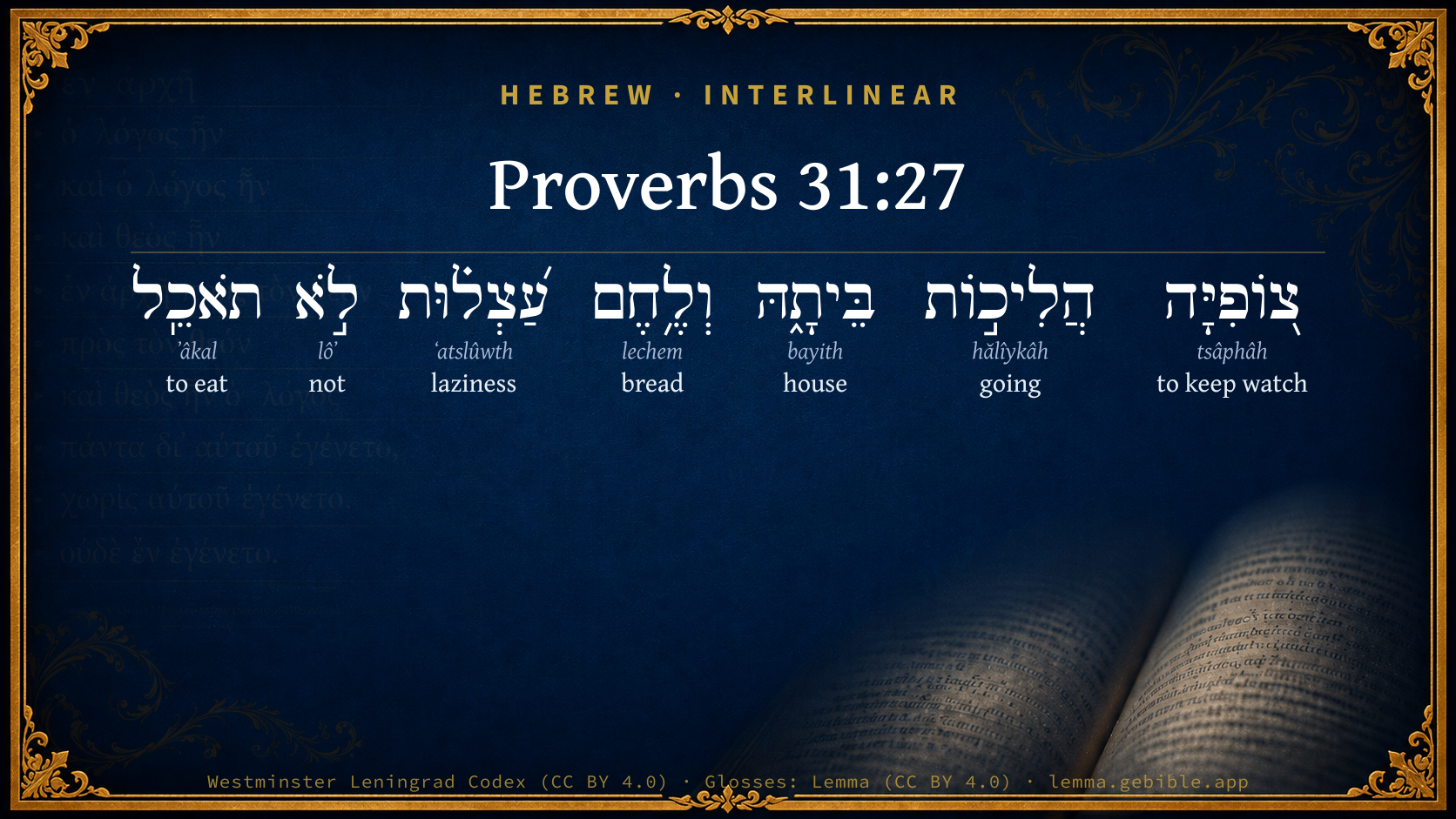
Hebrew (Westminster Leningrad Codex) Proverbs 31:27 appears in the Hebrew Old Testament. The text above is from the Westminster Leningrad Codex. Each word links to its Strong’s number, a concise gloss, and parsing drawn from the Open Scriptures Hebrew Bible morphology. Click any word for its full Brown-Driver-Briggs (BDB) entry.
Download image
Cite this verse

Proverbs 31:27 (World English Bible). Public Domain. Lemma interlinear Bible study tool, https://lemma.gebible.app/v/proverbs/31/27.

Show BibTeX & RIS
BibTeX
RIS
English Translation
She looks well to the ways of her household, And doesn't eat the bread of idleness.
World English Bible · Public Domain
Highlights
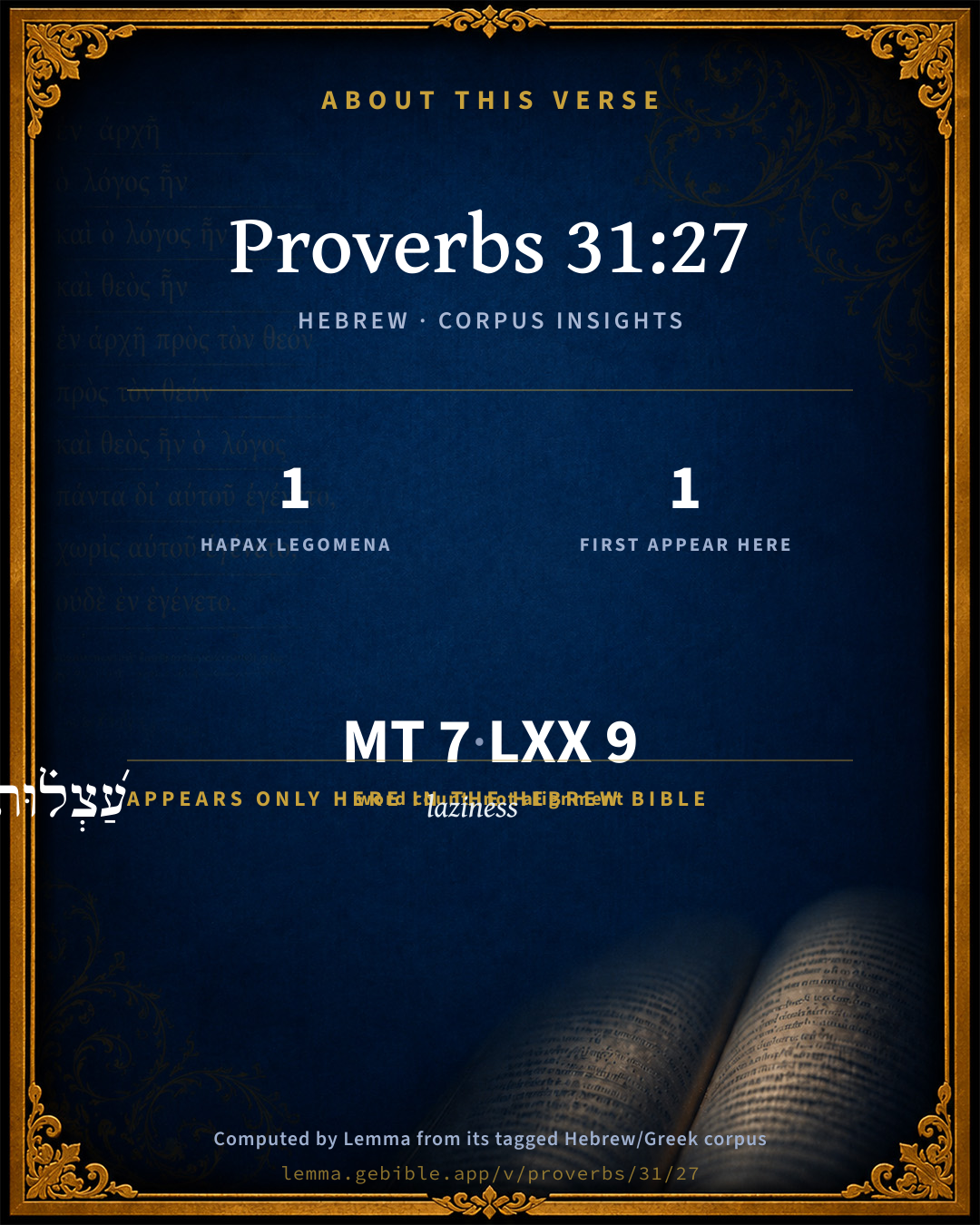
  • 1 hapax legomenon — only here in the Hebrew Bible
  • 1 first appearance in the Hebrew Bible
Full analysis ↓
Download a study sheet

One document with this verse’s original text, its word-by-word gloss line, the meaning frame, cross-references with their text, attributed commentary, and full source and license credits — printable, and it pastes into notes with its structure intact.

This verse Autodidact and up

Study sheet (.html) Plain text (.txt)

A passage Seminary Student

Up to 50 verses in one chapter. A passage sheet keeps up to 6 commentary sources and 12 cross-references per verse, in the order this page ranks them, and says so on the sheet whenever that leaves anything out. Ask for a single verse and you get the Autodidact verse sheet above.

Everything on this page stays free to read, with no account — the sheet is a download of what is already on screen, not access to it.

Want to remove ads? Support Godless Engineer
Compare translations 3

The same verse in 3 English versions, stacked beneath the original-language interlinear above. Click any original word for its lexicon entry.

Each is an independent rendering of the whole verse — the interlinear is not word-aligned to these translations.

Highlighted words mark where these versions differ — a whole-verse word diff, not a word-by-word alignment.

  • World English Bible Public Domain
    She looks well to the ways of her household, And doesn't eat the bread of idleness.
  • King James Version Public Domain
    She looketh well to the ways of her household, and eateth not the bread of idleness.
  • unfoldingWord Literal Text CC BY-SA 4.0
    She scans the goings on of her house, and the bread of laziness she does not eat.

unfoldingWord Literal Text — © unfoldingWord, licensed CC BY-SA 4.0. Word-aligned USFM3 via Door43 (git.door43.org/unfoldingWord/en_ult).

Versions to compare (up to 4)

3 of 4 selected

Show all 18 translations

Every available English version of this verse, each an independent rendering of the whole verse.

  • World English Bible Public Domain
    She looks well to the ways of her household, And doesn't eat the bread of idleness.
  • Berean Standard Bible Public Domain
    She watches over the affairs of her household and does not eat the bread of idleness.
  • Majority Standard Bible Public Domain
    She watches over the affairs of her household and does not eat the bread of idleness.
  • King James Version Public Domain
    She looketh well to the ways of her household, and eateth not the bread of idleness.
  • American Standard Version (1901) Public Domain
    She looketh well to the ways of her household, And eateth not the bread of idleness.
  • Revised Version (1885) Public Domain
    She looketh well to the ways of her household, and eateth not the bread of idleness.
  • Geneva Bible (1599) Public Domain
    She ouerseeth the wayes of her housholde, and eateth not the bread of ydlenes.
  • Douay-Rheims (1899) Public Domain
    She hath looked well to the paths of her house, and hath not eaten her bread idle.
  • Young's Literal Translation Public Domain
    She `is' watching the ways of her household, And bread of sloth she eateth not.
  • Literal Standard Version CC BY-SA 4.0
    She [is] watching the ways of her household, || And she does not eat bread of sloth.
  • Unlocked Literal Bible CC BY-SA 4.0
    She watches over the ways of her household and does not eat the bread of idleness.
  • unfoldingWord Literal Text CC BY-SA 4.0
    She scans the goings on of her house, and the bread of laziness she does not eat.
  • Darby Bible Public Domain
    She surveyeth the ways of her household, and eateth not the bread of idleness.
  • World Messianic Bible Public Domain
    She looks well to the ways of her household, and doesn’t eat the bread of idleness.
  • Webster's Bible Public Domain
    She looketh well to the ways of her household, and eateth not the bread of idleness.
  • Free Bible Version CC BY-SA 4.0
    She looks after the needs of her whole household, and she's never idle.
  • Bible in Basic English Public Domain
    She gives attention to the ways of her family, she does not take her food without working for it.
  • JPS Tanakh (1917) Public Domain
    She looketh well to the ways of her household, and eateth not the bread of idleness.

Literal Standard Version (2020), Covenant Press — licensed CC BY-SA 4.0. Text via the HelloAO Bible API (eBible.org). Unlocked Literal Bible (unfoldingWord) — licensed CC BY-SA 4.0. Text via the HelloAO Bible API (eBible.org). unfoldingWord Literal Text — © unfoldingWord, licensed CC BY-SA 4.0. Word-aligned USFM3 via Door43 (git.door43.org/unfoldingWord/en_ult). Free Bible Version, Dr. Jonathan Gallagher — licensed CC BY-SA 4.0. Text via the HelloAO Bible API (eBible.org).

Word by word

More ways to search: Search by grammar → Find every occurrence → Compare this word →

Practice this passage: Drill this verse → Learn its vocabulary →

About this verse

These counts appear in no published source. They are computed here, from the morphology-tagged text and Lemma’s own curated glosses. What Lemma adds →

7
words
7
distinct lemmas
Wisdom
section

Notable vocabulary

1 hapax legomenon — a word that appears only here in the entire Hebrew Bible:

  • עַ֝צְל֗וּת laziness H6104

First appearance in Scripture

This word makes its first canonical appearance in the Hebrew Bible here:

  • עַ֝צְל֗וּת laziness H6104

Shared distinctive vocabulary

הֲלִיכ֣וֹת going H1979 occurs in 5 verses of the Hebrew Bible. Also found in:

Grammatical profile

  • 2 verbs
  • 4 nouns
  • 1 particle

Verb forms

  • צ֭וֹפִיָּה Qal · Participle Active
  • תֹאכֵֽל Qal · Imperfect

Hebrew & Septuagint length

In English translation the verse runs 16 words from the Hebrew and 15 from the Septuagint (LXX English) — closely comparable.

A rough comparison of the two English renderings, which tokenize alike — not a word-level alignment.

Word counts can differ between the Hebrew and the Greek without any difference in meaning — e.g. the Hebrew direct-object marker אֵת has no separate Greek word, and Greek often adds the article ὁ.

In the original languages it is 7 Hebrew tokens and 9 Greek tokens — but the two are counted differently (Hebrew bundles its prefixes and suffixes into one token; the Greek is in lemma form), so that isn’t a like-for-like length.

Cross-references

5

Topical passages linked to Proverbs 31:27 in the Treasury of Scripture Knowledge — connected by theme and wording, ordered by reader-vote popularity; previews shown in the World English Bible.

  • 1 Timothy 5:10 being approved by good works, if she has brought up children, if she has been hospitable to strangers, if she has washed the saints' feet, if she has relieved the afflicted, and if she has diligently followed every good work.
  • Titus 2:4 that they may train the young women to love their husbands, to love their children,
  • 2 Thessalonians 3:6 Now we command you, brothers, in the name of our Lord Jesus Christ, that you withdraw yourselves from every brother who walks in rebellion, and not after the tradition which they received from us.
  • Proverbs 14:1 Every wise woman builds her house, But the foolish one tears it down with her own hands.
  • 1 Thessalonians 4:11 and that you make it your ambition to lead a quiet life, and to do your own business, and to work with your own hands, even as we charged you;

Cross-references courtesy of OpenBible.info (CC BY 4.0).

Hebrew and Greek witnesses Masoretic Hebrew ↔ Greek Septuagint

The same verse in the two great witnesses to the Old Testament, shown verse-for-verse.

These are two independent witnesses, not word-aligned to each other, and the Septuagint is shown in lemma (dictionary) form.

Hebrew Proverbs 31:27 Masoretic · Westminster Leningrad Codex

צ֭וֹפִיָּה הֲלִיכ֣וֹת בֵּיתָ֑הּ וְלֶ֥חֶם עַ֝צְל֗וּת לֹ֣א תֹאכֵֽל

She looks well to the ways of her household, And doesn't eat the bread of idleness.

World English Bible · Public Domain

Greek LXX Proverbs 31:27 Septuagint · lemma form

στεγνός διατριβή οἶκος αὐτός σῖτος δέ ὀκνηρός οὐ ἐσθίω

The ways of her household are careful, and she eats not the bread of idleness.

LXX2012 (modern English Septuagint) · Public Domain

On this verse, The Pulpit Commentary discusses the Septuagint’s reading. Read the note in Commentary ↓

Hebrew: Westminster Leningrad Codex (CC BY 4.0). Greek: Septuagint (public domain); English from LXX2012 (modern English Septuagint) (Public Domain). How the Septuagint differs from the Hebrew →

Commentary

Notes on Proverbs 31:27 from classic Christian and Jewish commentators (each source and its license shown beneath its notes). The classic Christian expositions comment on the surrounding passage and are grouped to its opening verse, so a note may address several verses; the Jewish commentaries on the Tanakh (Rashi and others) are per-verse, so they appear only where the commentator wrote on this verse.

Lemma curates 59 commentaries, every one of them public domain or Creative Commons licensed, each selected and text-cleaned for this edition rather than reprinted as found. About our sources →

Trapp's Complete Commentary

John Trapp

Pro 31:27 She looketh well to the ways of her household, and eateth not the bread of idleness.

Ver. 27. She looketh well to the ways of her household.] She hath an oar in every boat, an eye in every business; she spies and pries into her children’s and servants’ carriages, and exacts of them strict conversation and growth in godliness: she overlooks the whole family no otherwise than if she were in a watch tower; Speculatur itinera domus suae.

And eateth not the bread of idleness.] She earns it before she eats it. Aristotle {a} also commends φιλεργια, laboriousness, in a woman, and joins it with temperance and chastity, which are preserved by it. So is taciturnity and sober communication, for which she is commended in the former verse. For, as idleness is the seed of talkativeness, {1Ti 5:12} so painfulness is a singular help against it. Queen Catherine of Spain, wife to our Henry VIII, was not more busy in her calling than prudent in her carriage. She had been counselled to it by Ludovicus Vives, who came into England with her, and was master to her daughter, the Lady Mary. {See Trapp on "Pro 31:19"}

{a} Arist. Rhet., lib. i.

John Trapp, A Commentary or Exposition upon All the Books of the Old and New Testament (1647–1656) — public domain. Text from a community e-Sword module.

Joseph Benson's Commentary

Pro 31:27. She looketh well to her household — She diligently observes the management of her domestic business, and the whole carriage of her children and servants. Whereby he also intimates, that she spends not her time in gadding abroad to other people’s houses, and in idle discourses about the concerns of other persons, as the manner of many women is, but is wholly intent upon her own house and proper business; and eateth not the bread of idleness — That which is gotten by idleness, or without labour.

Joseph Benson's Commentary on the Old and New Testaments (1811–1818) — public domain. Text from a community e-Sword module.

Jamieson, Fausset & Brown

Robert Jamieson, A. R. Fausset & David Brown

(Compare Ti1 5:14; Tit 2:5). She adds to her example a wise management of those under her control.

Jamieson, Fausset & Brown — Commentary Critical and Explanatory on the Whole Bible (1871) — public domain (CC PDM 1.0). Text via the HelloAO Bible API.

Adam Clarke's Commentary

Verse 27. She looketh well to the ways of her household]

18. She is a moral manager: she takes care that all shall behave themselves well; that none of them shall keep bad company or contract vicious habits. A religious industry, or an industrious religion, is the law of her house. She can instruct them in religion, as well as she can teach them in their labour. In her house, diligence in business, and fervency of spirit, serving the Lord, go hand in hand.

And eateth not the bread of idleness.]

19. She knows that idleness leads to vice; and therefore every one has his work, and every one has his proper food. That they may work well, they are fed well; and every one, at least, earns the bread that he eats - eateth not the bread of idleness.

Adam Clarke's Commentary on the Bible (1810–1826) — public domain. Text from a community e-Sword/MySword module.

The Cambridge Bible for Schools and Colleges

gen. ed. J. J. S. Perowne

27. looketh well to] a happy rendering. Lit. keepeth watch upon, as in Pro_15:3. As Almighty God, from His lofty watch-tower in heaven, observes all the minutest details of the manifold work that is going on in the busy hive of earth, so does she from her exalted position in which He has placed her, as mistress of the family, and as responsible to Him, observe “the ways of her household.” Comp. “He that ruleth (let him do it) with diligence,” Rom_12:8.

The Cambridge Bible for Schools and Colleges (gen. ed. J. J. S. Perowne; Cambridge University Press, 1878–1918) — public domain. Text from a community e-Sword module.

John Gill's Exposition

She looketh well to the ways of her household,.... The business of her house, her domestic affairs; that her children and servants have convenient food, and in due season; that they have proper clothing, and keep their garments close about them, and unspotted; that everyone does the business of his calling, her several officers, and private members; that a good decorum is kept, that all things are done decently and in order; that the rules of her lord and husband are observed; that the conversations of all in her house are according to the word of God, and becoming their character: she takes care of the sick and weak, comforts the feeble minded, and supports the infirm; she cannot bear them that are evil, whether in principle or practice; that are immoral in their lives, or unsound in their faith; but admonishes them according to the nature of their offences, and casts out the obstinate or incorrigible. The words may be rendered, "she looks well to the ways of her house" (d); that lead unto it, so Gersom; either her house below, the way or entrance into which is by faith in Christ, and a profession of it; and she takes care that none be admitted but such who have it: or the ways in it, the commands, ordinances, appointments, and constitutions of Christ, called the ways of Zion; and concerned she is that all in her family walk in them, and observe them: or her house above, which is eternal in the heavens; Christ's Father's house and, hers, in which are many mansions, and everlasting habitations; the way to this also is Christ, who is the true way to eternal life, the strait gate and narrow way that leads to it; without his imputed righteousness, and the regenerating grace of his Spirit, there is no entrance into it: besides this, there are lesser paths which agree and coincide; as the paths of faith, truth, and holiness, and the ways of Christ's commandments, which issue in it, and which the church and her true members are careful to look unto and observe. The Arabic version renders it, "the paths of her house are strait"; with which compare Mat 7:13. Jarchi interprets these ways of the law, which teaches the good way, and to separate from transgression;

and eateth not the bread of idleness; of an idle woman, as Aben Ezra; or she being idle does not eat bread; she does not eat it without labour; it is "the bread of labour", of many labours she eats, as in Psa 127:2; she labours for the meat which endures to everlasting life, Joh 6:27; the Gospel, that bread which strengthens man's heart, refreshes his spirit, is made of the finest of the wheat, contains the wholesome words of Christ, and by which men are nourished up unto everlasting life; and which particularly directs to Christ the true bread, the bread of life, of which if a man eat he shall never die, but live for ever; and on which true believers feed by faith; but though this is prepared for them, and is the gift of God to them, yet must be laboured for; it is not eaten without labour: believers read, hear, and pray, and diligently attend all ordinances for the sake of this food.

(d) "vias domus suae", Paginius, Montanus, Mercerus, Gejerus, Michaelis; "ambulationes domus suae", Cocceius.

John Gill's Exposition of the Whole Bible (1746–1763) — public domain (CC PDM 1.0). Text via the HelloAO Bible API.

Haydock's Catholic Bible Commentary

Idle, out of a sense of duty, and not though avarice.

George Leo Haydock (1774–1849), Haydock's Catholic Family Bible and Commentary, 1859 edition — public domain. Excludes Psalms (Douay-Rheims chapter numbering differs from Protestant) and Deuterocanonical books (Catholic canon only).

Matthew Poole's English Annotations

She looketh well to the ways of her household; she diligently observeth the management and progress of her domestic business, and the whole carriage and conversation of her children and servants; whereby also he intimates that she spends not her thee in gadding abroad to other houses, and idle discourses about the concerns of other persons, as the manner of many women is, but is wholly intent upon her own house and proper business.

Eateth not the bread of idleness; that which is got by idleness, or without labour.

Matthew Poole's English Annotations on the Holy Bible (1683–1685) — public domain. Text from a community e-Sword/MySword module.

Whedon's Commentary on the Bible

Daniel D. Whedon

27. Looketh well to… her household — Watches over, controls, directs, cares for, all the affairs and persons of her family.

Eateth not the bread of idleness — She is neither idle herself nor suffers any of her family — children or servants — to be idle, well knowing that idleness is the parent of vice. She assigns employment to each, and sees that each is diligent in it.

Daniel D. Whedon (gen. ed.), Commentary on the Old and New Testaments (1874–1909) — public domain. Text from a community e-Sword module.

The Pulpit Commentary

TSADE. She looketh well to the ways of her house; the actions and habits of the household. She exercises careful surveillance over all that goes on in the family. Eateth not the bread of idleness; but rather bread won by active labour and conscientious diligence. She is of the opinion of the apostle who said "that if any would not work, neither should he eat". (2Th_3:10) Septuagint, "The ways of her house are confined ( stegnai diatribai oikwn authv ), and she eats not idle bread." The first of these clauses may mean that the proceedings of her household, being confined to a narrow circle, are readily supervised. But the meaning is very doubtful; and Schleusner renders, "continuae conversationes in aedibus ejus." St. Gregory applies our verse to the conscience, thus: "She considers the ways of her house, because she accurately examines all the thoughts of her conscience. She eateth not her bread in idleness, because that which she learned out of Holy Scripture by her understanding, she places before the eyes of the Judge by exhibiting it in her works" ("Moral.," 35:47).

The Pulpit Commentary (1880–1919), ed. H.D.M. Spence-Jones & Joseph S. Exell — public domain. Text from a community e-Sword module.

John Wesley's Explanatory Notes

Looketh well - She diligently observes the management of her domestick business, and the whole carriage of her children and servants.

John Wesley, Explanatory Notes Upon the Whole Bible (1754–1765) — public domain. Text via the GEBible commentary corpus.

Keil & Delitzsch

C. F. Keil & F. Delitzsch

27 צ She looketh well to the ways of her house,

And eateth not the bread of idleness.

Although there exists an inner relation between 27a and Pro 31:26, yet 27a is scarcely to be thought of (Hitzig) as appos. to the suffix in לשׁונהּ. Participles with or without determination occur in descriptions frequently as predicates of the subject standing in the discourse of the same force as abstr. present declarations, e.g., Isa 40:22., Psa 104:13. צופיּה is connected with the accus. of the object of the intended warning, like Pro 15:3, and is compared according to the form with המיּה, Pro 7:11. הליבה signifies elsewhere things necessary for a journey, Job 6:19, and in the plur. magnificus it denotes show (pompa), Hab 3:6 : but originally the walk, conduct, Nah 2:6; and here in the plur. walks = comings and goings, but not these separately, but in general, the modi procedendi (lxx διατριβαι). The Chethı̂b has הילכות, probably an error in writing, but possibly also the plur. of הלכה, thus found in the post-bibl. Heb. (after the form צדקות), custom, viz., appointed traditional law, but also like the Aram. הלכא (emph. הלכתא), usage, manner, common practice. Hitzig estimates this Chethı̂b, understood Talmudically, as removing the section into a late period; but this Talmudical signification is not at all appropriate (Hitzig translates, with an incorrect rendering of צופיה, "for she sees after the ordering of the house"), and besides the Aram. הלכא, e.g., Targ. Pro 16:9, in the first line, signifies only the walk or the manner and way of going, and this gives with the Kerı̂ essentially the same signification. Luther well: Sie schawet wie es in jrem Hause zugeht [= she looks how it goes in her house]. Her eyes are turned everywhere; she is at one time here, at another there, to look after all with her own eyes; she does not suffer the day's work, according to the instructions given, to be left undone, while she folds her own hands on her bosom; but she works, keeping an oversight on all sides, and does not eat the bread of idleness (עצלוּת = עצלה, Pro 19:15), but bread well deserved, for εἴ τις οὐ θέλει ἐργάζεσθαι, μηδὲ ἐσθιέτω, Th2 3:10.

Keil & Delitzsch — Biblical Commentary on the Old Testament (1861–1891) — public domain (CC PDM 1.0). Text via the HelloAO Bible API. (Old Testament only.)

Rashi

Rabbi Shlomo Yitzchaki (Rashi)

She supervises In her house, she pays attention to all the needs of her household, how they should act with truth and with modesty.

Rashi on the Tanakh — English translations: “The Judaica Press complete Tanach with Rashi, translated by A. J. Rosenberg” (CC BY 4.0); “Pentateuch with Rashi's commentary by M. Rosenbaum and A.M. Silbermann, 1929-1934” (public domain); “The Metsudah Tanach series, Lakewood, N.J” (CC BY 4.0); and “The Book of Joshua, Metsudah Publications, 1997” (CC BY 4.0). Text via Sefaria.

Lesson kit

Teaching starters — assembled from the data on this page, not authored interpretation. Every prompt links to the verse data it draws on. Edit before teaching.

Proverbs, in the Wisdom, opens this verse with 7 words (7 distinct Hebrew lemmas). Its most distinctive word is ʻatslûwth (“laziness”). A historical commentator’s framing appears above. Read the whole chapter for the surrounding context.

Discussion questions

  1. The word ʻatslûwth carries the sense “laziness.” How does it shape the verse?
  2. This verse holds 1 word here found nowhere else in the Hebrew Bible. What might the rare word draw attention to?
  3. The word “laziness” first appears here in Scripture. What is being introduced at this debut?
  4. Job 6:19 shares the word «going» with this verse. How do the two illuminate each other?
  5. These translations render this verse differently; the difference is in the English rendering, not the original. What questions does that raise?
  6. The verb «צ֭וֹפִיָּה» is Qal Participle Active. How does its form color the action?
  7. Reading how Trapp's Complete Commentary and Joseph Benson's Commentary read this verse, where do the two commentators agree and where do they part?

Things to notice

Reading settings

Reading text

Shown beneath each verse's original-language words.

Old Testament
Old Testament edition

Read the OT as the Masoretic Hebrew (MT) or the Greek Septuagint (LXX).

English shown for the Greek Septuagint (in the Hebrew ↔ Greek comparison).

Comparing translations? Open the Compare panel on any verse page to stack up to four side by side.