

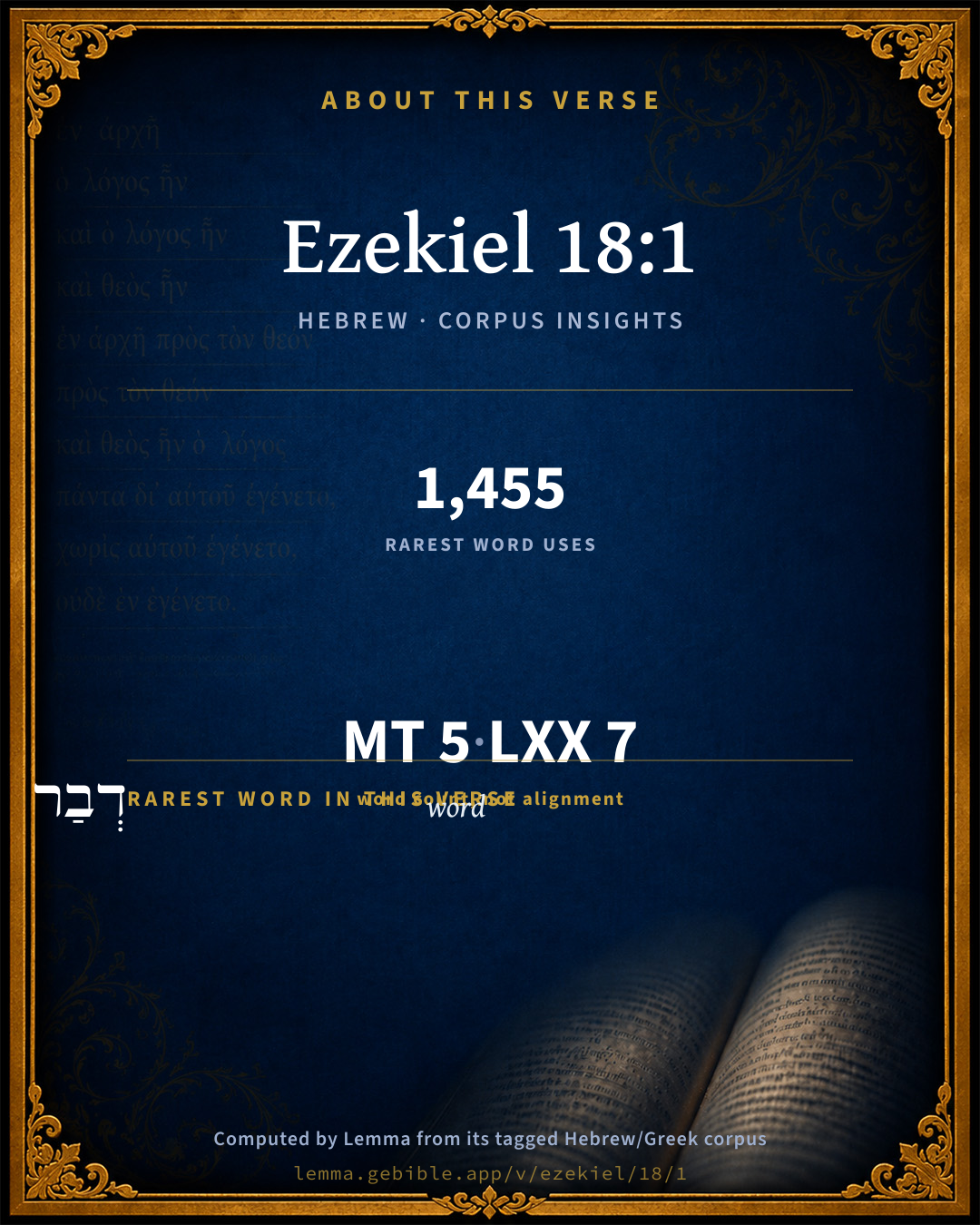
Ezekiel 18:1

Hebrew (Westminster Leningrad Codex) Ezekiel 18:1 appears in the Hebrew Old Testament. The text above is from the Westminster Leningrad Codex. Each word links to its Strong’s number, a concise gloss, and parsing drawn from the Open Scriptures Hebrew Bible morphology. Click any word for its full Brown-Driver-Briggs (BDB) entry.
Download image
Cite this verse

Ezekiel 18:1 (World English Bible). Public Domain. Lemma interlinear Bible study tool, https://lemma.gebible.app/v/ezekiel/18/1.

Show BibTeX & RIS
BibTeX
RIS
English Translation
The word of Yahweh came to me again, saying,
World English Bible · Public Domain
Download a study sheet

One document with this verse’s original text, its word-by-word gloss line, the meaning frame, cross-references with their text, attributed commentary, and full source and license credits — printable, and it pastes into notes with its structure intact.

This verse Autodidact and up

Study sheet (.html) Plain text (.txt)

A passage Seminary Student

Up to 50 verses in one chapter. A passage sheet keeps up to 6 commentary sources and 12 cross-references per verse, in the order this page ranks them, and says so on the sheet whenever that leaves anything out. Ask for a single verse and you get the Autodidact verse sheet above.

Everything on this page stays free to read, with no account — the sheet is a download of what is already on screen, not access to it.

Want to remove ads? Support Godless Engineer
Compare translations 3

The same verse in 3 English versions, stacked beneath the original-language interlinear above. Click any original word for its lexicon entry.

Each is an independent rendering of the whole verse — the interlinear is not word-aligned to these translations.

Highlighted words mark where these versions differ — a whole-verse word diff, not a word-by-word alignment.

  • World English Bible Public Domain
    The word of Yahweh came to me again, saying,
  • King James Version Public Domain
    The word of the LORD came unto me again, saying,
  • unfoldingWord Literal Text CC BY-SA 4.0
    The word of Yahweh came to me again, saying,

unfoldingWord Literal Text — © unfoldingWord, licensed CC BY-SA 4.0. Word-aligned USFM3 via Door43 (git.door43.org/unfoldingWord/en_ult).

Versions to compare (up to 4)

3 of 4 selected

Show all 18 translations

Every available English version of this verse, each an independent rendering of the whole verse.

  • World English Bible Public Domain
    The word of Yahweh came to me again, saying,
  • Berean Standard Bible Public Domain
    Then the word of the LORD came to me, saying,
  • Majority Standard Bible Public Domain
    Then the word of the LORD came to me, saying,
  • King James Version Public Domain
    The word of the LORD came unto me again, saying,
  • American Standard Version (1901) Public Domain
    The word of Jehovah came unto me again, saying,
  • Revised Version (1885) Public Domain
    The word of the Lord came unto me again, saying,
  • Geneva Bible (1599) Public Domain
    The worde of the Lord came vnto me againe, saying,
  • Douay-Rheims (1899) Public Domain
    And the word of the Lord came to me, saying: What is the meaning?
  • Young's Literal Translation Public Domain
    `And there is a word of Jehovah unto me, saying:
  • Literal Standard Version CC BY-SA 4.0
    And there is a word of YHWH to me, saying,
  • Unlocked Literal Bible CC BY-SA 4.0
    The word of Yahweh came to me again, saying,
  • unfoldingWord Literal Text CC BY-SA 4.0
    The word of Yahweh came to me again, saying,
  • Darby Bible Public Domain
    And the word of Jehovah came unto me, saying,
  • World Messianic Bible Public Domain
    The LORD’s word came to me again, saying,
  • Webster's Bible Public Domain
    The word of the LORD came to me again, saying,
  • Free Bible Version CC BY-SA 4.0
    A message from the Lord came to me, saying,
  • Bible in Basic English Public Domain
    The word of the Lord came to me again, saying,
  • JPS Tanakh (1917) Public Domain
    And the word of the LORD came unto me, saying:

Literal Standard Version (2020), Covenant Press — licensed CC BY-SA 4.0. Text via the HelloAO Bible API (eBible.org). Unlocked Literal Bible (unfoldingWord) — licensed CC BY-SA 4.0. Text via the HelloAO Bible API (eBible.org). unfoldingWord Literal Text — © unfoldingWord, licensed CC BY-SA 4.0. Word-aligned USFM3 via Door43 (git.door43.org/unfoldingWord/en_ult). Free Bible Version, Dr. Jonathan Gallagher — licensed CC BY-SA 4.0. Text via the HelloAO Bible API (eBible.org).

Word by word

More ways to search: Search by grammar → Find every occurrence → Compare this word →

Practice this passage: Drill this verse → Learn its vocabulary →

About this verse

These counts appear in no published source. They are computed here, from the morphology-tagged text and Lemma’s own curated glosses. What Lemma adds →

5
words
5
distinct lemmas
Prophets
section

Grammatical profile

  • 2 verbs
  • 2 nouns
  • 1 preposition

Verb forms

  • וַיְהִ֥י Qal · Sequential Imperfect
  • לֵאמֹֽר Qal · Infinitive Construct

Hebrew & Septuagint length

In English translation the verse runs 9 words from the Hebrew and 10 from the Septuagint (LXX English) — closely comparable.

A rough comparison of the two English renderings, which tokenize alike — not a word-level alignment.

Word counts can differ between the Hebrew and the Greek without any difference in meaning — e.g. the Hebrew direct-object marker אֵת has no separate Greek word, and Greek often adds the article ὁ.

In the original languages it is 5 Hebrew tokens and 7 Greek tokens — but the two are counted differently (Hebrew bundles its prefixes and suffixes into one token; the Greek is in lemma form), so that isn’t a like-for-like length.

Hebrew and Greek witnesses Masoretic Hebrew ↔ Greek Septuagint

The same verse in the two great witnesses to the Old Testament, shown verse-for-verse.

These are two independent witnesses, not word-aligned to each other, and the Septuagint is shown in lemma (dictionary) form.

Hebrew Ezekiel 18:1 Masoretic · Westminster Leningrad Codex

וַיְהִ֥י דְבַר יְהוָ֖ה אֵלַ֥י לֵאמֹֽר

The word of Yahweh came to me again, saying,

World English Bible · Public Domain

Greek LXX Ezekiel 18:1 Septuagint · lemma form

καί γίγνομαι λόγος κύριος πρός ἐγώ λέγω

And the word of the Lord came to me, saying,

LXX2012 (modern English Septuagint) · Public Domain

On this verse, Lange's Commentary on the Holy Scriptures discusses the Septuagint’s reading. Read the note in Commentary ↓

Hebrew: Westminster Leningrad Codex (CC BY 4.0). Greek: Septuagint (public domain); English from LXX2012 (modern English Septuagint) (Public Domain). How the Septuagint differs from the Hebrew →

Targum (Aramaic paraphrase)

1

The Targum is the ancient Jewish Aramaic paraphrase of the Hebrew Scriptures — an interpretive translation, not the Hebrew text itself. Onkelos (literal) and Pseudo-Jonathan (expansive) render the Torah, and Jonathan the Prophets. Coverage is partial: where no permissively-licensed English translation exists for a verse, only the Aramaic is shown. This is verse-level text, not a word-by-word alignment to the Hebrew.

  1. Targum Jonathan Prophets (Joshua–Malachi)
    וַהֲוָה פִתְגַם נְבוּאָה מִן קֳדָם יְיָ עִמִי לְמֵימָר:

    (no public-domain English translation for this verse)

    Targum Jonathan — Aramaic: “Mikraot Gedolot” (public domain). English: “Sefaria Community Translation” (CC0 1.0 (public-domain dedication)); “London "Chaldee Paraphrase," 1871” (public domain). Text via Sefaria.

Commentary

Notes on Ezekiel 18:1 from classic Christian and Jewish commentators (each source and its license shown beneath its notes). The classic Christian expositions comment on the surrounding passage and are grouped to its opening verse, so a note may address several verses; the Jewish commentaries on the Tanakh (Rashi and others) are per-verse, so they appear only where the commentator wrote on this verse.

Lemma curates 59 commentaries, every one of them public domain or Creative Commons licensed, each selected and text-cleaned for this edition rather than reprinted as found. About our sources →

Trapp's Complete Commentary

John Trapp

Eze 18:1 The word of the LORD came unto me again, saying,

Ver. 1. And the word of the Lord came unto me.] This is oft prefaced by the prophets to make their sermons more authoritative and authentic. Pausanias telleth us that some heathen sages, to add weight to their works, were wont to prefix Yεος, Yεος, i.e., God, God.

John Trapp, A Commentary or Exposition upon All the Books of the Old and New Testament (1647–1656) — public domain. Text from a community e-Sword module.

The Biblical Illustrator

Joseph S. Exell

Eze_18:1-3

What mean ye, that ye use this proverb concerning the land of Israel, saying, The fathers have eaten sour grapes, and the childrens teeth are set on edge?

Sins of fathers visited on their children only in this world

The fathers have eaten sour grapes, and the childrens teeth are set on edge. The declaration of God, in the second commandment, that He would visit the sins of the fathers upon the children, for three or four generations, had been translated into this quaint proverb. Manasseh and they which were seduced by him to wickedness, greater than that of the Amorites, have been long dead; why, they still argued, why should we be punished for their sins? Surely the ways of God are unequal in this thing, that the childrens teeth should be set on edge by the sour grapes which not they, but their fathers have eaten; and that a mans sins should be visited upon his innocent posterity. Ezekiels answer is two fold.

1. What mean ye to use this proverb? Ye, who have been at no pains to reform yourselves, and by such reformation avert the woes and the captivity denounced against your country for the sins of Manasseh, and those of his people; ye can with no reason complain, who are no better than they. What mean ye, saith the prophet, that ye use this proverb? For have not ye, and your fathers, yes, both your fathers and ye also, have rebelled against the Lord?

2. However, he tells them that they shall not have occasion to use this proverb any more in Israel. Concerning the meaning of this declaration there is some diversity of opinion. The most probable opinion is, that Ezekiel speaks of the times that were coming, when the doctrine of a future state should be generally entertained, and of the punishments which will be awarded in that state, to every individual, for his own sins and no other, according to their proper malignity. The soul that sinneth, it shall die, it only shall perish everlastingly. The prophet might also mean, that the great cause of mens sins being visited upon their posterity, so far as that punishment was the consequence of a special providence, was shortly to cease from among his people. That sin was the sin of idolatry. Of so many of the children of the captivity as were incapable of being reclaimed by the punishments all of them now suffered, the end would be, that they should die, by the sword, the plague, or famine, or, at all events, die in captivity, while those of the better sort, who were weaned from the practice of this great offence, should see their native land again, build again the wails of their city, and, whatever their other offences might be, should offend God no more by idolatry.

3. But the declaration of the text, that there should be no more occasion to use this proverb, may mean, that the times were coming, the times of the Messiah, when the old system of laws and ordinances should be superseded, the temporal sanctions of the law of Moses be forgotten and lost, in the thought of the everlasting rewards and punishments of a future state; concerning which punishments, if Ezekiel is, as we believe, speaking of them, he declares that the son shall not bear the iniquity of the father. Each man, in that state, shall suffer only for his own sins. The soul that sinneth, it shall die. It is not natural death that is meant. Both the bad and the good suffer that. It is what is called in Revelation, the second death, eternal misery after death, of which it is declared, that the carnally minded shall suffer it, and the righteous and the good never taste it.

4. Undoubtedly, there is a sense in which it will never cease to be true, that the son shall suffer for the sins of the father. The effects of every mans sins, as regards this world, are felt by his family, both while he fives and often long after.

Lessons--

1. The evidence, brought daily before our eyes, how severely the misconduct of parents is wont to be felt by their children, should reconcile us to the declarations of Scripture upon the subject.

2. The knowledge of this should be an availing consideration to deter us from evil courses, and show us the exceeding sinfulness, the madness also, and folly of sin; that by giving way to it we not only become enemies to our own souls, but cruel enemies to those whom we most love.

3. If we are ourselves suffering through the misconduct of those who have gone before us, let us by no means tread in their steps; let them be a warning to us, and not an example, and let us be very careful that we do not, by imitating their bad example, lose our own souls, which can only be through our own fault. (A. Gibson, M. A.)

The entail of suffering

I. The fact is indisputable. Men are liable to an entail of suffering. The Divine law asserts it (Exo_20:5). Compare with this the awful malediction of Christ (Mat_23:35). The teachings of sacred Scripture harmonise entirely with those of experience on this point. Not so surely will a fathers inheritance descend to his sons as his physical characteristics. Hence hereditary diseases. How many of these were originally the result of violations of the Divine laws, natural or moral, needs not to be shown. And so mysterious are the relations which bind together succeeding generations that, in many cases, both the mental and moral characteristics are seen to be transmitted. The evil tempers we have indulged reappear in our offspring to torture them; and when they are evil, it may be said, The fathers have eaten sour grapes, etc.

II. The procedure may be vindicated. We may confidently assert that this procedure cannot be shown to be unjust. Man is a sinner. We are a seed of evil-doers; children that are corrupters. We are therefore liable to punishment. The only question which, as sinners, we have a right to entertain respects the degree of our punishment. Does our punishment, in the entailed evils of which we have spoken, surpass our guilt? If not, we have no right to complain. But this procedure may be vindicated, moreover, by a reference to its adaptation to the great end of Gods moral government of mankind. That end may be simply stated to be the repression of moral evil. To secure this end, he appeals to us in every possible form, and by every conceivable motive. What more likely to deter a man from vicious indulgence than the thought that it may taint the blood, paralyse the limbs, and cloud the skies, of those who ought to inherit the reward and perpetuate the blessing of his own virtues? And what more humiliating to a parent than to see the very faults which have disgraced and plagued himself reproduced in the children of his fondest love?

III. The use of the proverb shall cease; not that Jehovah shall ever repeal this law, but that the consistency of it with moral perfection being perceived, men shall cease to urge that which shall afford them neither excuse nor ground of complaint.

1. An acquaintance with the rules which guide the Divine judgment of transgressors shall prevent men from using this proverb.

2. The common relation which all men sustain to Him may well prevent us from attributing iniquity to Him. Behold, all souls are Mine, etc.

3. The true spirit of penitence which a knowledge of His equity and His love excites shall, in a similar manner, acquit Him. A deep sense of sin, and true contrition on account of it, will not suffer men to cavil against God: then they meekly accept the punishment of their iniquity.

4. If any darkness yet seem to hover around these truths, the dawn of the last day shall assuredly dispel it; and friends and foes shall then unite--the former joyfully, the latter inevitably--in the confession that The ways of the Lord are equal. (Homilist.)

Heredity and responsibility

It is a well ascertained fact that not merely are the physical features of parents reproduced often in their offspring, but likewise their moral and intellectual characteristics. Genius runs in families. The son is frequently renowned for the same accomplishment for which his father, and perhaps his grandfather, were renowned before him. The same thing is true of moral defect. The vice to which the parent was the slave is the vice for which, in a multitude of cases, the child shows the most marked propensity. This reproduction of parental characteristics in the children may, indeed, be attributed to another cause than the principle of heredity; it may be attributed, and not without reason, to the effect of example. Children are great imitators. But much as example may have to do in the way of creating a likeness between parent and child, the fact that such likeness exists where example has had no opportunity of working--as in the case of the parent dying during the childs infancy--proves that the likeness cannot be the result of example alone. It is related in the life of the famous French philosopher and mathematician, Pascal, that his father, also a great mathematician, being desirous of educating his son for the Church, studiously kept out of his reach all books bearing upon his own favourite study, and took other precautions to prevent his son forming a taste for mathematics. But all his precautions were vain. Young Pascal engaged in the study in secret, without any of the usual aids, and as a result, reproduced and solved most of the propositions in the first book of Euclid, without, it is alleged, having ever had a copy of Euclid in his hands. The particular bent of the fathers genius here descended to the son, and found expression for itself in spite of all the efforts made to prevent such a result.

I. The reference is plainly to the sufferings which children have sometimes to endure in consequence of the evil-doings of their parents. We may not perhaps be very deeply affected, although we ought to be, by the thought that our wrong-doing causes suffering to others in whom we have comparatively little interest. But when we consider that we not only harm, by setting them an evil example, those whom we most deeply love, the children whose presence now brightens our home, but may also harm, may be preparing great suffering for children unborn, who may yet call us by the endearing name of parent, we cannot help feeling what need, what great need there is, apart altogether from the demands of morality as such, to live, for the sake of those whom we love most, and from whom we would ward off every pain, upright and pure lives--careful alike of our moral and spiritual health. Only in acting thus may we hope that, in as far as it rests with us, our children shall not enter upon the conflict of life crippled, handicapped, and thus have their prospect of victory immensely lessened. That good is perpetuated under this law of heredity as well as evil ought to be remembered, or we might otherwise think it a cruel law.

II. What bearing has the law upon our individual responsibility? Does it diminish or do away with it? The Jews, at the time Ezekiel wrote, were in a very miserable state. The nation was hastening to its doom. They were on the eve of that great catastrophe often predicted--the destruction of Jerusalem--their pride and glory, and the captivity. With this dismal prospect in view, and with present troubles pressing painfully upon them, they would not see in their own behaviour any reason for their suffering. They tried to make out that they were innocent children suffering solely for their fathers sins: Our fathers have eaten the sour grapes of idolatrous pleasures, and we are suffering the consequences. But although within certain limits it might be true they were suffering for their fathers sins, it was also true that their own evil doings, their sins against light and knowledge, were the main source of their sufferings. They could not divest themselves of individual responsibility. All souls are Gods; as the soul of the father, so also the soul of the son. The soul that sinneth, it shall die. He that hath withdrawn his hand from iniquity, he is just, he shall surely live. It is further pointed out in the context that a righteous son is not condemned for his fathers profligacy, any more than a profligate son is saved by his fathers righteousness. The son shall not bear the iniquity of the father, neither shall the father bear the iniquity of the son; the righteousness of the righteous shall be upon him, and the wickedness of the wicked shall be upon him. The teaching here is clearly to the effect that it is our own acts, and not the acts of another, that shall either justify or condemn us. And that is the teaching also of our Lord: By thy words shalt thou be justified, and by thy words shalt thou be condemned. Again, in the not uncommon fact that a bad father may have a good son, and a good father a bad son, we have a conclusive proof that the law of heredity does not act in such a way that its operation cannot be resisted. It can be resisted, and on the fact that it can be resisted, and successfully resisted, rests our moral responsibility. It may be a hard struggle, in some cases it will be an exceedingly hard struggle, but with Gods help it will not be a vain one. Numberless instances are on record of men who have developed a beautiful character under the most adverse circumstances, and this should encourage everyone, however hard his lot, and however heavily handicapped he may be by tendency or circumstance, to undertake the struggle and persevere therein. Stronger is He that is for us than all they that are against us. Let us but trust Him--let us but look to Jesus--and so fight. The victory will be sure. (N. M. Macfie, B. D.)

Heredity

Through the whole realm of living things there runs the great law of inheritance. All that lives tends to repeat itself in the life of its offspring. The ant, for example, begins life not only with the form and structure of its ancestry, but in full possession of all those marvellous industrial instincts which today have passed into a proverb. The marvellous sagacity of the sheep dog, which no amount of training would ever confer upon a poodle or a fox terrier, comes to it by way of inheritance as part of its birthright. In similar fashion old habits and curious antitheses tend to repeat themselves in like fashion, even where the originating circumstances no longer remain. For example, we are told, by those who know, that in menageries straw that has served as litter in the lions or the tigers cage is useless for horses; the smell of it terrifies them, although countless equine generations must have passed since their ancestors had any cause to fear attack from feline foes. You must often have noticed a dog turning itself round three or four times before it settles in front of the fire, but it is probably only doing what some savage and remote ancestry did many generations ago when it trundled down the long grass of the forest to make a lair for itself for the night. Everyone knows how the peculiar cast of features that we term Jewish tends to reappear in generation after generation. The vagabondism of the gipsy, again, is in his blood, and he cannot help it. It is said that on one occasion the Austrian Government started a regiment of gipsies, but on the first encounter they ran away, A hundred mental and physical characteristics run in families, and so we have the aquiline nose of the Bourbons, the insolent pride of the Guises, the musical genius of the Bachs, and the scientific genius of the Darwins. Along the lines of his being, physical, mental, and moral, man derives from the past. As an American writer very happily and sagaciously puts it: This body in which we journey across the isthmus from one ocean to another is not a private carriage, but an omnibus, and, be it said, it is our ancestors who are fellow passengers. Yesterday is at work in today; today will live again in tomorrow, and the deeds of the fathers, be they good or be they ill, are visited upon the children unto the third and fourth generation. Now, this doctrine of heredity, as it is termed, is, to use a popular phrase, at the present moment very much in the air. The novelist, the dramatist, the journalist, the educationalist, the moralist, the theologian, and the social reformer have all made it their own, and are all of them ready with this or that application of it to some aspect of our daily life. Now, it is impossible to ignore the fact that the doctrine of heredity, as it is held and taught by some today, practically robs life of all moral significance. It is not merely that it conflicts with this or that conclusion of morality; it cuts away the ground under the foot of all morality, and makes the word itself to be meaningless. It is not merely that it takes this or that doctrine of the Scriptures; it makes null and void the truths which the Scriptures, as it were, assume as the base and groundwork of all. Taking for granted the facts of heredity as I have illustrated them, how do these facts affect our ideas of moral responsibility? I think the answer may be put in three-fold form: heredity may increase, heredity may diminish, heredity can never destroy mans responsibility. Heredity may increase a mans responsibility, for if it be true that we inherit evil from the past, it is not less true that we inherit good; and if he is to be pitied and dealt tenderly with who, through no fault of his own, enters upon a grievous heritage of woe, is not he to be visited with stern condemnation who, reaping a rich harvest which other hands have sown, squanders his inheritance in riotous living? But it may also diminish, for there are certain hereditary vices, like drunkenness, for example, which are sometimes not only vices, but also diseases; and just in so far as they are diseases as well as vices, so far do they call for our pity rather than for our condemnation,--a fact, perhaps, that has not always had due weight given to it by some of our sterner moralists. God asks not only where does a man reach, but where does a man start. He counts not only the victories that men win, but the odds in the face of which men fight, the moral effort that is needed; and many a time when our poor blind eyes can only see the shame and disaster of seeming defeat, His eyes have marked the ceaseless, if often thwarted, struggle to cast off the yoke and bondage of evil. Heredity may increase, heredity may diminish, heredity ban never destroy mans responsibility, and it is just there that we join issue with so much that is being said and so much more that is being implied at the present day. This idea of heredity has so completely fascinated the minds of some, that to them man is nothing more than a bundle of transmitted tendencies, the resultant of antecedent forces, a projectile shot forth from the past, whose path he could calculate with mathematical accuracy, did he but know the precise character and amount of the hereditary forces that are at work in him. The unquestioned facts of heredity are emphasised to the exclusion of all other facts as though in this, and this alone, were the key to the whole mystery of the life of man. The prophet meets the complaints of the people with two words from the mouth of God, Behold, all souls are Mine,--that is to say, every individual soul is related to God. We are related to the past; that is the fact upon which those to whom Ezekiel spoke laid all the emphasis, but we are also related to God. We derive from the past, but that which we derive from the past is not the whole of us,--we derive also from God. As the soul of the father is Mine, so also the soul of the son is Mine. Weighted as we may be with sins which are not our own, we have each of us a moral life that is our own, received direct from God. If upon the one side of me--if I may put it in that awkward fashion--I am linked to a sinful human ancestry, and so rooted in Nature; on the other side of me I stand in a Divine lineage, I am rooted in God. The second word of the prophet follows from it as a natural corollary, All souls are Mine; therefore, the soul that sinneth, it shall die. That is the charter of the individual soul. What does it mean? That it is never our past that condemns us, that a mans past can be a mans ruin only in so far as he allies himself with it, and makes it his own. I repeat, we are related to the past, therefore the facts of heredity cannot be denied, and must not be overlooked; but that which we derive from the past is not the whole of us. We are also related to God, and through that relationship the strength of the grace of God can come to us. And it is that two-fold fact concerning every man that makes man a responsible being. He can choose, he can take sides; and it is only when a man takes evil to be his good, when, barking the struggle altogether, he leaves evil in undisputed possession of the field, that he stands condemned before God. Turning aside from the prophet for one closing moment, I want you, looking beyond the prophets teaching, to gather confirmation of his message. Look at the Bible. There is no book to make allowance for us all like this Book; no place where earths failings have such kindly judgment given. Our wills are ours, we know not how. We cannot sound the mysteries of our frame, but Our wills are ours to make them Thine. The peace that follows righteousness, remorse after wrong-doings, the honour that everywhere men pay to self-sacrifice, the kindling indignation with which we listen to some story of base cunning and cruel wrong, the passionate thrill that passes through the whole nation to its very centre when a deed is done for freedom or a blow is struck for truth,--these things, which are among the most sacred and splendid of human experience, and which, as Dr. Dale used to say, are as real as the movements of the planets and as the ebb and flow of the tides--these things are only to be explained if it be true that man is free to choose betwixt truth and falsehood, for the good or evil side. So, in fact, with this. If a man is living in conscious rebellion against God, the poor and paltry plea of the fathers sins will not avail. Oh yes, we may talk as we will about sour grapes, and I know not what else besides, but when conscience has a man by the throat he follows humbly in the footsteps of the Psalmist--The guilt is mine, the sin is mine before God. If Gods angel has us by the hand and is drawing us away from our bad evil selves, let us hear and answer to His call, and it may be that even yet by His grace we shall be crowned. (G. Jackson, M. A.)

Individuality

There is scarcely a thing in the world which is well attested which can bring forward more strong or more indisputable evidence than this truth which is incorporated in the proverb. Every land, every race, every age, has seen its truth. The fathers are always eating sour grapes, and the childrens teeth alas, are always being set on edge. Look, I would ask, at your own life and your own experience. Here are men placed in divergent circumstances in life. We often look round and see how true it is that a man is weighted in the race of life by folly, by the extravagance of his father. A man, on the other hand, toils on industriously, accumulates possessions for his children, and in doing so gives them the advantage of the position which he has established. Or, take that other thing we often speak of--that which we cannot help--the inheritance of our name. How true it is that a man inheriting a good name is often carried away to a position far in advance of what we may call his native worth, because the great flowing wave of his fathers success carries him high up the beach of life; and how true, on the other hand--painfully true it is, that, when a child inherits a disgraced name, he finds himself at once in the midst of a world that is ready to close its doors upon him. Or, take that which is a stronger illustration still--this law of hereditary descent which operates throughout the whole world. What strange power is it that makes a man vacillate? How is it he cannot hold on to the straight and true way of life? Or again, why is it this man is unable to cope with the strain of life? Watch him, and see what hesitancies there are about his nature. See how he starts; what strange apprehensions visit him that do not visit healthier organisations. There you have in that strange nervous organisation the story of that which has been the perilous fault of his ancestry: the overstrained life, the long hours, the eager toil, the care, the anxiety, the worry that has worn into the fathers frame are reproduced here. And that which is true with regard to personal history is true, also, with regard to national history. Are we not bearing the weight of our fathers sins? Look on the difficulties which surround our own administration. See how hard it is for men exactly to poise their legislation between leniency and justice. And understand that when we have to deal with the wild, tumultuous dispositions of those people who entirely disbelieve in our good intentions towards them we are, as it were, enduring the pain of our teeth being set on edge because of the follies and the sins of past generations. Now, what is the reason, then, that the prophet should take upon himself to denounce what is so obviously true? A little reflection will show that it is not so strange as it at first sight appears. He denounces its use because it is used in an untrue sense and for an unlawful purpose. It is certainly true that when the fathers had eaten sour grapes the childrens teeth were set on edge. All the past history of Israel showed it. These men to whom the prophet wrote were themselves illustrations of it; they were exiles, and their exile and their national disintegration was the result of their fathers sin. But it was quoted in a wrong sense, it was quoted in the sense of trying to make people cast a shadow upon the loving kindness of God; therefore the prophet takes up his parable against them. He argues and expostulates, he shows that the sense in which it is used is an unfair and an unjust sense; he says, Look upon life; watch the man whose career has been good--one who has been pure, who has been just, who has been generous--observe him. He is under the care and protection of God. If his son, he argues, becomes a man of violence, a man of impurity, a man who is full of the debaucheries and injustices of life, then, indeed, upon that man will fall the shadow of his own sin; but if his son rises up, and gazing upon the life of his grandfather, and gazing upon the life of his father, turns aside from his own false ways, then upon such a man will dawn the brightness of Gods favour. The soul that sinneth shall die. The son shall not bear in that sense the iniquity of the father. It is true he must inherit the disadvantages which are handed down to him from father to son; that the great and fatal law of life will operate, and that he cannot expect to ca, use, as it were, the shadow to go back upon the sundial of life, and to claim the position which would have been his had his father not sinned at all; but, as far as the love of God is concerned, as far as the capacity of rising up and doing some fit and noble work in life is concerned, as far as purification of his own spirit is concerned, as far as the ennobling of his own character is concerned, as far as his capacity to do something great and worthy is concerned, he is not at a disadvantage at all. The soul that sinneth shall die. The sons, in that sense, shall not bear the iniquity of their fathers. It was used, then, in an untrue sense, and it was used (and this is more important still) for a false and unworthy purpose. Our fathers, said they, had national life; they had grand energy; they had the concentration and the spirit of a nation; they had that great spirit of unity and all the glorious associations which created patriotic hearts;, they had the everlasting hills; the snowy Lebanon was theirs; the rich and swift-flowing Jordan was theirs; the fields instinct with the memories of a thousand victories were theirs: but we are condemned to exile, condemned to dwell here by the barrier set by these waters of Babylon. There is no hope for us: no future for us; our fathers eat sour grapes, and our teeth are set on edge. No wonder that when the prophet saw they were quoting the proverb to bolster up their own indolence, and to make it the shameful apology of their own disregard of their highest and noblest duties, that, with all the indignation and sacred fire of his spirit, he rose up to denounce such an unworthy use of a truth. As I live, saith the Lord God, ye shall not have occasion any more to use this proverb in Israel. All souls are Mine--the soul of every individual, be he on the banks of Babylon or not, is Mine; all nations are Mine, whether they be in the plenitude of their power, or whether they be in a poverty-stricken existence. For every soul, for every nation, there is a glorious destiny; and for men to shelter themselves from their duty by declaring that a hard fate has bound them about with its fetters of iron, and that there is no escape for them; that their whole life is shipwrecked and ruined; that they are the miserable inheritors of the fatality of their own organisation, of the tyranny of their national position, is forever to declare themselves unworthy of the name of men, that they have lost faith in the power of God--it is to take a solemn truth, and wrest it to their own destruction; it is to forge the weapons of their own imprisonment out of the very thing which should be their highest stimulus to exertion. The greatest of truths may be perverted to a false use. Truth is like a beam of light, which indeed falls straight from its parent sun, but it is possible for us to divert and alter the beauty of its hue by putting the prism of our own fancy and conceit between it and the object on which we cast it; in like manner we may misuse truths as well as use them; and if we misuse them, it is to our own detriment and shame. Oh, fatal way in which extremes meet--that the pessimist should say that he is under the fatal law of organisation, and it is useless to do anything; and that the optimist should say he is under the fatal and sweet law of organisation, and that it is needless for him to do anything. Midway between these truths which we meet in mens lives, and which often become the fatal sources of the apology of their indulgence--midway between them lies the real truth; these are but the opposite poles of truth, the great world upon which we live revolves upon its axis between these two. It is not your part to live forever in the north pole of life, and declare that it is all bitterness and a blasted fate; it is not your duty to live in the sunny pole of the south, and to declare that your life is all sweetness and sunshine; your lot and mine is cast in these moderate poles, where we know that law rules, and love rules above our heads, sweet love beneath our feet, sweet law, both strong, both sweet, both the offspring of God, both the sweet heralds of encouragement, to lift up our energies, to exert ourselves in the toil of life, and to be men, for do you not say that it is precisely in the counterpoising truths of law which is inexorable, and love which is never inexorable, that the power of life, and heroism of life, is found? (Bp. Boyd Carpenter.)

The two-fold heredity

It seems, then, that there is nothing new under the sun, and that in the days of Ezekiel men had anticipated, in some respects at least, Darwin and Ibsen and the problem novel; they were dealing with some, at least, of the difficulties which perplex us, upon whom the ends of the world have come. Science has made plain the part played by the law of heredity, the transmission of tendencies and characteristics from parents to offspring, in the development of life upon the globe. Criminologists have carried the idea over into the moral and judicial sphere, producing specimens of pedigree criminals, families in which the criminal taint has descended from parents to children for generation after generation, Novelists and dramatists have found in the subject a fertile source of plots and tragedies. Social reformers find heredity a fact to be reckoned with. And now, as in Ezekiels day, sinning souls are often inclined to lay the blame of their own failures on those whose blood runs in their veins. The first step to be taken in approaching this theme from the Christian standpoint is to notice how frequently it is dealt with in the Bible, the book which by some gracious miracle anticipates all other books and reveals to us the antiquity of our most modern problems. Our Lord Himself said, Can men gather grapes of thorns, or figs of thistles? There is such a thing in the moral world as pedigree, propagation of species, lines along which certain qualities and tendencies are transmitted, and you do not expect out of one stock that which, by its moral qualities, is properly the fruit of another. Pauls close observation of the organism of human society, as reflected specially in the Epistle to the Romans, is also a contribution to the subject; he sees that the human race is one in sin, that the taint is transmitted from generation to generation, that human history in one aspect of it gathers itself round a kind of pedigree of degeneration, so that by the disobedience of one many are made sinners. But though there is something in the knew Testament on the theme, there is more in the Old. In the New Testament it is specially the individual who comes to his rights; in the Old Testament more attention is given to the family, the nation, the generations which succeed each other and yet are part of each other--at once inheritors and transmitters of the blessing or the curse. It works for good: the mercy of the Lord is from everlasting to everlasting upon them that fear Him, and His righteousness unto childrens children. It works also for evil--visiting the iniquity of the fathers upon the children unto the third and fourth generation. And both in Jeremiah and in Ezekiel we meet this idea, which had evidently become proverbial in Israel--The fathers have eaten sour grapes, and the childrens teeth are set on edge. The people were making too much of that; the prophets were eager to show them that there was another side to the truth. But that their proverb has some truth in it, who can deny?

I. And first, the fact. Here it is as a theologian (Dr. Denney, Studies in Theology) states it: We are born with a history in us. Here it is as a novelist (Oliver Wendell Holmes, Elsie Venner) states it: Each one of us is only the footing up of a double column of figures that goes back to the first pair. Every unit tells, and some of them are plus and some minus We are mainly nothing but the answer to a long sum in addition and subtraction. If you prefer scientific witnesses, their name is legion; this doctrine is one of the cornerstones of scientific thought. One of the quaintest and most delightful studies of the subject it is hardly profound enough to be called a study, and yet it is exceedingly suggestive--is in Robert Louis Stevensons Memories and Portraits. You may remember the passage in which he describes his grim old minister-grandfather, and wonders what he has inherited from him: Try as I please, I cannot join myself on with the reverend doctor; and all the while, no doubt he moves in my blood and whispers words to me, and sits efficient in the very knot and centre of my being. And not he alone, but a broadening line of ancestors, stretching back into the cloudy past, the toilers and fighters and adventurers of earlier generations, Picts who rallied round Macbeth,. . . star-gazers on Chaldean plateaus.. . .And furthest of all, what sleeper in green tree tops, what muncher of nuts, concludes my pedigree? Probably arboreal in his habits. It all amounts to this, that each human being is a thousand rolled into one; the roots of our lives go deep down into history, drawing from many different strata some of the elements that make us what we are. It is the darker side of this fact that is reflected in the text. The fathers have eaten sour grapes,--in other words, they have sinned, perhaps they have suffered for their sins, the grapes have been sour even in the act of eating; but their children after them have suffered also, perhaps in nothing more than in this, that in them the ancestral tendencies to evil have been perpetuated and reproduced. It means this, that if a man has had ancestors who have been, say, drunkards or loose livers or men of ungovernable temper, very likely something of their besetting tendency is transmitted into his very blood, and the battle is all the harder for him because of their sin. And if he in his turn yields himself a servant to sins like these, very likely his children and his childrens children will be enslaved by the same bondage. This is a reality so tremendous that it has made some men curse the day they were born. Here is a relationship which is not in the smallest degree in a mans own control; he was not consulted as to the family into which he should be born. Yet that relationship affects not only his physical but his moral and spiritual life; it follows him into the race of life and into the fight of faith; it may prove a continual burden and snare. Thank God if those who have gone before us have been His servants, living sweet, strong, clean lives. We do not know how much easier that has made the battle for us. It is a personal matter, a care and conscience so to live that no one in whose veins your blood may run may have reason to hate your memory for what you have been or have handed on to them. And it is a social matter, the mightiest of arguments for every form of moral and religious effort that can be brought to bear on the life of today. Today is the parent of tomorrow. And anything of health and purity and love and God that is sown like seed in the soil of the present generation does not end its fruitfulness there; it is a gift and a blessing to the future--and the people which shall be created shall praise the Lord.

II. I notice that, though heredity is a fact, and sometimes a terrible influence, it is an influence which has its limits. This needs to be emphasised, because when mens hearts are in revolt against this tyranny of the dead past, they are apt to forget that the evil transmitted is not unlimited or unmixed. Even taking the bright and dark sides of hereditary influence together, it does not cover all the facts of life. Professor Drummond is right when he says that for half of life, at least, we have no inherited storage of habit or tendency. And if we take the darker side alone, still more is that a limited influence. It is limited in duration: those words unto the third and fourth generation have a meaning. So far and no further extends what Jeremy Taylor calls the entail of curses; there is a beneficent law which limits the time through which any evil habit in a given family can continue its self-propagating power; if it had not been for that, the world would be an infinitely worse place today. And it is limited in extent also in the individual life; it is limited by the very fact that a brighter side of hereditary influence exists; nobler instincts and finer tendencies can also be transmitted; there is a kind of entail in the blessing as surely as in the curse, and the entail of the blessing lasts the longer. These limitations imply that individuality has its own rights and possibilities. They imply that free will is not destroyed, even though hereditary influence gives a strong bias towards evil. They imply that each life may be a fresh starting point for the nobler possibilities of humanity. They imply that though a mans ancestors may be among his most subtle and powerful tempters, not all their power can forge upon him the fetters of an absolute fate. The truth seems to be this, that there is enough reality in this fact of heredity to constitute an important element in each mans trial and conflict, in some lives perhaps quite the most important element. But there is not enough in it to abolish the trial and the conflict, to make it an inevitable certainty that any man will fail in the trial or go under in the conflict. Over against the fact of corporate unity Ezekiel sets the equally real facts of personal responsibility; if men die, it is for their own sins, not for the sins of their fathers. They could turn; heavily weighted and sadly biassed though it is, human nature still swings upon its pivot, and all things are possible. Grant that they cannot rid themselves of sin, they have still a mighty defence against fate in this, that they can turn from sin towards God--the God who waits to be a refuge and a deliverer.

III. That brings me to the last thought, the counteractive. For it is too mild a statement of the case to say that the influence of heredity is limited: it is attacked, it is opposed, its overthrow is planned and dared from the strongholds of eternity. Mr. Rendel Harris (Union with God, the chapter on Grace and Heredity)

speaks the truth when he says: If we have not a Gospel against heredity it is very doubtful whether we have any Gospel at all. At any rate, many souls are painfully conscious that if there is no Gospel against heredity, there is no Gospel at all for them. But there is an older heredity than that which is commonly meant by the word, older, deeper, more essentially related to our true selves, reaching back even to the great deep from which we came. Listen to a fragment of a human genealogy. Which was the son of Enos, which was the son of Seth, which was the son of Adam, which was the son of God. The Evangelist is very daring. David the adulterer is in that genealogical tree, and Jacob the supplanter, and many others, all more or less diseased, dwarfed, defiled with sin. Can this, indeed, be allowed to stand as the ultimate origin of their being, the oldest source from which they drew their life, which was the son of God? That honourable lineage is allowed even to them, and indeed the genealogical tree of every one of us ends there, which was the son of God. Has not this God created us? Are not all our souls His, and is not His image stamped upon us all? Older than any link which binds us to the past generations, deeper than any resemblance to human ancestors which may appear in our faces or actions or characters,--so old and so deep is the relationship which connects us with the living God. Nay, it is a direct and immediate relationship; that is the chief burden of the prophets message here, in answer to the morbid melancholy of the peoples mood. As I live, saith the Lord God, all souls are Mine. Each soul has still its own link with God, its own responsibility to Him, and its own inheritance in Him. We may have done our best to break this connection, to blot out this likeness. But He does not disown the relationship. Now, this more wonderful heredity, so central and essential in mans true nature, has been sadly overlaid and overborne by other influences, such as those I have spoken of today. And God has taken special means to restore it to its true place and influence, to create the family that should realise the Divine intention, and bring the race of man to its true and glorious destiny. Think of the wonder of that interposition! The man Christ Jesus, bone of our bone, flesh of our flesh, descendant on His human side of a stock that was no more exempt than we are from the universal disease. Yet He was without sin, without one stain or taint of sin. The law of human heredity was laid aside for once in Him, that the older, deeper, diviner heredity might fully express itself, the answer to the worlds despair! And this second Adam became the head and founder of a new family, reproducing Himself in those who believed on Him, filling them with His grace, training and enabling them to follow in His steps, that He might be the first-born among many brethren. Can men gather grapes of thorns or figs of thistles? Of course not; but many a sorry branch of the human tree, barren and almost ready for the burning, has begun to bear wondrous fruit when it has been grafted into the true Vine. Jesus gives power to become the sons of God; He starts them on the life in which the true end of their being is to be fulfilled. Let us believe in this. Let us pray to have it realised in us and ours. So we have a Gospel against heredity, and surely it is a Gospel indeed. (J. M. E. Ross, M. A.)

Heredity and grace

The context also makes it clear that the captives in Chaldea used the words as a querulous reproach against the Almighty. Their forefathers had sinned; they, the descendants, were reaping the fruit. Not for their own misdeeds were they now suffering such dire calamity, They were simply involved as by the operation of a remorseless fate in the sins of their predecessors, and they were unable to shake themselves free from the crushing incubus. Now, these Jewish exiles voice very much of contemporary English thought at the beginning of the twentieth Christian century. Men do not attempt to deny the fact of moral evil. It is no longer pretended that this is the best of all possible worlds; that the advance of education, refinement, and civilisation is steadily driving sin out of the universe; and that under the evolutionary process we may confidently anticipate the speedy advent of the new heavens and the new earth. No! that shallow optimism of English Deism is scouted by modern philosophy, whose keynote is heredity. The idea that the offence of the ancestor involves the race in disability is no longer confined to the theology of the dark ages. Scientists, social reformers, journalists, and novelists have claimed it as their own. Darwin corroborates Paul. When the preachers of a century ago talked of original sin they were grievously reproached for their dark, gloomy views of human nature. It was a monstrous notion that men should be handicapped in all their after destiny by the sin of one primitive man from whom they chanced to be the descendants. That doctrine was only the invention of diseased consciences, the fiction of priests, and impossible of acceptance by any but the least enlightened of mankind. But modern philosophy has changed all that, and now proclaims in its own way every principle of the old creed. So widespread and dominant has this teaching become that in the words of a discriminating critic, one would think that the problem of heredity constituted the sum and substance of life, and that a man is nothing but a sum of tendencies transmitted from his ancestors. Nor can we be blind to the substantial truth of the modern doctrine. There is no theory which could marshal a greater or more appalling array of evidence in its favour than the theory incorporated in this Jewish proverb. The Bible itself assures us that the sins of the fathers are visited upon the children to the third and fourth generation. We see all around us men who inherit physical capacities, physical qualities, physical aptitudes which make it not only difficult for them to enter into life with the same advantage as their fellows, but which furnish them with a terrible bias the wrong way. And let us thankfully acknowledge that science has, at least, rendered this great service to the Christian faith. It has shown that we do not stand alone. We are not isolated units. We are parts of a great social organism bound to each other by close and indissoluble ties. No man liveth unto himself, we are all members one of another. And yet the startling fact remains that Ezekiel only quotes this proverb, expressive of so much truth, in order to repudiate it. He declares that it is unworthy of those who bear the name of Israel. What mean ye that ye use this proverb in the land of Israel?--the land which acknowledges Jehovah, and which is His peculiar possession? It is only fit for heathen, and ought to be swept forever from the records of Israel. He repudiates the proverb because it was used in an untrue sense, and was bound up with absolutely false inferences. The captives said they were suffering because of their fathers sin. That was true. Their present misery was the result of the idolatry of their fathers. What then? Shall men make the ugly inheritance from the past a bolster for indolence today, and an apology for disregarding the duties of the hour? It was this mistake which the exiles were making. Their eyes were so fixed upon their fathers sin that they could see none in themselves. They were the victims of dire misfortune--men to be pitied and excused. A spirit of fatalism and despair had settled down upon them, and they moaned that a hard fate had bound them in fetters of iron, from which there was no escape. If our transgressions and our sins be upon us, and we pine away in them, how, then, should we live? There is a similar spirit around us today. It is felt in much of our literature. Sin is regarded as a mans misfortune rather than his fault. The drunkard, the impure, the idler, and neer-do-well can no more help themselves for these evil things than they can interfere with the size of their stature or the colour of their hair. I am not exaggerating the trend of popular opinion. One of our best-known writers, in a little book which has become a household word, tells us that at the end of the twentieth century men will look backward, and then, for the first time, seeing things as they really are, will always speak of crime as atavism. This means, in plain language, that what has been bred in the bone must sooner or later come out in the flesh. The murderer is therefore what he has been made; he acts by necessity of nature, and cannot be otherwise than he is. Of course, we see at once where such teaching lands us. It means the denial of all moral responsibility, and the paralysis of all aspiration. It is the doctrine of despair. It is here that the Bible parts company with modern philosophy. It does not deny the facts of heredity. It admits that men do not start equally in the race of life. It shirks none of the hideous facts which are plain to every observer of human life. It declares that to whom little is given of him little shall be required. It speaks of One who watches above--With larger other eyes than ours to make allowance for us all. But it refuses to regard any man as absolutely determined by the influences he has received from the past. Our consciences tell us that the Bible is right. How otherwise can we explain our feelings of personal responsibility, our sense of shame and remorse? No man ever yet morally felt accountable because he was of diminutive height. The sense of accountability for our actions, however, is always with us. The very men who deny it cannot write a page without using language which contradicts their denial. And there is no explanation whatever for this persistency of conscience, and its lofty refusal to be gagged and silenced, when we plead our flimsy excuses at its bar, if a man is so hopelessly bound by his past that it is impossible for him to be free. You never yet succeeded in justifying yourself by shuffling the blame on to the shoulders of those who have gone before you. No! the attempt to evade responsibility is essentially dishonest. It is a futile make-believe. The man who attempts it hardly cheats himself, for in his deepest heart he knows that, however hampered he may be in his fight with sin, he is not justified in the resignation of despair. The prophet supplies the ground on which this verdict of conscience is justified. Ezekiel sets over against the proverbial half truth of the exiles another which counterbalances it. Ye shall no more use this proverb in Israel, for all souls are Mine. Man does not belong only to the family, the tribe, the nation. He belongs to God. He possesses not only what he has derived from a tainted ancestry, but that which he has received straight from God. The deeds of my forefathers are not the only factor in the case. God must be taken into account. God lives and works, and I belong to Him. The reply of the prophet is carried further in the Christian Gospel. It tells me of a Saviour who is able to save unto the uttermost. It opposes to these natural forces which incline to sin the power of almighty grace. Every man here stands in direct personal relations with Jesus Christ, and may come into personal saving contact with the strong Son of God. Here is our hope. Christianity is a Gospel, because it points me to a Redeemer who makes all things new. And so the work of the second Adam comes in to restore the balance of moral forces disturbed in the fall of the first. The sin of the natural head of the race is more than outweighed by the righteousness of Jesus Christ. The new pulses of life from Him are mightier than the tide of tainted life that comes to me out of the past. The transfusion of grace prevails over that of corruption. Where sin abounded, grace has much more abounded. We are not under the tyranny of natural law. We are under grace. If, therefore, anyone says, It is useless for me to hope to be better, greater, truer than I am. You do not know by what circumstances I am environed; you do not know what terrible physical organisation I inherit. You do not know the temper, the passion, the lust that are in me. I am the victim of this terrible law which makes it impossible for me to rise and shake off its tyranny. I answer, It is not so. You are not so weighted in the race that you must fall and perish. There is help for every man, the eternal and undying energy of Divine grace. I tell you of Jesus, the servant of Jehovah who is anointed to give deliverance to the captives. He breaks the power of cancelled sin, He sets the prisoners free. Jesus told the man with the withered hand to stretch it forth. That is just what he had tried to do again and again without success. But faith in Jesus, who gave the command, induced him to make the effort to obey, and in the effort he received power. Jesus speaks to us all in His Gospel, and He speaks to the weak and sinful side of our nature. He calls us to a life of self-conquest, of purity, of holy service and high endeavour. And when we set forth the insuperable obstacles in our way, our surroundings in business, our inherited tendencies, our strong passions, our weak wills, and say We cannot; He replies: Stretch forth thy hand. Make this venture of faith. You see all the forces arrayed against you. You do not see the living Saviour who can make you more than conqueror. But act as if He were on your side, and you shall find new life and new power. The will to be saved is the beginning of salvation. (W. E. Bloomfield.)

The doctrine of heredity perverted

How do men pervert this doctrine of the fathers having eaten sour grapes, and the childrens teeth being set on edge? They seek to ride off from responsibility on the ground that they are suffering vicariously, and perhaps innocently; they cannot help doing evil: the thirsty throat was born within them, and water cannot quench it, so they must drink fire and brimstone; they say they are fated to do evil; the thief is in their muscles, and they must steal; their father was a felon, and they must keep up the family line. In a pensive tone, with a melancholy that is supposed to express a degree of resignation, philosophical, although self-reproachful, they speak now about law, heredity, development: and thus they walk down to darkness on the stilts of polysyllables. The fathers have eaten sour grapes, say they, and our innocent teeth are set on edge: this is the outworking of the mystery, the occult law of heredity. The Lord will not have that any longer; He says, This proverb shall cease; these people are being ruined by their own epigrams, they do not see the full sweep and scope and bent of things. Then He lays down the grand, all-inclusive, all-involving doctrine to which we shall presently turn. But is there not a law of succession, of heredity; is there not a mystery of paternity, following the little boy all the time? Yes, there is. Take care what use you make of that fact. Let it fall under the great all-governing law, and then it will come into right perspective. How does society, that humanity which is next to God, treat this law of heredity? Very directly, summarily, and justly. The culprit, being not only a felon but a philosopher, says to the magistrate, I was born as you find me; I am not the thief, it is my father who is guilty of felony; pity me as the victim of heredity. And his worship, being also a philosopher, without being a felon, says, The argument is good, it is based in reason; you are discharged. Is it so in society? Is it not accounted just in society that the soul that sinneth, it shall be punished? Instead, therefore, of having a theology that does not coincide with our own highest instincts and noblest practices, we had better see what adjustment can be created as between our theology and our habits, laws, and practices. In society we ignore heredity: what if in the Church it has been pushed as a doctrine to evil because of irrational uses? What is the great principle, then, that is to supersede small proverbs and local sayings and misapplied epigrams? As I live, saith the Lord--solemn word: when it is uttered I feel as if the gates of eternity had been thrown back, that the King might come out in person and address His people the universe--As I live, saith the Lord God,. . .behold, all souls are Mine; and the law of punishment is, The soul that sinneth, it shall die. The universe replies, That is just, that is good. That is not arbitrary; that is necessary, that is reason working itself out, a great stern law operating beneficently, when judged by sufficient breadth of time. The Lord is not a tyrant with a rod of iron in His hand, smiting men because they do wrong; He is the Sovereign of a universe so constituted that no man can tell a lie without loss--loss of quality, loss of standing, loss of dignity, loss of confidence. That is Gods universe--sensitive to truth, sensitive to all that is exact, honourable, noble, pure, right. It is good to live in such a universe so long as we are in harmony with its spirit, but when we lose touch with its moral music it crushes us, not tyrannically and arbitrarily, not in a spirit of petty resentment, which begets resentment, but in a spirit of justice, reason, righteousness. See how good the Lord is. The just man shall live, saith the Lord. If the just man have a son that is a robber, the robber shall not be saved because the father was a just man. If a bad man have a good son, that good son shall live, though his father be wallowing in hell. The question is, not what was your father, but what you are. Shall we say, Lord, my father was a bad man, and therefore I cannot help being bad myself? The Lord will not allow that reasoning. The Lord gives every man a chance in life, an opportunity; allots to every man a measure of faith, or grace, or reason; attaches to every man something on which he can found a Divine judgment. Shall we say, My father was so good that I have not felt the need of being good myself; I want to be saved with the family? The Lord will not admit such reasoning. We are not saved in families, we are saved one by one; so the Lord will have it that His way is equal. The great law of punishment therefore stands. (J. Parker, D. D.)

Heredity and environment

Various themes are afoot in our days, and have been in generations past, to relieve us from the pressure of personal responsibility for the character of our own life. We want to get some scientific ground to excuse ourselves whenever the ideal in our souls condemns the real in our action. The theory abroad in our day, clad in a robe of scientific weaving, and therefore counted respectable, has these two feet--one called heredity, the other environment. It is assumed by many that a man can stand firmly, and hold up his head bravely, if only he alternates these two ideas. If one gives out and will not account for things, he can put the other forward. The consequence is that many people are fatalists. I am what I am, because my father and mother and grandfather and grandmother were what they were. This fatalism is paralyzing to the higher moralities and charities of life. While on the one side it condemns, on the other side it discourages. Let us not say (it would be foolish to do it) that the influences of heredity do not descend. The Old Testament people knew they did. The idea was expressed very strongly in the words that, not in their guilt but in their natural consequences, the sins of the fathers should be visited on the children to the third and fourth generations. That is about the longest period of life (in the human family) an evil has; but goodnesses and virtues keep on to thousands of generations. In that is our hope of the final complete triumph of good over evil. Visiting the iniquities of the fathers upon the children to the third and fourth generation, and showing mercy unto thousands (of generations) of them that love Me and keep My commandments. Heredity justifies itself. It is beneficent in its purpose and working. Notwithstanding that evil tendencies are started, notwithstanding that a next generation may be handicapped, yet the question whether more evil than good ever descends is one which we cannot now stay to discuss. Personally, I cannot but believe that life is always a blessing given, and that along the line of the most unfortunate heredity that thin stream of Divine life flows which can never be extinguished till God withdraws Himself. And that is, to my mind, proved by the experiences we have of the regenerating force of a purified environment. The cases are legion for numbers in which some of the most useful lives now being lived have carried in them an heredity of the very worst. People were thinking in Ezekiels time as we are thinking in our time. They were misrepresenting God and His providence. They were talking of one another as if each were simply the exact sum of a row of figures; as if they were animals of certain sorts or families. The lion is not responsible for being a lion, nor the leopard for his spots, nor the tiger for his bloodthirstiness, nor man for his characteristics. That was the kind of speech heard from lip to lip. Into the midst of it all the prophet came with his message from God, The soul that sinneth, it shall die. The son shall not bear the iniquity, etc. This language recognises that each of us is something more than a section in the stream of heredity, and something more than a silver-plated mirror receiving the impression of the life round about us, whether we will to receive it or not. A man is not accountable for his heredity, and only partly for his environment, but he has a self which is related to both, but which is more than both. He can say I. He can say I will. Around those two words all his responsibility gathers. What fathers and mothers have given us, that is between them and God. But there is something they have not given us. Within all the forces of life, vital and mechanical, there is a Divine movement. Out of theft Divine Spirit has come the soul which is the self, which sits at the centre of things, receiving and rejecting, approving and disapproving--the Ego--the I--the self. This is the mystery--the wonder of life. No theories, no philosophies, no systems can deny it or undo it or scatter it, or give it to someone else, or make someone else responsible for it. Individuality is as real as society itself. Evaporate it we cannot. Melt it into something else than itself we cannot. All theories about man being heredity and environment, and nothing else, are lifeless, in the presence of this persistent, unsubduable, and unconquerable I which presides over every mans destiny. Not for Adams sin--not for your fathers sin--not for your mothers sin--but for your own, that which is unquestionably your own, will you be called to account. The truth under Ezekiels words, The soul that sinneth, it shall die, etc.

that truth is the reassertion of Gods claim on the faithfulness of each as well as on the allegiance of all. If you examine history you will find that God has moved the race forward, and reforward by consecrated individualities. When He has punished its laziness and sloth and wickedness, it has been by the misleading force of men of strong individuality, not consecrated but desecrated,--for everything that is not used for God is desecrated. It,. Old Testament times men were gradually led from one truth to another. Not till Ezekiels time did the great truth of each persons individual accountability to God ring out clear and free. It was Ezekiels revival note, and, indeed, is not the root distinctiveness between Romanism and Protestantism in this very truth? In Romanism individualism is so controlled that it can never arise to the place where between it and God there is nothing to intervene. In Protestantism the individual finds himself face to face with God. His first allegiance is not to the Church and not to the State, but to God. As intelligence increases he learns that he can serve the Church best and the State best by serving God. What was the impression that the early Christians produced on the society around them? These all do contrary to the decrees of Caesar, saying that there is another King--one Jesus. Does not that passage show the simplicity of their allegiance? It was not divided. It gave them no trouble. They were not perplexed about it, because they were honest and sincere. Each man serving the same Christ, and subjecting his own will, came into a new and deeper relationship to other men than had aforetime been realised. There was no question of the collision of interests. Each man knew he could serve the interests of his own family best by individual allegiance to Christ. Each knew he could serve his Church best and his country best by serving Christ. (Rouen Thomas.)

The proverb of heredity falsely used

There is a sense in which that proverb was then, and is now, perfectly true. No generation starts fresh in the race of being. It is the offspring of a past; it is the parent of a future. It is so; and it must be so. The England of today, the Church of today, the grown man, and the little child of today, is not and cannot be what any one of these would have been if it had had no yesterday; if each or any of them had not had an ancestry as well as a history. There is a sense in which the proverb is perfectly true and applicable to almost everybody--The fathers have eaten sour grapes, and the childrens teeth are set on edge. But this was not the use made of the proverb by the contemporaries and countrymen of Ezekiel. They represented not that their outward condition alone, their national or individual circumstances, but that their spiritual state, their spiritual destiny, depended upon that for which they were not responsible. God was displeased at them for sins not their own. It was vain to approach Him with the cry of penitence or the prayer for grace. A sentence of wrath and reprobation had gone forth against them, and to struggle against it was to fight against God. This terrible view of life is combated at length in the chapter. (Dean Vaughan.)

Parental responsibility

Dr. Leonard Bacon once preached a sermon on what he called the obverse side of the Fifth Commandment, the duty of parents to be worthy of honour. The child is born into the world with this right. His pure eyes look to his elders for example. His soul waits for impulse and inspiration from them. Woe unto that parent, who by unworthy character causes one of these little ones to stumble; it were better for him that a millstone were hanged about his neck, and that he were drowned in the depths of the sea. (Christian Union.)

The Biblical Illustrator, edited by Joseph S. Exell (c. 1880s–1900s) — public domain. Text from a community e-Sword module.

Dummelow's Commentary on the Holy Bible

J. R. Dummelow

God's Equity vindicated

The popular view of Israel's calamities, as expressed in a current proverb, was that they were the punishment of the sins of former generations. Though there was a measure of truth in this, the proverb was used in a false and mischievous sense. It led the present generation to ignore their own sin, to doubt the justice of God's providence, to despair of escape from the working of a blind fate. Ezekiel, consequently, emphasised in the strongest way the truths of individual responsibility, and of God's impartiality in dealing with every man according to his own character (Eze_18:1-4). If a man is righteous he shall live (Eze_18:5-9). If a righteous man has a wicked son, the son will not be saved by his father's righteousness, but will die (Eze_18:10-13). If this wicked man, in turn, has a righteous son, the latter will not die for his father's sin, but will live (Eze_18:14-18). Further, a wicked man who repents and becomes righteous will live (Eze_18:21-22, Eze_18:27-28), and a righteous man who becomes wicked will die (Eze_18:24, Eze_18:26). All this is unquestionably just, and God does not wish any to die, but appeals to all to forsake sin and live (Eze_18:19-20, Eze_18:23, Eze_18:25, Eze_18:29-32). This chapter recalls Eze_3:17-21, and the teaching of both passages is repeated in Eze_33:1-20.

2. The fathers, etc.] The same proverb is quoted and refuted in Jer_31:29, Jer_31:30.

4. All souls are mine] God deals directly with every one, and not with the son through the father.

It shall die] 'Die' and 'live' are used in the sense explained under Eze_3:18.

6. Eaten upon the mountains] shared in an idolatrous meal at a high place.

7. Restored.. his pledge] see Exo_22:6; Deu_24:12.

22. Mentioned unto] RV 'remembered against': so in Eze_18:24.

24. Ezekiel does not raise the question whether a truly righteous man could thus fall away. He assumes that a man's final conduct expresses his real and final character.

J. R. Dummelow, A Commentary on the Holy Bible (Macmillan, 1909) — public domain. Text from a community e-Sword module.

The Preacher's Complete Homiletical Commentary

Joseph S. Exell (gen. ed.)

THE EQUITY OF THE DIVINE JUSTICE (chap. 18)

EXEGETICAL NOTES.—The judgments announced in chaps. 8, 11, were intended to bring Israel to repentance. But this salutary purpose was frustrated by the manner in which these judgments were interpreted. The people considered themselves as innocent children suffering for the iniquity of their fathers, and that, therefore, repentance was useless. The prophet destroys this refuge by declaring that each man shall have to bear the punishment of his own sin. That punishment can only be averted by repentance (Eze_18:21-29). Thus the rule of God’s judgments was equity.

THE UNGODLY PROVERB, AND THE DECLARATION THAT IT SHALL BE NO MORE HEARD IN ISRAEL (Eze_18:1-4)

Eze_18:1-2. “The fathers have eaten sour grapes, and the children’s teeth are set on edge.” The same proverb is quoted in Jer_31:29-30, where it is also condemned as an error. The meaning of it is sufficiently clear. The sour grapes which the fathers eat are their own personal sins which they commit; the setting of the children’s teeth on edge is the suffering consequent upon these sins, and which is visited upon the children.

Eze_18:3. “Ye shall not have occasion any more to use this proverb in Israel.” Heb. “It shall not be to you.” The meaning is, that it shall be no longer morally possible for them to use this proverb; for they would be convinced of the justice of God’s ways, not only by the reason of the thing itself, but also by the judgments which would be sent upon them. The equity of God’s dealings would be vindicated in so clear a manner, that none would be bold enough to call it in question.

Eze_18:4. “All souls are Mine; as the soul of the father, so also the soul of the son is Mine.” They are His by right of creation. They have come from Him, the Fountain of Life, the Father of Spirits. “God would surrender His property if He permitted souls, whether individuals or whole generations, to suffer punishment for the guilt of others. In the likeness of God, on which the sentence “All souls are Mine” rests, lies the principle that souls cannot be degraded into servile instruments—that each can only be treated according to His works.”—(Hengstenberg). “In this verse God asserts His universal propriety in His rational creation. All the souls, i.e., persons—the noblest part of the constituent elements of the human subject being put for the whole. He had created them all, and having endowed them with those powers and faculties which are necessary to constitute them subjects of moral government, He had a sovereign and indisputable right to deal with them in equity according to their deserts. In punishing the guilty, He acts without respect of persons. The individual culprit is dealt with on the ground of his own personal deserts.”—(Henderson). “The soul that sinneth, it shall die.” “Die, the end of a process,—the separation of the soul from its life-source, the Spirit of God (Deu_30:15; Jer_21:8; Pro_11:19). This cannot happen without an act of God’s retributive justice, so that the punishment inflicted by God must correspond to man’s guilt.”—(Lange).

HOMILETICS

(Eze_18:2)

Two things are to be considered concerning this proverb—

1. The meaning of it. By “sour grapes,” the Jews understand sin, not sin simply, but such sins as bring heavy judgments of God upon a land or people, as idolatry, murder, oppression, drunkenness, profaneness, etc. The prophet Isaiah warrants this sense of sour grapes, when he calls the sins of Judah “wild grapes” (Isa_5:24). God looked that His vineyard should bring forth grapes, good fruit, justice, righteousness, truth; and it brought forth wild grapes, oppression, a cry, covetousness, lasciviousness, drunkenness, pride. Such sins are called sour or wild grapes, because they wound conscience, are burdensome unto others, are as distasteful unto God as such grapes are to us. They provoke Him to lay waste the vine that bears such fruit. By this proverb thus much is signified, that the fathers had sinned, and the children suffered for their sin; the fathers did that which was very offensive unto God, and the children were punished for it; they did eat the sour grapes, brought forth the bitter fruit, and these smarted for it; the children’s teeth were set on edge, they were punished for what their fathers had done. They thought and said that their fathers were the cause of all the evils which befell them. Like unto this proverb are these: “Kings sin, and the people suffer.” “The child offends, and the servant is beaten.”

II. The occasion. The princes and people going on in the wicked ways of their fathers, the prophets did threaten them with destruction of their temple, city and estate. Thereupon they said, “Our fathers did as we do, and they were spared; why should we suffer”? And when the prophets pressed the sins of Manasseh, as Jer_15:3-4, “I will appoint over them four kinds, saith the Lord; the sword to slay, the dogs to tear, the fowls of heaven, the beasts of the earth, to devour and destroy: and I will cause them to be removed into all kingdoms of the earth, because of Manasseh the son of Hezekiah, king of Judah, for that which he did in Jerusalem.” When God stirred the prophets to tell them that for the sins of this king he would lay Jerusalem waste, as he had the ten tribes for Jeroboam’s sins, they then took up this proverb, and said, “The fathers have eaten sour grapes, and the childrens’ teeth are set on edge.” Ahaz, Manasseh, Amon, and others of our forefathers, have sinned, and we must suffer! Or thus: Zedekiah and his counsellors had perfidiously broken covenant with Nebuchadnezzar, for which the prophets threatened utter ruin to all: hereupon the people said, “Our fathers have eaten sour grapes,” etc.; the kings and nobles have transgressed, and we shall be ruined for it! This proverb was grown common amongst them, both in Babylon and in Zion, it was tossed up and down and spread. Ezekiel tells them of it in Babylon, and Jeremiah in Zion (Jer_31:29). The evil of this proverb was great, for besides their charging God with injustice and impartiality, hereby—

(1). They discovered their father’s sins and nakedness, and that without sorrow or repentance for them.

(2). Made light of anything the prophets threatened against them.

(3). Obstructed the way against future repentance, or profiting by the judgments of God which should come upon them. For being persuaded and possessed with this opinion, that they suffered unjustly for their father’s sins, not their own, they would never submit, mourn, condemn, but justify themselves.—(Greenhill).

The cause of the cessation of this proverb is the severity of the Divine judgments. When these appear, the fig-leaves fall off, the slumbering conscience awakens and cries out. “It is I and my sins!” There is a multitude of theorems and theological dogmas which are possible only in certain times, and slink away abashed when the thunders of Divine judgment begin to roll.—(Hengstenberg).

Either a man recognises in judgment—in the self-judgment of a believing repentance—his guilt before God, or God makes the whole world recognise it in us, through the judgment which overtakes us, even when we would deny our guilt. God swears by His life; for where His righteousness is called in question, His life in this world of sin and death is assailed.—(Lange.)

(Eze_18:4)

“The soul that sinneth, it shall die.” Hence—

1. God may lay what Punishment. He pleases upon the soul that sins. “All souls are Mine,” and the soul that sinneth shall suffer whatever I see good, according to the nature of its sin. However the words seem to impart an equal punishment for all sins, yet it is otherwise; according to the intrinsical nature, circumstances, and demerit of the sin, shall be the death. God will proportion the one unto the other; as He rewards men according to their works, so He will punish them according to their sins. God hath variety of deaths, and various degrees of those deaths, variety of afflictions, and various degrees of the same; He lays on which and in what measure He pleases. If states think good to inflict upon delinquents several punishments, and in high degree as they find men guilty, how much more may God. He smote Jehoram with incurable and sore diseases (2Ch_21:18-19). He sent fire and brimstone upon Sodom and Gomorrah (Genesis 19). He did that in Jerusalem which He never did before, nor ever would do the like (Eze_5:9-10). Neither these nor any that suffer in what kind soever, do suffer unjustly; men may pretend innocency, but if they suffer, and that severely, God is not cruel, they are not guiltless.

2. Sin is a deadly thing “The soul that sinneth shall die. Sin is the great murderer, it let death into the world, and keeps death alive. If there were no sin there would be no death, no punishment, but if men sin they must suffer. The old world sinned and died for it; Sodomites sinned and died for it; the Bethshemites sinned by looking into the ark, and fifty thousand of them died for it: Jerusalem sins and is burnt for it, and her children buried in a Babylonish grave; Ananias and Sapphira die for their dissimulation. “The wages of sin is death” (Rom_6:23). Let us then take heed of sin, whereby we offend that God who hath said, “The soul that sinneth it shall die.” He is a dreadful Majesty and ought greatly to be feared. “Who would not fear Thee, O King of nations? for to Thee doth it appertain” (Jer_10:7). Fear is God’s due, and your duty; “Stand in awe,” then, “and sin not” (Psa_4:4). If you sin, you must die; death is the king of fears, and God is the King of death; He can command it to seize upon you in a moment.—(Greenhill).

HOMILETICS

THE INDIVIDUALITY OF THE SOUL

(Eze_18:4)

These idolatrous Israelites complained that they were unjustly punished for the sins of their fathers. The innocent suffered instead of the guilty. “The fathers have eaten sour grapes, and the children’s teeth are set on edge.” By nature’s law the man who eats sour grapes, and he alone, will feel the unpleasant sensation of the acid on his own teeth. They complain that the dealings of Providence, as expounded by the prophet, are contrary to the equity and justice of nature. And this complaint is, to a very large extent, founded upon a truth. Under God’s moral government the innocent do suffer for the guilty. All generations of men are subject to the stern law of inheritance, so that the email of sin and suffering falls to the lot of those who are innocent of the original transgression. But the prophet assures his countrymen that, despite all appearances to the contrary, God’s ways are equal. There is no injustice done to any man on account of any complication of his history with that of another, or with that of the human race. “As I live, saith the Lord God, ye shall not have occasion any more to use this proverb in Israel.” And the reason given is this:—“Behold all souls are mine; as the soul of the father, so also the soul of the son is mine: the soul that sinneth, it shall die” Each individual soul comes from God, who is the fountain of life, is accountable ultimately to Him alone, and each man will be treated in sole regard to himself without reference to any other man. He who continues in sin will incur the penalty of death; which will be visited upon him for his own sins, and not for those of his forefathers. This death of the soul is not the loss of existence, but such death as the soul can suffer, i.e., moral and spiritual death, exclusion from God’s light and love. Such a man is dead while he liveth. His portion is a living death. This passage speaks to us of the origin, and of the individuality of the human soul.

I. The origin of the human soul. “All souls are mine.” They are God’s by right of creation, which is the strongest title of ownership. And God said, “Let us make man in our image, after our likeness” (Gen_1:26). “The Lord God formed man of the dust of the ground, and breathed into his nostrils the breath of life; and man became a living soul” (Gen_2:7). God is the “Father of spirits,” and “we are also His offspring.” “Man is from God as well as to God. He is of the blood-royal of heaven. The Bible itself, what is it but a biography of the soul?” Its noble and illustrious birth, beautiful childhood, and its terrible fall; its long and painful discipline of sorrow through the ages of history; the grace of God towards it in the gifts of salvation, the provisions for its perfect restoration through a Divine Redeemer, a paradise won for it beyond the grave—these great facts concerning the soul are the main burden of the Bible. To know, as a deep and heart felt conviction, the origin and worth of the soul is to be a religious man: to live a life founded on that conviction is to be a Christian.

II. The individuality of the soul. Each soul of man has a separate existence in eternity as well as in time. When we die we do not become an unconscious portion of the universal life. We are not absorbed into God, like a drop which falls into the ocean. We do not perish by infinite diffusion. Such is the teaching of the Bible. But—

1. It is very difficult for us to realise this truth. The truth we have to consider is—that each and every one of all who now live, or who have ever lived, is a distinct and independent being. There are certain facts and circumstances of human life which render it difficult for us to realise this truth. Take the case of the commander of a large army. Does such a man realise this truth fully when he sends a large body of men on some dangerous service? Or, does he not rather regard each man as one of the springs or wheels of a vast machine? To the whole collection of separate powers ministering to one end he assigns individuality. The only fact is not present vividly before him, that the real individuality is that of each single soul. And all men are liable, more or less, to make this false estimate. We are prone to class men in masses, and to regard them as we do the stones of a building which derives unity only from its form and from the disposition of all its parts to the general effect. We deal only with great unities; the separate portions do not enter into our thought. We have a tendency to treat abstractions of our own creation as real things. Thus we speak of national greatness. And what does this mean? It means that multitudes of men who happen to be living together at one time, and in the same country, are able to act upon each other and upon the world at large in such a way as to gain importance, power, wealth, and eminence. We regard these multitudes as one great body, and when one and another dies we do not consider it as the passage of a soul into the unseen state. Their places are supplied by others: the individual perishes, the nation remains. We think of the nation as still the same in its vast and energetic life, but we are apt to forget that it is only the component parts that are the true realities. Consider again, the multitudes of a great city. We gain an idea of human energy, of the splendour and magnificence of man’s works. But what is the real truth? Why, that each man in that city is his own centre, and all things about him are but mere shades among which he walks, as “in a vain shadow and disquieteth himself in vain.” Nothing outside of him can touch his soul or quench his immortality. He must live with himself for ever. He has an unfathomable depth within him, and an infinite abyss of existence.

2. We should make an effort to realise this truth. The truth, that all who have ever lived here and have seen the sun successively are alive now, each one in his own person; all those who lived before the Flood and in the ages since, all who have gained a name in the world, or who have died without fame—the good, the bad, the wise, the ignorant; all those whose names we see written in churches or churchyards, great writers whose works we see in our libraries, the workmen who have raised those great buildings and monuments which are the wonder of the world: they are all in God’s remembrance, and before His eye—they still live. To see a human being, even by a mere passing glance, is an act which, in its deep significance, is unlike all other occurrences in nature. The rain falls, the wind blows; but showers and storms have no existence beyond the time when they happened. They are gone, and are nothing in themselves. But when we have seen a child of Adam, we have seen the temple of an immortal soul. It lives on; and when here on earth it is seen no more, it is still somewhere awaiting God.

3. It is as individual souls that we shall return to God. We must all take that solemn journey which will bring us face to face with God. We cannot pass on one side of Him, or in any way avoid Him, but must go straight into His presence. Each man will feel that he is himself, and not another, and that the eye of God is upon him. When a few more years have come and gone, there will be no need of any effort of mind on our part, in order to realise the individuality of the soul. No need of any effort to realise the nothingness of this vain world when the world has for us vanished away and we are left alone with God. There is one Being to whom alone we are ultimately accountable. Strive to say at last in faith and hope, “Father, into Thy hands I commit my spirit.” “Lord, Jesus, receive my spirit.”

The Preacher's Complete Homiletical Commentary (gen. ed. Joseph S. Exell; Funk & Wagnalls, c. 1892) — public domain (pre-1929). A full-Bible homiletical/sermon-outline anthology covering 65 of 66 books (2 John is absent from the source module). Text from a community e-Sword module.

Keil & Delitzsch

C. F. Keil & F. Delitzsch

In the word of God contained in this chapter, the delusion that God visits the sins of fathers upon innocent children is overthrown, and the truth is clearly set forth that every man bears the guilt and punishment of his own sins (Eze 18:1-4). The righteous lives through his righteousness (Eze 18:5-9), but cannot save his wicked son thereby (Eze 18:10-13); whilst the son who avoids the sins and wickedness of his father, will live through his own righteousness (Eze 18:14-20). The man who repents and avoids sin is not even charged with his own sin; and, on the other hand, the man who forsakes the way of righteousness, and gives himself up to unrighteousness, will not be protected from death even by his own former righteousness (Eze 18:21-29). Thus will God judge every man according to his way; and it is only by repentance that Israel itself can live (Eze 18:30-32). The exposition of these truths is closely connected with the substance and design of the preceding and following prophecies. In the earlier words of God, Ezekiel had taken from rebellious Israel every support of false confidence in the preservation of the kingdom from destruction. But as an impenitent sinner, even when he can no longer evade the punishment of his sins, endeavours as much as possible to transfer the guilt from himself to others, and comforts himself with the thought that he has to suffer for sins that other shave committed, and hardens himself against the chastisement of God through such false consolation as this; so even among the people of Israel, when the divine judgments burst upon them, the delusion arose that the existing generation had to suffer for the fathers' sins. If, then, the judgment were ever to bear the fruit of Israel's conversion and renovation, which God designed, the impenitent generation must be deprived even of this pretext for covering over its sins and quieting its conscience, by the demonstration of the justice which characterized the government of God in His kingdom.

The proverb and the word of God. - Eze 18:1. And the word of Jehovah came to me, saying, Eze 18:2. Why do you use this proverb in the land of Israel, saying, Fathers eat sour grapes, and the sons' teeth are set on edge. Eze 18:3. As I live, is the saying of the Lord Jehovah, this proverb shall not be used any more in Israel. Eze 18:4. Behold, all souls are mine; as the father's soul, so also the soul of the son, - they are mine; the soul which sinneth, it shall die. - On Eze 18:2 compare Eze 12:22. מה־לּכם, what is to you, what are you thinking of, that...? is a question of amazement. על־אדמת , in the land of Israel (Eze 12:22), not "concerning the land of Israel," as Hvernick assumes. The proverb was not, "The fathers have eaten sour grapes," for we have not אכלוּ, as in Jer 31:29, but יאכלוּ, they eat, are accustomed to eat, and אבות has no article, because it applies to all who eat sour grapes. Bōsĕr, unripe, sour grapes, like bēsĕr in Job 16:33 (see the comm. in loc.). The meaning of the proverb is self-evident. The sour grapes which the fathers eat are the sins which they commit; the setting of the children's teeth on edge is the consequence thereof, i.e., the suffering which the children have to endure. The same proverb is quoted in Jer 31:29-30, and there also it is condemned as an error. The origin of such a proverb is easily to be accounted for from the inclination of the natural man to transfer to others the guilt which has brought suffering upon himself, more especially as the law teaches that the sins of the fathers are visited upon the children (Exo 20:5), and the prophets announce that the Lord would put away Judah from before His face on account of the sins of Manasseh (Kg2 24:3; Jer 15:4), while Jeremiah complains in Lam 5:7 that the people are bearing the fathers' sins. Nevertheless the proverb contained a most dangerous and fatal error, for which the teaching of the law concerning the visitation of the sins of the fathers, etc., was not accountable, and which Jeremiah, who expressly mentions the doctrine of the law (Jer 32:18), condemns as strongly as Ezekiel. God will visit the sins of the fathers upon the children who hate Him, and who also walk in the footsteps of their fathers' sins; but to those who love Him, and keep His commandments, He will show mercy to the thousandth generation. The proverb, on the other hand, teaches that the children would have to atone for their fathers' sins without any culpability of their own. How remote such a perversion of the truth as to the transmission of sins and their consequences, viz., their punishment, was from the law of Moses, is evident from the express command in Deu 24:16, that the children were not to be put to death with the fathers for the sins which the latter had committed, but that every one was to die for his own sin. What God here enjoins upon the judicial authorities must apply to the infliction of his own judgments. Consequently what Ezekiel says in the following verses in opposition to the delusion, which this proverb helped to spread abroad, is simply a commentary upon the words, "every one shall die for his own sin," and not a correction of the law, which is the interpretation that many have put upon these prophetic utterances of Jeremiah and Ezekiel. In Eze 18:3, the Lord declares with an oath that this proverb shall not be used any more. The apodosis to 'אם יהיה וגו, which is not expressed, would be an imprecation, so that the oath contains a solemn prohibition. God will take care that this proverb shall not be used any more in Israel, not so much by the fact that He will not give them any further occasion to make use of it, as by the way in which He will convince them, through the judgments which He sends, of the justice of His ways. The following is Calvin's admirable paraphrase: "I will soon deprive you of this boasting of yours; for your iniquity shall be made manifest, so that all the world may see that you are but enduring just punishment, which you yourselves have deserved, and that you cannot cast it upon your fathers, as you have hitherto attempted to do." At the same time, this only gives one side; we must also add the other, which is brought out so prominently in Jer 31:29., namely, that after the judgment God will manifest His grace so gloriously in the forgiveness of sins, that those who are forgiven will fully recognise the justice of the judgments inflicted. Experience of the love and compassion of the Lord, manifesting itself in the forgiveness of sin, bows down the heart so deeply that the pardoned sinner has no longer any doubt of the justice of the judgments of God. "In Israel" is added, to show that such a proverb is opposed to the dignity of Israel. In Eze 18:4, the reason assigned fore the declaration thus solemnly confirmed by an oath commences with a general thought which contains the thesis for further discussion. All souls are mine, the soul of the father as well as that of the son, saith the Lord. In these words, as Calvin has well said, "God does not merely vindicate His government or His authority, but shows that He is moved with paternal affection towards the whole of the human race which He created and formed." There is no necessity for God to punish the one for the other, the son for the father, say because of the possibility that the guilty person might evade Him; and as the Father of all, He cannot treat the one in a different manner from the other, but can only punish the one by whom punishment has been deserved. The soul that sinneth shall die. הנּפשׁ is used here, as in many other passages, for "man," and מוּת is equivalent to suffering death as a punishment. "Death" is used to denote the complete destruction with which transgressors are threatened by the law, as in Deu 30:15 (compare Jer 21:8; Pro 11:10). This sentence is explained in the verses which follow (vv. 5-20).

Keil & Delitzsch — Biblical Commentary on the Old Testament (1861–1891) — public domain (CC PDM 1.0). Text via the HelloAO Bible API. (Old Testament only.)

Lange's Commentary on the Holy Scriptures

7. The Laws of the Divine Punitive Righteousness (Ezekiel 18)

1, 2And the word of Jehovah came unto me, saying, Why do ye use this proverb upon the land of Israel, saying, The fathers have eaten sour [wild] grapes, and the teeth of the sons are set on edge? 3As I live—sentence of the Lord Jehovah—if ye shall have occasion to use this proverb longer in Israel 4[ye shall no longer use this proverb]. Behold, all souls to me they [belong]; as the soul of the father, so also the soul of the son is mine. The soul that sinneth, it 5shall die. And if any man be righteous, and do judgment and righteousness: 6Has not eaten on the mountains, nor lifted up his eyes to the idols of the house of Israel, nor defiled his neighbour’s wife, nor drawn near to his wife 7in her uncleanness; And oppresses no one, restores his debt-pledge, robs not, 8gives his bread to the hungry, and covers the naked with clothing; Gives not on usury, and takes not increase, withdraws his hand from injustice, 9exercises true judgment between man and man; Walks in My statutes and keeps My judgments, to do truth,—he is righteous, he shall surely live,—10sentence of the Lord Jehovah. And should he beget a violence-doing son, a shedder of blood,—and he [the father] did towards his brother each of those 11[things]:—And he [the son] does none of all those things, for [but] he has eaten 12upon the mountains, and defiled his neighbour’s wife; The poor and needy he has oppressed, he has robbed, he restores not the pledge, and to the idols 13he has lifted up his eyes, he has done abomination; Has given on usury and taken increase, and shall he live?—He shall not live. He has done all these 14abominations; he shall surely die. His blood shall be upon him, And, lo, should he beget a son who sees all the sins of his father which he hath done, 15and sees and does not the like:—He has not eaten upon the mountains, nor lifted up his eyes to the idols of the house of Israel; he has not defiled his 16neighbour’s wife, Nor oppressed any one, nor taken pledge in pledge, nor robbed; he has given his bread to the hungry, and covered the naked with 17clothing; From the needy he has turned away [withheld] his hand, usury and increase he took not, he executed My judgments, he walked in My statutes: 18he shall not die in [on account of] his father’s iniquity; he shall surely live. His father, because he practised extortion, committed robbery against his brother, and did that which is not good in the midst of his people, lo, he died in his 19iniquity. And ye say, Why has not the son borne the iniquity of the father? Because the son has done judgment and righteousness, kept all My statutes and done them, he shall surely live. The soul that sinneth, it shall die. 20The son shall not bear the iniquity of the father, and the father shall not bear the iniquity of the son. The righteousness of the righteous shall be upon him [the one], and the wickedness of the wicked shall be upon him [the 21other]. And if [because] the wicked shall turn from all his sins which he hath done, and keep all My statutes, and do judgment and righteousness, he shall surely live, he shall not die. 22All his transgressions which he hath done shall not be remembered to him; in [on account of] his righteousness which he hath done, he shall live. 23Have I any pleasure at all in the death of the wicked? Sentence of the Lord Jehovah. Not when he turns from his way [ways] and 24lives!? But if the righteous turn from his righteousness, and commit iniquity, and do according to all the abominations which the wicked commits, shall he live?—All his righteousness which he hath done shall not be remembered; in [on account of] his faithlessness which he hath practised, and in [on account of] 25his sins which he hath sinned, in [on account of] them shall he die. And say ye, The way of the Lord is not equal!? Hear now, O house of Israel, is My way 26not equal? Are not your ways unequal? When the righteous turns from his righteousness, and does iniquity, and dies thereby; in his iniquity which 27he hath done he dies. And when the wicked turns from his wickedness which he hath done, and does judgment and righteousness, he shall save his soul 28alive. And should he see and turn from all his transgressions which he hath 29done, he shall surely live, he shall not die. But they of the house of Israel say, The way of the Lord is not equal!? Are My ways not equal, O house of Israel? Are not your ways unequal? 30Therefore I will judge you, each man according to his ways, O house of Israel,—sentence of the Lord Jehovah. Return, and turn [you] from all your transgressions, and iniquity shall not be your ruin. 31Cast away from you all your transgressions, in which ye have gone astray, and make you a new heart, and a new spirit; and why will ye die, O house of Israel ? 32For I have no pleasure in the death of him that dies,—sentence of the Lord Jehovah; therefore turn ye [be converted] and live!

Eze_18:2. Sept: ... τι ὑμιν ἡ παραβολη αὑτη—

Eze_18:4. ... αὑτη ἀποθανειται, κ. του φαγοντος τον ὀμφακα αἱμωδιασουσιν οἱ ὀδονσεσ αὐτου.

Eze_18:7. Vulg.: … pignus debitori reddiderit—

Ver 10. Sept.: ... κ. ποιουντα ἁμαρτηματα, (11) ἐν τη ὁδω τ. πατρος αὐτου του δικαιου οὐκ ἐπορευθη,—Vulg.: … effundentem sanguinem, et fecerit unum de istis, (11) et hæc quidem omnia non facientem—(10. Some codices read: מאחת fem.)

Eze_18:14. Sept.: ... κ. ἰδη... κ. φοβηθη—The Chald. only translates: et vidit; Sept., Vulg., Arab.: et timuerit.

Eze_18:17. κ. ἀπο ἀδικιας ἀπεστρεψεν τ. χειρα—Vulg.: … a pauperis injuria averterit manum—

Eze_18:18. Vulg.: Pater ejus quia calumniatus est et vim fecit fratri—

Eze_18:22. Omnium … non recordabor—

Eze_18:23. Sept.: Ὁτι οὐ βουλομαι τ. θανατον... ὡς το ἀποστρεψαι αὐτον ἐκ τ. ὁδου... κ. ζην αὐτον. (For מות there is a reading: במות; for מדרכיו,מדרכו in plur.)

Eze_18:24. Vulg: Si autem averterit … et fecerit iniquitatem secundum omnes abominationes quas operari solet impius, numquid vivet?—

Eze_18:29. Another reading: דרככם, sing., Sept., Arab.

Eze_18:30. Sept.: ... κ. οὐκ ἐσονται ὑμιν εἰς κολασιν ἀδικιας. Vulg.: … et non erit vobis in ruinam iniquitas.

Eze_18:31. Sept.: κ. κνευμα καινον, κ. ποιησχτε πασας τ. ἐντολας μου.

EXEGETICAL REMARKS

Eze_18:1-4. The Principle of the Divine Punitive Righteousness

Eze_18:2. Comp. Eze_12:22. A popular expression, arrogating to itself the authority of a divine voice, has established itself in Israel in opposition to the word of God.—The land of Israel should emphatically not be the place for such language, as it is the scene of God’s holy justice as well as His gracious mercy.—The question is not one of mere surprise, but of solemn anger, as befits divine speech.—Fathers taken generally, so that it is left to each to consider for himself who are particularly designated (2Ki_24:3; Jer_15:4). Our chapter at the same time links itself on thereby to what has gone before (especially Ezekiel 16). The proverb took the prophet, as it were, at his word.—יאֹכְלוּ corresponding to the general form of statement: to be accustomed to eat.—The sons, on the other hand, are the definite persons who are exposed to suffering in the existing state of things. In the most thoughtless and frivolous manner the popular criticism of God’s way,—of the history of Israel, expresses itself. What those did wrongly must be visited on us! There is no sense of sin, nor acknowledgment of guilt, and just as little reference to divine judgment and retributive righteousness. Hävernick refers rightly to the “heathenish” disposition of the people, who, “destitute of faith in a living God, were driven to the delusion of a blind Nemesis,” a natural necessity. “Accordingly repentance seems useless”. (Hengst.). They could thus shield themselves against the ever-repeated call to radical repentance. The divine answer sets itself over against the people’s word, energetically, in the form of an oath, Eze_18:3, in which, according to the two-sided tenor of our chapter, it remains undecided whether the impending judgment, or the Messianic redemption, embraced in conversion, shall bring this style of speech to an end in the future.—בְּיִשְׂרָאֵל, a thing unbecoming even “upon the land of Israel” (Eze_18:2), above all, unbecoming among the people to whom (Romans 3) the oracles of God are committed.—After the form has thus been found fault with, the substance, Eze_18:4, is objected to; and since the question actually touched is the retributive righteousness of God, its ground-principle is first of all stated, from which its individual laws naturally proceed. Behold points to an undeniable fact, and therefore presupposes universal assent.—All souls, sq.: “perhaps an allusion to Gen_18:25” (Häv.). In other respects, as Calvin: not merely would God here maintain His paramount authority and lordship, but, still more, evince His fatherly love towards all mankind as their Creator. Hengst.: “God would surrender His property if souls suffered punishment for the guilt of others; since they are in the likeness of God, souls cannot be degraded into servile instruments.” Hitz.: “I am not under the necessity of punishing another,—the son,—as if I could not lay hold of the guilty father.” Philipps: “Before God all souls are equal, so that each man represents himself only.” All these explanations are insufficient to meet the thought. The proposition is in reality a fundamental principle, for it goes back to the origin of things, according to which the souls of men, created by the breathing of the divine Spirit of life into corporal matter, breathe supernatural, spiritual vital energy, in a sentient form of life and activity. This divineness of men, at least in respect to their souls, which, on the other hand, they possess in common with the lower creatures as animal life, is opposed to every form of dependence on nature, whether on a heathen fate, or, in particular (which is here the immediate contrast), on bodily parents, therefore to the dependence of the son on the father. God’s exclusive property-right (emphasized by the repeated לִי) in persons could not be maintained, if any man required to suffer death from the fact of being his father’s son. Die, the end of a process,—the separation of the soul from its life-source, the Spirit of God. (Deu_30:15; Jer_21:8; Pro_11:19.)—Comp. on Eze_3:18. This cannot happen without an act of God’s retributive justice, so that the punishment inflicted by God must correspond to man’s guilt. The soul that sinneth—disloyalty to the living influences of the Spirit of God, considered as a continuous present—it shall die. Through this latter, as a judicial utterance, the general proposition as to God’s possessory-right is more specifically expressed in reference to His authority to judge. Comp. Jam_4:12.

Eze_18:5-9. The Law of the Righteous Man

Eze_18:5. The first application of the principle is made to the righteous man. Comp. Eze_3:18 sq. He is described according to Being and Doing,—essentially and actually; in particular, doing judgment, in general, righteousness: his doing is then more precisely depicted, not without a tendency to antithesis.

Eze_18:6. Even kings who were otherwise loyal to the law, were unable to abolish the worship of the “high places.” [Usually the expression is made to refer to the gross forms of idol-worship (1Co_8:4-10; 1Co_10:7); and what follows, to the more refined.]—The feasts referred to are sacrificial feasts which were not observed in the sanctuary, Deuteronomy 12.—The second thing, singled out in reference to the first table of the law, is the undoubtedly rare case of complete apathy and indifference towards the popular idols of Israel. Hitzig understands it of supplicating, worshipping, Job_31:26 (Psa_121:1). Hävernick, of inward longing. Comp. Eze_6:4.—The natural transition, after Ezekiel 16, to the marriage relation singles out from the second table of the law not ordinary adultery (the word is neither נָאַף, nor even תָמַד, Exodus 20), but the more precise and deeper defilement (טָמֵא) of the neighbour’s wife, in order, through the selected expression, to throw a clear ray of light on their own marriage relation and its mysteries (domestic purity). Comp. Lev_18:19; Lev_20:18.

Eze_18:7. Oppression in general, in its more peaceful as well as its directly violent (וָּזֵל) form (Lev_19:13).—תוֹב, according to Hengst., the accusative of restriction: debt-pledge; Hävernick, on the other hand: his pledge, a debt, i.e., along with the pledge, the obligation, softening the always rather offensive signification of תְַבֹלָה (from חָבַ, to bind, to tie), so that just demands are referred to. Hitzig makes the word a participle: “restores his pledge to the debtor (Gesen.: for debt).” Compare besides at Exo_22:25; Deu_24:12. Following this, more positive benevolence.

Eze_18:8. Comp. Lev_25:36-37; Deu_23:20.—The close of the verse probably refers to the special activity of a judge or arbiter.

Eze_18:9. Concluding summation corresponding to the introduction in Eze_18:5,—the apodosis to the protasis. Righteousness before God in contradistinction to its semblance (לַעְַשׂוֹת אְֶמֶת). The Septuagint read אוֹתָם.—חָיֹה יִחְיֶה, live in the fullest, deepest sense of the word.

Eze_18:10-13. The Law of the Unrighteous Son

A second application of the principle deals with the case of an unrighteous man,—the son of the righteous man. Personally there is a connection (should he beget), essentially, the greatest contrast, as פָּרִיץ, etc., immediately shows. But the actual contrast shall become still more decided, and shall, for that reason, appear as a personal one,—therefore וְעָשָׂה, etc.

Eze_18:10. The description of the father reduced to a minimum: if there was any one of these forementioned just and righteous things, he did it,—in short, he was righteous. [את Hengst.: in relation to his brother, as the antithetic parallel in Eze_18:18 decidedly recommends. So also the Chaldee version. Rosenm.: simile quid. According to others, it is the apocopate form of אַתַד. Others, again, have omitted it. את has also been proposed as a reading. Hitzig., Ewald: = אַךְ, “only.”]—The contrast follows more at length in Eze_18:11, in the description of the son. And he does none of all those things, which are then mentioned in detail. Comp. Eze_18:6.

Eze_18:12. Poor and needy illustrates the undefined object of Eze_18:7. Compare in other respects with Eze_18:6.

Eze_18:13. See Eze_18:8.—וָתָי, the apodosis. The facts oppose every other issue; the emphatic divine negative only adds confirmation. His deeds adjudge him to death,—yes, he himself is to blame. With the judicial form of expression (מוֹת יוּמָת, not as in Gen_2:17) comp. Lev_20:9; only that in this case the son curses his righteous father virtually by his life!

Eze_18:14-20. The Law of the Righteous Son

Third application of the principle, in which, as in the first case, the reference is to a righteous person,—the son of the forementioned unrighteous man,—who takes warning from his father’s sins. Always father and son, corresponding with the proverb which was being answered.

Eze_18:14. Comp. Eze_18:10. He sees, repeated for the sake of emphatic description. The reading וַיִרָא, followed by the Sept. and Vulg. in the latter part of the verse, is to be rejected.

Eze_18:15. Comp. Eze_18:6.

Eze_18:16. Comp. Eze_18:7.—(“He allowed himself even less than he might,” in contrast to the conduct of his father—Hitzig.)

Eze_18:17. From the needy, etc. Not only doing him no violence, but, as described, showing him compassion. Ewald reads מֵעָוֶל from Eze_18:8. Comp. as to further details, Eze_18:8-9. Here and in Eze_18:18, עָוֹן, in anticipation of Eze_18:19. In order to separate and contrast father and son as decidedly as possible, the former is once more briefly described.

Eze_18:19. There is here no allusion, as most suppose, to Exo_20:5. Nothing necessitates this. Since the proverb (Eze_18:2) in its frivolous rude form was at once disregarded, and since the divine reply to it immediately made it more profound, and, especially from Eze_18:17, applied it to the question of guilt and perdition on the one hand, righteousness and life on the other—so with the inquiry as to the why, a perception of the deeper signification of its contents generally may therefore be attributed to the people. This not only recommends itself on rhetorical grounds, since in the case before us the conclusion is introduced by it,—and the thought can hardly be introduced in a more lively manner than by the deduction of a general maxim from the foregoing concrete examples,—but the moral presumption that the people are so far interested in the profound gravity of the subject, requires that they also should contribute the “why,” which was altogether so natural (not merely with reference to the law), and which sounds so full of meaning, because by what has gone before the unity of Israel must seem shattered, nothing being taken into account but the individual. “Have ye (supposition) said: Why,” etc. The individual facts answer you. So say ye; so did he! Comp. further, Eze_18:5; Eze_18:9.

Eze_18:20. A quotation from Eze_18:4, which is impressively extended, concludes the paragraph with a statement which so sharply contrasts righteousness and wickedness, that a new solution, to wit, through the action of the one or the other, i.e. through a change of disposition, must come into view.

Eze_18:21-32. The Principle of Grace, as against the Principle of Retribution, expressed in the Call to Repentance

Eze_18:21. Comp. Eze_3:18 sq. Return from wickedness to God’s righteousness, evidenced by facts, ensures true life instead of death. The principle of divine retribution affected the case of persistent, continued sinning only. Whoever abandons sin is left untouched by the retributive righteousness of God.

Eze_18:22. In such an event, viz. of return, the past, however full of sin, is left out of account; one is not required to bear the penalty of one’s own, much less of another’s sin. Righteousness is done. But the principle thus contrasted with the previously explained law of retribution proclaims itself in the plainest way as the principle of grace and divine compassion.

Eze_18:23. If the retributive righteousness of God—the law of His government—must occupy itself with the sin of the sinner, the sinner himself is God’s property (Eze_18:4), and to the profoundest law of the Divine nature (חָפֵץ) not death, but life corresponds, although for righteousness’ sake, the right of the divine Possessor must exhibit itself in the case of the sinner who continues in sin, or who apostatizes, as the might of the Judge.—Hengst. translates תְַלאֹ׳, “Should he not live if he returns,” etc.?

Eze_18:24. The foregoing strengthened and confirmed by a counter-proof, as it were, and that the strongest imaginable, by a caricature of the holy—the reverse if conversion. The previous sentence is still in a manner continued by בְ, yet so that with the contrasted case the appropriate negative is also understood; then it breaks off, and the matter of fact which is adduced brings in the question which must naturally be negatived,—וָתָי, as in Eze_18:13. The usual translation is: “but if the righteous turn, etc., should he live?”—“All his righteousness,” etc.—The antithesis to Eze_18:22. Comp. Eze_3:20; Eze_15:8; Eze_17:20.

Eze_18:25. תָּכַן, to measure, weigh; to be equal. Comp. 1Sa_2:3. The assumed objection presupposes, like Eze_18:19, that the people have intelligently followed the exposition up to this point. “And (supposed) say ye,” etc. Measure your own ways! Hitzig rightly refers the questioned “way of the Lord” to a procedure, such as has just been described in regard to an apostate righteous person, which would leave all his righteousness unweighed. The counter-accusation, contained in the divine answer, is in complete harmony with the scope of our chapter, since it points at self-examination, and thereby at the sense of sin. For the argument finally occupies itself with each individual man, and with the way which each chooses, and continues in.

Eze_18:26 is therefore a recapitulation from Eze_18:24, as Eze_18:27 from Eze_18:21.—But as the conclusion of the whole is to be the call to repentance, the case of Eze_18:27 is again introduced with this in view.

Eze_18:28. Comp. Eze_18:21.

Eze_18:29. Renewed remonstrance, with the object of inducing them to seek self-knowledge by means of trying their own ways—see Eze_18:25. (Not: “and ye say,” but: and they of the house of Israel say.) יִתָּכֵן, the singular, according to some: each of your ways, thus individualizing them; or, the actual diversity of the way comprehended in the ideal unity of the walk; or better, what they had said of the Lord’s way (it is not equal) adopted as a motto which is far more applicable to their ways.

Eze_18:30. לָכֵן points, in the first place, as a reason for judgment, to the equity of God’s way as compared with Israel’s; then, as a reason for every one being visited according to his ways, to the principle of Eze_18:4 sq. Finally, however, Eze_18:27-28, as Return, etc. shows, also come in with the greatest emphasis. Comp. Eze_14:6.—עָוֹן לְמִכְשׁוֹל, rendered by Hitzig and most others as in Eze_14:3; sin as a stumbling-block, whereby one falls into guilt and punishment. This is right in point of fact, but not in this connection (nor according to the accents), according to which iniquity, even their own, does not prove their ruin, and this because Israel shall abstain from everything which entails guilt. Hengst.: “let not iniquity be your ruin.”

Eze_18:31. And make you, to be understood agreeably to Eze_11:19, and therefore without difficulty. The divine gift of grace stands as it were ready, and Israel only requires to cast away sin (Eze_11:18; Heb_12:1) and to lay hold of it, while death is equally in their choice (Mat_23:37)! Comp. Php_2:12-13. And as this readiness of divine grace here, so in Eze_18:32 the statement of Eze_18:23 is made as intense as possible. Instead of רָשָׁע we have הַמֵּת (Deu_17:6),—the wicked being represented as already the victim of death. (“The prophet unveils to us the nature of the divine retributive righteousness in its most glorious light. Here no one but the unrepentant sinner dies unblessed. Whoever repents, and does what is good in God’s sight, receives the gracious promise of life. The Living One can have no pleasure in death,” Umbreit.)

DOCTRINAL REFLECTIONS

1. Proverbs reflect the moral and religious mood of a people in any particular period.

2. The proverb cited here and in Jer_31:29 is usually regarded as containing a reference to Exo_20:5 (Eze_34:7). The words of the proverb do not require this, nor does the surrounding context involve the slightest allusion. Neither is its substance, nor, corresponding to that, the divine controversy against it, of a nature to lead us to infer that a misunderstanding of the passage of the law in question, regarding the visitation of the sins of the fathers on the children, is to be combated. The idea that Ezekiel here and Jeremiah in Ezekiel 31. announce the repeal of the retribution-doctrine contained in the law of Moses, is quite foreign to the sense and connection of the passage. Ezekiel appears here neither as improver nor yet “simply as expositor of the law” (Hengst.). Hitzig is of opinion that Exo_20:5 “leaves the question undecided (!) whether children, who are themselves guiltless, also bear the sin of their fathers,” and that “the fact that the son is often quite unlike his father morally, has at last gained recognition, and subjectivity received its due at the hands of Ezekiel.” The assumed indefiniteness of the teaching of the decalogue would place the law of God (Gen_18:25) upon the same level with ‘the righteousness of men in the east,” from which, as from heathen retributive justice universally, the judicial practice which should obtain in Israel is expressly distinguished (Deu_24:16). Comp. also 2Ki_14:6; 2Ch_25:4. The jealousy of the holy and righteous God which subscribes the two first commands (Exo_20:5) is illustrated and made more conspicuous by the well-known words, “visiting the iniquities of the fathers,” etc.; the words only say that sin, especially the sin of hating God, shall certainly be overtaken by divine vengeance, even if not till the third and fourth generation, although it was not punished judicially in its own time, nor even appeared to incur divine retribution. Moreover, the national character of the ten commandments is also to be taken into account, and the fact that Israel’s national life rested essentially on the family, and especially the relation between parents and children. But the defence of the truth and equity of such retribution is foreign to our purpose, for the proverb which the prophet uses as the text of his discourse has nothing to do with Exo_20:5; Exo_34:7; Num_14:18; Deu_5:9 (comp. also Jer_32:18; Lam_5:7). For this style of criticising the national circumstances which had taken the form of a proverb never once touches the question of sin and chastisement—into this region the proverb is first carried by the divine address—but merely the question of the natural result of an insipid craving being visited upon those who yet “will not eat sour grapes,” who consider themselves too prudent to do so (Mat_23:30). Only when one perceives the levity (the gallows-humour) of the self-satisfaction and self-righteousness which display themselves in the proverb, will one be in a condition to recognise the thunder of the Eternal in Ezekiel’s treatment of it.

3. According to Jeremiah, the proverb ceases to be used contemporaneously with the dawning of the Messianic epoch. The connection in Ezekiel is to be similarly interpreted, especially with Eze_17:22 sq. It should, however, be peculiar to the Messianic redemptive-period, that while Israel as a people would reject the Messiah, the individual would be brought to account for himself, according to his personal guilt, for his unbelief, the result of his outward, seeming, hypocritical work-righteousness. One supposes oneself planted among statements like Joh_3:17 sq. The question is not one of outward family or national weal and woe, but of life and death in their most pregnant and individual sense. The case before us is just as little that of teeth set on edge in regard to the children, as of sour grapes in regard to the fathers. (Comp. Eze_16:17.) The moment of judgment decides as to the soul’s salvation and blessedness, but it is a self-determination, a self-judgment. “To every man will be given the opportunity of turning to God, the door will stand open to all; he only who persists in wickedness through his own unbelief shall die” (Cocceius).

4. As in the law, even the taking of a pledge is difficult, almost impossible, so according to it, whatever could be properly called interest or usury falls aside. What was permissible towards a foreigner, the duty of benevolence towards the fellow-Israelite, as well as the fellow-inhabitant of the land, even though he were a stranger, for bade. Lending in these circumstances could only aim at relieving sudden, personal, domestic necessities. (Israel was not a mercantile people, at least in an inland sense.) [“The tendency of usury is to oppress one’s brother, and hence it is to be wished that the very names of usury and interest were buried and blotted out from the memory of men,” Calvin.]

5. If Ezekiel 16. depicted the Jewish people as it were in their ancestral sin, according to their Canaan-nature, the turning to grace, repentance, which is wholly in Christ, exonerates from the ancestral sin. Liability to death, increased by each actual sin, issues in the punishment of death in his case only who does not flee from it in the appointed way of God’s righteousness (judgment and grace). “Thereby a contrast is indicated between nature’s order, and the supernatural order of grace” (Neteler). “Dying, according to our prophet, means more than returning to the dust of the ground, for that happens to all, even to the repentant. Still the latter do not die, but live. The reference is not to the judgment of God which follows sin, but the reference to divine grace is to be held fast” (Cocceius).

6. Israel’s question (Eze_18:19) must not be narrowed by referring it solely to Exo_20:5. It is a “why” from the Old Testament view-point as a whole; and in so far as in the answer to it the significance of the individual becomes more prominent, so far also is another view-point, viz. that of the New Testament, placed in opposition to that of the old, which is emphatically abandoned. The matter could not have been settled in this way from a merely Old Testament standpoint.

7. “The expression of the prophet has rightly been reckoned as a dulcis exhortatio ad peccatores for all times. God has no pleasure in the death of the wicked, is a dictum of itself sufficient to refute the charges of a modern heathenism (Feuerbach), which professes to discover its own cold, unfeeling God in the Old Testament. The God of the Old Testament has a heart: Himself the essence of all blessedness, and mirroring Himself in the blessedness of the creature, He has a heart for every being who has fallen away from Him, and who is exposed to death. The fundamental feature of His character is holy love: He delights in the return of the sinner from death to life” (Häv.).

8. “How deeply and clearly our prophet sees into the nature of redemption! Here are crowded together, the law with its demands, God’s rigour in executing its sentences, His boundless grace and compassion, the conversion of the sinner to God, the laying hold of that divine grace which obliterates all guilt, and the proof of repentance in sanctification of life” (Häv.).

9. As the sinner who persists in sinning, rather than sin, comes into view in this chapter,—sins are treated of in so far as they bring to light the sinful personality of the sinner,—so righteousness also is here that which the man who was previously righteous, or who becomes so by conversion, manifests in his life and walk. To be in the law as in the covenant of God, through faith, or to return to the law of the covenant God full of grace and compassion, by repentance; this is righteousness. The law was there for the knowledge of sin, so also the righteousness of the law is a mirror, that Israel, recognising itself in its distance from God, may seek the righteousness of God which is His grace. (See Introd.)

10. Manasseh, son of Hezekiah, may be regarded as an example of a godless son (Eze_18:10 sq.) of a God-fearing father, as Hezekiah, son of Ahaz, of the opposite case (Eze_18:14 sq.). Manasseh (see 2Ch_33:11 sq.) may also illustrate the case of Eze_18:21 sq.

HOMILETIC HINTS

Eze_18:2. “It is the way of the old Adam never to acknowledge sin, but always to put the blame on others, Gen_3:12-13” (O.). “There is no greater folly than a man’s murmuring against God on account of chastisement, and exculpating himself before this all-seeing and most righteous Judge” (Tüb. Bib.).—“The insolent sinner has neither shame nor sorrow, but must boast and proclaim himself before the whole world “(Stck.).—“The teeth are set on edge only when a man himself eats sour grapes” (B. B.).—“Men lay hold of and quote bad proverbs more readily than good” (St.).—The end of all the words we have spoken will be that for each useless word we shall require to give an account.—“The cause of its cessation is the severity of the divine judgments. When these appear, the fig leaves fall off, the slumbering conscience awakens and cries out, It is I and my sins! There is a multitude of theorems and theological dogmas which are possible only in certain times, and slink away abashed when the thunders of divine judgment begin to roll” (Hengst.). Either one recognises in judgment—in the self-judgment of a believing repentance—his guilt before God, or God makes the whole world recognise it in us, through the judgment which overtakes us, even when we would deny our guilt.—God swears by His life; for where His righteousness is called in question, His life in this world of sin and death is assailed.

Eze_18:4. If God is the father of all souls, other fathers cannot destroy souls. Each man is his own self-destroyer through unbelief.

Eze_18:5 sq. “Righteousness of life is necessarily associated with the righteousness of faith, Rom_6:22” (St.). Righteousness is defined by the law of God, but the end and fulfilment of the law is Christ; whosoever believes in Him is righteous.—There is a righteousness in works which is a mere semblance, but one is not justified by it. The justified man must be righteous.

Eze_18:6. “God’s table and the devil’s do not agree” (Stck.).—“What the idols are here, creatures to whom one cleaves idolatrously are now-a-days” (Lange).—“God abhors these three, atheism, indifferentism, syncretism” (Stck.).—Our conduct towards our neighbour, towards the nearest of all also, who is one flesh with us, reflects our relation to God.

Eze_18:7. “Covetousness is a root of all evil, and a vice which is too little accounted of, 1Ti_6:10” (St.).

Eze_18:8. “Not without reason is that which is said of usury coupled with compassion and gentleness towards the poor; Christ also connects giving and lending, Mat_5:42” (Cocc.).

Eze_18:9. “Were it possible for a man to abandon all that is evil, and yet do nothing positively good, should he fulfil the will of God? Isa_1:16 sq.” (St.)—By conduct it is made clear of whose spirit one is the child. If the fruits are wanting, where is faith?

Eze_18:10 sq. The apple often falls far from the stem. Nothing has so much power as children, to bring shame and disgrace on their parents.—That struck at the hope and boast of the Jews, that they were the children of Abraham, who was justified by faith.

Eze_18:11 sq. “Sins are linked together; whoever plunges voluntarily into one sin will not shrink from another when the temptation comes. This is to be noted, for when Satan entices us at the beginning, we believe that we are always free to turn back as soon as it seems good to us. But we are presently entangled in this sin and that, and when we are now taken in the snares of Satan we no longer desire to become free. Since one can make such progress, let each be careful lest he fall into any sin” (H.-H.).

Eze_18:15 sq. “It does no harm to pious children that they have had godless parents, provided they walk not in the same footsteps” (St.).—“The righteousness of the works of the children of God is no doubt but halting, although they are at pains to fashion themselves according to the directions of God’s law; yet it is regarded by God as perfect, because He does not impute to them their sins, and their works are pleasing to Him because His Spirit operates in them. Sanctification of life proceeds doubtless from faith alone. Yet God also recognises the hidden faith of those who have not yet come to clear knowledge of His saving grace, but who sincerely fear Him, and commit themselves to the discipline and guidance of His Spirit” (H.-H. after Calv.).

Eze_18:19. “Men are more concerned about the question of God’s equity than with searching into their own sins” (Stck.).

Eze_18:20. “Sinner, see to it that thou thyself sinnest not!” (Tüb. Bib.).

Eze_18:21. “If a man turn honestly to God, he must resolve to forswear all sins: here no reservations can be made, 1Pe_3:11” (St.). —“The true turning consists in this, that one gives his sins their dismissal, and consecrates himself to God for obedience. One sees a half conversion in many: they join virtues with transgressions, and imagine that their guilt will be removed when they do something praiseworthy. But that is as if a servant should bring to his master spoiled wine, for God will not so save men as to abolish the distinction between good and evil” (H. -H.).—How do we escape death, and enter into life? By passing over from the sin which is our own to the righteousness which is God’s.

Eze_18:22. “To the truly penitent sins are so forgiven as if they had never been committed, Isa_43:25” (O.).—He who turns does righteousness.

Eze_18:23. The immediate element in the turning is faith in God’s mercy.—“A word of comfort which can and should encourage every forlorn sinner to turn” (Schm.).—The question from heart to heart.—It grieves God when the wicked perish.—Life is not on our way, when our way is not God’s.

Eze_18:24. The bad and the good turning.—One can fall from righteousness, but that he can fall from grace is not here said.

Eze_18:25 sq. Jehovah’s way, and the ways of Israel.—Accusations enough, only no self-accusation!—God must be weighed by sinners!

Eze_18:26. “As thou leavest this life, so must thou appear before the judgment-seat” (B. B.).

Eze_18:27 sq. Turning from iniquity a defence against death.—The true life assurance.—The sinner is blind; but he who repents receives eyes to see.

Eze_18:30. Iniquity brings ruin when it is not removed through forgiveness, as in the case of the repentant.—The thought of divine retribution a motive to repentance.

Eze_18:31 sq. “God, who is rich in love, as it were meets the sinner’s soul wandering under its burden of sins on the way which leads to perdition. Although it will not recognise Him, yet in beseeching love and compassion He unceasingly addresses it” (Scriv.).—“David made himself a new heart when he entreated God to create it within him, Psalms 51.” (Cocc.).—“Give what thou requirest, and require what thou wilt!” (Aug.) Why will ye die? Again a question from heart to heart.—“As a worthy forerunner of the great apostle, the prophet exhorts us, not only to put off the old filthy garment of sin, but to put on an altogether new man” (Umbr.).

Lange's Commentary on the Holy Scriptures (Critical, Doctrinal, and Homiletical), ed. John Peter Lange, English translation edited by Philip Schaff (1864–1880) — public domain. Text from a community e-Sword module.

Fairbairn on Ezekiel, Jonah & the Pastoral Epistles

Patrick Fairbairn

CHAPTER 18.

THE RETRIBUTIVE RIGHTEOUSNESS OF GOD.

Eze 18:1. And the word of Jehovah came to me, saying,

Eze 18:2. Why do ye use this proverb upon the land of Israel, saying, The fathers have eaten sour grapes, and the children’s teeth are set on edge?

Eze 18:3. As I live, saith the Lord Jehovah, ye shall no longer use this proverb in Israel.

Eze 18:4. Behold, all the souls are mine; behold, as the soul of the father, so also the soul of the son is mine; behold, the soul that sinneth, it shall die.

Eze 18:5. And when there is a man that is righteous, and does judgment and justice:

Eze 18:6. On the mountains has not eaten, nor has lifted up his eyes to the idols of the house of Israel, and has not polluted the wife of his neighbour, nor drawn near to an unclean woman;

Eze 18:7. And has not oppressed a man, has restored his debt-pledge, has practised no robbery, has given of his bread to the hungry, and the naked has clothed with raiment;

Eze 18:8. Has not given forth on usury, nor has taken increase, has withheld his hand from iniquity, has executed true judgment between man and man;

Eze 18:9. Has walked in my statutes, and kept my judgments to deal truly; righteous is he, he shall surely live, saith the Lord Jehovah.

Eze 18:10. And should he beget a son a robber, a shedder of blood, and a doer of any one of such things,

Eze 18:11. But does none of all those, yea, besides, has eaten upon the mountains, and polluted his neighbour’s wife,

Eze 18:12. Has oppressed the poor and needy, has practised robbery, has not restored a pledge, and to the idols has lifted up his eyes, working abomination,

Eze 18:13. Has given forth on usury, and taken increase; shall he live? he shall not live; he has done all these abominations; he shall surely die; his blood shall be upon him.

Eze 18:14. And, lo, shall he beget a son, that sees all the sins of his father which he has done, yea, shall see and not do according to them,

Eze 18:15. Shall not eat upon the mountains, nor lift up his eyes to the idols of the house of Israel, nor pollute his neighbour’s wife,

Eze 18:16. And shall not oppress a man, take no pledge, practise no robbery, give his bread to the hungry, and clothe the naked with raiment,

Eze 18:17. From the poor shall not turn back his hand, shall not take usury and increase, execute my judgments, walk in my statutes; he shall not die for the iniquity of his father; he shall surely live.

Eze 18:18. His father, since he did most unjustly, fraudulently spoiled his brother, and did what is not good in the midst of his people, behold, he shall die in his iniquity.

19. And ye say, Wherefore? Does not the son bear the iniquity of the father? Nay, should the son do justice and righteousness, keep all my statutes, and do them, he shall surely live.

Eze 18:20. The soul that sinneth, it shall die. The son shall not bear the iniquity of the father, nor the father bear the iniquity of the son: the righteousness of the righteous shall be upon him, and the wickedness of the wicked shall be upon him.

Eze 18:21. And if the wicked shall turn from all his sins which he hath done, and shall keep all my statutes, and do judgment and righteousness, he shall surely live, he shall not die.

Eze 18:22. None of his transgressions which he has done shall be remembered against him; in his righteousness that he has done he shall live.

Eze 18:23. Have I any pleasure at all in the death of the wicked? saith the Lord Jehovah; and not that he turn from his way and live?

Eze 18:24. But when the righteous turns from his righteousness, and commits iniquity, doing according to all the abominations which the wicked does, shall he then live? Nothing of all his righteousness which he has done shall be remembered; in his trespass that he has trespassed, and in his sin that he has sinned, in them shall he die.

Eze 18:25. Yet ye say, The way of the Lord is not equal. Hear now, house of Israel, is not my way equal? are not your ways unequal?

Eze 18:26. When a righteous man turns from his righteousness, and committeth iniquity, and dies upon them (i.e. on account of his acts of iniquity), for his iniquity that he has done he dies.

Eze 18:27. And when the wicked turns away from his wickedness that he has committed, and does that which is just and right, he shall save his soul alive.

Eze 18:28. And should he see and return from all his transgressions that he has committed, he shall surely live, he shall not die.

Eze 18:29. But the house of Israel say, The way of the Lord is not equal. Are not my ways equal, house of Israel? are not your ways unequal?

Eze 18:30. Therefore every man according to his way will I judge you, house of Israel, saith the Lord Jehovah. Return, and come back from all your transgressions, and iniquity shall not be your ruin.

Eze 18:31. Cast away from you all your transgressions, by which ye have transgressed; and make you a new heart and a new spirit; and why will ye die, house of Israel?

Eze 18:32. For I have no pleasure in the death of him that dies, saith the Lord Jehovah; therefore (The vau here must plainly be taken as an example of the inferential use of the conjunction—so then therefore (Ges. Gr. sec. 152, Id).) return and live ye.

THE prophet passes from the purposes of God respecting the future establishment of his kingdom and glory in the world—as disclosed in the preceding chapter to an expostulation with the people on account of sin, and an earnest pleading on behalf of righteousness. He wished them to understand that, however gracious the intentions of Heaven might be, and however certainly they would reach their destined accomplishment, they were not to move as in an orbit of their own, independently of the condition of the people; nor might the people expect any benefit from them, if wedded to the love and practice of sin. While, on the one hand, God might confidently be expected to do what he had promised, they, on the other, should not be entitled to look for any blessing, unless they applied themselves in earnest to do what he required at their hands.

The chapter preserves throughout the form of a controversial pleading; because the people are contemplated by the prophet as in a self-righteous condition, disposed to shift off themselves the blame of what was evil in their lot, and lay it partly on their fathers, partly on God himself. We suffer, it is true, they were complacently saying among themselves, under the rod of chastisement, but that we do so is our misfortune, rather than our sin; it is not we, but our fathers, who ate the sour grapes, and now, inheriting what was justly due to their transgression, our teeth are set on edge. What was it but in effect to say, God can have no proper quarrel with us? We are dealing faithfully by the commandments of his law, and we can no otherwise account for his subjecting us to punishment than on the principle of our being made to bear the iniquities of those who have gone before us.

The mere fact of their taking up such a view of their case, and putting it forth in vindication of themselves, was obviously a proof of some sort of reformation having been accomplished. The feeling could not have sprung up, and taken shape in their minds as a ground of defence, without at least an ostensible justification in the present, as compared with the past. To what extent this might actually be the case, either with the remnant at Jerusalem, or with the captives on the Chebar, we have no very specific data for ascertaining. Reckoning from the period of Manasseh’s reign, when the practice of all manner of corruption seemed to have reached its climax, we can have no reasonable doubt that in both divisions of the Jewish people a visible reform had taken place—more particularly with the captives, as their actual experience of God’s judgments would naturally have forced on them a more serious and thoughtful examination of their ways. But ample grounds exist, both in this prophet and Jeremiah, for holding that in each division alike there still was no thorough and general renunciation of iniquity. The partial improvements that had been made were chiefly of a superficial nature, and seem to have had no other effect than in fostering the self-righteous spirit, which induced them to seek elsewhere than in themselves the cause of their troubles and calamities. Therefore, in a word of severe expostulation and rebuke, which, if called forth by what then existed, has been no less applicable to succeeding generations of the Jewish people, the prophet exposes the vanity of their imaginations, and declares them to be still at war with the principles of God’s righteous administration. (How little the Jews of modern times have learned from what was spoken to their ancestors, may be gathered from the defence Orobius makes, as noticed by Warburton in his Dedication to the Jews, for the evils of their long dispersion: “They suffer,” says he, “not for their own sins, but for the sins of their forefathers.”)

In doing this, Ezekiel first announces the general principle of God’s righteousness as a principle of fair and impartial dealing with each individual according to his actions; then he explains and illustrates the operation of this principle in a series of supposed cases; and finally calls the people to repentance and amendment of life, as being still far from righteousness, and in danger of perdition.

1. There is, first, a general announcement made of the principle of God’s righteousness; which is declared to be a principle of fair and impartial dealing with each individual, according to his actions:” As I live, saith the Lord God, ye shall no longer use this proverb in Israel. Behold, all the souls are mine; as the soul of the father, so also the soul of the son is mine; the soul that sinneth, it shall die” (Eze 18:3-4);—it alone shall die, as having, through sin, incurred the law’s penalty; others, who have lived righteously, shall be treated according to their desert, not as persons appointed to die, but rather as entitled to the blessings of life. And this on the broad and comprehensive ground that God is alike the maker of all, and can have no reason for adjudging some to a punishment from which he exempts others, except the different manner in which they conduct themselves toward him.

Here, of course, the question naturally arises, whether such has always been the principle of God’s dealing? or, whether the announcement made by the prophet marked a change in the Divine administration? There can be no doubt that the law did sanction the principle of a certain visitation of the sins of the fathers upon the children: “I the Lord thy God am a jealous God, visiting the iniquities of the fathers upon the children unto the third and fourth generation of them that hate me, and showing mercy unto thousands of them that love me and keep my commandments.” But then this principle, it would seem, remained still in active operation, neither suspended, nor in any way materally affected, by what is written here. For the prophet Jeremiah expressly connects the judgments which were shortly afterwards to alight upon Judah and Jerusalem with the sins of Manasseh’s time in the preceding generation (Jer 15:4); and again in Lam 5:7, after the judgments had actually been inflicted, “our fathers have sinned, and are not; and we have borne their iniquities.” Even in gospel times we find our Lord speaking of the principle as still in force, nay, as ready to be acted on with such fearful severity in the case of that generation, that upon them was to be charged and visited the righteous blood shed in all preceding ages of the Church’s history (Mat 23:34-36).

Yet neither our Lord in later, nor the prophets in earlier, times, seem to have had the least suspicion of any contrariety existing between the principle which thus connected the child with the parent in visitations of evil, and the direct and proper responsibility of each person for the actions merely of his own life. How thoroughly the gospel is pervaded by this latter principle requires no particular proof; there every one is made to feel that his condition and destiny depend upon the course he himself takes in respect to the will of God. And the prophet Jeremiah, when addressing God as “recompensing the iniquity of the fathers into the bosom of the children after them,” in the very next breath celebrates his impartial administration of justice to all according to their doings: “Great in counsel and mighty in work; for thine eyes are upon all the ways of the sons of men, to give every one according to his ways, and according to the fruit of his doings” (Jer 32:18-19). In the law itself, indeed, there is as strong an assertion of this principle of individual responsibility as anywhere in Scripture, in the charge that is given to the judges: “The fathers shall not be put to death for the children, neither shall the children be put to death for the fathers; every man shall be put to death for his own sin” (Deu 24:16); a charge which never would have been given to God’s representatives on earth, unless it were in full accordance with the character of his own administration. It is clear, therefore, from these distinct and unambiguous testimonies, that the two principles in question must have been perfectly consistent with each other, and that only the perverseness or misapprehensions of the people could have led to their being viewed as in any sort of antagonism. Nor is the ground of the reconciliation far to seek. The principle of a descending curse to families on account of sin proceeds on the assumption of a descending guilt as the reason of the appointment. The iniquity was to be visited from father to son, because the iniquity itself was viewed as passing with cumulative force from the one to the other. Hence the line of descent is characterized as “the generations of them that hate God,” while the superabundant flow of mercy on the other side is declared to be “to thousands of them that love him.” In truth, the principle which has its connection with the jealousy of God, as most intently watching the movements of sin, is just the manifestation of God’s righteousness in respect to the tendency of sin to spread and perpetuate itself in the world, and especially to go downward from parent to child as a growing and swelling tide of corruption. So that, if successive generations, yielding to this tendency, should become known as a hereditary band of evil-doers, God must in turn unite them in a bond of chastisement, and proportion his visitations of wrath to the degree of perverseness and obstinacy shown in pursuing the course of iniquity. But respect was ever had, at the same time, to the personal responsibility and behaviour of each; and only because the son was regarded as consenting to his father’s iniquity, and deliberately choosing it as his own inheritance, did the Lord visit him for both together. (It is a striking proof of the loose and arbitrary manner in which subjects of this kind were handled half a century ago in this country, that such a man as Paley could deliberately, and with apparent satisfaction, state, “that the only way of reconciling them (the principle set forth in the second commandment, and that in this passage of Ezekiel) together, is by supposing that the second commandment related solely to temporal, or rather family adversity and prosperity, and Ezekiel’s chapter to the rewards and punishments of a future life” (Serm. xiii). As if the very point under debate in this chapter were not why the covenant-people were subjected to their present temporal troubles and misfortunes. Drop this, and there is no question agitated between them and the prophet. As for the view of Warburton, that the principle of the second commandment was introduced to supply the want of a future state, and that the word by Ezekiel amounted to a virtual abrogation of it, now that the hope of immortality was going to be brought in, it can only be characterised as an utterly groundless assertion, proceeding on a mistaken view of the Divine dispensations. The idea of an innocent posterity suffering for a guilty parentage is justly designated by Hävernick as a heathenish one. “When men lost the faith of a living God, they were impelled to the worship of a blind Nemesis—a fate pregnant with mischief. The sentiments uttered by the people here are precisely what we find in those words of Solon with Stobæus (Ecl. ix. p. 100), Ἀλλʼ ὁ μὲν αὐτιχ ἔτισεν, etc., and in the well-known passage of Horace’s Delicta majorum immeritus lues, Romane (Od. iii. 6. 1, comp. iii. 2. 30). See also Homer, Il. iv. 161 ss.” )

When the Lord, then, declares in this passage that the people should no longer have occasion to use the proverb of the fathers having eaten the sour grapes, and the children’s teeth being set on edge, allusion is not made to any projected change in the government of God, but merely to the sharp, personal dealing he was going to hold with each, which would not permit them any more to throw upon others the blame that was properly their own. “It was just as if he had said,” to use the excellent words of Calvin, “I will drive out of you this boasting, by laying bare your iniquity, in such a manner that the whole world shall perceive you to suffer the punishment you yourselves deserve, and you shall not be able, as you have been hitherto endeavouring, to cast the burden on your fathers.” It was to be made fully manifest that their punishment only corresponded to their own guilt. And the circumstance of the Lord prefacing this declaration with his oath, “As I live, it shall be done,” was like a solemn and earnest protest against the injurious and blasphemous character of the thought, which led them to impute to him a partial and arbitrary principle of dealing with his people.

This very protest, however, against the wrong principle of dealing falsely imputed to God, carried along with it a strong assertion of the necessity of the opposite principle—that of holding those liable to punishment who were guilty of sin. If it is abhorrent to the mind of God to render the just desert of sin in the wrong quarter, because contrary to the essential principles of justice, it must be equally abhorrent, and for the same reason, to withhold punishment from the quarter where it is due. For to protect and countenance the sinner is all one with discouraging and depressing the righteous. Therefore, the soul that sinneth must die; and the less God can punish the innocent for the guilty, the less also can he refrain from dealing with the guilty according to their transgressions. Thus, the severe impartiality of God, while it is a wall of security and defence for the good, becomes of necessity like a consuming fire to the wicked; and if death is not yet actually their portion, it can only be because the long-suffering of God is still waiting for their repentance.

2. So much for the principle itself of fair and impartial dealing, which the prophet here asserts for God in his government toward men. Let us now glance for a moment at the series of supposed cases, by which the prophet explains and illustrates the operation of the principle. There are altogether four distinct cases specified, which are also followed up toward the close by a renewed vindication of the Lord’s method of dealing in respect to them.

(1.) The first case supposed is that of a righteous man, who applies with sincere and honest purpose of heart to keep the ways of the Lord (Eze 18:5-9). And because very lax and imperfect notions prevailed concerning God’s ways, the prophet enters into some particulars, with the view of exhibiting clearly the nature of the requirements which the Divine law made at the hands of men, and thereby administering a reproof for prevailing evils. His enumeration of excellences was, doubtless, chosen with a respect to existing circumstances, that the mass of his countrymen might perceive how far they were deviating in their conduct from the character they ought to have maintained. And if, in one or two features of the representation, undue prominence seems to be given to points which in themselves were less important than others that might have been mentioned, a ready explanation is to be found in the prevailing character of the times. The prophet must adapt his description to the persons whom he sought more especially to benefit by it. And when he has thus delineated one who stood aloof from the reigning corruptions, and gave ample proof of having the law of God within his heart, the prophet draws the conclusion in his favour, that he shall live: “He is just; he shall surely live, saith the Lord God.”

Perhaps what will strike most readers in the present day as chiefly peculiar in the description given of the righteous man, is the stress laid upon his abstaining from usury: “He hath not given forth upon usury, neither hath taken any increase.” We find the same prominence, however, given to this feature in the still briefer description of the righteous by the Psalmist in the 15th Psalm: “Putteth not out his money to usury.” It arose in both cases from the strict prohibition in the law against lending money for interest to an Israelite (Exo 22:25; Lev 25:35; Lev 25:37; Deu 23:19-20). In several of the passages it is clearly implied that the money to be lent was to the poor, which consequently ought to have been done in a spirit of brotherly love, and not for the purpose of taking advantage of their necessities, and turning the loan into an occasion of trouble and oppression. The word denoting usury, נֶשֶּׁך (from the verb to bite or eat), has respect to this vexatious and selfish mode of dealing with a brother’s poverty—making gain out of the distress of the borrower. But as the law permitted the lending of money on usury to strangers, it of course indicated that the practice was not in all circumstances improper. The law had respect to a very simple state of society, and a polity which was designed to form a check on speculation in trade and commerce, and diffuse a general well-being and comfort; hence it was important to encourage liberality to the poorer members of the commonwealth, and, on the part of the richer, repress the tendency to undue exactions; though, in corrupt times, the spirit of selfishness was always breaking through the restrictions. In the artificial and complicated affairs of modern times, the prohibitions of the law against usury cannot fairly be stretched farther than to regard them as involving the imperative obligation of dealing in a kind and liberal spirit toward our poorer brethren, lending to them when they have need, without expecting anything again, and to discourage the spirit of rash and ambitious speculation. (The general feelings of remote antiquity perfectly harmonized with those expressed in the Jewish law. Usury was unknown among the ancient Germans (Tacit. Ger. 26). Even in Greece, Aristotle and other superior men pronounced it unworthy of an honourable citizen to lend money on interest; and at Rome, Cato went so far as to denounce the practice as a heinous crime. They regarded it as among the discreditable tricks of trade, and left it to the lower class of citizens. See Grote’s Greece, iii. pp. 145-7.)

We notice, in regard to another part of the description, “the not eating upon the mountains,” in Eze 18:6, that it has respect to the tendency, which so naturally and so frequently also manifested itself in the history of the Israelites, of holding their sacrificial feasts upon the neighbouring mountains, instead of repairing to the place God had chosen. Even when these feasts were held in honour of Jehovah, they were contrary to the express enactments of the law (Deu 12:13, etc.), but of course they became much more so when they were coupled, as they too commonly were, with the worship of false gods. The righteous man is described as not so much as “lifting up his eyes to these false gods,” that is, not cherishing any wistful desire toward them in his heart. And with this shrinking abhorrence of idolatry, or abstinence from whatever is idolatrous and sensual in the services of religion, he is further described as carefully shunning any manifestation of such a spirit in his earthly relations; he is sober, chaste, and faithful. (Upon the last clause in Eze 18:6 Cocceius well: “notatur castitas observanda in matrimonio; nam etiam propria conjuga potest quis abuti.”)

(2.) The next case supposed is precisely the reverse of the preceding one; it is that of a son refusing to follow the example of a righteous parent, and turning aside to the ways of vanity and corruption. Here, again, to make the charge pointed and specific, the prophet descends to an enumeration of the particular deeds in which he held the unrighteousness to consist. But it differs in nothing material from that already given—the son being simply represented as doing the bad things, which were shunned by the father, and leaving undone the good which he did. Therefore, being guilty of such flagrant offences against the Divine law, this ungodly son must bear his own doom; his pious parentage, which only aggravated his guilt, cannot be allowed to screen him from judgment; “he has done all these abominations; he shall surely die; his blood shall be upon him.”

(3.) The third supposition, again, presents a reverse picture; it is the case of a son of such an unrighteous person as the one just described, seeing the evil of his father’s doings, and turning from them to do the will of God. Having more respect to the authority of God than to the pernicious example of a degenerate parent, he obtains an exemption from the heritage of evil; though “the father dies in his iniquity,” yet “the son shall not die for the iniquity of the father; he shall surely live.”

Here the people are introduced objecting to the word of the prophet, and in their objection apparently seeking for a continuance of that which they had originally preferred as a complaint. It seemed to be their burden that the son was made to bear” the iniquity of the father,” as to that principle in the Divine government they ascribed their present suffering condition (Eze 18:2). But now when they have heard the prophet, in the Lord’s name, repudiating this alleged principle, and asserting the Divine impartiality in dealing with each according to his ways, they interpose and say: “Wherefore? Doth not the son bear the iniquity of the father?” or as we might read, “Where fore doth not the son bear the iniquity of the father?” Is not such actually the case? We had thought this was an undoubted principle of the Divine government, and on it alone could account for what otherwise was quite inexplicable to us. It seems now as if it would be a consolation for them to think that the son might suffer for the father’s misdeeds, or, in the language of the proverb, that, while the fathers ate the sour grapes, the children’s teeth should be set on edge. And the reason, no doubt, was that they found it more agreeable to their carnality, and more soothing to their pride, to regard themselves as innocent sufferers for sins they had not personally committed, than to ascribe their troubles to their own departures from the law of righteousness. For in the one case they were furnished with an excuse for continuing to live on still as they had been doing in the past; while in the other, as the evil came to be traced up to their own misdeeds, the necessity forced itself upon them of striving, if they really wished to get rid of it, to realize the high pattern of righteousness set before them in the descriptions of the prophet. This, however, they were by no means inclined to do; and hence it came upon them rather as a disappointment, to have the querulous complaint taken out of their mouths, that the innocent children were suffering for the sins of their guilty parents. But the prophet will not allow them to enjoy this miserable solace, or to rest in a confidence so utterly groundless. He must convince them of their own sinfulness, and lead them to repentance and amendment of life, as the one way of escape from their depressed and abject condition. Therefore, in reply to their query, he again reiterates the great truth of each man’s treatment being according to his personal condition and character before God: “When the son hath done that which is lawful and right, hath kept all my statutes and hath done them, he shall surely live. The soul that sinneth shall die; the son shall not bear the iniquity of the father, neither shall the father bear the iniquity of the son: the righteousness of the righteous shall be upon him, and the wickedness of the wicked shall be upon him.”

(4.) And now, having repudiated the false imagination of the people, as to the innocent suffering for the guilty, and asserted anew the great principle of God’s impartiality in dealing with each according to his desert, the prophet comes to his last hypothetical case—the case, namely, of a supposed change, not, as hitherto, in the character of one generation as compared with another, but in the character of one and the same individual, from bad to good and from good to bad. This was more especially the practical case for the persons here addressed by the prophet, and therefore he reserved it to the last; as it enabled him to shut them up to the alternative of either abandoning at once their sinful ways, or of charging upon their own hardened impenitence all that they might still experience of the troubles and afflictions that pressed upon them. For the message here is, that so far from laying to men’s charge the burden of iniquities that had been committed by others, the Lord would not even visit them for their own, if they sincerely repented and turned to the way of righteousness; while on the other hand, if they should begin to fall away into transgression, they must not expect their earlier goodness to screen them from judgment,—because in that case, having taken up with a new condition, it was just and proper that a corresponding change should be introduced into the Divine procedure toward them: “If the wicked will turn from all his sins that he has committed, and keep all my statutes, and do that which is lawful and right, he shall surely live, he shall not die. None of his transgressions that he has committed shall be remembered against him: in his righteousness that he has done he shall live. Have I any pleasure at all that the wicked should die? saith the Lord Jehovah, and not that he turn from his way and live? But when the righteous turns away from his righteousness, and commits iniquity, and does according to all the abominations that the wicked does, shall he live? Nothing of all his righteousness that he has done shall be remembered: in his trespass that he has trespassed, and in his sin that he has sinned, in them shall he die.”

What a beautiful simplicity and directness in the statement! It is like the lawgiver anew setting before the people the way of life and the way of death, and calling upon them to determine which of the two they were inclined to choose. Then, what a moving tenderness in the appeal, “Have I any pleasure in the death of the wicked? saith the Lord God.” You think of me as if I were a heartless being, indifferent to the calamities that befall my children, and even delighting to inflict chastisement on them for sins they have not committed. So far from this, I have no pleasure in the destruction of those who by their own transgressions have deserved it, but would rather that they turn from their ways and live. Thus he presents himself as a God of holy love,—love yearning over the lost condition of his wayward children, and earnestly desiring their return to peace and safety,—yet still exercising itself in strict accordance with the principles of righteousness, and only, in so far as these might admit, seeking the good of men. For however desirous to secure their salvation, he neither can nor will save them, except in the way of righteousness.

The people, however, being still wedded to their own sinfulness, continued as before to find fault; and, looking superficially to the outward diversity that appeared in God’s dealings with men, they raised the objection, “The way of the Lord is not equal.” An outward inequality the prophet, indeed, had admitted; it was the very design of his expostulation to prove that such must have place according to the varying conditions of those with whom he had to do; but only so as to establish a real equality in a moral point of view. Therefore the prophet turns the accusation against the people themselves: “Hear, now, O house of Israel! is not my way equal? Are not your ways unequal?” My way is equal, he virtually affirms, because I deal with the guilty backslider and the penitent transgressor, each according to his behavior—the one as deserving of death, the other as a proper subject of life and blessing. But your ways are unequal, since, living in idolatry and corruption, you expect to be dealt with as if you were following the paths of uprightness.

3. Therefore, finally, having driven the people from all their false imaginations and captious objections—having shut them up to the conclusion, that as they were in a depressed and suffering, they must also be in a sinful condition, the prophet closes his expostulation by urging them to repent and turn from all their unrighteous ways, that so they might not perish in their sins: “Therefore I will judge you, O house of Israel, every one according to his ways, saith the Lord God. Return, and come back from all your transgressions, and iniquity shall not be your ruin (more properly: and iniquity shall not be for a snare to you, the occasion of restraining you from good, and entangling you in ruin). Cast away from you all your transgressions, whereby ye have transgressed; and make you a new heart and a new spirit; and why will ye die, O house of Israel? For I have no pleasure in the death of him that dieth, saith the Lord Jehovah; but turn ye, and live.”

The charge is given to the whole house of Israel; for the people, as a whole, are regarded by the prophet as in a state of apostasy and alienation from God. And it was no slight or partial reformation that was needed to restore them to the favour and blessing of God, but an entire and radical change. Therefore they are called upon not only to repent and cast away their transgressions, but also to get possession of a new heart and a new spirit, nay, even to make such to themselves, as if it were a matter that lay within the compass of their own responsible agency. This has an appearance of strangeness, as already, in Ezekiel 11, and again in Ezekiel 36, the imparting of such a new heart and spirit is represented as the great boon which at some future period they were to receive from the grace and mercy of God. Nor, indeed, is there anything more clearly announced, or more frequently stated in the word of God, than that a regenerated condition can only be reached through the quickening power of his grace; he must himself be the author of this new creation, wherever it is brought into being, as he was at first of the old. But why then should God call upon men to make to themselves a new heart, seeing he alone is able to produce it? Does not such a call but seem to mock men’s impotence, or to beget in them false expectations? By no means. It was rather intended to set before them what was necessary to rectify their state in so strong and startling a manner, that from the very height of the requirement they would despair of themselves, and betake to the promised grace of God. For, as Calvin justly remarks, “it must always be considered for what end God speaks in such a manner, viz. that being convinced of their sinfulness, men may cease to lay the blame elsewhere, as they constantly endeavour to do, there being nothing to which we are more prone than shifting the ground of our condemnation away to some other quarter, that we ourselves may seem to be just, and God unjust. Therefore, because this perversity is prevalent among men, the Holy Spirit demands of us what no man can deny he ought to do, And so far as regards God’s elect people, when he shows what they ought to do, and what they are conscious they can never of themselves perform, they then have recourse to the promised aid of the Spirit; so that the outward command becomes the occasion or instrument which God employs for conferring the grace of his Spirit. ... As often, therefore, as such passages meet us, let the well-known saying of Augustine come to our mind, ‘Da quod jubes, et jube quod velis’ (give what thou requirest, and re quire what thou pleasest). For otherwise, if God should lay upon us the least tittle of commanded duty, we shall not be able to bear it; while, on the other hand, our strength shall suffice for whatever he may exact of us, if only he himself shall give the supply, and we shall not be so foolish as to suppose that nothing more is demanded in his precepts than what we have power in ourselves to do.”

Such, then, is the case which the prophet presses on the covenant-people as the result of this long and earnest expostulation with their sinfulness. The Lord demands of them a renovated condition—a heart that should dispose them to yield a sincere and ready obedience to his commandments. Never till such a spiritual change was effected could they expect his judgments to be turned into blessings. Never could they hope to see and reap the accomplishment of that promise of renewed prosperity at the close of the preceding chapter, according to which the little twig of the Lord’s planting was to become a mighty tree, with fowl of every wing lodging in its branches. And never can the Church of God in any age justly expect to be safe and prosperous in her condition, and to be a fit instrument in the hand of the Lord for executing his righteous purposes, till she becomes possessed through all her members of such a spirit of obedience as shall prompt her to embrace heartily his Divine will, and keep the way of his commandments. Oh! need we wonder, when we see how little this is really possessed, that the flow of the Divine goodness should be arrested, and that we should seem so often to be dwelling among the tombs, instead of basking, as we should be, in the sunshine of life and blessing? In how many forms is the controversy still maintained with the righteousness of God? and with all her privileges of grace, how far is the Church of Christ, either individually or collectively, from the measure of perfection that ought to be reached? How much cause still for the prayer, Turn us again, Lord God of hosts, and cause thy face to shine, and we shall be saved! Rekindle in the bosoms of thy people the love of holiness, which so sadly languishes and droops; and let not iniquity and death prevail, where only righteousness and blessing should be found!

Patrick Fairbairn — An Exposition of Ezekiel (1851), Jonah (1849), and The Pastoral Epistles (1874) — public domain. Text from a community e-Sword module.

The Annotated Bible

Arno C. Gaebelein

Eze 18:1-32. In Eze 18:1-4, we find the false accusation against God and the divine answer, and this is followed in Eze 18:5-9 by the conditions of life, “The soul that sinneth, it shall die” (Eze 18:4). But the conditions to have life and to be just cannot be fulfilled by sinful man; nor is In these verses “eternal life” in view; these are not conditions to secure “eternal life,” but to escape physical death in the announced judgment. The conditions which bring death are given in Eze 18:10-13. The son does not die for his father’s sins, as they thought in their wrong reasonings (Eze 18:14-20). All their accusations that the Lord is unjust are completely answered in the final paragraph of this message (Eze 18:21-32).

Eze 19:1-14. This lamentation has two sections. The lamentations for the princes come first (Eze 19:1-9), and that is followed by the lamentation for the land of Judah (Eze 19:10-14).

The princes are Jehoahaz and Jehoiachin. King Jehoahaz was carried away captive into Egypt 2Ki 23:33; his fate is lamented in Eze 19:1-4. King Jehoiachin was taken to Babylon and he is lamented in Eze 19:5-9. In the lamentation for the land of Judah the vine is once more mentioned. The vine is burned, the fruit devoured and there is no scepter in Judah.

Arno C. Gaebelein, The Annotated Bible (1913–1922) — public domain. Text from a community e-Sword module.

The Sermon Bible

William Robertson Nicoll (ed.)

Eze 18:1-4

This chapter helps us to clear up a puzzle which has tormented the minds of men in all ages whenever they have thought of God, and of whether God meant them well or meant them ill. For all men have been tempted. We are tempted at times to say: "The fathers have eaten sour grapes, and the children’s teeth are set on edge." That is, we are punished not for what we have done wrong, but for what our fathers did wrong. Men complain of their ill luck and bad chance, as they call it, till they complain of God, and say, as the Jews said in Ezekiel’s time: God’s ways are unequal, partial, unfair.

I. God does visit the sins of the fathers upon the children unto the third and fourth generation—but of whom? Of them that hate Him. If a family, or a class, or a whole nation become incorrigibly profligate, foolish, base—in three or four generations they will either die out or vanish. Whole nations will sink thus; as the Jews sank in Ezekiel’s time, and again in our Lord’s time; and be conquered, trampled on, counted for nothing, because they were worth nothing.

II. But suppose that the children, when their fathers’ sins are visited on them, are not incorrigible. Suppose they are like the wise son of whom Ezekiel speaks (Eze 18:14), who seeth all his father’s sins, and doeth not such like—then has not God been merciful and kind to him in visiting his father’s sins on him? He has. God is justified therein. His eternal laws of natural retribution, severe as they are, have worked in love and in mercy, if they have taught the young man the ruinousness, the deadliness of sin. Men fall by sin; they rise again by repentance and amendment. They rise—they enter into their new life weak and wounded, from their own fault. But they enter in, and from that day things begin to mend—the weather begins to clear—the soil begins to yield again; punishment gradually ceases when it has done its work, the weight lightens, the wounds heal, the weakness strengthens, and by God’s grace they are made men of again and saved.

C. Kingsley, All Saints’ Day and Other Sermons, p. 238.

Eze 18:2

It is not strange that so well known a law as the fatal persistency with which evil follows on from generation to generation, should find its expression in the Proverbs of Israel, but it is strange that you should find the prophet quoting it only to denounce it. He rises up, having quoted the proverb, and he declares that it is unworthy of those who bear the name of Israel. "It is a heathenish proverb. What mean ye to use it concerning Israel? It is not only heathenish, it does wrong to God; it violates the rights of the Almighty over His creatures. Behold, all souls are Mine."

I. The proverb is unquestionably true. Every land, every race, every age, has seen its truth. We often look round and see how true it is that a man is weighted in the race of life by the folly, by the extravagance, of his father. A man, on the other hand, toils on industriously, accumulates possessions for his children, and in doing so gives them the advantage of the position which he has established. That which is true with regard to personal history is true also with regard to national history. Are we not bearing the weight of our fathers’ sins? We are enduring the pain of our teeth being set on edge because of the follies and the sins of past generations.

II. What is the reason, then, that the prophet should take upon himself to denounce what is so obviously true? He denounces its use because it is used in an untrue sense, and for an untrue purpose. It is quoted in the sense of trying to make people cast a shadow upon the lovingkindness of God; therefore, the prophet takes up his parable against them. For every soul, for every nation, there is a glorious destiny; and for men to shelter themselves from their duty by declaring that a hard fate has bound them about with its fetters of iron, and that there is no escape for them; that their whole life is shipwrecked and ruined; that they are the last miserable inheritors of the fatality of their own organisation, of the tyranny of their national position, is to declare that they have lost faith in the power of God; it is to take a solemn truth and wrest it to their own destruction. Life is the prerogative of man, and the power of taking upon them a new life is never denied to those who look God in the face, to those who grasp firmly the weapons of life, and turn to their duty as men. It is not our part to live for ever in the north pole of life, and declare that it is all bitterness, and a blasted fate; it is not our duty to live in the sunny south, and to declare that our life is all sweetness and sunshine; your lot and mine is cast in these moderate poles, where we know that law rules, and love rules above our heads, sweet love beneath our feet, sweet law, both strong, both sweet, both the offspring of God, both heralds of encouragement, to lift up our energies, to exert ourselves in the toil of life, and to be men. It is in the counterpoising truths of law which is inexorable, and love which is never inexorable, that the power of life and heroism of life is found.

Bishop Boyd Carpenter, Christian World Pulpit, vol. xxiii., p. 353.

Reference: Eze 18:2.—Homiletic Magazine, vol. xiv., p. 107.

Eze 18:4

I. Every living soul is, in a sense, the subject, the sharer, of the privileges, the attributes of God. (1) There is, without contradiction, the privilege of life. Better than silent stone, or sounding waves, or moving worlds, is one who holds the eternal spark of life. Whatever comes we feel we know it; it is something to have lived. This is what it means. It is to have been single, separate, self-determining. Man is conscious that he is himself a cause, a self-determining power, that he can will, and freely choose between alternative courses. Free, personal, individual, he has indeed a splendid, if an awful, heritage—life and like God’s life: "All souls are Mine." (2) Another privilege of this lofty place in the scale of being is immortality. (3) A third privilege is the intuition of moral truth, and with this the sense of moral obligation.

II. If the soul is so endowed by God, it follows necessarily that God has a claim upon the soul. It is on success in realising, remembering, acting upon this truth of our relationship to God, that so much of our true happiness and our true dignity depends. Of what character is this claim? (1) God has a rightful claim upon our conscious dependence. We must render Him this service for many reasons. (a) Clearly because to do so is to recognise and reverence facts. We do depend on God. He holds thee and me in the hollow of His hand. All things bright and dark, and glad and sorrowful, are full of the purposes of His unutterable compassion. (b) Such recognition is only a just outcome of gratitude. To be ungrateful is to be at once thoughtless and selfish and dishonourable. Gratitude is the loving recollection of those who, in some sense, first loved us. (c) The keeping alive the sense of conscious dependence upon God exercises upon our character a great moral influence. We never rise to the dignity of nature but by being natural. This dependence is one of those pure facts of nature which has imbibed none of the poison of the fall. Two powers accrue to the soul from cultivating the sense of it—resignation and strength. (2) God’s preserving and so richly endowing the soul gives Him a claim that in its plan and activities He should have the first place. (3) And lastly, God makes this claim upon you that you despise no soul.

III. We learn from this subject two serious lessons: (1) The first is individual responsibility. (2) The second that the soul’s true beatitude is to know God.

W. J. Knox-Little, Manchester Sermons, p. 22.

Note some of the elements which constitute the soul’s priceless worth.

I. When God says, "All souls are Mine," there is in the term "Mine" a peculiar force, inapplicable in a similar degree to any other created existence on earth. God places Himself by His indwelling in such a relation to the souls of His elect, that the parting with a lost soul becomes the occasion of profound, mysterious sadness to God Himself. He has lived in it. He had purposed to live in it for ever. He made it for this end.

II. The soul possesses the awful attribute of immortality; it is infinite in its duration. The sense of infiniteness is in itself overwhelming. The mind is incapable of conceiving infinite time or space, and is burdened even by the vague shadowy idea that imagination attempts to picture. When it is not in reference to time or space, but to the breathing, thinking soul, we may well shrink back with amazement and fear from the contemplation.

III. There are in the soul capacities which seem as inexhaustible as its duration of existence. The early dreams of youth often embody themselves in after life in actual realities; and in like manner the spiritual imaginations of the soul may be ideal pictures of what will hereafter be realised, of love, or beatitude, or power, or beauty, in worlds where all energies of the life attain their perfect fulness in God.

IV. Again, to enter into the mystery of a soul, it is necessary to consider its special vocation. Each separate soul is the embodying of a distinct idea of the mind of God. Each one is ordained to accomplish some one distinct purpose of God. This is the soul’s vocation. It is this distinct personality which gives their dignity to individual men.

V. It is the property of every individual soul to comprehend more or less clearly the fact of its own responsibility, and to contemplate the end of its existence. Each dwells in a sphere of his own, revolving in his own orbit, which is beyond our earthly vision, as the real heavens are within the blue air which is the limit of our eyesight. All these elements of the inner world of life will in great measure depend, as to their character and intensity, on the apprehension which the soul has attained, through grace, of its own true dignity, its origin and purpose, its calling and its end.

T. T. Carter, Sermons, p. 1.

References: Eze 18:4.—Plain Sermons by Contributors to "Tracts for the Times," vol. vii., p. 153; Preacher’s Monthly, vol. iv., p. 232; vol. viii., p. 288; vol. x., p. 308. Eze 18:5-9.—S. Cox, Expositions, 3rd series, p. 30. Eze 18:13.—Ibid., p. 16; E. V. Hall, Sermons in Worcester Cathedral, p. 58. Eze 18:16, Eze 18:17.—H. S. Fagan, Good Words, 1874, p. 842.

Eze 18:20

(Exo 20:5)

These passages severally profess to give a rule of Divine dealing, if not with the world generally at least with the people of Israel. And at first sight certainly they seem to enunciate principles which are diametrically opposed. To use the language of modern controversy, the one seems to adopt and the other to repudiate, the doctrine of imputed sin.

I. Quite independently of other difficulties, the picture of the Divine government drawn by Ezekiel at once suggests these questions—Is it true? Is it true that the son does not bear the iniquity of the father, nor the father the iniquity of the son? Ask the history of the world. What answer does it give? Blighted fortune, blighted name, blighted health, descending even to the third and fourth generation—do they not tell you that the son does bear the iniquity of his father? Father of a bad son, sinking brokenhearted into his grave,—can you not read in his withered life that the father does bear the iniquity of the son? It needs but small acquaintance with the world’s history to know that in this life vicarious suffering is no mere theological fiction, but a terrible reality.

II. We have but to admit that the lawgiver and the prophet are speaking of different things, and the difficulty of these two passages will almost disappear. (1) The whole scope of the Mosaic law, so far at least as its sanctions are concerned, is in the present life. Gratitude for earthly blessings, hope of earthly prosperity—the law strikes no higher note than these, and therefore we may fairly interpret Exo 20:5 as referring to this life only, and as containing a statement which, even without Scriptural authority, we should know to be true. (2) The Divine message delivered by Ezekiel tells us, in fact, that the rules by which the world of eternity is governed are not identical with those which rule the world of time. It tells us that things are permitted, done, nay, ordained here, which find no place there. And one of these essentially temporary ordinances is vicarious suffering. The suffering of the innocent does play a large and important part in the history of this world. And if there were no other world than this, it would be hard to reconcile such an ordinance with the existence of a perfectly moral governor. But look to that wondrous existence, some glimpses of which Christianity opens to our view. Think of all the powers of compensation for earthly suffering which may be found there; and then say whether, as a matter of pure selfishness, it may not be well for the innocent sufferer himself that he has suffered. Certainly St. Paul thought so when he declared, "Our light affliction, which is but for a moment, worketh for us a far more exceeding and eternal weight of glory."

J. H. Jellett, The Elder Son and Other Sermons, p. 103.

References: Eze 18:20, Eze 18:21.—S. Cox, Expositions, 3rd series, p. 1. Eze 18:23, Eze 18:32.—Spurgeon, Sermons, vol. xxx., No. 1795.

Eze 18:25

It seems that the Jews complained of the law under which they lived as unjust, because it spoke of the sins of fathers being visited upon their children. The proverb of the sour grapes was one which had a very direct bearing upon the conduct of the people; if the proverb generally found favour in their eyes, and spoke the thoughts of their hearts, then it was of no use that Ezekiel should talk of sin and its punishment, and the need of repentance and amendment. Therefore, Ezekiel protested against the proverb as wicked and profane, and he lays down as the great truth which should destroy the effect of the lying proverb, that of the necessary punishment of sin; "the soul that sinneth, it shall die."

I. Ezekiel was not bringing in any new principle of government, but was only asserting a principle as old as the creation; and what he wished the people to believe was this, that although it had been held out as a warning against disobedience and an encouragement to obedience, that those who sinned were bringing in a curse which would affect others besides themselves, and that contrariwise, those who were holy and good were bringing a blessing down upon their children; still this was not to be supposed to be in opposition to the great law of every man standing or falling by his own deeds, being "judged by the things done in the body, whether good or bad.." And so he would urge them to repentance; he would urge them not to speculate about their fathers’ sins, but to leave their own.

II. There is still something repugnant to our idea of justice in the law, that the sins of the fathers should be visited upon the children, as the second commandment states that in some cases they are. But the principle of the children suffering for the fathers’ sin was not at all peculiar to the Jewish law; it is a principle which, whether just or no, is manifestly the principle upon which the world is governed. It is the Lord’s doing, however wonderful it may be in our eyes. God did not put us here to explain difficulties, but to work out our salvation; God does not require us to show how all His doings are the best and wisest that could be; but He requires of us to do His will. "As I live, saith the Lord God, I have no pleasure in the death of him that dieth." Here is argument enough for a holy life; argument enough for all works of mercy, of patience, of faith, and love.

Bishop Harvey Goodwin, Parish Sermons, 3rd series, p. 1.

References: Eze 18:27.—R. D. B. Rawnsley, Village Sermons, 1st series, p. 91. Eze 18:29.—F. Wagstaff, Christian World Pulpit, vol. xvi., p. 136. Eze 18:30-32.—S. Cox, Expositions, 3rd series, p. 43.

Eze 18:31

I. Whoever would teach as the Scriptures do, and especially whoever would teach as Christ does, must be careful to show men both sides of the awful picture beyond the grave: he must tell of judgment, as well as mercy; he must try always to temper fear with love. Observe the tone even of such a consoling passage as the text. Do not the words plainly teach that if sinners will not take our Saviour’s most gracious offer—if they will not cast away all their transgressions and make them a new heart and a new spirit... they will most surely die; there is no remedy for it.

II. The Almighty speaks as if in this matter of our salvation He had in some wonderful manner parted with His own power and put it into our hands. The text is the voice of a tender Father, most unwilling to punish His children, yet declaring that He must punish them, if they continue in their disobedience. And on the other hand, when the same gracious voice alters to a more severe and peremptory tone, still the very threatening is a pledge of His unfailing love to the penitent.

III. True and full repentance is a greater work than some of us may have imagined. It is two great works in one; the first is hating the evil, "casting away all our transgressions;" the other is loving the good, "making us a new heart and a new spirit." The conversion and amendment of sinners is in some mysterious way both God’s work and their work; they "work out their own salvation," because it is "God that worketh in them both to will and to do of His good pleasure." The mere hating our former sins is not sufficient, for that may be, as in the case of Judas, in mere despondency, for no good end; in fact, it is what the impenitent transgressor must come to in the next world. But those whom Christ is guiding to true repentance are learning to love Him as well as hate their sins. They are learning to delight in His Presence and rejoice in the feeling that He ever beholds them, to take pleasure in denying themselves for His sake, as a mother takes pleasure in what she does and endures for her child.

Plain Sermons by Contributors to "Tracts for the Times," vol. viii., p. 193.

Eze 18:31

I. How are we to get a new heart? Some answers come very readily to our lips. They have been preached over and over again to us; they are quite true, but they do not much help an earnest inquirer. He is left in the same position; he does not know where to turn or what to do, and so goes on until he has given up caring about a new heart. For the first step to a new and better heart is the conviction that we need a new heart. The answer usually given to the inquiry, How am I to get a new heart? is this: It must come from God. This is perfectly true; but it does not help a man much. All good comes from God. But the question is, How does it come from God? It is a gift we must seek in a certain way, in accordance with the laws of nature, the laws of our constitution. It must, in some sense, be within our own power; or else we should never have been commanded, as we have been, to make us a new heart and a new spirit.

II. The new heart—that is, a right state of the feelings—consists generally in the dislike and hatred of evil, and the love of goodness and of God. It is a law of our nature that we are ruled and governed by our strongest love. Whatever we care for most in the world, that rules our life; and if we come to love God best of all, whatever our liking for evil might be, it must be driven out, for it can never be gratified, since the love of God rules, and that love does not allow of indulgence in sin. If our feelings towards God are to be changed, if we are to learn to love Him, we must come to know Him, we must come to know something about Him which appeals to our love and reverence. Before Christ the love of God was to a large extent, and in nearly every nation, an impossibility. The civil governments were tyrannies, and the people were slaves, and their religious system was a tyranny, and its service slavery. To Christ we owe our salvation. He taught a truer and more winning faith. He was the one Mediator who took the frightened, hesitating child by the hand, and led him gently up to the throne where sat the great Father, shining forth His infinite tenderness, and the child was converted and forgot to tremble, and began to love and delightedly adore.

III. And if we want to love God, we must, day by day, with Christ to teach us, learn to know our Father, to see His beauty and majesty and saving love; day by day we must try to be with Him, for love comes by nearness; love comes of mutual converse. And this is prayer. Thus we shall come to love God with all our heart, and our soul will get an upward look as the plants feel out to the light; our burdens are lightened, for there is one sure place to which we may fly for refuge, and there be comforted; by earthly anxieties

"... o’ertaken,

As by some spell divine,

Your cares drop from you, like the needles shaken

From out the gusty pine."

W. Page-Roberts, Law and God, p. 101.

Eze 18:31

I. The nature of our ruin. The death of the body is not meant here. That is inevitable. Natural death will be only the beginning of that most awful death to which our text alludes. (1) This death is not the extinction of existence, thought, feeling, conscience. (2) It is the death of pleasure, hope, and love. (3) It involves exclusion from heaven, from the society of the really great and good, from the Father, Son, and Holy Ghost.

II. The author of our ruin. Does it proceed primarily and effectually from God’s will, or from man’s will? The latter, beyond all doubt. The sinner destroys himself. The fact of the sinner’s self-destruction is apparent from: (1) the character of the Gospel; (2) the character of man; (3) the character of his future condition.

III. The reason of our ruin. It does not at all depend upon our will whether we shall die in this world. But most of you in reply to this question of the text—Why will ye die?—would have to say: "Because we love the pleasures of the world more than the joys of eternal life; because we desire the approbation of man more than the inheritance of heaven; because we are addicted to the ways of sin,—are not disposed to break off our evil habits; because we have been living in impenitence and unbelief, and have no mind to change our course." The guilt, folly, shame, and ignominy of suicide belong to you.

J. Stoughton, Penny Pulpit, No. 1714.

References: Eze 18:31.—J. Keble, Sermons for Sundays after Trinity, part ii., p. 197; Preacher’s Monthly, vol. vi., p. 171. Eze 18:32.—Christian Chronicle, May 3rd, 1883.

The Sermon Bible, ed. William Robertson Nicoll (1888–1900) — public domain. Text from a community e-Sword module.

F. W. Grant's Numerical Bible

Section 5 (Eze 18:1-32).

The righteous ways of God.

We have now another chapter after the manner of, and according to the line of things committed to Ezekiel -the affirmation of God’s righteous ways in government. These governmental ways form the matter of his whole prophecy hitherto. And they are ways that need to be affirmed; for in God’s government of the world, clouds and darkness are round about Him, and we have here that in which the whole law given to Israel finds its explanation. Even now, with His face fully seen, as Moses yet could not see it, we are in some sense upon the mount with Moses still hearing Him say: "Thou canst not see my face." And though we may be consciously hidden and safe under His hand while His glory passes by, yet still what we see is just the glory of the back parts -glory after it is passed. The apostle says of the chastening Hand (which so often is like a cloud encompassing the throne), "Afterward it yieldeth the peaceable fruit of righteousness to them that are exercised thereby." Faith, therefore, is the requisite all through; but it is faith, now, in One who has fully manifested Himself in Christ, so that as to what He Himself is there should be henceforth no rightful question. But His ways may still perplex us; and the exercise which we have under them is intended as part of the wholesome discipline under which we are.

With Israel under the law, the glory was under a covering; and here we have to look at things necessarily from the standpoint of men in those days. The chapter before us deals with the unbelief which prevailed so much in Israel, which argued from what was but the consequence of their own sin, against the righteousness, as well as the goodness, of God’s chastening hand.

1. The statement of the chapter is very full, and we see easily God’s earnestness about it. It is not of little account to Him what man, the creature He has made, may make of Him. He is saying here, as in the opening words of another prophet: "Come, let us reason together;" although upon His side, there is here little of what we might call reasoning. He reasons in fact upon that in man which should be obvious upon the mere statement of it, which if denied would mean there was no God at all, none worthy to be called that. On the other hand, man’s arguments are but those of unbelief, of self-ignorance; for he who knows not God, we may be sure, knows not himself to begin with. We must come to ourselves in order to come to Him. As surely as we have taken our true place before Him, so surely will His glory shine upon us.

"And the word of Jehovah came unto me saying, What mean ye that ye use this proverb in the land of Israel, saying, The fathers have eaten sour grapes and the children’s teeth are set on edge?" It is to be noted that it was in the land of Israel that this proverb was being used; the land of God’s gift to them, the land that was emphatically "a good land," a land into which God had brought them by the display of most wonderful miracles, beating down the haughtiest power on earth existing then, to give them deliverance, and executing judgment upon Egypt’s false gods in a way which rang in the ears of the nations around for long. It was in this good land they could speak of "sour grapes" which their fathers had eaten, and their children’s teeth were set on edge through no failure of their own! How little need of argument, one would say, against a proverb of this sort in the land and among the people of Israel! All the more, and because these people are the objects of His love, for whom He has shown Himself mighty, must He silence this talk forever: "As I live, saith the Lord Jehovah, ye shall not have any more to use this proverb in Israel." In fact, throughout all the judgments which the prophet had had to announce, we have heard echoing again and again the assurance that He is Jehovah, the One who took them up under this Name. How plainly His heart is in the answer: "Behold, all souls are mine. As the soul of the father, so also the soul of the son is mine." Will they take from Him the souls of those He has created? Will they doubt His care and goodness toward those whom He had created? Will they think, in the face of the goodness which He has lavished upon them, that those for whom He has thus provided are of no concern to Him? And as the apostle asks long after, "Is God the God of the Jews only? Is He not also of the Gentiles?" As surely as man is man, wherever he is, so surely must God be God to them all. Clouds and darkness may be round about Him, but is the sun less bright because it is hidden? And are the clouds that encompass it of heaven or of earth?

We must remember that Israel was brought into special relationship with God as Creator. As such the very opening of their inspired oracles declare Him; and if Israel had special nearness to Him, yet, even where this is declared, there is careful remembrance of His relation to all others on the same ground. Thus, if God says to Pharaoh: "Israel is my son, even my first-born," the first-born son implies there are other sons. And if there be a special promise to Abraham and to his seed, that promise (indirectly, but as truly) takes in others: "In thee and in thy seed shall all the families of the earth be blessed." Thus the relationship of the Creator to His creatures is especially insisted on in the Old Testament. So the Psalmist (Psa 139:13-16), if troubled at the omniscient eye of God ever upon him, has but to go back and consider how that same eye watched over him before ever he was born, while gradually that delicately interwoven body of his was forming. How could he do other than welcome the eye of such an One to search him through and through? So, pitiful even in His anger, God says in Isa 57:16: "For I will not contend forever, neither will I be always wroth: for the spirit should fail before Me, and the souls that I have made."

True, death has come into the old creation, and God does not forget it here. It is His own penalty, and He cannot overlook it. It is meant to have meaning for man. The very law is the ministration of it; and if all souls are His, the soul of the son as of the father is an object of emphatic interest to Him; none the less is it true that "the soul that sinneth, it shall die." It is solemnly affirmed that it is for his own sins that man dies -not for the sins of another.

We must pause a moment here to consider (what has been considered elsewhere and in various places) what the "soul" is that is intended here, and what death. The "soul that sinneth" is so constantly assumed to be the immortal part of man, and therefore the death, with which it is immortal death, as it were, that we must stop to consider the Old Testament’s constant speech as to this, and the law which is in a special way the spirit of the Old Testament. It has often been said that if it is the judgment of eternity that is affirmed in the law, and its death-judgment eternal death, then God has pledged Himself that every sinner shall receive eternal condemnation. But we know this is contrary to every principle that Scripture declares. God has not thus bound Himself as to be unable to show grace; nor could He play fast and loose with what He has declared. "The soul that sinneth, it shall die" is the patent fact before all men, and pressed upon them by what is itself the ministration of death. It is the undeniable reality of this fact, that all men are under the sentence of death, which makes the law a true and full test of man’s condition -shows his inability to stand before God in judgment. It says, "The man that doeth these things shall live in them." Is it not plain that the man who really doeth these things, in a way absolutely according to God, could not be under the sentence of death at all? How could God put such a sentence upon one who is altogether according to His mind? Ah, but that is the contention. Does God really mean that all must be according to His mind? Does He not know, do we not all know and confess, that men are sinners? And if we be so, why any test of man in this way at all?

The answer is, that man will ever mix up God’s mercy and man’s righteousness, so as to get credit for himself for whatever partial righteousness he thinks he can furnish; and God did, in fact, in the second giving of the law, contemplate this very thought which was in man’s heart. With the first giving of the law no promise of forgiveness was attached; the trial was soon over, as we know. The golden calf was the end of that; and the tables of the covenant as first made were simply broken under the mount, and never reached the people. In the second giving of the law God declares that He is not only righteous but "merciful and gracious, long-suffering, and abundant in goodness and truth . . . forgiving iniquity and transgression and sin." Here, then, is a provision made for those who are allowed -what, in fact, the first trial proved them so clearly to be -sinners. God was ready to forgive sins -though the ground of it is not yet stated -with regard to every one who truly turns to Him. Yet, according to this, man is under a legal system still; and it is of the essence of a legal system that God should say that He can "by no means clear the guilty." How reconcile this with the forgiveness which He has just declared? Where shall the line be drawn? How much sin will God forgive? And where will He put the limit? Here man would interpret in the easiest way according to the measure of his own light thoughts, making God such an one as himself. It is of all importance, therefore, to show precisely what God means, and to declare also from His side what must be the issue of such a trial. And this is not held back at all. The ten commandments are the measure of the righteousness God requires. But who can yield to Him this requirement? And if that be the measure (however often God may come in to cancel the past, and bid him begin again) will man, in result, be anything else but guilty, at any time God comes in? and then how can God clear him? Thus, clearly, it is of this second giving of the law that the apostle asserts it is "the ministration of death and condemnation." No need to say so as to the first. It was of the time when God had declared His mercy, and thus His glory, which made the face of Moses to shine, that the apostle is speaking; and how important it is to realize that God here actually cuts off all hope as to the issue. No man can stand before Me and live, He says. How far does that go? Moses himself, the mediator of this covenant, can in no wise behold His face, as He declares. After He has gone by, God will take away His hand and let him see His back parts; but this is God turned -His back, not the face. And this is the constant tenor of the law. Man misreads it because he is anxious to maintain his own righteousness in whatever fragment of it he thinks himself able.

But grace was always in God’s heart; and grace is the only possible hope for any. "But if it be of grace," says the apostle, "it is no more of works, otherwise grace is no more grace." You cannot mix these principles at all. The legal system could not but be a ministration of death to man. And this yet has its use, as is also plain. The law becomes in this very way the handmaid of the gospel, cutting off all hope derived from human effort, and thus making us debtors to God’s grace alone. How suited to this character of it, then, that the law should affirm, not the penalty of eternity (unseen as yet), but the penalty which man can plainly see exacted from man day by day, the penalty which in its universality is designed to cut off hope absolutely from all on that ground. Thus the death must be the present death; and God can maintain the penalty here and now, while holding to His own grace as to the eternity that follows. All is absolutely clear and perfectly consistent.

The death here in Ezekiel, then, is not what we think of as the death of the soul. It is "the soul that sinneth" that dies, true; but what is the soul in this Old Testament language? Just the person himself, the man who was made "a living soul." The soul of the father and the soul of the son is just the person of the father and of the son, and this use is retained in our common language.* And it is well to see how perfectly all this unites with the whole character of Ezekiel’s prophecy, which contemplates the world and God’s judgment of the nations as nations, of Israel as a nation, judgment executed by special instruments, as here by Nebuchadnezzar. Eternal judgment is entirely out of the question. It is not Nebuchadnezzar who inflicts eternal penalty.

{*It is interesting to find in the Syriac New Testament the word nephesh, "soul," constantly used for "self." -S. Ridout.}

Another difficulty must also be considered here. It will be said, and rightly, that the penalty of death, of which God speaks by Ezekiel in, "The soul that sinneth, it shall die" can scarcely be a penalty resting upon all, when God Himself positively exempts the righteous from it. "The soul that sinneth, it shall die" is but in contrast with the righteous man who shall not die, but live; and that God is not speaking of absolute righteousness, but of those who in heart are His own, who are constantly spoken of, in the Old Testament especially, as "the righteous." Nor that it means the righteous by faith, as it was not the principle yet clearly announced.

We acknowledge this to be true. It is the man righteous in character of whom God is speaking, distinguished in this way from the wicked, even while he "the righteous" lays no claim to any absolute righteousness. Yet he escapes death as it is spoken of here. We can easily see how some at once would say: Here, at least, it must be eternal death that is intended. But, whatever the implication, that is not what is meant. It is death, no question, but as a special judgment of God -not as what comes upon man so universally that he thinks of it as the law of nature with him; but it is a cutting off before the time, in such a way as declares God’s wrath upon the person so cut off.

It is the same here as ever in the Old Testament therefore; just what we call natural death, but as a special infliction. For instance,we have no difficulty in understanding what the apostle means when he says to the Corinthians (because of their profanation of the Lord’s supper). "For this cause many are weak and sickly among you, and many sleep." And he adds as to it: "For if we would judge ourselves, we should not be judged," while at the same time carefully preserving the grace in which the Christian stands by the declaration, "But when we are judged, we are chastened of the Lord, that we should not be condemned with the world." Thus there is a death in judgment here which is, nevertheless, not eternal judgment, but which is God’s open manifestation of what departure from Him naturally leads to. So the apostle John speaks again: "If any one see his brother sin a sin which is not unto death, he shall ask, and he shall give him life, for them that sin not unto death. There is a sin unto death: I do not say that he shall pray for it." This is perhaps more than what is necessary to be said upon the matter, but Christians and commentators have so largely gone astray with regard to just such things.

As already said, Ezekiel keeps constantly in view what the law has in view, the tribunal of God in His providential dealings with men upon earth. He is, through all this, contemplating the issue and the end of this very legal covenant; and thus the penalty which He announces is the penalty in human history.

In the first place, then, the Lord speaks of His way with a righteous man -not absolutely such, as already said, but distinctively so: "If a man be righteous, and do judgment and justice, he hath not eaten upon the mountains, nor lifted up his eyes to the idols of the house of Israel, . . . he hath walked in my statutes and kept mine ordinances to deal faithfully; he is righteous; he shall surely live, saith the Lord Jehovah." This was entirely subversive, therefore, of the proverb which Israel was using. There is no question about their ancestry; each one was responsible for himself; and this is the basic principle of all that follows.

2. In the second place we have the son of the righteous, or the son of the wicked, as he is himself righteous or wicked. First, as to the son of the righteous: If this righteous man "have begotten a son that is violent, a shedder of blood . . . shall he live because of his father’s righteousness?" This was an important question for the Jew, and especially for the Jew of the captivity, who with the nation under God’s dealings, cut off from their land and temple, more and more learned to fall back upon the merits of Abraham, which Rabbis pressed to the extent of involving in some sense the acceptance of all his natural seed. The question is turned back upon them. Here was a father who had not eaten sour grapes; did it prevent his children having their teeth on edge? God was dealing with them for their own sins; and all the privileges they had through Abraham were necessarily forfeited, if in their own character they were not the true seed of Abraham.*

{*This is dwelt upon by our Lord in Joh 8:1-59, where it is well to note the distinction He makes between Abraham’s seed -according to the flesh -and Abraham’s children according to faith and new birth. See Joh 8:37; Joh 8:39. -S. Ridout.}

Next comes the question of the son of the wicked man, who "sees all his father’s sins which he hath done, and considereth, and doeth not such like." This should ever be the result with one who has had such an object lesson before him. If he read it aright, so as to turn from his father’s iniquity and to walk in the divine statutes, should he die for the iniquity of his father? Nay, he should surely live. Father and son are thus judged according to their own personal character.

But they raise the objection: "Why? Doth not the son bear the iniquity of his father?" Spite of many commentators, the second commandment of the law is evidently in question here. It was that which gave a seeming excuse for the proverb itself. For God had declared that He was "a jealous God, visiting the iniquity of the fathers upon the children, unto the third and fourth generation of them that hate Me, and showing mercy unto thousands of them, that love Me and keep my commandments." It seems evident that the resentful thought that is in the mind of those overtaken by the present calamities of the nation, is that the third and fourth generations were suffering for faults that were in no wise their own. Allowing the wickedness of former generations -which is not so hard to confess as one’s own -they admit that their fathers indeed ate the sour grapes, but not themselves. But the commandment speaks quite otherwise than this; for those who love God and keep His commandments have in it the definite assurance of mercy to be shown them, and could not come, therefore, under the contradictory law of inheriting their father’s sins.

This is quite plain as to the law. But it may be argued, Is there not a testimony of fact, however, which we cannot help taking as an interpretation of the commandment? Is there not a law of heredity entailing the most serious consequences? What do we all inherit from Adam? There is but one answer to this. We certainly inherit both a sinful nature and its consequences; but the nature is not in question here. It is the penalty, of which the popular proverb here is speaking. A fallen nature we all have, truly -though we must remember that man is not as a beast to be bound by his nature, nor to be excused by it. Let a man argue as he will about what he has inherited from Adam, he knows in his own soul, as to every sin that he has committed, that he is responsible, and why he is responsible for it. He cannot put his sins to Adam’s account. They are his own. Theology may complicate matters for him, indeed, but we are not concerned with that now -it is looked at elsewhere. (See Rom 5:12-21, Notes.)

As to penalty, the apostle plainly declares that "by one man sin entered into the world, and death by sin; and so death passed upon all men" (not, for that Adam sinned, but) "for that all have sinned." Any one who can say he has not sinned, may justly argue that he should be free from a penalty which comes to him simply from his fathers. But let us look at this in the light of some examples that may help us. The Christian at least is free from wrath. He is accepted in Christ before God in all the fulness of Christ’s own acceptance. With regard to him the Lord distinctly states: "Verily, verily, I say unto you, He that heareth my word, and believeth on Him that sent Me, hath everlasting life, and shall not come into judgment (as the word is), but is passed from death unto life" (Joh 5:24). In this thought of judgment (not as the holy discipline of God with His people, as in 1Co 11:30-32, but) as true penalty, the Christian is wholly free; yet he dies as others do (unless the Lord comes before), for death came into the world through Adam. Plainly, we must carefully distinguish here. Death for the Christian has changed its character. The Lord has pronounced with regard to this that he who believeth on Him, though he were dead, yet shall live, and whosoever liveth and believeth in Him shall never die (Joh 11:25-26). Yet we must admit a death which is the result of chastisement. Discipline, so far from being penalty merely, is that which secures our being partakers of God’s holiness (Heb 12:10). It is a proof thus of sonship, as the apostle says.

An Old Testament example is of great value to us here. The book of Job gives an account of the trial of a man who had not his like upon the earth; a man that feared God and eschewed evil. Yet Job is permitted to be in Satan’s hands in such a way that his suffering through it is proverbial. His friends argue, as men so commonly do, that this must be the visitation of God for sins in his life, thus detected and exposed, in spite of all his righteous seeming. Of the suffering there was no doubt. Of its being distinctly from God there can be no proper doubt either. Yet Job could proclaim his blameless conduct without possibility of any one controverting it. But there was another cause, which the speech of Elihu (who alone has God’s mind with regard to it) brings into open view. There is often an inner condition of heart which has to be reached, and which Job’s very claim of righteousness, truthful as in a sense it was, clearly manifests. He has to come where, instead of any such claim to righteousness, he can only say: "I have heard of Thee by the hearing of the ear, but now mine eye seeth Thee; wherefore I abhor myself, and repent in dust and ashes" (Job 42:5-6).

By such examples as these we can see clearly how the fruits and consequences of sin -which is indeed penalty for the unrepentant sinner -may be found in the case of the righteous. If a man like Job needed the discipline through which he passed to open his eyes to his condition -to sin in his very nature -it is plain that no one could think of being exempt from these ways of a holy and merciful God with regard to him. And proportionately as we have little knowledge of ourselves, these ways may be mysterious to us. They were surely that to Job until they found their interpretation; and it is plain that the great point through it all is, as Elihu says, to turn man from his purpose, from all his own ends and ways, and to hide pride from man. Pride is that which, above all, obscures the ways of God with us, while it necessitates a severity of trial which, arguing from the mere outward conduct, when there is even a general desire to be right with God, is hard to penetrate. Thus we can see why, in a world like this, the righteous and the wicked seem often to fare so similarly; indeed, as the psalmist thought, the wicked may get on best. He found that he must be in the sanctuary to understand this.

3. We have now another case considered; which closes the account. It is that of the sinner turning to righteousness; or, on the other hand, the turning of the righteous outwardly to sin. In either case, the judgment must be according to the end of the trial. Former sin, or former righteousness, cannot be remembered; that is, the sin of the past will not make the present righteousness to which one has turned, unavailing; nor, on the other hand, the past righteousness make the present sin to be cancelled by it. We must remember in all this that it is not the final account in eternity that is spoken of, but the present entering into the favor or under the judgment of God in government. Nor have we the grace of God’s mercy, as the gospel has shown it to us, spoken of at all. It is God’s ways in government that are before us, which is the constant theme of the prophet. We must remember also how, in the case of sin like David’s, there might have to be, as far as outward experiences go, the remembrance of the sin, even when it had been forgiven and the soul was once more in the unclouded favor of God. The need in David’s case is explicitly given to us. Because he had made the enemies of the Lord to blaspheme, God must glorify Himself as to the sin, not merely on account of any disciplinary need on David’s part, but because God cares for His glory among men in general. He must maintain His character, and show that He cannot pass over evil in the lives of His own people because they are that. Thus the sword was never to depart from David’s house, and the sin that he had committed sprang up again and again in his own family history. How great the need that there should be no right question with regard to the holiness of Him who yet delights in mercy, abundant in goodness and in truth at the same time! But with Him, "mercy rejoiceth against judgment," and He emphatically declares, therefore, that He can have no pleasure in the death of the sinner. In fact, the nation of Israel as a whole were in such a state as necessitated judgment. The darkness over the ways of God was with them the fruit of that darkened understanding which a heart turned away from Him will surely produce; and he closes here with an earnest appeal to their conscience and heart together.

Their ways, not His, were unequal; of necessity therefore, judgment was at hand; but still He would have them turn from all their transgressions, that they might not be to their destruction. "Cast away from you all your transgressions wherewith ye have transgressed, and make you a new heart and a new spirit: for why will ye die, O house of Israel?" How fully is man’s responsibility for his whole condition recognized in this appeal! It is not, of course, what the Lord urged upon Nicodemus, when the new light was dawning upon him, that man must be born again; but it is responsibility pressed to the full, and man is fully recognized as one who ought to be master of himself, capable of such appeal as is made to him here: "For why will ye die, O house of Israel? For I have no pleasure in the death of him that dieth, saith the Lord Jehovah; therefore, turn ye and live."

F. W. Grant, The Numerical Bible (4th ed., 1903) — public domain. Text from a community e-Sword module.

Tyndale Open Study Notes

Tyndale Open Resources

18:1-2 The people had been quoting an aphorism, The parents have eaten sour grapes, but their children’s mouths pucker at the taste, meaning that innocent children sometimes suffer because of their parents’ actions. In Ezekiel’s context, people were using this proverb to imply that the sins that had brought about the Exile had been committed by their forefathers, while they were paying the price (cp. Lam 5:7).

Tyndale Open Study Notes — © Tyndale Open Resources, licensed CC BY-SA 4.0. Text via the HelloAO Bible API.

Matthew Henry's Commentary

Evil manners, we say, beget good laws; and in like manner sometimes unjust reflections occasion just vindications; evil proverbs beget good prophecies. Here is,

I. An evil proverb commonly used by the Jews in their captivity. We had one before (Eze 12:22) and a reply to it; here we have another. That sets God's justice at defiance: "The days are prolonged and every vision fails; the threatenings are a jest." This charges him with injustice, as if the judgments executed were a wrong: "You use this proverb concerning the land of Israel, now that it is laid waste by the judgments of God, saying, The fathers have eaten sour grapes and the children's teeth are set on edge; we are punished for the sins of our ancestors, which is as great an absurdity in the divine regimen as if the children should have their teeth set on edge, or stupefied, by the fathers' eating sour grapes, whereas, in the order of natural causes, if men eat or drink any thing amiss, they only themselves shall suffer by it." Now, 1. It must be owned that there was some occasion given for this proverb. God had often said that he would visit the iniquity of the fathers upon the children, especially the sin of idolatry, intending thereby to express the evil of sin, of that sin, his detestation of it, and just indignation against it, and the heavy punishments he would bring upon idolaters, that parents might be restrained from sin by their affection to their children and that children might not be drawn to sin by their reverence for their parents. He had likewise often declared by his prophets that in bringing the present ruin upon Judah and Jerusalem he had an eye to the sins of Manasseh and other preceding kings; for, looking upon the nation as a body politic, and punishing them with national judgments for national sins, and admitting the maxim in our law that a corporation never dies, reckoning with them now for the iniquities of former ages was but like making a man, when he is old, to possess the iniquities of his youth, Job 13:26. And there is no unrighteousness with God in doing so. But, 2. They intended it as a reflection upon God, and an impeachment of his equity in his proceedings against them. Thus far that is right which is implied in this proverbial saying, That those who are guilty of wilful sin eat sour grapes; they do that which they will feel from, sooner or later. The grapes may look well enough in the temptation, but they will be bitter as bitterness itself in the reflection. They will set the sinner's teeth on edge. When conscience is awake, and sets the sin in order before them, it will spoil the relish of their comforts as when the teeth are set on edge. But they suggest it as unreasonable that the children should smart for the fathers' folly and feel the pain of that which they never tasted the pleasure of, and that God was unrighteous in thus taking vengeance and could not justify it. See how wicked the reflection is, how daring the impudence; yet see how witty it is, and how sly the comparison. Many that are impious in their jeers are ingenious in their jests; and thus the malice of hell against God and religion is insinuated and propagated. It is here put into a proverb, and that proverb used, commonly used; they had it up ever and anon. And, though it had plainly a blasphemous meaning, yet they sheltered themselves under the similitude from the imputation of downright blasphemy. Now by this it appears that they were unhumbled under the rod, for, instead of condemning themselves and justifying God, they condemned him and justified themselves; but woe to him that thus strives with his Maker.

II. A just reproof of, and reply to, this proverb: What mean you by using it? That is the reproof. "Do you intend hereby to try it out with God? Or can you think any other than that you will hereby provoke him to be angry with you will he has consumed you? Is this the way to reconcile yourselves to him and make your peace with him?" The reply follows, in which God tells them,

1. That the use of the proverb should be taken away. This is said, it is sworn (Eze 18:3): You shall not have occasion any more to use this proverb; or (as it may be read), You shall not have the use of this parable. The taking away of this parable is made the matter of a promise, Jer 31:29. Here it is made the matter of a threatening. There it intimates that God will return to them in ways of mercy; here it intimates that God would proceed against them in ways of judgment. He will so punish them for this impudent saying that they shall not dare to use it any more; as in another case, Jer 23:34, Jer 23:36. God will find out effectual ways to silence those cavillers. Or God will so manifest both to themselves and others that they have wickedness of their own enough to bring all these desolating judgments upon them that they shall no longer for shame lay it upon the sins of their fathers that they were thus dealt with: "Your own consciences shall tell you, and all your neighbours shall confirm it, that you yourselves have eaten the same sour grapes that your fathers ate before you, or else your teeth would not have been set on edge."

2. That really the saying itself was unjust and a causeless reflection upon God's government. For,

(1.) God does not punish the children for the fathers' sins unless they tread in their fathers' steps and fill up the measure of their iniquity (Mat 23:32), and then they have no reason to complain, for, whatever they suffer, it is less than their own sin has deserved. And, when God speaks of visiting the iniquity of the fathers upon the children, that is so far from putting any hardship upon the children, to whom he only renders according to their works, that it accounts for God's patience with the parents, whom he therefore does not punish immediately, because he lays up their iniquity for their children, Job 21:19.

(2.) It is only in temporal calamities that children (and sometimes innocent ones) fare the worse for their parents' wickedness, and God can alter the property of those calamities, and make them work for good to those that are visited with them; but as to spiritual and eternal misery (and that is the death here spoken of) the children shall by no means smart for the parents' sins. This is here shown at large; and it is a wonderful piece of condescension that the great God is pleased to reason the case with such wicked and unreasonable men, that he did not immediately strike them dumb or dead, but vouchsafed to state the matter before them, that he may be clear when he is judged. Now, in his reply,

[1.] He asserts and maintains his own absolute and incontestable sovereignty: Behold, all souls are mine, Eze 18:4. God here claims a property in all the souls of the children of men, one as well as another. First, Souls are his. He that is the Maker of all things is in a particular manner the Father of spirits, for his image is stamped on the souls of men; it was so in their creation; it is so in their renovation. He forms the spirit of man within him, and is therefore called the God of the spirits of all flesh, of embodied spirits. Secondly, All souls are his, all created by him and for him, and accountable to him. As the soul of the father, so the soul of the son, is mine. Our earthly parents are only the fathers of our flesh; our souls are not theirs; God challenges them. Now hence it follows, for the clearing of this matter, 1. That God may certainly do what he pleases both with fathers and children, and none may say unto him, What doest thou? He that gave us our being does us no wrong if he takes it away again, much less when he only takes away some of the supports and comforts of it; it is as absurd to quarrel with him as for the thing formed to say to him that formed it, Why hast thou made me thus? 2. That God as certainly bears a good-will both to father and son, and will put no hardship upon either. We are sure that God hates nothing that he has made, and therefore (speaking of the adult, who are capable of acting for themselves) he has such a kindness for all souls that none die but through their own default. All souls are his, and therefore he is not partial in his judgment of them. Let us subscribe to his interest in us and dominion over us. He says, All souls are mine; let us answer, "Lord, my soul is thine; I devote it to thee to be employed for thee and made happy in thee." It is with good reason that God says, "My son, give me thy heart, for it is my own," to which we must yield, "Father, take my heart, it is thy own."

[2.] Though God might justify himself by insisting upon his sovereignty, yet he waives that, and lays down the equitable and unexceptionable rule of judgment by which he will proceed as to particular persons; and it is this: - First, The sinner that persists in sin shall certainly die, his iniquity shall be his ruin: The soul that sins shall die, shall die as a soul can die, shall be excluded from the favour of God, which is the life and bliss of the soul, and shall lie for ever under his wrath, which is its death and misery. Sin is the act of the soul, the body being only the instrument of unrighteousness; it is called the sin of the soul, Mic 6:7. And therefore the punishment of sin is the tribulation and the anguish of the soul, Rom 2:9. Secondly, The righteous man that perseveres in his righteousness shall certainly live. If a man be just, have a good principle, a good spirit and disposition, and, as an evidence of that, do judgment and justice (Eze 18:5), he shall surely live, saith the Lord God, Eze 18:9. He that makes conscience of conforming in every thing to the will of God, that makes it his business to serve God and his aim to glorify God, shall without fail be happy here and for ever in the love and favour of God; and, wherein he comes short of his duty, it shall be forgiven him, through a Mediator. Now here is part of the character of this just man. 1. He is careful to keep himself clean from the pollutions of sin, and at a distance from all the appearances of evil. (1.) From sins against the second commandment. In the matters of God's worship he is jealous, for he knows God is so. He has not only not sacrificed in the high places to the images there set up, but he has not so much as eaten upon the mountains, that is, not had any communion with idolaters by eating things sacrificed to idols, Co1 10:20. He would not only not kneel with them at their altars, but not sit with them at their tables in their high places. He detests not only the idols of the heathen but the idols of the house of Israel, which were not only allowed of, but generally applauded and adored, by those that were accounted the professing people of God. He has not only not worshipped those idols, but he has not so much as lifted up his eyes to them; he has not given them a favourable look, has had no regard at all to them, neither desired their favour nor dreaded their frowns. He has observed so many bewitched by them that he has not dared so much as to look at them, lest he should be taken in the snare. The eyes of idolaters are said to go a whoring, Eze 6:9. See Deu 4:19. (2.) From sins against the seventh commandment. He is careful to possess his vessel in sanctification and honour, and not in the lusts of uncleanness; and therefore he has not dared to defile his neighbour's wife, nor said or done any thing which had the least tendency to corrupt or debauch her, no, nor will he make any undue approaches to his own wife when she is put apart for her uncleanness, for it was forbidden by the law, Lev 18:19; Lev 20:18. Note, It is an essential branch of wisdom and justice to keep the appetites of the body always in subjection to reason and virtue. (3.) From sins against the eighth commandment. He is a just man, who has not, by fraud and under colour of law and right, oppressed any, and who has not with force and arms spoiled any by violence, not spoiled them of their goods or estates, much less of their liberties and lives, Eze 18:7. Oppression and violence were the sins of the old world, that brought the deluge, and are sins of which still God is and will be the avenger. Nay, he is one that has not lent his money upon usury, nor taken increase (Eze 18:8), though, being done by contract, it may seem free from injustice (Volenti non fit injuria - What is done to a person with his own consent is no injury to him), yet, as far as it is forbidden by the law, he dares not do it. A moderate usury they were allowed to receive from strangers, but not from their brethren. A just man will not take advantage of his neighbour's necessity to make a prey of him, nor indulge himself in ease and idleness to live upon the sweat and toil of others, and therefore will not take increase from those who cannot make increase of what he lends them, nor be rigorous in exacting what was agreed for from those who by the act of God are disabled to pay it; but he is willing to share in loss as well as profit. Qui sentit commodum, sentire debet et onus - He who enjoys the benefit should bear the burden. 2. He makes conscience of doing the duties of his place. He has restored the pledge to the poor debtor, according to the law. Exo 22:26. "If thou take thy neighbour's raiment for a pledge, the raiment that is for necessary use, thou shalt deliver it to him again, that he may sleep in his own bedclothes." Nay, he has not only restored to the poor that which was their own, but has given his bread to the hungry. Observe, It is called his bread, because it is honestly come by; that which is given to some is not unjustly taken from others; for God has said, I hate robbery for burnt-offerings. Worldly men insist upon it that their bread is their own, as Nabal, who therefore would not give of it to David (Sa1 25:11); yet let them know that it is not so their own but that they are bound to do good to others with it. Clothes are necessary as well as food, and therefore this just man is so charitable as to cover the naked also with a garment, Eze 18:7. The coats which Dorcas had made for the poor were produced as witnesses of her charity, Act 9:39. This just man has withdrawn his hands from iniquity, Eze 18:8. If at any time he has been drawn in through inadvertency to that which afterwards has appeared to him to be a wrong thing, he does not persist in it because he has begun it, but withdraws his hand from that which he now perceives to be iniquity; for he executes true judgment between man and man, according as his opportunity is of doing it (as a judge, as a witness, as a juryman, as a referee), and in all commerce is concerned that justice be done, that no man be wronged, that he who is wronged be righted, and that every man have his own, and is ready to interpose himself, and do any good office, in order hereunto. This is his character towards his neighbours; yet it will not suffice that he be just and true to his brother, to complete his character he must be so to his God likewise (Eze 18:9): He has walked in my statutes, those which relate to the duties of his immediate worship; he has kept those and all his other judgments, has had respect to them all, has made it his constant care and endeavour to conform and come up to them all, to deal truly, that so he may approve himself faithful to his covenant with God, and, having joined himself to God, he does not treacherously depart from him, nor dissemble with him. This is a just man, and living he shall live; he shall certainly live, shall have life and shall have it more abundantly, shall live truly, live comfortably, live eternally. Keep the commandments, and thou shalt enter into life, Mat 19:17.

Matthew Henry's Commentary on the Whole Bible (1708–1710) — public domain (CC PDM 1.0). Text via the HelloAO Bible API.

Adam Clarke's Commentary

CHAPTER XVIII

The Jews, in Ezekiel's time, complained of God's dealing hardly

with them in punishing them for the sins of their forefathers,

1, 2;

their temporal calamities having been long threatened as the

consequence of the national guilt, (Jer 15:4, c.)

and, from the general complexion of this chapter, it appears

that the Jews so interpreted the second commandment of the

Decalogue and other passages of like import, as if the sins of

the forefathers were visited upon the children, independently

of the moral conduct of the latter, not only in this world, but

in that which is to come. To remove every foundation for such

an unworthy idea of the Divine gorcrnment, God assures them,

with an oath, that he had no respect of persons, 3, 4;

strongly intimating that the great mysteries in Providence,

(mysterious only on account of the limited capacity of man,)

are results of the most impartial administration of justice;

and that this would be particularly manifested in the rewards

and punishments of another life; when every ligament that at

present connects societies and nations together shall be

dissolved, and each person receive according to his work, and

bear his own burden. This is illustrated by a variety of

examples: such as that of a just or righteous man, 5-9;

his wicked son, 10-13;

and again the just son of this wicked person, 14-20.

Then a wicked man repenting, and finding mercy, whose former

wickedness shall be no impediment to his salvation, 21-23;

and a righteous man revolting, and dying in his sins, whose

former righteousness shall be of no avail, 24.

The conduct of the Divine Providence is then vindicated, 25-29;

and all persons, without any exception, most earnestly exhorted

to repentance, 30, 31;

because the Lord hath no pleasure in the death of the sinner,

32.

As the whole of this chapter is taken up with the illustration

of a doctrine nearly connected with the comfort of man, and the

honour of the Divine government, the prophet, with great

propriety, lays aside his usual mode of figure and allegory,

and treats his subject with the utmost plainness and

perspicuity.

NOTES ON CHAP. XVIII

Adam Clarke's Commentary on the Bible (1810–1826) — public domain. Text from a community e-Sword/MySword module.

John Calvin's Commentaries

We may collect from this rebuke that the Jews were perverse interpreters of the best teaching; yea, they purposely reviled the Prophet’s expression, and drew it to a contrary meaning. For it, is far commoner than it ought to be among unbelievers, always to take occasion of turning backwards, twisting, distorting, and tearing the teaching of heaven. And at this time we see this impudence increasing greatly in the world. For the world is full of buffoons and other deceivers, who wickedly sport with God, and seek material for joking from the law and the gospel: and so also it appears to have been in the Prophet’s time; for although they listened to the wrath of God hanging over them, they did not cease to provoke him, and that too for many years. And not only were their own iniquities set forth against them, but also those of their fathers: hence the occasion for cavil when they heard — For so many ages you do not cease your warfare against God: he has borne with you patiently unto this day. Do you think that you can carry on your audacity with impunity? God wished hitherto to tame you by his forbearance; but your obstinacy is not to be subdued. Since, therefore, not only for one or two generations, but for four and five, your obstinacy has wrestled with God’s goodness, he cannot any longer pardon you. Since the prophets thus gathered up the iniquities of their fathers, impious men scattered abroad their witticisms — then we are to pay the penalty of our fathers’ sins: they provoked God, but we suffer the punishment which they deserved. The Prophet now convinces them of this unfairness, and shows that they had no reason for transferring their faults to others, or to thrust them away from themselves, since God was just in taking vengeance on them. We know that men willingly shuffle so as to free themselves from blame, and then afterwards accuse God of cruel injustice. It is true, indeed, that they are held in such constraint by their own consciences that they are compelled, whether they will or not, to feel that they are suffering punishment justly; but afterwards they become refractory, and suffocate their conscience, and strive pettishly with God. Hence these words —

Though guiltless of your fathers’ crimes, Roman, ‘tis thine to latest times The vengeance of the gods to bear, Till you their awful domes repair. Horace, lib. 3, Od. 6, as translated by Francis.

Since so many crimes were rife at Rome, why does that trifler say that the men of his own age were undeservedly paying the penalty due by their ancestors? But, as I have said, this is the testimony of a corrupt nature, because we desire to throw off the blame as far from ourselves as we possibly can. Hence we begin to strive with God, and to rebel against his judgments. And hence this destruction is the more useful to us, since it is proposed as a remedy for a disease by far too common. Whatever the meaning is, this sentiment came into common use like a proverb — that the children’s teeth were set on edge, because their fathers had eaten sour grapes. By these allegorical words they wished to free themselves from blame, as if God was unjustly charging the wickedness of their fathers against them. For to eat the sour grape or wild grape has the same meaning as to set the teeth on edge; for we know this to be the effect of acidity. If any one eats a sour grape, his teeth will suffer from its unripeness. To eat then is to cause this effect on the teeth — referring to sin: for they said that their own teeth suffered, not through their own eating the sour grapes, but through its flowing down from their fathers. On the whole, they wished to contend with God, as if he were afflicting the innocent, and that, too, under the fallacious pretext which I have mentioned, as God announced that he would avenge the wickedness which had been perpetrated in former ages.

John Calvin's Commentaries (1540-1563) — public domain. Text from the Calvin Translation Society English edition (1840s-50s) via the Christian Classics Ethereal Library (ccel.org). Calvin's coverage is partial (roughly two-thirds of the Bible); uncommented books and verses are honest gaps, never fabricated. The 19th-century editor's footnotes and remarks are omitted so the notes are faithfully Calvin's own voice.

John Gill's Exposition

As I live, saith the Lord God,.... This is a form of an oath; the Lord here swears by his life, by himself, because he could swear by no greater, Heb 6:13; and it expresses how displeased he was with the above proverb, and how much he resented it, as well as the certainty of what follows; which, it might be depended on, would be assuredly done, since the Lord not only said it, but swore unto it:

ye shall not have occasion any more to use this proverb in Israel; signifying that he would no longer defer the execution of his judgments, but immediately bring them upon them; so that or the future there would be no use of the proverb; no occasion to make mention of it in the next generation; and, moreover, that he would make it so manifest to themselves and others, by his dealings with them, that it should be seen, and known, and acknowledged by all, that it was for their own sins and transgressions that they were visited and corrected.

John Gill's Exposition of the Whole Bible (1746–1763) — public domain (CC PDM 1.0). Text via the HelloAO Bible API.

Albert Barnes' Notes on the Bible

The last verse of Ezek. 17 gives occasion for a declaration of the principle upon which God’s providential dispensations proceed, namely, that every individual shall be equitably dealt with - a principle that precludes the children from either presuming on the father’s merits or despairing on account of the father’s guilt. This chapter is an enlargement of Jer 31:29, and sets forth fully the doctrine of individual responsibility.

Albert Barnes' Notes on the Bible (1834–1885) — public domain. Text from a community e-Sword/MySword module.

Matthew Poole's English Annotations

He did not entertain them with a dream of his own head, but the Holy Spirit of prophecy suggests this to him, which now he speaketh on God’s behalf, and against the Jews. He had often before spoke God’s word in his name, as Eze 6; Eze 7; Eze 13; Eze 12:25, and now once more he is commanded so to do.

Matthew Poole's English Annotations on the Holy Bible (1683–1685) — public domain. Text from a community e-Sword/MySword module.

Whedon's Commentary on the Bible

Daniel D. Whedon

2. Concerning — Rather, in. The fathers have eaten [do eat] sour grapes — This was a proverb which contained a half truth, but which the people were twisting to their own destruction. There may be a physical or political inheritance of trouble, but there can be no heredity of guilt. The people said: “Our fathers brought this calamity upon us,” but Ezekiel replied, “It comes because of sin, and because of your own sin. This is the direct punishment of Jehovah, and the just God will neither punish nations nor individuals for the sins of their ancestors.”

Daniel D. Whedon (gen. ed.), Commentary on the Old and New Testaments (1874–1909) — public domain. Text from a community e-Sword module.

The Pulpit Commentary

Vers. 1, 2. What mean ye, that ye use this proverb, etc.? Another and entirely different section opens, and we see at once from what it started. Ezekiel had heard from the lips of his countrymen, and had seen its working in their hearts, the proverb (already familiar to him, it may be, through (Jer_31:29) with which they blunted their sense of personal responsibility. They had to bear the punishment of sins which they had not committed. The sins of the fathers were visited, as in Exo_20:5 Exo_34:7; Lev_26:39, Lev_26:40; Num_14:18; Deu_5:9, upon the third and fourth generations. Manasseh and his people had sinned, and Josiah and his descendants and their contemporaries had to suffer for it. The thought was familiar enough, and the general law of the passages above referred to was afterwards applied, as with authority, to what was then passing. (2Ki_23:26 2Ki_24:3) Even Jeremiah recognized it in Lam_5:7 and Jer_15:4, and was content to look, for a reversal of the proverb, to the distant Messianic time of the new covenant. (Jer_31:29-31) The plea with which Ezekielhad to deal was therefore one which seemed to rest on the basis of a Divine authority. And that authority was confirmed by the induction of a wide experience. Every preacher of righteousness in every age has to warn the evil doer that he is working evil for generations yet unborn, to whom he transmits his own tendencies, the evil of his own influence and example. It is well that he can balance that thought with the belief that good also may work in the future with a yet wider range and mightier power. (Exo_20:5) Authority and experience alike might seem to favour the plea that the fathers had eaten sour grapes, and the children"s teeth were set on edge. Ezekiel was led, however, to feel that there was a latent falsehood in the plea. In the depth of his consciousness there was the witness that every man was personally responsible for the things that he did, that the eternal righteousness of God would not ultimately punish the innocent for the guilty, he had to work out, according to the light given him, his vindication of the ways of God to man, to sketch at least the outlines of a theodicy.

Did he, in doing this, come forward as a prophet, correcting and setting aside the teaching of the Law? At first, and on a surface view, he might seem to do so. But it was with him as it was afterwards with St. Paul He "established the Law" in the very teaching which seemed to contradict it. He does not deny (it would have been idle to do so) that the sins of the fathers are visited upon the children, i.e. affect those children for evil. What he does is to define the limits of that law. And he may have found his starting point in that very book which, for him and his generation, was the great embodiment of the Law as a whole. If men were forbidden, as in Deu_24:16, to put the children to death for the sins of the fathers; if that was to be the rule of human justice, the justice of God could not be less equitable than the rule which he prescribed for his creatures. It is not without interest to note the parallelism between Ezekiel and the Greek poet who was likest to him, as in his genius, so also in the courage with which he faced the problems of the universe. Aeschylus also recognizes ("Agam.," 727-756) that there is a righteous order in the seeming anomalies of history. Men might say, in their proverbs, that prosperity as such provoked the wrath of the gods, and brought on the downfall of a "woe insatiable;" and then he adds

But I, apart from all, Hold this my creed alone.

And that creed is that punishment comes only when the children reproduce the impious recklessness of their fathers. "Justice shines brightly in the dwellings of those who love the right, and rule their life by law." Into the deeper problem raised by the modern thought of inherited tendencies developed by the environment, which itself originates in the past, it was not given to Ezekiel or Aeschylus to enter.

HOMILIES BY J.D. DAVIES Vers. 1-4. The Divine equity.

The unbounded compassion of God is seen in his patience under human provocation, and in his repeated messages to rebellious men. There is "line upon line, precept upon precept." Every style of expostulation is adopted; every complaint silenced; for his "love is stronger than death," mightier than sin.

I GOD HAS SUPREME PROPRIETORSHIP IN MEN. "All souls are mine." This statement is prefaced by a "Behold!" for this was a fact overlooked by querulous men. As undisputed and irresponsible Proprietor of souls, God need give no account of his doings. Every lip of complaint ought to be dumb. And this truth has also an encouraging aspect; for as God accounts a human soul his precious property, he will provide for its security. Nowhere can we be so safe as in the hands of this Proprietor.

II GOD"S SOLEMN ATTESTATION OF RIGHTEOUSNESS. God"s glory is his righteousness, and he deigns to make that righteousness understood and acknowledged by men. He loves to dwell in the esteem and admiration of his creatures; therefore he condescends to speak after the manner of men. He comes down to our level; and as in judicial cases we accept the testimony of men, given under the sanction of an oath; God attempts to scatter our doubts by speaking in a similar manner. That he is immaculately righteous, all the unsinning hosts of heaven affirm; and this shall all mankind ultimately confess.

III SINNING MEN ALWAYS ATTEMPT SELF-JUSTIFICATION. These murmurers in Chaldea felt the severity of their chastisement, but did not feel the gravity of their sin. They imagined that it must have been their fathers" sins which were being avenged in them. This state of mind has always been a characteristic of the sinner. "My punishment," he argues, "is in excess of my sin." Now, a part of the penalty of sin is the blinding of the mind, the perversion of the judging faculty. The man fastens his attention on his suffering loses sight of his secret sin.

IV VICE IS ENTAILED FROM FATHER TO SON; GUILT IS NOT ENTAILED. It has for ages been a knotty problem among thoughtful men, whether children suffered for the sins of their parents. Undoubtedly they suffer they suffer in privation, in health, in reputation, in the tone of moral feeling, in the loss of high example and holy stimulus. But properly speaking, this is not guile, this is not punishment. A man"s vices are entailed to his posterity. A child follows in its father"s steps at first, until it learns to reflect then often it turns away in disgust. But guilt means sin in the light of law, and a man does not contract guilt until he understands the law and can distinguish between right and wrong. At this point, sin, if persisted in, becomes guilt, and suffering then becomes punishment.

V THE LAST PENALTY OF LAW IS ALWAYS THE EFFECT OF PERSONAL GUILT. "The soul that sinneth, it shall die it, and not another in its stead. Other suffering such as poverty, ill repute, a sickly body, an ill-furnished mind all this is disciplinary; all this can be made the means of higher good. This is not penalty, though it is suffering. But the culminating stroke of punishment, viz. death, falls alone on him who is personally guilty. No guilty man shall escape. No innocent man shall suffer final destruction. This is God"s equity. D.

HOMILIES BY W. JONES Vers. 1-4. The misapplied proverb of sour grapes.

word of the Lord came unto me again, saying, What mean ye, that ye use this proverb concerning the land of Israel?" etc. In the "Speaker"s Commentary" a connection between this and the preceding chapter is pointed out. "The last verse of the preceding chapter declares that God is wont to abase the lofty and to exalt those of low estate. This gives occasion for a declaration of the principle upon which these providential dispensations proceed, viz. that every individual shall be equitably dealt with a principle that precludes the children from either presuming on the fathers" merits or despairing on account of the fathers" guilt.

I THE SOLEMN TRUTH EXPRESSED IN THIS PROVERB. Regarding this proverb apart from the spirit in which it was used by the Jews, it sets forth the truth that there is a transmission of certain qualities and tendencies, advantages and disadvantages, from parents to their children; that children inherit good or evil, or both, from their parents; that some of the consequences of parental character and conduct extend to their children.

1. This truth is stated in the sacred Scriptures. We find it in Exo_20:5, Exo_20:6; 2Sa_21:1; Jer_15:4; Lam_5:7; Luk_11:50, Luk_11:51.

2. This truth may be distinctly traced in human life. It is apparent physically. It is exemplified in the sound constitutions of the children of healthy and virtuous parents; in the debilitated frame and depraved appetite of the children of drunkards; and in the transmission of certain diseases of the body from generation to generation. The operation of this principle is clearly seen in the secular circumstances of persons. Prudent and thrifty parents often bequeath to their children material comforts and riches, while the reckless and thriftless squander their possessions and leave to their children encumbered estates or no estate at all. This principle is exhibited socially in the respect which is accorded to the offspring of honourable parents, and in the infamy of vicious or criminal parents which damages the reputation of their unfortunate children. It is apparent mentally. The children of educated and thoughtful parents generally manifest inclination and aptitude for learning and intellectual pursuits. The reverse is usually the case with the children of unthinking and ignorant parents, It is traceable even in moral character and tendency. The prolivities to sin in the offspring of depraved and vicious parents are far more active and powerful than in the children of the godly. To live virtuous and Christian lives is much less difficult for the latter than for the former. Moral tendencies are transmissible. We may trace the presence and working of this principle in communities. Much of the good and also much of the evil which we have in our life and circumstances today we inherit from the generations which have preceded us from the governments, the Churches, the authors, of earlier ages, The connection of the generations necessitates the fact upon which we are dwelling.

II THE UNJUSTIFIABLE USE OF THIS PROVERB. It was in common and frequent use amongst the Jews in Babylon and also in Jerusalem. (Jer_31:29) It was used wrongly by them. They used it:

1. So as to ignore their own sins. They were suffering because of the sins of their ancestors, especially of Manasseh; (Jer_15:4) and they repeated this proverb as though they had done nothing to merit the afflictions under which they laboured, and were being unrighteously dealt with. Whereas we have seen already in these prophecies of Ezekiel how widely they had departed from God, and how deeply they were implicated in the worst of sins. (cf. Eze_5:5-11 Eze_6:1-7 Eze_7:1-9 Eze_8:5-18 Eze_16:15-34) They were suffering not one iota more than they deserved for their own sins.

2. So as to ignore the beneficial action of the essential principle of this proverb.

(1) By the operation of this principle good is transmitted from parents to children as well as evil. They overlooked all the good which they had inherited from such ancestors as Abraham, Moses, Samuel, David, Solomon, and others. We inherit many and precious blessings through the lives and labours, the sufferings and sacrifices, of those who have preceded us on this planet.

(2) The operation of this principle is calculated to exert a powerful influence in restraining from sin and inciting to virtue. The love of parents for their children is one of the purest and strongest affections of the human heart. That love, combined with a recognition of this principle, would constrain parents to live wisely and purely, lest otherwise they should injure their beloved offspring. But in using this proverb the Jews took no account of the beneficial operation of this principle. They quoted it as though it were productive only of evil.

3. So as by implication to challenge the justice of God in his providential dealings with them. They repeated this proverb complainingly, as if they were suffering wrongfully, and were not receiving righteous treatment at the hand of the Lord. They had themselves eaten sour grapes, and their teeth were set on edge; but they spoke only of their fathers having eaten the sour grapes, and the children suffering the consequences. Thus tacitly they aspersed the righteousness of the government of the Lord Jehovah in relation to them.

III THE CESSATION OF THE USE OF THIS PROVERB. "As I live, saith the Lord God, ye shall not any more use this proverb in Israel. Behold, all souls are mine," etc. Ezekiel does not explicitly say by what means the use of this proverb should be brought to an end. But we suggest:

1. By the manifestation of the personal wickedness of those who used it. God would so bring their sin to light that it should be evident that their punishment did not exceed their guilt. Calvin clearly expresses the idea: "It was just as if he had said, I will drive out of you this boasting, by laying bare your iniquity, in such a manner that the whole world shall perceive you to suffer the punishment you yourselves deserve, and you shall not be able, as you have been hitherto endeavouring, to cast the burden on your fathers.

2. Because of the relationship which God bears to all souls in common. "Behold, all souls are mine; as the soul of the father, so also the soul of the son is mine." He is "the God of the spirits of all flesh." He is "the Father of spirits." In this relationship we have a guarantee that he will not deal unjustly with any one. All souls are his; and therefore he will not manifest partiality in his dealings with any. "The soul of one man was as much regarded by him as that of another. He had the soul of the father as absolutely at his disposal as that of the son; and he could have no motive for letting the one escape with impunity in order to punish the other in his stead" (Scott).

3. Because the real punishment of sin can only befall the actual sinner. "The soul that sinneth, it shall die." This death is "the end of a process, the separation of the soul from its life source, the Spirit of God". (Deu_30:15; Pro_11:19; Jer_21:8) Only in union with God can the soul live. When through Christ the soul reposes its utmost confidence in God, sets its supreme affection upon him, and renders its loyal obedience to him, it lives. Sin is the very opposite of this; it is disobedience, disaffection, distrust. It sunders the soul from God, and that is death to the soul. "Your iniquities have separated between you and your God, and your sins have hid his face from you." That separation is death, and that is the real punishment of sin. And it can come only upon the actual sinner, because it grows out of the sin. Sin and punishment are related as seed and fruit. "Whatsoever a man soweth, that Shall he also reap;" "Sin when it is full groan, bringeth forth death." Men may and do suffer by reason of the sins of others, but that suffering is not their punishment, but their misfortune. Spiritual death, which is the true penalty of sin, can only come upon the sinner himself. "The wages of sin is death;" "The soul that sinneth, it shall die.

CONCLUSION. Our subject shows:

1. The fallacy of the notion that sin is an injury only to the sinner himself. The essential penalty falls upon him alone. But others are ill-affected by his pernicious example, and feel some of the sad consequences of his evil character and conduct. "For none of us liveth to himself.

2. The solemn obligations of parents to live upright and worthy lives. All men are under such obligations. But parents are specially so bound by reason of their relation to their children. They ought so to live that their lives shall entail nothing but good to their offspring, in every respect physically, etc.

3. The temerity and sin of challenging the justice of the Divine dealings with man. "The Lord is righteous in all his works;" "Clouds and darkness are round about him: righteousness and judgment are the foundation of his throne." If we cannot always discern the righteousness of his ways and acts, it is not because that righteousness does not exist, but because of the imperfection of our perceptions. These are not wide or clear enough to survey the vast extent or penetrate the profound depth of his designs and doings. Or our perceftions may be dulled or perverted by our sins. But his ways and works are ever not only just, but infinitely holy. "Righteous and true are thy ways, thou King of the nations. W.J.

The Pulpit Commentary (1880–1919), ed. H.D.M. Spence-Jones & Joseph S. Exell — public domain. Text from a community e-Sword module.

John Wesley's Explanatory Notes

God reproves a corrupt proverb, ver. 1-4. It shall be well with the righteous, ver. 5-9. but ill with the wicked man, tho' he had a good father, ver. 10-13. It shall be well with a good man, tho' he had a wicked father, ver. 14-18. Therefore God is righteous, ver. 19-20. It shall be well with penitents, but ill with apostates, ver. 21-29. An exhortation to repentance, ver. 30-32.

John Wesley, Explanatory Notes Upon the Whole Bible (1754–1765) — public domain. Text via the GEBible commentary corpus.

Kretzmann's Popular Commentary

Paul E. Kretzmann

The Parable of the Sour Grapes

v. 1. The word of the Lord came unto me again, saying,

v. 2. What mean ye, that ye use this proverb concerning the land of Israel, literally, "upon the land of Israel," in the sense of something that is harmful and wrong, saying, The fathers have eaten sour grapes, and the children’s teeth are set on edge? This proverbial saying in the land of Judah reflected the self-righteousness of its inhabitants, for they meant to say that the sins of their fathers, of which they considered themselves innocent, were unjustly visited upon them. It is the tendency of natural man to place the blame for his troubles upon others; but although others may be guilty, yet it is the nature of true contrition to disregard the transgressions of every one else and to see nothing but one’s own guilt and proneness to punishment. For that reason this false understanding of Exo 20:5 was combated also by Jer 31:29; Jer 32:18. The sins of the fathers are visited upon the children only in the case of those who hate Him, who follow their fathers in the enmity against the Lord.

v. 3. As I live, saith the Lord God, the sovereign Ruler of the Universe making this declaration with a solemn oath, ye shall not have occasion any more to use this proverb in Israel. His intention was, by means of His righteous punishments, so to emphasize the justice of His acts that the people would no longer seek excuses of this kind.

v. 4. Behold, so the Lord says in stating the theme for His further discussion of the principle of His righteousness, all souls are Mine, they are all equally His, as Creator of the universe, as Father of all mankind; as the soul of the father, so also the soul of the son is Mine, each one standing before the Lord for himself alone, responsible only for his act; the soul that sinneth, it shall die, becoming subject to the final summary and climax of all sufferings which are the consequence of sin, temporal death, in this instance, becoming the portal to everlasting death and damnation. For a sinner to put the blame for his sufferings upon others, whereas he alone is guilty, is both foolish and unjust. True repentance puts aside all excuses and humbly says with the publican, "God be merciful to me, a sinner. " Cf 1Ti 1:15.

Paul E. Kretzmann, Popular Commentary of the Bible (1921–1924) — public domain. Text from a community e-Sword module.

The Expositor's Bible

THE RELIGION OF THE INDIVIDUAL

Ezekiel 18

IN the sixteenth chapter, as we have seen, Ezekiel has asserted in the most unqualified terms the validity of the principle of national retribution. The nation is dealt with as a moral unit, and the catastrophe which closes its history is the punishment for the accumulated guilt incurred by the past generations. In the eighteenth chapter he teaches still more explicitly the freedom and the independent responsibility of each individual before God. No attempt is made to reconcile the two principles as methods of the divine government; from the prophets standpoint they do not require to be reconciled. They belong to different dispensations. So long as the Jewish state existed the principle of solidarity remained in force. Men suffered for the sins of their ancestors; individuals shared the punishment incurred by the nation as a whole. But as soon as the nation is dead, when the bonds that unite men in the organism of national life are dissolved, then the idea of individual responsibility comes into immediate operation. Each Israelite stands isolated before Jehovah, the burden of hereditary guilt falls away from him, and he is free to determine his own relation to God. He need not fear that the iniquity of his fathers will be reckoned against him; he is held accountable only for his own sins, and these can be forgiven on the condition of his own repentance.

The doctrine of this chapter is generally regarded as Ezekiels most characteristic contribution to theology. It might be nearer the truth to say that he is dealing with one of the great religious problems of the age in which he lived. The difficulty was perceived by Jeremiah, and treated in a manner which shows that his thoughts were being led in the same direction as those of Ezekiel. {Jer_31:29-30} If in any respect the teaching of Ezekiel makes an advance on that of Jeremiah, it is in his application of the new truth to the duty of the present: and even here the difference is more apparent than real. Jeremiah postpones the introduction of personal religion to the future, regarding it as an ideal to be realised in the Messianic age. His own life and that of his contemporaries was bound up with the old dispensation which was passing away, and he knew that he was destined to share the fate of his people. Ezekiel, on the other hand, lives already under the powers of the world to come. The one hindrance to the perfect manifestation of Jehovahs righteousness has been removed by the destruction of Jerusalem, and henceforward it will be made apparent in the correspondence between the desert and the fate of each individual. The new Israel must be organised on the basis of personal religion, and the time has already come when the task of preparing the religious community of the future must be earnestly taken up. Hence the doctrine of individual responsibility has a peculiar and practical importance in the mission of Ezekiel. The call to repentance, which is the keynote of his ministry, is addressed to individual men, and in order that it may take effect their minds must be disabused of all fatalistic preconceptions which would induce paralysis of the moral faculties. It was necessary to affirm in all their breadth and fulness the two fundamental truths of personal religion-the absolute righteousness of Gods dealings with individual men, and His readiness to welcome and pardon the penitent.

The eighteenth chapter falls accordingly into two divisions. In the first the prophet sets the individuals immediate relation to God against the idea that guilt is transmitted from father to children (Eze_18:2-20). In the second he tries to dispel the notion that a mans fate is so determined by his own past life as to make a change of moral condition impossible (Eze_18:21-32).

I.

It is noteworthy that both Jeremiah and Ezekiel, in dealing with the question of retribution, start from a popular proverb which had gained currency in the later years of the kingdom of Judah: "The fathers have eaten sour grapes, and the childrens teeth are set on edge." In whatever spirit this saying may have been first coined, there is no doubt that it had come to be used as a witticism at the expense of Providence. It indicates that influences were at work besides the word of prophecy which tended to undermine mens faith in the current conception of the divine government. The doctrine of transmitted guilt was accepted as a fact of experience, but it no longer satisfied the deeper moral instincts of men. In early Israel it was otherwise. There the idea that the son should bear the iniquity of the father was received without challenge and applied without misgiving in judicial procedure. The whole family of Achan perished for the sin of their father; the sons of Saul expiated their fathers crime long after he was dead. These are indeed but isolated facts, yet they are sufficient to prove the ascendency of the antique conception of the tribe or family as a unit whose individual members are involved in the guilt of the head. With the spread of purer ethical ideas among the people there came a deeper sense of the value of the individual life, and at a later time the principle of vicarious punishment was banished from the administration of human justice. {cf. 2Ki_14:6 with Deu_24:16} Within that sphere the principle was firmly established that each man shall be put to death for his own sin. But the motives which made this change intelligible and necessary in purely human relations could not be brought to bear immediately on the question of divine retribution. The righteousness of God was thought to act on different lines from the righteousness of man. The experience of the last generation of the state seemed to furnish fresh evidence of the operation of a law of providence by which men were made to inherit the iniquity of their fathers. The literature of the period is filled with the conviction that it was the sins of Manasseh that had sealed the doom of the nation. These sins had never been adequately punished, and subsequent events showed that they were not forgiven. The reforming zeal of Josiah had postponed for a time the final visitation of Jehovahs anger; but no reformation and no repentance could avail to roll back the flood of judgment that had been set in motion by the crimes of the reign of Manasseh. "Notwithstanding Jehovah turned not from the fierceness of His great wrath, wherewith His anger was kindled against Judah, because of all the provocations that Manasseh had provoked Him withal". {2Ki_23:26}

The proverb about the sour grapes shows the effect of this interpretation of providence on a large section of the people. It means no doubt that there is an irrational element in Gods method of dealing with men, something not in harmony with natural laws. In the natural sphere if a man eats sour grapes his own teeth are blunted or set on edge; the consequences are immediate, and they are transitory. But in the moral sphere a man may eat sour grapes all his life and suffer no evil consequences whatever; the consequences, however, appear in his children who have committed no such indiscretion. There is nothing there which answers to the ordinary sense of justice. Yet the proverb appears to be less an arraignment of the divine righteousness than a mode of self-exculpation on the part of the people. It expresses the fatalism and despair which settled down on the minds of that generation when they realised the full extent of the calamity that had overtaken them: "If our transgressions and our sins be upon us, and we pine away in them, how then should we live?". {Eze_33:10} So the exiles reasoned in Babylon, where they were in no mood for quoting facetious proverbs about the ways of Providence; but they accurately expressed the sense of the adage that had been current in Jerusalem before its fall. The sins for which they suffered were not their own, and the judgment that lay on them was no summons to repentance, for it was caused by sins of which they were not guilty and for which they could not in any real sense repent.

Ezekiel attacks this popular theory of retribution at what must have been regarded as its strongest point-the relation between the father and son. "Why should the son not bear the iniquity of his father?" the people asked in astonishment (Eze_18:19). "It is good traditional theology, and it has been confirmed by our own experience." Now Ezekiel would probably not have admitted that in any circumstances a son suffers because his father has sinned. With that notion he appears to have absolutely broken. He did not deny that the Exile was the punishment for all the sins of the past as well as for those of the present: but that was because the nation was treated as a moral unit, and not because of any law of heredity which bound up the fate of the child with that of the father. It was essential to his purpose to show that the principle of social guilt or collective retribution came to an end with the fall of the state; whereas in the form in which the people held to it, it could never come to an end so long as there are parents to sin and children to suffer. But the important point in the prophets teaching is that, whether in one form or in another, the principle of solidarity is now superseded. God will no longer deal with men in the mass, but as individuals; and facts which gave plausibility and a relative justification to cynical views of Gods providence shall no more occur. There will be no more occasion to use that objectionable proverb in Israel. On the contrary, it will be manifest in the case of each separate individual that Gods righteousness is discriminating, and that each mans destiny corresponds with his own character. And the new principle is embodied in words which may be called the charter of the individual soul-words whose significance is fully revealed only in Christianity: "All souls are Mine The soul that sinneth, it shall die."

What is here asserted is of course not a distinction between the soul or spiritual part of a mans being and another part of his being which is subject to physical necessity, but one between the individual and his moral environment. The former distinction is real, and it may be necessary for us in our day to insist on it, but it was certainly not thought of by Ezekiel or perhaps by any other Old Testament writer. The word "soul" denotes simply the principle of individual life. "All persons are Mine" expresses the whole meaning which Ezekiel meant to convey. Consequently the death threatened to the sinner is not what we call spiritual death, but death in the literal sense-the death of the individual. The truth taught is the independence and freedom of the individual, or his moral personality. And that truth involves two things. First, each individual belongs to God, stands in immediate personal relation to Him. In the old economy the individual belonged to the nation or the family, and was related to God only as a member of a larger whole. Now he has to deal with God directly-possesses independent personal worth in the eye of God. Secondly, as a result of this, each man is responsible for his own acts, and for these alone. So long as his religious relations are determined by circumstances outside of his own life his personality is incomplete. The ideal relation to God must be one in which the destiny of every man depends on his own free actions. These are the fundamental postulates of personal religion as formulated by Ezekiel.

The first part of the chapter is nothing more than an illustration of the second of these truths in a sufficient number of instances to show both sides of its operation. There is first the case of a man perfectly righteous, who as a matter of course lives by his righteousness, the state of his father not being taken into account. Then this good man is supposed to have a son who is in all respects the opposite of his father, who answers none of the tests of a righteous man; he must die for his own sins, and his fathers righteousness avails him nothing. Lastly, if the son of this wicked man takes warning by his fathers fate and leads a good life, he lives just as the first man did because of his own righteousness, and suffers no diminution of his reward because his father was a sinner. In all this argument there is a tacit appeal to the conscience of the hearers, as if the case only required to be put clearly before them to command their assent. This is what shall be, the prophet says; and it is what ought to be. It is contrary to the idea of perfect justice to conceive of Jehovah as acting otherwise than as here represented. To cling to the idea of collective retribution as a permanent truth of religion, as the exiles were disposed to do, destroys belief in the Divine righteousness by making it different from the righteousness which expresses itself in the moral judgments of men.

Before we pass from this part of the chapter we may take note of some characteristics of the moral ideal by which Ezekiel tests the conduct of the individual man. It is given in the form of a catalogue of virtues, the presence or absence of which determines a mans fitness or unfitness to enter the future kingdom of God. Most of these virtues are defined negatively; the code specifies sins to be avoided rather than duties to be performed or graces to be cultivated. Nevertheless they are such as to cover a large section of human life, and the arrangement of them embodies distinctions of permanent ethical significance. They may be classed under the three heads of piety, chastity, and beneficence. Under the first head, that of directly religious duties, two offences are mentioned which are closely connected with each other, although to our minds they may seem to involve different degrees of guilt (Eze_18:6). One is the acknowledgment of other gods than Jehovah, and the other is participation in ceremonies which denoted fellowship with idols. To us who "know that an idol is nothing in the world" the mere act of eating with the blood has no religious significance. But in Ezekiels time it was impossible to divest it of heathen associations, and the man who performed it stood convicted of a sin against Jehovah. Similarly the idea of sexual purity is illustrated by two outstanding and prevalent offences (Eze_18:6). The third head, which includes by far the greater number of particulars, deals with the duties which we regard as moral in a stricter sense. They are embodiments of the love which "worketh no ill to his neighbour," and is therefore "the fulfilling of the law." It is manifest that the list is not meant to be an exhaustive enumeration of all the virtues that a good man must practise, or all the vices he must shun. The prophet has before his mind two broad classes of men-those who feared God, and those who did not; and what he does is to lay down outward marks which were practically sufficient to discriminate between the one class and the other.

The supreme moral category is Righteousness, and this includes the two ideas of right character and a right relation to God. The distinction between an active righteousness manifested in the life and a "righteousness which is by faith" is not explicitly drawn in the Old Testament. Hence the passage contains no teaching on the question whether a mans relation to God is determined by his good works, or whether good works are the fruit and outcome of a right relation to God. The essence of morality, according to the Old Testament, is loyalty to God, expressed by obedience to His will; and from that point of view it is self-evident that the man who is loyal to Jehovah stands accepted in His sight. In other connections Ezekiel makes it abundantly clear that the state of grace does not depend on any merit which man can have towards God.

The fact that Ezekiel defines righteousness in terms of outward conduct has led to his being accused of the error of legalism in his moral conceptions. He has been charged with resolving righteousness into "a sum of separate tzedaqoth," or virtues. But this view strains his language unduly, and seems moreover to be negatived by the presuppositions of his argument. As a man must either live or die at the day of judgment, so he must at any moment be either righteous or wicked. The problematic case of a man who should conscientiously observe some of these requirements and deliberately violate others would have been dismissed by Ezekiel as an idle speculation: "Whosoever shall keep the whole law, and yet offend in one point, he is guilty of all". {Jam_2:10} The very fact that former good deeds are not remembered to a man in the day when he turns from his righteousness shows that the state of righteousness is something different from an average struck from the statistics of his moral career. The bent of the character towards or away from goodness is no doubt spoken of as subject to sudden fluctuations, but for the time being each man is conceived as dominated by the one tendency or the other; and it is the bent of the whole nature towards the good that constitutes the righteousness by which a man shall live. It is at all events a mistake to suppose that the prophet is concerned only about the external act and indifferent to the state of heart from which it proceeds. It is true that he does not attempt to penetrate beneath the surface of the outward life. He does not analyse motives. But this is because he assumes that if a man keeps Gods law he does it from a sincere desire to please God and with a sense of the rightness of the law to which he subjects his life. When we recognise this the charge of externalism amounts to very little. We can never get behind the principle that "he that doeth righteousness is righteous," {1Jn_3:7} and that principle covers all that Ezekiel really teaches. Compared with the more spiritual teaching of the New Testament his moral ideal is no doubt defective in many directions, but his insistence on action as a test of character is hardly one of them. We must remember that the New Testament itself contains as many warnings against a false spirituality as it does against the opposite error of reliance on good works.

II.

The second great truth of personal religion is the moral freedom of the individual to determine his own destiny in the day of judgment. This is illustrated in the latter part of the chapter by the two opposite cases of a wicked man turning from his wickedness (Eze_18:21-22) and a righteous man turning from his righteousness (Eze_18:24). And the teaching of the passage is that the effect of such a change of mind, as regards a mans relation to God, is absolute. The good life subsequent to conversion is not weighed against the sins of past years; it is the index of a new state of heart in which the guilt of the former transgressions is entirely blotted out: "All his transgressions that he hath committed shall not be remembered in regard to him; in his righteousness that he hath done he shall live." But in like manner the act of apostasy effaces the remembrance of good deeds done in an earlier period of the mans life. The standing of each soul before God, its righteousness or its wickedness, is thus wholly determined by its final choice of good or evil, and is revealed by the conduct which follows that great moral decision. There can be no doubt that Ezekiel regards these two possibilities as equally real, falling away from righteousness being as much a fact of experience as repentance. In the light of the New Testament we should perhaps interpret both cases somewhat differently. In genuine conversion we must recognise the imparting of a new spiritual principle which is ineradicable, containing the pledge of perseverance in the state of grace to the end. In the case of final apostasy we are compelled to judge that the righteousness which is renounced was only apparent, that it was no true indication of the mans character or of his condition in the sight of God. But these are not the questions with which the prophet is directly dealing. The essential truth which he inculcates is the emancipation of the individual, through repentance, from his own past. In virtue of his immediate personal relation to God each man has the power to accept the offer of salvation, to break away from his sinful life and escape the doom which hangs over the impenitent. To this one point the whole argument of the chapter tends. It is a demonstration of the possibility and efficacy of individual repentance, culminating in the declaration which lies at the very foundation of evangelical religion, that God has no pleasure in the death of him that dieth, but will have all men to repent and live (Eze_18:32).

It is not easy for us to conceive the effect of this revelation on the minds of people so utterly unprepared for it as the generation in which Ezekiel lived. Accustomed as they were to think of their individual fate as bound up in that of their nation, they could not at once adjust themselves to a doctrine which had never previously been enunciated with such incisive clearness. And it is not surprising that one effect of Ezekiels teaching was to create fresh doubts of the rectitude of. the Divine government. "The way of the Lord is not equal," it was said (Eze_18:25, Eze_18:29). So long as it was admitted that men suffered for the sins of their ancestors or that God dealt with them in the mass, there was at least an appearance of consistency in the methods of Providence. The justice of God might not be visible in the life of the individual, but it could be roughly traced in the history of the nation as a whole. But when that principle was discarded, then the question of the Divine righteousness was raised in the case of each separate Israelite, and there immediately appeared all those perplexities about the lot of the individual which so sorely exercised the faith of Old Testament believers. Experience did not show that correspondence-between a mans attitude towards God and his earthly fortunes which the doctrine of individual freedom seemed to imply; and even in Ezekiels time it must have been evident that the calamities which overtook the state fell indiscriminately on the righteous and the wicked. The prophets purpose, however, is a practical one, and he does not attempt to offer a theoretical solution of the difficulties which thus arose. There were several considerations in his mind which turned aside the edge of the peoples complaint against the righteousness of Jehovah. One was the imminence of the final judgment, in which the absolute rectitude of the Divine procedure would be clearly manifested. Another seems to be the irresolute and unstable attitude of the people themselves towards the great moral issues which were set before them. While they professed to be more righteous than their fathers they showed no settled purpose of amendment in their lives. A man might be apparently righteous today and a sinner tomorrow: the "inequality" of which they complained was in their own ways, and not in the way of the Lord (Eze_18:25, Eze_18:29). But the most important element in the case was the prophets conception of the character of God as one who, though strictly just, yet desired that men should live. The Lord is long-suffering, not willing that any should perish; and He postpones the day of decision that His goodness may lead men to repentance. "Have I any pleasure in the death of the wicked? saith the Lord: and not that he should turn from his ways, and live?" (Eze_18:23). And all these considerations lead up to the urgent call to repentance with which the chapter closes.

The importance of the questions dealt with in this eighteenth chapter is shown clearly enough by the hold which they have over the minds of men in the present day, The very same difficulties which Ezekiel had to encounter in his time confront us still in a somewhat altered form, and are often keenly felt as obstacles to faith in God. The scientific doctrine of heredity, for example, seems to be but a more precise modern rendering of the old proverb about the eating of sour grapes. The biological controversy over the possibility of the transmission of acquired characteristics scarcely touches the moral problem. In whatever way that controversy may be ultimately settled, it is certain that in all cases a mans life is affected both for good and evil by influences which descend upon him from his ancestry. Similarly within the sphere of the individual life the law of habit seems to exclude the possibility of complete emancipation from the penalty due to past transgressions. Hardly anything, in short, is better established by experience than that the consequences of past actions persist through all changes of spiritual condition, and, further, that children do suffer from the consequences of their parents sin.

Do not these facts, it may be asked, amount practically to a vindication of the theory of retribution against which the prophets argument is directed? How can we reconcile them with the great principles enunciated in this chapter? Dictates of morality, fundamental truths of religion, these may be: but can we say in the face of experience that they are true?

It must be admitted that a complete answer to these questions is not given in the chapter before us, nor perhaps anywhere in the Old Testament. So long as God dealt with men mainly by temporal rewards and punishments, it was impossible to realise fully the separateness of the soul in its spiritual relations to God; the fate of the individual is necessarily merged in that of the community, and Ezekiels doctrine remains a prophecy of better things to be revealed. This indeed is the light in which he himself teaches us to regard it; although he applies it in all its strictness to the men of his own generation, it is nevertheless essentially a feature of the ideal kingdom of God, and is to be exhibited in the judgment by which that kingdom is introduced. The great value of his teaching therefore, lies in his having formulated with unrivalled clearness principles which are eternally true of the spiritual life, although the perfect manifestation of these principles in the experience of believers was reserved for the final revelation of salvation in Christ.

The solution of the contradiction referred to lies in the separation between the natural and the penal consequences of sin. There is a sphere within which natural laws have their course, modified, it may be, but not wholly suspended by the law of the spirit of life in Christ. The physical effects of vicious indulgence are not turned aside by repentance, and a man may carry the scars of sin upon him to the grave. But there is also a sphere into which natural law does not enter. In his immediate personal relation to God a believer is raised above the evil consequences which flow from his past life, so that they have no power to separate him from the love of God. And within that sphere his moral freedom and independence are as much matter of experience as is his subjection to law in another sphere. He knows that all things work together for his good, and that tribulation itself is a means of bringing him nearer to God. Amongst those tribulations which work out his salvation there may be the evil conditions imposed on him by the sin of others, or even the natural consequences of his own former transgressions. But tribulations no longer bear the aspect of penalty, and are no longer a token of the wrath of God. They are transformed into chastisements by which the Father of spirits makes His children perfect in holiness. The hardest cross to bear will always be that which is the result of ones own sin; but He who has borne the guilt of it can strengthen us to bear even this and follow Him.

William Robertson Nicoll, ed., The Expositor's Bible (London: Hodder & Stoughton, 1887–1910) — public domain. 65 of 66 books (1 Corinthians is not separately keyed, as that volume carries no machine-parseable verse references); section-level commentary keyed to the opening verse. Introductory and overview sections not keyed to a specific passage are excluded.

unfoldingWord translationNotes

Door43 World Missions Community

The word of Yahweh came to me again

The phrase "the word of Yahweh came" is an idiom that is used to introduce something that God told his prophets or his people. AT: "Yahweh spoke to me again" (See: Idiom)

What do you mean, you who use this proverb ... 'Fathers eat sour grapes, and the children's teeth are made blunt'?

Yahweh asks this rhetorical question to remind Ezekiel something he already knows. The question is a rebuke for the people who use the proverb. AT: "The people in the land of Israel have this proverb ... 'Fathers eat sour grapes, and the children's teeth are made blunt'." (See: Rhetorical Question)

What do you mean, you who use this proverb

Here the word "you" is plural and refers to the people of Israel. (See: Forms of You)

land of Israel

This refers to the people of Israel. (See: Metonymy)

Fathers eat sour grapes, and the children's teeth are made blunt

This proverbs means that children experience the consequences of their parents' actions. (See: Proverbs)

the children's teeth are made blunt

The idiom "teeth are made blunt" refers to the sour taste in one's mouth that is a result of eating unripe or sour fruit. AT: "the children get a sour taste in their mouths" (See: Idiom)

translationWords

word of God

proverb

Israel

grape

unfoldingWord translationNotes — © Distant Shores Media and the Door43 World Missions Community, licensed CC BY-SA 4.0. Source: git.door43.org/Door43/en_tn.

Lesson kit

Teaching starters — assembled from the data on this page, not authored interpretation. Every prompt links to the verse data it draws on. Edit before teaching.

Ezekiel, in the Prophets, opens this verse with 5 words (5 distinct Hebrew lemmas). Its most distinctive word is dâbâr (“word”). A historical commentator’s framing appears above. Read the whole chapter for the surrounding context.

Discussion questions

  1. What does “word” (dâbâr) contribute to the verse as a whole?
  2. These translations render this verse differently; the difference is in the English rendering, not the original. What questions does that raise?
  3. «וַיְהִ֥י» is a Qal Sequential Imperfect verb. How does that grammatical form shape the action described?
  4. Compare how Trapp's Complete Commentary and The Biblical Illustrator read this verse. Where do they agree or differ?

Things to notice

Reading settings

Reading text

Shown beneath each verse's original-language words.

Old Testament
Old Testament edition

Read the OT as the Masoretic Hebrew (MT) or the Greek Septuagint (LXX).

English shown for the Greek Septuagint (in the Hebrew ↔ Greek comparison).

Comparing translations? Open the Compare panel on any verse page to stack up to four side by side.