
Psalms 89:45

Hebrew (Westminster Leningrad Codex) Psalms 89:45 appears in the Hebrew Old Testament. The text above is from the Westminster Leningrad Codex. Each word links to its Strong’s number, a concise gloss, and parsing drawn from the Open Scriptures Hebrew Bible morphology. Click any word for its full Brown-Driver-Briggs (BDB) entry.
Download image
Cite this verse

Psalms 89:45 (World English Bible). Public Domain. Lemma interlinear Bible study tool, https://lemma.gebible.app/v/psalms/89/45.

Show BibTeX & RIS
BibTeX
RIS
English Translation
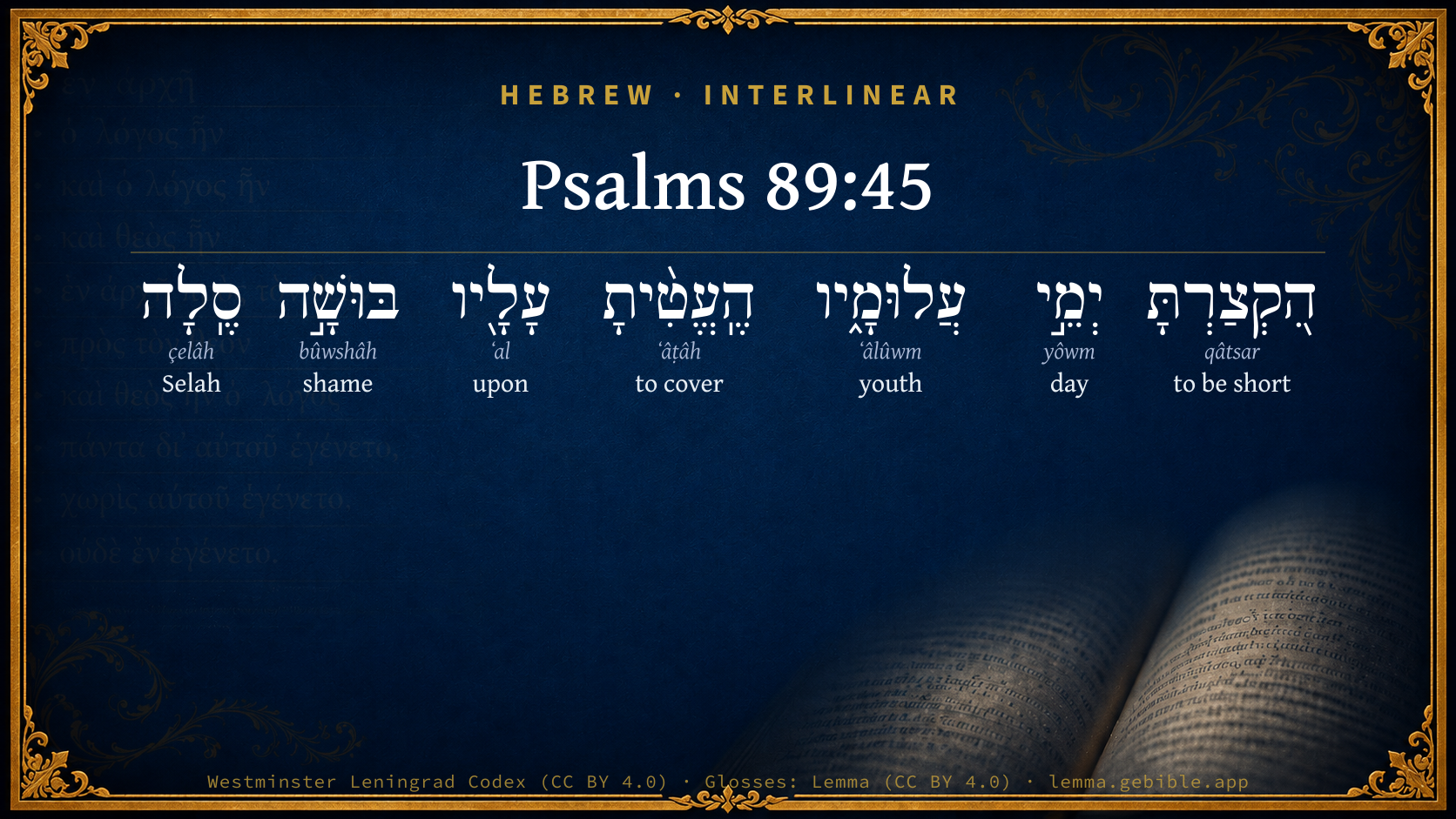
You have shortened the days of his youth. You have covered him with shame. Selah.
World English Bible · Public Domain
Highlights
  • 1 first appearance in the Hebrew Bible
Full analysis ↓
Download a study sheet

One document with this verse’s original text, its word-by-word gloss line, the meaning frame, cross-references with their text, attributed commentary, and full source and license credits — printable, and it pastes into notes with its structure intact.

This verse Autodidact and up

Study sheet (.html) Plain text (.txt)

A passage Seminary Student

Up to 50 verses in one chapter. A passage sheet keeps up to 6 commentary sources and 12 cross-references per verse, in the order this page ranks them, and says so on the sheet whenever that leaves anything out. Ask for a single verse and you get the Autodidact verse sheet above.

Everything on this page stays free to read, with no account — the sheet is a download of what is already on screen, not access to it.

Want to remove ads? Support Godless Engineer
Compare translations 3

The same verse in 3 English versions, stacked beneath the original-language interlinear above. Click any original word for its lexicon entry.

Each is an independent rendering of the whole verse — the interlinear is not word-aligned to these translations.

Highlighted words mark where these versions differ — a whole-verse word diff, not a word-by-word alignment.

  • World English Bible Public Domain
    You have shortened the days of his youth. You have covered him with shame. Selah.
  • King James Version Public Domain
    The days of his youth hast thou shortened: thou hast covered him with shame. Selah.
  • unfoldingWord Literal Text CC BY-SA 4.0
    You have shortened the days of his youth; you have covered him over with shame. Selah

unfoldingWord Literal Text — © unfoldingWord, licensed CC BY-SA 4.0. Word-aligned USFM3 via Door43 (git.door43.org/unfoldingWord/en_ult).

Versions to compare (up to 4)

3 of 4 selected

Show all 18 translations

Every available English version of this verse, each an independent rendering of the whole verse.

  • World English Bible Public Domain
    You have shortened the days of his youth. You have covered him with shame. Selah.
  • Berean Standard Bible Public Domain
    You have cut short the days of his youth; You have covered him with shame. Selah
  • Majority Standard Bible Public Domain
    You have cut short the days of his youth; You have covered him with shame. Selah
  • King James Version Public Domain
    The days of his youth hast thou shortened: thou hast covered him with shame. Selah.
  • American Standard Version (1901) Public Domain
    The days of his youth hast thou shortened: Thou hast covered him with shame. Selah
  • Revised Version (1885) Public Domain
    The days of his youth hast thou shortened: thou hast covered him with shame. Selah
  • Geneva Bible (1599) Public Domain
    The dayes of his youth hast thou shortned, and couered him with shame. Selah.
  • Douay-Rheims (1899) Public Domain
    Thou hast made his purification to cease: and thou hast cast his throne down to the ground.
  • Young's Literal Translation Public Domain
    Thou hast shortened the days of his youth, Hast covered him over `with' shame. Selah.
  • Literal Standard Version CC BY-SA 4.0
    You have shortened the days of his youth, || Have covered him over [with] shame. Selah.
  • Unlocked Literal Bible CC BY-SA 4.0
    You have shortened the days of his youth. You have covered him with shame. Selah
  • unfoldingWord Literal Text CC BY-SA 4.0
    You have shortened the days of his youth; you have covered him over with shame. Selah
  • Darby Bible Public Domain
    The days of his youth hast thou shortened; thou hast covered him with shame. Selah.
  • World Messianic Bible Public Domain
    You have shortened the days of his youth. You have covered him with shame. Selah.
  • Webster's Bible Public Domain
    \\89:44\\Thou hast made his glory to cease, and cast his throne down to the ground.
  • Free Bible Version CC BY-SA 4.0
    You have made him grow old before his time; you have totally humiliated him. Selah.
  • Bible in Basic English Public Domain
    You have made him old before his time; he is covered with shame. (Selah.)
  • JPS Tanakh (1917) Public Domain
    (89-46) The days of his youth hast Thou shortened; Thou hast covered him with shame. Selah

Literal Standard Version (2020), Covenant Press — licensed CC BY-SA 4.0. Text via the HelloAO Bible API (eBible.org). Unlocked Literal Bible (unfoldingWord) — licensed CC BY-SA 4.0. Text via the HelloAO Bible API (eBible.org). unfoldingWord Literal Text — © unfoldingWord, licensed CC BY-SA 4.0. Word-aligned USFM3 via Door43 (git.door43.org/unfoldingWord/en_ult). Free Bible Version, Dr. Jonathan Gallagher — licensed CC BY-SA 4.0. Text via the HelloAO Bible API (eBible.org).

Word by word

More ways to search: Search by grammar → Find every occurrence → Compare this word →

Practice this passage: Drill this verse → Learn its vocabulary →

About this verse

These counts appear in no published source. They are computed here, from the morphology-tagged text and Lemma’s own curated glosses. What Lemma adds →

7
words
7
distinct lemmas
Wisdom
section

Notable vocabulary

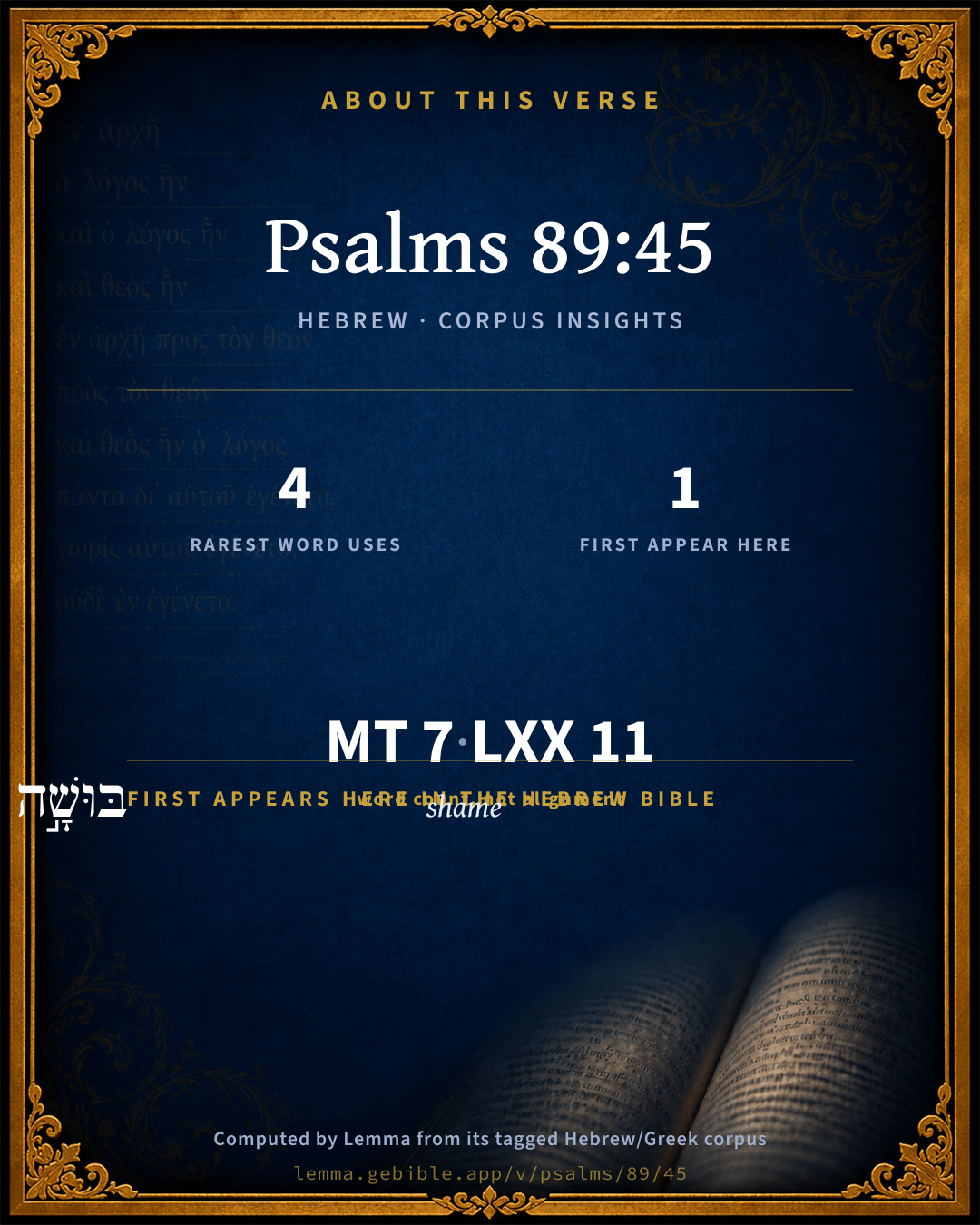
The rarest word here is בּוּשָׁ֣ה shame H955 — appearing just 4 times in the whole Hebrew Bible.

First appearance in Scripture

This word makes its first canonical appearance in the Hebrew Bible here:

  • בּוּשָׁ֣ה shame H955

Shared distinctive vocabulary

בּוּשָׁ֣ה shame H955 occurs in 4 verses of the Hebrew Bible. Also found in:

Grammatical profile

  • 2 verbs
  • 3 nouns
  • 1 preposition
  • 1 particle

Verb forms

  • הִ֭קְצַרְתָּ Hiphil · Perfect
  • הֶֽעֱטִ֨יתָ Hiphil · Perfect

Hebrew & Septuagint length

In English translation the verse runs 15 words from the Hebrew and 15 from the Septuagint (LXX English) — the same length.

A rough comparison of the two English renderings, which tokenize alike — not a word-level alignment.

Word counts can differ between the Hebrew and the Greek without any difference in meaning — e.g. the Hebrew direct-object marker אֵת has no separate Greek word, and Greek often adds the article ὁ.

In the original languages it is 7 Hebrew tokens and 11 Greek tokens — but the two are counted differently (Hebrew bundles its prefixes and suffixes into one token; the Greek is in lemma form), so that isn’t a like-for-like length.

Cross-references

8

Topical passages linked to Psalms 89:45 in the Treasury of Scripture Knowledge — connected by theme and wording, ordered by reader-vote popularity; previews shown in the World English Bible.

  • Psalms 109:29 Let my adversaries be clothed with dishonor. Let them cover themselves with their own shame as with a robe.
  • Psalms 44:15 All day long my dishonor is before me, And shame covers my face,
  • Psalms 102:23 He weakened my strength along the course. He shortened my days.
  • Micah 7:10 Then my enemy will see it, And shame will cover her who said to me, Where is Yahweh your God? Then my enemy will see me and will cover her shame. Now she will be trodden down like the mire of the streets.
  • 2 Chronicles 10:19 So Israel rebelled against the house of David to this day.
  • Psalms 71:13 Let my accusers be disappointed and consumed. Let them be covered with disgrace and scorn who want to harm me.
  • Psalms 89:28–29 I will keep my loving kindness for him forevermore. My covenant will stand firm with him.
  • Isaiah 63:18 Your holy people possessed [it] but a little while: our adversaries have trodden down your sanctuary.

Cross-references courtesy of OpenBible.info (CC BY 4.0).

Hebrew and Greek witnesses Masoretic Hebrew ↔ Greek Septuagint

The same verse in the two great witnesses to the Old Testament, shown verse-for-verse.

You’re reading Greek Psalm 88 (Hebrew Psalm 89). The Septuagint counts the superscription, so verse numbers can differ from the Hebrew — chapter-level alignment, not verse-by-verse. Numbering follows Rahlfs.

These are two independent witnesses, not word-aligned to each other, and the Septuagint is shown in lemma (dictionary) form.

Hebrew Psalms 89:45 Masoretic · Westminster Leningrad Codex

הִ֭קְצַרְתָּ יְמֵ֣י עֲלוּמָ֑יו הֶֽעֱטִ֨יתָ עָלָ֖יו בּוּשָׁ֣ה סֶֽלָה

You have shortened the days of his youth. You have covered him with shame. Selah.

World English Bible · Public Domain

Greek LXX Greek Psalm 88:45 Septuagint · lemma form

καταλύω ἀπό καθαρισμός αὐτός ὁ θρόνος αὐτός εἰς ὁ γῆ καταῥήγνυμι

You have shortened the days of his throne: you have poured shame upon him. Pause.

LXX2012 (modern English Septuagint) · Public Domain

Hebrew: Westminster Leningrad Codex (CC BY 4.0). Greek: Septuagint (public domain); English from LXX2012 (modern English Septuagint) (Public Domain). How the Septuagint differs from the Hebrew →

Commentary

Notes on Psalms 89:45 from classic Christian and Jewish commentators (each source and its license shown beneath its notes). The classic Christian expositions comment on the surrounding passage and are grouped to its opening verse, so a note may address several verses; the Jewish commentaries on the Tanakh (Rashi and others) are per-verse, so they appear only where the commentator wrote on this verse.

Lemma curates 59 commentaries, every one of them public domain or Creative Commons licensed, each selected and text-cleaned for this edition rather than reprinted as found. About our sources →

Trapp's Complete Commentary

John Trapp

Psa 89:45 The days of his youth hast thou shortened: thou hast covered him with shame. Selah.

Ver. 45. The days of his youth hast thou shortened] Thou hast nipped him in the bud, snatched him away by an untimely end, as a young man is sometimes in his prime and pride.

Thou hast covered him with shame. Selah] Thou hast wrapped him up in the winding sheet of shame. Lord, this is true.

John Trapp, A Commentary or Exposition upon All the Books of the Old and New Testament (1647–1656) — public domain. Text from a community e-Sword module.

J. A. Alexander on Psalms

Joseph Addison Alexander

46. (Psa 89:45) Thou hast shortened the days of his youth; thou hast covered him with shame. Selah. His youth, his youthful energy and vigour. See Job 33:25. Thou hast made him an object of contempt by cutting short his vigorous career and rendering him prematurely old. This may be said of certain individual kings, as well as of the kingdom when approaching its catastrophe. Covered him with shame, literally covered shame upon him, i.e. heaped it on him so as to cover him.

Joseph Addison Alexander, The Psalms Translated and Explained (1850) — public domain. Text from a community e-Sword module.

Geneva Bible (1599)

Geneva Bible translators

He showeth that the kingdom fell before it came to perfection, or was ripe.

Geneva Bible (1599) marginal notes — public domain. Text via Bolls.life.

Adam Clarke's Commentary

Verse 45. The days of his youth hast thou shortened] Our kings have not reigned half their days, nor lived out half their lives. The four last kings of Judea reigned but a short time, and either died by the sword or in captivity.

Jehoahaz reigned only three months, and was led captive to Egypt, where he died. Jehoiakim reigned only eleven years, and was tributary to the Chaldeans, who put him to death, and cast his body into the common sewer. Jehoiachin reigned three months and ten days, and was led captive to Babylon, where he continued in prison to the time of Evilmerodach, who, though he loosed him from prison, never invested him with any power. Zedekiah, the last of all, had reigned only eleven years when he was taken, his eyes put out, was loaded with chains, and thus carried to Babylon. Most of these kings died a violent and premature death. Thus the days of their youth-of their power, dignity, and life, were shortened, and they themselves covered with shame. Selah; so it most incontestably is.

Adam Clarke's Commentary on the Bible (1810–1826) — public domain. Text from a community e-Sword/MySword module.

John Calvin's Commentaries

45. Thou hast shortened the days of his youth. Some would explain this sentence as meaning, that God had weakened the king, so that he faded or withered away at his very entrance upon the flower of youth, and was exhausted with old age before reaching the period of manhood. This exposition may be regarded as not improbable; but still it is to be observed, in order to our having a clearer understanding of the mind of the prophet, that he does not speak exclusively of any one individual, but compares the state of the kingdom to the life of man. His complaint then amounts to this, That God caused the kingdom to wax old, and finally to decay, before it reached a state of complete maturity; its fate resembling that of a young man, who, while yet increasing in strength and vigor, is carried away by a violent death before his time. This similitude is highly appropriate; for the kingdom, if we compare the state of it at that period with the Divine promise, had scarce yet fully unfolded its blossom, when, amidst its first advances, suddenly smitten with a grievous decay, its freshness and beauty were defaced, while at length it vanished away. Moreover, what we have previously stated must be borne in mind, that when the prophet complains that the issue does not correspond with the promise, or is not such as the promise led the chosen people to expect, he does not, on that account, charge God with falsehood, but brings forward this apparent discrepancy for another purpose — to encourage himself, from the consideration of the Divine promises, to come to the throne of grace with the greater confidence and boldness; and, while he urged this difficulty before God, he was fully persuaded that it was impossible for Him not to show himself faithful to his word. As the majority of men drink up their sorrow and keep it to themselves, because they despair of deriving any benefit from prayer so true believers, the more frankly and familiarly they appeal to God in reference to his promises, the more valiantly do they wrestle against their distrust, and encourage themselves in the hope of a favorable issue.

John Calvin's Commentaries (1540-1563) — public domain. Text from the Calvin Translation Society English edition (1840s-50s) via the Christian Classics Ethereal Library (ccel.org). Calvin's coverage is partial (roughly two-thirds of the Bible); uncommented books and verses are honest gaps, never fabricated. The 19th-century editor's footnotes and remarks are omitted so the notes are faithfully Calvin's own voice.

The Cambridge Bible for Schools and Colleges

gen. ed. J. J. S. Perowne

45. He is prematurely old. Cp. Psa_102:23. The words might be figuratively applied to the nation (Hos_7:9), or to the kingdom, prematurely brought to an end: but it is more natural to regard them as referring to the king himself. Jehoiachin was but 18 (2Ki_24:8), or according to 2Ch_36:9, only 8 years old, when he came to the throne, and he reigned only three months and ten days. The prime of his life was spent in exile, apparently in actual confinement in which he was literally ‘clothed with dishonour’ (2Ki_25:29).

The Cambridge Bible for Schools and Colleges (gen. ed. J. J. S. Perowne; Cambridge University Press, 1878–1918) — public domain. Text from a community e-Sword module.

John Gill's Exposition

How long, Lord, wilt thou hide thyself? for ever?.... When God hides his face front his people, though it is but for a little while, it seems long, and a kind of an eternity to them; and so it seemed to the man Christ Jesus; and indeed what he endured, when his Father hid his face from him, was of the same kind with an eternal absence; see Psa 13:1,

shall thy wrath burn like fire? it did so when Christ bore the sins of his people, and all the punishment due unto them; when his strength was dried up like a potsherd; when he, the antitype of the passover lamb roasted with fire, was sacrificed for us; all which is entirely consistent with God's everlasting and invariable love to him, as his own Son. See Gill on Psa 89:38.

John Gill's Exposition of the Whole Bible (1746–1763) — public domain (CC PDM 1.0). Text via the HelloAO Bible API.

Albert Barnes' Notes on the Bible

The days of his youth hast thou shortened - This does not mean that he had shortened his life, but that he had abbreviated the period of his vigor, his hope, and his prosperity; instead of lengthening out these, and prolonging them into advancing years, he had by calamities, disappointments, reverses, and troubles, as it were, abridged them. No such youthful vigor, no such youthful hope now remained. The feelings of age - the cutting off from the world - had come suddenly upon him, even before he had reached the season when this might be expected to occur. Though at a time of life and in circumstances when he might have hoped for a longer continuance of that youthful vigor, he had suddenly been brought into the sad condition of an old man.

Thou hast covered him with shame - Hast clothed him with shame or disgrace. Everything in his circumstances and in his appearance indicates shame and disgrace, and the divine displeasure.

Albert Barnes' Notes on the Bible (1834–1885) — public domain. Text from a community e-Sword/MySword module.

Matthew Poole's English Annotations

The youthful and flourishing estate of David’s kingdom was very short, and reached not beyond his next successor, and it hath been languishing by degrees till this time, when it seems to be dead and buried.

Matthew Poole's English Annotations on the Holy Bible (1683–1685) — public domain. Text from a community e-Sword/MySword module.

The Treasury of David

Charles H. Spurgeon

Ver. 45. The days of his youth hast thou shortened. The time of the king's energy was brief, he grew feeble before his time.

Thou hast covered him with shame. Shame was heaped upon him because of his premature decay and his failure in arms. This was very grievous to the writer of this Psalm, who was evidently a most loyal adherent of the house of David. In this our day we have to bemoan the lack of vigour in religionthe heroic days of Christianity are over, her raven locks are sprinkled with untimely grey. Is this according to the covenant? Can this be as the Lord has promised? Let us plead with the righteous Judge of all the earth, and beseech him to fulfil his word wherein he has promised that those who wait upon him shall renew their strength.

Selah. The interceding poet takes breath amid his lament, and then turns from describing the sorrows of the kingdom to pleading with the Lord.

Ver. 45. The days of his youth hast thou shortened. Our kings have not reigned half their days, nor lived out half their lives. The four last kings of Judea reigned but a short time, and either died by the sword or in captivity. Jehoahaz reigned only three months, and was led captive to Egypt, where he died. Jehoiakim reigned only eleven years, and was tributary to the Chaldeans, who put him to death, and cast his body into the common sewer. Jehoiachim, reigned three months and ten days, and was led captive to Babylon, where he continued in prison to the time of Evil merodach, who, though he loosed him from prison, never invested him with any power. Zedekiah, the last of all, had reigned only eleven years when he was taken, his eyes put out, was loaded with chains, and thus carried to Babylon. Most of these kings died a violent and premature death. Thus the "days of their youth" of their power, dignity, and life, "were shortened", and they themselves covered with shame. Selah; so it most incontestably is. Adam Clarke.

Ver. 45. Thou hast covered them with shame. Selah. Thou hast wrapped him up in the winding sheet of shame. Lord, this is true. John Trapp.

Ver. 45. The excellence of the first days of Christianity, and in what respect their glory has departed from us.

Psalms 89:46*

Charles H. Spurgeon's The Treasury of David (1869–1885) — public domain. Psalms only. Text from a community e-Sword/MySword module.

Whedon's Commentary on the Bible

Daniel D. Whedon

45. Days of his youth hast thou shortened—Contrast Psalm 4:29-36. In fine, every specification of the covenant seems annulled by the present disastrous state of the nation.

Daniel D. Whedon (gen. ed.), Commentary on the Old and New Testaments (1874–1909) — public domain. Text from a community e-Sword module.

The Pulpit Commentary

The days of his youth hast thou shortened. This does not seem to mean an actual cutting short by death (since the Davidical king has been spoken of as alive in vers. 38, 41, 43), but rather a cutting short of youthful energy and vigour, a premature senescence, such as may well have fallen upon Jehoiachin or Zedekiah. Thou hast covered him with shame; or, "heaped shame upon him him up with shame." The phrase would suit Jehoiachin, who was kept in prison by Nebuchadnezzar, and in "prison garments", (2Ki_25:29) for the space of thirty-five years.

The Pulpit Commentary (1880–1919), ed. H.D.M. Spence-Jones & Joseph S. Exell — public domain. Text from a community e-Sword module.

John Wesley's Explanatory Notes

Youth - The youthful and flourishing estate of David's kingdom was very short, and reached not beyond his next successor.

John Wesley, Explanatory Notes Upon the Whole Bible (1754–1765) — public domain. Text via the GEBible commentary corpus.

Rashi

Rabbi Shlomo Yitzchaki (Rashi)

You have brought an end to his shining Heb. מטהרו, his shining, as צהרים, noon, is translated טהרא, and like (Exod. 24:10): “and like the appearance of the heaven for splendor (לטהר).”

You have cast down to the earth Heb. מגרת. You have humbled and destroyed. Every expression of bending down is, in Targum Jonathan, מגר.

Rashi on the Tanakh — English translations: “The Judaica Press complete Tanach with Rashi, translated by A. J. Rosenberg” (CC BY 4.0); “Pentateuch with Rashi's commentary by M. Rosenbaum and A.M. Silbermann, 1929-1934” (public domain); “The Metsudah Tanach series, Lakewood, N.J” (CC BY 4.0); and “The Book of Joshua, Metsudah Publications, 1997” (CC BY 4.0). Text via Sefaria.

Lesson kit

Teaching starters — assembled from the data on this page, not authored interpretation. Every prompt links to the verse data it draws on. Edit before teaching.

Psalms, in the Wisdom, opens this verse with 7 words (7 distinct Hebrew lemmas). Its most distinctive word is bûwshâh (“shame”). A historical commentator’s framing appears above. Read the whole chapter for the surrounding context.

Discussion questions

  1. How does “shame” (bûwshâh) shape what this verse is saying?
  2. The word “shame” first appears here in Scripture. What is being introduced at this debut?
  3. Ezekiel 7:18 shares the word «shame» with this verse. How do the two illuminate each other?
  4. These translations render this verse differently. What is at stake in choosing one wording over another?
  5. The verb «הִ֭קְצַרְתָּ» is Hiphil Perfect. How does its form color the action?
  6. Reading how Trapp's Complete Commentary and J. A. Alexander on Psalms read this verse, where do the two commentators agree and where do they part?

Things to notice

Reading settings

Reading text

Shown beneath each verse's original-language words.

Old Testament
Old Testament edition

Read the OT as the Masoretic Hebrew (MT) or the Greek Septuagint (LXX).

English shown for the Greek Septuagint (in the Hebrew ↔ Greek comparison).

Comparing translations? Open the Compare panel on any verse page to stack up to four side by side.