
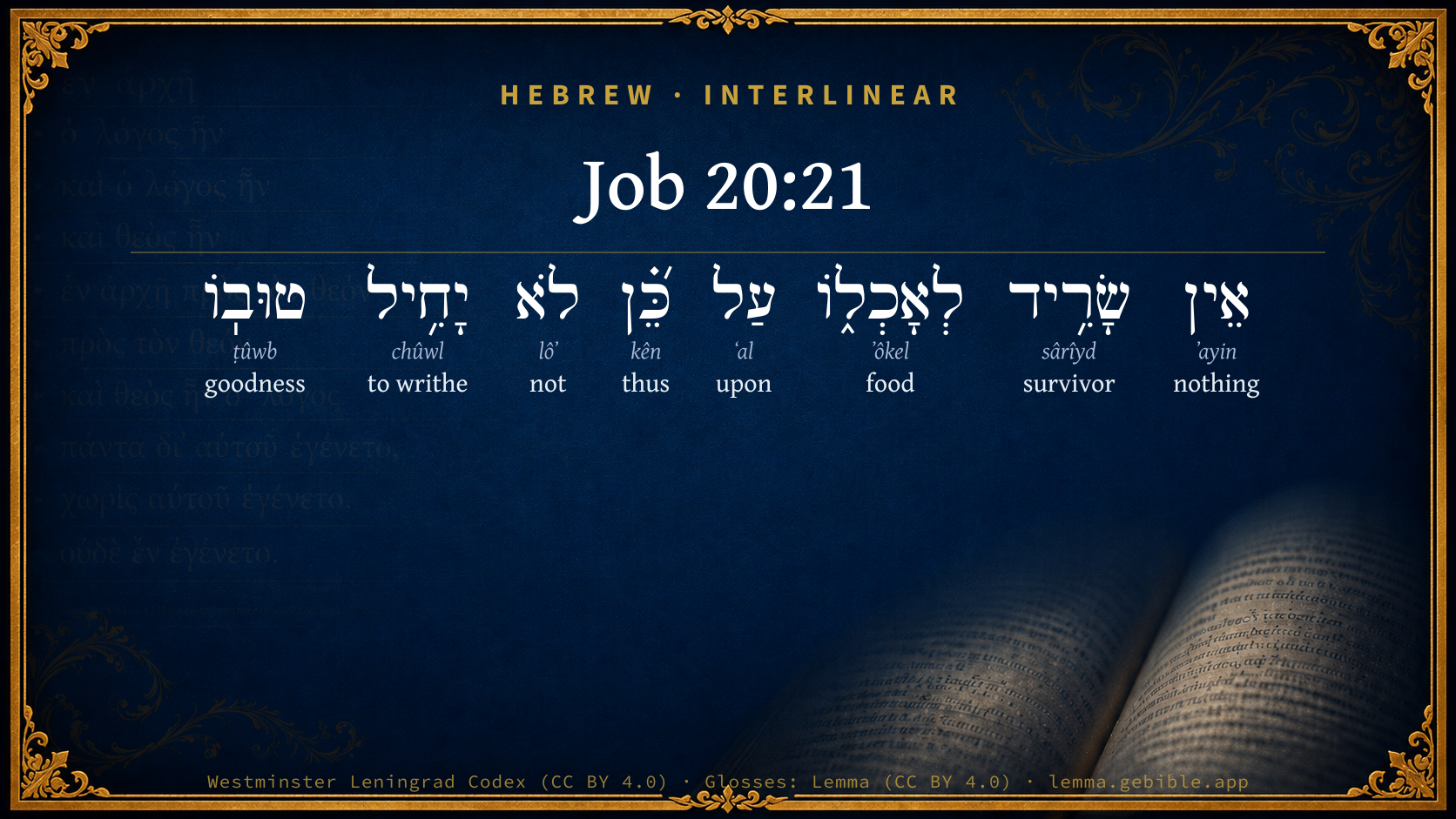
Job 20:21

Hebrew (Westminster Leningrad Codex) Job 20:21 appears in the Hebrew Old Testament. The text above is from the Westminster Leningrad Codex. Each word links to its Strong’s number, a concise gloss, and parsing drawn from the Open Scriptures Hebrew Bible morphology. Click any word for its full Brown-Driver-Briggs (BDB) entry.
Download image
Cite this verse

Job 20:21 (World English Bible). Public Domain. Lemma interlinear Bible study tool, https://lemma.gebible.app/v/job/20/21.

Show BibTeX & RIS
BibTeX
RIS
English Translation
There was nothing left that he didn't devour, Therefore his prosperity shall not endure.
World English Bible · Public Domain
Download a study sheet

One document with this verse’s original text, its word-by-word gloss line, the meaning frame, cross-references with their text, attributed commentary, and full source and license credits — printable, and it pastes into notes with its structure intact.

This verse Autodidact and up

Study sheet (.html) Plain text (.txt)

A passage Seminary Student

Up to 50 verses in one chapter. A passage sheet keeps up to 6 commentary sources and 12 cross-references per verse, in the order this page ranks them, and says so on the sheet whenever that leaves anything out. Ask for a single verse and you get the Autodidact verse sheet above.

Everything on this page stays free to read, with no account — the sheet is a download of what is already on screen, not access to it.

Want to remove ads? Support Godless Engineer
Compare translations 3

The same verse in 3 English versions, stacked beneath the original-language interlinear above. Click any original word for its lexicon entry.

Each is an independent rendering of the whole verse — the interlinear is not word-aligned to these translations.

Highlighted words mark where these versions differ — a whole-verse word diff, not a word-by-word alignment.

  • World English Bible Public Domain
    There was nothing left that he didn't devour, Therefore his prosperity shall not endure.
  • King James Version Public Domain
    There shall none of his meat be left; therefore shall no man look for his goods.
  • unfoldingWord Literal Text CC BY-SA 4.0
    There is no remnant for his eating; therefore his prosperity does not endure.

unfoldingWord Literal Text — © unfoldingWord, licensed CC BY-SA 4.0. Word-aligned USFM3 via Door43 (git.door43.org/unfoldingWord/en_ult).

Versions to compare (up to 4)

3 of 4 selected

Show all 18 translations

Every available English version of this verse, each an independent rendering of the whole verse.

  • World English Bible Public Domain
    There was nothing left that he didn't devour, Therefore his prosperity shall not endure.
  • Berean Standard Bible Public Domain
    Nothing is left for him to consume; thus his prosperity will not endure.
  • Majority Standard Bible Public Domain
    Nothing is left for him to consume; thus his prosperity will not endure.
  • King James Version Public Domain
    There shall none of his meat be left; therefore shall no man look for his goods.
  • American Standard Version (1901) Public Domain
    There was nothing left that he devoured not; Therefore his prosperity shall not endure.
  • Revised Version (1885) Public Domain
    There was nothing left that he devoured not; therefore his prosperity shall not endure.
  • Geneva Bible (1599) Public Domain
    There shall none of his meate bee left: therefore none shall hope for his goods.
  • Douay-Rheims (1899) Public Domain
    There was nothing left of his meat, and therefore nothing shall continue of his goods:
  • Young's Literal Translation Public Domain
    There is not a remnant to his food, Therefore his good doth not stay.
  • Literal Standard Version CC BY-SA 4.0
    There is not a remnant to his food, || Therefore his good does not stay.
  • Unlocked Literal Bible CC BY-SA 4.0
    There is nothing left that he did not devour; therefore his prosperity will not be permanent.
  • unfoldingWord Literal Text CC BY-SA 4.0
    There is no remnant for his eating; therefore his prosperity does not endure.
  • Darby Bible Public Domain
    Nothing escaped his greediness; therefore his prosperity shall not endure.
  • World Messianic Bible Public Domain
    There was nothing left that he didn’t devour, therefore his prosperity will not endure.
  • Webster's Bible Public Domain
    There shall none of his food be left; therefore shall no man look for his goods.
  • Free Bible Version CC BY-SA 4.0
    Nothing escapes their ravenous appetites, so their happiness doesn't last long.
  • Bible in Basic English Public Domain
    He had never enough for his desire; for this cause his well-being will quickly come to an end.
  • JPS Tanakh (1917) Public Domain
    There was nothing left that he devoured not — therefore his prosperity shall not endure.

Literal Standard Version (2020), Covenant Press — licensed CC BY-SA 4.0. Text via the HelloAO Bible API (eBible.org). Unlocked Literal Bible (unfoldingWord) — licensed CC BY-SA 4.0. Text via the HelloAO Bible API (eBible.org). unfoldingWord Literal Text — © unfoldingWord, licensed CC BY-SA 4.0. Word-aligned USFM3 via Door43 (git.door43.org/unfoldingWord/en_ult). Free Bible Version, Dr. Jonathan Gallagher — licensed CC BY-SA 4.0. Text via the HelloAO Bible API (eBible.org).

Word by word

More ways to search: Search by grammar → Find every occurrence → Compare this word →

Practice this passage: Drill this verse → Learn its vocabulary →

About this verse

These counts appear in no published source. They are computed here, from the morphology-tagged text and Lemma’s own curated glosses. What Lemma adds →

8
words
8
distinct lemmas
Wisdom
section

Shared distinctive vocabulary

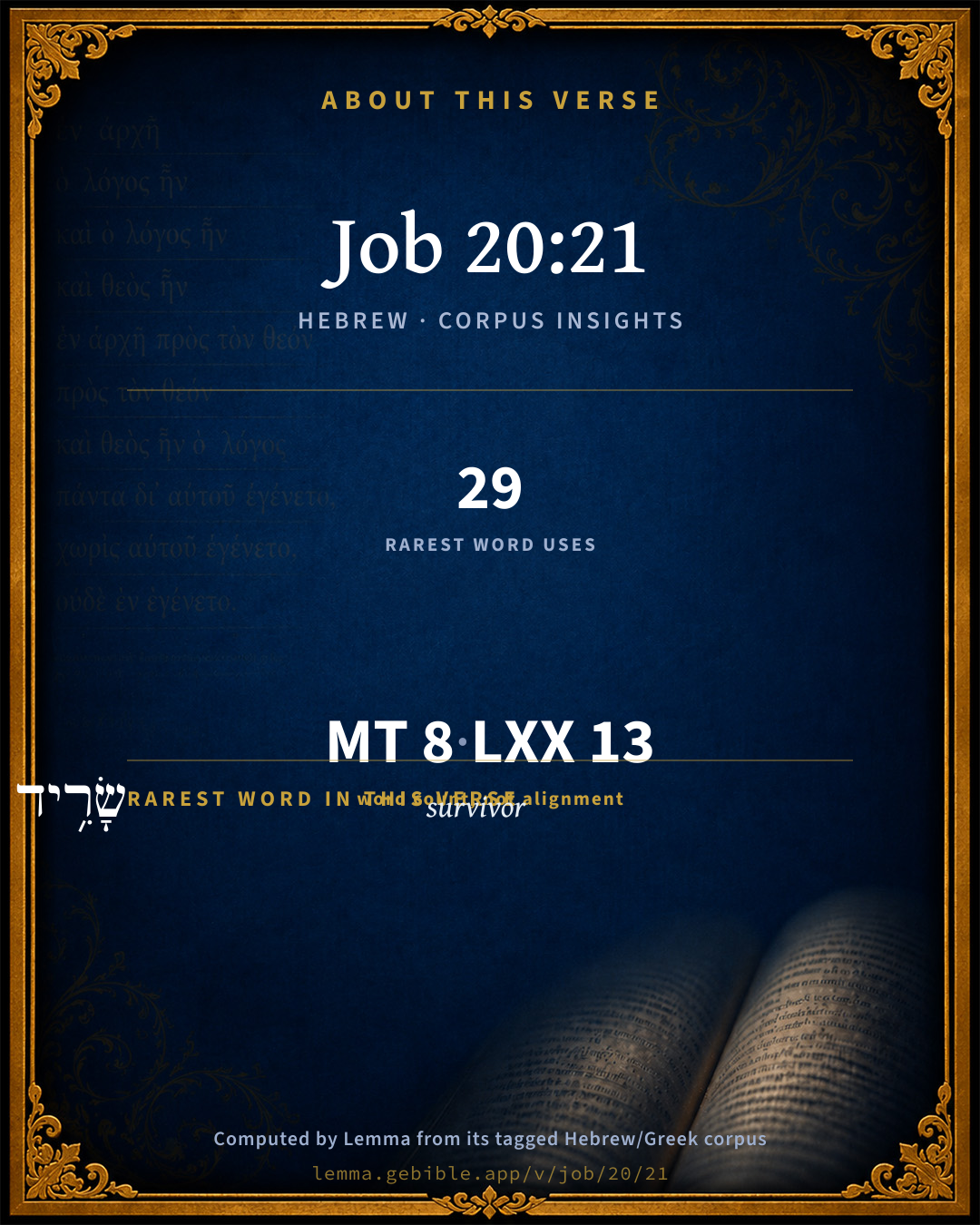
שָׂרִ֥יד survivor H8300 occurs in 28 verses of the Hebrew Bible. Also found in:

Grammatical profile

  • 2 verbs
  • 2 nouns
  • 1 preposition
  • 3 particles

Verb forms

  • לְאָכְל֑וֹ Qal · Infinitive Construct
  • יָחִ֥יל Qal · Imperfect

Hebrew & Septuagint length

In English translation the verse runs 14 words from the Hebrew and 13 from the Septuagint (LXX English) — closely comparable.

A rough comparison of the two English renderings, which tokenize alike — not a word-level alignment.

Word counts can differ between the Hebrew and the Greek without any difference in meaning — e.g. the Hebrew direct-object marker אֵת has no separate Greek word, and Greek often adds the article ὁ.

In the original languages it is 8 Hebrew tokens and 13 Greek tokens — but the two are counted differently (Hebrew bundles its prefixes and suffixes into one token; the Greek is in lemma form), so that isn’t a like-for-like length.

Cross-references

4

Topical passages linked to Job 20:21 in the Treasury of Scripture Knowledge — connected by theme and wording, ordered by reader-vote popularity; previews shown in the World English Bible.

  • Job 15:29 He shall not be rich, neither shall his substance continue, Neither shall their possessions be extended on the earth.
  • Job 18:19 He shall have neither son nor grandson among his people, Nor any remaining where he sojourned.
  • Jeremiah 17:11 As the partridge that sits on [eggs] which she has not laid, so is he who gets riches, and not by right; in the midst of his days they shall leave him, and at his end he shall be a fool.
  • Luke 16:24–25 He cried and said, 'Father Abraham, have mercy on me, and send Lazarus, that he may dip the tip of his finger in water, and cool my tongue! For I am in anguish in this flame.'

Cross-references courtesy of OpenBible.info (CC BY 4.0).

Hebrew and Greek witnesses Masoretic Hebrew ↔ Greek Septuagint

The same verse in the two great witnesses to the Old Testament, shown verse-for-verse.

These are two independent witnesses, not word-aligned to each other, and the Septuagint is shown in lemma (dictionary) form.

Hebrew Job 20:21 Masoretic · Westminster Leningrad Codex

אֵין שָׂרִ֥יד לְאָכְל֑וֹ עַל כֵּ֝֗ן לֹא יָחִ֥יל טוּבֽוֹ

There was nothing left that he didn't devour, Therefore his prosperity shall not endure.

World English Bible · Public Domain

Greek LXX Job 20:21 Septuagint · lemma form

οὐ εἰμί ὑπόλειμμα ὁ βρῶμα αὐτός διά οὗτος οὐ ἀνθέω αὐτός ὁ ἀγαθός

There is nothing remaining of his provisions; therefore his goods shall not flourish.

LXX2012 (modern English Septuagint) · Public Domain

On this verse, Keil & Delitzsch discusses the Septuagint’s reading. Read the note in Commentary ↓

Hebrew: Westminster Leningrad Codex (CC BY 4.0). Greek: Septuagint (public domain); English from LXX2012 (modern English Septuagint) (Public Domain). How the Septuagint differs from the Hebrew →

Commentary

Notes on Job 20:21 from classic Christian and Jewish commentators (each source and its license shown beneath its notes). The classic Christian expositions comment on the surrounding passage and are grouped to its opening verse, so a note may address several verses; the Jewish commentaries on the Tanakh (Rashi and others) are per-verse, so they appear only where the commentator wrote on this verse.

Lemma curates 59 commentaries, every one of them public domain or Creative Commons licensed, each selected and text-cleaned for this edition rather than reprinted as found. About our sources →

Trapp's Complete Commentary

John Trapp

Job 20:21 There shall none of his meat be left; therefore shall no man look for his goods.

Ver. 21. There shall none of his meat be left] Zophar still pursueth the allegory of the belly; and in all striketh at poor Job, who had scarce a bit of bread to eat, but yet was not without the hidden manna, the feast of a good conscience, which made him say with Luther, Manducato pane hic vivamus, &c., Let us take up with coarse fare here, since we have better within, and better yet we shall have in heaven; in our Father’s house is bread enough, &c.

Therefore no man shall look for his goods] Heb. His goods, or goodness. It was well said, that he that first called riches Bona, goods, was a better husband than divine. But it may be thought that the most are such husbands. The common cry is, "Who will show us any good?" The Lord answereth, Exo 33:19, "I will make all my good pass before thee, and I will proclaim the name of the Lord before thee." The prophet answereth, Mic 6:8, "He hath showed thee, O man, what is good," viz. to do justly; and to love mercy, and to walk humbly with thy God. But most men are of his mind who said, He that will not venture his body will never be valiant, and he that will not venture his soul will never be rich (Nevessan). But what saith the prophet? He that getteth riches, and not by right, shall die a poor fool, Jer 17:11. And what saith Zophar here? He shall die a plain beggar, and leave no estate worth the looking after or suing for; this does not always happen, but ως επι το πολυ, many times it doth, as is easily to be observed.

John Trapp, A Commentary or Exposition upon All the Books of the Old and New Testament (1647–1656) — public domain. Text from a community e-Sword module.

Joseph Benson's Commentary

Job 20:21-22. There shall none of his meat be left, &c. — For his future use; but he shall be stripped of all, which being publicly known, none of his kindred or friends shall trouble themselves to seek for any relics of his estate. But the Hebrew, אין שׁריד לאכלו, een shorid leachlo, rather means, There shall none be left for his meat, that is, he shall leave no heir who shall possess or enjoy his goods. In the fulness of his sufficiency, &c. — In the height of his prosperity he shall be distressed. Every hand of the wicked shall be upon him — So his wickedness shall be punished by those as wicked as himself.

Joseph Benson's Commentary on the Old and New Testaments (1811–1818) — public domain. Text from a community e-Sword module.

Keil & Delitzsch

C. F. Keil & F. Delitzsch

21 Nothing escaped his covetousness,

Therefore his prosperity shall not continue.

22 In the fulness of his need it shall be strait with him,

Every hand of the needy shall come upon him.

23 It shall come to pass: in order to fill his belly,

He sendeth forth the glow of His anger into him,

And He causeth it to rain upon him into his flesh.

24 He must flee from an iron weapon,

Therefore a brazen bow pierceth him through.

25 It teareth, then it cometh forth out of his body,

And the steel out of his gall,

The terrors of death come upon him.

The words of Job 20:21 are: there was nothing that escaped (שׂריד, as Job 18:19, from שׂרד, Arab. šarada, aufugere) his eating (from אכל, not from אכל), i.e., he devoured everything without sparing, even to the last remnant; therefore טוּבו, his prosperity, his abundant wealth, will not continue or hold out (יחיל, as Psa 10:5, to be solid, powerful, enduring, whence חיל, Arab. ȟı̂lat, ḥawl). Hupf. transl. differently: nihil ei superstes ad vescendum, itaque non durant ejus bona; but שׂריד signifies first elapsum, and על־כן propterea; and we may retain these first significations, especially since Job 20:21 is not future like Job 20:21. The tone of prediction taken up in Job 20:21 is continued in what follows. The inf. constr. מלאות (prop. מלאות, but with Cholem by the Aleph, since the Waw is regarded as יתיר, superfluous), formed after the manner of the verbs Lamed He (Ew. 238, c), is written like קראות, Jdg 8:1 (comp. on the other hand the scriptio devectiva, Lev 8:33; Lev 12:4); and שׂפקו (with Sin, as Norzi decides after Codd., Kimchi, and Farisol, not Samech) is to be derived from שׂפק (ספק), sufficientia (comp. the verb, Kg1 20:10): if his sufficiency exists in abundance, not from שׂפק = Arab. safqat, ṣafqat, complosio, according to which Schultens explains: if his joyous clapping of hands has reached its highest point (Elizabeth Smith: "while clapping the hands in the fulness of joy"), to which מלאות is not suitable, and which ought at least to be שׁפק כּפּיו. Therefore: in the fulness of his need shall he be straitened (יצר with the tone drawn back for יצר on account of the following monosyllable, although also apocopated futt. follow further on in the strict future signification, according to poetic usage), by which not merely the fearful foreboding is meant, which just in the fullest overflow makes known his impending lot, but the real calamity, into which his towering prosperity suddenly changes, as Job 20:22 shows: All the hands of the destitute come upon him (בּוא seq. acc.: invadere) to avenge on him the injustice done to the needy. It is not necessary to understand merely such as he has made destitute, it is כּל־יד; the assertion is therefore general: the rich uncompassionate man becomes a defenceless prey of the proletaries.

Job 20:23

The יהי which opens this verse (and which also occurs elsewhere, e.g., Job 18:12, in a purely future signification), here, like ויהי, Sa2 5:24 (Ew. 333, b), serves to introduce the following ישׁלּח (it shall happen: He shall send forth); ויהי (e.g., Gen 40:1) frequent in the historical style, and והיה in the prophetical, are similarly used. In order to fill his belly, which is insatiable, God will send forth against him His glowing wrath (comp. Lam 1:13, from on high hath He sent fire into my bones), and will rain upon him into his flesh, or his plumpness (Arab. fi lachmihi). Thus we believe בּלחוּמו must be understood by referring to Zep 1:17; where, perhaps not without reference to this speech of Zophar, the כּגּללים, which serves to explain Job 20:7, coincides with וּלחמּם, which serves to explain this בלחומו; and the right meaning is not even missed by the lxx, which translates καὶ τὰς σάρκας αὐτῶν ὡς βόλβιτα.

(Note: This passage is translated: and their blood is poured forth as dust, i.e., useless rubbish (Arab. el-ghabra אלעברה), and their flesh as filth. The form of inflection לחמּם is referable to לחם after the form לאם.)

A suitable thought is obtained if לחוּם is taken in the signification, food: He will rain upon him his food, i.e., what is fit for him (with Beth of the instrument instead of the accusative of the object), or: He will rain down (His wrath) upon him as his food (with Beth essent., according to which Ew.: what can satisfy him; Bridel: pour son aliment; Renan: en guise de pain); but we give the preference to the other interpretation, because it is at once natural in this book, abounding in Arabisms, to suppose for לחום the signification of the Arab. laḥm, which is also supported in Hebrew by Zep 1:17; further, because the Targ. favours it, which transl. בּשׁלדיהּ, and expositors, as Aben-Ezra and Ralbag, who interpret by בבשׂרו; finally, because it gives an appropriate idea, to which Lam 1:13 presents a commendable parallel, comp. also Jam 5:3, and Koran, Sur. 2, 169: "those who hide what God has sent down by the Scripture, and thereby obtain a small profit, eat only fire into their belly." That עלימו can be used pathetically for עליו is unmistakeably clear from Job 22:2, comp. Job 27:23, and on Psa 11:7; the morally indignant speech which threatens punishment, intentionally seeks after rare solemn words and darksome tones. Therefore: Upon his flesh, which has been nourished in unsympathizing greediness, God rains down, i.e., rain of fire, which scorches it. This is the hidden background of the lot of punishment, the active principle of which, though it be effected by human agency, is the punitive power of the fire of divine wrath. Job 20:24 describe, by illustration, how it is worked out. The evil-doer flees from a hostile superior power, is hit in the back by the enemy's arrows; and since he, one who is overthrown, seeks to get free from them, he is made to feel the terrors of inevitably approaching death.

Job 20:24

The two futt. may be arranged as in a conditional clause, like Psa 91:7, comp. Amo 9:2-4; and this is, as it seems, the mutual relation of the two expressions designed by the poet (similar to Isa 24:18): if he flee from the weapons of iron, i.e., the deadly weapon in the thick of the fight, he succumbs to that which is destructive by and by: the bow of brass (נחוּשׁה poet. for נחשׁת, as Psa 18:35, although it might also be an adj., since eth, as the Arab. qaws shows, is really a feminine termination) will pierce him through (fut. Kal of חלף, Arab. chlf, to press further and further, press after, here as in Jdg 5:26). The flight of the disheartened is a punishment which is completed by his being hit while fleeing by the arrow which the brazen bow sends with swift power after him. In Job 20:25 the Targ. reads מגּוהּ with He mappic., and translates: he (the enemy, or God) draws (stringit), and it (the sword) comes out of its sheath, which is to be rejected because גּו cannot signify vagina. Kimchi and most Jewish expositors interpret מגּוה by מגּוּף; the lxx also translates it σῶμα. To understand it according to גּו (back), of the hinder part of the body, gives no suitable sense, since the evil-doer is imagined as hit in the back, the arrow consequently passing out at the front;

(Note: Thus sings the warrior Cana'an Tjr (died about 1815) after the loss of his wife: -

"My grief for her is the brief of him whose horse is dashed in pieces in the desert.

The way is wild, and there is no help from the travellers who have hurried on before.

My groaning is like the groaning of one who, mortally wounded between the shoulders,

Will flee, and trails after him the lance that is fastened in him."

- Wetzst.)

whereas the signification body is suitable, and is also made sufficiently certain by the cognate form גּויּה. The verb שׁלף, however, is used as in Jdg 3:22 : he who is hit drawn the arrow out, then it comes out of his body, into which it is driven deep; and the glance, i.e., the metal head of the arrow (like להב, Jdg 3:22, the point in distinction from the shaft), out of his gall (מררה = מררה, Job 16:13, so called from its bitterness, as χολή, χόλος, comp. χλόος, χλωρός, from the green-yellow colour), since, as the Syriac version freely translates, his gall-bladder is burst.

(Note: Abulwalid (in Kimchi) understands the red gall, i.e., the gall-bladder, by מרורה, after the Arabic marâre. If this is pierced, its contents are emptied into the lower part of the body, and the man dies.)

Is יהלך, as a parallel word to ויּצא, to be connected with ממררתו, or with what follows? The accentuation varies. The ordinary interpunction is וברק with Dech, ממררתו Mercha, or more correctly Mercha-Zinnorith, יהלך Rebia mugrasch (according to which, Ew., Umbr., Vaih., Welte, Hahn, Schlottm., and Olsh. divide); ממררתו is, however, also found with Athnach. Although the latter mode of accentuation is only feebly supported, we nevertheless consider it as the more correct, for עליו אמים, in the mind of the poet, can hardly have formed a line of the verse. If, however, יהלך עליו אמים is now taken together, it is a matter for inquiry whether it is to be explained: he passes away, since terrors come upon him (Schult., Rosenm., Hirz., Von Gerl., Carey), or: terrors come upon him (lxx, Targ., Syr., Jer., Ramban). We consider the latter as the only correct interpretation; for if יהלך ought to be understood after Job 14:20; Job 16:22, the poet would have expressed himself ambiguously, since it is at least as natural to consider אמים as the subject of יהלך, as to take עליו אמים as an adverbial clause. The former, however, is both natural according to the syntax (vid., Ges. 147, a) and suitable in matter: terrors (i.e., of certain death to him in a short time) draw on upon him, and accordingly we decide in its favour.

Keil & Delitzsch — Biblical Commentary on the Old Testament (1861–1891) — public domain (CC PDM 1.0). Text via the HelloAO Bible API. (Old Testament only.)

Geneva Bible (1599)

Geneva Bible translators

He shall leave nothing to his posterity.

Geneva Bible (1599) marginal notes — public domain. Text via Bolls.life.

Jamieson, Fausset & Brown

Robert Jamieson, A. R. Fausset & David Brown

look for--rather, "because his goods," that is, prosperity shall have no endurance.

Jamieson, Fausset & Brown — Commentary Critical and Explanatory on the Whole Bible (1871) — public domain (CC PDM 1.0). Text via the HelloAO Bible API.

Adam Clarke's Commentary

Verse 21. There shall none of his meat be left] Coverdale translates thus: He devoured so gredily, that he left nothinge behynde, therefore his goodes shal not prospere. He shall be stripped of every thing.

Adam Clarke's Commentary on the Bible (1810–1826) — public domain. Text from a community e-Sword/MySword module.

Ellicott's Commentary for English Readers

(21) There shall none of his meat be left.—Rather, There was nothing left that he devoured not, therefore his prosperity shall not endure.

A Bible Commentary for English Readers, edited by Charles John Ellicott (1878–1897) — public domain. Text from a community e-Sword module.

The Cambridge Bible for Schools and Colleges

gen. ed. J. J. S. Perowne

21. his goods] This may mean his prosperity. In all these verses the retribution corresponds to the sin—the insatiable greediness is recompensed by utter loss and want.

The Cambridge Bible for Schools and Colleges (gen. ed. J. J. S. Perowne; Cambridge University Press, 1878–1918) — public domain. Text from a community e-Sword module.

John Gill's Exposition

There shall none of his meat be left,.... Not in his belly, all shall be cast up; none of his substance left for himself or others; none of his riches for his children or heirs, all being consumed: or this may respect either the profuseness or niggardliness of his living, that he should live in great luxury himself, but take no care of the poor; or else keep so mean a table, that there would be nothing left for the poor, not so much as a few crumbs to fall from it; but the first sense seems best; though some render the words, "there shall be none left for his meat" (b), or his substance; he shall leave no children, have no heirs, all his family shall be cut off, see Job 18:19;

therefore shall no man look for his goods; for there shall be none to look for them; or rather there shall be none to look for, all being gone: a man in good circumstances of life, his heirs expect to enjoy much at his death, but when he is stripped of all, as Job was, his relations and friends are in no expectation of having anything at his death; and therefore do not think it worth their while to look out, or make an inquiry whether there is anything for them or not, see Job 20:28.

(b) "non erit superstes haeres qui ejus bonis fruetur"; so some in Mercer. Drusius.

John Gill's Exposition of the Whole Bible (1746–1763) — public domain (CC PDM 1.0). Text via the HelloAO Bible API.

Albert Barnes' Notes on the Bible

“There shall none of his meat be left Margin, “or, be none left for his meat.” Noyes renders it, “Because nothing escaped his greatness.” Prof. Lee, “no surviver shall remain for his provision.” But the meaning, probably, is, nothing shall remain of his food, or it shall all be wasted, or dissipated.

Therefore, shall no man look for his goods - Or rather, his goods or his property shall not endure. But a great variety of interpretations has been given to the passage. The Hebrew word rendered “shall look,” יחיל yāchı̂yl, is from חוּל chûl, which means, “to turn round, to twist, to whirl;” and thence, arises the notion of being firm, stable, or strong - as a rope that is twisted is strong. That is the idea here; and the sense is, that his property should not be secure or firm; or that he should not prosper. Jerome renders it, “Nothing shall remain of his goods.” The Septuagint, “Therefore his good things - αὐτοῦ τὰ ἀγκθά autou ta agatha - shall not flourish” - ἀνθήσει anthēsei.

Albert Barnes' Notes on the Bible (1834–1885) — public domain. Text from a community e-Sword/MySword module.

Haydock's Catholic Bible Commentary

Continue. Hebrew, "no one shall look for his goods." The sinner eat up all in his life-time, or saw his possessions slip from him. (Haydock) --- At least, he shall not take them with him to the grave. (Calmet)

George Leo Haydock (1774–1849), Haydock's Catholic Family Bible and Commentary, 1859 edition — public domain. Excludes Psalms (Douay-Rheims chapter numbering differs from Protestant) and Deuterocanonical books (Catholic canon only).

Matthew Poole's English Annotations

None of his meat be left for his own future use; but he shall be stripped of all.

Therefore shall no man look for his goods; it being publicly known and observed that he was totally ruined, none of his kindred or friends shall trouble themselves to seek for any relics of his estate, as is usually done after men’s deaths. But this verse is and may be rendered otherwise, There shall none be left for his meat, (i.e. he shall leave no heir who shall possess or enjoy his goods,) because, (for so the Hebrew particle al-chen is oft used; as Gen 38:26; Num 14:13; Psa 42:7; Jer 48:36) none of his goods shall remain, either for his heir or any other; all shall be utterly lost.

Matthew Poole's English Annotations on the Holy Bible (1683–1685) — public domain. Text from a community e-Sword/MySword module.

Whedon's Commentary on the Bible

Daniel D. Whedon

21. His goods — Nothing escaped his devouring. Therefore his good, שׂוב, shall not endure. “By the word good is intended his summum bonum, or what seemed such to the bad man. It sounds like a sentence of judgment after the arraignment in the previous items.” — Tayler Lewis. Kindred is the expression of Milton’s fallen angel: —

“Evil, be thou my good.”

Daniel D. Whedon (gen. ed.), Commentary on the Old and New Testaments (1874–1909) — public domain. Text from a community e-Sword module.

The Pulpit Commentary

There shall none of his meat be left; rather, there was nothing left that he detoured not, or nothing remained over from his eating (Schultens). Scarcely intended literally, as Canon Cook supposes. Rather said in reference to the wicked man"s persistent oppression and robbery of the poor, the needy, and the powerless. (comp. vers. 19, 20; and note our Lord"s words, "Ye devour widows" houses," Mat_23:14) Therefore shall no man look for his goods. This is an impossible rendering. Translate, with Rosenmuller, Canon Cook, Stanley Leathes, and our Revisers, therefore his prosperity shall not endure. In other words, a Nemesis shall overtake him. For his oppression and cruelty he shall be visited by the Divine auger; a sudden end shall be made of his prosperity, and he shall fall into penury and misfortune. Covert allusion is, no doubt, intended to Job"s sudden loss of his extraordinary prosperity by the series of calamities so graphically portrayed in Job_1:13-19.

Vers. 21-26. Disappointment to the wicked.

Even when all promises well to the wicked, evil shall lurk under cover of the seeming prosperity. When he is about to satisfy himself, suddenly he shall be in straits. His hopes shall be blasted, his strong confidence disappointed. With a singular cluster of strong figures Zophar depicts the unsatisfying position of the wicked man. He is in the midst of enemies. Every source of help and joy seems to fail him.

I HE FINDS NO HELP IN MAN. "Every hand of the wicked shall come upon him." Even they of his own way of thinking disappoint him. They turn upon him. An ungodly man can have no true confidence in his ungodly associates. Evil in them enables them to detect evil in him. The spirit which they know within themselves to be wrong and untrustworthy, unkind and evil-plotting, they know w be the same in him.

II HE FINDS NO HELP IN GOD. "When he is about to fill his belly, God shall cast the fury of his wrath upon him." The wicked, so long as he continues wicked, has nothing to hope for from God. It was the joyful boast of one assailed on every hand, "If God be for us, who can be against us?" So if God be "against" a man, of what avail is it that any are "for" him? God is the best of friends, the most mighty of enemies. Not that in the Divine heart are any sentiments of enmity against the children of men, but men turn blessings into curses by the way they use them- So men make an enemy of their best Friend.

III HE FINDS NO HELP IN CIRCUMSTANCES. The iron weapon which he might have grasped he shall flee from; and the bow of steel which he might have drawn shall strike him through. "Terrors" seize him, "darkness" hides in his secret places, "a fire not blown" consumes him. He is encompassed by foes. All things are against him. Though he prosper, yet "in the fulness of his sufficiency he shall be in straits." "This is the portion of the wicked man from God, and the heritage appointed unto him by God R.G.

The Pulpit Commentary (1880–1919), ed. H.D.M. Spence-Jones & Joseph S. Exell — public domain. Text from a community e-Sword module.

John Wesley's Explanatory Notes

Therefore - It being publickly known that he was totally ruined, none of his kindred shall trouble themselves about any relicks of his estate.

John Wesley, Explanatory Notes Upon the Whole Bible (1754–1765) — public domain. Text via the GEBible commentary corpus.

Rashi

Rabbi Shlomo Yitzchaki (Rashi)

Nothing remains of his food He left nothing over from his food to share with the poor.

therefore his goods shall not prosper Heb. יחיל, shall not prosper, as in (Ps. 10:5), “His ways prosper (יחילו).” He speaks of the people of Sodom, who were stingy with travelers, for so did Ezekiel testify (16:49) concerning Sodom: “proud with plenty of food etc. and yet, she did not strengthen the hand of the poor and needy.” And our Sages explained (Sanh. 92a) אין שריד לאכלוֹ to mean that he did not allow Torah scholars to sit at his table, like (Joel 3:5): “and among the survivors whom the Lord calls.”

Rashi on the Tanakh — English translations: “The Judaica Press complete Tanach with Rashi, translated by A. J. Rosenberg” (CC BY 4.0); “Pentateuch with Rashi's commentary by M. Rosenbaum and A.M. Silbermann, 1929-1934” (public domain); “The Metsudah Tanach series, Lakewood, N.J” (CC BY 4.0); and “The Book of Joshua, Metsudah Publications, 1997” (CC BY 4.0). Text via Sefaria.

Lesson kit

Teaching starters — assembled from the data on this page, not authored interpretation. Every prompt links to the verse data it draws on. Edit before teaching.

Job, in the Wisdom, opens this verse with 8 words (8 distinct Hebrew lemmas). Its most distinctive word is sârîyd (“survivor”). A historical commentator’s framing appears above. Read the whole chapter for the surrounding context.

Discussion questions

  1. What does “survivor” (sârîyd) contribute to the verse as a whole?
  2. Numbers 21:35 shares the word «survivor» with this verse. How do the two illuminate each other?
  3. These translations render this verse differently. What is at stake in choosing one wording over another?
  4. The verb «לְאָכְל֑וֹ» is Qal Infinitive Construct. How does its form color the action?
  5. Reading how Trapp's Complete Commentary and Joseph Benson's Commentary read this verse, where do the two commentators agree and where do they part?

Things to notice

Reading settings

Reading text

Shown beneath each verse's original-language words.

Old Testament
Old Testament edition

Read the OT as the Masoretic Hebrew (MT) or the Greek Septuagint (LXX).

English shown for the Greek Septuagint (in the Hebrew ↔ Greek comparison).

Comparing translations? Open the Compare panel on any verse page to stack up to four side by side.