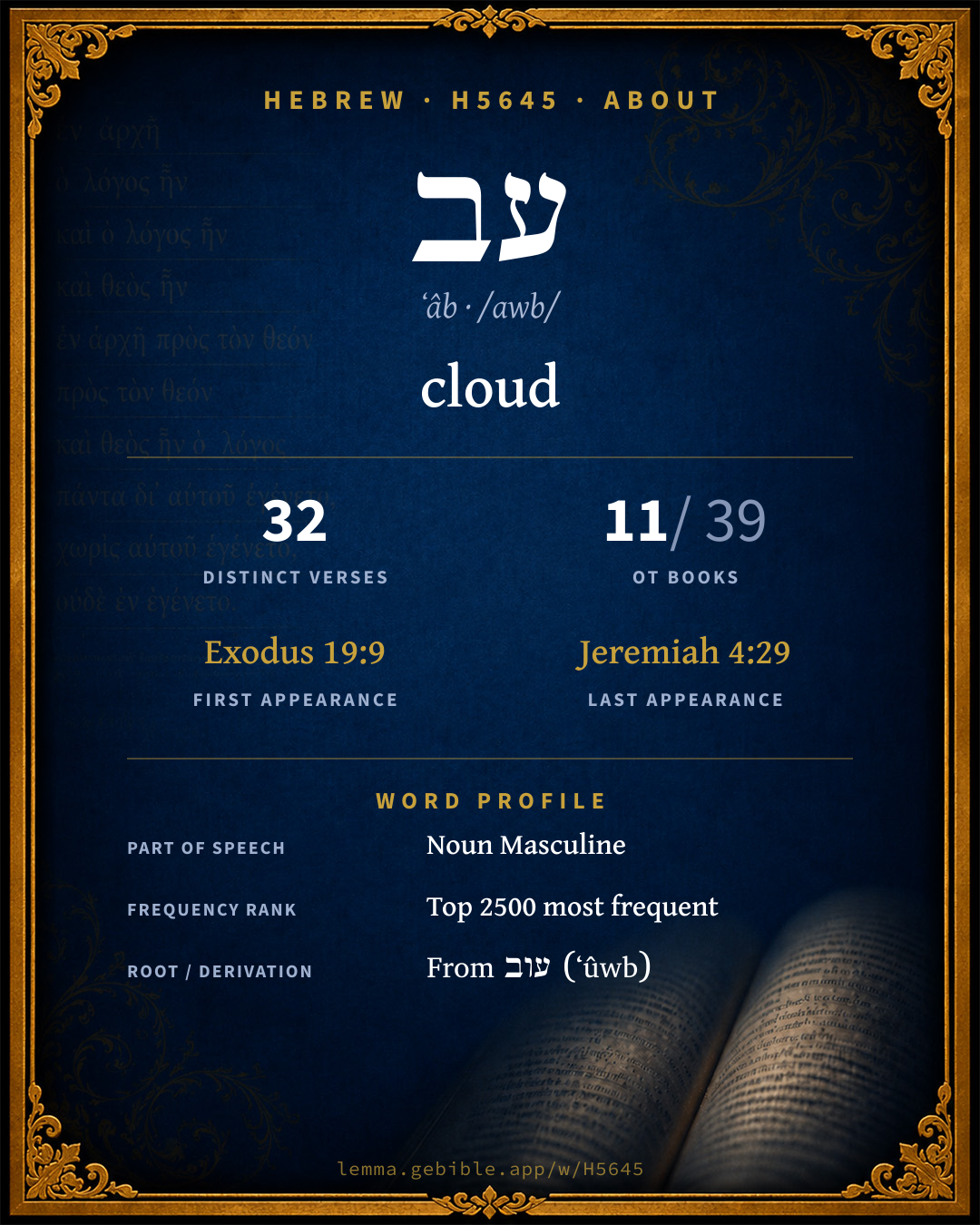
עָב
cloud
also: darkness, thicket fuller range ↓
Full lexicon entry — Brown-Driver-Briggs (BDB)
From Brown-Driver-Briggs (BDB)
Where this word appears
See every Absolute-state word in the Hebrew Bible →
Grammar key — what these labels mean
Part of speech
- Noun
- A naming word — a person, place, thing, or idea.
Noun type
- Common
- A common noun — a general class of person, place, or thing (“king,” “city,” “water”), not a specific name.
State
- Absolute
- The independent form of a noun, not bound to a following word.
- Construct
- A noun bound to a following noun in a possessive / “of” relationship (the construct chain).
Gender
- Both
- Attested as both masculine and feminine.
Number
- Singular
- One.
- Plural
- More than one (in Hebrew, generally three or more).
Grammatical forms
- Noun, Common, Both, Singular, Absolute 12 times (38%)
- Noun, Common, Both, Plural, Absolute 12 times (38%)
- Noun, Common, Both, Singular, Construct 4 times (13%)
- Noun, Common, Both, Plural, Construct 4 times (13%)
Parsed forms decoded from the imported morphology (morphhb / Westminster Leningrad Codex — WLC text public domain, morphhb tagging CC BY 4.0), counted across 32 parsed occurrences — not distinct verses.
Every verse where H5645 appears — 32 distinct verses across 11 books. Click any verse to open its interlinear word-by-word view. Verse text shown in the World English Bible for context — . Each verse’s Hebrew form is shown with its reference; the English is not keyword-highlighted, since the data carries no word-level English alignment. Use “Compare translations” on any verse to read it across multiple English versions. This concordance covers the Hebrew Bible; Septuagint (Greek Old Testament) occurrences are not indexed here.
Exodus 1 verse
Judges 1 verse
2 Samuel 2 verses
- 2 Samuel 22:12 עָבֵ֥י n c bp cs He made darkness pavilions round about him, Gathering of waters, thick clouds of the skies.
- 2 Samuel 23:4 עָב֔וֹת n c bp [He shall be] as the light of the morning, when the sun rises, A morning without clouds, [When] the tender grass [springs] out of the earth, Through clear shining after rain.
1 Kings 2 verses
- 1 Kings 18:44 עָ֛ב n c bs It happened at the seventh time, that he said, "Behold, a small cloud, like a man's hand, is rising out of the sea." He said, Go up, tell Ahab, Make ready [your chariot], and get you down, that the rain not stop you.
- 1 Kings 18:45 עָבִ֣ים n c bp It happened in a little while, that the sky grew black with clouds and wind, and there was a great rain. Ahab rode, and went to Jezreel:
2 Chronicles 1 verse
Job 8 verses
- Job 20:6 לָ/עָ֥ב prep det + n c bs Though his height mount up to the heavens, And his head reach to the clouds,
- Job 22:14 עָבִ֣ים n c bp Thick clouds are a covering to him, so that he doesn't see. He walks on the vault of the sky.'
- Job 26:8 בְּ/עָבָ֑י/ו prep + n c bp cs + sfx pers 3ms He binds up the waters in his thick clouds, And the cloud is not burst under them.
- Job 30:15 וּ֝/כְ/עָ֗ב conj + prep + n c bs Terrors are turned on me. They chase my honor as the wind. My welfare has passed away as a cloud.
- Job 36:29 עָ֑ב n c bs Yes, can any understand the spreading of the clouds, And the thunderings of his pavilion?
- Job 37:11 עָ֑ב n c bs Yes, he loads the thick cloud with moisture. He spreads abroad the cloud of his lightning.
- Job 37:16 עָ֑ב n c bs Do you know the workings of the clouds, The wondrous works of him who is perfect in knowledge?
- Job 38:34 לָ/עָ֣ב prep det + n c bs "Can you lift up your voice to the clouds, That abundance of waters may cover you?
Psalms 5 verses
- Psalms 18:11 עָבֵ֥י n c bp cs He made darkness his hiding-place, his pavilion around him, Darkness of waters, thick clouds of the skies.
- Psalms 18:12 עָבָ֥י/ו n c bp cs + sfx pers 3ms At the brightness before him his thick clouds passed, Hailstones and coals of fire.
- Psalms 77:17 עָב֗וֹת n c bp The clouds poured out water. The skies resounded with thunder. Your arrows also flashed around.
- Psalms 104:3 עָבִ֥ים n c bp He lays the beams of his chambers in the waters. He makes the clouds his chariot. He walks on the wings of the wind.
- Psalms 147:8 בְּ/עָבִ֗ים prep + n c bp Who covers the sky with clouds, Who prepares rain for the earth, Who makes grass grow on the mountains.
Proverbs 1 verse
Ecclesiastes 3 verses
- Ecclesiastes 11:3 הֶ/עָבִ֥ים ptcl def.art + n c bp If the clouds are full of rain, they empty themselves on the earth; And if a tree falls toward the south, or toward the north, In the place where the tree falls, there shall it be.
- Ecclesiastes 11:4 בֶ/עָבִ֖ים prep det + n c bp He who observes the wind won't sow; And he who regards the clouds won't reap.
- Ecclesiastes 12:2 הֶ/עָבִ֖ים ptcl def.art + n c bp Before the sun, the light, the moon, and the stars are darkened, And the clouds return after the rain;
Isaiah 7 verses
- Isaiah 5:6 הֶ/עָבִים֙ ptcl def.art + n c bp I will lay it a wasteland. It won't be pruned nor hoed, But it will grow briers and thorns. I will also command the clouds that they rain no rain on it."
- Isaiah 14:14 עָ֑ב n c bs I will ascend above the heights of the clouds; I will make myself like the Most High.
- Isaiah 18:4 כְּ/עָ֥ב prep + n c bs cs For thus has Yahweh said to me, I will be still, and I will see in my dwelling-place, like clear heat in sunshine, like a cloud of dew in the heat of harvest.
- Isaiah 19:1 עָ֥ב n c bs The burden of Egypt. Behold, Yahweh rides on a swift cloud, and comes to Egypt: and the idols of Egypt shall tremble at his presence; and the heart of Egypt shall melt in the midst of it.
- Isaiah 25:5 עָ֔ב n c bs As the heat in a dry place will you bring down the noise of strangers; as the heat by the shade of a cloud, the song of the awesome ones shall be brought low.
- Isaiah 44:22 כָ/עָב֙ prep det + n c bs I have blotted out, as a thick cloud, your transgressions, and, as a cloud, your sins: return to me; for I have redeemed you.
- Isaiah 60:8 כָּ/עָ֣ב prep det + n c bs Who are these who fly as a cloud, and as the doves to their windows?
Jeremiah 1 verse
About this entry
At a glance — auto-summarized from this page’s data, not written by a person. Every figure links to its source below. This summary describes the numbers; it doesn’t interpret them.
The Hebrew noun עב centers on the idea of “cloud.” Alongside “cloud” the lexicon also lists “darkness” and “thicket” — part of its full sense range. The Hebrew Bible uses it across 32 verses — moderately common. Job dominates its distribution — 8 of 32 verses. Its earliest occurrence is Exodus 19:9. For the data behind this summary, explore the sense tree and the renderings breakdown below.
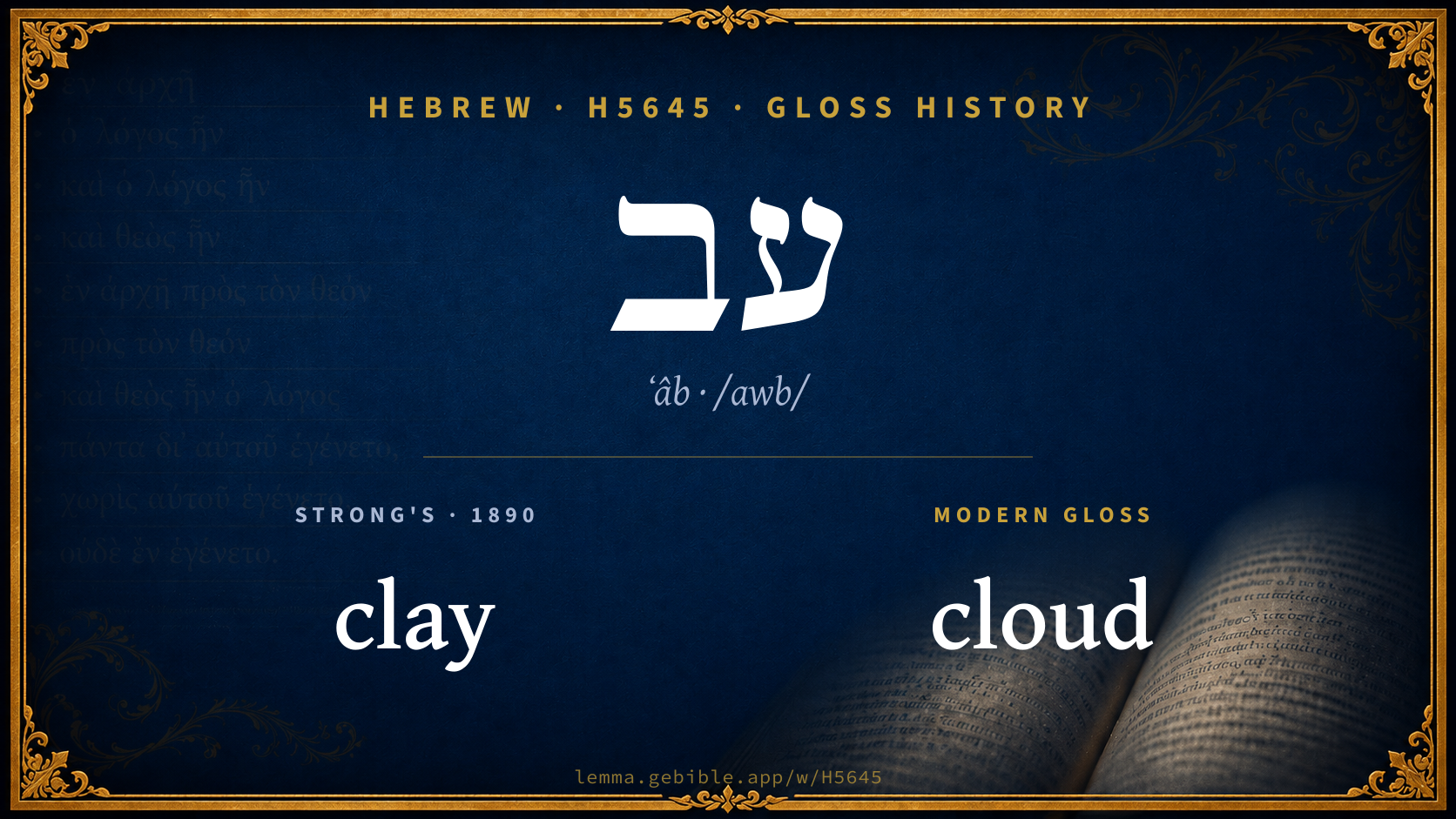
Gloss history
Strong's 1890 vs modern scholarship
About this word
Strong's H5645 catalogs a Hebrew word from the Hebrew Old Testament.
These counts are not copied from any lexicon or concordance. They are computed here, from the morphology-tagged Hebrew Old Testament. What Lemma adds →
- 32
- distinct verses
- The word appears in 32 distinct verses.
- 11 / 39
- OT books
- The word appears in 11 of 39 Old Testament books.
- #1,086
- by frequency
- Top 2500 most frequent Hebrew words (rank 1,086 of 8,640 Hebrew words by occurrence).
View all 32 occurrences in the concordance →
By section of the Old Testament
By traditional corpus
Conventional, traditional groupings — biblical authorship is debated, so this is a traditional corpus grouping, not an authorship claim. Each share is this word’s portion of its verses in that division of the Hebrew canon. Each figure is a share of the word’s 32 distinct verses.
- Writings (Ketuvim) 18 verses · 56%
- Prophets (Nevi'im) 13 verses · 41%
- Torah (Pentateuch) 1 verse · 3%
How translations render this word
Counts come from each version’s own published word-to-Strong’s tagging or interlinear alignment — an approximate guide to how each version renders this word, not a word-level alignment the data otherwise carries. Because each total is that version’s own tagged count, the per-version totals vary from one another and need not match the appearance or distinct-verse counts above. These counts may also differ from a printed concordance because Lemma counts each distinctly tagged rendering and does not collapse phrase taggings into a single head-word total. This is a fixed set of word-tagged versions (KJV, ASV, BSB, ULT) and does not change with the reading translation you choose elsewhere. Each version’s license is shown beside its name below (and on Sources).
BDB lists this Strong’s number as 2 distinct words (homographs). Each count above pools all of them and is not split by sense — see the Senses section below. A low-frequency rendering may belong to a different one of those words, not the primary meaning.
- King James Version†: Clouds 15×, Cloud 5×, Thick clouds 4×
- American Standard Version†: Clouds 14×, Cloud 4×, Thick clouds 4×
- Berean Standard Bible†: Clouds 17×, Cloud 3×, Like a cloud 3×
- unfoldingWord Literal Text†: Clouds 10×, Cloud 8×, Like a cloud 3×
King James Version Public Domain
Renders H5645 across 32† tagged occurrences — most commonly:
Plus 6 renderings that appear only once — usually multi-word phrases or single function words the recovered tagging swept in, not distinct renderings.
American Standard Version Public Domain
Renders H5645 across 33† tagged occurrences — most commonly:
Plus 11 renderings that appear only once — usually multi-word phrases or single function words the recovered tagging swept in, not distinct renderings.
Berean Standard Bible Public Domain
Renders H5645 across 30† tagged occurrences — most commonly:
Plus 5 renderings that appear only once — usually multi-word phrases or single function words the recovered tagging swept in, not distinct renderings. Not rendered by a distinct English word in 1 further occurrence.
unfoldingWord Literal Text CC BY-SA 4.0
Renders H5645 across 36† tagged occurrences — most commonly:
Plus 9 renderings that appear only once — usually multi-word phrases or single function words the recovered tagging swept in, not distinct renderings.
8 senses and sub-senses in the full BDB
What do BDB’s symbols mean?
BDB uses these scholarly abbreviations:
| Symbol | Meaning |
|---|---|
| 𝔊 | the Septuagint (the ancient Greek translation, LXX) |
| 𝔙 | the Vulgate (the Latin translation) |
| 𝔖 | the Syriac version (the Peshitta) |
| 𝔗 | the Targum (the Aramaic translation) |
| ψ | the Psalms |
| √ | root (the underlying root or stem) |
| ‖ | parallel passage (a synonymous or contrasted parallel) |
| † | the dagger: every passage where the word occurs is cited |
The 8 senses and sub-senses the full Brown-Driver-Briggs lexicon distinguishes for this word, in lexicon order (not ranked by frequency), with BDB’s own verbatim wording and sub-sense lettering. Shown in Hebrew script with BDB’s own scholarly abbreviations. The condensed entry is in the Lexicon Entry tab. See also the Forms in the corpus table below.
עב I [עֹב] n.m. archit. term, meaning unknown
עב II Is 19, 1 and (1 K 18
- 1. dark cloud:
- a. rain-cloud Ju 5:4; Is 5:6; 1 K 18:44, 45 + 9 times. e.g. Judges 5:4
- b. as high Is 14:14 Jb 20:6, + Ez 19:11; 31:3, 10, 14 (reading עָבוֹת, v. עֲבֹת). e.g. Isaiah 14:14
- c. chariot of י׳ Is 19:1 ψ 104:3; covering his eyes Jb 22:14. e.g. Isaiah 19:1
- d. casting shadow Is 25:5, cf. 2 S 23:4. e.g. Isaiah 25:5
- e. as swift Is 60:8, and transient 44:22; Jb 30:15 (all sim.). f. disposed by God Jb 36:29; 37:16. g. ע׳ טַל Is 18:4 cloud of dew, dew-mist (sim.). e.g. Isaiah 60:8
- 2. (cloud-) mass, ע׳ שְׁחָקִים 2 S 22:12 masses of clouds (enwrapping י׳) = ψ 18:12 (v 13 v. supr.). e.g. 2 Samuel 22:12
- 3. thicket as refuge Je 4:29 (perhaps under Aramaic influence).—עַב Ex 19:9 v. עֲבִי sub עבה. 1. עָב v. p. 712 supr. e.g. Jeremiah 4:29
Senses from the full Brown-Driver-Briggs lexicon (Brown, Driver, Briggs; Oxford 1906 — public domain), digitized via Sefaria, supplemented by the OpenScriptures HebrewLexicon (CC BY 4.0). Full attribution on Sources.
Word origin
I. [עֹב] n.m. archit. term, meaning unknown; projecting roof is conjectured (Sm Co Berthol); others landing (Da); AV RV thick beam or plank, RVm threshold; Benz Kit Toy leave untranslated; in any case a structure of wood;—abs. וְעַסֻּדִים וְעָב 1 K 7:6; appar. cstr. וְעָב עֵץ אֶל־פְּנֵי הָאוּלָם מֵהַחוּץ Ez 41:25; pl. (si vera l.) הָעֻבִּים v 26.
III. n.m. Is 19, 1 and (1 K 18:44 KöSynt. 163) f. dark cloud, cloud-mass, thicket;—ע׳ abs. 1 K 18:44 +, cstr. Is 18:4; Pr 16:15; pl. עָבִים Ju 5:4 +, עָבוֹת 2 S 23:4 ψ 77:18; cstr. עָבֵי 2 S 22:12 ψ 18:12; sf. עָבָיו ψ 18:13 (but prob. del., v. עבר Qal ad fin.);—
— Brown-Driver-Briggs (Oxford 1906, public domain), digitized via Sefaria, supplemented by the OpenScriptures HebrewLexicon (CC BY 4.0). See Sources.
Derived from עוב (ʻûwb) (H5743) — to becloud.
Jastrow Dictionary
A second Hebrew/Aramaic lexicon for comparison, covering Aramaic and post-biblical (Talmudic, Targumic, Midrashic) usage that the biblical-Hebrew BDB does not. Matched by lemma rather than by Strong’s number, so a lemma may carry more than one Jastrow headword (shown separately below), and the entries cover usage well beyond the Bible.
עָב I
- (עָבַב) thick, dense, large. Men. III, 2, v. בְּלִילָה. Pes. 36ᵇ sq.; Bets. 22ᵇ אין אופין פת ע׳ וכ׳ you must not bake thick bread on the Passover; וכמה פת ע׳ טפח and how high must it be to be called thick bread? One handbreadth; ib. (Rabbi’s interpret.) פת מרובה a large batch; a. fr.—Pl. עָבִים, עָבִין; עָבוֹת. Tosef. Kel. B. Bath. V, 11 אלו הן הע׳ these are the thick (heavy) garments; Kel. XXVIII, 8; Y. Sabb. II, 4ᵈ bot. הע׳ הרכים the thick but soft garments. Mikv. VIII, 3 טפין ע׳ thick (turbid) drops; a. fr.—[Y. Kil. V, beg. 29ᵈ היו עבות, ed. Krot. העבות, R. S. to Kil. V, 1 היו עבים, read: הֶעֱבוּ, v. עָבָה.]
עָב II
- preced.) [thick,] dark cloud. Gen. R. s. 13 עב שהוא מעבב וכ׳ the cloud is called ʿab, because it makes the sky look thick (dark); Yalk. ib. 20; Y. Taan. III, 66ᶜ שהוא מעבה את הרקיע; a. e.—Pl. עָבִים. Taan. 3ᵇ הע׳ והרוחות שניות למטר the clouded sky and the winds are (as blessings) secondary only to the rain. Ib. 20ᵃ נתקשרו שמים בע׳ the sky became covered with clouds. Ib. נתפזרו הע׳ the clouds dispersed; a. e.
עֹב
- , v. עוֹב
A Dictionary of the Targumim, the Talmud Babli and Yerushalmi, and the Midrashic Literature (Marcus Jastrow; London, Luzac, 1903) — Public Domain. Digitized via Sefaria. Digitized via Sefaria. Full attribution on Sources.
Forms in the corpus
The 27 distinct written forms H5645 takes in the Hebrew Bible, most frequent first — each parse links to that state’s occurrences in the concordance. Hebrew forms include their vowel points and cantillation, so a single lemma takes many written forms.
Septuagint verse parallels
This word appears in 32 verses that also exist in the Greek Old Testament (Septuagint), out of the 32 Hebrew verses it occurs in. You can read those verses in Greek by switching the Old Testament edition to the Septuagint.
Read these verses in the Septuagint
- Exodus 19:9
- Judges 5:4
- 2 Samuel 22:12
- 1 Kings 18:44
- 2 Chronicles 4:17
- Job 20:6
- Psalms 18:11
- Proverbs 16:15
- Ecclesiastes 11:3
- Isaiah 5:6
- Jeremiah 4:29
This is a verse-level parallel only — the same verses exist in both the Hebrew and Greek Old Testaments. No word-level Hebrew↔Greek correspondence is claimed: the data carries no such alignment, so no Greek word is shown as this Hebrew word’s translation. Coverage is not total — the Septuagint omits the deuterocanon and renumbers the Psalms, so some Hebrew verses have no direct Greek parallel.