
Deuteronomy 6:16

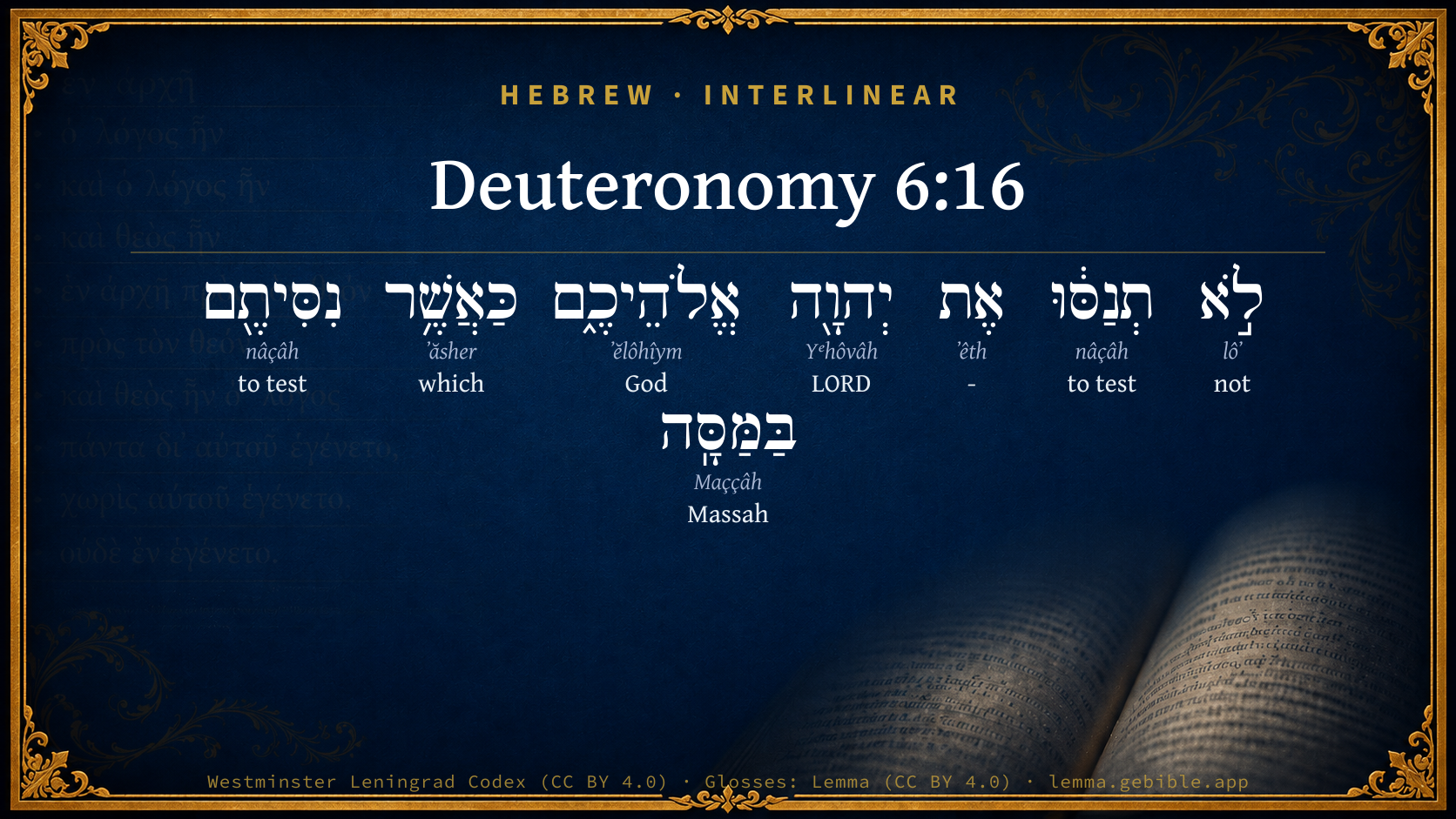
Hebrew (Westminster Leningrad Codex) Deuteronomy 6:16 appears in the Hebrew Old Testament. The text above is from the Westminster Leningrad Codex. Each word links to its Strong’s number, a concise gloss, and parsing drawn from the Open Scriptures Hebrew Bible morphology. Click any word for its full Brown-Driver-Briggs (BDB) entry.
Download image
Cite this verse

Deuteronomy 6:16 (World English Bible). Public Domain. Lemma interlinear Bible study tool, https://lemma.gebible.app/v/deuteronomy/6/16.

Show BibTeX & RIS
BibTeX
RIS
English Translation
You shall not tempt Yahweh your God, as you tempted him in Massah.
World English Bible · Public Domain
Download a study sheet

One document with this verse’s original text, its word-by-word gloss line, the meaning frame, cross-references with their text, attributed commentary, and full source and license credits — printable, and it pastes into notes with its structure intact.

This verse Autodidact and up

Study sheet (.html) Plain text (.txt)

A passage Seminary Student

Up to 50 verses in one chapter. A passage sheet keeps up to 6 commentary sources and 12 cross-references per verse, in the order this page ranks them, and says so on the sheet whenever that leaves anything out. Ask for a single verse and you get the Autodidact verse sheet above.

Everything on this page stays free to read, with no account — the sheet is a download of what is already on screen, not access to it.

Want to remove ads? Support Godless Engineer
Compare translations 3

The same verse in 3 English versions, stacked beneath the original-language interlinear above. Click any original word for its lexicon entry.

Each is an independent rendering of the whole verse — the interlinear is not word-aligned to these translations.

Highlighted words mark where these versions differ — a whole-verse word diff, not a word-by-word alignment.

  • World English Bible Public Domain
    You shall not tempt Yahweh your God, as you tempted him in Massah.
  • King James Version Public Domain
    Ye shall not tempt the LORD your God, as ye tempted him in Massah.
  • unfoldingWord Literal Text CC BY-SA 4.0
    Do not test Yahweh your God as you tested at Massah.

unfoldingWord Literal Text — © unfoldingWord, licensed CC BY-SA 4.0. Word-aligned USFM3 via Door43 (git.door43.org/unfoldingWord/en_ult).

Versions to compare (up to 4)

3 of 4 selected

Show all 18 translations

Every available English version of this verse, each an independent rendering of the whole verse.

  • World English Bible Public Domain
    You shall not tempt Yahweh your God, as you tempted him in Massah.
  • Berean Standard Bible Public Domain
    Do not test the LORD your God as you tested Him at Massah.
  • Majority Standard Bible Public Domain
    Do not test the LORD your God as you tested Him at Massah.
  • King James Version Public Domain
    Ye shall not tempt the LORD your God, as ye tempted him in Massah.
  • American Standard Version (1901) Public Domain
    Ye shall not tempt Jehovah your God, as ye tempted him in Massah.
  • Revised Version (1885) Public Domain
    Ye shall not tempt the LORD your God, as ye tempted him in Massah.
  • Geneva Bible (1599) Public Domain
    Ye shall not tempt the Lord your God, as ye did tempt him in Massah:
  • Douay-Rheims (1899) Public Domain
    Thou shalt not tempt the Lord thy God, as thou temptedst him in the place of temptation.
  • Young's Literal Translation Public Domain
    `Ye do not try Jehovah your God as ye tried in Massah;
  • Literal Standard Version CC BY-SA 4.0
    You do not try your God YHWH as you tried [Him] in Massah.
  • Unlocked Literal Bible CC BY-SA 4.0
    You will not test Yahweh your God as you tested him at Massah.
  • unfoldingWord Literal Text CC BY-SA 4.0
    Do not test Yahweh your God as you tested at Massah.
  • Darby Bible Public Domain
    Ye shall not tempt Jehovah your God, as ye tempted him in Massah.
  • World Messianic Bible Public Domain
    You shall not tempt the LORD your God, as you tempted him in Massah.
  • Webster's Bible Public Domain
    Ye shall not tempt the LORD your God, as ye tempted him in Massah.
  • Free Bible Version CC BY-SA 4.0
    Don't test the Lord your God like you did at Massah.
  • Bible in Basic English Public Domain
    Do not put the Lord your God to the test as you did in Massah.
  • JPS Tanakh (1917) Public Domain
    Ye shall not try the LORD your God, as ye tried Him in Massah.

Literal Standard Version (2020), Covenant Press — licensed CC BY-SA 4.0. Text via the HelloAO Bible API (eBible.org). Unlocked Literal Bible (unfoldingWord) — licensed CC BY-SA 4.0. Text via the HelloAO Bible API (eBible.org). unfoldingWord Literal Text — © unfoldingWord, licensed CC BY-SA 4.0. Word-aligned USFM3 via Door43 (git.door43.org/unfoldingWord/en_ult). Free Bible Version, Dr. Jonathan Gallagher — licensed CC BY-SA 4.0. Text via the HelloAO Bible API (eBible.org).

Word by word

More ways to search: Search by grammar → Find every occurrence → Compare this word →

Practice this passage: Drill this verse → Learn its vocabulary →

About this verse

These counts appear in no published source. They are computed here, from the morphology-tagged text and Lemma’s own curated glosses. What Lemma adds →

8
words
7
distinct lemmas
Pentateuch
section

Notable vocabulary

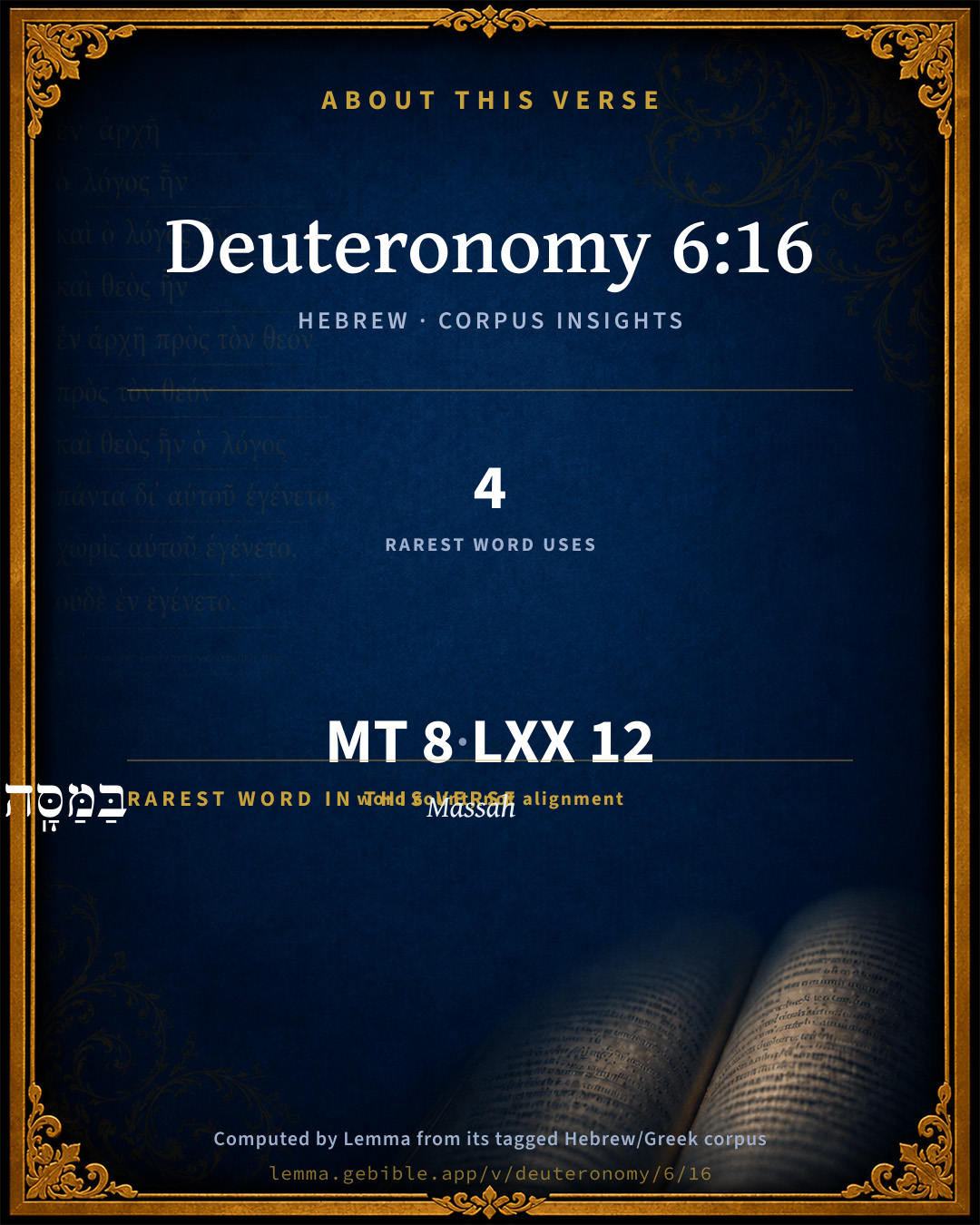
The rarest word here is בַּמַּסָּֽה Massah H4532 — appearing just 4 times in the whole Hebrew Bible.

Shared distinctive vocabulary

בַּמַּסָּֽה Massah H4532 occurs in 4 verses of the Hebrew Bible. Also found in:

Grammatical profile

  • 2 verbs
  • 3 nouns
  • 3 particles

Verb forms

  • תְנַסּ֔וּ Piel · Imperfect
  • נִסִּיתֶ֖ם Piel · Perfect

Repetition

A word recurs within this verse — often emphatic in Hebrew:

  • תְנַסּ֔וּ to test H5254 ×2

Hebrew & Septuagint length

In English translation the verse runs 13 words from the Hebrew and 15 from the Septuagint (LXX English) — closely comparable.

A rough comparison of the two English renderings, which tokenize alike — not a word-level alignment.

Word counts can differ between the Hebrew and the Greek without any difference in meaning — e.g. the Hebrew direct-object marker אֵת has no separate Greek word, and Greek often adds the article ὁ.

In the original languages it is 8 Hebrew tokens and 12 Greek tokens — but the two are counted differently (Hebrew bundles its prefixes and suffixes into one token; the Greek is in lemma form), so that isn’t a like-for-like length.

Cross-references

10

Topical passages linked to Deuteronomy 6:16 in the Treasury of Scripture Knowledge — connected by theme and wording, ordered by reader-vote popularity; previews shown in the World English Bible.

  • Exodus 17:7 He called the name of the place Massah, and Meribah, because the children of Israel quarreled, and because they tested Yahweh, saying, "Is Yahweh among us, or not?"
  • Luke 4:12 Jesus answering, said to him, "It has been said, 'You shall not tempt the Lord your God.'"
  • Matthew 4:7 Jesus said to him, "Again, it is written, 'You shall not test the Lord, your God.'"
  • Psalms 95:8–9 Don't harden your heart, as at Meribah, As in the day of Massah in the wilderness,
  • Hebrews 3:8–9 Don't harden your hearts, as in the provocation, Like as in the day of the trial in the wilderness,
  • 1 Corinthians 10:9 Neither let us test the Lord, as some of them tested, and perished by the serpents.
  • Exodus 17:2 Therefore the people quarreled with Moses, and said, "Give us water to drink." Moses said to them, "Why do you quarrel with me? Why do you test Yahweh?"
  • Numbers 21:4–5 They traveled from Mount Hor by the way to the Red Sea, to compass the land of Edom: and the soul of the people was much discouraged because of the way.
  • Numbers 20:3–4 The people strove with Moses, and spoke, saying, Would that we had died when our brothers died before Yahweh!
  • Numbers 20:13 These are the waters of Meribah; because the children of Israel strove with Yahweh, and he was sanctified in them.

Cross-references courtesy of OpenBible.info (CC BY 4.0).

Hebrew and Greek witnesses Masoretic Hebrew ↔ Greek Septuagint

The same verse in the two great witnesses to the Old Testament, shown verse-for-verse.

These are two independent witnesses, not word-aligned to each other, and the Septuagint is shown in lemma (dictionary) form.

Hebrew Deuteronomy 6:16 Masoretic · Westminster Leningrad Codex

לֹ֣א תְנַסּ֔וּ אֶת יְהוָ֖ה אֱלֹהֵיכֶ֑ם כַּאֲשֶׁ֥ר נִסִּיתֶ֖ם בַּמַּסָּֽה

You shall not tempt Yahweh your God, as you tempted him in Massah.

World English Bible · Public Domain

Greek LXX Deuteronomy 6:16 Septuagint · lemma form

οὐ ἐκπειράζω κύριος ὁ θεός σύ ὅς τρόπος ἐκπειράζω ἐν ὁ πειρασμός

You shall not tempt the Lord your God, as you⌃ tempted him in the temptation.

LXX2012 (modern English Septuagint) · Public Domain

On this verse, Ellicott's Commentary for English Readers discusses the Septuagint’s reading. Read the note in Commentary ↓

Hebrew: Westminster Leningrad Codex (CC BY 4.0). Greek: Septuagint (public domain); English from LXX2012 (modern English Septuagint) (Public Domain). How the Septuagint differs from the Hebrew →

Targum (Aramaic paraphrase)

2

The Targum is the ancient Jewish Aramaic paraphrase of the Hebrew Scriptures — an interpretive translation, not the Hebrew text itself. Onkelos (literal) and Pseudo-Jonathan (expansive) render the Torah, and Jonathan the Prophets. Coverage is partial: where no permissively-licensed English translation exists for a verse, only the Aramaic is shown. This is verse-level text, not a word-by-word alignment to the Hebrew.

  1. Targum Onkelos Torah (Genesis–Deuteronomy)
    לָא תְנַסוּן קֳדָם יְיָ אֱלָהֲכוֹן כְּמָא דִי נַסֵתוּן בְנִסֵיתָא

    (no public-domain English translation for this verse)

    Targum Onkelos — Aramaic: “Onkelos Genesis” (public domain); “Onkelos Exodus” (public domain); “Onkelos Leviticus” (public domain); “Onkelos Numbers” (public domain); “Onkelos Deuteronomy” (public domain). English: “Sefaria Community Translation” (CC0 1.0 (public-domain dedication)); “J.W. Etheridge. The Targums of Onkelos and Jonathan Ben Uzziel on the Pentateuch. London: Longmans, Green, 1862” (public domain). Text via Sefaria.

  2. Targum Pseudo-Jonathan Torah (Genesis–Deuteronomy)
    עַמִּי בְּנֵי יִשְרָאֵל הֲווֹ זְהִירִין דְּלָא תְנַסּוּן יַת יְיָ אֱלָהָכוֹן הֵיכְמָא דְנַסִּיתוּן בְּעִישַרְתֵּי נִסְיוֹנִין

    Sons of Israel, my people, be warned not to tempt the Lord your God as you tempted Him in the ten temptations;

    Targum Pseudo-Jonathan — Aramaic: “Targum Jonathan on Genesis” (public domain); “Targum Jonathan on Exodus” (public domain); “Targum Jonathan on Leviticus” (public domain); “Targum Jonathan on Numbers” (public domain); “Targum Jonathan on Deuteronomy” (public domain). English: “The Targum of Jonathan ben Uzziel, trans. J. W. Etheridge, London, 1862” (public domain). Text via Sefaria.

Commentary

Notes on Deuteronomy 6:16 from classic Christian and Jewish commentators (each source and its license shown beneath its notes). The classic Christian expositions comment on the surrounding passage and are grouped to its opening verse, so a note may address several verses; the Jewish commentaries on the Tanakh (Rashi and others) are per-verse, so they appear only where the commentator wrote on this verse.

Lemma curates 59 commentaries, every one of them public domain or Creative Commons licensed, each selected and text-cleaned for this edition rather than reprinted as found. About our sources →

Trapp's Complete Commentary

John Trapp

Deu 6:16 Ye shall not tempt the LORD your God, as ye tempted [him] in Massah.

Ver. 16. Ye shall not tempt the Lord.] By prescribing to God, and "limiting the Holy One of Israel," as these men did at Massah. {Psa 78:41} {See Trapp on "Mat 4:7"} {See Trapp on "Act 5:9"} {See Trapp on "Exo 17:2"}

John Trapp, A Commentary or Exposition upon All the Books of the Old and New Testament (1647–1656) — public domain. Text from a community e-Sword module.

The Biblical Illustrator

Joseph S. Exell

Deu_6:16

Ye shall not tempt the Lord.

Christ tempted through unbelief

We know that though God cannot be tempted with evil, He may justly be said to be tempted whenever men, by being dissatisfied with His dealings, virtually ask that He will alter those dealings, and proceed in a way more congenial to their feelings. Suppose a man to be discontented with the appointments of Providence, suppose him to murmur at what the Almighty allots him to do or to bear: is he not to be charged with the asking God to change His purposes? And what is this if it is not tempting God, and striving to induce Him to swerve from His plans, though every one of those plans has been settled by Infinite Wisdom? Or again, if anyone of us, notwithstanding the multiplied proofs of Divine loving kindness, question whether or not God do indeed love him, of what is he guilty, if not of tempting the Lord, seeing that he solicits God to the giving additional evidence, as though there was a deficiency, and challenges Him to a fresh demonstration of what He has already abundantly displayed? In short, unbelief of every kind and every degree may be said to tempt God. For not to believe upon the evidence which He has seen fit to give is to provoke Him to give more, offering our possible assent if proof were increased as an inducement to Him to go beyond what His wisdom has prescribed. And if in this, and the like sense, God may be tempted, what can be more truly said of the Israelites than that they tempted God in Massah? Was there ever a people for whom so much had been done, on whose behalf so many miracles had been wrought, or for whose protection there had been such signal displays of Omnipotence? And, indeed, we are perhaps not accustomed to think of unbelief or murmuring as a tempting God, and therefore we do not attach to what is so common, its just degree of heinousness. Yet we cannot be dissatisfied with Gods dealings, and not be virtually guilty of tempting God. It may seem a harsh definition of a slight and scarcely avoidable fault, but nevertheless it is a true definition. You cannot mistrust God, and not accuse Him of want either of power or of goodness. So that your fear, or your despondency, or your anxiety in circumstances of perplexity or peril are nothing less than the calling upon God to depart from His fixed course--a suspicion, or rather an assertion, that He might proceed in a manner more worthy of Himself, and therefore a challenge to Him to alter His dealings if He would prove that He possesses the attributes which He claims. But it is now in His mediatorial rather than His Divine capacity that we would wish to show you how Christ may be tempted. There is a great general similarity between the two cases, for in both the Supreme Being is tempted if we practically undervalue what He has done for us--throw scorn upon the proofs already given of His love, and thus virtually challenge Him to do more or give greater. Ah, this may be putting neglect of Christ and His Gospel under an unusual aspect; but prove to us, if you can, that it is not just. We affirm, that by every refusal to turn from your sins, and to seek that repentance and remission which Christ died to procure, and lives to bestow, you are as literally guilty of tempting Christ as were the Israelites in the desert, when they provoked God by their repining and unbelief. You tempt Him precisely in the sense in which the Israelites tempted God, by practically denying that what has been done on your behalf has bound you to His service; and therefore, by practically demanding that He interfere again and again, and with mightier tokens of supremacy and compassion. And how little had been done for the Israelites by God in comparison with what has been done by Christ Jesus for us! It was much that God had wrenched from the neck of a captive people the yoke of an oppressor; but think of your emancipation from the thraldom of Satan! By plague and prodigy had the Egyptians been discomfited: but what is this to death vanquished, the grave rifled, and heaven opened by the triumphs of the Mediator? God gave the people manna from heaven; but what is this to Christ giving the true bread--His own flesh--for the life of the world? The tabernacle was set up, and Aaron, with the Urim and Thummim on his breast, could intercede with God, and gain oracular response; but what is this to our having a High Priest within the veil, having at His disposal all the gifts of the Spirit? Ay, if it show great hardness of heart, great ingratitude, great perverseness, that men who had seen waters turned into blood, and the sea divided, and the food brought in profusion by the stretching forth the rod of the lawgiver, should have been fretful and mistrustful in every new trial, what is evidenced by our conduct if we continue to be careless and unbelieving--we before whose eyes Christ Jesus is evidently set forth crucified amongst us? I dare no longer compare that tempting of God with which the Israelites were charged, with that tempting of Christ of which numbers amongst ourselves are continually guilty. It were to say that a temporal deliverance and a temporal Canaan gave as great evidence of the love of the Almighty towards men, and of infinite power being engaged in their succour, as redemption from everlasting death, and an inheritance that fadeth not away. Oh, no! there is sameness in the mode of temptation, but there is vast difference in the degree of guiltiness. Yet the Israelites were terribly visited. And how shall we escape if we neglect so great salvation? (H. Melvill, B. D.)

The Biblical Illustrator, edited by Joseph S. Exell (c. 1880s–1900s) — public domain. Text from a community e-Sword module.

Tyndale Open Study Notes

Tyndale Open Resources

6:16 When Israel journeyed through the Sinai desert after the Exodus, they came to Rephidim, where they found no water (Exod 17:1-7). Moses saw the people’s demand for water as testing the Lord; hence the name Massah (“testing”) for this place. Jesus quoted this verse to rebut Satan (Matt 4:7; Luke 4:12).

Tyndale Open Study Notes — © Tyndale Open Resources, licensed CC BY-SA 4.0. Text via the HelloAO Bible API.

Geneva Bible (1599)

Geneva Bible translators

By doubting of his power, refusing lawful means, and abusing his graces.

Geneva Bible (1599) marginal notes — public domain. Text via Bolls.life.

Adam Clarke's Commentary

Verse 16. Ye shall not tempt the Lord] Ye shall not provoke him by entertaining doubts of his mercy, goodness, providence, and truth.

As ye tempted him in Massah.] How did they tempt him in Massah? They said, Is the Lord among us or not? Ex 17:1-7. After such proofs as they had of his presence and his kindness, this was exceedingly provoking. Doubting God's kindness where there are so many evidences of it, is highly insulting to God Almighty.

Adam Clarke's Commentary on the Bible (1810–1826) — public domain. Text from a community e-Sword/MySword module.

Ellicott's Commentary for English Readers

(16) Ye shall not tempt the Lord your God.—In the LXX., “Thou shalt not tempt,” and so where our Lord used it against the tempter (Matthew 4 and Luke 4).

As ye tempted him in Massah.—How did they tempt Him in Massah? By raising the unbelieving question, “Is the Lord among us, or not?” (Exo_17:7). Even by the side of Satan upon the giddy pinnacle of the Temple, our Saviour refused to doubt the care of Jehovah. He would not throw Himself from thence into the arms of the angels to escape Satan, but “He endured as seeing Him who is invisible.” To this standard of action Israel was called in face of the powers of evil. But it was not always realised.

A Bible Commentary for English Readers, edited by Charles John Ellicott (1878–1897) — public domain. Text from a community e-Sword module.

The Cambridge Bible for Schools and Colleges

gen. ed. J. J. S. Perowne

16. Ye shall not tempt, etc.] Rather, try, or put to the proof. On Massah cp. Deu_9:22, Deu_33:8, and see on Exo_17:2; Exo_17:7.

16, 17. Another interruption by the Pl. Because of this; because the reference to Massah is hardly relevant to the context, and because the perfect, he hath commanded, is not yet true of the separate laws; these sentences seem to be a later editorial insertion. The return to the Sg. at their close is explicable by the attraction of the Sg. in Deu_6:18.

The Cambridge Bible for Schools and Colleges (gen. ed. J. J. S. Perowne; Cambridge University Press, 1878–1918) — public domain. Text from a community e-Sword module.

John Gill's Exposition

Ye shall not tempt the Lord your God,.... By striving with him or against him, by murmuring at or complaining of his providential dealings with them, or by requiring a sign of him, or miracles to be done by him; this is another passage used by Christ to repel the temptations of Satan, Mat 4:7,

as tempted him in Massah; a place so called from the Israelites tempting the Lord there, Exo 17:7, the Targum of Jonathan adds, with ten temptations; see Num 14:21.

John Gill's Exposition of the Whole Bible (1746–1763) — public domain (CC PDM 1.0). Text via the HelloAO Bible API.

Haydock's Catholic Bible Commentary

Temptation. Hebrew, "in Massa," where Moses gave the people water from Horeb, Exodus xvii. 7.

George Leo Haydock (1774–1849), Haydock's Catholic Family Bible and Commentary, 1859 edition — public domain. Excludes Psalms (Douay-Rheims chapter numbering differs from Protestant) and Deuterocanonical books (Catholic canon only).

Matthew Poole's English Annotations

i.e. Not provoke him, as the following instance explains. Sinners, especially presumptuous sinners, are oft said to

tempt God, i.e. to make a trial of God, whether he be what he pretends to be, so wise as to see their sins, so just and true and powerful as to take vengeance on them for their sins, concerning which they are very apt to doubt because of the present impunity and prosperity of many such persons. See Num 14:22; Psa 78:18; Mat 4:7; Act 5:9.

Matthew Poole's English Annotations on the Holy Bible (1683–1685) — public domain. Text from a community e-Sword/MySword module.

Whedon's Commentary on the Bible

Daniel D. Whedon

16. Ye shall not tempt the Lord — This is one of the passages quoted by our Lord in the temptation in the wilderness. Mat_4:7. “And as he quoted Deuteronomy as a part of the sacred Scriptures, and as it was then held — that is, as the work of Moses — so we have here again his endorsement of the Mosaic authorship of this book.” — LANGE’S Deuteronomy, p. 96.

As ye tempted him in Massah — They had there tempted God by their murmuring and unbelief. The reference is to Exo_17:1-7. The place was Rephidim, but Moses called it Massah and Meribah, “because of the chiding of the children of Israel, and because they tempted the Lord.” “Massah” is derived from a verb which means to tempt; “Meribah,” from one that means to strive. Rephidim was the place of tempting and striving.

In the concluding verses the teaching of the commandments to their children, already enjoined in the seventh verse, is more fully enforced. The people were to instruct their children as to the significance of the requirements of Jehovah.

Daniel D. Whedon (gen. ed.), Commentary on the Old and New Testaments (1874–1909) — public domain. Text from a community e-Sword module.

The Pulpit Commentary

Tempting God. Wealth has its temptations; so has poverty. It incites to unbelievingmurmurs, and to a spirit called here "tempting the Lord.

I THE NATURE OF THIS SIN. The peculiarity of it deserves to be carefully studied. It is apt to be taken for granted that "tempting God" means simply provoking him to anger. This, however, is a sense of tempting scarcely applicable to the Divine. God can be provoked to wrath, but he is not "tempted" thereby. (Jam_1:13) "Tempting," in the senseof the text, means "putting to the proof," "imposing tests." Professor Tyndall"s famous proposal of a prayer test would have fallen under this description. That this is the right view of the sin is plain from the narrative, and from allusions in the Psalms. "They tempted the Lord, saying, Is the Lord among us or not?". (Exo_17:7) "They tempted God in their hearts they said, Can God furnish a table in the wilderness?". (Psa_78:18-20) In this view of it the appositeness of the Savior"s quotation of the passage becomes more obvious. (Mat_4:7)

II THE OCCASION OF THE SIS. A result of the want of food and water. Poverty suggests this class of doubts, and inspires the thought of putting God to some test of his faithfulness. But the temptation may originate in other causes in intellectual doubt, in a sign-seeking spirit, (Mat_16:1) in downright presumptuousness.

III THE EVIL OF THIS SIN.

1. Its root of unbelief. It is a "limiting of the Holy One of Israel". (Psa_78:41)

1. Its querulous impatience. Instead of trusting God, waiting upon him, and seeking light and help in a proper spirit, it flies in God"s face, accuses him of unkindness, and complains of his injustice.

2. Its daring presumption in presuming to lay down rules to the Almighty, to which he is required to conform. God brings us into situations of trial, not that we may apply tests to him, but that he may test us test our faith, our patience, our humility. For those who come successfully through the trial there is the great reward of having dark things at length cleared up, and of being purified and strengthened by the struggle. Failure, on the other hand, exposes to severe chastisements. J.O.

The Pulpit Commentary (1880–1919), ed. H.D.M. Spence-Jones & Joseph S. Exell — public domain. Text from a community e-Sword module.

John Wesley's Explanatory Notes

Ye shall not tempt - Not provoke him, as the following instance explains. Sinners, especially presumptuous sinners, are said to tempt God, that is, to make a trial of God, whether he be, so wise as to see their sins, so just and true and powerful as to take vengeance on them, concerning which they are very apt to doubt because of the present impunity and prosperity of many such persons.

John Wesley, Explanatory Notes Upon the Whole Bible (1754–1765) — public domain. Text via the GEBible commentary corpus.

Kretzmann's Popular Commentary

Paul E. Kretzmann

The Admonition Substantiated

v. 16. Ye shall not tempt the Lord, your God, put either His mercy or His righteousness to a test, as ye tempted Him in Massah, Exo 17:2-7, in the matter of demanding water to drink in the wilderness.

v. 17. Ye shall diligently keep, literally, "observing ye shall observe," the commandments of the Lord, your God, and His testimonies and His statutes which He hath commanded thee. It was and is a sacred duty, a solemn obligation.

v. 18. And thou shalt do that which is right and good in the sight of the Lord, that it may be well with thee, and that thou mayest go in and possess the good land which the Lord sware unto thy fathers,

v. 19. to cast out all thine enemies from before thee, to make room for His own people, as the Lord hath spoken. This was the reward of faithfulness, and its object was to strengthen Israel in its loyalty to Jehovah.

v. 20. And when thy son, any of the children or descendants, asketh thee in time to come, saying, What mean the testimonies and the statutes and the judgments which the Lord, our God, hath commanded you?

v. 21. then thou shalt say unto thy son, We were Pharaoh’s bondmen in Egypt, forced to perform the work of slaves; and the Lord brought us out of Egypt with a mighty hand, Exo 3:19;

v. 22. and the Lord showed signs and wonders, great and sore, namely, the bad plagues, upon Egypt, upon Pharaoh, and upon all his household, before our eyes, Deu 4:34;

v. 23. and He brought us out from thence that He might bring us in to give us the land which He sware unto our fathers. Thus the Lord carried out His promise to its full completion.

v. 24. And the Lord commanded us to do all these statutes, to fear the Lord, our God, for our good always, for it is always to the believer’s own advantage if he walks in the ways of the Lord, that He might preserve us alive as it is at this day.

v. 25. And it shall be our righteousness if we observe to do all these commandments before the Lord, our God, as He hath commanded us. In this the righteousness of the children of Israel consisted, namely, that they observed and kept the will of the Lord in the love which flows from true faith. Thus the righteousness of faith always precedes the righteousness of life, and the latter serves to indicate the presence of the former. The believers in Christ will not walk after the flesh, but after the Spirit, and thus give evidence of the fact that they are possessors of justification by faith.

Paul E. Kretzmann, Popular Commentary of the Bible (1921–1924) — public domain. Text from a community e-Sword module.

unfoldingWord translationNotes

Door43 World Missions Community

General Information:

Moses continues to tell the people of Israel Yahweh's words as if the Israelites are one person. (See: Forms of You)

You will not test Yahweh

Here "test" means to challenge Yahweh and force him to prove himself.

Massah

This is the name of a place in the desert. The translator may add a footnote that says: "The name 'Massah' means 'testing.'" (See: How to Translate Names)

translationWords

test

Yahweh

God

command

statute

unfoldingWord translationNotes — © Distant Shores Media and the Door43 World Missions Community, licensed CC BY-SA 4.0. Source: git.door43.org/Door43/en_tn.

Rashi

Rabbi Shlomo Yitzchaki (Rashi)

במסה IN MASSAH, when they went forth from Egypt: that they put Him to the test in respect to water, as it is said, (Exodus 17:7) that they asked, “Is the Lord amongst us or not?".

Rashi on the Tanakh — English translations: “The Judaica Press complete Tanach with Rashi, translated by A. J. Rosenberg” (CC BY 4.0); “Pentateuch with Rashi's commentary by M. Rosenbaum and A.M. Silbermann, 1929-1934” (public domain); “The Metsudah Tanach series, Lakewood, N.J” (CC BY 4.0); and “The Book of Joshua, Metsudah Publications, 1997” (CC BY 4.0). Text via Sefaria.

Ramban (Nachmanides)

Rabbi Moshe ben Nachman (Ramban / Nachmanides)

YE SHALL NOT TRY THE ETERNAL YOUR G-D, meaning AS YE TRIED HIM IN MASSAH. You are not to say “If the Eternal is among us to perform miracles on our behalf or, if we succeed when we worship Him and we have plenty of food, and are well, then we will observe His Torah.” For that was the intent of the people there [in Massah] that they would see that if G-d would provide water for them through a miracle from Himself, they would follow Him in the wilderness, and if not, they would forsake Him. This was considered a great sin on their part, for, after it had been confirmed to them with signs and wonders that Moses was a prophet of G-d and that the word of the Eternal in his mouth was truth, it was no longer proper to do anything as a test. Whoever does it, is not testing [the credibility of] the prophet, it is only G-d blessed be He, whom he is testing to determine whether the Eternal’s hand waxed short. He prohibited for all generations to test the Torah or the prophets because it is not proper to worship G-d by being skeptical or by requesting a wonder or some test, since it is not G-d’s will to perform miracles for all men at all times. Nor is it fitting to serve Him in order to receive a reward. Instead, should one find suffering and misfortune [as a result of] serving Him and walking in the ways of the Torah, it is proper that he accept everything as a just judgment and he should not say, as the wicked ones of our people said, And what profit is it that we have kept His charge, and that we have walked mournfully, because of the Eternal of hosts? Scripture states here Ye shall diligently keep the commandments of the Eternal your G-d, and His testimonies, [alluding] that these are the miracles which He did for you of old in order that they be a testimony for you, such as the Passover, the Unleavened Bread, and the Booth. And you should keep His statutes even though you do not know their purpose for, in truth, He will benefit you in the end. There is no need for verification of the Torah and the commandments since it has been confirmed to you that it is from Him, blessed be He. Similarly, if any prophet has [previously] been tested and confirmed as a true prophet with signs and wonders in accordance with the law of the Torah, 7:7. you must not challenge his words regarding any reward or punishment he tells you about, and have no doubt about His power, exalted be He, [to bring it about]. Rather, you are to believe in His Torah and believe in His prophets and you will prosper. Thus he has assured us that ultimately the honor will surely come through possession of the Land and triumph over the enemies, for this was the great beneficence that was necessary for that generation. Thereafter he said that for future generations there was no need for testing [the reward for] the observance of the commandments; instead, they are to inquire of their fathers and their elders and they [the fathers and elders] will tell them of the veracity of the Torah and the commandments, as he will explain [in the verse], When thy son asketh thee — up to the conclusion of the section.

Ramban (Nachmanides) on the Tanakh — English translation: “Commentary on the Torah by Ramban (Nachmanides). Translated and annotated by Charles B. Chavel. New York, Shilo Pub. House, 1971-1976” (CC BY 4.0). Text via Sefaria.

Lesson kit

Teaching starters — assembled from the data on this page, not authored interpretation. Every prompt links to the verse data it draws on. Edit before teaching.

Deuteronomy, in the Pentateuch, opens this verse with 8 words (7 distinct Hebrew lemmas). Its most distinctive word is Maççâh (“Massah”). A historical commentator’s framing appears above. Read the whole chapter for the surrounding context.

Discussion questions

  1. How does “Massah” (Maççâh) shape what this verse is saying?
  2. Exodus 17:7 shares the word «Massah» with this verse. How do the two illuminate each other?
  3. “to test” occurs 2× in this one verse. What is the effect of the repetition?
  4. These translations render this verse differently; the difference is in the English rendering, not the original. What questions does that raise?
  5. The verb «תְנַסּ֔וּ» is Piel Imperfect. How does its form color the action?
  6. Reading how Trapp's Complete Commentary and The Biblical Illustrator read this verse, where do the two commentators agree and where do they part?

Things to notice

Reading settings

Reading text

Shown beneath each verse's original-language words.

Old Testament
Old Testament edition

Read the OT as the Masoretic Hebrew (MT) or the Greek Septuagint (LXX).

English shown for the Greek Septuagint (in the Hebrew ↔ Greek comparison).

Comparing translations? Open the Compare panel on any verse page to stack up to four side by side.