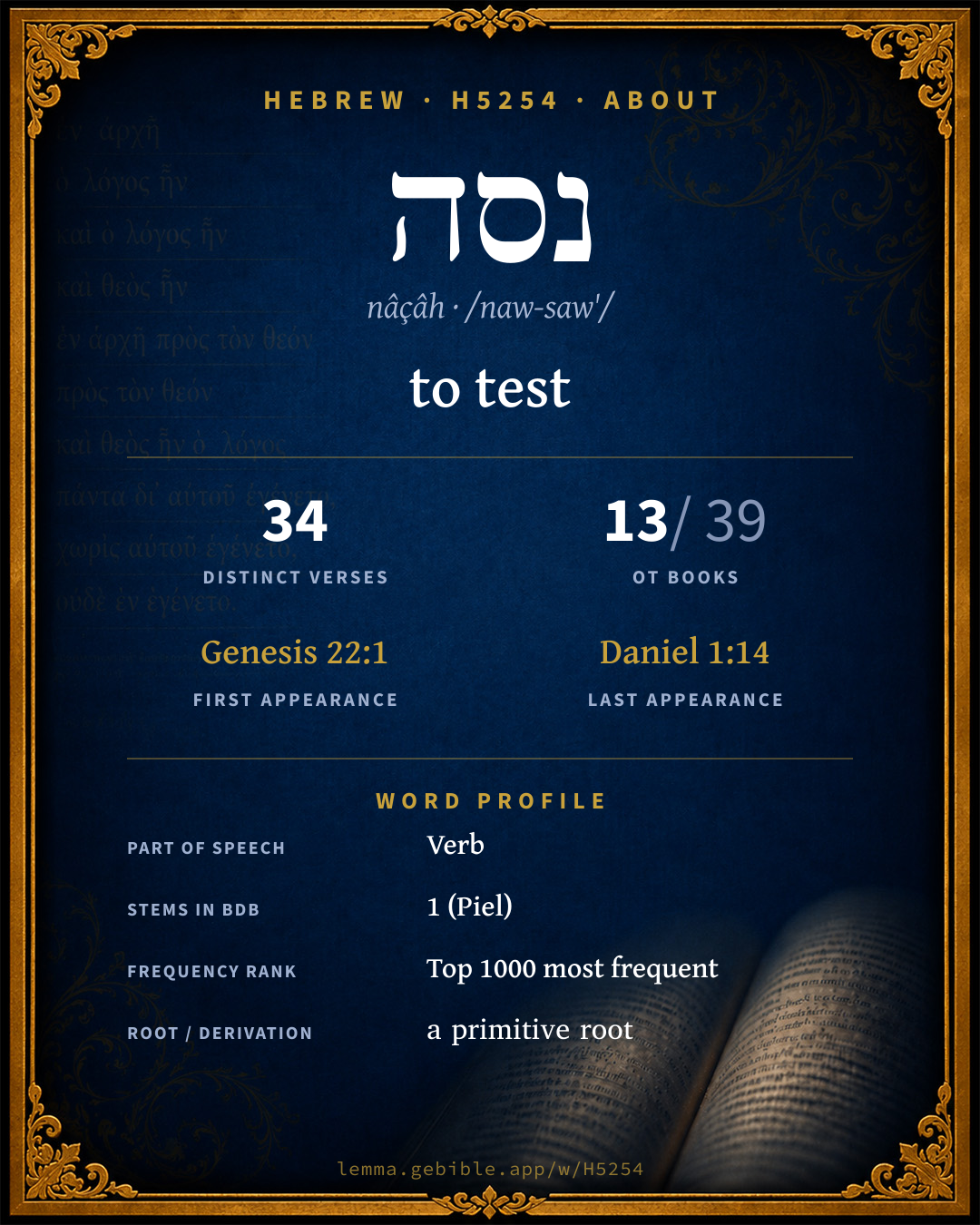
נָסָה
to test
also: try, prove, tempt, assay fuller range ↓
Full lexicon entry — Brown-Driver-Briggs (BDB)
From Brown-Driver-Briggs (BDB)
Where this word appears
See every Piel verb in the Hebrew Bible →
Grammar key — what these labels mean
Part of speech
- Verb
- An action or state-of-being word.
Stem
- Piel
- An intensive or resultative active stem. Here: ‘test’
- Niphal
- Usually the simple passive or reflexive of the Qal (“he was written”).
Form
- Sequential Imperfect
- An imperfect with prefixed waw — the standard past-narrative form (waw-consecutive imperfect).
- Infinitive Construct
- A bound verbal noun, frequently with prepositions (“to write / in writing”).
- Perfect
- A completed action or state — Hebrew marks aspect (completeness) more than strict tense (“he wrote”).
- Imperative
- A direct command (“write!”).
- Cohortative
- A first-person volitional form expressing wish or resolve (“let me / let us write”).
- Imperfect
- An incomplete, ongoing, or future action (“he will / would write”).
- Participle Active
- A verbal adjective expressing ongoing or characteristic action (“writing / one who writes”).
State
- Absolute
- The independent form of a noun, not bound to a following word.
Person
- 3rd Person
- The one spoken about (“he / she / it / they”).
- 1st Person
- The speaker (“I / we”).
- 2nd Person
- The one addressed (“you”).
Gender
- Masculine
- Grammatically masculine.
- Common
- Either gender — not distinguished for this form.
- Feminine
- Grammatically feminine.
Number
- Plural
- More than one (in Hebrew, generally three or more).
- Singular
- One.
Grammatical forms 15 distinct
- Verb, Piel, Infinitive Construct 10 times (28%)
- Verb, Piel, Sequential Imperfect, 3rd Person, Masculine, Plural 5 times (14%)
- Verb, Piel, Perfect, 3rd Person, Masculine, Singular 4 times (11%)
- Verb, Piel, Perfect, 1st Person, Common, Singular 2 times (6%)
- Verb, Piel, Imperative, 2nd Person, Masculine, Singular 2 times (6%)
- Verb, Piel, Cohortative, 1st Person, Common, Singular 2 times (6%)
- Verb, Piel, Imperfect, 1st Person, Common, Singular 2 times (6%)
- Verb, Piel, Imperfect, 2nd Person, Masculine, Plural 2 times (6%)
+7 more forms (7 occurrences)
Parsed forms decoded from the imported morphology (morphhb / Westminster Leningrad Codex — WLC text public domain, morphhb tagging CC BY 4.0), counted across 36 parsed occurrences — not distinct verses.
Every verse where H5254 appears — 34 distinct verses across 13 books. Click any verse to open its interlinear word-by-word view. Verse text shown in the World English Bible for context — . Each verse’s Hebrew form is shown with its reference; the English is not keyword-highlighted, since the data carries no word-level English alignment. Use “Compare translations” on any verse to read it across multiple English versions. This concordance covers the Hebrew Bible; Septuagint (Greek Old Testament) occurrences are not indexed here.
Genesis 1 verse
Exodus 5 verses
- Exodus 15:25 נִסָּֽ/הוּ Piel pf 3ms + sfx pers 3ms Then he cried to Yahweh. Yahweh shown him a tree, and he threw it into the waters, and the waters were made sweet. There he made a statute and an ordinance for them, and there he tested them;
- Exodus 16:4 אֲנַסֶּ֛/נּוּ Piel impf 1cs + sfx pers 3ms Then said Yahweh to Moses, "Behold, I will rain bread from the sky for you, and the people shall go out and gather a day's portion every day, that I may test them, whether they will walk in my law, or not.
- Exodus 17:2 תְּנַסּ֖וּ/ן Piel impf 2mp + sfx n Therefore the people quarreled with Moses, and said, "Give us water to drink." Moses said to them, "Why do you quarrel with me? Why do you test Yahweh?"
- Exodus 17:7 נַסֹּתָ֤/ם Piel inf.cs + sfx pers 3mp He called the name of the place Massah, and Meribah, because the children of Israel quarreled, and because they tested Yahweh, saying, "Is Yahweh among us, or not?"
- Exodus 20:20 נַסּ֣וֹת Piel inf.cs Moses said to the people, "Don't be afraid, for God has come to test you, and that his fear may be before you, that you won't sin."
Numbers 1 verse
Deuteronomy 7 verses
- Deuteronomy 4:34 הֲ/נִסָּ֣ה ptcl inter + Piel pf 3ms Or has God tried to go and take him a nation from the midst of [another] nation, by trials, by signs, and by wonders, and by war, and by a mighty hand, and by an outstretched arm, and by great terrors, according to all that Yahweh your God did for you in Egypt before your eyes?
- Deuteronomy 6:16 תְנַסּ֔וּ נִסִּיתֶ֖ם Piel impf 2mp Piel pf 2mp You shall not tempt Yahweh your God, as you tempted him in Massah.
- Deuteronomy 8:2 לְ/נַסֹּֽתְ/ךָ֗ prep + Piel inf.cs + sfx pers 2ms You shall remember all the way which Yahweh your God has led you these forty years in the wilderness, that he might humble you, to prove you, to know what was in your heart, whether you would keep his commandments, or not.
- Deuteronomy 8:16 נַסֹּתֶ֔/ךָ Piel inf.cs + sfx pers 2ms who fed you in the wilderness with manna, which your fathers didn't know; that he might humble you, and that he might prove you, to do you good at your latter end:
- Deuteronomy 13:3 מְנַסֶּ֞ה Piel ptcp.act ms you shall not listen to the words of that prophet, or to that dreamer of dreams: for Yahweh your God proves you, to know whether you love Yahweh your God with all your heart and with all your soul.
- Deuteronomy 28:56 נִסְּתָ֤ה Piel pf 3fs The tender and delicate woman among you, who would not adventure to set the sole of her foot on the ground for delicateness and tenderness, her eye shall be evil toward the husband of her bosom, and toward her son, and toward her daughter,
- Deuteronomy 33:8 נִסִּית/וֹ֙ Piel pf 2ms + sfx pers 3ms Of Levi he said, Your Thummim and your Urim are with your godly one, Whom you did prove at Massah, With whom you did strive at the waters of Meribah;
Judges 4 verses
- Judges 2:22 נַסּ֥וֹת Piel inf.cs that by them I may prove Israel, whether they will keep the way of Yahweh to walk therein, as their fathers did keep it, or not.
- Judges 3:1 לְ/נַסּ֥וֹת prep + Piel inf.cs Now these are the nations which Yahweh left, to prove Israel by them, even as many [of Israel] as had not known all the wars of Canaan;
- Judges 3:4 לְ/נַסּ֥וֹת prep + Piel inf.cs They were [left], to prove Israel by them, to know whether they would listen to the commandments of Yahweh, which he commanded their fathers by Moses.
- Judges 6:39 אֲנַסֶּ֤ה Piel coh 1cs Gideon said to God, Don't let your anger be kindled against me, and I will speak but this once: Please let me make a trial just this once with the fleece; let it now be dry only on the fleece, and on all the ground let there be dew.
1 Samuel 1 verse
1 Kings 1 verse
2 Chronicles 2 verses
- 2 Chronicles 9:1 לְ/נַסּוֹת֩ prep + Piel inf.cs When the queen of Sheba heard of the fame of Solomon, she came to prove Solomon with hard questions at Jerusalem, with a very great train, and camels that bore spices, and gold in abundance, and precious stones: and when she was come to Solomon, she talked with him of all that was in her heart.
- 2 Chronicles 32:31 לְ/נַ֨סּוֹת֔/וֹ prep + Piel inf.cs + sfx pers 3ms However in [the business of] the ambassadors of the princes of Babylon, who sent to him to inquire of the wonder that was done in the land, God left him, to try him, that he might know all that was in his heart.
Job 1 verse
Psalms 6 verses
- Psalms 26:2 וְ/נַסֵּ֑/נִי conj + Piel impv 2ms + sfx pers 1cs Examine me, Yahweh, and prove me. Try my heart and my mind.
- Psalms 78:18 וַ/יְנַסּוּ conj + Piel wimpf 3mp They tempted God in their heart By asking food according to their desire.
- Psalms 78:41 וַ/יְנַסּ֣וּ conj + Piel wimpf 3mp They turned again and tempted God, And provoked the Holy One of Israel.
- Psalms 78:56 וַ/יְנַסּ֣וּ conj + Piel wimpf 3mp Yet they tempted and rebelled against the Most High God, And didn't keep his testimonies;
- Psalms 95:9 נִ֭סּוּ/נִי Piel pf 3cp + sfx pers 1cs When your fathers tempted me, Tested me, and saw my work.
- Psalms 106:14 וַ/יְנַסּוּ conj + Piel wimpf 3mp But gave in to craving in the desert, And tested God in the wasteland.
Ecclesiastes 2 verses
- Ecclesiastes 2:1 אֲנַסְּ/כָ֛ה Piel coh 1cs + sfx pers 2ms I said in my heart, "Come now, I will test you with mirth: therefore enjoy pleasure;" and, behold, this also was vanity.
- Ecclesiastes 7:23 נִסִּ֣יתִי Piel pf 1cs All this have I proved in wisdom. I said, "I will be wise;" but it was far from me.
Isaiah 1 verse
Daniel 2 verses
About this entry
At a glance — auto-summarized from this page’s data, not written by a person. Every figure links to its source below. This summary describes the numbers; it doesn’t interpret them.
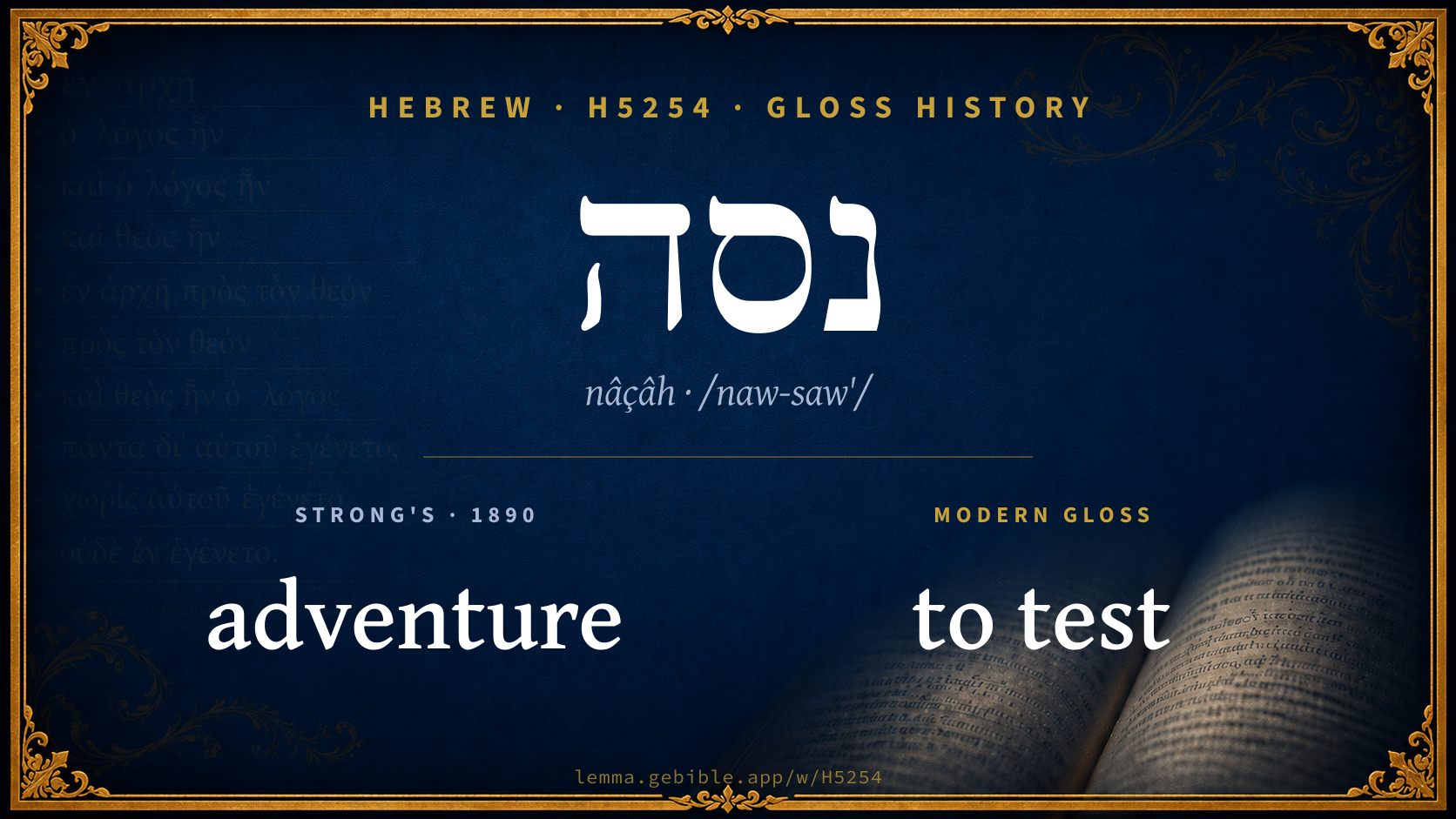
At its core, נסה (nâçâh) means “to test.” Its English rendering has broadened — “prove” classically, “test” (Berean Standard Bible) in modern versions; see the renderings breakdown. Spanning 34 verses in 13 books, it ranks among the moderately common words of the Hebrew Bible. It first appears in Genesis 22:1. Beyond its headline sense, its full sense range takes in “try”, “prove”, and “tempt”. Dig into 34-verse concordance and the renderings breakdown below.
Gloss history
Strong's 1890 vs modern scholarship
About this word
Strong's H5254 catalogs a Hebrew word from the Hebrew Old Testament.
These counts are not copied from any lexicon or concordance. They are computed here, from the morphology-tagged Hebrew Old Testament. What Lemma adds →
- 34
- distinct verses
- The word appears in 34 distinct verses.
- 13 / 39
- OT books
- The word appears in 13 of 39 Old Testament books.
- #990
- by frequency
- Top 1000 most frequent Hebrew words (rank 990 of 8,640 Hebrew words by occurrence).
View all 34 occurrences in the concordance →
Most concentrated in
- Deuteronomy 7 verses 21%
- Psalms 6 verses 18%
- Exodus 5 verses 15%
By section of the Old Testament
By traditional corpus
Conventional, traditional groupings — biblical authorship is debated, so this is a traditional corpus grouping, not an authorship claim. Each share is this word’s portion of its verses in that division of the Hebrew canon. Each figure is a share of the word’s 34 distinct verses.
- Torah (Pentateuch) 14 verses · 41%
- Writings (Ketuvim) 13 verses · 38%
- Prophets (Nevi'im) 7 verses · 21%
How translations render this word
Counts come from each version’s own published word-to-Strong’s tagging or interlinear alignment — an approximate guide to how each version renders this word, not a word-level alignment the data otherwise carries. Because each total is that version’s own tagged count, the per-version totals vary from one another and need not match the appearance or distinct-verse counts above. These counts may also differ from a printed concordance because Lemma counts each distinctly tagged rendering and does not collapse phrase taggings into a single head-word total. This is a fixed set of word-tagged versions (KJV, ASV, BSB, ULT) and does not change with the reading translation you choose elsewhere. Each version’s license is shown beside its name below (and on Sources).
- King James Version: Prove 6×, Tempted 3×, They tempted 3×
- American Standard Version: Prove 5×, They tempted 3×, I may prove 2×
- Berean Standard Bible: Test 7×, Tested 4×, I will test 3×
- unfoldingWord Literal Text: Test 6×, They tested 5×, Testing of 4×
King James Version Public Domain
Renders H5254 across 36 tagged occurrences — most commonly:
Plus 24 renderings that appear only once — usually multi-word phrases or single function words the recovered tagging swept in, not distinct renderings.
American Standard Version Public Domain
Renders H5254 across 35 tagged occurrences — most commonly:
Plus 23 renderings that appear only once — usually multi-word phrases or single function words the recovered tagging swept in, not distinct renderings.
Berean Standard Bible Public Domain
Renders H5254 across 36 tagged occurrences — most commonly:
Plus 12 renderings that appear only once — usually multi-word phrases or single function words the recovered tagging swept in, not distinct renderings.
unfoldingWord Literal Text CC BY-SA 4.0
Renders H5254 across 46 tagged occurrences — most commonly:
Plus 22 renderings that appear only once — usually multi-word phrases or single function words the recovered tagging swept in, not distinct renderings.
Senses in the full BDB
What do BDB’s symbols mean?
BDB uses these scholarly abbreviations:
| Symbol | Meaning |
|---|---|
| 𝔊 | the Septuagint (the ancient Greek translation, LXX) |
| 𝔙 | the Vulgate (the Latin translation) |
| 𝔖 | the Syriac version (the Peshitta) |
| 𝔗 | the Targum (the Aramaic translation) |
| ψ | the Psalms |
| √ | root (the underlying root or stem) |
| ‖ | parallel passage (a synonymous or contrasted parallel) |
| † | the dagger: every passage where the word occurs is cited |
The 6 senses and sub-senses the full Brown-Driver-Briggs lexicon distinguishes for this word, in lexicon order (not ranked by frequency), with BDB’s own verbatim wording and sub-sense lettering. Shown in Hebrew script with BDB’s own scholarly abbreviations. The condensed entry is in the Lexicon Entry tab. See also the Forms in the corpus table below.
Piel
- Pf. 3 ms. נִסָּה Dt 4:34 + 3 times; sf. נִסָּהוּ Ex 15:25; 3 fs. נִסְּתָה Dt 28:56; 1 s. נִסִּיתִי Ec 7:23, + 4 times Pf.; Impf. 3 ms. sf. יְנַסֵּם Dn 1:14; 1 s. אֲנְסֶּה Ju 6:39; sf. אֲנַסְּכָה Ec 2:2; 3 mpl. יְנַסּוּ Nu 14:22; 2 mpl. תְּנַסּ֑וּן Ex 17:2, + 7 times Impf.; Imv. נַס Dn 1:12; sf. נַסֵּנִי ψ 26:2; Inf. cstr. נַסּוֹת Ex 20:20, + 8 times Inf.; Pt. מְנַסֶּה Dt 13:4;— e.g. Deuteronomy 4:34
- 1. test, try (syn. בחן), abs. 1 S 17:39 (equipment); c. בְּ Ju 6:39 Ec 2:1; c. acc. Dn 1:12, 14; acc. + בְּ 1 K 10:1 = 2 Ch 9:1, Ec 2:1; 7:23. e.g. 1 Samuel 17:39
- 2. attempt, essay, try to do a thing, c. Inf. Dt 4:34 (c. לְ) 28:56; c. acc. Jb 4:2 (venture a word). e.g. Deuteronomy 4:34
- 3. test, try, prove, tempt [but not in modern sense of the word: v. Dr Dt 6:16; ψ 453, 483]
- a. God tests or proves Abr. Gn 22:1 (E), Isr. Ex 15:25; 20:20 (E), 16:4 (J), Dt 8:2, 16; 13:4; c. בְּ Ju 2:22; 3:1, 4; tribe of Levi Dt 33:8 (poem); Hezekiah 2 Ch 32:31; psalmist ψ 26:2. e.g. Genesis 22:1
- b. Isr. tests, or tries God: Ex 17:2, 7; Nu 14:22 (J), Dt 6:16 ψ 78:18, 41, 56; 95:9; 106:14; so Ahaz, Is 7:12. e.g. Exodus 17:2
Senses from the full Brown-Driver-Briggs lexicon (Brown, Driver, Briggs; Oxford 1906 — public domain), digitized via Sefaria, supplemented by the OpenScriptures HebrewLexicon (CC BY 4.0). Full attribution on Sources.
Word origin
vb. Pi. test, try (NH id., Pi.; 𝔗 Pa. נַסִּי; Syriac Pa. ܢܰܣܺܝ; cf. Ethiopic መንሱት temptation);—
— Brown-Driver-Briggs (Oxford 1906, public domain), digitized via Sefaria, supplemented by the OpenScriptures HebrewLexicon (CC BY 4.0). See Sources.
Origin: a primitive root
Jastrow Dictionary
A second Hebrew/Aramaic lexicon for comparison, covering Aramaic and post-biblical (Talmudic, Targumic, Midrashic) usage that the biblical-Hebrew BDB does not. Matched by lemma rather than by Strong’s number, so a lemma may carry more than one Jastrow headword (shown separately below), and the entries cover usage well beyond the Bible.
נסי ²
- (cmp. preced.) to lift up.
- 1. same; 2) (denom. of נֵס) to put up a sign; to ask for a test (cmp. Is. VII, 11, sq.); to try, test. Gen. R. s. 55, beg. (interpret. נִסָּה, Gen. XXII, 1) בשביל לנַסּוֹתָן … לגדלן וכ׳ in order to lift them up (as a standard) for the world, to raise them &c., v. נֵס. Ib. (ref. to Gen. l. c.) R. J. says גדלו כנס וכ׳ he raised him &c.; R. A. says, נ׳ אותן בוודאי he really tried him, v. וַדַּאי. Ib. אין הקב"ה מְנַסֶּה וכ׳ the Lord does not test the wicked, but only the righteous; ib. s. 32; s. 34. Mekh. B’shall., Vayassa, s. 1 (ref. to Ex. XV, 25) גדולה(ל) שם נשא לו there he raised him (Moses) to greatness; … שם נסה המקום את ישראל there God tested Israel. Ib. Yithro, Baḥod., s. 9 לבעבור נַסּוֹת אתכם בשביל לגדל אתכם (Ex. XX, 28) ‘to lift you up’, to raise you. Arakh. 15ᵃ עשר נסיונות נִיסּוּ וכ׳ ten times did our ancestors try the Lord; Ab. V, 4; a. fr. e.g. Isaiah 7:11
- to be tried. Ib. 3. Yalk. Ps. 777 הראשונים מִתְנַסִּים ביד הקב"ה … אבל האחרונים נִתְנַסּוּ וכ׳ the ancients were tried by the Lord …, but the latter generations were tried by the nations; a. fr.
A Dictionary of the Targumim, the Talmud Babli and Yerushalmi, and the Midrashic Literature (Marcus Jastrow; London, Luzac, 1903) — Public Domain. Digitized via Sefaria. Digitized via Sefaria. Full attribution on Sources.
Forms in the corpus
The 32 distinct written forms H5254 takes in the Hebrew Bible, most frequent first — each parse links to that stem’s occurrences in the concordance. Hebrew forms include their vowel points and cantillation, so a single lemma takes many written forms.
Same root — word family
Other BDB entries built from the same root as H5254, grouped by Strong’s listed origin. These share a root / origin per the lexicon — not necessarily a shared meaning. Each links to that word’s own entry.
Derived from this word
Compare all same-root words → They share a root, not necessarily a meaning.
Septuagint verse parallels
This word appears in 30 verses that also exist in the Greek Old Testament (Septuagint), out of the 34 Hebrew verses it occurs in. You can read those verses in Greek by switching the Old Testament edition to the Septuagint.
Read these verses in the Septuagint
- Genesis 22:1
- Exodus 15:25
- Numbers 14:22
- Deuteronomy 4:34
- Judges 2:22
- 1 Kings 10:1
- 2 Chronicles 9:1
- Job 4:2
- Psalms 26:2
- Ecclesiastes 2:1
- Isaiah 7:12
- Daniel 1:12
This is a verse-level parallel only — the same verses exist in both the Hebrew and Greek Old Testaments. No word-level Hebrew↔Greek correspondence is claimed: the data carries no such alignment, so no Greek word is shown as this Hebrew word’s translation. Coverage is not total — the Septuagint omits the deuterocanon and renumbers the Psalms, so some Hebrew verses have no direct Greek parallel.