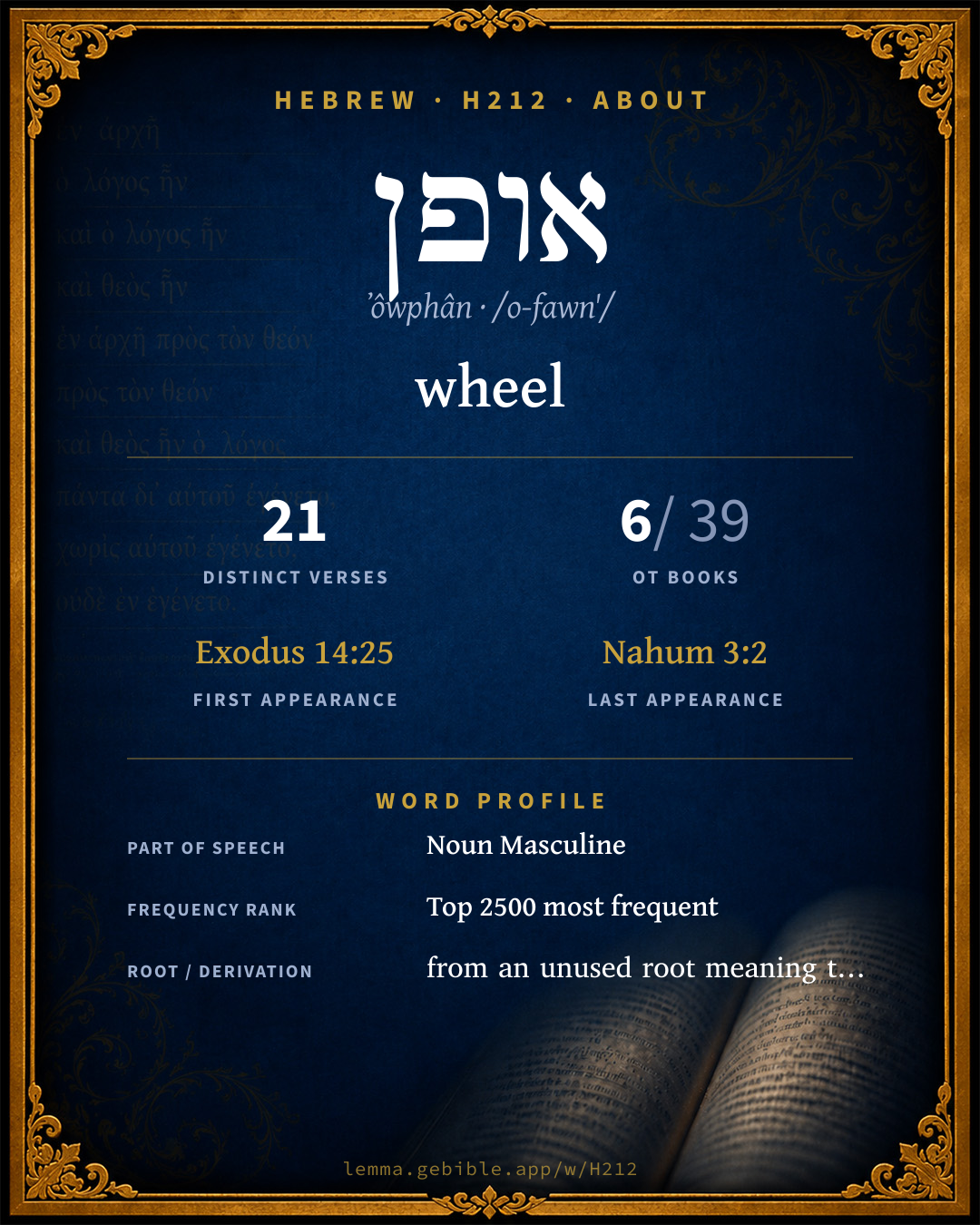
אוֹפָן
wheel
‘wheel’ is one of 4 main senses fuller range ↓
Full lexicon entry — Brown-Driver-Briggs (BDB)
From Brown-Driver-Briggs (BDB)
Where this word appears
See every Absolute-state word in the Hebrew Bible →
Grammar key — what these labels mean
Part of speech
- Noun
- A naming word — a person, place, thing, or idea.
Noun type
- Common
- A common noun — a general class of person, place, or thing (“king,” “city,” “water”), not a specific name.
State
- Absolute
- The independent form of a noun, not bound to a following word.
- Construct
- A noun bound to a following noun in a possessive / “of” relationship (the construct chain).
Gender
- Masculine
- Grammatically masculine.
Number
- Plural
- More than one (in Hebrew, generally three or more).
- Singular
- One.
Grammatical forms
- Noun, Common, Masculine, Plural, Absolute 19 times (54%)
- Noun, Common, Masculine, Singular, Absolute 11 times (31%)
- Noun, Common, Masculine, Singular, Construct 3 times (9%)
- Noun, Common, Masculine, Plural, Construct 2 times (6%)
Parsed forms decoded from the imported morphology (morphhb / Westminster Leningrad Codex — WLC text public domain, morphhb tagging CC BY 4.0), counted across 35 parsed occurrences — not distinct verses.
Every verse where H212 appears — 21 distinct verses across 6 books. Click any verse to open its interlinear word-by-word view. Verse text shown in the World English Bible for context — . Each verse’s Hebrew form is shown with its reference; the English is not keyword-highlighted, since the data carries no word-level English alignment. Use “Compare translations” on any verse to read it across multiple English versions. This concordance covers the Hebrew Bible; Septuagint (Greek Old Testament) occurrences are not indexed here.
Exodus 1 verse
1 Kings 3 verses
- 1 Kings 7:30 אוֹפַנֵּ֨י n c mp cs Every base had four brazen wheels, and axles of brass; and the four feet of it had supports: beneath the basin were the supports molten, with wreaths at the side of each.
- 1 Kings 7:32 הָ/אֽוֹפַנִּ֗ים הָ/אֽוֹפַנִּ֖ים הָ/אוֹפַ֣ן ptcl def.art + n c mp ptcl def.art + n c mp ptcl def.art + n c ms The four wheels were underneath the panels; and the axles of the wheels were in the base: and the height of a wheel was a cubit and half a cubit.
- 1 Kings 7:33 הָ/א֣וֹפַנִּ֔ים אוֹפַ֣ן ptcl def.art + n c mp n c ms cs The work of the wheels was like the work of a chariot wheel: their axles, and their rims, and their spokes, and their naves, were all molten.
Proverbs 1 verse
Isaiah 1 verse
Ezekiel 14 verses
- Ezekiel 1:15 אוֹפַ֨ן n c ms Now as I saw the living creatures, behold, one wheel on the earth beside the living creatures, for each of the four faces of it.
- Ezekiel 1:16 הָ/אוֹפַנִּ֤ים הָ/אוֹפַ֖ן הָ/אוֹפָֽן ptcl def.art + n c mp ptcl def.art + n c ms ptcl def.art + n c ms The appearance of the wheels and their work was like a beryl: and they four had one likeness; and their appearance and their work was as it were a wheel within a wheel.
- Ezekiel 1:19 הָ/אוֹפַנִּ֖ים הָ/אוֹפַנִּֽים ptcl def.art + n c mp ptcl def.art + n c mp When the living creatures went, the wheels went beside them; and when the living creatures were lifted up from the earth, the wheels were lifted up.
- Ezekiel 1:20 וְ/הָ/אוֹפַנִּ֗ים בָּ/אוֹפַנִּֽים conj + ptcl def.art + n c mp prep det + n c mp Wherever the spirit was to go, they went; there was the spirit to go: and the wheels were lifted up beside them; for the spirit of the living creature was in the wheels.
- Ezekiel 1:21 הָ/אֽוֹפַנִּים֙ בָּ/אוֹפַנִּֽים ptcl def.art + n c mp prep det + n c mp When those went, these went; and when those stood, these stood; and when those were lifted up from the earth, the wheels were lifted up beside them: for the spirit of the living creature was in the wheels.
- Ezekiel 3:13 הָ/אוֹפַנִּ֖ים ptcl def.art + n c mp [I heard] the noise of the wings of the living creatures as they touched one another, and the noise of the wheels beside them, even the noise of a great rushing.
- Ezekiel 10:6 הָ/אוֹפָֽן ptcl def.art + n c ms It came to pass, when he commanded the man clothed in linen, saying, Take fire from between the whirling wheels, from between the cherubim, that he went in, and stood beside a wheel.
- Ezekiel 10:9 אוֹפַנִּים֮ אוֹפַ֣ן וְ/אוֹפַ֣ן הָ/א֣וֹפַנִּ֔ים n c mp n c ms conj + n c ms ptcl def.art + n c mp I looked, and behold, four wheels beside the cherubim, one wheel beside one cherub, and another wheel beside another cherub; and the appearance of the wheels was like a beryl stone.
- Ezekiel 10:10 הָ/אוֹפַ֖ן הָ/אוֹפָֽן ptcl def.art + n c ms ptcl def.art + n c ms As for their appearance, they four had one likeness, as if a wheel have been within a wheel.
- Ezekiel 10:12 וְ/הָ/אֽוֹפַנִּ֗ים אוֹפַנֵּי/הֶֽם conj + ptcl def.art + n c mp n c mp cs + sfx pers 3mp Their whole body, and their backs, and their hands, and their wings, and the wheels, were full of eyes round about, [even] the wheels that they four had.
- Ezekiel 10:13 לָ/א֖וֹפַנִּ֑ים prep det + n c mp As for the wheels, they were called in my hearing, the whirling [wheels].
- Ezekiel 10:16 הָ/אוֹפַנִּ֖ים הָ/אוֹפַנִּ֛ים ptcl def.art + n c mp ptcl def.art + n c mp When the cherubim went, the wheels went beside them; and when the cherubim lifted up their wings to mount up from the earth, the wheels also didn't turn from beside them.
- Ezekiel 10:19 וְ/הָ/אֽוֹפַנִּ֖ים conj + ptcl def.art + n c mp The cherubim lifted up their wings, and mounted up from the earth in my sight when they went forth, and the wheels beside them: and they stood at the door of the east gate of Yahweh's house; and the glory of the God of Israel was over them above.
- Ezekiel 11:22 וְ/הָ/אֽוֹפַנִּ֖ים conj + ptcl def.art + n c mp Then did the cherubim lift up their wings, and the wheels were beside them; and the glory of the God of Israel was over them above.
Nahum 1 verse
About this entry
At a glance — auto-summarized from this page’s data, not written by a person. Every figure links to its source below. This summary describes the numbers; it doesn’t interpret them.
אופן — transliterated ʼôwphân — is a Hebrew noun carrying the sense “wheel.” Its uses cluster heavily in Ezekiel (67% of all occurrences). With 21 verses in 6 books, it is an uncommon word in the Hebrew Bible. Debuting at Exodus 14:25, it then recurs through the corpus. The lexicon spreads it across several senses; see its full sense range. Each statement above links to its evidence; the full detail follows below.
Gloss history
Strong's 1890 vs modern scholarship
About this word
Strong's H212 catalogs a Hebrew word from the Hebrew Old Testament.
These counts are not copied from any lexicon or concordance. They are computed here, from the morphology-tagged Hebrew Old Testament. What Lemma adds →
- 21
- distinct verses
- The word appears in 21 distinct verses.
- 6 / 39
- OT books
- The word appears in 6 of 39 Old Testament books.
- #1,023
- by frequency
- Top 2500 most frequent Hebrew words (rank 1,023 of 8,640 Hebrew words by occurrence).
View all 21 occurrences in the concordance →
By section of the Old Testament
By traditional corpus
Conventional, traditional groupings — biblical authorship is debated, so this is a traditional corpus grouping, not an authorship claim. Each share is this word’s portion of its verses in that division of the Hebrew canon. Each figure is a share of the word’s 21 distinct verses.
- Prophets (Nevi'im) 19 verses · 90%
- Torah (Pentateuch) 1 verse · 5%
- Writings (Ketuvim) 1 verse · 5%
How translations render this word
Counts come from each version’s own published word-to-Strong’s tagging or interlinear alignment — an approximate guide to how each version renders this word, not a word-level alignment the data otherwise carries. Because each total is that version’s own tagged count, the per-version totals vary from one another and need not match the appearance or distinct-verse counts above. These counts may also differ from a printed concordance because Lemma counts each distinctly tagged rendering and does not collapse phrase taggings into a single head-word total. This is a fixed set of word-tagged versions (KJV, ASV, BSB, ULT) and does not change with the reading translation you choose elsewhere. Each version’s license is shown beside its name below (and on Sources).
- King James Version: Wheels 21×, Wheel 10×, Was in the wheels 2×
- American Standard Version: Wheels 20×, Wheel 9×, Was in the wheels 2×
- Berean Standard Bible: Wheels 20×, Wheel 10×, Was in the wheels 2×
- unfoldingWord Literal Text: Wheels 18×, Wheel 8×, Like a wheel 2×
King James Version Public Domain
Renders H212 across 36 tagged occurrences — most commonly:
Plus 3 renderings that appear only once — usually multi-word phrases or single function words the recovered tagging swept in, not distinct renderings.
American Standard Version Public Domain
Renders H212 across 36 tagged occurrences — most commonly:
Plus 5 renderings that appear only once — usually multi-word phrases or single function words the recovered tagging swept in, not distinct renderings.
Berean Standard Bible Public Domain
Renders H212 across 33 tagged occurrences — most commonly:
Plus 1 rendering that appears only once — usually multi-word phrases or single function words the recovered tagging swept in, not distinct renderings. Not rendered by a distinct English word in 2 further occurrences.
unfoldingWord Literal Text CC BY-SA 4.0
Renders H212 across 37 tagged occurrences — most commonly:
Plus 5 renderings that appear only once — usually multi-word phrases or single function words the recovered tagging swept in, not distinct renderings.
Senses in the full BDB
What do BDB’s symbols mean?
BDB uses these scholarly abbreviations:
| Symbol | Meaning |
|---|---|
| 𝔊 | the Septuagint (the ancient Greek translation, LXX) |
| 𝔙 | the Vulgate (the Latin translation) |
| 𝔖 | the Syriac version (the Peshitta) |
| 𝔗 | the Targum (the Aramaic translation) |
| ψ | the Psalms |
| √ | root (the underlying root or stem) |
| ‖ | parallel passage (a synonymous or contrasted parallel) |
| † | the dagger: every passage where the word occurs is cited |
The 3 senses and sub-senses the full Brown-Driver-Briggs lexicon distinguishes for this word, in lexicon order (not ranked by frequency), with BDB’s own verbatim wording and sub-sense lettering. Shown in Hebrew script with BDB’s own scholarly abbreviations. The condensed entry is in the Lexicon Entry tab. See also the Forms in the corpus table below.
- a. wheel of chariot (מֶרְכָּבָה) Ex 14:25 1 K 7:33 Na 3:2; of (threshing) cart (עֲגָלָה) Is 28:27 cf. Pr 20:26 (as instr. of punishment). e.g. Exodus 14:25
- b. wheels in Ezek.’s vision Ez 1:15, 16(×3), 19(×2), 20(×2), 21, (del. Co) 21; 3:13; 10:6, 9(×4), 10(×2), 12(×3), 13, 16(×2), 19; 11:22. e.g. Ezekiel 1:15
- c. wheels of the ten bases beneath the lavers in Sol.’s temple 1 K 7:30, 32(×3), 33. e.g. 1 Kings 7:30
Senses from the full Brown-Driver-Briggs lexicon (Brown, Driver, Briggs; Oxford 1906 — public domain), digitized via Sefaria, supplemented by the OpenScriptures HebrewLexicon (CC BY 4.0). Full attribution on Sources.
Word origin
n.m.Ez 1:20 wheel.—abs. אוֹפַן 1 K 7:32 +; אוֹפָן Ez 1:16 +; cstr. אוֹפַן 1 K 7:33 Is 28:27; אֹפַן Ex 14:25; pl. אוֹפַנִּים 1 K 7:32 +; cstr. אוֹפַנֵּי 1 K 7:30; אוֹפַנֵּיהֶם Ez 10:12, etc.—
— Brown-Driver-Briggs (Oxford 1906, public domain), digitized via Sefaria, supplemented by the OpenScriptures HebrewLexicon (CC BY 4.0). See Sources.
Origin: from an unused root meaning to revolve
Jastrow Dictionary
A second Hebrew/Aramaic lexicon for comparison, covering Aramaic and post-biblical (Talmudic, Targumic, Midrashic) usage that the biblical-Hebrew BDB does not. Matched by lemma rather than by Strong’s number, so a lemma may carry more than one Jastrow headword (shown separately below), and the entries cover usage well beyond the Bible.
אוֹפָן
- , v. פנה)
- 1. wheel.
- 2. (with ref. to Ezek. I, 15) pr. n. Ofan, name of an angel. Ḥag. 13ᵇ.—Pl. אוֹפַנִּים. Ib. 12ᵇ. R. Hash. 24ᵇ.—[In liturgic literature אופנים and אופן are used as the names of a section of the morning prayers; v. אוֹפַנָּא.] e.g. Ezekiel 1:15
אוֹפֶן
- turn, method, plan. [In later Hebr.: method of interpretation = פָּנִים.]—Pl. אוֹפָנִים; Du. אוֹפְנַיִים. Ruth. R. s. 2, beg. You will soon find out איפניים שלהם וכ׳ (Yalk. Josh. 7 אופנים) their plans (strategic movements). Ab. d’R. Nath. (ed. Taussig, N’veh Shal. p. 12) על אופניו in its proper way.
A Dictionary of the Targumim, the Talmud Babli and Yerushalmi, and the Midrashic Literature (Marcus Jastrow; London, Luzac, 1903) — Public Domain. Digitized via Sefaria. Digitized via Sefaria. Full attribution on Sources.
Forms in the corpus
The 25 distinct written forms H212 takes in the Hebrew Bible, most frequent first — each parse links to that state’s occurrences in the concordance. Hebrew forms include their vowel points and cantillation, so a single lemma takes many written forms.
Septuagint verse parallels
This word appears in 19 verses that also exist in the Greek Old Testament (Septuagint), out of the 21 Hebrew verses it occurs in. You can read those verses in Greek by switching the Old Testament edition to the Septuagint.
Read these verses in the Septuagint
This is a verse-level parallel only — the same verses exist in both the Hebrew and Greek Old Testaments. No word-level Hebrew↔Greek correspondence is claimed: the data carries no such alignment, so no Greek word is shown as this Hebrew word’s translation. Coverage is not total — the Septuagint omits the deuterocanon and renumbers the Psalms, so some Hebrew verses have no direct Greek parallel.