Ephesians 5:7

Greek (Tischendorf 8th ed.) Ephesians 5:7 appears in the Greek New Testament. The text above is from the Tischendorf 8th edition. Each word links to its Strong’s number and a concise gloss. Click any word for its full Thayer’s Greek Lexicon entry.
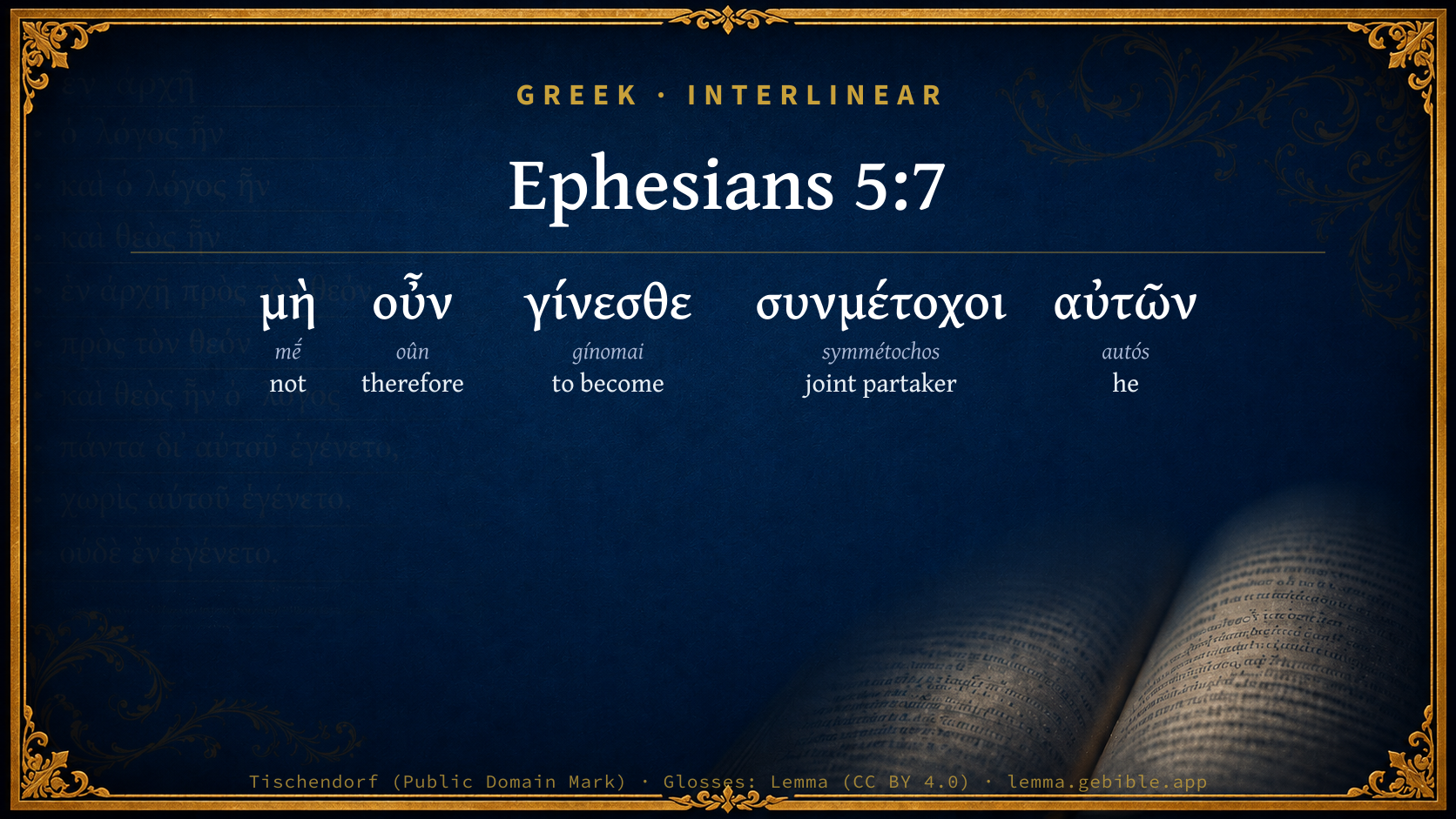
Download image
Cite this verse

Ephesians 5:7 (World English Bible). Public Domain. Lemma interlinear Bible study tool, https://lemma.gebible.app/v/ephesians/5/7.

Show BibTeX & RIS
BibTeX
RIS
English Translation
Therefore don't be partakers with them.
World English Bible · Public Domain
Download a study sheet

One document with this verse’s original text, its word-by-word gloss line, the meaning frame, cross-references with their text, attributed commentary, and full source and license credits — printable, and it pastes into notes with its structure intact.

This verse Autodidact and up

Study sheet (.html) Plain text (.txt)

A passage Seminary Student

Up to 50 verses in one chapter. A passage sheet keeps up to 6 commentary sources and 12 cross-references per verse, in the order this page ranks them, and says so on the sheet whenever that leaves anything out. Ask for a single verse and you get the Autodidact verse sheet above.

Everything on this page stays free to read, with no account — the sheet is a download of what is already on screen, not access to it.

Want to remove ads? Support Godless Engineer
Compare translations 3

The same verse in 3 English versions, stacked beneath the original-language interlinear above. Click any original word for its lexicon entry.

Each is an independent rendering of the whole verse — the interlinear is not word-aligned to these translations.

Highlighted words mark where these versions differ — a whole-verse word diff, not a word-by-word alignment.

  • World English Bible Public Domain
    Therefore don't be partakers with them.
  • King James Version Public Domain
    Be not ye therefore partakers with them.
  • unfoldingWord Literal Text CC BY-SA 4.0
    Therefore, do not become partners with them,

unfoldingWord Literal Text — © unfoldingWord, licensed CC BY-SA 4.0. Word-aligned USFM3 via Door43 (git.door43.org/unfoldingWord/en_ult).

Versions to compare (up to 4)

3 of 4 selected

Show all 19 translations

Every available English version of this verse, each an independent rendering of the whole verse.

  • World English Bible Public Domain
    Therefore don't be partakers with them.
  • Berean Standard Bible Public Domain
    Therefore do not be partakers with them.
  • Majority Standard Bible Public Domain
    Therefore do not be partakers with them.
  • King James Version Public Domain
    Be not ye therefore partakers with them.
  • American Standard Version (1901) Public Domain
    Be not ye therefore partakers with them;
  • Revised Version (1885) Public Domain
    Be not ye therefore partakers with them;
  • Geneva Bible (1599) Public Domain
    Be not therefore companions with them.
  • Douay-Rheims (1899) Public Domain
    Be ye not therefore partakers with them.
  • Young's Literal Translation Public Domain
    become not, then, partakers with them,
  • Literal Standard Version CC BY-SA 4.0
    do not become, then, partakers with them,
  • Unlocked Literal Bible CC BY-SA 4.0
    Therefore, do not join in with them.
  • unfoldingWord Literal Text CC BY-SA 4.0
    Therefore, do not become partners with them,
  • Darby Bible Public Domain
    Be not ye therefore fellow-partakers with them;
  • World Messianic Bible Public Domain
    Therefore don’t be partakers with them.
  • Webster's Bible Public Domain
    Be ye not therefore partakers with them.
  • Free Bible Version CC BY-SA 4.0
    So don't partner with them in this.
  • Bible in Basic English Public Domain
    Have no part with such men;
  • Text-Critical English NT CC BY 4.0
    Therefore do not be partners with them.
  • Tyndale New Testament (1534) Public Domain
    Be not therfore companions with them.

Literal Standard Version (2020), Covenant Press — licensed CC BY-SA 4.0. Text via the HelloAO Bible API (eBible.org). Unlocked Literal Bible (unfoldingWord) — licensed CC BY-SA 4.0. Text via the HelloAO Bible API (eBible.org). unfoldingWord Literal Text — © unfoldingWord, licensed CC BY-SA 4.0. Word-aligned USFM3 via Door43 (git.door43.org/unfoldingWord/en_ult). Free Bible Version, Dr. Jonathan Gallagher — licensed CC BY-SA 4.0. Text via the HelloAO Bible API (eBible.org).

Word by word

More ways to search: Search by grammar → Find every occurrence → Compare this word →

Practice this passage: Drill this verse → Learn its vocabulary →

About this verse

These counts appear in no published source. They are computed here, from the morphology-tagged text and Lemma’s own curated glosses. What Lemma adds →

5
words
5
distinct lemmas
Pauline Epistles
section

Notable vocabulary

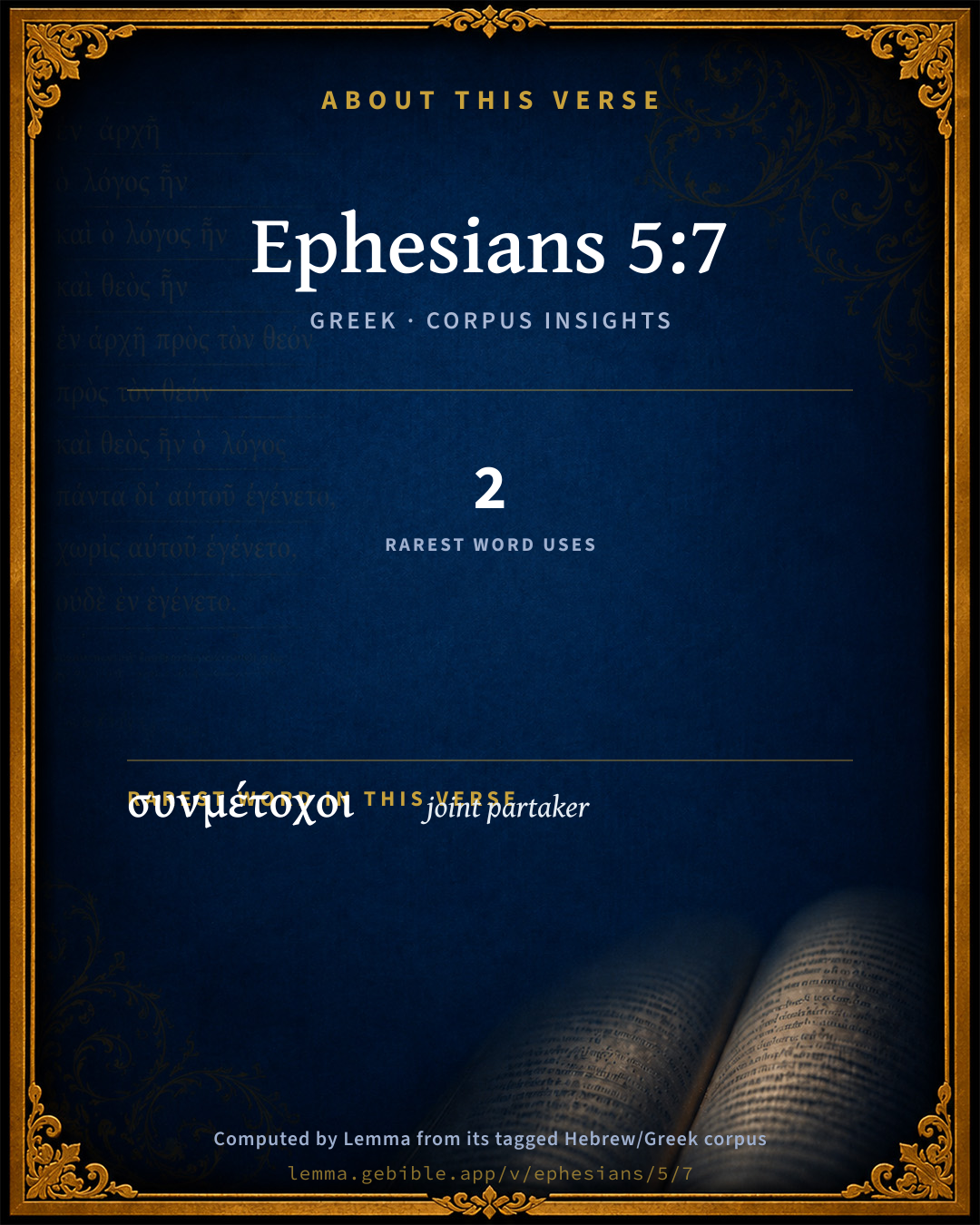
The rarest word here is συνμέτοχοι joint partaker G4830 — appearing just 2 times in the whole Greek New Testament.

Shared distinctive vocabulary

συνμέτοχοι joint partaker G4830 occurs in 2 verses of the Greek New Testament. Also found in:

Cross-references

9

Topical passages linked to Ephesians 5:7 in the Treasury of Scripture Knowledge — connected by theme and wording, ordered by reader-vote popularity; previews shown in the World English Bible.

  • Revelation 18:4 I heard another voice from heaven, saying, "Come out of her, my people, that you have no participation in her sins, and that you don't receive of her plagues,
  • 1 Timothy 5:22 Lay hands hastily on no one, neither be a participant in other men's sins. Keep yourself pure.
  • Ephesians 5:11 Have no fellowship with the unfruitful works of darkness, but rather even reprove them.
  • Numbers 16:26 He spoke to the congregation, saying, Depart, I pray you, from the tents of these wicked men, and touch nothing of theirs, lest you be consumed in all their sins.
  • Psalms 50:18 When you saw a thief, you consented with him, And have participated with adulterers.
  • Proverbs 1:10–17 My son, if sinners entice you, don't consent.
  • Proverbs 13:20 One who walks with wise men grows wise, But a companion of fools suffers harm.
  • Proverbs 9:6 Leave your simple ways, and live. Walk in the way of understanding."
  • Ephesians 3:6 that the Gentiles are fellow heirs, and fellow members of the body, and fellow partakers of his promise in Christ Jesus through the Gospel,

Cross-references courtesy of OpenBible.info (CC BY 4.0).

Commentary

Notes on Ephesians 5:7 from classic Christian and Jewish commentators (each source and its license shown beneath its notes). The classic Christian expositions comment on the surrounding passage and are grouped to its opening verse, so a note may address several verses; the Jewish commentaries on the Tanakh (Rashi and others) are per-verse, so they appear only where the commentator wrote on this verse.

Lemma curates 59 commentaries, every one of them public domain or Creative Commons licensed, each selected and text-cleaned for this edition rather than reprinted as found. About our sources →

The Biblical Illustrator

Joseph S. Exell

Eph_5:7

Be not ye therefore partakers with them.

Fellowship with evil doers

I. Illustrate this fellowship in wickedness.

1. Not to oppose, in many cases, is to embolden transgressors, and to be partakers with them.

2. We have more direct fellowship with the wicked when we encourage them by our example.

3. They who provoke and incite others to evil works have fellowship with them.

(1) This may be done by the propagation of licentious opinions, which confound the difference between virtue and vice.

(2) This may also be effected by direct persuasions and enticements.

4. They who explicitly consent to, and actually join with sinners in their evil works, have fellowship with them.

5. To comfort and uphold sinners in their wickedness is to have fellowship with them.

6. There are some who rejoice in iniquity when they have lent no hand to accomplish it.

II. Apply the apostles arguments.

1. One argument is taken from the superior light which Christians enjoy.

2. Another argument is taken from the grace of the Holy Spirit, of which believers are the subjects.

3. The apostle teaches us that the works of darkness are unfruitful.

4. This is a shameful fellowship.

5. If we have fellowship with sinners in their works we must share with them in their punishment. (J. Lathrop, D. D.)

The children of God should not be partakers with others in their sins

The marrow of this truth lies in knowing how and in what ways we may be in danger to be partakers of other mens sins.

1. By practising the like evils. The apostle seems especially to intend this. Commit not the like sins; act not like the children of disobedience. If ye be imitators of them, you are in some sense partakers with them; and so the Lord may justly punish you for them.

2. By concurring. And this in divers ways.

(1) By contriving. When sin is contrived, there is concurrence of the head, though not of the hand. Thus David was guilty of Uriahs death, though Joab was the actor, and the Ammonites the executioners (2Sa_11:15). Thus Rebekah of Jacobs dissembling. She contrived it, to defeat Esau, though he was the actor. And if he smarted for it in so many hardships after, she had her share in his chastisement. Whoever effect what thou plottest, though thy hand be not in it, though theft be not seen therein, the Lord, who is the searcher of hearts, will charge the sin upon thy soul.

(2) By consenting. Where there is consent to sin, there is a concurrence of the will, though not of the outward man. This consent is always guilty, whether it be free, so Saul was guilty of Stephens death (Act_8:1); or whether it be extorted, so Pilate was guilty of Christs death, though the Jews seemed to overrule him thereto; or whether it be tacit,, and showed no way but by silence.

(3) By inclination. Where there is an inclination to an unlawful act, there is a concurrence of the heart, though the outward man act not.

(4) By rejoicing. When a man is glad that an unlawful act is done by others, he concurs in affection, though not in action. Thus was Ahab guilty of Naboths blood.

(5) By sentence and vote. Thus Saul was guilty of Christians death (Act_26:10).

(6) By assisting. He that contributes anything to the promoting of sin, though he be not the principal actor of it, brings the guilt thereof upon his soul. Thus was Saul also guilty of Stephens death (Act_7:58). He did not cast stones at Stephen; so far as the relation acquaints us, he only kept the clothes of those that stoned him. Yet, promoting this sin but thus far, he made himself guilty of it.

(7) By communicating in the pleasures or profits of sin. Thus panders are guilty of whoredom, and receivers are guilty of theft.

3. By occasioning the sins of others. When we give others occasion to sin, and that may be done many ways.

(1) By evil example. One sin of an exemplary person may occasion many. When magistrates, or ministers, or parents, or masters of families, or anyone eminent in the account of others, makes bold with that which is evil, it is a pregnant sin, has many in the bowels of it. One sin may this way bring along with it the guilt of many thousands.

(2) By the offensive use of things indifferent. Is it not better not to go so high, than to endanger the ruin of others by following thee?

(3) By scandalous sins, either in judgment or practice; for these are not only abominable in themselves, and the occasions of sin in others by example, but also in a more dangerous and dreadful way, by strengthening the hands of sinners, and opening their mouths to blaspheme.

(4) By provoking. He that says or does that which provokes another to sin is at least the occasion of it. Hence the apostle advises so often to beware of this (Gal_5:26; Eph_6:4).

(5) By ensnaring. Those whose garb, gestures, words, are as snares, may justly be accounted occasions of sin, and so guilty of those iniquities wherein they ensnare others.

(6) By leading others into temptations. Thus was Eve guilty, not only of her own, but of her husbands sin (Gen_3:6).

(7) By showing opportunities to sin. Thus Judas was guilty of crucifying Christ by showing the Jews an opportunity to apprehend and crucify Him.

(8) By affording matter of sin to others, that which they know or suspect will be sinfully abused, hereby occasion their sin, and partake in their guilt:

(9) By not removing the occasions of sin. When costly apparel becomes an occasion of pride, or delicate fare an occasion of intemperance, etc. Those that have power, magistrates, parents, should reduce them to necessaries, who abuse superfluities, else they are in danger of a participation in others guilt. I might exemplify this in many particulars.

(10) By authorising. When those are put into such place and office, as they are not fit, not qualified for, those that are instrumental in calling them thereto are accessory to their sinful miscarriages in the managing thereof.

4. By causing. He that is the cause of anothers sin, partakes thereof, not only as an accessory, but many times as a principal. Now, one may be the cause of anothers sin many ways.

(1) By commanding.

(2) By threatening.

(3) By counselling and persuading.

(4) By alluring.

(5) By deriding.

(6) By boasting of sin.

(7) By hiring others to sin.

(8) By countenancing the sins of others.

He that is a countenencer of others sins, is a partaker of other mens sin; and that sometimes of sins past, sometimes of future sins. Now, ye may countenance the sins of others, and so be accessory to them, many ways.

(1) By defending them.

(2) By justifying others sins.

(3) By extenuating of others sins.

(4) By commending.

(5) By conniving.

(6) By company.

(7) By rejoicing.

6. By not hindering sin. He that hinders not others from sinning is in danger thereby to partake of their sins. He that hinders not others from doing evil, does the evil himself; is guilty of, accessory to it.

(1) By not punishing, censuring, correcting, in State, Church, families.

(2) By not complaining of sin. He that has not power to punish sin may complain of it to those that have power; and he that complains not is in danger to be accessory to the sin which he conceals. I confess there are many temptations to keep men from the practice of this duty. It is counted odious to be an accuser; and so it is, when it proceeds from spite, malice, and revenge, and not from tenderness to the glory of God and thy brothers soul; but against the temptations which may hinder thee from complaining of others sins, set the danger of sin to him, to thee, and the command of God; see how strictly and punctually He enjoins it without respect of persons and relations, how near and dear soever (Deu_13:6; Deu_13:8).

(3) By not reproving or admonishing sinners. He that rebukes not, nor does not admonish, according to the quality of those who are guilty, makes himself guilty with them (Lev_19:17). To reprove another is a thankless office, and carnal men take it as an expression of hatred; but see how the Lord judges of it: He that rebukes not his brother does hate him in his heart.

(4) By not mourning for it. He that mourns not for the sins of others is in danger to partake of them. Mourning is a means to hinder the increase of sin; he that bewails not the sins of others does not what he can to hinder them, and so may be accessory to them.

(5) By not praying against the sins of others. Prayer is a sovereign means to hinder sin. He that prays not against it is accessory to it, by not endeavouring to hinder it.

(6) By not affording means whereby sin may be hindered. He that denies others the means requisite to the avoiding of sin, when it is his duty to afford them, is accessory to the sins of others by not hindering them; e.g., as we say, he that denies a man food, without which death cannot be prevented, is accessory to his death.

(7) By not applying severe providences for the hindering of sin. The Lord sometimes speaks from heaven against sin by remarkable acts of providence. (D. Clarkson, B. D.)

The Biblical Illustrator, edited by Joseph S. Exell (c. 1880s–1900s) — public domain. Text from a community e-Sword module.

The Expositor's Bible

Chapter 23

THE CHILDREN OF THE LIGHT

Eph_5:7-14

The contrast between the Christian and heathen way of life is now, finally, to be set forth under St. Pauls familiar figure of the light and the darkness. He bids his Gentile readers not to be "jointpartakers with them"-with the sons of disobedience upon whom Gods wrath is coming (Eph_5:6) -for he has hailed them already, in Eph_3:6, as "joint-partakers of the promise in Christ Jesus through the gospel." "Once" indeed they shared in the lot of the disobedient; but for them the darkness has past, and the true light now shineth.

In wrath or promise, in hope of life eternal or in the fearful looking for of judgment they, and we, must partake. This future participation depends upon present character. "Do not," the apostle entreats, "cast in your lot again with the unclean and covetous. Their ways you have renounced, and their doom you have exchanged for the heritage of the saints. Let no vain words deceive you into supposing that you may keep your new inheritance, and yet return to your old sins. Show yourselves worthy of your calling. Walk as children of the light, and you will possess the eternal kingdom." Each man carries with him into the next state of being the entail of his past life. That heritage depends on his own choice; yet not upon his individual will working by itself, but on the grace and will of God working with him, as that grace is accepted or rejected. He has light: he must walk in it; and he will reach the realm of light. Thus the apostle, in Eph_5:7-8, concludes his warning against relapse into heathen sin.

Eph_5:9-10 delineate the character of the children of the light: Eph_5:11-14 set forth their influence upon the surrounding darkness. Into these two divisions the exposition of this paragraph naturally falls.

I. "The fruit of the light" (not of the Spirit) is the true text of Eph_5:9, as it stands in the older Greek copies, Versions, and Fathers. Calvin showed his judgment and independence in preferring this reading to that of the received Greek text. Similarly Bengel, and most of the later critics. The sentence is parenthetical, and contains a singular and instructive figure. It is one of those sparks from the anvil, in which great writers not unfrequently give us their finest utterances, -sentences that get a peculiar point from the eagerness with which they are struck off in the heat and clash of thought, as the mind reaches forward to some thought lying beyond. The clause is an epitome, in five words, of Christian virtue, whose qualities, origin, and method are all defined. It sums up exquisitely the moral teaching of the epistle. Gal_5:22-23 (the fruit of the Spirit) and Php_4:8 (Whatsoever things are true, etc.) are parallel to this passage, as Pauline definitions, equally perfect, of the virtues of a Christian man. This has the advantage of the others in brevity and epigrammatic point.

"You are light in the Lord," the apostle said; "walk as children of the light." But his readers might ask: "What does this mean? It is poetry: let us have it translated into plain prose. How shall we walk as children of the light? Show us the path."-"I will tell you," the apostle answers: "the fruit of the light is in all goodness and righteousness and truth. Walk in these ways; let your life bear this fruit; and you will be true children of the light of God. So living, you will find out what it is that pleases God, and how joyful a thing it is to please Him (Eph_5:10). Your life wilt then be free from all complicity with the works of darkness. It will shine with a brightness clear and penetrating, that will put to shame the works of darkness and transform the darkness itself. It will speak with a voice that all must hear, bidding them awake from the sleep of sin to see in Christ their light of life." Such is the setting in which this delightful definition stands.

But it is more than a definition. While this sentence declares what Christian virtue is, it signifies also whence it comes, how it is generated and maintained. It asserts the connection that exists between Christian character and Christian faith. The fruit cannot be grown without the tree, any more than the tree can grow soundly without yielding its proper fruit.

Right is the fruit of light.

The principle that religion is the basis of moral virtue is one that many moralists disputed in St. Pauls time; and it has fallen into some discredit in our own. In philosophical theory, and to a large extent in popular maxim and belief, it is assumed that faith and morals, character and creed, are not only distinct, but independent things, and that there is no necessary connection between the two. Christians are themselves to blame for this fallacy, through the discrepancy not seldom visible between their creed and life. Our narrowness of view and the harshness of our ethical judgments have helped to foster this grave error.

Great Christian teachers have spoken of the virtues of the heathen as "splendid sins." But Christ and His Apostles never said so. He said: "Other sheep I have, which are not of this fold." And they said: "In every nation he that feareth God and worketh righteousness, is accepted of Him." The Christian creed has no jealousy in regard to human excellence. "Whatsoever things are true and honourable and just and pure," wherever and in whomsoever they arc found, our faith honours and delights in them, and accepts them to the utmost of their worth. But then it claims them all for its own, -as the fruit of the one "true light which lighteth every man," Wherever this fruit appears, we know that that light has been, though its ways are past finding out. Through secret crevices, by subtle refractions and multiplied reflections, the true light reaches many a life lying far outside its visible course.

All goodness has one source; for, said Jesus, "there is none good but one, that is God." The channels may be tortuous, obstructed and obscure: the stream is always one. There is nothing more touching, and nothing more encouraging to our faith in Gods universal love and His will that all men should be saved, than to see, as we do sometimes under conditions most adverse and in spots the most unlikely, features of moral beauty and Christlike goodness appearing like springs in the desert or flowers blooming in Alpine snows, -signs of the universal light,

"Which yet in the absolutest drench of dark Neer wants its witness, some stray beauty-beam To the despair of hell!"

The action of Gods grace in Christ is by no means limited to the sphere of its recognised working. All the more earnestly on this account do we vindicate this grace against those who deny its necessity or the permanence of its moral influence. The fruit, in the main, they approve. But they would cut down the plant from which it came; they seek to quench the light under which it grew. They are like men who should take you to some lofty tree that has flourished for ages rooted in the rock, and who should say: "See how wide its branches and how stout its stem, how firmly it stands upon its native soil! Let us cut it loose from those dark and ugly roots-that mysterious theology, those superstitions of the past. The human mind has outgrown them. Virtue can support itself on its own proper basis. It is time to assert the dignity of man, and to proclaim the independence of morality." If these men have their way, and if European society renounces the authority of God, how quickly will that tree of the Lords planting, the vast growth of Christian virtue and beneficence, wither to its topmost bough; and the next storm will bring it to the ground, with all its stately strength and summer beauty. Unbelief in God lays the axe at the root of human society. Our life-the life of individuals, of families and nations-is rooted in the unseen and hid with Christ in God. Thence it draws its vitality and virtue, through those spiritual fibres by which we are linked to God and lay hold on eternal life. Since Christ Jesus our forerunner entered the heavenly places the anchor of human hope has been cast within the veil; if that anchor drags, there is no other that will hold. The rocks are plain to see on which our richly freighted ship of life will founder. Without the religion of Jesus Christ our civilisation is not worth a hundred years purchase.

Moral effects do not follow upon their causes as rapidly as physical effects: they follow as certainly. We live largely upon the accumulated ethical capital of our forefathers. When that is spent, we are left to our intrinsic poverty of soul, to our faithlessness and feebleness. The scepticism of one generation bears fruit in the immorality of the next, or the next after that; the unbelief and cynicism of the teacher in the vice of his disciple. Such fruit of blasting and mildew the decay of faith has never failed to bear.

The corresponding truth will be at once acknowledged. There is no real religion without: virtue. If the godly man is not a good man, if he is not a sincere and pure-hearted man, "that mans religion is vain": no matter what his professions or his emotions, no matter what his services to the Church. He is one of those to whom-Jesus Christ will say: "I know you not; depart from me, all ye that work iniquity." There is a flaw in him somewhere, a rift within the lute that spoils all its music. "A good tree cannot. bring forth corrupt fruit."

In Christs garden there forms in clustered beauty and perfectness the ripe growth of virtue, which in the sunshine of His love and under the freshening breath of His Spirit sends forth its spices and "yieldeth its fruit every month." In it there abide goodness, righteousness, truth- these three; and who shall say which of them is greatest?

I. Goodness stands first, as the most visible, and obvious form of Christian excellence, -that which every one looks for in a religious man, and which every one admires when it is to be seen. Righteousness, regarded by itself, is not so readily appreciated. There is something austere and forbidding in it. "For a righteous man scarcely would one die"-you respect, even revere him; but you do not love him: "but for the good man peradventure, one would even dare to die." Christian goodness is the sanctification of the heart and its affections, renewed and governed by the love of God in Christ. It is, notwithstanding, but seldom inculcated in the New Testament; because it is referred to its spring and principle in love. Goodness is love embodied. "Now love us He loved us, and bent His Son to be the propitiation for our sins." This is the faith that makes good men, -the best the world has ever known, the best that it holds now. Vanity, selfishness, evil temper and desire are shamed-and burnt out of the soul by the holy fire of the love of God in Jesus Christ our Lord. In the warm, tender light of the cross the heart is softened and cleansed, and expanded to the widest charity, it becomes the home of all generous instincts and pure affections. So "the fruit of the light is in all goodness."

II. And righteousness.

This second and central definition applies a searching test to all spurious forms of goodness, superficial or sentimental, -to the goodness of mere good manners, or good nature. The principle of righteousness, fully understood, includes everything in moral worth, and is often used to denote in one word the entire fruit of Gods grace in man. For righteousness is the sanctification of the conscience. It is loyalty to Gods holy and perfect law. It is no mere outward keeping of formal rules, such as the legal righteousness of Judaism, no submission to necessity or calculation of advantages: it is a love of the law in a mans inmost spirit; it is the quality of a heart one with that law, reconciled to it as it is reconciled to God Himself in Jesus Christ.

At the bottom, therefore, righteousness and goodness are one. Each is the counterface and complement of the other. Righteousness is to goodness as the strong backbone of principle, the firm hand and the vigorous grasp of duty, the steadfast foot that plants itself on the eternal ground of the right and true and stands against a worlds assault. Goodness without righteousness is a weak and fitful sentiment: righteousness without goodness is a dead formality. He cannot love God or his neighbour truly, who does not love Gods law; and he knows nothing aright of that law, who does not know that it is the law of love.

This also, this above all is "the fruit of the light." Two watchwords we have from the lips of Jesus, two mottoes of His own life and mission, -the one given at the end, the other at the beginning of His course: "Greater love hath none than this, that one lay down his life for his friends"; and, "Thus it becometh us to fulfil all righteousness." By a double flame was He consumed a sacrifice upon the cross, -by the passion of His zeal for Gods righteousness, and by the passion of His pity for mankind. In that twofold light we see light, and become "light in the Lord." Therefore the fruit of the light, the moral product of a true faith in the gospel, is in all goodness and righteousness.

There is a danger of merging the latter in the former of these attributes. Evangelical piety is credited with an excess of the sentimental and emotional disposition, cultivated at the expense of the more sterling elements of character. High principle, scrupulous honour, stern fidelity to duty are no less essential to the image of Christ in the soul than are warm feeling and zealous devotion to his service, Jesus Christ the righteous, as His apostles loved to call Him, is the pattern of a manly faith, up to which we must grow in all things. "He is the propitiation for our sins." Never was there an act of such unswerving integrity and absolute loyalty to the law of right as the sacrifice of Calvary. God forbid that we should magnify love at the expense of law, or make good feeling a substitute for duty.

III. Truth comes last in this enumeration, for it signifies the inward reality and depth of the other two.

Truth does not mean veracity alone, the mere truth of the lips. Heathen honesty goes as far as this. Men of the world expect as much from each other, and brand the liar with their contempt. Truth of words requires a reality behind itself. The acted falsehood is excluded, the hinted and intended lie no less than that expressly uttered. Beyond all this is the truth of the man that God requires-speech, action, thought, all consistent, harmonious, and transparent, with the. light of Gods truth shining through them. Truth is the harmony of the inward and the outward, the correspondence of what the man is in himself with that which he appears and wishes to appear to be.

Now, it is only Children of the light, only men thoroughly good and upright, who can, in this strict sense, be men of truth. So long as any malice or iniquity is left in our nature, we have something to conceal. We cannot afford to he sincere. We are compelled to pay, by very shame, the degrading tribute which vice renders to virtue, the homage of hypocrisy. But find a man whose intellect, whose heart and will, tried at whatever point, ring sound and true, in whom there is no affectation, no make-believe, no pretence or exaggeration, no discrepancy, no discord in the music of his life and thought, "an Israelite indeed, in whom is no guile"-there is a saint for you, and a man of God; there is one whom you may "grapple to your soul with hooks of steel." Truth is the hall-mark of entire sanctification; it is the highest and rarest attainment of the Christian life. It is equally the charm of an innocent, unspoilt childhood, and of a ripe and purified old age. The apostle John, "the disciple whom Jesus loved," is the most perfect embodiment, after his Master, of this consummating grace. In him righteousness and love were blended in the translucence of an utter simplicity and truth.

We must beware of giving a subjective and merely personal aspect to this divine quality. While truth is the unity of the outward and inward, of heart and act and word in the man, it is at the same time the agreement of the man with the reality of things as they exist in God. The former kind of truth rests upon the latter; the subjective upon the objective order. The truth of God makes us true. We magnify our own sincerity until it becomes vitiated and pretentious. In our eagerness to realise and express our own convictions, we give too little pains to form them upon a sound basis; we make a great virtue of speaking out what is in our hearts, but take small heed of what comes in to the heart, and speak out of a loose self-confidence and idolatry of our own opinions. So the Pharisees were true, who called Christ an impostor. So every careless slanderer, and scandalmonger credulous of evil, who believes the lies he propagates. "Imagination has pictured to itself a domain in which every one who enters should be compelled to speak only what he thought, and pleased itself by calling such domain the Palace of Truth. A palace of veracity, if you will; but no temple of the truth. A place where each one would be at liberty to utter his own crude unrealities, to bring forth his delusions, mistakes, half-formed, hasty judgments; where the depraved ear would reckon discord harmony, and the depraved eye mistake colour; the depraved moral taste take Herod or Tiberius for a king, and shout beneath the Redeemers cross, Himself He cannot save! A temple of the truth? Nay, only a palace echoing with veracious falsehoods, a Babel of confused sounds, in which egotism would rival egotism, and truth would be each mans own lie." In the pride of our veracity, we miss the verity of things; we are true only to our blind self, false to the light of God. "Every one that is of the truth heareth my voice": so said He who was truth incarnate, making His word a law for all true men. "In all goodness and righteousness and truth," says the apostle. Let us seek them all. We are apt to become specialists in virtue, as in other departments of life. Men will endeavour even to compensate by extreme efforts in one direction for deficiencies in some other direction, which they scarcely desire to make good. So they grow out of shape, into oddities and moral malformations. There is a want of balance and of finish about a multitude of Christian lives, even of those who have long and steadily pursued the way of faith. We have sweetness without strength, and strength without gentleness, and truth spoken without love, and words of passionate zeal without accuracy and heedfulness.

All this is infinitely sad, and infinitely damaging to the cause of our religion.

"It is the little rift within the lute That by-and-by will make the music mute And ever widening slowly silence all; The little rift within the lovers lute, Or little pitted speck in garnered fruit, That rotting inward slowly moulders all."

Let us judge ourselves, that we be not judged by the Lord. Let us count no wrong a trifle. Let us never imagine that our defects in one kin will be atoned for by excellences in another. Our friends may say this, in charity, for us; it is a fatal thing when a man begins to say so to himself. "May the God of peace sanctify you fully. May your whole spirit, soul, and body in blameless integrity be preserved to the coming of the Lord Jesus Christ." {1Th_5:23}

I. The effect upon surrounding darkness of the light of God in Christian lives is described in Eph_5:11-14, in words which it remains for us briefly to examine.

Eph_5:12 distinguishes "the things secretly done" by the Gentiles, "of which it is a shame even to speak," from the open and manifest forms of evil in which they invite their Christian neighbours to join (Eph_5:11). Instead of doing this and having fellowship with the "unfruitful works of darkness," they must "rather reprove them." Silent absence, or abstinence is not enough. Where sin is open to rebuke, it should at all hazards be rebuked. On the other hand, St. Paul does not warrant Christians in prying into the hidden sins of the world around them and playing the moral detective. Publicity is not a remedy for all evils, but a great aggravation of some, and the surest means of disseminating them. "It is a shame"-a disgrace to our common nature, and a grievous peril to the young and innocent-to fill the public prints with the nauseous details of crime and to taint the air with its putridities.

"But all things," the apostle says-whether it be those open works of darkness, profitless of good, which expose themselves to direct conviction, or the depths of Satan that hide their infamy from the light of day-"all things being reproved by the light, are made manifest" (Eph_5:13). The fruit of the light convicts the unfruitful works of darkness. The daily life of a Christian man amongst men of the world is a perpetual reproof, that tells against secret sins of which no word is spoken, of which the reprover never guesses, as well as against open and unblushing vices.

"This is the condemnation," said Jesus, "that light is come into the world." And this condemnation every one who walks in Christs steps, and breathes His Spirit amid the corruptions of the world, is carrying on, more frequently in silence than by spoken argument. Our unconscious and spontaneous influence is the most real and effective part of it. Life is the light of men-words only are the index of the life from which they spring. Just so far as our lives touch the conscience of others and reveal the difference between darkness and light, so far do we hold forth the word of life and carry on the Holy Spirits work of convincing the world of sin. "Let your light so shine."

This manifestation leads to a transformation: "For every thing that is made manifest is light" (Eph_5:13). "You are light in the Lord," St. Paul says to his converted Gentile readers, -"you who were "once darkness," once wandering in the lusts and pleasures of the heathen around you, without hope and without God. The light of the gospel disclosed, and then dispelled the darkness of Sat former time; and so it may be with your still heathen kindred, through the light you bring to them. So it will be with the night of sin that is spread over the world. The light which shines upon sinladen and sorrowful hearts shines on them to change them into its own nature. The manifested is light: in other words, if men can be made to see the true nature of their sin, they will forsake it. If the light can but penetrate their conscience it will save them." Wherefore He saith:-

"Awake, O sleeper; and arise from out of the dead! And the Christ shall dawn upon thee!"

The speaker of this verse can be no other than God, or the Spirit of God in Scripture. The sentence is no mere quotation. It re-utters, in the style of Marys or Zechariahs song, the promise of the Old Covenant from the lips of the New. It gathers up the import of the prophecies concerning the salvation of Christ, as they sounded in the apostles ears and as he conveyed them to the world. Isa_60:1-3 supplies the basis of our passage, where the prophet awakens Zion from the sleep of the Exile and bids her shine once more in the glory of her God and show forth His light to the nations: "Arise, " he cries, "shine, for thy light is. come!" There are echoes in the verse, besides, of Isa_51:17, Isa_26:19; perhaps even of Jon_1:6 : "What meanest thou, O sleeper? arise and call upon thy God!" We seem to have here, as in Eph_4:4-6, a snatch of the earliest Christian hymns. The lines are a free paraphrase from the Old Testament, formed by weaving together Messianic passages-belonging to such a hymn as might be sung at baptisms in the Pauline Churches. Certainly those Churches did not wait until the second century to compose their hymns and spiritual songs (comp. Eph_5:19). Our Lords sublime announcement, {Joh_5:25} already verified, that "the hour had come when the dead should hear the voice of the Son of God, and they that heard should live," gave the key to the prophetic sayings which promised through Israel the light of life to all nations.

With this song on her lips the Church went forth, clad in the armour of light, strong in the joy of salvation; and darkness and the works of darkness fled before her.

William Robertson Nicoll, ed., The Expositor's Bible (London: Hodder & Stoughton, 1887–1910) — public domain. 65 of 66 books (1 Corinthians is not separately keyed, as that volume carries no machine-parseable verse references); section-level commentary keyed to the opening verse. Introductory and overview sections not keyed to a specific passage are excluded.

Tyndale Open Study Notes

Tyndale Open Resources

5:7 Don’t participate: Cp. 2 Cor 6:14–7:1.

Tyndale Open Study Notes — © Tyndale Open Resources, licensed CC BY-SA 4.0. Text via the HelloAO Bible API.

Bengel's Gnomon

Johann Albrecht Bengel

Eph 5:7. Μὴ, be not) lest the anger of God should come upon you. Two parts; be not willing, and be not willing, Eph 5:7; Eph 5:11. Fellowship both with wicked men, Eph 5:7, and with wicked works, Eph 5:11, must be avoided.

Bengel's Gnomon of the New Testament — English translation (T&T Clark, Edinburgh, 1860) — public domain. Text from a community e-Sword module.

Meyer's Critical & Exegetical Commentary

Heinrich August Wilhelm Meyer

Eph_5:7. Οὖν] since on account of these sins, etc.

συμμέτοχοι αὐτῶν] αὐτῶν can, in keeping with the context, only be referred to the υἱοὺς τῆς ἀπειθ., whose co-partners the Christians become, if they practise the same sins, whereby they fall from the state of reconciliation (Rom_11:22; 2Pe_3:17) and incur the divine ὀργή (Eph_5:5). Koppes interpretation: ejusdem cum iis fortunae compotem fieri, is an importation at variance with the context (see Eph_5:8-11).

As to συμμέτοχος, see on Eph_3:6.

Meyer — Critical and Exegetical Commentary on the New Testament — English translation by Peter Christie, edited by Frederick Crombie (T&T Clark, 1880) — public domain. Text from a community e-Sword module.

Expositor's Greek Testament

ed. W. Robertson Nicoll

Eph 5:7 . μὴ οὖν γίνεσθε συμμέτοχοι αὐτῶν : become not ye then partakers with them . γίνεσθε again = “do not become,” “suffer not yourselves to be”; not ἐστε , “be not”. What is meant is a possible falling back into ways by grace forsaken. The participation which is negatived is obviously taking part with the sons of disobedience ( αὐτῶν ) in their vices , not merely in their punishment or in the ὀργή . The term συμμέτοχος (or συνμέτοχος , TWH) occurs only here and in Eph 3:6 above. The οὖν has the force which it has in Eph 5:1 , giving the inference to be drawn from the statement of the wrath of God .

The Expositor's Greek Testament, edited by W. Robertson Nicoll (1897–1910) — public domain. Text from a community e-Sword module.

Hodge's Commentary on Romans, Ephesians & First Corinthians

Charles Hodge

Eph_5:7

Such being the determination of God to punish the unclean and the covetous, the apostle says, Be ye not therefore partakers with them. That is, be not their associates in these sins, which of necessity would expose you to the penalty threatened against them.

Charles Hodge — Commentary on Romans (1835), First Corinthians (1857), and Ephesians (1856) — public domain. Text from a community e-Sword module.

Geneva Bible (1599)

Geneva Bible translators

Because we are not so ready to anything as to follow evil examples, therefore the Apostle warneth the godly to remember always that the others are but as it were darkness, and that they themselves are as it were light. And therefore the others commit all villany (as men are wont in the dark) but they ought not only not to follow their examples, but also (as the property of the light is) reprove their darkness, and to walk so (having Christ that true light going before them) as it becometh wise men.

Geneva Bible (1599) marginal notes — public domain. Text via Bolls.life.

Jamieson, Fausset & Brown

Robert Jamieson, A. R. Fausset & David Brown

Here fellowship with wicked workers is forbidden; in Eph 5:11, with their wicked works.

Jamieson, Fausset & Brown — Commentary Critical and Explanatory on the Whole Bible (1871) — public domain (CC PDM 1.0). Text via the HelloAO Bible API.

Adam Clarke's Commentary

Verse 7. Be not ye therefore partakers with them] Do not act as your fellow citizens do; nor suffer their philosophy, to it in vain words, κενοις λογοις, with empty and illusive doctrines, to lead you astray from the path of truth.

That there was much need for such directions and cautions to the people of Ephesus has been often remarked. It appears, from Athenaeus, that these people were addicted to luxury, effeminacy c. He tells us that the famous Aspasia, who was herself of the Socratic sect, brought a vast number of beautiful women into Greece, and by their means filled the country with prostitutes, και επληθυνεν απο των ταυτης ἑταιριδων ἡ Ελλας, lib. xiii. cap. 25. Ibid. cap. 31, he observes that the Ephesians had dedicated temples εταιρα αφροδιτη, to the prostitute Venus and again, cap. 32, he quotes from Demosthenes, in Orat. contra Neaeram: τας μεν ἑταιρας ἡδονης ἑνεκα εχομεν, τας δε παλλακας της καθ' ἡμεραν παλλακειας, τας δε γυναικας του παιδοποιεισθαι γνησιως, και των ενδον φυλακα πιστην εχειν· "We have whores for our pleasure, harlots for daily use, and wives for the procreation of legitimate children, and for the faithful preservation of our property." Through the whole of this 13th book of Athenaeus the reader will see the most melancholy proofs of the most abominable practices among the Greeks, and the high estimation in which public prostitutes were held; the greatest lawgivers and the wisest philosophers among the Greeks supported this system both by their authority and example. Is it not in reference to their teaching and laws that the apostle says: Let no man deceive you with vain words?

Adam Clarke's Commentary on the Bible (1810–1826) — public domain. Text from a community e-Sword/MySword module.

The Cambridge Bible for Schools and Colleges

gen. ed. J. J. S. Perowne

7. Be not] Lit., Become not. Nolite fieri (Latin versions).

partakers] in disobedience, and so in the coming wrath.

The Cambridge Bible for Schools and Colleges (gen. ed. J. J. S. Perowne; Cambridge University Press, 1878–1918) — public domain. Text from a community e-Sword module.

John Gill's Exposition

Be not ye therefore partakers with them. In their sins, and acts of disobedience; by keeping needless company with them; by abetting and encouraging sinful practices; by conniving at them, and not reproving for them; or by committing the same things.

Be not ye therefore partakers with them. In their sins, and acts of disobedience; by keeping needless company with them; by abetting and encouraging sinful practices; by conniving at them, and not reproving for them; or by committing the same things.

Ephesians 5:8

eph 5:8

eph 5:8

eph 5:8For ye were sometimes darkness,.... Not only dark, but darkness itself; exceeding blind, dark, and ignorant, respecting spiritual things; so the Gentiles were wont to be called by the Jews, "darkness" (k) itself; of this darkness; see Gill on Eph 4:18.

But now are ye light in the Lord; either in, or by the Lord Jesus Christ, the light of men, from whom all spiritual light comes; or by the Lord the Spirit, by whom the eyes of their understandings were enlightened, to see the exceeding sinfulness of sin, in heart and life; the insufficiency of their own righteousness and moral virtues, to justify them before God; and the true and right way of righteousness, life and salvation by Christ; and to have some light into the several doctrines of the Gospel, and even a glimpse of the invisible glories and realities of another world: and this light is so great, that they are not only said to be enlightened, but to be light itself; and this they have not of, and from themselves, but the Lord; and therefore should

walk as children of light; not in sins, which are works of darkness, but in faith, truth, and holiness.

(k) Tzeror Hammor, fol. 1. 2.

John Gill's Exposition of the Whole Bible (1746–1763) — public domain (CC PDM 1.0). Text via the HelloAO Bible API.

Trapp's Complete Commentary

John Trapp

7 Be not ye therefore partakers with them.

Ver. 7. Be not ye therefore partakers] Lest by infection of their sin ye come under infliction of their punishment. We are accountable as well for sins of communion as of commission; and he knew what he said, that prayed, From mine other men’s sins, good Lord, deliver me. Evil men endanger good men as weeds the corn, as bad humours the blood, or an infected house the neighbourhood. And when an overflowing storm sweeps away the wicked, the tail of it may dash their best neighbours, Zec 9:3. Hamath lay near to Damascus in place, and therefore partook with it in punishment.

John Trapp, A Commentary or Exposition upon All the Books of the Old and New Testament (1647–1656) — public domain. Text from a community e-Sword module.

Albert Barnes' Notes on the Bible

Be not ye therefore partakers with them - Since these things displease God and expose to his wrath, avoid them.

Albert Barnes' Notes on the Bible (1834–1885) — public domain. Text from a community e-Sword/MySword module.

Haydock's Catholic Bible Commentary

Be ye not, therefore, partakers with them: do not imitate their wickedness, or the wrath of the Almighty will likewise fall on you. (Estius)

George Leo Haydock (1774–1849), Haydock's Catholic Family Bible and Commentary, 1859 edition — public domain. Excludes Psalms (Douay-Rheims chapter numbering differs from Protestant) and Deuterocanonical books (Catholic canon only).

Matthew Poole's English Annotations

With those children of disobedience, who continue in the forementioned sins: see Job 34:8; Psa 50:18.

Matthew Poole's English Annotations on the Holy Bible (1683–1685) — public domain. Text from a community e-Sword/MySword module.

Whedon's Commentary on the Bible

Daniel D. Whedon

7. Be—Rather, become. Note, Eph_4:32.

Daniel D. Whedon (gen. ed.), Commentary on the Old and New Testaments (1874–1909) — public domain. Text from a community e-Sword module.

The Pulpit Commentary

Be not ye therefore partakers with them. If you are partakers of their sins, you must be of their punishments too. Refuse all partnership, therefore. Your natural instincts recoil from partnership in punishment; let your spiritual instincts recoil from partnership in sin.

Separation from evil.

The apostle counsels believers not to be partakers with sinners. That is, in their sins, not their punishment. We are here taught

I THAT IT IS POSSIBLE FOR BELIEVERS TO PARTAKE OF THE SINS OF OTHERS. They may do so by conniving at them, by not checking or punishing them, by not mourning over them, as well as by actually committing them. It is a dishonor to God, a lure to others, a mischief to ourselves, to stand in the way of transgressors.

II THAT BELIEVERS OUGHT TO MAINTAIN A VERY SEPARATE WALK IN THE WORLD. They who have named the name of Christ ought to depart from iniquity. (2Ti_2:19) The cry to them ever is," Come out from among them, and be ye separate". (2Co_6:17) There is no common standing-room for Christ and Belial in the Church. This does not countenance our separation from society; for Jesus, who was" separate from sinners," was always in society that he might win stoners to God. Our walk is yet to be as separate as it is to be circumspect, that we may stand apart from the plagues that will descend upon a doomed world. T.C.

The Pulpit Commentary (1880–1919), ed. H.D.M. Spence-Jones & Joseph S. Exell — public domain. Text from a community e-Sword module.

The People's New Testament

B. W. Johnson

7. Partakers. Have no share with them in their sins.

B. W. Johnson's The People's New Testament with Notes (1889–1891) — public domain. Electronic text from the Christian Classics Ethereal Library (CCEL) ThML edition.

Cambridge Greek Testament for Schools and Colleges

7. μὴ γίνεσθε, ‘do not develope into,’ ‘prove in the end,’ implying danger, but not actual failure, cf. Eph 5:17.

συνμέτοχοι, ct. Eph 3:6. There is solidarity in evil as well as in good. The tares are bound into bundles (Mat 13:30) for burning.

Cambridge Greek Testament for Schools and Colleges (Cambridge University Press, 1896; 21 vols, various authors incl. Carr, Maclear, Plummer, Farrar, Lumby, Moule, M. R. James, Simcox) — public domain. Text from a community e-Sword module.

Alford’s Greek Testament

Henry Alford

7.] Be not (the distinction ‘Become not’ (‘nolite effici,’ Vulg.: so Stier, Ellic., al.) is unnecessary and indeed unsuitable: it is not a gradual ‘becoming,’ but ‘being,’ like them, which he here dehorts from. See on γίνεσθε not bearing the meaning “become,” note, ch. 4. ult.) therefore (since this is so—that God’s wrath comes on them) partakers (see ch. 3:6) with them (the νἱοὶ τ. ἀπ., not the sins:—sharers in that which they have in common, viz. these practices: their present habitude, not, their punishment, which is future: nor can the two senses be combined, as Stier characteristically tries to do).

Henry Alford, The Greek Testament (1849–1861) — public domain. Text from a community e-Sword module.

International Critical Commentary

7. μὴ οὖν γίνεσθε συμμέτοχοι αὐτῶν. “Do not therefore become partakers with them.” αὐτῶν refers to the persons, not the sins (as Braune). This sharing is by some understood of sharing in their punishment, but by most expositors of sharing in their sins; Stier combines both, and not unreasonably, since it has just been said that these sins bring punishment, and the sense naturally is : Have nothing in common with them, for ye surely do not desire to share the wrath with them.

International Critical Commentary — older volumes (1896–1929), various authors — public domain. Text from a community e-Sword module.

Vincent's Word Studies in the New Testament

Marvin R. Vincent

Be not [γινεσθε] . Lit., become not. It is a warning against lapsing into old vices.

Marvin R. Vincent, Word Studies in the New Testament (1887–1900) — public domain. Text from a community e-Sword/MySword module.

Lesson kit

Teaching starters — assembled from the data on this page, not authored interpretation. Every prompt links to the verse data it draws on. Edit before teaching.

Ephesians, in the Pauline Epistles, opens this verse with 5 words (5 distinct Greek lemmas). Its most distinctive word is symmétochos (“joint partaker”). A historical commentator’s framing appears above. Read the whole chapter for the surrounding context.

Discussion questions

  1. The word symmétochos carries the sense “joint partaker.” How does it shape the verse?
  2. Ephesians 3:6 shares the word «joint partaker» with this verse. How do the two illuminate each other?
  3. These translations render this verse differently. What is at stake in choosing one wording over another?
  4. Reading how The Biblical Illustrator and The Expositor's Bible read this verse, where do the two commentators agree and where do they part?

Things to notice

Reading settings

Reading text

Shown beneath each verse's original-language words.

Old Testament
Old Testament edition

Read the OT as the Masoretic Hebrew (MT) or the Greek Septuagint (LXX).

English shown for the Greek Septuagint (in the Hebrew ↔ Greek comparison).

Comparing translations? Open the Compare panel on any verse page to stack up to four side by side.