
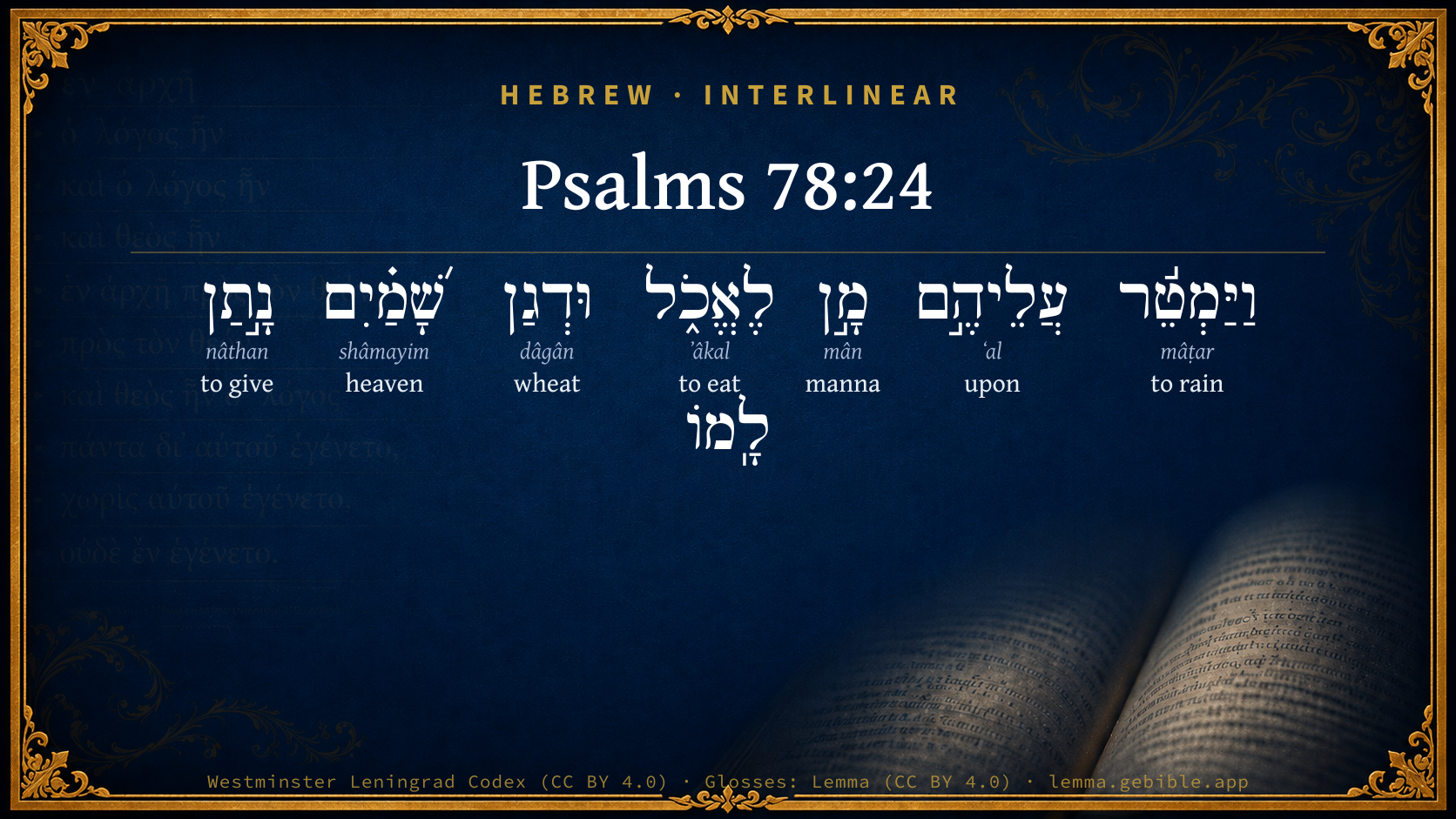
Psalms 78:24

Hebrew (Westminster Leningrad Codex) Psalms 78:24 appears in the Hebrew Old Testament. The text above is from the Westminster Leningrad Codex. Each word links to its Strong’s number, a concise gloss, and parsing drawn from the Open Scriptures Hebrew Bible morphology. Click any word for its full Brown-Driver-Briggs (BDB) entry.
Download image
Cite this verse

Psalms 78:24 (World English Bible). Public Domain. Lemma interlinear Bible study tool, https://lemma.gebible.app/v/psalms/78/24.

Show BibTeX & RIS
BibTeX
RIS
English Translation
He rained down manna on them to eat, And gave them food from the sky.
World English Bible · Public Domain
Download a study sheet

One document with this verse’s original text, its word-by-word gloss line, the meaning frame, cross-references with their text, attributed commentary, and full source and license credits — printable, and it pastes into notes with its structure intact.

This verse Autodidact and up

Study sheet (.html) Plain text (.txt)

A passage Seminary Student

Up to 50 verses in one chapter. A passage sheet keeps up to 6 commentary sources and 12 cross-references per verse, in the order this page ranks them, and says so on the sheet whenever that leaves anything out. Ask for a single verse and you get the Autodidact verse sheet above.

Everything on this page stays free to read, with no account — the sheet is a download of what is already on screen, not access to it.

Want to remove ads? Support Godless Engineer
Compare translations 3

The same verse in 3 English versions, stacked beneath the original-language interlinear above. Click any original word for its lexicon entry.

Each is an independent rendering of the whole verse — the interlinear is not word-aligned to these translations.

Highlighted words mark where these versions differ — a whole-verse word diff, not a word-by-word alignment.

  • World English Bible Public Domain
    He rained down manna on them to eat, And gave them food from the sky.
  • King James Version Public Domain
    And had rained down manna upon them to eat, and had given them of the corn of heaven.
  • unfoldingWord Literal Text CC BY-SA 4.0
    And he rained down manna to eat on them, and gave to them the grain of heaven.

unfoldingWord Literal Text — © unfoldingWord, licensed CC BY-SA 4.0. Word-aligned USFM3 via Door43 (git.door43.org/unfoldingWord/en_ult).

Versions to compare (up to 4)

3 of 4 selected

Show all 18 translations

Every available English version of this verse, each an independent rendering of the whole verse.

  • World English Bible Public Domain
    He rained down manna on them to eat, And gave them food from the sky.
  • Berean Standard Bible Public Domain
    He rained down manna for them to eat; He gave them grain from heaven.
  • Majority Standard Bible Public Domain
    He rained down manna for them to eat; He gave them grain from heaven.
  • King James Version Public Domain
    And had rained down manna upon them to eat, and had given them of the corn of heaven.
  • American Standard Version (1901) Public Domain
    And he rained down manna upon them to eat, And gave them food from heaven.
  • Revised Version (1885) Public Domain
    And he rained down manna upon them to eat, and gave them of the corn of heaven.
  • Geneva Bible (1599) Public Domain
    And had rained downe MAN vpon them for to eate, and had giuen them of the wheate of heauen.
  • Douay-Rheims (1899) Public Domain
    And had rained down manna upon them to eat, and had given them the bread of heaven.
  • Young's Literal Translation Public Domain
    And He raineth on them manna to eat, Yea, corn of heaven He hath given to them.
  • Literal Standard Version CC BY-SA 4.0
    And He rains manna on them to eat, || Indeed, He has given grain of the heavens to them.
  • Unlocked Literal Bible CC BY-SA 4.0
    He rained down manna for them to eat, and gave them the grain from heaven.
  • unfoldingWord Literal Text CC BY-SA 4.0
    And he rained down manna to eat on them, and gave to them the grain of heaven.
  • Darby Bible Public Domain
    And had rained down manna upon them to eat, and had given them the corn of the heavens.
  • World Messianic Bible Public Domain
    He rained down manna on them to eat, and gave them food from the sky.
  • Webster's Bible Public Domain
    And had rained down manna upon them to eat, and had given them of the corn of heaven.
  • Free Bible Version CC BY-SA 4.0
    and he made manna rain down on them to eat, giving them bread from heaven.
  • Bible in Basic English Public Domain
    And he sent down manna like rain for their food, and gave them the grain of heaven.
  • JPS Tanakh (1917) Public Domain
    And He caused manna to rain upon them for food, and gave them of the corn of heaven.

Literal Standard Version (2020), Covenant Press — licensed CC BY-SA 4.0. Text via the HelloAO Bible API (eBible.org). Unlocked Literal Bible (unfoldingWord) — licensed CC BY-SA 4.0. Text via the HelloAO Bible API (eBible.org). unfoldingWord Literal Text — © unfoldingWord, licensed CC BY-SA 4.0. Word-aligned USFM3 via Door43 (git.door43.org/unfoldingWord/en_ult). Free Bible Version, Dr. Jonathan Gallagher — licensed CC BY-SA 4.0. Text via the HelloAO Bible API (eBible.org).

Word by word

More ways to search: Search by grammar → Find every occurrence → Compare this word →

Practice this passage: Drill this verse → Learn its vocabulary →

About this verse

These counts appear in no published source. They are computed here, from the morphology-tagged text and Lemma’s own curated glosses. What Lemma adds →

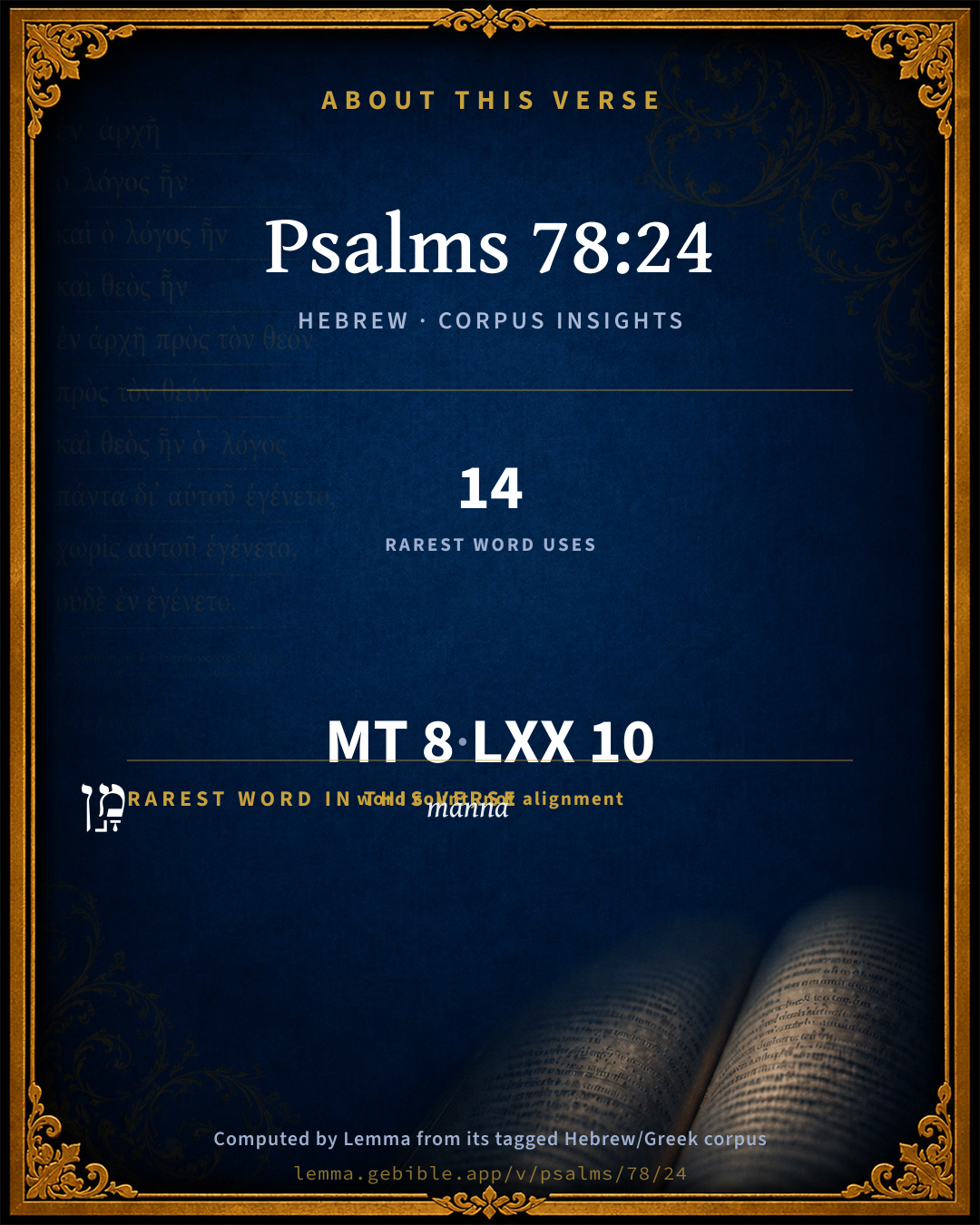
8
words
7
distinct lemmas
Wisdom
section

Notable vocabulary

The rarest word here is מָ֣ן manna H4478 — appearing just 14 times in the whole Hebrew Bible.

Shared distinctive vocabulary

מָ֣ן manna H4478 occurs in 12 verses of the Hebrew Bible. Also found in:

Grammatical profile

  • 3 verbs
  • 3 nouns
  • 2 prepositions

Verb forms

  • וַיַּמְטֵ֬ר Hiphil · Sequential Imperfect
  • לֶאֱכֹ֑ל Qal · Infinitive Construct
  • נָ֣תַן Qal · Perfect

Hebrew & Septuagint length

In English translation the verse runs 15 words from the Hebrew and 14 from the Septuagint (LXX English) — closely comparable.

A rough comparison of the two English renderings, which tokenize alike — not a word-level alignment.

Word counts can differ between the Hebrew and the Greek without any difference in meaning — e.g. the Hebrew direct-object marker אֵת has no separate Greek word, and Greek often adds the article ὁ.

In the original languages it is 8 Hebrew tokens and 10 Greek tokens — but the two are counted differently (Hebrew bundles its prefixes and suffixes into one token; the Greek is in lemma form), so that isn’t a like-for-like length.

Cross-references

9

Topical passages linked to Psalms 78:24 in the Treasury of Scripture Knowledge — connected by theme and wording, ordered by reader-vote popularity; previews shown in the World English Bible.

  • Exodus 16:4 Then said Yahweh to Moses, "Behold, I will rain bread from the sky for you, and the people shall go out and gather a day's portion every day, that I may test them, whether they will walk in my law, or not.
  • Psalms 105:40 They asked, and he brought quails, And satisfied them with the bread of the sky.
  • Deuteronomy 8:3 He humbled you, and allowed you to hunger, and fed you with manna, which you didn't know, neither did your fathers know; that he might make you know that man does not live by bread only, but by everything that proceeds out of the mouth of Yahweh does man live.
  • John 6:31–71 Our fathers ate the manna in the wilderness. As it is written, 'He gave them bread out of heaven to eat.'"
  • Exodus 16:14 When the dew that lay had gone, behold, on the surface of the wilderness was a small round thing, small as the hoar-frost on the ground.
  • Nehemiah 9:15 and gave them bread from the sky for their hunger, and brought forth water for them out of the rock for their thirst, and commanded those who they should go in to possess the land which you had sworn to give them.
  • Nehemiah 9:20 You gave also your good Spirit to instruct them, and didn't withhold your manna from their mouth, and gave them water for their thirst.
  • Psalms 68:9 You, God, sent a plentiful rain. You confirmed your inheritance, when it was weary.

Cross-references courtesy of OpenBible.info (CC BY 4.0).

Hebrew and Greek witnesses Masoretic Hebrew ↔ Greek Septuagint

The same verse in the two great witnesses to the Old Testament, shown verse-for-verse.

You’re reading Greek Psalm 77 (Hebrew Psalm 78). The Septuagint counts the superscription, so verse numbers can differ from the Hebrew — chapter-level alignment, not verse-by-verse. Numbering follows Rahlfs.

These are two independent witnesses, not word-aligned to each other, and the Septuagint is shown in lemma (dictionary) form.

Hebrew Psalms 78:24 Masoretic · Westminster Leningrad Codex

וַיַּמְטֵ֬ר עֲלֵיהֶ֣ם מָ֣ן לֶאֱכֹ֑ל וּדְגַן שָׁ֝מַ֗יִם נָ֣תַן לָֽמוֹ

He rained down manna on them to eat, And gave them food from the sky.

World English Bible · Public Domain

Greek LXX Greek Psalm 77:24 Septuagint · lemma form

καί βρέχω αὐτός μαννα ἐσθίω καί ἄρτος οὐρανός δίδωμι αὐτός

and rained upon them manna to eat, and gave them the bread of heaven.

LXX2012 (modern English Septuagint) · Public Domain

On this verse, John Gill's Exposition discusses the Septuagint’s reading. Read the note in Commentary ↓

Hebrew: Westminster Leningrad Codex (CC BY 4.0). Greek: Septuagint (public domain); English from LXX2012 (modern English Septuagint) (Public Domain). How the Septuagint differs from the Hebrew →

Commentary

Notes on Psalms 78:24 from classic Christian and Jewish commentators (each source and its license shown beneath its notes). The classic Christian expositions comment on the surrounding passage and are grouped to its opening verse, so a note may address several verses; the Jewish commentaries on the Tanakh (Rashi and others) are per-verse, so they appear only where the commentator wrote on this verse.

Lemma curates 59 commentaries, every one of them public domain or Creative Commons licensed, each selected and text-cleaned for this edition rather than reprinted as found. About our sources →

Trapp's Complete Commentary

John Trapp

Psa 78:24 And had rained down manna upon them to eat, and had given them of the corn of heaven.

Ver. 24. And had rained down manna upon them] Manna signifieth, What is this? whereunto in the allegory answereth, This is my body. Or, according to others, it signifieth a prepared portion, prepared by God, so that they might presently eat of it, though they might grind, or pound, or bake, or boil it also, they might do anything with it, as they might with meal; whence it is here called the corn of heaven, that is, a seed which was unto them instead of corn.

John Trapp, A Commentary or Exposition upon All the Books of the Old and New Testament (1647–1656) — public domain. Text from a community e-Sword module.

The Biblical Illustrator

Joseph S. Exell

Psa_78:24

And had rained down manna upon them to eat, and had given them of the corn of Heaven.

The manna in the wilderness

That this miraculous provision was designed to be an emblem of the Lord Jesus Christ, and of those precious blessings of which He is the Author, is evident from His own declaration I am the living Bread, etc.

1. The manna in the wilderness was the bread which the Lord gave the Israelites to save them from perishing. Even so Christ crucified is the heavenly bread which God hath given to save our souls alive; to preserve them from that eternal decay, which, through sin, would otherwise have been their portion, and to nourish them to eternal life.

2. The manna descended freely, as the gift of God; and so the blessings of salvation through Christ are offered freely in the Gospel. Desert is no more required in the one case than in the other. By grace ye are saved, etc. The Gospel salvation is no less freely offered than it has been provided. It is a gift for which no price is demanded, and which looks for nothing in its recipient but want and misery. Though unspeakably precious, it is placed within the reach of all; and if we do but ask in faith, it will be made ours. Those, therefore, who refuse to partake of it are entirely without excuse.

3. The manna was suitable alike to all; and so the blessings of Christs purchase are precisely such as are suited to the circumstances of His people. In their natural condition they are hungering and thirsting after true happiness; but nothing in the wide range of the universe can ever satisfy the cravings of their immortal spirits. But that satisfaction which all created objects are unable to yield is to be found in Jesus Christ--He that cometh to Me, He declared, shall never hunger; and he that believeth on Me shall never thirst. How diversified soever their circumstances, they find in Him that spiritual food which is fitted to satisfy all the wants of their souls. Are they guilty? In Him they have redemption through His blood, the forgiveness of sins, according to the riches of His grace. Are they estranged from God? They are made accepted in the Beloved. Do they need deliverance from the power of sin? He gave Himself for us that He might redeem us from all iniquity, and purify us unto Himself, a peculiar people, zealous of good works. Are they doomed to die, and moulder away into dust? He is the resurrection and the life, and has promised to redeem them from death, and ransom them from the power of the grave.

4. It was necessary for the Israelites to gather the manna, though freely given of God; and it is required of us that we believe to the saving of our souls. Nor is the faith by which we obtain a personal interest in Christs salvation a mere transient act. As the Israelites gathered the manna daily, so we must be daily feeding upon the heavenly Bread offered to us in the Gospel. Our whole life must be a life of faith upon the Son of God. And blessed be God! we may always have the grace that we need.

5. As the manna sustained the Israelites from day to day, so are they supported and strengthened who live by faith upon the Son of God. By believing on Him who is the living Bread that cometh down from heaven, they dwell in Him, and He dwells in them. He that eateth this Bread shall live for ever.

6. The appointed mode of distributing the manna among the Israelites is not without its significance. Some gathered more, and others less, according to their activity, but all received a plentiful supply. So believers receive liberally out of the exceeding abundant grace of Christ. It pleased the Father that in Him should all fulness dwell; and if we only come to Him, we shall receive out of His fulness grace for grace, abundance of every kind of heavenly and spiritual blessings.

7. A portion of the manna was laid up in the golden vessels of the tabernacle, where it remained for ages without suffering corruption. Even so, Jesus Christ liveth for ever in the heavenly sanctuary, as the hidden manna, which He promises for the support and nourishment of His conflicting and overcoming people. And as He is represented in Scripture as dwelling in their hearts by faith, the hope of glory, should not the purity of the golden vessels, in which the manna was hidden, teach us to cleanse our hearts from all sin and corruption, that they may be fit receptacles for Jesus Christ our heavenly manna? (P. Grant.)

The manna a type of Christ

We observe, first, that the food was supernatural. The Israelites were sustained by nourishment furnished them immediately from heaven. And did not this represent that the food of the soul was to be holy and good, and that the bread of life, whereof all men must eat who would not everlastingly die, must descend from heaven and fall around the camp?--that the person of Christ should not be produced in the ordinary course of nature, and that His birth should not be as the birth of other men? The manna, in the next place, sufficed for the whole multitude; there was enough for all, and it was suited to all, so that the old and young, the rich and the poor, partook of the same food and were equally benefited. Jesus Christ hath given Himself for the ransom of the world, and there is not an individual in the wide family of man for whom provision has not been made in the rich supplies of the Gospel. It may be further observed that the manna, before it was eaten, was ground in a mill, or broken in a mortar; so ere Christ could become the food of the world He was bruised and put to grief, became a curse and was pressed down by the weight of Gods wrath against sin. There is something so remarkable in the direction that the manna should be used on the day it was gathered. In spiritual things God supplies our wants as they occur; He does not give strength till He gives the trial, As is thy day, so shall thy strength be. If I may use such an expression, we have no stock in hand, but when the necessity arises we must apply afresh to the Saviour; yet practically we often endeavour to set aside that law. We distress ourselves with thinking that if such and such troubles overtake us we can never endure them, thus calculating on to-days strength for to-morrows trials; or because we have been diligent in prayer, and feel we have obtained a communication of grace, we are apt to suppose with the psalmist, that our mountain stands strong and can never be moved. All this is but laying by till to-morrow the manna of to-day: and white experience teaches us that we cannot carry with us the provision, but must have recourse in every want to the Saviour, we learn the lesson which is typically taught in the inability of the Israelites to secure out of what God gave them on one day sustenance for the following. There is, however, another striking particular in which the manna was typical. It fell only when the Israelites were in the wilderness, ceasing as soon as they crossed Jordan and reached the promised land. And is not the type to be also traced in the food being given throughout the journey, but withheld on its completion? We shall have no more need of sacraments when once we are admitted into the kingdom of heaven. It is one of the finest descriptions given us by the evangelist of the new Jerusalem, I saw no temple therein; for the Lord God Almighty and the Lamb are the temple of it.(H. Melvill, B. D.)

The Biblical Illustrator, edited by Joseph S. Exell (c. 1880s–1900s) — public domain. Text from a community e-Sword module.

The Treasury of David

Charles H. Spurgeon

Ver. 24. And had rained down manna upon them to eat. There was so much of it, the skies poured with food, the clouds burst with provender. It was fit food, proper not for looking at but for eating; they could eat it as they gathered it. Mysterious though it was, so that they called it manna, or "what is it?" yet it was eminently adapted for human nourishment; and it was both abundant and adapted, so also was it available! They had not far to fetch it, it was nigh them, and they had only to gather it up. O Lord Jesus, thou blessed manna of heaven, how all this agrees with Thee! We will even now feed on Thee as our spiritual meat, and will pray Thee to chase away all wicked unbelief from us. Our fathers ate manna and doubted; we feed upon Thee and are filled with assurance.

And had given them of the corn of heaven. It was all a gift without money and without price. Food which dropped from above, and was of the best quality, so as to be called heavenly corn, was freely granted them. The manna was round, like a coriander seed, and hence was rightly called corn; it did not rise from the earth, but descended from the clouds, and hence the words of the verse are literally accurate. The point to be noted is that this wonder of wonders left the beholders, and the feasters, as prone as ever to mistrust their Lord.

Ver. 24-25. Manna. The prophet celebrates this miracle, first, because of the unusual place whence the manna was sent. For he did not produce fruits from the earth wherewith to feed them, but rained down this food from the clouds, and from the depths of the skies. Secondly, because of the facility of the distribution. By the command of God alone, without any labour of men, yea, while they slept, this food was prepared. Therefore is it said, He gave, etc. Thirdly, he celebrates its great abundance which sufficed to supply so great a multitude. Fourthly, the excellence of the food. He calls it the food of the excellent or the strong, such as was not pleasant merely to the common multitude, but to the princes also, and to the heroes, for it was the food of the mighty ones. Mollerus.

None.

Psalms 78:25*

Ver. 24-25. Manna. See Psalms on "Ps 78:24" for further information.

Charles H. Spurgeon's The Treasury of David (1869–1885) — public domain. Psalms only. Text from a community e-Sword/MySword module.

J. A. Alexander on Psalms

Joseph Addison Alexander

24. (Psa 78:24) And rained upon them manna to eat, and corn of heaven gave to them. The expression rained is borrowed from the history, Exo 16:4. Theaddition of the words to eat may have reference to the primary import of the word for manna as an interrogative or indefinite pronoun, meaning what or somewhat, so that the words here might also bear the sense of something to eat. See Exo 16:15; Exo 16:31. It is called corn of heaven as a miraculous substitute for bread, and also in allusion to its granular form and appearance, Exodus 16.

Joseph Addison Alexander, The Psalms Translated and Explained (1850) — public domain. Text from a community e-Sword module.

Adam Clarke's Commentary

Verse 24. The corn of heaven.] The manna. It fell about their camp in the form of seeds; and as it appeared to come down from the clouds, it was not improperly termed heavenly corn, or heavenly grain, דגן שמים degan shamayim. The word shamayim is frequently taken to express the atmosphere.

Adam Clarke's Commentary on the Bible (1810–1826) — public domain. Text from a community e-Sword/MySword module.

The Cambridge Bible for Schools and Colleges

gen. ed. J. J. S. Perowne

24. And he rained down manna upon them to eat,

And gave them the corn of heaven.

The Cambridge Bible for Schools and Colleges (gen. ed. J. J. S. Perowne; Cambridge University Press, 1878–1918) — public domain. Text from a community e-Sword module.

John Gill's Exposition

Man did eat angels' food,.... Or, "the bread of the mighty" (d); such as Moses and Elijah ate of; so Arama; but Aben Ezra and Kimchi interpret it of the clouds, or skies, said to be strong, Job 37:18 in which the manna was prepared, and let down: but rather the words may be read, "every man did eat the bread of the mighty ones"; of princes and nobles, and the great men of the earth; it was royal food, it was princely fare; and, indeed, the common people of Israel ate the same as their princes and nobles did; they all fared alike; but the Septuagint, Vulgate Latin, and all the Oriental versions, render the word "angels", and so Jarchi interprets it, and who are called mighty angels, and are creatures that excel in strength, Th2 1:7 now the manna may be said to be their food, as it is in the Apocrypha:

"Instead whereof thou feddest thine own people with angels' food, and didst send them from heaven bread prepared without their labour, able to content every man's delight, and agreeing to every taste.'' (Wisdom 16:20)

because it might be prepared in the air by the ministry of angels, and given by their disposition, as the law was, Act 7:53 or because it came down from heaven, where they dwell, and so the Targum,

"the children of men did eat food, which came down from the habitation of angels;''

or because it was most excellent food, as the tongue of angels is the most excellent and eloquent, Co1 13:1, or because it was such food, that, if angels ate any, it was fit for them, and not at all unworthy of them. Cocceius thinks, and so Gussetius (e), that by the mighty ones are meant the mighty God, Father, Son, and Spirit, by whom this food was prepared and given; so the word is used in the singular number, of Jehovah, who is called the mighty One of Jacob, Gen 49:24 and of the Redeemer, Isa 49:26,

he sent them meat to the full; which may be understood either of the manna, of which they had great plenty, so that there was no lack for any man, and this continued with them till they came to the land of Canaan; or of the quails, of which in the following verses.

(d) "fortium", Pagninus, Montanus, &c. "magnificorum, potentium", Vatablus. (e) Comment. Ebr. p. 14. Vid. Witsium de Oeconom. Foeder. l. 4. c. 10. sect. 99.

John Gill's Exposition of the Whole Bible (1746–1763) — public domain (CC PDM 1.0). Text via the HelloAO Bible API.

Albert Barnes' Notes on the Bible

And had rained down manna upon them to eat - Exo 16:4-5, Exo 16:14; Num 11:7-9. Compare the notes at Joh 6:31.

And had given them of the corn of heaven - Food that seemed to come down from heaven. The reference here is to the manna, and it is called corn in the sense that it was food, or that it supplied the place of grain. It may also have been called corn from its resemblance to grain. See Exo 16:31.

Albert Barnes' Notes on the Bible (1834–1885) — public domain. Text from a community e-Sword/MySword module.

Matthew Poole's English Annotations

Which was made in heaven, or the air, and sent down thence to the earth.

Matthew Poole's English Annotations on the Holy Bible (1683–1685) — public domain. Text from a community e-Sword/MySword module.

Whedon's Commentary on the Bible

Daniel D. Whedon

24. Manna—Hebrew מנ, (man,) according to Gesenius from the Arabic, which signifies a portion, gift, because it was an allotment bestowed from Heaven. But more probably, in the popular phraseology, (Keil and Delitzsch,) used for מה, (mah,) an interrogative, who? what? The Israelites did not know what to call it, and they exclaimed מנ הוא, What is this? (Exo_16:15,) not “It is manna,” as in our English version. Josephus says, (Ant., book iii, chap. i, sec. 6,) “The Hebrews call it manna, for the particle man in our language is the asking a question, What is this?” and so the passage should read. In form and colour it is compared to coriander seed, globular, and of whitish colour. Num_11:7. It is not to be confounded with the manna now known in merchandise, nor with the Arabian manna, a resinous substance which exudes from the leaf of the tamarisk, or turfa, as described by Burckhardt (Travels in Syria, etc., p. 500) and other travellers, and called in Arabic mann. Ehrenberg discovered that this manna flows from the puncture of an insect. Its colour is a cloudy yellow, its taste like honey, and slightly aromatic. It falls in crystal drops from the trees, and is still gathered by the Arabs as a luxury. Though gathered in June, Lieutenant Welsted found the twigs in September retaining the sweetness of the gum. He says, in the best seasons the quantities gathered about Sinai may amount to $9,000 in value in the Cairo market. But the quantity necessary to sustain the Israelites for one week has been computed to be not less than 15,000,000 pounds. But neither in quantity nor quality does this compare with the Israelitish manna.

Corn of heaven—Poetical for manna.

Daniel D. Whedon (gen. ed.), Commentary on the Old and New Testaments (1874–1909) — public domain. Text from a community e-Sword module.

The Pulpit Commentary

And had rained down manna upon them to eat, and had given them; rather, and rained down manna to eat, and gave them. (comp. Exo_16:13, Exo_16:14) Of the corn of heaven. (comp. Exo_16:4 Psa_105:40 Joh_6:6, Joh_6:7)

The Pulpit Commentary (1880–1919), ed. H.D.M. Spence-Jones & Joseph S. Exell — public domain. Text from a community e-Sword module.

Lesson kit

Teaching starters — assembled from the data on this page, not authored interpretation. Every prompt links to the verse data it draws on. Edit before teaching.

Psalms, in the Wisdom, opens this verse with 8 words (7 distinct Hebrew lemmas). Its most distinctive word is mân (“manna”). A historical commentator’s framing appears above. Read the whole chapter for the surrounding context.

Discussion questions

  1. How does “manna” (mân) shape what this verse is saying?
  2. How does Exodus 16:15, which shares the word «manna», read alongside this verse?
  3. These translations render this verse differently. What is at stake in choosing one wording over another?
  4. «וַיַּמְטֵ֬ר» is a Hiphil Sequential Imperfect verb. How does that grammatical form shape the action described?
  5. Compare how Trapp's Complete Commentary and The Biblical Illustrator read this verse. Where do they agree or differ?

Things to notice

Reading settings

Reading text

Shown beneath each verse's original-language words.

Old Testament
Old Testament edition

Read the OT as the Masoretic Hebrew (MT) or the Greek Septuagint (LXX).

English shown for the Greek Septuagint (in the Hebrew ↔ Greek comparison).

Comparing translations? Open the Compare panel on any verse page to stack up to four side by side.