1 Corinthians 15:7

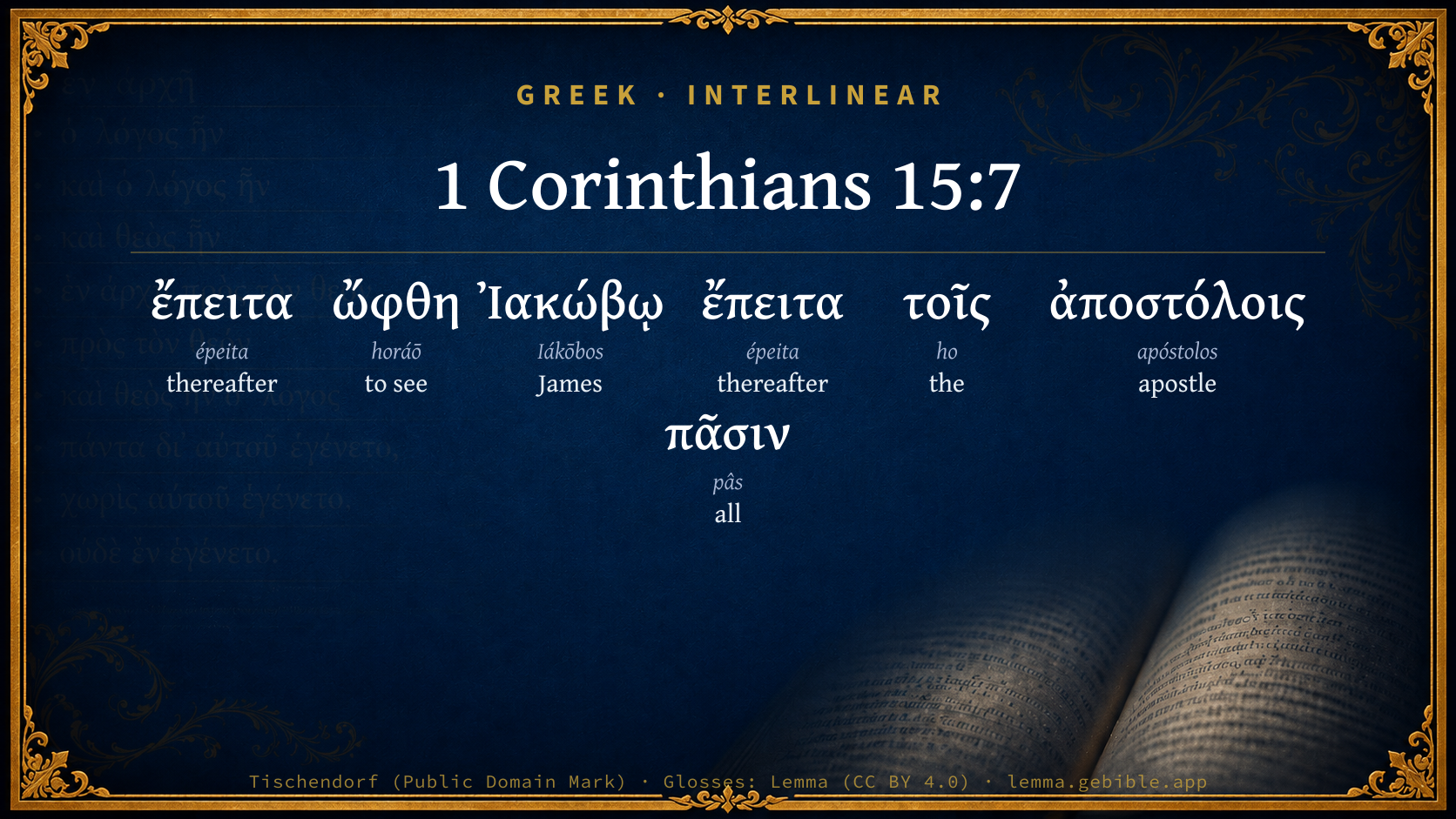
Greek (Tischendorf 8th ed.) 1 Corinthians 15:7 appears in the Greek New Testament. The text above is from the Tischendorf 8th edition. Each word links to its Strong’s number and a concise gloss. Click any word for its full Thayer’s Greek Lexicon entry.
Download image
Cite this verse

1 Corinthians 15:7 (World English Bible). Public Domain. Lemma interlinear Bible study tool, https://lemma.gebible.app/v/1-corinthians/15/7.

Show BibTeX & RIS
BibTeX
RIS
English Translation
Then he appeared to James, then to all the apostles,
World English Bible · Public Domain
Download a study sheet

One document with this verse’s original text, its word-by-word gloss line, the meaning frame, cross-references with their text, attributed commentary, and full source and license credits — printable, and it pastes into notes with its structure intact.

This verse Autodidact and up

Study sheet (.html) Plain text (.txt)

A passage Seminary Student

Up to 50 verses in one chapter. A passage sheet keeps up to 6 commentary sources and 12 cross-references per verse, in the order this page ranks them, and says so on the sheet whenever that leaves anything out. Ask for a single verse and you get the Autodidact verse sheet above.

Everything on this page stays free to read, with no account — the sheet is a download of what is already on screen, not access to it.

Want to remove ads? Support Godless Engineer
Compare translations 3

The same verse in 3 English versions, stacked beneath the original-language interlinear above. Click any original word for its lexicon entry.

Each is an independent rendering of the whole verse — the interlinear is not word-aligned to these translations.

Highlighted words mark where these versions differ — a whole-verse word diff, not a word-by-word alignment.

  • World English Bible Public Domain
    Then he appeared to James, then to all the apostles,
  • King James Version Public Domain
    After that, he was seen of James; then of all the apostles.
  • unfoldingWord Literal Text CC BY-SA 4.0
    Then he was seen by James, then by all the apostles.

unfoldingWord Literal Text — © unfoldingWord, licensed CC BY-SA 4.0. Word-aligned USFM3 via Door43 (git.door43.org/unfoldingWord/en_ult).

Versions to compare (up to 4)

3 of 4 selected

Show all 19 translations

Every available English version of this verse, each an independent rendering of the whole verse.

  • World English Bible Public Domain
    Then he appeared to James, then to all the apostles,
  • Berean Standard Bible Public Domain
    Then He appeared to James, then to all the apostles.
  • Majority Standard Bible Public Domain
    Then He appeared to James, then to all the apostles.
  • King James Version Public Domain
    After that, he was seen of James; then of all the apostles.
  • American Standard Version (1901) Public Domain
    then he appeared to James; then to all the apostles;
  • Revised Version (1885) Public Domain
    then he appeared to James; then to all the apostles;
  • Geneva Bible (1599) Public Domain
    After that, he was seene of Iames: then of all the Apostles.
  • Douay-Rheims (1899) Public Domain
    After that, he was seen by James, then by all the apostles.
  • Young's Literal Translation Public Domain
    afterwards he appeared to James, then to all the apostles.
  • Literal Standard Version CC BY-SA 4.0
    afterward He appeared to James, then to all the apostles.
  • Unlocked Literal Bible CC BY-SA 4.0
    Then he appeared to James, then to all the apostles.
  • unfoldingWord Literal Text CC BY-SA 4.0
    Then he was seen by James, then by all the apostles.
  • Darby Bible Public Domain
    Then he appeared to James; then to all the apostles;
  • World Messianic Bible Public Domain
    Then he appeared to Jacob, then to all the emissaries,
  • Webster's Bible Public Domain
    After that he was seen by James; then by all the apostles.
  • Free Bible Version CC BY-SA 4.0
    He appeared to James, then all the apostles.
  • Bible in Basic English Public Domain
    Then he was seen by James; then by all the Apostles.
  • Text-Critical English NT CC BY 4.0
    Next he appeared to James, then to all the apostles.
  • Tyndale New Testament (1534) Public Domain
    After that appered he to Iames then to all the Apostles.

Literal Standard Version (2020), Covenant Press — licensed CC BY-SA 4.0. Text via the HelloAO Bible API (eBible.org). Unlocked Literal Bible (unfoldingWord) — licensed CC BY-SA 4.0. Text via the HelloAO Bible API (eBible.org). unfoldingWord Literal Text — © unfoldingWord, licensed CC BY-SA 4.0. Word-aligned USFM3 via Door43 (git.door43.org/unfoldingWord/en_ult). Free Bible Version, Dr. Jonathan Gallagher — licensed CC BY-SA 4.0. Text via the HelloAO Bible API (eBible.org).

Word by word

More ways to search: Search by grammar → Find every occurrence → Compare this word →

Practice this passage: Drill this verse → Learn its vocabulary →

About this verse

These counts appear in no published source. They are computed here, from the morphology-tagged text and Lemma’s own curated glosses. What Lemma adds →

7
words
6
distinct lemmas
Pauline Epistles
section

Notable vocabulary

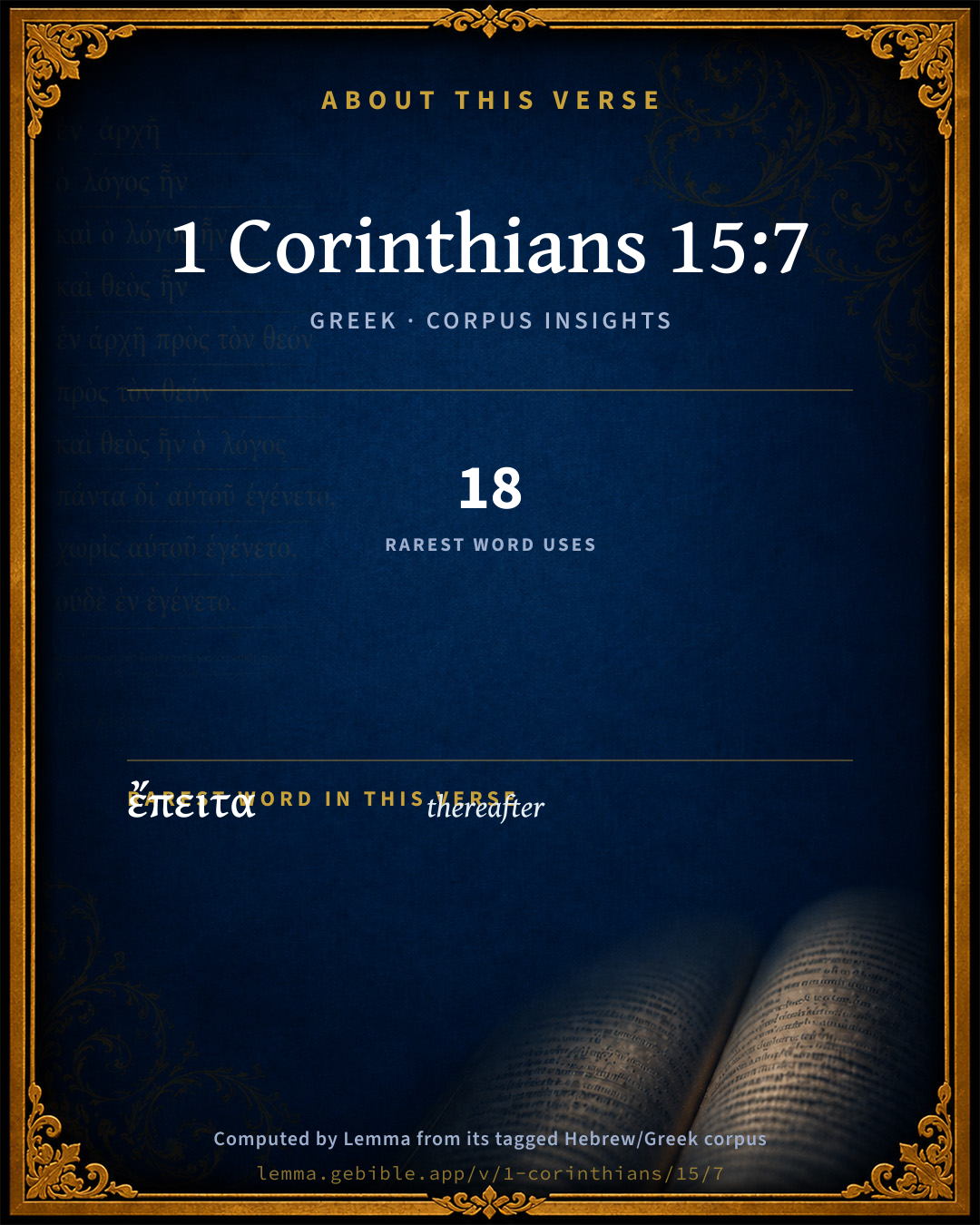
The rarest word here is ἔπειτα thereafter G1899 — appearing just 18 times in the whole Greek New Testament.

Shared distinctive vocabulary

ἔπειτα thereafter G1899 occurs in 16 verses of the Greek New Testament. Also found in:

Repetition

A word recurs within this verse:

  • ἔπειτα thereafter G1899 ×2

Cross-references

5

Topical passages linked to 1 Corinthians 15:7 in the Treasury of Scripture Knowledge — connected by theme and wording, ordered by reader-vote popularity; previews shown in the World English Bible.

  • Luke 24:50 He led them out as far as Bethany, and he lifted up his hands, and blessed them.
  • Acts 1:2–12 until the day in which he was received up, after he had given commandment through the Holy Spirit to the apostles whom he had chosen.
  • Luke 24:33 They rose up that very hour, returned to Jerusalem, and found the eleven gathered together, and those who were with them,
  • Luke 24:36 As they said these things, Jesus himself stood among them, and said to them, "Peace be to you."
  • Acts 12:17 But he, beckoning to them with his hand to be silent, declared to them how the Lord had brought him out of the prison. He said, "Tell these things to James, and to the brothers." Then he departed, and went to another place.

Cross-references courtesy of OpenBible.info (CC BY 4.0).

Commentary

Notes on 1 Corinthians 15:7 from classic Christian and Jewish commentators (each source and its license shown beneath its notes). The classic Christian expositions comment on the surrounding passage and are grouped to its opening verse, so a note may address several verses; the Jewish commentaries on the Tanakh (Rashi and others) are per-verse, so they appear only where the commentator wrote on this verse.

Lemma curates 59 commentaries, every one of them public domain or Creative Commons licensed, each selected and text-cleaned for this edition rather than reprinted as found. About our sources →

Tyndale Open Study Notes

Tyndale Open Resources

15:7 This James was almost certainly Jesus’ brother, who became a leader of the Jerusalem church after Jesus’ death (see Mark 6:3; John 7:1-5; Gal 1:19; cp. Acts 12:17; 15:13; 21:18).

Tyndale Open Study Notes — © Tyndale Open Resources, licensed CC BY-SA 4.0. Text via the HelloAO Bible API.

Bengel's Gnomon

Johann Albrecht Bengel

1Co 15:7. [135] ΠᾶΣΙΝ, by all) More seem here to be called Apostles than the twelve, 1Co 15:5; and yet the term is used in a stricter sense than at Rom 16:7.

[135] Ιἀκωβῳ, James) the Less.—V. g.

Bengel's Gnomon of the New Testament — English translation (T&T Clark, Edinburgh, 1860) — public domain. Text from a community e-Sword module.

Meyer's Critical & Exegetical Commentary

Heinrich August Wilhelm Meyer

1Co_15:7. Both of these appearances also are otherwise unknow.

Ἰακώβῳ] The non-addition of any distinguishing epithet makes it more than probable that the person meant is he who was then the James κατʼ ἐξοχήν, James the Just,[30] not one of the Twelve, but universally known as the brother of the Lord (see on 1Co_9:4). Perhaps it was this appearance which made him become decided for the cause and service of his divine brother. Comp. Michaelis on our passage. The apocryphal narrative of the Evang. sec. Hebr. in Jerome, de vir. ill. 2, is, even as regards time, here irrelevant (in opposition to Grotius).

τοῖς ἀποστόλοις πᾶσιν] ἀπόστολοι, since it takes in James also (comp. Gal_1:19), must stand here in a wider sense than ΤΟῖς ΔΏΔΕΚΑ, but includes them along with others. In the Book of Acts, Barnabas, for instance, is called an apostle (1Co_14:4; 1Co_14:14); and in 1Th_2:7, Timothy and Silvanus are comprehended under the conception ἀπόστολοι, of whom, of course, Timothy at least cannot be as yet included here. Chrysostom supposes the Seventy to be included. Comp. on 1Co_12:28. In no case is it simply the Twelve again who are meant, whom Hofmann conceives to be designated here in their relation to the church. How arbitrary that is, and how superfluous such a designation would be! But πᾶσι stands decidedly opposed to it; Paul would have required to write ΕἾΤΑ ΠΆΛΙΝ ΤΟῖς ἈΠΟΣΤ. Notice also the strict marking off of the original apostles by ΟἹ ΔΏΔΕΚΑ, an expression which Paul uses in no other place.

[30] Comp. Plitt in the Zeitschrift f. Luth. Theol. 1864, p. 28 ff.

Meyer — Critical and Exegetical Commentary on the New Testament — English translation by Peter Christie, edited by Frederick Crombie (T&T Clark, 1880) — public domain. Text from a community e-Sword module.

Expositor's Greek Testament

ed. W. Robertson Nicoll

1Co 15:7 . “After that, He appeared to James” sc . James, the brother of the Lord , as elsewhere in P. (Gal 1:19 ; Gal 2:9 ; Gal 2:12 ), included in the ἀδελφοὶ τ . Κυρίου of 1Co 9:5 above (see note); associated with P. in Act 15:13 ; Act 21:18 (see notes). The manifestation to James only mentioned here the chief of our Lord’s formerly unbelieving brothers (Joh 7:5 ), explains the presence of “His brothers” amongst the 120 disciples at Jerus. (Act 1:14 ) and James’ subsequent leadership in the mother Church. His high position at the time of writing accounts for his citation in this place. Paul made acquaintance with James as well as Peter on his first visit to the Jerus. Church (Gal 1:18 f.). The well-known story about the meeting of Jesus with James told by Jerome ( De viris illustr ., 2) implies an earlier date for this than Paul’s narrative admits of, since ἔπειτα signifies succession in time ; succession of rank cannot be intended. “After that, to all the apostles”: in this formal enumeration, ἀπόστολοις bears its strictest sense, and could hardly include James (see Act 1:13 f.; he is not certainly so styled in Gal 1:19 ). Paul was, presumably, aware of the absence of Thomas on the occasion of 1Co 15:5 , and his consequent scepticism (Joh 20:24 ff.); he therefore says distinctly that all participated in this latter sight, which coincides in point of time with Act 1:6-12 , not Joh 20:26 . The witness of the First App. to the resurrection was complete and unqualified.

The Expositor's Greek Testament, edited by W. Robertson Nicoll (1897–1910) — public domain. Text from a community e-Sword module.

Hodge's Commentary on Romans, Ephesians & First Corinthians

Charles Hodge

1Co_15:7

After that, he was seen of James; then of all the apostles.

Which James is here intended cannot be determined, as the event is not elsewhere recorded. The chronological order indicated in this citation of witnesses, renders it improbable that the reference is to our Lords interview with the two disciples on their way to Emmaus, and is inconsistent with the tradition preserved by Jerome, that Christ appeared to James immediately after his resurrection. It has been inferred that the James intended was James the brother of our Lord, who presided over the church in Jerusalem, because he was so conspicuous and universally known. Then to all the apostles. This, for the reason given above, probably does not refer to the appearance of Christ to the eleven on the day in which he rose from the dead. It may refer to what is recorded in Joh_20:26; or to the interview mentioned in Act_1:4. Whether James was one of the apostles is not determined by any thing in the verse. The word πᾶσιν may be used to indicate that the appearance was to the apostles collectively; and this, from its position, is the most natural explanation. Or the meaning may be, he appeared to James separately, and then to all the apostles including James. If the James intended was James of Jerusalem; and if that James were a different person from James the son of Alpheus (a disputed point), then the former interpretation should be preferred. For the apostle answers to the twelve, and if James of Jerusalem was not the son of Alpheus, he was not one of the twelve.

Charles Hodge — Commentary on Romans (1835), First Corinthians (1857), and Ephesians (1856) — public domain. Text from a community e-Sword module.

Jamieson, Fausset & Brown

Robert Jamieson, A. R. Fausset & David Brown

seen of James--the Less, the brother of our Lord (Gal 1:19). The Gospel according to the Hebrews, quoted by JEROME [On Illustrious Men, p. 170 D.], records that "James swore he would not eat bread from the hour that he drank the cup of the Lord, till he should see Him rising again from the dead."

all the apostles--The term here includes many others besides "the Twelve" already enumerated (Co1 15:5): perhaps the seventy disciples (Luk 10:1) [CHRYSOSTOM].

Jamieson, Fausset & Brown — Commentary Critical and Explanatory on the Whole Bible (1871) — public domain (CC PDM 1.0). Text via the HelloAO Bible API.

Adam Clarke's Commentary

Verse 7. After that, he was seen of James] But where, and on what occasion, we are not told; nor indeed do we know which James is intended; James the son of Zebedee, or James the son of Alpheus. But one thing is sufficiently evident, from what is here said, that this James, of whom the apostle speaks, was still alive; for the apostle's manner of speaking justifies this conclusion.

Then of all the apostles.] Including, not only the eleven, but, as some suppose, the seventy-two disciples.

Adam Clarke's Commentary on the Bible (1810–1826) — public domain. Text from a community e-Sword/MySword module.

The Cambridge Bible for Schools and Colleges

gen. ed. J. J. S. Perowne

7. of James] It would seem from this (see Stanley and Alford) that St James was an Apostle. But it does not necessarily follow that he was one of the twelve. See Professor Plumptre’s elaborate note on the brethren of our Lord in the Commentary on St James in this series.

The Cambridge Bible for Schools and Colleges (gen. ed. J. J. S. Perowne; Cambridge University Press, 1878–1918) — public domain. Text from a community e-Sword module.

John Gill's Exposition

After that he was seen of James,.... Not James the son of Zebedee, and brother of John, though he was seen by him with other disciples, Joh 20:19 who was now dead when the apostle wrote this, having been killed by Herod many years ago, Act 12:2 and so not quite so proper a witness to be mentioned; but James the son of Alphaeus, and brother of our Lord, a man of great fame and credit with the Jews, and still living, and therefore a proper and pertinent evidence. This appearance was made unto him when alone; and though the Scripture elsewhere makes no mention of it, there is no room to doubt it, since the apostle here affirms it. As for the account of the appearance of Christ to this James, immediately, after his resurrection, recorded by Jerom as he found it in the Gospel according to the Hebrews, it seems to be fabulous. His account is this (h);

"the Gospel written according to the Hebrews, which was lately translated by me into the Greek and Latin tongues, and which Origen often uses, relates, after the resurrection of the Saviour, that when the Lord had given the linen cloth to the priest's servant, he went to James, and appeared to him: for James had swore that he would not taste any bread from the time he had drank the cup of the Lord, until he saw him rising from the dead. Again, a little after, bring me, says the Lord, the table and the bread; and it is immediately added, he took the bread, and blessed, and brake it, and gave it to James the just, and said unto him, my brother, eat thy bread, for the son of man is risen from the dead.''

Then of all the apostles; at the Mount of Olives, when he led them out of Jerusalem, as far as Bethany, blessed them, and was parted from them, and ascended to heaven out of their sight, Luk 24:50 so that this was the last appearance of him on earth after his resurrection.

(h) Catalog. Script. Eccles. sect. 3. fol. 90. 1.

John Gill's Exposition of the Whole Bible (1746–1763) — public domain (CC PDM 1.0). Text via the HelloAO Bible API.

Trapp's Complete Commentary

John Trapp

7 After that, he was seen of James; then of all the apostles.

Ver. 7. Seen of James] This is not mentioned in the Gospel, as neither that of Peter, 1Co 15:5.

John Trapp, A Commentary or Exposition upon All the Books of the Old and New Testament (1647–1656) — public domain. Text from a community e-Sword module.

Albert Barnes' Notes on the Bible

After that, he was seen of James - This appearance is not recorded by the evangelists. It is mentioned in the fragment of the apocryphal Gospel according to the Hebrews, which is, however, of no authority. It is probable that the Lord Jesus appeared often to the disciples, since he was 40 days on earth after his resurrection, and the evangelists have only mentioned the more prominent instances, and enough to substantiate the fact of his resurrection. This James, the fathers say, was James the Less, the brother or cousin-german of the Lord Jesus. The other James was dead (see Act 12:1) when this Epistle was written. This James, the author of the Epistle that bears his name, was stationed in Jerusalem. When Paul went there, after his return from Arabia, he had an interview with James (see Gal 1:19, “But other of the apostles saw I none, save James the Lord’s brother”), and it is highly probable that Paul would state to him the vision which he had of the Lord Jesus on his way to Damascus, and that James also would state to Paul the fact that he had seen him after he rose. This may be the reason why Paul here mentions the fact, because he had it from the lips of James himself.

Then of all the apostles - By all the apostles. Perhaps the occasion at the sea of Galilee, recorded in Joh 21:14. Or it is possible that he frequently met the apostles assembled together, and that Paul means to say, that during the forty days after his resurrection he was often seen by them.

Albert Barnes' Notes on the Bible (1834–1885) — public domain. Text from a community e-Sword/MySword module.

Haydock's Catholic Bible Commentary

He was seen by James. The time is not mentioned in the gospels. (Witham)

George Leo Haydock (1774–1849), Haydock's Catholic Family Bible and Commentary, 1859 edition — public domain. Excludes Psalms (Douay-Rheims chapter numbering differs from Protestant) and Deuterocanonical books (Catholic canon only).

Matthew Poole's English Annotations

The Scripture tells us nothing, in the history of the gospel, of Christ’s appearing to James; but we read of two appearances to the apostles besides these, which the apostle had before mentioned.

Matthew Poole's English Annotations on the Holy Bible (1683–1685) — public domain. Text from a community e-Sword/MySword module.

Whedon's Commentary on the Bible

Daniel D. Whedon

7. James—Half brother of the Lord, bishop of Jerusalem, author of the Epistle of James. See notes on Mat_10:3; and Act_12:2.

All the apostles—Probably the same as mentioned in Act_1:4.

Daniel D. Whedon (gen. ed.), Commentary on the Old and New Testaments (1874–1909) — public domain. Text from a community e-Sword module.

The Pulpit Commentary

Seen of James. The "James" intended is undoubtedly the only James then living, who was known to the whole Christian Church, namely, "the Lord"s brother," the author of the Epistle, and the Bishop of Jerusalem. (Gal_2:9; Act_15:13 Act_21:18) James the son of Zebedee had by this time been martyred, and James the son of Alphaeus was never much more than a name to the Church in general. There is no mention of this appearance in the Gospel; but in the Gospel of the Hebrews was a curious legend (preserved in St. Jerome, "De Virr. Illust.," 2.) that James had made a vow that he would neither eat nor drink till he had seen Jesus risen from the dead, and that Jesus, appearing to him, said, "My brother, eat thy bread, for the Son of man is risen from the dead." The truth of the appearance is strongly supported by the fact that James, like the rest of the Lord"s "brothers," "did not believe" in Christ before the Crucifixion, whereas after the Resurrection we find him and the rest of "the Lord"s brothers" ardently convinced (Joh_12:3-5; Act_1:14 Act_9:5, etc.) Of all the apostles. (Act_1:3; Luk_24:50) James the Lord"s brother was only an apostle in the wider sense of the word.

The Pulpit Commentary (1880–1919), ed. H.D.M. Spence-Jones & Joseph S. Exell — public domain. Text from a community e-Sword module.

John Wesley's Explanatory Notes

Then by all the apostles - The twelve were mentioned ver. 5. This title here, therefore, seems to include the seventy; if not all those, likewise, whom God afterwards sent to plant the gospel in heathen nations.

John Wesley, Explanatory Notes Upon the Whole Bible (1754–1765) — public domain. Text via the GEBible commentary corpus.

McGarvey & Pendleton's Commentaries

J. W. McGarvey

then he appeared to James [This was the one called "the brother of our Lord," and "James the just." Though Paul speaks of him as an apostle ( Gal_1:19 ), he was not one of the twelve. But he was prominent in that day as a chief elder at Jerusalem ( Act_15:13 ; Act_21:18 ; Gal_2:9 ; Gal_2:11 ). He was author of the Epistle which bears his name. The appearance here mentioned evidently converted James, for before the resurrection the brethren of our Lord did not believe on him--comp. Joh_12:3-5 ; Act_1:14 ; Act_9:5 ]; then to all the apostles [ Act_1:3 ];

J. W. McGarvey (with Philip Y. Pendleton), Commentaries on the New Testament (The Fourfold Gospel, 1914; Acts; and the epistles) — public domain. Text from a community e-Sword/MySword module.

The People's New Testament

B. W. Johnson

7. After that he was seen by James. James, the Lord's brother, not James the apostle. This James was prominent, when Paul wrote, as the chief bishop at Jerusalem (Acts 15:13; Acts 21:18) and the author of the epistle of James. James, the apostle, had been killed by Herod (Acts 12:2). Then of all the apostles. See Luke 24:50.

B. W. Johnson's The People's New Testament with Notes (1889–1891) — public domain. Electronic text from the Christian Classics Ethereal Library (CCEL) ThML edition.

Cambridge Greek Testament for Schools and Colleges

7. Ἰακώβῳ. It would seem from this (see Stanley and Alford) that St James was an Apostle. But it does not necessarily follow that he was one of the Twelve. See Professor Plumptre’s elaborate note on the brethren of our Lord in the Commentary on St James in this series. Also note on 1Co 9:5.

Cambridge Greek Testament for Schools and Colleges (Cambridge University Press, 1896; 21 vols, various authors incl. Carr, Maclear, Plummer, Farrar, Lumby, Moule, M. R. James, Simcox) — public domain. Text from a community e-Sword module.

Alford’s Greek Testament

Henry Alford

7. Ἰακώβῳ] Probably, from no distinguishing epithet being added, the celebrated James, the brother of the Lord: see Gal 1:19. So Chrys.: ἐμοὶ δοκεῖ, τῷ ἀδελφῷ τῷ ἑαυτοῦ, p. 355. See notes on ch. 9:5, Mat 13:55, and the Prolegg. to the Epistle of James. On Wieseler’s view that this is the appearance on the road to Emmaus, see note on Luk 24:13. This appearance cannot however be identical with that traditional one quoted by Jerome (from the Gospel according to the Hebrews), Catal. Script. Eccles. ii. vol. ii. p. 831 f.: “Juraverat enim Jacobus, se non comesturum panem ab illa hora qua biberat calicem Domini, donec videret eum resurgentem a mortuis.” This would imply that the appearance was very soon after the Resurrection, and before any of those to large collections of believers, in which James would naturally be present.

ἀποστ. πᾶσιν] This is decisive for the much wider use of the term ἀπόστολος than as applying to the Twelve only: and a strong presumption that James, just mentioned, and evidently here and Gal 1:19, included among the ἀπόστολοι, was not one of the Twelve. Chrys. (ubi supra) extends the term to the Seventy of Luk_10 and others: ἦσαν γὰρ καὶ ἄλλοι ἀπόστολοι, ὡς οἱ ἑβδομήκοντα.

Henry Alford, The Greek Testament (1849–1861) — public domain. Text from a community e-Sword module.

International Critical Commentary

7. ἔπειτα ὤφθη Ἰακώβῳ. Nothing is known of this appearance, or as to which James is meant. But there is little doubt that the James is the Lord’s brother, who became president of the Church in Jerusalem, and that he is placed here among the chief witnesses because of his high position at Jerusalem. There may also be another reason, viz. the resemblance between his case and that of St. Paul. Our Lord’s brethren had refused to believe on Him during His ministry (Joh 7:5), but are found among believers after the Ascension (Act 1:14). What converted them? The appearance of the Risen Lord to the eldest of them may have done so, and the appearance may have been granted for this very purpose. In that case St James was converted in the same way as St Paul. Three years after his own conversion St Paul met the Lord’s brother at Jerusalem, and probably heard of this appearance from St James himself. Each told the other his experiences. But it may be doubted whether either James or Peter (v. 5) told St Paul what the Lord had said to him. In any case, such details are not needed here. What is of importance here is the fact that within ten years of the Resurrection St Paul had the opportunity of talking with St Peter and St James and comparing their experiences of the Risen Lord with his own, and that within thirty years of the Resurrection he records their testimony. For James and Peter see 9:5; Gal 1:18, Gal 1:19, 2:Gal 1:9-12.

For the narrative about an appearance to James recorded in the Gospel according to the Hebrews (Jerome, De Viris illustr. 2), see Nicholson, pp. 62 f.; Lightfoot, Galatians, pp. 265, 274; Swete, Appearances of our Lord, p. 89; Resch, Agrapha, pp. 248 f. The narrative may be mere legend; but if it is historical, it is not likely that St Paul is alluding here to what is there recorded.

εἶτα τοῖς ἀποστόλοις πᾶσιν. ‘Then to the whole body of the Apostles.’ There is no emphasis on πᾶσιν, which does not look back to Ἰακώβῳ. The antithesis, ‘to one, then to all, ’ is false, for the πᾶσιν does not imply that James was an Apostle. He wast not one of the Twelve, and it is unlikely that St Paul here thinks of him as an Apostle in the wider sense, and idea quite foreign to the context. The meaning here is, ‘then’ to the Apostolic body as a whole,’ Thomas being now present. The addition of πᾶσιν here confirms the view that τοῖς δώδεκα (v. 5) is official and not numerical.* As St Paul at once passes on to the appearance to himself, he evidently means this manifestation to the whole body of the Apostles as the final one to others, viz. at the time of the Ascension. The conjecture of πάλιν for πᾶσιν is unnecessary.

Respecting St Paul’s testimony, Professor Percy Gardner remarks; “As regards his own life, and the phenomena of Christianity which came under his direct observation, he is as good an authority as we can have in regard to any events in ancient history. … However confused and inconsistent may be the accounts in the Gospels of the appearances of the risen Lord, there can be no doubt that the society believed such appearances to hace taken place. No other cause can be suggested for the sudden change in the minds of the disciples from consternation and terror to confidence and boldness. And the well-known Pauline passage as to the witnesses of the Resurrection is as historic evidence of the belief of the first disciples unimpeachable. Paul himself claims with perfect confidence that he has seen the risen Lord” (Hibbert Journal Supplement, 1909, pp. 49, 51).

International Critical Commentary — older volumes (1896–1929), various authors — public domain. Text from a community e-Sword module.

Godet's Commentaries

Frédéric Louis Godet

Vv. 7. “After that He was seen of James, then of all the apostles.”

The reading ἔπειτα, afterwards, is preferable here; for we come now to the last appearances granted to the apostles. That given to James no doubt preceded by a short time the appearing on the day of the ascension, which immediately follows. This James can only be the one who played a considerable part in the Church of Jerusalem, as head of its council of elders (Act 15:13; Act 21:18), and who is called, Gal 1:19, “the Lord’s brother,” and 1Co 2:9, “one of the pillars of the Church.” He was not a believer during the Lord’s lifetime (Joh 7:5); but we find him united with the apostles and holy women, in the upper chamber, immediately after the ascension (Act 1:14). This extraordinary change was no doubt brought about by the appearance here mentioned, which should not be confounded with that described by a legend preserved in the Gospel of the Hebrews (Jerome, de viris illustr. c. 2); for had there been a foundation of truth in this narrative of the apocryphal book, the fact must have immediately followed the resurrection.

The subsequent appearance to all the apostles can only be that of the day of ascension. But why the adjective all, and why is it placed so emphatically after the substantive? Meyer thinks Paul wishes thereby to indicate a larger circle of persons than that of the Twelve properly so called (1Co 15:5), including, for example, James or others, such as Barnabas or Silas, who sometimes in the New Testament bear the title of apostles; comp. Act 14:4; Act 14:14; 1Th 2:6. But the expression all the apostles does not naturally express the idea of a circle larger than the Twelve, and at the time when this appearance took place, before Pentecost, no apostles different from the Twelve could possibly be thought of (see Holsten). On the other hand, if the expression all the apostles has the same meaning as that which was used in 1Co 15:5 (the Twelve), why this wholly different expression here? Hofmann answers: Because in 1Co 15:5 the apostles were mentioned as forming the intimate companions of Jesus, while here they are mentioned as founders of the Church. Holsten rightly regards this distinction as arbitrary, and on this, according to him, inexplicable difference of expression he again fastens the suspicion of inauthenticity, which he throws on the last words of 1Co 15:5. But this is a very risky conclusion. Perhaps the particular expression used here is explained by the special character of this last gathering of the apostles round their Master. One is struck with the two expressions in Luke’s narrative, Act 1:4; Act 1:6 : καὶ συναλιζόμενος, and having assembled them; then: οἱ μὲν οὖν συνελθόντες, they, therefore, having come together. It is obvious that this gathering was, like that of 1Co 15:6, the result of a positive and solemn convocation on the part of Jesus. It was to be the last, His adieu to the apostles, as that of 1Co 15:6 had been His adieu to the Church. The apostolic college must be there in full, and Jesus had provided that none of the apostles should be wanting. This explains the πᾶσι, all, especially if we think of Thomas, who was absent the first time (the appearance of 1Co 15:5), and must on no account be wanting this last time. The term apostles reminds us of their mission to the world, of which the ascension was about to become the signal.

Finally, Paul mentions the fact which closed the series of the appearances of the risen One, and which was separated from all the preceding by a much greater interval than those which had separated these from one another.

Frédéric Louis Godet — Commentaries on Luke, John, Romans, and 1 Corinthians — English translation (T&T Clark, Edinburgh, 1870s–1890s) — public domain. Text from a community e-Sword module.

Lesson kit

Teaching starters — assembled from the data on this page, not authored interpretation. Every prompt links to the verse data it draws on. Edit before teaching.

1 Corinthians, in the Pauline Epistles, opens this verse with 7 words (6 distinct Greek lemmas). Its most distinctive word is épeita (“thereafter”). A historical commentator’s framing appears above. Read the whole chapter for the surrounding context.

Discussion questions

  1. The word épeita carries the sense “thereafter.” How does it shape the verse?
  2. Luke 16:7 shares the word «thereafter» with this verse. How do the two illuminate each other?
  3. “thereafter” occurs 2× in this one verse. What is the effect of the repetition?
  4. These translations render this verse differently. What is at stake in choosing one wording over another?
  5. Reading how Tyndale Open Study Notes and Bengel's Gnomon read this verse, where do the two commentators agree and where do they part?

Things to notice

  • These translations choose different wording for 3 words in this verse.
  • “thereafter” occurs 2× in this single verse.
  • 6 distinct Greek lemmas span 7 words in this verse.

Reading settings

Reading text

Shown beneath each verse's original-language words.

Old Testament
Old Testament edition

Read the OT as the Masoretic Hebrew (MT) or the Greek Septuagint (LXX).

English shown for the Greek Septuagint (in the Hebrew ↔ Greek comparison).

Comparing translations? Open the Compare panel on any verse page to stack up to four side by side.