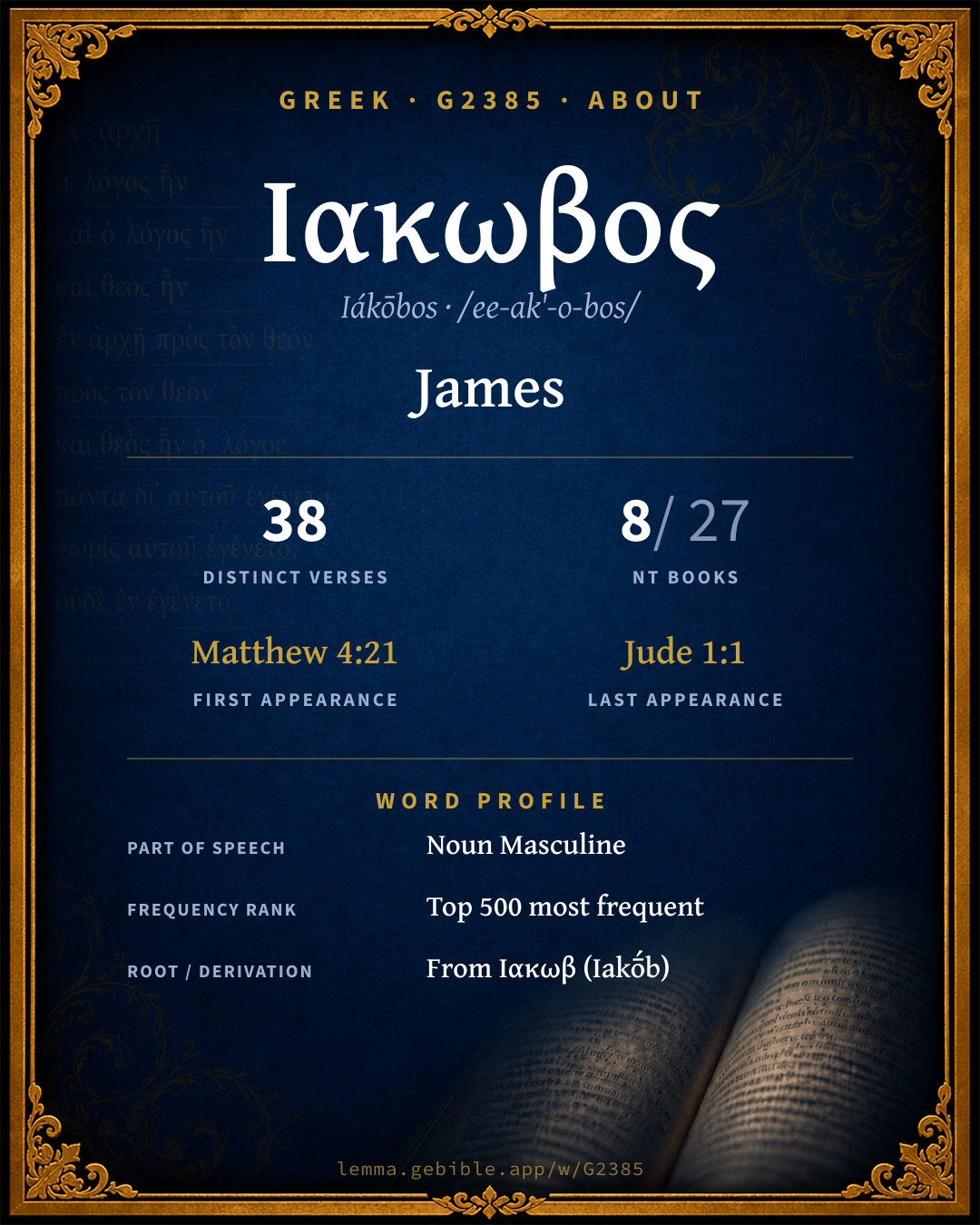
Ἰάκωβος
James
Thayer's lists 5 entries for ‘James’ fuller range ↓
Full lexicon entry — Thayer's Greek Lexicon
From Thayer's Greek Lexicon
Where this word appears
See every Accusative-case word in the Greek New Testament →
Grammar key — what these labels mean
Part of speech
- Noun
- A naming word — a person, place, thing, or idea.
Case
- Accusative
- The case of the direct object and of extent.
- Genitive
- The case of source, possession, or “of” — answers “whose / from what.”
- Nominative
- The case of the subject (and the predicate nominative).
- Dative
- The case of the indirect object, means, or location — “to / for / with / in.”
Gender
- Masculine
- Grammatically masculine.
Number
- Singular
- One.
Grammatical forms
- Noun, Accusative, Singular, Masculine 16 times (38%)
- Noun, Genitive, Singular, Masculine 13 times (31%)
- Noun, Nominative, Singular, Masculine 11 times (26%)
- Noun, Dative, Singular, Masculine 2 times (5%)
Parsed forms decoded from the imported morphology (Robinson–Tischendorf, public domain), counted across 42 parsed occurrences — not distinct verses.
Every verse where G2385 appears — 38 distinct verses across 8 books. Click any verse to open its interlinear word-by-word view. Verse text shown in the World English Bible for context — . Each verse’s Greek form is shown with its reference; the English is not keyword-highlighted, since the data carries no word-level English alignment. Use “Compare translations” on any verse to read it across multiple English versions. This concordance covers the Greek New Testament; Septuagint (Greek Old Testament) occurrences of this word are not indexed here.
Matthew 6 verses
- Matthew 4:21 Ἰάκωβον n acc sg masc Going on from there, he saw two other brothers, James the son of Zebedee, and John his brother, in the boat with Zebedee their father, mending their nets. He called them.
- Matthew 10:2 Ἰάκωβος n nom sg masc Now the names of the twelve apostles are these. The first, Simon, who is called Peter; Andrew, his brother; James the son of Zebedee; John, his brother;
- Matthew 10:3 Ἰάκωβος n nom sg masc Philip; Bartholomew; Thomas; Matthew the tax collector; James the son of Alphaeus; and Lebbaeus, whose surname was Thaddaeus;
- Matthew 13:55 Ἰάκωβος n nom sg masc Isn't this the carpenter's son? Isn't his mother called Mary, and his brothers, James, Joses, Simon, and Judas?
- Matthew 17:1 Ἰάκωβον n acc sg masc After six days, Jesus took with him Peter, James, and John his brother, and brought them up into a high mountain by themselves.
- Matthew 27:56 Ἰακώβου n gen sg masc Among them were Mary Magdalene, Mary the mother of James and Joses, and the mother of the sons of Zebedee.
Mark 13 verses
- Mark 1:19 Ἰάκωβον n acc sg masc Going on a little further from there, he saw James the son of Zebedee, and John, his brother, who were also in the boat mending the nets.
- Mark 1:29 Ἰακώβου n gen sg masc Immediately, when they had come out of the synagogue, they came into the house of Simon and Andrew, with James and John.
- Mark 3:17 Ἰάκωβον Ἰακώβου n acc sg masc n gen sg masc James the son of Zebedee; John, the brother of James, and he surnamed them Boanerges, which means, Sons of Thunder;
- Mark 3:18 Ἰάκωβον n acc sg masc Andrew; Philip; Bartholomew; Matthew; Thomas; James, the son of Alphaeus; Thaddaeus; Simon the Zealot;
- Mark 5:37 Ἰάκωβον Ἰακώβου n acc sg masc n gen sg masc He allowed no one to follow him, except Peter, James, and John the brother of James.
- Mark 6:3 Ἰακώβου n gen sg masc Isn't this the carpenter, the son of Mary, and brother of James, Joses, Judas, and Simon? Aren't his sisters here with us?" They were offended at him.
- Mark 9:2 Ἰάκωβον n acc sg masc After six days Jesus took with him Peter, James, and John, and brought them up onto a high mountain privately by themselves, and he was changed into another form in front of them.
- Mark 10:35 Ἰάκωβος n nom sg masc James and John, the sons of Zebedee, came near to him, saying, "Teacher, we want you to do for us whatever we will ask."
- Mark 10:41 Ἰακώβου n gen sg masc When the ten heard it, they began to be indignant towards James and John.
- Mark 13:3 Ἰάκωβος n nom sg masc As he sat on the Mount of Olives opposite the temple, Peter, James, John, and Andrew asked him privately,
- Mark 14:33 Ἰάκωβον n acc sg masc He took with him Peter, James, and John, and began to be greatly troubled and distressed.
- Mark 15:40 Ἰακώβου n gen sg masc There were also women watching from afar, among whom were both Mary Magdalene, and Mary the mother of James the less and of Joses, and Salome;
- Mark 16:1 Ἰακώβου n gen sg masc When the Sabbath was past, Mary Magdalene, and Mary the mother of James, and Salome, bought spices, that they might come and anoint him.
Luke 8 verses
- Luke 5:10 Ἰάκωβον n acc sg masc and so also were James and John, sons of Zebedee, who were partners with Simon. Jesus said to Simon, "Don't be afraid. From now on you will be catching people alive."
- Luke 6:14 Ἰάκωβον n acc sg masc Simon, whom he also named Peter; Andrew, his brother; James; John; Philip; Bartholomew;
- Luke 6:15 Ἰάκωβον n acc sg masc Matthew; Thomas; James, the son of Alphaeus; Simon, who was called the Zealot;
- Luke 6:16 Ἰακώβου n gen sg masc Judas the son of James; and Judas Iscariot, who also became a traitor.
- Luke 8:51 Ἰάκωβον n acc sg masc When he came to the house, he didn't allow anyone to enter in, except Peter, John, James, the father of the child, and her mother.
- Luke 9:28 Ἰάκωβον n acc sg masc It happened about eight days after these sayings, that he took with him Peter, John, and James, and went up onto the mountain to pray.
- Luke 9:54 Ἰάκωβος n nom sg masc When his disciples, James and John, saw this, they said, "Lord, do you want us to command fire to come down from the sky, and destroy them, just as Elijah did?"
- Luke 24:10 Ἰακώβου n gen sg masc Now they were Mary Magdalene, Joanna, and Mary the mother of James. The other women with them told these things to the apostles.
Acts 5 verses
- Acts 1:13 Ἰάκωβος Ἰάκωβος Ἰακώβου n nom sg masc n nom sg masc n gen sg masc When they had come in, they went up into the upper room, where they were staying; that is Peter, John, James, Andrew, Philip, Thomas, Bartholomew, Matthew, James the son of Alphaeus, Simon the Zealot, and Judas the son of James.
- Acts 12:2 Ἰάκωβον n acc sg masc He killed James, the brother of John, with the sword.
- Acts 12:17 Ἰακώβῳ n dat sg masc But he, beckoning to them with his hand to be silent, declared to them how the Lord had brought him out of the prison. He said, "Tell these things to James, and to the brothers." Then he departed, and went to another place.
- Acts 15:13 Ἰάκωβος n nom sg masc After they were silent, James answered, "Brothers, listen to me.
- Acts 21:18 Ἰάκωβον n acc sg masc The day following, Paul went in with us to James; and all the elders were present.
1 Corinthians 1 verse
Galatians 3 verses
- Galatians 1:19 Ἰάκωβον n acc sg masc But of the other apostles I saw no one, except James, the Lord's brother.
- Galatians 2:9 Ἰάκωβος n nom sg masc and when they perceived the grace that was given to me, James and Cephas and John, they who were reputed to be pillars, gave to me and Barnabas the right hand of fellowship, that we should go to the Gentiles, and they to the circumcision.
- Galatians 2:12 Ἰακώβου n gen sg masc For before some people came from James, he ate with the Gentiles. But when they came, he drew back and separated himself, fearing those who were of the circumcision.
James 1 verse
Jude 1 verse
About this entry
At a glance — auto-summarized from this page’s data, not written by a person. Every figure links to its source below. This summary describes the numbers; it doesn’t interpret them.
At its core, Ιακωβος (Iákōbos) means “James.” Scripture first uses it in Matthew 4:21. With 38 verses in 8 books, it is a moderately common word in the Greek New Testament. Its uses concentrate in Mark (34% of all occurrences). Each statement above links to its evidence; the full detail follows below.
Gloss history
Strong's 1890 vs modern scholarship

About this word
Strong's G2385 catalogs a Greek word from the Greek New Testament.
These counts are not copied from any lexicon or concordance. They are computed here, from the morphology-tagged Greek New Testament. What Lemma adds →
- 38
- distinct verses
- The word appears in 38 distinct verses.
- 8 / 27
- NT books
- The word appears in 8 of 27 New Testament books.
- #356
- by frequency
- Top 500 most frequent Greek words (rank 356 of 5,347 Greek words by occurrence).
View all 38 occurrences in the concordance →
By section of the New Testament
By traditional corpus
Conventional, traditional groupings — biblical authorship is debated, so this is a traditional corpus grouping, not an authorship claim. Some books belong to more than one corpus (Luke is in both the Gospels and the Lukan corpus, and so on), so these shares overlap and need not total 100%. Each figure is a share of the word’s 38 distinct verses.
- Gospels 27 verses · 71%
- Lukan (Luke–Acts) 13 verses · 34%
- Pauline corpus 4 verses · 11%
- General (Catholic) Epistles 2 verses · 5%
How translations render this word
Counts come from each version’s own published word-to-Strong’s tagging or interlinear alignment — an approximate guide to how each version renders this word, not a word-level alignment the data otherwise carries. Because each total is that version’s own tagged count, the per-version totals vary from one another and need not match the appearance or distinct-verse counts above. These counts may also differ from a printed concordance because Lemma counts each distinctly tagged rendering and does not collapse phrase taggings into a single head-word total. This is a fixed set of word-tagged versions (KJV, ASV, BSB, ULT) and does not change with the reading translation you choose elsewhere. Each version’s license is shown beside its name below (and on Sources).
- King James Version: James 39×, Brother of james 2×
- American Standard Version: James 35×, Mother of james 2×, Son of james 2×
- Berean Standard Bible: James 40×
- unfoldingWord Literal Text: James 41×
King James Version Public Domain
Renders G2385 across 42 tagged occurrences — most commonly:
Plus 1 rendering that appears only once — usually multi-word phrases or single function words the recovered tagging swept in, not distinct renderings.
American Standard Version Public Domain
Renders G2385 across 41 tagged occurrences — most commonly:
Plus 2 renderings that appear only once — usually multi-word phrases or single function words the recovered tagging swept in, not distinct renderings. Not rendered by a distinct English word in 1 further occurrence.
Berean Standard Bible Public Domain
Renders G2385 across 42 tagged occurrences — most commonly:
Plus 2 renderings that appear only once — usually multi-word phrases or single function words the recovered tagging swept in, not distinct renderings.
unfoldingWord Literal Text CC BY-SA 4.0
Renders G2385 across 42 tagged occurrences — most commonly:
Plus 1 rendering that appears only once — usually multi-word phrases or single function words the recovered tagging swept in, not distinct renderings.
Senses in Thayer's
The 5 senses Thayer's distinguishes for this word, in lexicon order (not ranked by frequency or importance). The full entry — with sub-senses — is in the Lexicon Entry tab.
- James = "supplanter"
- son of Zebedee…
- an apostle, son of Alphaeus, called the less
- James the half-brother of Christ
- an unknown James, father of the apostle Judas (?)
Word origin
Derived from Ιακωβ (Iakṓb) (G2384) — Jacob.
the same as G2384 Graecized; Jacobus the name of three Israelites : - James.
— Strong’s Exhaustive Concordance (1890), public domain.
Forms in the corpus
The 4 distinct written forms G2385 takes in the Greek New Testament, most frequent first — each parse links to that case’s occurrences in the concordance.
| Form | Parsing | Example | Uses |
|---|---|---|---|
| Ἰάκωβον Iákōbon | Noun, Accusative, Singular, Masculine | Matthew 4:21 | 16 |
| Ἰακώβου Iakṓbou | Noun, Genitive, Singular, Masculine | Matthew 27:56 | 13 |
| Ἰάκωβος Iákōbos | Noun, Nominative, Singular, Masculine | Matthew 10:2 | 11 |
| Ἰακώβῳ Iakṓbō | Noun, Dative, Singular, Masculine | Acts 12:17 | 2 |
Bible dictionary
Public-domain dictionary articles matched to this entry by name (James). A biblical name can be shared by more than one person or place, so an article may treat several.
Easton's Bible Dictionary · M. G. Easton, 1897
(1.) The son of Zebedee and Salome; an elder brother of John the apostle. He was one of the twelve. He was by trade a fisherman, in partnership with Peter (Matt. 20:20; 27:56). With John and Peter he was present at the transfiguration (Matt. 17:1; Mark 9:2), at the raising of Jairus's daughter (Mark 5:37-43), and in the garden with our Lord (14:33). Because, probably, of their boldness and energy, he and John were called Boanerges, i.e., "sons of thunder." He was the first martyr among the apostles, having been beheaded by King Herod Agrippa (Acts 12:1, 2), A.D. 44. (Comp. Matt. 4:21; 20:20-23).
(2.) The son of Alphaeus, or Cleopas, "the brother" or near kinsman or cousin of our Lord (Gal. 1:18, 19), called James "the Less," or "the Little," probably because he was of low stature. He is mentioned along with the other apostles (Matt. 10:3; Mark 3:18; Luke 6:15). He had a separate interview with our Lord after his resurrection (1 Cor. 15:7), and is mentioned as one of the apostles of the circumcision (Acts 1:13). He appears to have occupied the position of head of the Church at Jerusalem, where he presided at the council held to consider the case of the Gentiles (Acts 12:17; 15:13-29: 21:18-24). This James was the author of the epistle which bears his name.
Smith's Bible Dictionary · William Smith, 1863
(the Greek form of Jacob, supplanter).
+ James the son of Zebedee, one of the twelve apostles. He was elder brother of the evangelist John. His mother's name was Salome. We first hear of him in A.D. 27, (Mark 1:20) when at the call of the Master he left all, and became, one and forever, his disciple, in the spring of 28. (Matthew 10:2; Mark 3:14; Luke 6:13; Acts 1:13) It would seem to have been at the time of the appointment of the twelve apostles that the name of Boanerges was given to the sons of Zebedee. The "sons of thunder" had a burning and impetuous spirit, which twice exhibits itself. (Mark 10:37; Luke 9:54) On the night before the crucifixion James was present at the agony in the garden. On the day of the ascension he is mentioned as persevering with the rest of the apostles and disciples, in prayer. (Acts 1:13) Shortly before the day of the Passover, in the year 44, he was put to death by Herod Agrippa I. (Acts 12:1,2) + James the son of Alpheus, one of the twelve apostles. (Matthew 10:3) Whether or not this James is to be identified with James the Less, the son of Alphaeus, the brother of our Lord, is one of the most difficult questions in the gospel history. By comparing (Matthew 27:56) and Mark 15:40 with John 19:25 We find that the Virgin Mary had a sister named, like herself, Mary, who was the wife of Clopas or Alpheus (varieties of the same name), and who had two sons, James the Less and Joses. By referring to (Matthew 13:55) and Mark 6:3 We find that a James the Less and Joses, with two other brethren called Jude and Simon, and at least three sisters, were sisters with the Virgin Mary at Nazareth by referring to (Luke 6:16) and Acts 1:13 We find that there were two brethren named James and Jude among the apostles. It would certainly be natural to think that we had here but one family of four brothers and three or more sisters, the children of Clopas and Mary, nephews and nieces of the Virgin Mary. There are difficulties however, in the way of this conclusion into which we cannot here enter; but in reply to the objection that the four brethren in (Matthew 13:55) are described as the brothers of Jesus, not as his cousins, it must be recollected that adelphoi, which is here translated "brethren," may also signify cousins.
Hitchcock's Bible Names Dictionary · Roswell D. Hitchcock, 1869
same as Jacob
Classic public-domain reference works; full attribution on Sources.