
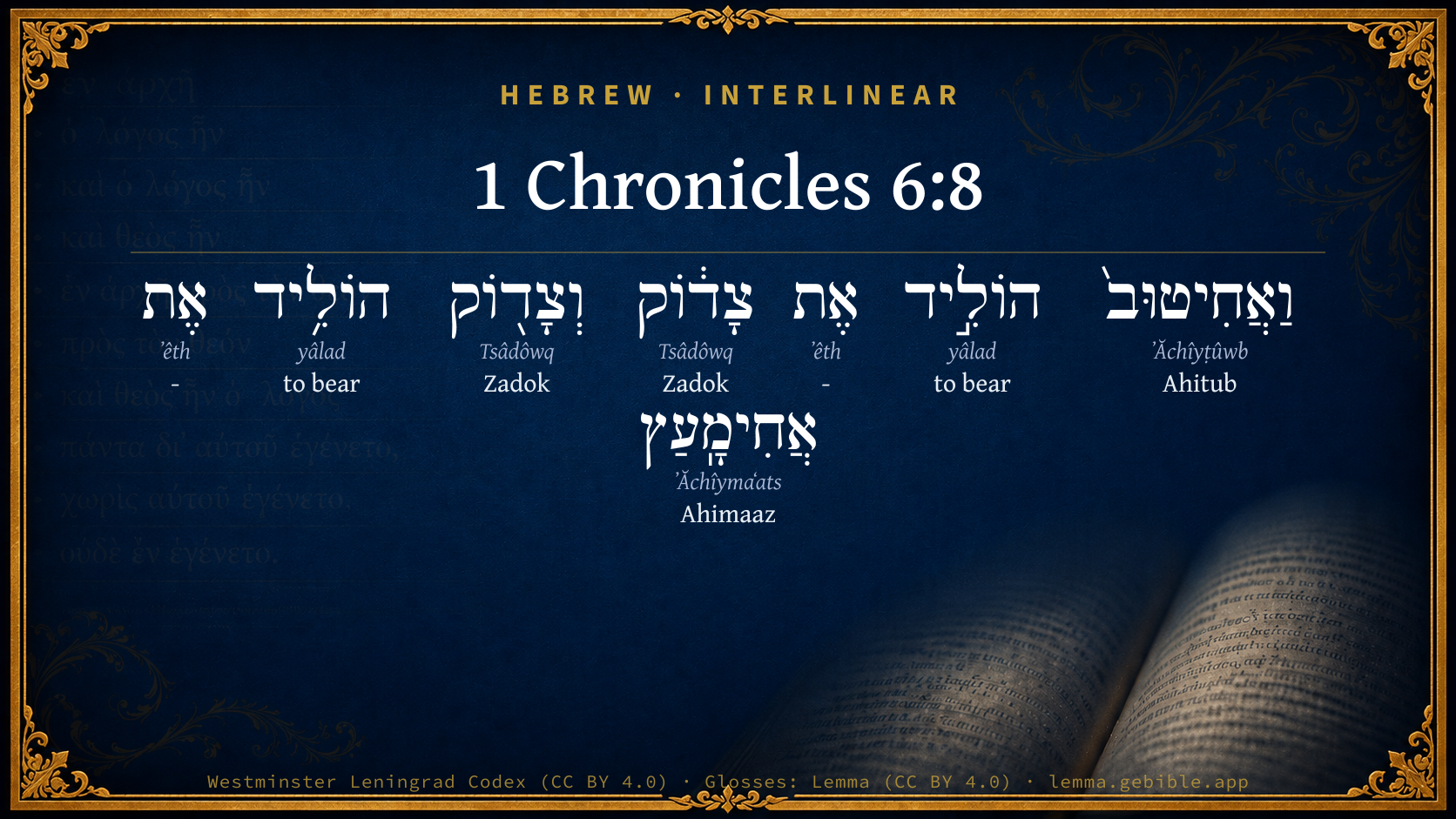
1 Chronicles 6:8

Hebrew (Westminster Leningrad Codex) 1 Chronicles 6:8 appears in the Hebrew Old Testament. The text above is from the Westminster Leningrad Codex. Each word links to its Strong’s number, a concise gloss, and parsing drawn from the Open Scriptures Hebrew Bible morphology. Click any word for its full Brown-Driver-Briggs (BDB) entry.
Download image
Cite this verse

1 Chronicles 6:8 (World English Bible). Public Domain. Lemma interlinear Bible study tool, https://lemma.gebible.app/v/1-chronicles/6/8.

Show BibTeX & RIS
BibTeX
RIS
English Translation
and Ahitub became the father of Zadok, and Zadok became the father of Ahimaaz,
World English Bible · Public Domain
Download a study sheet

One document with this verse’s original text, its word-by-word gloss line, the meaning frame, cross-references with their text, attributed commentary, and full source and license credits — printable, and it pastes into notes with its structure intact.

This verse Autodidact and up

Study sheet (.html) Plain text (.txt)

A passage Seminary Student

Up to 50 verses in one chapter. A passage sheet keeps up to 6 commentary sources and 12 cross-references per verse, in the order this page ranks them, and says so on the sheet whenever that leaves anything out. Ask for a single verse and you get the Autodidact verse sheet above.

Everything on this page stays free to read, with no account — the sheet is a download of what is already on screen, not access to it.

Want to remove ads? Support Godless Engineer
Compare translations 3

The same verse in 3 English versions, stacked beneath the original-language interlinear above. Click any original word for its lexicon entry.

Each is an independent rendering of the whole verse — the interlinear is not word-aligned to these translations.

Highlighted words mark where these versions differ — a whole-verse word diff, not a word-by-word alignment.

  • World English Bible Public Domain
    and Ahitub became the father of Zadok, and Zadok became the father of Ahimaaz,
  • King James Version Public Domain
    And Ahitub begat Zadok, and Zadok begat Ahimaaz,
  • unfoldingWord Literal Text CC BY-SA 4.0
    And Ahitub fathered Zadok, and Zadok fathered Ahimaaz.

unfoldingWord Literal Text — © unfoldingWord, licensed CC BY-SA 4.0. Word-aligned USFM3 via Door43 (git.door43.org/unfoldingWord/en_ult).

Versions to compare (up to 4)

3 of 4 selected

Show all 18 translations

Every available English version of this verse, each an independent rendering of the whole verse.

  • World English Bible Public Domain
    and Ahitub became the father of Zadok, and Zadok became the father of Ahimaaz,
  • Berean Standard Bible Public Domain
    Ahitub was the father of Zadok, Zadok was the father of Ahimaaz,
  • Majority Standard Bible Public Domain
    Ahitub was the father of Zadok, Zadok was the father of Ahimaaz,
  • King James Version Public Domain
    And Ahitub begat Zadok, and Zadok begat Ahimaaz,
  • American Standard Version (1901) Public Domain
    and Ahitub begat Zadok, and Zadok begat Ahimaaz,
  • Revised Version (1885) Public Domain
    and Ahitub begat Zadok, and Zadok begat Ahimaaz;
  • Geneva Bible (1599) Public Domain
    And Ahitub begate Zadok, and Zadok begate Ahimaaz,
  • Douay-Rheims (1899) Public Domain
    Achitob beget Sadoc, and Sadoc begot Achimaas.
  • Young's Literal Translation Public Domain
    and Ahitub begat Zadok, and Zadok begat Ahimaaz,
  • Literal Standard Version CC BY-SA 4.0
    and Ahitub begot Zadok, and Zadok begot Ahimaaz,
  • Unlocked Literal Bible CC BY-SA 4.0
    Ahitub became the father of Zadok, and Zadok became the father of Ahimaaz.
  • unfoldingWord Literal Text CC BY-SA 4.0
    And Ahitub fathered Zadok, and Zadok fathered Ahimaaz.
  • Darby Bible Public Domain
    and Ahitub begot Zadok, and Zadok begot Ahimaaz,
  • World Messianic Bible Public Domain
    Ahitub became the father of Zadok. Zadok became the father of Ahimaaz.
  • Webster's Bible Public Domain
    And Ahitub begat Zadok, and Zadok begat Ahimaaz,
  • Free Bible Version CC BY-SA 4.0
    Ahitub was the father of Zadok, Zadok was the father of Ahimaaz,
  • Bible in Basic English Public Domain
    And Ahitub was the father of Zadok, and Zadok was the father of Ahimaaz,
  • JPS Tanakh (1917) Public Domain
    (5-34) and Ahitub begot Zadok, and Zadok begot Ahimaaz;

Literal Standard Version (2020), Covenant Press — licensed CC BY-SA 4.0. Text via the HelloAO Bible API (eBible.org). Unlocked Literal Bible (unfoldingWord) — licensed CC BY-SA 4.0. Text via the HelloAO Bible API (eBible.org). unfoldingWord Literal Text — © unfoldingWord, licensed CC BY-SA 4.0. Word-aligned USFM3 via Door43 (git.door43.org/unfoldingWord/en_ult). Free Bible Version, Dr. Jonathan Gallagher — licensed CC BY-SA 4.0. Text via the HelloAO Bible API (eBible.org).

Word by word

More ways to search: Search by grammar → Find every occurrence → Compare this word →

Practice this passage: Drill this verse → Learn its vocabulary →

About this verse

These counts appear in no published source. They are computed here, from the morphology-tagged text and Lemma’s own curated glosses. What Lemma adds →

8
words
5
distinct lemmas
Historical
section

Notable vocabulary

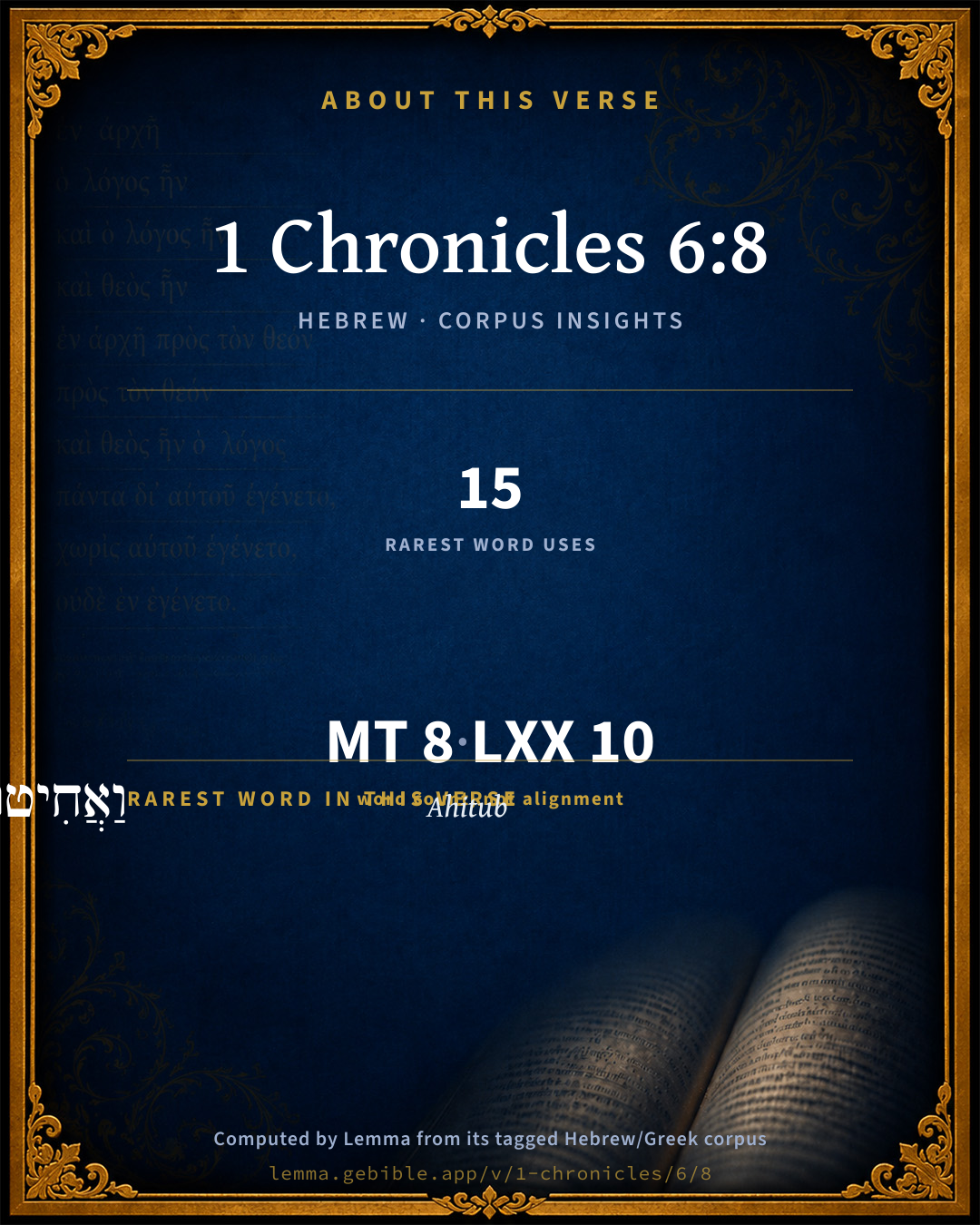
The rarest word here is וַאֲחִיטוּב֙ Ahitub H285 — appearing just 15 times in the whole Hebrew Bible.

Shared distinctive vocabulary

וַאֲחִיטוּב֙ Ahitub H285 occurs in 15 verses of the Hebrew Bible. Also found in:

Grammatical profile

  • 2 verbs
  • 4 nouns
  • 2 particles

Verb forms

  • הוֹלִ֣יד Hiphil · Perfect
  • הוֹלִ֥יד Hiphil · Perfect

Repetition

Words recur within this verse — often emphatic in Hebrew:

  • הוֹלִ֣יד to bear H3205 ×2
  • צָד֔וֹק Zadok H6659 ×2

Hebrew & Septuagint length

In English translation the verse runs 14 words from the Hebrew and 8 from the Septuagint (LXX English) — the Septuagint runs noticeably shorter here. See the side-by-side →

A rough comparison of the two English renderings, which tokenize alike — not a word-level alignment.

Word counts can differ between the Hebrew and the Greek without any difference in meaning — e.g. the Hebrew direct-object marker אֵת has no separate Greek word, and Greek often adds the article ὁ.

In the original languages it is 8 Hebrew tokens and 10 Greek tokens — but the two are counted differently (Hebrew bundles its prefixes and suffixes into one token; the Greek is in lemma form), so that isn’t a like-for-like length.

Cross-references

14

Topical passages linked to 1 Chronicles 6:8 in the Treasury of Scripture Knowledge — connected by theme and wording, ordered by reader-vote popularity; previews shown in the World English Bible.

  • 2 Samuel 8:17 and Zadok the son of Ahitub, and Ahimelech the son of Abiathar, were priests; and Seraiah was scribe;
  • 2 Samuel 15:27 The king said also to Zadok the priest, "Aren't you a seer? Return into the city in peace, and your two sons with you, Ahimaaz your son, and Jonathan the son of Abiathar.
  • 1 Kings 1:34 and let Zadok the priest and Nathan the prophet anoint him there king over Israel; and blow you the trumpet, and say, [Long] live king Solomon.
  • 1 Kings 1:44 and the king has sent with him Zadok the priest, and Nathan the prophet, and Benaiah the son of Jehoiada, and the Cherethites and the Pelethites; and they have caused him to ride on the king's mule;
  • 1 Kings 2:35 The king put Benaiah the son of Jehoiada in his room over the host; and Zadok the priest did the king put in the room of Abiathar.
  • 2 Samuel 15:35–36 Don't you have Zadok and Abiathar the priests there with you? therefore it shall be, that whatever thing you shall hear out of the king's house, you shall tell it to Zadok and Abiathar the priests.
  • 2 Samuel 17:15 Then said Hushai to Zadok and to Abiathar the priests, Thus and thus did Ahithophel counsel Absalom and the elders of Israel; and thus and thus have I counseled.
  • 2 Samuel 17:17 Now Jonathan and Ahimaaz were staying by En Rogel; and a maid-servant used to go and tell them; and they went and told king David: for they might not be seen to come into the city.
  • 2 Samuel 17:20 Absalom's servants came to the woman to the house; and they said, Where are Ahimaaz and Jonathan? The woman said to them, They have gone over the brook of water. When they had sought and could not find them, they returned to Jerusalem.
  • 2 Samuel 18:19 Then said Ahimaaz the son of Zadok, Let me now run, and bear the king news, how that Yahweh has avenged him of his enemies.
  • 2 Samuel 18:22 Then said Ahimaaz the son of Zadok yet again to Joab, But come what may, Please let me also run after the Cushite. Joab said, Why will you run, my son, seeing that you will have no reward for the news?
  • 2 Samuel 18:27–29 The watchman said, I think the running of the foremost is like the running of Ahimaaz the son of Zadok. The king said, He is a good man, and comes with good news.
  • 2 Samuel 20:25 and Sheva was scribe; and Zadok and Abiathar were priests;
  • 1 Kings 1:8 But Zadok the priest, and Benaiah the son of Jehoiada, and Nathan the prophet, and Shimei, and Rei, and the mighty men who belonged to David, were not with Adonijah.

Cross-references courtesy of OpenBible.info (CC BY 4.0).

Hebrew and Greek witnesses Masoretic Hebrew ↔ Greek Septuagint

The same verse in the two great witnesses to the Old Testament, shown verse-for-verse.

Here the Septuagint runs noticeably shorter than the Hebrew — LXX2012 (modern English Septuagint) 8 words vs World English Bible 14. A rough length comparison of the two English translations, not a word-level alignment — read both below.

These are two independent witnesses, not word-aligned to each other, and the Septuagint is shown in lemma (dictionary) form.

Hebrew 1 Chronicles 6:8 Masoretic · Westminster Leningrad Codex

וַאֲחִיטוּב֙ הוֹלִ֣יד אֶת צָד֔וֹק וְצָד֖וֹק הוֹלִ֥יד אֶת אֲחִימָֽעַץ

and Ahitub became the father of Zadok, and Zadok became the father of Ahimaaz,

World English Bible · Public Domain

Greek LXX 1 Chronicles 6:8 Septuagint · lemma form

ελκανα υἱός αὐτός καί αβιασαφ υἱός αὐτός ασιρ υἱός αὐτός

and Achitob begot Sadoc, and Sadoc begot Achimaas;

LXX2012 (modern English Septuagint) · Public Domain

Hebrew: Westminster Leningrad Codex (CC BY 4.0). Greek: Septuagint (public domain); English from LXX2012 (modern English Septuagint) (Public Domain). How the Septuagint differs from the Hebrew →

Commentary

Notes on 1 Chronicles 6:8 from classic Christian and Jewish commentators (each source and its license shown beneath its notes). The classic Christian expositions comment on the surrounding passage and are grouped to its opening verse, so a note may address several verses; the Jewish commentaries on the Tanakh (Rashi and others) are per-verse, so they appear only where the commentator wrote on this verse.

Lemma curates 59 commentaries, every one of them public domain or Creative Commons licensed, each selected and text-cleaned for this edition rather than reprinted as found. About our sources →

Geneva Bible (1599)

Geneva Bible translators

Which was high priest after that Abiathar was deposed, according to the prophecy of Eli the Priest, 1 Sam. 2:31, 35.

Geneva Bible (1599) marginal notes — public domain. Text via Bolls.life.

Adam Clarke's Commentary

Verse 8. Ahitub begat Zadok] Through this person the high priesthood came again into the family of Eleazar.

Adam Clarke's Commentary on the Bible (1810–1826) — public domain. Text from a community e-Sword/MySword module.

The Cambridge Bible for Schools and Colleges

gen. ed. J. J. S. Perowne

8. Ahitub begat Zadok] From 2Sa_8:17; 2Sa_15:29; 2Sa_20:25 it appears that there were two highpriests in David’s day; Zadok however is always mentioned before his colleague.

Ahimaaz] 2Sa_15:27; 2Sa_17:17-21; 2Sa_18:19 ff.

The Cambridge Bible for Schools and Colleges (gen. ed. J. J. S. Perowne; Cambridge University Press, 1878–1918) — public domain. Text from a community e-Sword module.

The Pulpit Commentary

Ahitub. With this name begins the light again. Ahitub, Zadok, Ahimaaz, and Azariah are of frequent mention in the Books of Samuel and Kings. Ahitub, here and elsewhere plainly given as father of Zadok, seems to be given as father of Meraioth in 1Ch_9:11 and Neh_11:11, and grandfather of Zadok; and in both passages is termed "ruler of the house of God an expression probably equivalent to high priest, as Azariah, high priest in the reign of Hezekiah, is also so described. (2Ch_31:13) The recurrence of the two names Ahitub and Zadok in vers. 11 and 12 is very possibly the result of some error; and it is in favour of such a supposition, in some form of it, at all events, that in that place, where, including Shallum (or Meshullam), only three steps are found, several more seem to be required the period one of some one hundred and eighty years, and filled in the list of Judah"s kings by as many as nine in succession. On the other hand, it is open to question whether the recurrence of the names Ahitub and Zadok be not legitimate. And this may then be the solution of 1Ch_9:11 and Neh_11:11, as above, with their insertion of Meraioth still other names being absent which would make up the requisite number of generations. Zadok. The earliest glimpse we get of him is in 1Ch_12:28, where he is introduced as "a young man mighty of valour," who now casts in his lot with David at Hebron, on Saul"s death. In 2Sa_15:24, 2Sa_15:29, 2Sa_15:35, we find him and Abiathar the recognized priests. In 1Ki_1:7, 1Ki_1:8, we find him true to David when Abiathar joined Adonijah the punishment of the latter and the reward of the former being recorded in 1Ki_2:27, 1Ki_2:35, respectively. Up to that time it is evident. that Abiathar had precedence in rank over Zadok. His death is not recorded, but it must be assigned to a date previous to the dedication of the temple, from the account of which (1Ki 8) his name is entirely absent. The last allusions to him are in 1Ki_4:2, 1Ki_4:4; in the latter of which verses (specially coupled as the name is with the deposed Abiathar) the notice is probably as merely historical as it certainly is in the former. This same verse states that Azariah was "the priest," and that he was son, i.q. grandson, of Zadok, proving, with very little doubt, that the explanatory parenthesis of our ver. 10 should follow the Azariah mentioned in the previous verse.

The Pulpit Commentary (1880–1919), ed. H.D.M. Spence-Jones & Joseph S. Exell — public domain. Text from a community e-Sword module.

Lesson kit

Teaching starters — assembled from the data on this page, not authored interpretation. Every prompt links to the verse data it draws on. Edit before teaching.

1 Chronicles, in the Historical, opens this verse with 8 words (5 distinct Hebrew lemmas). Its most distinctive word is ʼĂchîyṭûwb (“Ahitub”). The Greek Septuagint runs shorter here. A historical commentator’s framing appears above. Read the whole chapter for the surrounding context.

Discussion questions

  1. How does “Ahitub” (ʼĂchîyṭûwb) shape what this verse is saying?
  2. How does 1 Samuel 14:3, which shares the word «Ahitub», read alongside this verse?
  3. What does the repetition of “to bear” (2× in this one verse) do in this verse?
  4. The Septuagint runs shorter here than the Hebrew. What might account for the difference?
  5. These translations render this verse differently. What is at stake in choosing one wording over another?
  6. «הוֹלִ֣יד» is a Hiphil Perfect verb. How does that grammatical form shape the action described?
  7. Compare how Geneva Bible (1599) and Adam Clarke's Commentary read this verse. Where do they agree or differ?

Things to notice

Reading settings

Reading text

Shown beneath each verse's original-language words.

Old Testament
Old Testament edition

Read the OT as the Masoretic Hebrew (MT) or the Greek Septuagint (LXX).

English shown for the Greek Septuagint (in the Hebrew ↔ Greek comparison).

Comparing translations? Open the Compare panel on any verse page to stack up to four side by side.