
Ezekiel 17:11

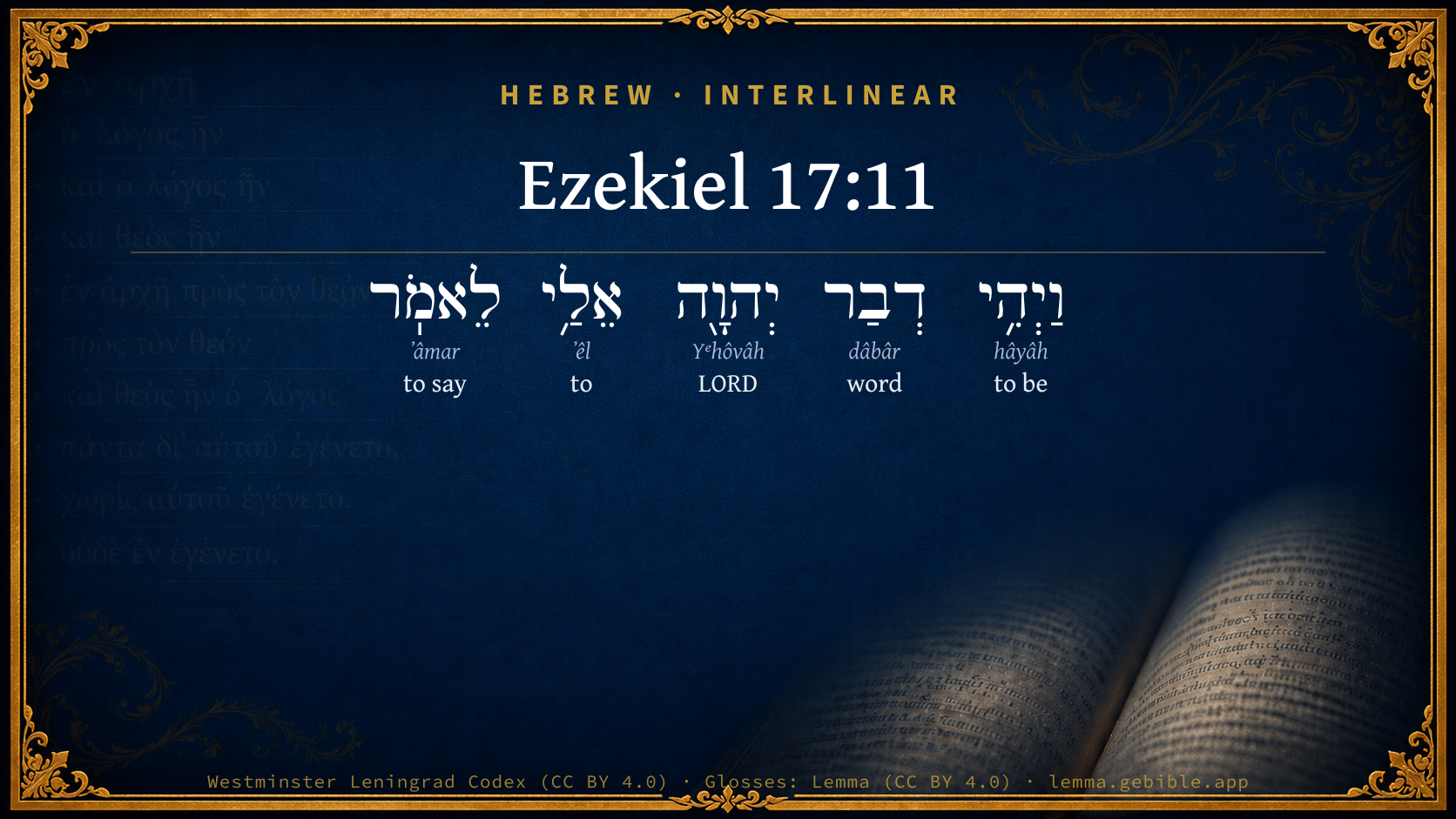
Hebrew (Westminster Leningrad Codex) Ezekiel 17:11 appears in the Hebrew Old Testament. The text above is from the Westminster Leningrad Codex. Each word links to its Strong’s number, a concise gloss, and parsing drawn from the Open Scriptures Hebrew Bible morphology. Click any word for its full Brown-Driver-Briggs (BDB) entry.
Download image
Cite this verse

Ezekiel 17:11 (World English Bible). Public Domain. Lemma interlinear Bible study tool, https://lemma.gebible.app/v/ezekiel/17/11.

Show BibTeX & RIS
BibTeX
RIS
English Translation
Moreover the word of Yahweh came to me, saying,
World English Bible · Public Domain
Download a study sheet

One document with this verse’s original text, its word-by-word gloss line, the meaning frame, cross-references with their text, attributed commentary, and full source and license credits — printable, and it pastes into notes with its structure intact.

This verse Autodidact and up

Study sheet (.html) Plain text (.txt)

A passage Seminary Student

Up to 50 verses in one chapter. A passage sheet keeps up to 6 commentary sources and 12 cross-references per verse, in the order this page ranks them, and says so on the sheet whenever that leaves anything out. Ask for a single verse and you get the Autodidact verse sheet above.

Everything on this page stays free to read, with no account — the sheet is a download of what is already on screen, not access to it.

Want to remove ads? Support Godless Engineer
Compare translations 3

The same verse in 3 English versions, stacked beneath the original-language interlinear above. Click any original word for its lexicon entry.

Each is an independent rendering of the whole verse — the interlinear is not word-aligned to these translations.

Highlighted words mark where these versions differ — a whole-verse word diff, not a word-by-word alignment.

  • World English Bible Public Domain
    Moreover the word of Yahweh came to me, saying,
  • King James Version Public Domain
    Moreover the word of the LORD came unto me, saying,
  • unfoldingWord Literal Text CC BY-SA 4.0
    Then the word of Yahweh came to me, saying,

unfoldingWord Literal Text — © unfoldingWord, licensed CC BY-SA 4.0. Word-aligned USFM3 via Door43 (git.door43.org/unfoldingWord/en_ult).

Versions to compare (up to 4)

3 of 4 selected

Show all 18 translations

Every available English version of this verse, each an independent rendering of the whole verse.

  • World English Bible Public Domain
    Moreover the word of Yahweh came to me, saying,
  • Berean Standard Bible Public Domain
    Then the word of the LORD came to me, saying,
  • Majority Standard Bible Public Domain
    Then the word of the LORD came to me, saying,
  • King James Version Public Domain
    Moreover the word of the LORD came unto me, saying,
  • American Standard Version (1901) Public Domain
    Moreover the word of Jehovah came unto me, saying,
  • Revised Version (1885) Public Domain
    Moreover the word of the LORD came unto me, saying,
  • Geneva Bible (1599) Public Domain
    Moreouer, the worde of the Lord came vnto me, saying,
  • Douay-Rheims (1899) Public Domain
    And the word of the Lord came to me, saying:
  • Young's Literal Translation Public Domain
    And there is a word of Jehovah unto me, saying:
  • Literal Standard Version CC BY-SA 4.0
    And there is a word of YHWH to me, saying,
  • Unlocked Literal Bible CC BY-SA 4.0
    Then the word of Yahweh came to me, saying,
  • unfoldingWord Literal Text CC BY-SA 4.0
    Then the word of Yahweh came to me, saying,
  • Darby Bible Public Domain
    And the word of Jehovah came unto me, saying,
  • World Messianic Bible Public Domain
    Moreover the LORD’s word came to me, saying,
  • Webster's Bible Public Domain
    Moreover the word of the LORD came to me, saying,
  • Free Bible Version CC BY-SA 4.0
    A message from the Lord came to me, saying,
  • Bible in Basic English Public Domain
    Then the word of the Lord came to me, saying,
  • JPS Tanakh (1917) Public Domain
    Moreover the word of the LORD came unto me, saying:

Literal Standard Version (2020), Covenant Press — licensed CC BY-SA 4.0. Text via the HelloAO Bible API (eBible.org). Unlocked Literal Bible (unfoldingWord) — licensed CC BY-SA 4.0. Text via the HelloAO Bible API (eBible.org). unfoldingWord Literal Text — © unfoldingWord, licensed CC BY-SA 4.0. Word-aligned USFM3 via Door43 (git.door43.org/unfoldingWord/en_ult). Free Bible Version, Dr. Jonathan Gallagher — licensed CC BY-SA 4.0. Text via the HelloAO Bible API (eBible.org).

Word by word

More ways to search: Search by grammar → Find every occurrence → Compare this word →

Practice this passage: Drill this verse → Learn its vocabulary →

About this verse

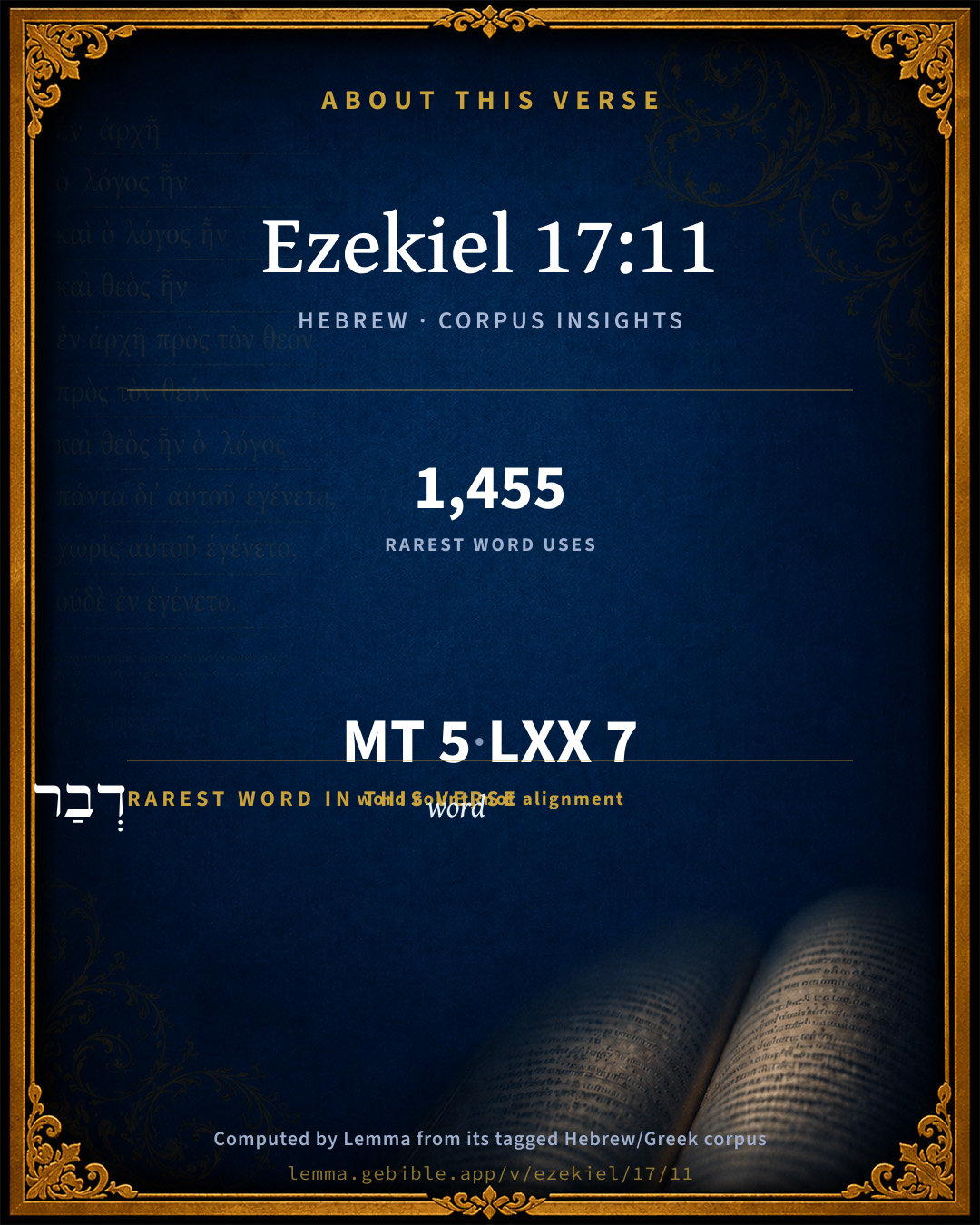
These counts appear in no published source. They are computed here, from the morphology-tagged text and Lemma’s own curated glosses. What Lemma adds →

5
words
5
distinct lemmas
Prophets
section

Grammatical profile

  • 2 verbs
  • 2 nouns
  • 1 preposition

Verb forms

  • וַיְהִ֥י Qal · Sequential Imperfect
  • לֵאמֹֽר Qal · Infinitive Construct

Hebrew & Septuagint length

In English translation the verse runs 9 words from the Hebrew and 10 from the Septuagint (LXX English) — closely comparable.

A rough comparison of the two English renderings, which tokenize alike — not a word-level alignment.

Word counts can differ between the Hebrew and the Greek without any difference in meaning — e.g. the Hebrew direct-object marker אֵת has no separate Greek word, and Greek often adds the article ὁ.

In the original languages it is 5 Hebrew tokens and 7 Greek tokens — but the two are counted differently (Hebrew bundles its prefixes and suffixes into one token; the Greek is in lemma form), so that isn’t a like-for-like length.

Hebrew and Greek witnesses Masoretic Hebrew ↔ Greek Septuagint

The same verse in the two great witnesses to the Old Testament, shown verse-for-verse.

These are two independent witnesses, not word-aligned to each other, and the Septuagint is shown in lemma (dictionary) form.

Hebrew Ezekiel 17:11 Masoretic · Westminster Leningrad Codex

וַיְהִ֥י דְבַר יְהוָ֖ה אֵלַ֥י לֵאמֹֽר

Moreover the word of Yahweh came to me, saying,

World English Bible · Public Domain

Greek LXX Ezekiel 17:11 Septuagint · lemma form

καί γίγνομαι λόγος κύριος πρός ἐγώ λέγω

Moreover the word of the Lord came to me saying,

LXX2012 (modern English Septuagint) · Public Domain

On this verse, The Preacher's Complete Homiletical Commentary discusses the Septuagint’s reading. Read the note in Commentary ↓

Hebrew: Westminster Leningrad Codex (CC BY 4.0). Greek: Septuagint (public domain); English from LXX2012 (modern English Septuagint) (Public Domain). How the Septuagint differs from the Hebrew →

Targum (Aramaic paraphrase)

1

The Targum is the ancient Jewish Aramaic paraphrase of the Hebrew Scriptures — an interpretive translation, not the Hebrew text itself. Onkelos (literal) and Pseudo-Jonathan (expansive) render the Torah, and Jonathan the Prophets. Coverage is partial: where no permissively-licensed English translation exists for a verse, only the Aramaic is shown. This is verse-level text, not a word-by-word alignment to the Hebrew.

  1. Targum Jonathan Prophets (Joshua–Malachi)
    וַהֲוָה פִּתְגָם נְבוּאָה מִן קֳדָם יְיָ עִמִי לְמֵימָר:

    (no public-domain English translation for this verse)

    Targum Jonathan — Aramaic: “Mikraot Gedolot” (public domain). English: “Sefaria Community Translation” (CC0 1.0 (public-domain dedication)); “London "Chaldee Paraphrase," 1871” (public domain). Text via Sefaria.

Commentary

Notes on Ezekiel 17:11 from classic Christian and Jewish commentators (each source and its license shown beneath its notes). The classic Christian expositions comment on the surrounding passage and are grouped to its opening verse, so a note may address several verses; the Jewish commentaries on the Tanakh (Rashi and others) are per-verse, so they appear only where the commentator wrote on this verse.

Lemma curates 59 commentaries, every one of them public domain or Creative Commons licensed, each selected and text-cleaned for this edition rather than reprinted as found. About our sources →

Trapp's Complete Commentary

John Trapp

Eze 17:11 Moreover the word of the LORD came unto me, saying,

Ver. 11. Moreowr, the word of the Lord came unto me, saying.] God had one saying more to this rebellious house by way of explication here, and another of application for comfort and encouragement to the better sort among them. {Eze 17:22-24}

John Trapp, A Commentary or Exposition upon All the Books of the Old and New Testament (1647–1656) — public domain. Text from a community e-Sword module.

The Preacher's Complete Homiletical Commentary

Joseph S. Exell (gen. ed.)

THE INTERPRETATION OF THE PARABLE (Eze_17:11-21)

EXEGETICAL NOTES.—From Eze_17:12-17 we have the formal interpretation of the parable. In Eze_17:19-21, the threat contained in the parable is confirmed and still further expanded.

Eze_17:12. “Behold the king of Babylon is come to Jerusalem, and hath taken the king thereof.” The account of the carrying away of the king, i.e., Jehoiachin, and his princes into Babylon is related in 2Ki_24:11, etc.; Jer_24:1; Jer_29:2.

Eze_17:13. “And hath taken of the king’s seed, and made a covenant with Him, and hath taken an oath of Him.” “The king’s seed is Jehoiachin’s uncle Mattaniah, whom Nebuchadnezzar made king under the name of Zedekiah (2Ki_24:17), and from whom he took an oath of fealty” (2Ch_36:13).—(Keil.)

Eze_17:14. “That the kingdom might be base, that might not lift itself up, but that by keeping of his covenant it might stand.” The design of Nebuchadnezzar was to weaken the kingdom so that it could not revolt against his authority, but, at the same time, to protect them if they continued loyal.

Eze_17:15. “But he rebelled against Him in sending his ambassadors into Egypt, that they might give him horses and much people.” “Though we have no account of this mission to the King of Egypt anywhere else in the Jewish records we may rest satisfied with the testimony of Ezekiel, who was a contemporary. Egypt was celebrated in ancient times for its herd of horses. According to Diod. Sic. i. 45, the whole region from Thebes to Memphis was filled with royal stalls, and such was the abundance of horses, that no fewer than twenty thousand chariots, each having two, could be furnished in time of war. It was, therefore, natural for Zedekiah to turn to that quarter for aid, and considering the hostile attitude of the two great empires, he might reasonably expect that his application would not be made in vain.”—(Henderson.) “Shall he escape that doeth such things? or shall he break the covenant, and be delivered?” “Such things,”—perjury—breach of covenant. Even Pagan nations had great reverence for an oath, and looked upon these as among the highest crimes. When one enquired of the Delphic oracle whether he might break his oath, he was told that for putting so impious a question he should be punished by the untimely death of his children.

Eze_17:17. “Make for him in the war.” Heb., “Act with him in war,” i.e., be of service to him. “Pharaoh will not render him the expected powerful aid against the Chaldeans; he will leave his protegé in the lurch when he is hard pressed by his enemies. That the Chaldeans need no great military force against Jerusalem, is manifest here from this, that the Egyptians, against whom alone it could be necessary, come not to its aid with any force. Egypt was already at that time worm-eaten, which the Spirit of God showed to his prophets, while the world went no further than the surface.”—(Hengstenberg.)

Eze_17:18. “He had given his hand.” “To give the hand,” is still in the East a pledge of agreement, or fidelity (2Ki_10:15; Ezr_10:19; Jer_1:15). Zedekiah proved faithless to God, because in pledging his fealty to the King of Babylon he made a solemn appeal to the God of the Jews (2Ch_36:13). The oath which Zedekiah swore to the King of Babylon is designated in Eze_17:19 as Jehovah’s oath, and the covenant made with him as Jehovah’s covenant.

Eze_17:20. “And I will spread my net upon him, and he shall be taken in my snare, and I will bring him to Babylon.” “My net” (Eze_12:13). Nebuchadnezzar was God’s instrument to punish this rebellious king. “And will plead with him there for his trespass.” To “plead” with him signifies to bring him to submission, to work conviction in him by means of suffering (Eze_20:36). This prophecy was fulfilled five years afterwards, when Zedekiah was carried away captive to Babylon, where he died in prison (Jer_52:8-11).

Eze_17:21. “And all his fugitives with all his bands shall fall by the sword, and they that remain shall be scattered to all winds.” Instead of fugitives the Chaldee reads, “chosen ones,” “his brave men,” or “heroes.” But the ordinary reading yields a suitable sense, and is the one adopted by the LXX. and the Vulgate. “The mention of some who remain, and who are to be scattered towards all the winds, is not at variance with the statement that all the fugitives in the wings of the army are to fall by the sword. The latter threat simply declares that no one will escape death by flight. But there is no necessity to take those who remain as being simply fighting men; and the word “all” must not be taken too literally.”—(Keil).

HOMILETICS

(Eze_17:17-21.)

1. Men look for help from an arm of flesh when in straits. Zedekiah expected that Pharoah’s mighty army, and great company, his chariots and horses, should make for him. We are prone to look unto second causes and creature help more than God’s. Asa, being in distress, did so, “he relied,” saith the text, “on the king of Syria, and not on the Lord his God,” (2Ch_16:7); and “in his disease he sought not to the Lord, but to the physicians” (Eze_17:12). Confidence in man is a common practice of the sons of men. Ephraim, when he saw his sickness, went to the Assyrian and sent to Jareb (Hos_5:13). Men’s spirits look any way, turn any whither, for relief, rather than to God. The arm of flesh is more to them than the arm of God. “Some trust in chariots, and some in horses;” Some in riches (Psa_52:7); some in falsehood (Jer_23:25); some in strongholds (Zec_9:3); some in men (Isa_2:22). But it argues atheism, ignorance, pride, unbelief, that men look not unto God at such times; yea, it proclaims the baseness of our spirits, that we fall upon what is visible, weak, unfaithful, at a distance, and neglect God, who is strong, all-sufficient, near; and all because invisible, not seen of us.

2. Divine Providence overrules and orders things so, that wicked men are frustrated and dissappointed of their hopes and expectations. Zedekiah hoped and expected that Pharaoh with his great forces, should make much for him; but “neither shall Pharaoh with his mighty army and great company make for him.” It is not kings, armies, counsellors, and counsels, will do it. Pharaoh’s army came forth of Egypt, raised the seige when Nebuchadnezzar was before Jerusalem (Jer_37:11); yet it did not make for him. The Chaldeans returned again, sat down before the city, took it, Zedekiah, the princes and others. Absalom expected much from the counsel and advice of Ahithophel, but God turned it into foolishness (2Sa_17:14); and all the strength he had made not for him (2 Samuel 18). He disappointeth the devices of the crafty, so that their hands cannot perform their enterprise” (Job_5:12). Haman could not perform his enterprize. Herod could not accomplish his design to murder Christ when he slew the infants (Matthew 2). Kings and people imagine vain things, and the Lord laughs them to scorn (Psa_2:1; Psa_2:4). He brings “the counsel of the heathen to nought. He maketh the devices of the people,” princes, armies, “of none effect,” and establisheth His own thoughts and counsels, and that to all generations (Psa_33:10-11). God served His own will upon Pharoah and his army. Zedekiah was frustrated—he looked for light and met with darkness. He leaned upon Pharoah, a broken reed, that ran into his hand and pierced him (2Ki_18:21). God’s providence works in all, by all, and overrules all; and He brings to pass His own sacred purposes by kings’ armies, by men’s wits, wills, policies, and powers.

3. The Lord takes notice of the circumstances and aggravations of men’s sins, especially kings’. “He despised the oath by breaking the covenant, when, lo! he had given his hand” (Eze_17:18). I saw him, saith God, reach out his hand, give it as a pawn and pledge of his fidelity to Nebuchadnezzar; he engaged himself thereby to be subject and tributary to him. This aggravated his sin much. It was against the light of nature, special mercy. It was against his superior, Nebuchadnezzar, the greatest king then on earth. It was against the good of the whole Jewish state, for it brought war, famine, plague, captivity upon them all: yea, more than all these, it was a high offence against God and His attributes, and therefore the Lord saith, “he trespassed against me.” God minds with what circumstances men’s sins are clothed. Solomon’s sin had the aggravation nailed to it, “His heart was turned from the Lord God, which had appeared unto him twice” (1Ki_11:9).

4. Oaths and covenants made with men are divine things, and not to be slighted: “Mine oath that he hath despised, and my covenant that he hath broken” (Eze_17:19). It was made with a heathen king, an idolator, yet God owns it as made with Himself, because His sacred and dreadful name was used therein, and judges the breach and violation thereof as bad as if it had been formally made with Himself. Oaths made between man and man are called in Scripture the “oaths of God” (Ecc_8:2); and the covenant made between Jonathan and David is called “the Lord’s oath” (2Sa_21:7). Let not man, therefore, slight covenants and oaths they have made with men, but remember they have to do with God, who is faithful, performing what He swears, and keeping covenant for ever.

5. The Lord hath nets and snares to catch and take perfidious princes and people in. “I will spread my net upon him, and he shall be taken in my snare” (Eze_17:20). There is no evasion when God seeks after sinners. If He throw the net, it shall encompass the greatest leviathan; if He set the snare, it shall take the stoutest lion. God had a net for Pharaoh, and caught that great leviathan in the sea. An oak was the net He caught Absalom in (2Sa_18:9). The earth was his net to take Korah, Datham, and Abiram. A heap of stones was His net thrown upon Achan. A cave was the snare He took five kings in (Jos_10:16-18). The kings of Sodom and Gomorrah were snared in slime pits (Gen_14:10). Herod could not escape the worms, they were God’s net and snare to catch him. The Babylonish armies were His nets and snares to take Hoshea (2 Kings 17); Manasseh (2 Chronicles 33); Jehoiakim, Jehoiachin, and Zedekiah, who were all kings (2 Chronicles 35). Zedekiah had thoughts he should escape, but he did not escape besieging, taking, carrying into Babylon. When the city was taken, he fled by night (Jer_39:4); but God spread His net so, that it fell upon him and all with him. Let men take heed of offending the great God of Heaven and earth, for He hath nets and snares to take them with. If once He throws His net and set His snare, He will take them; and being taken, you may struggle, but shall never get out. Nets and snares are hidden things, they catch suddenly, and hold certainly.—(Greenhill.) Eze_17:17. The help of man is of no avail when God means to destroy. God’s help, on the other hand, avails even against man’s help. Zedekiah with Egypt, Nebuchadnezzar with Jehovah. Look at the co-partneries for thyself, and bestow thy confidence accordingly. The latter firm is the more reliable. Cursed is the man that trusteth in man (Jeremiah 17). Men promise, and break their promise; God promises, and does not break His. (Eze_17:19). God’s oath as against Zedekiah’s perjury. God does not swear, and then fail to keep His oath: that shall be learned by experience by those who swear falsely, or who do not keep their oath. If thou appealest to God as a witness, thou summonest Him also as a judge, as an avenger! We have never to do with men alone. (Eze_17:20, etc.). No one can escape God. The enemies’ sword is sharp; God’s sword is sharper still. God’s judgments are always meant to lead to the knowledge of Himself as well, and not merely of ourselves.—(Lange).

The Preacher's Complete Homiletical Commentary (gen. ed. Joseph S. Exell; Funk & Wagnalls, c. 1892) — public domain (pre-1929). A full-Bible homiletical/sermon-outline anthology covering 65 of 66 books (2 John is absent from the source module). Text from a community e-Sword module.

Keil & Delitzsch

C. F. Keil & F. Delitzsch

Interpretation of the Riddle

Eze 17:11. And the word of Jehovah came to me, saying, Eze 17:12. Say to the refractory race: Do ye not know what this is? Say, Behold, the king of Babel came to Jerusalem and took its king and its princes, and brought them to himself to Babel. Eze 17:13. And he took of the royal seed, and made a covenant with him, and caused him to enter into an oath; and he took the strong ones of the land: Eze 17:14. That it might be a lowly kingdom, not to lift itself up, that he might keep his covenant, that it might stand. Eze 17:15. But he rebelled against him by sending his messengers to Egypt, that it might give him horses and much people. Will he prosper? will he that hath done this escape? He has broken the covenant, and should he escape? Eze 17:16. As I live, is the saying of the Lord Jehovah, surely in the place of the king, who made him king, whose oath he despised, and whose covenant he broke with him, in Babel he will die. Eze 17:17. And not with great army and much people will Pharaoh act with him in the war, when they cast up a rampart and build siege-towers, to cut off many souls. Eze 17:18. He has despised an oath to break the covenant, and, behold, he has given his hand and done all this; he will not escape. Eze 17:19. Therefore thus saith the Lord Jehovah, As I live, surely my oath which he has despised, and my covenant which he has broken, I will give upon his head. Eze 17:20. I will spread out my net over him, so that he will be taken in my snare, and will bring him to Babel, and contend with him there on account of his treachery which he has been guilty of towards me. Eze 17:21. And all his fugitives in all his regiments, by the sword will they fall, and those who remain will be scattered to all winds; and ye shall see that I Jehovah have spoken it.

In Eze 17:12-17 the parable in Eze 17:2-10 is interpreted; and in Eze 17:19-21 the threat contained in the parable is confirmed and still further expanded. We have an account of the carrying away of the king, i.e., Jehoiachin, and his princes to Babel in Kg2 24:11., Jer 24:1, and Jer 29:2. The king's seed (זרע המּלוּכה, Eze 17:13, as in Jer 41:1 = זרע המּלך, Kg1 11:14) is Jehoiachin's uncle Mattaniah, whom Nebuchadnezzar made king under the name of Zedekiah (Kg2 24:17), and from whom he took an oath of fealty (Ch2 36:13). The strong of the land (אילי = אוּלי, Kg2 24:15), whom Nebuchadnezzar took (לקח), i.e., took away to Babel, are not the heads of tribes and families (Kg2 24:15); but the expression is used in a wide sense for the several classes of men of wealth, who are grouped together in Kg2 24:14 under the one term כּל־גּבּורי ח (אנשׁי חיל, Kg2 24:16), including masons, smiths, and carpenters (Kg2 24:14 and Kg2 24:16), whereas the heads of tribes and families are classed with the court officials (סריסים, Kg2 24:15) under the title שׂריה (princes) in Eze 17:12. The design of these measures was to make a lowly kingdom, which could not raise itself, i.e., could not revolt, and to deprive the vassal king of the means of breaking of the covenant. the suffix attached to לעמדהּ is probably to be taken as referring to ממלכה rather than בּריתי, although both are admissible, and would yield precisely the same sense, inasmuch as the stability of the kingdom was dependent upon the stability of the covenant. But Zedekiah rebelled (Kg2 24:20). The Egyptian king who was to give Zedekiah horses and much people, in other words, to come to his assistance with a powerful army of cavalry and fighting men, was Hophrah, the Apries of the Greeks, according to Jer 44:30 (see the comm. on Kg2 24:19-20). היצלח points back to תּצלח in Eze 17:9; but here it is applied to the rebellious king, and is explained in the clause 'הימּלט וגו. The answer is given in Eze 17:16 as a word of God confirmed by a solemn oath: he shall die in Babel, the capital of the king, who placed him on the throne, and Pharaoh will not render him any effectual help (Eze 17:17). עשׂה אותו, as in Eze 15:1-8 :59, to act with him, that is to say, assist him, come to his help. אותו refers to Zedekiah, not to Pharaoh, as Ewald assumes in an inexplicable manner. For 'שׁפך סללה , compare Eze 4:2; and for the fact itself, Jer 34:21-22, and Jer 37:5, according to which, although an Egyptian army came to the rescue of Jerusalem at the time when it was besieged by the Chaldeans, it was repulsed by the Chaldeans who marched to meet it, without having rendered any permanent assistance to the besieged.

In Eze 17:18, the main thought that breach of faith can bring no deliverance is repeated for the sake of appending the further expansion contained in Eze 17:19-21. נתן ידו, he gave his hand, i.e., as a pledge of fidelity. The oath which Zedekiah swore to the king of Babel is designated in Eze 17:19 as Jehovah's oath (אלתי), and the covenant made with him as Jehovah's covenant, because the oath had been sworn by Jehovah, and the covenant of fidelity towards Nebuchadnezzar had thereby been made implicite with Jehovah Himself; so that the breaking of the oath and covenant became a breach of faith towards Jehovah. Consequently the very same expressions are used in Eze 17:16, Eze 17:18, and Eze 17:19, to designate this breach of oath, which are applied in Eze 16:59 to the treacherous apostasy of Jerusalem (Israel) from Jehovah, the covenant God. And the same expressions are used to describe the punishment as in Eze 12:13-14. נשׁפּט אתּו is construed with the accusative of the thing respecting which he was to be judged, as in Sa1 12:7. Jehovah regards the treacherous revolt from Nebuchadnezzar as treachery against Himself (מעל); not only because Zedekiah had sworn the oath of fidelity by Jehovah, but also from the fact that Jehovah had delivered up His people and kingdom into the power of Nebuchadnezzar, so that revolt from him really became rebellion against God. את before כּל־מברחו is nota accus., and is used in the sense of quod adtinet ad, as, for example, in Kg2 6:5. מברחו, his fugitives, is rendered both by the Chaldee and Syriac "his brave men," or "heroes," and is therefore identified with מבחרו (his chosen ones), which is the reading in some manuscripts. But neither these renderings nor the parallel passage in Eze 12:14, where סביבותיו apparently corresponds to it, will warrant our adopting this explanation, or making any alteration in the text. The Greek versions have πάσας φυγαδείας αὐτοῦ; Theodoret: ἐν πάσαις ταῖς φυγαδείαις αὐτοῦ; the Vulgate: omnes profugi ejus; and therefore they all had the reading מברחו, which also yields a very suitable meaning. The mention of some who remain, and who are to be scattered toward all the winds, is not at variance with the statement that all the fugitives in the wings of the army are to fall by the sword. The latter threat simply declares that no one will escape death by flight. But there is no necessity to take those who remain as being simply fighting men; and the word "all" must not be taken too literally.

Keil & Delitzsch — Biblical Commentary on the Old Testament (1861–1891) — public domain (CC PDM 1.0). Text via the HelloAO Bible API. (Old Testament only.)

Tyndale Open Study Notes

Tyndale Open Resources

17:11-18 The first eagle was Nebuchadnezzar, king of Babylon. The cedar sprig was Jehoiachin, who was carried off to Babylon by Nebuchadnezzar. The replacement that grew into a low vine was Zedekiah, and the second eagle was Egypt, from whom Zedekiah was seeking help in his bid to break free of the Babylonians. The hot east wind of judgment blew from Babylon, uprooting and withering Jerusalem. • The image of the eagle that spared no effort in providing for the vine seems to describe God’s care for Israel more than Nebuchadnezzar’s concern for Zedekiah. These connections point us to a fundamental analogy between Zedekiah’s rebellion against his overlord, Nebuchadnezzar, and Israel’s rebellion against the Lord. Zedekiah’s rebellion against the might of the Babylonians was foolish to the point of being suicidal. Even more foolish was Israel’s rebellion against the Lord, the God of heaven and earth.

Tyndale Open Study Notes — © Tyndale Open Resources, licensed CC BY-SA 4.0. Text via the HelloAO Bible API.

John Calvin's Commentaries

An explanation of the allegory is now added. The figure being dropped, God shows what he had hitherto set forth enigmatically. We said the object of the allegory was to induce the Jews to apply their minds more diligently to the Prophet’s destruction; for if he had used common and ordinary language, we know how carelessly they were accustomed to despise all rebukes and threatenings; but a riddle, while it held them in suspense, at the same time roused them, and so they were prepared for receiving the instruction which now follows. God says, therefore, that the king of Babylon came to Jerusalem. This reason has induced some to think that Lebanon is metaphorically called Jerusalem, but falsely, as we have already said. As long as the Prophet spoke figuratively, the parts ought to be mutually fitted to each other, as a tree and its branches have some connection with an eagle. The king of Babylon came to Jerusalem, and took the king away, and the elders, and led them off to Babylon. Although the Jews thought to be sufficiently moved by simple narrative, yet God here reproves them, because he saw how sluggish they were. First, he calls them a rebellious house; then he asks, Whether they know the meaning of all this? This is a kind of reproach by which God reminds them of their stupidity; since that riddle was not so obscure as to prevent them from understanding what had happened, unless they had been destitute of reason and judgment. But the Prophet thrusts at them more pointedly, by calling them a rebellious house, although at the same time he obliquely reproves their stupidity in not immediately perceiving the meaning of the riddle. He now adds, that the king of Babylon had taken from the royal seed. We said that Zedekiah was the uncle of Jehoiakim: he was placed on the throne beyond all expectation; because, if Jehoiakim had begat sons when he was still secure, they would have been his successors: hence it was an extraordinary advantage to Zedekiah in being placed on the throne. But he says, that he was so created king, that the king of Babylon made a covenant with him, and induced him to take an oath. Here God shows that, humanly speaking, Zedekiah’s revolt could not prosper; for even profane men are always persuaded that the perfidy of him who breaks his word will not go unpunished, especially in treaties, which are held sacred by common consent. Since, therefore, the sacredness of treaties was so great, that they could not be violated without weakening the bonds of society, hence the general persuasion that the falsehood of all truce-breakers will turn out unhappily. Now, therefore, God leaves his own cause, and takes up that of King Nebuchadnezzar: Behold, says he, you was made king by gratuitous liberality: a conqueror indeed imposed conditions upon thee, but still thy state was desirable — you could rule your own people splendidly and with moderate dignity: now, because thy covenant has been despised, and your oath broken, you has been ungrateful to the king of Babylon, who had bound thee to himself by his munificence: how can this perfidy prosper? Now, therefore, we see the Prophet’s meaning, when he says that the king of Babylon made a treaty with King Zedekiah, and took an oath of him: this is added for the sake of amplifying; for although men never enter into treaties without a mutual oath, yet Ezekiel seems to have doubled the crime of Zedekiah, when he expresses that an oath intervened. He says that he took the strong of the land, namely, as hostages. There is no doubt that Nebuchadnezzar assembled this troop around him that the Jews might be more quiet: for he knew the turbulent character of the nation, and that the maintenance of so many was expensive: but, as I have said, it was his plan to hold the whole country at peace in this way. But Zedekiah rendered his own brothers and relations liable to death, since Nebuchadnezzar might be induced, by just anger, to slay them all. Hence Zedekiah’s revolt was the betrayal of his brothers: for this reason the Prophet adds, that the strong ones of the people were led away to Babylon; that is, those of the first rank, who were held in honor by the people.

John Calvin's Commentaries (1540-1563) — public domain. Text from the Calvin Translation Society English edition (1840s-50s) via the Christian Classics Ethereal Library (ccel.org). Calvin's coverage is partial (roughly two-thirds of the Bible); uncommented books and verses are honest gaps, never fabricated. The 19th-century editor's footnotes and remarks are omitted so the notes are faithfully Calvin's own voice.

Ellicott's Commentary for English Readers

(11) Moreover the word of the Lord.—The form of expression leaves it uncertain whether the explanation of the parable was given at the same time with the parable itself, or whether, as is more probable, a little time was suffered to elapse, during which it should be “a riddle” to the people that they might be the more attentive to its meaning when given to them.

A Bible Commentary for English Readers, edited by Charles John Ellicott (1878–1897) — public domain. Text from a community e-Sword module.

John Gill's Exposition

And hath taken of the king's seed,.... One of the royal family, signified by the seed of the land, Eze 17:5. Mattaniah, son of King Josiah, and uncle to King Jeconiah; whom Nebuchadnezzar took and made king of Judea, and called him Zedekiah, which signifies the "justice of the Lord": to put him in mind of doing justly, by observing the covenant and oath after mentioned, or that he must expect vengeance:

and made a covenant with him, and hath taken an oath of him; he gave him the throne and kingdom upon certain conditions to be performed, and for the perform once of which he made him swear by the God of Israel; see Ch2 36:13;

he hath also taken the mighty of the land: or, "the rams of the land" (x); the principal men of it for wisdom, riches, and valour, the princes and nobles of it; which he did, as to weaken the nation, that it might not be so capable of rebelling against him, so to be hostages for the performance of the covenant entered into; and this is meant by planting the seed with circumspection, Eze 17:5.

(x) "arietes terrae", Montanus.

John Gill's Exposition of the Whole Bible (1746–1763) — public domain (CC PDM 1.0). Text via the HelloAO Bible API.

The Pulpit Commentary

Vers. 11-21. The sacredness of treaties.

The Old Testament abounds in illustrations of the bearing of religion upon national and corporate life. In this passage of prophecy Ezekiel rebukes his countrymen for their disc, intent under the Assyrian rule, and for their treacherous intrigues with Egypt. Speaking in the name of the King of kings, he upbraids them for deliberate infraction of a covenant which they were bound to observe. He shows them that political action may be sinful, and that, when such is the case, the Divine Ruler will not suffer it to go unpunished.

I THE JUSTICE OF GOD IS DISCERNIBLE IN NATIONAL CALAMITIES. This was most evident in the case of Judah and Israel, who by their defection and apostasy incurred the righteous displeasure of the Almighty Ruler, and brought upon themselves the judgment beneath which, in the time of Ezekiel, they were smarting. The King of Babylon had come to Jerusalem, had taken the king thereof and the princes thereof, and had led them with him to Babylon; he had taken of the king"s seed, and had established him in authority over the remnant in the land, that the kingdom, though base, might stand. In all this the righteous hand of God was visible to every observant and reflecting mind.

II THE MERCY OF GOD IS DISCERNIBLE IN THE COVENANT BETWEEN THE CONQUERORS AND THE CONQUERED. Judah would have met with the fate she deserved had she been treated as an ordinary subject province. But God"s providence ordered matters otherwise. The King of Babylon was disposed to deal favourably with the conquered sons of Judah. He made a covenant with Zedekiah, and took an oath of him. Thus some semblance of self-government was left with the vanquished. Although their chiefs were carried captive, those who were permitted to remain did so under the sovereignty of a member of the royal house. We are taught to see in this arrangement an evidence of the favour and forbearance of the Most High.

III THE SANCTION OF GOD RESTS UPON NATIONAL ENGAGEMENTS SOLEMNLY UNDERTAKEN AND RATIFIED. An oath is an appeal to God, and he will not hold him guiltless that taketh his Name in vain. A nation may appeal to Heaven, as may an individual. Peoples come voluntarily into certain relations with each other in the great community of mankind. As surely as there is an Almighty Ruler who sways a righteous sceptre over the nations, so surely does sacredness attach to those obligations which nations take upon themselves with regard to one another. They are not indifferent and trivial matters, but matters with which the moral life of nations is bound up.

IV THE DISPLEASURE OF GOD IS UPON THOSE WHO VIOLATE SOLEMN TREATIES. In language of truly prophetic indignation, the prophet upbraids the king and those who acted with him in secretly rebelling against the court of Babylon, to whose favour they owed whatever national existence was left to them, and with whom they had entered into sacred and binding treaty. "Shall he prosper? shall he escape that doeth such things? shall he break the covenant, and yet escape?" The Eternal regarded this conduct as a wrong, not so ranch to Babylon, as to himself. Mine oath he hath despised; my covenant he hath broken." "He hath trespassed against me." It is to be feared that this is a consideration which never enters into the minds of some rulers and statesmen; they think of the effect of their conduct upon the great and mighty of this world, but they do not ask themselves how their falsehood and treachery are regarded by him who rules not in heaven only, but on the earth.

V THE JUDGMENTS OF GOD WILL OVERTAKE THOSE WHO REGARD INTEREST AND EXPEDIENCY RATHER THAN PRINCIPLE AND PROMISES. It was foretold that Judah should gain nothing by her deceptive and base conduct. Pharaoh should not deliver the people with his mighty army. Judah"s conduct should be recompensed by Divine interposition; the king who had rebelled should die in the midst of Babylon, and should not escape; the fugitives should fall by the sword, and they that remained should be scattered toward all winds. The lesson is one of universal import. Be they high or low, men who violate the compacts and disregard the engagements into which they have voluntarily and deliberately entered, shall not be unpunished, shall not escape the righteous judgments of the Judge of all the earth. T.

The Pulpit Commentary (1880–1919), ed. H.D.M. Spence-Jones & Joseph S. Exell — public domain. Text from a community e-Sword module.

Kretzmann's Popular Commentary

Paul E. Kretzmann

The Double Application of the Parable

v. 11. Moreover, the word of the Lord came unto me, saying,

v. 12. Say now to the rebellious house, literally, "the house of rebelliousness," the children of Israel, to whom this parable had been told as a warning, Know ye not what these things mean? Were they intellectually as well as morally stupid? Tell them, Behold, the king of Babylon is come to Jerusalem, 2Ki 24:11 ff. ; Jer 24:1; Jer 29:2, and hath taken the king thereof, namely, Jehoiachin, and the princes thereof and led them with him to Babylon, theirs being the first company of exiles from Jerusalem;

v. 13. and hath taken of the king’s seed, of the royal family, and made a covenant with him and hath taken an oath of him, the oath of allegiance as a tributary ruler, this man being Zedekiah himself; he hath also taken the mighty of the land, all the representatives of the wealthier class, the landowners and the artisans,

v. 14. that the kingdom might be base, of a low condition, of a very secondary rank, that it might not lift itself up, not develop enough strength to regain its independence, but that by keeping of his covenant it might stand.

v. 15. But he, the king of Judah, rebelled against him, namely, Nebuchadnezzar, king of Babylon, in sending his ambassadors into Egypt, 2Ki 24:20, that they might give him horses and much people, come to his assistance with a strong army. Shall he prosper? Shall he escape that doeth such things? Or shall he break the covenant, his oath of fealty, and be delivered?

v. 16. As I live, saith the Lord God, the sovereign Ruler of the universe swearing his most solemn oath, surely, in the place where the king dwelleth that made him king, whose oath he despised, rejecting the obligation which it laid upon him, and whose covenant lie brake, even with him in the midst of Babylon he shall die. Zedekiah’s revolt was an act of treachery, and was to be punished as it well deserved.

v. 17. Neither shall Pharaoh, upon whom Zedekiah depended, with his mighty army and great company, make for him in the war, as Zedekiah’s ally in battle, by casting up mounts and building forts, to cut off many persons, in an effort to relieve the besieged city;

v. 18. seeing he despised the oath, valid and sacred as it was, by breaking the covenant, when, lo, he had given his hand, in a solemn pledge, and hath done all these things, he shall not escape, he was to pay the penalty of his perjury.

v. 19. Therefore, thus saith the Lord God, As I live, surely Mine oath that he hath despised, for it was made in the name of Jehovah, and My covenant that he hath broken, even it will I recompense upon his own head, in His punishment upon the perjurer.

v. 20. And I will spread My net upon him, like a fowler setting his traps for birds, and he shall be taken in My snare, and I will bring him to Babylon, these words coming true a few years later, and will plead with him there, contending with him as when a case is argued in court, for his trespass that he hath trespassed against Me, the accusation here involving also the punishment.

v. 21. And all his fugitives with all his bands, even the picked ones of his military forces, shall fall by the sword, and they that remain shall be scattered toward all winds, doomed to death though they escape the first onslaught; and ye shall know that I, the Lord, have spoken it, bitter experience teaching them what all the admonitions of the Lord’s prophets had not been able to accomplish.

v. 22. Thus saith the Lord God, I will also take of the highest branch of the high cedar, a shoot of the royal house of David, and will set it, give it a place where it might grow; I will crop off from the top of his young twigs a tender one, tender both in age and in character, and will plant it upon an high mountain and eminent, in a position of power and magnificence;

v. 23. in the mountain of the height of Israel will I plant it, figurative for the exalted position of the Kingdom of Grace; and it shall bring forth boughs and bear fruit and be a goodly cedar, a glorious and beautiful tree; and under it shall dwell all fowl of every wing, representative of all nations; in the shadow of the branches thereof shall they dwell. Cf Mat 13:32.

v. 24. And all the trees of the field, men throughout the world, shall know that I, the Lord, have brought down the high tree, the proud Zedekiah, have exalted the low tree, the lowly Messiah, have dried up the green tree, which the last king of Judah considered himself to be, and have made the dry tree to flourish, Cf Isa 53:2. I, the Lord, have spoken and have done it. The passage sets forth, in a most unmistakable fashion, the rise of the Messiah from His lowly origin, as a branch of the impoverished family of David, to be the King of His Church, which, under His benign and powerful rule, extends throughout the world and gathers into its communion men from every race and nation.

Paul E. Kretzmann, Popular Commentary of the Bible (1921–1924) — public domain. Text from a community e-Sword module.

unfoldingWord translationNotes

Door43 World Missions Community

the word of Yahweh came

This is an idiom that is used to introduce something that God told his prophets or his people. See how you translated this in Ezekiel 3:16. AT: "Yahweh spoke this message" or "Yahweh spoke these words" (See: Idiom)

the rebellious house

This is a metonym for the family that lives in the house, in this case the Israelites, the descendants of Jacob over many years. See how you translated this in Ezekiel 2:5. AT: "the rebellious people" (See: Metonymy)

Do you not know what these things mean?

Yahweh asks this as a leading question in order to provide the answer. The question can be translated as a statement. AT: "This is what these things mean." (See: Rhetorical Question)

Behold

"Look" or "Listen" or "Pay attention to what I am about to tell you"

her king and her princes

The word "her" refers to Jerusalem.

translationWords

word of God

rebel

house

king

Babylon

Jerusalem

prince

unfoldingWord translationNotes — © Distant Shores Media and the Door43 World Missions Community, licensed CC BY-SA 4.0. Source: git.door43.org/Door43/en_tn.

Lesson kit

Teaching starters — assembled from the data on this page, not authored interpretation. Every prompt links to the verse data it draws on. Edit before teaching.

Ezekiel, in the Prophets, opens this verse with 5 words (5 distinct Hebrew lemmas). Its most distinctive word is dâbâr (“word”). A historical commentator’s framing appears above. Read the whole chapter for the surrounding context.

Discussion questions

  1. The word dâbâr carries the sense “word.” How does it shape the verse?
  2. These translations render this verse differently. What is at stake in choosing one wording over another?
  3. «וַיְהִ֥י» is a Qal Sequential Imperfect verb. How does that grammatical form shape the action described?
  4. Compare how Trapp's Complete Commentary and The Preacher's Complete Homiletical Commentary read this verse. Where do they agree or differ?

Things to notice

Reading settings

Reading text

Shown beneath each verse's original-language words.

Old Testament
Old Testament edition

Read the OT as the Masoretic Hebrew (MT) or the Greek Septuagint (LXX).

English shown for the Greek Septuagint (in the Hebrew ↔ Greek comparison).

Comparing translations? Open the Compare panel on any verse page to stack up to four side by side.