
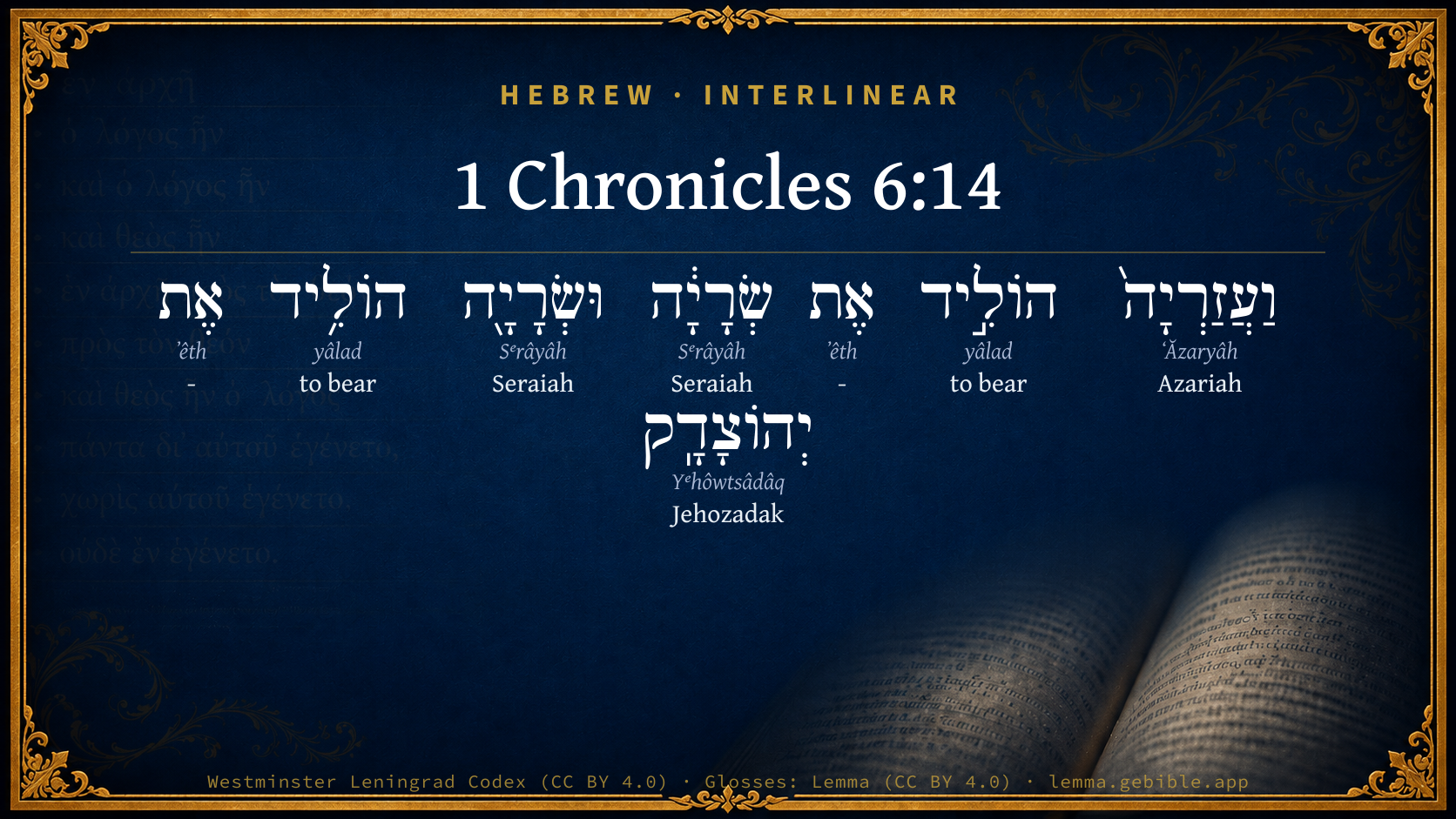
1 Chronicles 6:14

Hebrew (Westminster Leningrad Codex) 1 Chronicles 6:14 appears in the Hebrew Old Testament. The text above is from the Westminster Leningrad Codex. Each word links to its Strong’s number, a concise gloss, and parsing drawn from the Open Scriptures Hebrew Bible morphology. Click any word for its full Brown-Driver-Briggs (BDB) entry.
Download image
Cite this verse

1 Chronicles 6:14 (World English Bible). Public Domain. Lemma interlinear Bible study tool, https://lemma.gebible.app/v/1-chronicles/6/14.

Show BibTeX & RIS
BibTeX
RIS
English Translation
and Azariah became the father of Seraiah, and Seraiah became the father of Jehozadak;
World English Bible · Public Domain
Highlights Full analysis ↓
Download a study sheet

One document with this verse’s original text, its word-by-word gloss line, the meaning frame, cross-references with their text, attributed commentary, and full source and license credits — printable, and it pastes into notes with its structure intact.

This verse Autodidact and up

Study sheet (.html) Plain text (.txt)

A passage Seminary Student

Up to 50 verses in one chapter. A passage sheet keeps up to 6 commentary sources and 12 cross-references per verse, in the order this page ranks them, and says so on the sheet whenever that leaves anything out. Ask for a single verse and you get the Autodidact verse sheet above.

Everything on this page stays free to read, with no account — the sheet is a download of what is already on screen, not access to it.

Want to remove ads? Support Godless Engineer
Compare translations 3

The same verse in 3 English versions, stacked beneath the original-language interlinear above. Click any original word for its lexicon entry.

Each is an independent rendering of the whole verse — the interlinear is not word-aligned to these translations.

Highlighted words mark where these versions differ — a whole-verse word diff, not a word-by-word alignment.

  • World English Bible Public Domain
    and Azariah became the father of Seraiah, and Seraiah became the father of Jehozadak;
  • King James Version Public Domain
    And Azariah begat Seraiah, and Seraiah begat Jehozadak,
  • unfoldingWord Literal Text CC BY-SA 4.0
    And Azariah fathered Seraiah, and Seraiah fathered Jozadak.

unfoldingWord Literal Text — © unfoldingWord, licensed CC BY-SA 4.0. Word-aligned USFM3 via Door43 (git.door43.org/unfoldingWord/en_ult).

Versions to compare (up to 4)

3 of 4 selected

Show all 18 translations

Every available English version of this verse, each an independent rendering of the whole verse.

  • World English Bible Public Domain
    and Azariah became the father of Seraiah, and Seraiah became the father of Jehozadak;
  • Berean Standard Bible Public Domain
    Azariah was the father of Seraiah, and Seraiah was the father of Jehozadak.
  • Majority Standard Bible Public Domain
    Azariah was the father of Seraiah, and Seraiah was the father of Jehozadak.
  • King James Version Public Domain
    And Azariah begat Seraiah, and Seraiah begat Jehozadak,
  • American Standard Version (1901) Public Domain
    and Azariah begat Seraiah, and Seraiah begat Jehozadak;
  • Revised Version (1885) Public Domain
    and Azariah begat Seraiah, and Seraiah begat Jehozadak;
  • Geneva Bible (1599) Public Domain
    And Azariah begate Seraiah, and Seraiah begate Iehozadak,
  • Douay-Rheims (1899) Public Domain
    Azarias beget Saraias, and Saraias beget Josedec.
  • Young's Literal Translation Public Domain
    and Azariah begat Seraiah, and Seraiah begat Jehozadak;
  • Literal Standard Version CC BY-SA 4.0
    and Azariah begot Seraiah, and Seraiah begot Jehozadak;
  • Unlocked Literal Bible CC BY-SA 4.0
    Azariah became the father of Seraiah, and Seraiah became the father of Jozadak.
  • unfoldingWord Literal Text CC BY-SA 4.0
    And Azariah fathered Seraiah, and Seraiah fathered Jozadak.
  • Darby Bible Public Domain
    and Azariah begot Seraiah, and Seraiah begot Jehozadak,
  • World Messianic Bible Public Domain
    Azariah became the father of Seraiah. Seraiah became the father of Jehozadak.
  • Webster's Bible Public Domain
    And Azariah begat Seraiah, and Seraiah begat Jehozadak,
  • Free Bible Version CC BY-SA 4.0
    Azariah was the father of Seraiah, and Seraiah was the father of Jehozadak.
  • Bible in Basic English Public Domain
    And Azariah was the father of Seraiah, and Seraiah was the father of Jehozadak;
  • JPS Tanakh (1917) Public Domain
    (5-40) and Azariah begot Seraiah, and Seraiah begot Jehozadak;

Literal Standard Version (2020), Covenant Press — licensed CC BY-SA 4.0. Text via the HelloAO Bible API (eBible.org). Unlocked Literal Bible (unfoldingWord) — licensed CC BY-SA 4.0. Text via the HelloAO Bible API (eBible.org). unfoldingWord Literal Text — © unfoldingWord, licensed CC BY-SA 4.0. Word-aligned USFM3 via Door43 (git.door43.org/unfoldingWord/en_ult). Free Bible Version, Dr. Jonathan Gallagher — licensed CC BY-SA 4.0. Text via the HelloAO Bible API (eBible.org).

Word by word

More ways to search: Search by grammar → Find every occurrence → Compare this word →

Practice this passage: Drill this verse → Learn its vocabulary →

About this verse

These counts appear in no published source. They are computed here, from the morphology-tagged text and Lemma’s own curated glosses. What Lemma adds →

8
words
5
distinct lemmas
Historical
section

Notable vocabulary

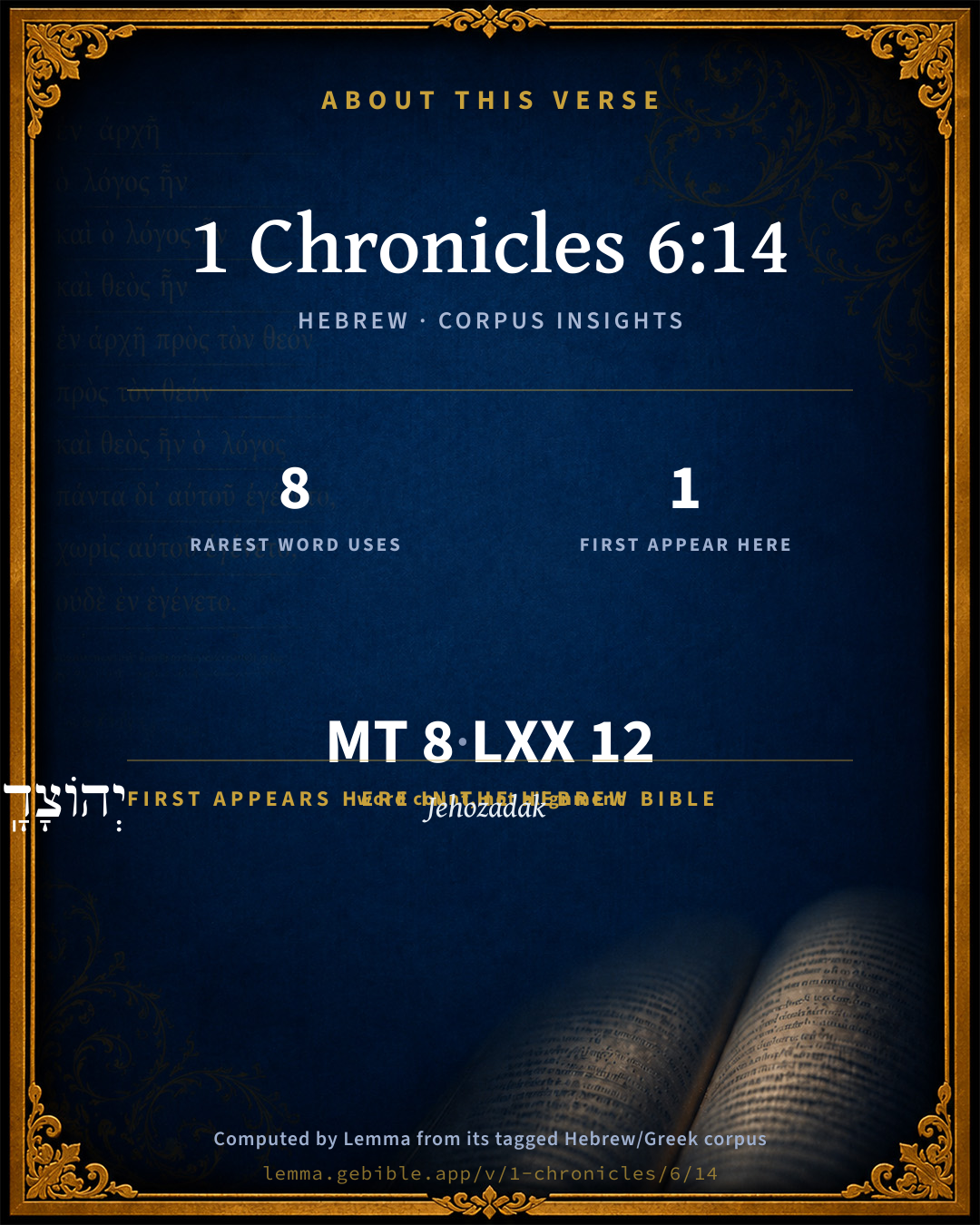
The rarest word here is יְהוֹצָדָֽק Jehozadak H3087 — appearing just 8 times in the whole Hebrew Bible.

First appearance in Scripture

This word makes its first canonical appearance in the Hebrew Bible here:

  • יְהוֹצָדָֽק Jehozadak H3087

Shared distinctive vocabulary

יְהוֹצָדָֽק Jehozadak H3087 occurs in 8 verses of the Hebrew Bible. Also found in:

Grammatical profile

  • 2 verbs
  • 4 nouns
  • 2 particles

Verb forms

  • הוֹלִ֣יד Hiphil · Perfect
  • הוֹלִ֥יד Hiphil · Perfect

Repetition

Words recur within this verse — often emphatic in Hebrew:

  • הוֹלִ֣יד to bear H3205 ×2
  • שְׂרָיָ֔ה Seraiah H8304 ×2

Hebrew & Septuagint length

In English translation the verse runs 14 words from the Hebrew and 8 from the Septuagint (LXX English) — the Septuagint runs noticeably shorter here. See the side-by-side →

A rough comparison of the two English renderings, which tokenize alike — not a word-level alignment.

Word counts can differ between the Hebrew and the Greek without any difference in meaning — e.g. the Hebrew direct-object marker אֵת has no separate Greek word, and Greek often adds the article ὁ.

In the original languages it is 8 Hebrew tokens and 12 Greek tokens — but the two are counted differently (Hebrew bundles its prefixes and suffixes into one token; the Greek is in lemma form), so that isn’t a like-for-like length.

Cross-references

4

Topical passages linked to 1 Chronicles 6:14 in the Treasury of Scripture Knowledge — connected by theme and wording, ordered by reader-vote popularity; previews shown in the World English Bible.

  • 2 Kings 25:18 The captain of the guard took Seraiah the chief priest, and Zephaniah the second priest, and the three keepers of the threshold:
  • Nehemiah 11:11 Seraiah the son of Hilkiah, the son of Meshullam, the son of Zadok, the son of Meraioth, the son of Ahitub, the ruler of the house of God,
  • Ezra 7:1 Now after these things, in the reign of Artaxerxes king of Persia, Ezra the son of Seraiah, the son of Azariah, the son of Hilkiah,
  • Zechariah 6:11 Yes, take silver and gold, and make crowns, and set them on the head of Joshua the son of Jehozadak, the high priest;

Cross-references courtesy of OpenBible.info (CC BY 4.0).

Hebrew and Greek witnesses Masoretic Hebrew ↔ Greek Septuagint

The same verse in the two great witnesses to the Old Testament, shown verse-for-verse.

Here the Septuagint runs noticeably shorter than the Hebrew — LXX2012 (modern English Septuagint) 8 words vs World English Bible 14. A rough length comparison of the two English translations, not a word-level alignment — read both below.

These are two independent witnesses, not word-aligned to each other, and the Septuagint is shown in lemma (dictionary) form.

Hebrew 1 Chronicles 6:14 Masoretic · Westminster Leningrad Codex

וַעֲזַרְיָה֙ הוֹלִ֣יד אֶת שְׂרָיָ֔ה וּשְׂרָיָ֖ה הוֹלִ֥יד אֶת יְהוֹצָדָֽק

and Azariah became the father of Seraiah, and Seraiah became the father of Jehozadak;

World English Bible · Public Domain

Greek LXX 1 Chronicles 6:14 Septuagint · lemma form

υἱός μεραρι μοολι λοβενι υἱός αὐτός σεμεϊ υἱός αὐτός οζα υἱός αὐτός

and Azarias begot Saraia, and Saraias begot Josadac.

LXX2012 (modern English Septuagint) · Public Domain

Hebrew: Westminster Leningrad Codex (CC BY 4.0). Greek: Septuagint (public domain); English from LXX2012 (modern English Septuagint) (Public Domain). How the Septuagint differs from the Hebrew →

Commentary

Notes on 1 Chronicles 6:14 from classic Christian and Jewish commentators (each source and its license shown beneath its notes). The classic Christian expositions comment on the surrounding passage and are grouped to its opening verse, so a note may address several verses; the Jewish commentaries on the Tanakh (Rashi and others) are per-verse, so they appear only where the commentator wrote on this verse.

Lemma curates 59 commentaries, every one of them public domain or Creative Commons licensed, each selected and text-cleaned for this edition rather than reprinted as found. About our sources →

Trapp's Complete Commentary

John Trapp

1Ch 6:14 And Azariah begat Seraiah, and Seraiah begat Jehozadak,

Ver. 14. And Azariah begat Seraiah.] Who was the father, or grandfather, of Ezra the scribe. {Ezr 7:1}

John Trapp, A Commentary or Exposition upon All the Books of the Old and New Testament (1647–1656) — public domain. Text from a community e-Sword module.

Jamieson, Fausset & Brown

Robert Jamieson, A. R. Fausset & David Brown

Azariah begat Seraiah--He filled the supreme pontifical office at the destruction of Jerusalem, and, along with his deputy and others, he was executed by Nebuchadnezzar's orders at Riblah (Kg2 25:18, Kg2 25:21). The line of high priests, under the first temple, which from Zadok amounted to twelve, terminated with him.

Jamieson, Fausset & Brown — Commentary Critical and Explanatory on the Whole Bible (1871) — public domain (CC PDM 1.0). Text via the HelloAO Bible API.

Adam Clarke's Commentary

Verse 14. Seraiah] He was put to death by Nebuchadnezzar, 2Kg 25:18; 2Kg 25:21.

Adam Clarke's Commentary on the Bible (1810–1826) — public domain. Text from a community e-Sword/MySword module.

The Cambridge Bible for Schools and Colleges

gen. ed. J. J. S. Perowne

14. Seraiah] slain soon after the capture of Jerusalem by the Chaldeans; 2Ki_25:18-21; Jer_52:24-27.

Jehozadak] Jozadak in Ezr_3:2; Ezr_5:2. His son Jeshua was the first highpriest after the exile.

The Cambridge Bible for Schools and Colleges (gen. ed. J. J. S. Perowne; Cambridge University Press, 1878–1918) — public domain. Text from a community e-Sword module.

Matthew Poole's English Annotations

Seraiah, who was slain by Nebuchadnezzar at Riblah, 2Ki 25:18,21.

Matthew Poole's English Annotations on the Holy Bible (1683–1685) — public domain. Text from a community e-Sword/MySword module.

The Pulpit Commentary

Azariah. The third occurrence of this name in this list. This person is found again in Ezr 2:l, but is wanting in Neh_11:11. Seraiah; found also in Neh_11:11, in a list which omits the preceding Azariah, and in Ezr_7:1. The end of his high priesthood and of himself is recorded with that of Zephaniah, (2Ki_25:18, 2Ki_25:21) and (not the Seraiah, "the quiet prince," of Jer_51:59-64) he is alsospoken of in Jer_52:24-27. He was high priest in the time ofZedekiah.

HOMILIES BY R. TUCK Vers. 14, 15.

A witness in a man"s name.

In the midst of a long list of names the compiler of this record stops, as if one name set him thinking. The name was one with a significant meaning;

yet it was one that seemed very strange when taken in the light of the man"s history. This name, Jehozadak, meant "Jehovah is righteous;" but the man who bore it "went into captivity, when the Lord carried away Judah and Jerusalem," "It has been noted as remarkable that the heads of both the priestly and the royal stock carried to Babylon should have had names (Zedekiah and Jehozaoak) composed of the same elements, and assertive of the "justice of God," which their sufferings showed forth so signally.

I THE WITNESS OF A SIGNIFICANT NAME. This was a singular recurrence to the ways of an older time, when children"s names were given as embodying circumstances of birth, feelings of parents, etc., and when names were changed to express new relations of the life. In those earlier times names became elements of Divine revelations and agents of Divine witness and teaching. Ab-ra-ham taught men by his name, and so did Is-ra-el. Other instances of revival of this witness by names may be found in the prophetic names given by the later prophets to their children, such as Immanuel, Shear-jashub, and Maher-shalal-hash-baz. It is interesting to add that, among the glories of the future held out before the faithful, is this, "And I will give him a new name. " So Jehozadak had his mission in his name. Down into captivity he went, but in all his intercourse with the humbled and captive people, he pleaded with his name, saying, "Jehovah is righteous." And so we may learn that the least thing about us, a matter as seemingly unimportant as our name, may be taken up into God"s service, and used by him. Therefore we "present our bodies" (our entire selves) "a living sacrifice.

II THE POSSIBLE CONTRAST BETWEEN A MAN"S NAME (OR THE PROMISE OF A MAN"S BIRTH) AND HIS CIRCUMSTANCES. It looked to be a most unlikely thing that a man whose very name declared that "Jehovah was righteous" would ever go into captivity, and be remarkable for a suffering and humiliated life. And yet this is the contrast often observed. It puzzled Asaph and the writer of Job and the writer of Ecclesiastes, in the olden time. It puzzles God"s people still. Men born in sunshine spend lives in the ever-deepening shadows; and sufferers for life, lying in their sick-beds, are the noblest of all witnesses that "Jehovah is righteous." Illustrate by the exquisite reference in the life of Dr. Arnold of Rugby, to the beautiful witness for God made through long years by his invalid sister. Can there be Jehovah"s righteousness seen even in the sufferings which come upon men as the natural fruitage of their own wrong-doings? for that is precisely the case with Israel crushed under the Babylonian tyranny. The presence of Jehozadak and Zedekiah among the captives declared that there can be. Look below the train of causes of which captivity seems the natural effect, and we may see God"s purposes being accomplished, God"s laws being vindicated, and God"s Judgments being executed. Ever we may turn away from the mere course of history and details of events, and watch the "Judge of all the earth doing right." If, however, the suffering of the good troubles us, we may find rest in an appeal to the great case our Lord suffered. He was not merely "smitten of God and afflicted." There was Divine righteousness in the affliction. He was man"s Sin-bearer, and judged for others. Here is a firm foundation-truth, then, which no earthly appearances or strange human experiences can shake. Proclaim it once again, and proclaim it ever is righteous. R.T.

The Pulpit Commentary (1880–1919), ed. H.D.M. Spence-Jones & Joseph S. Exell — public domain. Text from a community e-Sword module.

Lesson kit

Teaching starters — assembled from the data on this page, not authored interpretation. Every prompt links to the verse data it draws on. Edit before teaching.

1 Chronicles, in the Historical, opens this verse with 8 words (5 distinct Hebrew lemmas). Its most distinctive word is Yᵉhôwtsâdâq (“Jehozadak”). The Greek Septuagint runs shorter here. A historical commentator’s framing appears above. Read the whole chapter for the surrounding context.

Discussion questions

  1. What does “Jehozadak” (Yᵉhôwtsâdâq) contribute to the verse as a whole?
  2. The word “Jehozadak” first appears here in Scripture. What is being introduced at this debut?
  3. 1 Chronicles 6:15 shares the word «Jehozadak» with this verse. How do the two illuminate each other?
  4. “to bear” occurs 2× in this one verse. What is the effect of the repetition?
  5. Compared with the Hebrew, the Septuagint runs shorter here. What questions does that raise?
  6. These translations render this verse differently; the difference is in the English rendering, not the original. What questions does that raise?
  7. The verb «הוֹלִ֣יד» is Hiphil Perfect. How does its form color the action?
  8. Reading how Trapp's Complete Commentary and Jamieson, Fausset & Brown read this verse, where do the two commentators agree and where do they part?

Things to notice

Reading settings

Reading text

Shown beneath each verse's original-language words.

Old Testament
Old Testament edition

Read the OT as the Masoretic Hebrew (MT) or the Greek Septuagint (LXX).

English shown for the Greek Septuagint (in the Hebrew ↔ Greek comparison).

Comparing translations? Open the Compare panel on any verse page to stack up to four side by side.