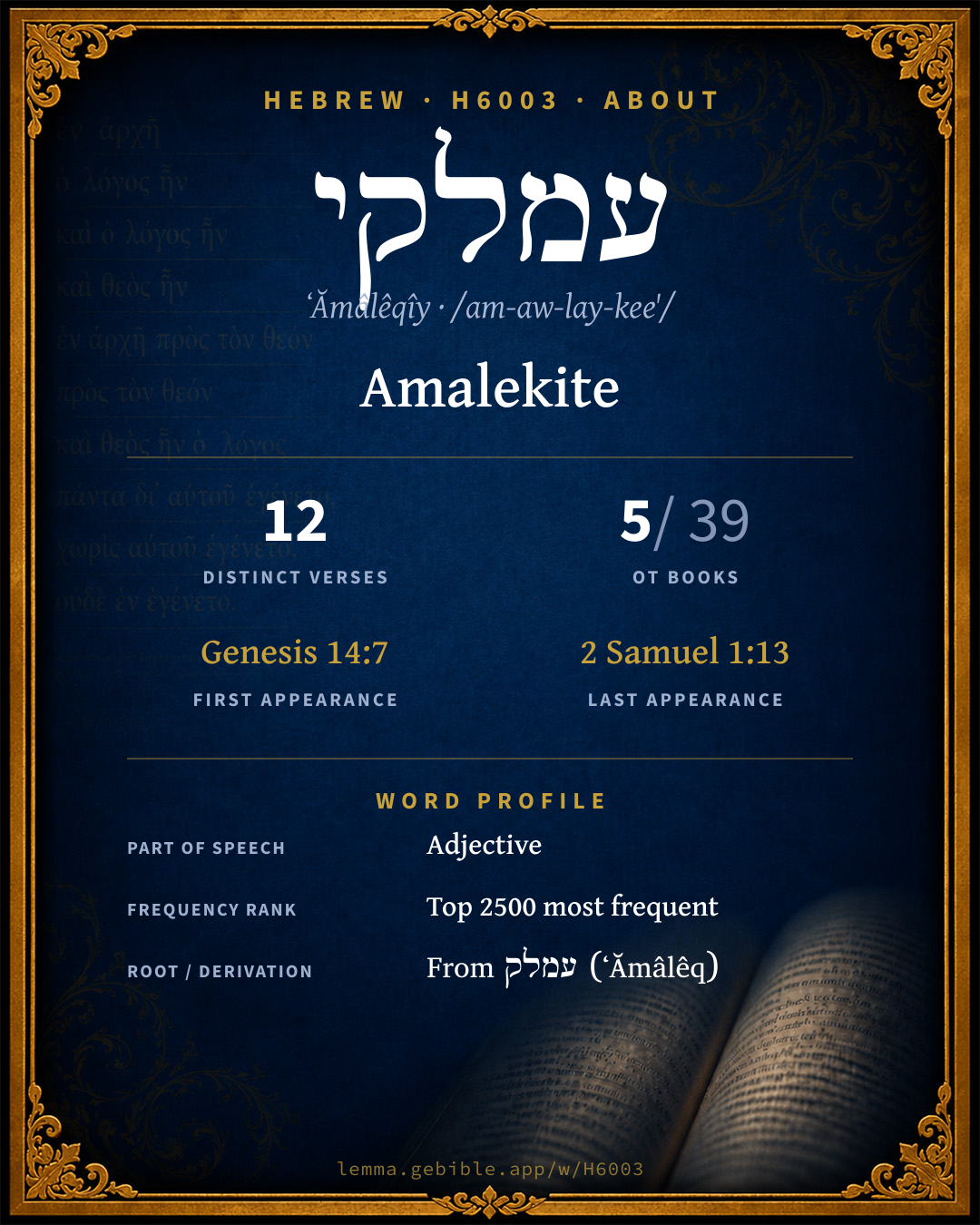
עֲמָלֵקִי
Amalekite
BDB lists 2 entries for ‘Amalekite’ fuller range ↓
Full lexicon entry — Brown-Driver-Briggs (BDB)
From Brown-Driver-Briggs (BDB)
Where this word appears
Grammar key — what these labels mean
Part of speech
- Noun
- A naming word — a person, place, thing, or idea.
Noun type
- Gentilic
- A noun naming a member of a people, tribe, or region of origin (e.g. an Israelite, a Moabite).
State
- Absolute
- The independent form of a noun, not bound to a following word.
Gender
- Masculine
- Grammatically masculine.
Number
- Singular
- One.
Every verse where H6003 appears — 12 distinct verses across 5 books. Click any verse to open its interlinear word-by-word view. Verse text shown in the World English Bible for context — . Each verse’s Hebrew form is shown with its reference; the English is not keyword-highlighted, since the data carries no word-level English alignment. Use “Compare translations” on any verse to read it across multiple English versions. This concordance covers the Hebrew Bible; Septuagint (Greek Old Testament) occurrences are not indexed here.
Genesis 1 verse
Numbers 3 verses
- Numbers 14:25 וְ/הָֽ/עֲמָלֵקִ֥י conj + ptcl def.art + n Gentilic ms Now the Amalekite and the Canaanite dwell in the valley: tomorrow turn you, and get you into the wilderness by the way to the Red Sea.
- Numbers 14:43 הָ/עֲמָלֵקִ֨י ptcl def.art + n Gentilic ms For there the Amalekite and the Canaanite are before you, and you shall fall by the sword: because you are turned back from following Yahweh, therefore Yahweh will not be with you.
- Numbers 14:45 הָ/עֲמָלֵקִי֙ ptcl def.art + n Gentilic ms Then the Amalekite came down, and the Canaanite who lived in that mountain, and struck them and beat them down, even to Hormah.
Judges 1 verse
1 Samuel 5 verses
- 1 Samuel 15:6 עֲמָלֵקִ֗י n Gentilic ms Saul said to the Kenites, Go, depart, get you down from among the Amalekites, lest I destroy you with them; for you shown kindness to all the children of Israel, when they came up out of Egypt. So the Kenites departed from among the Amalekites.
- 1 Samuel 15:15 מֵ/עֲמָלֵקִ֣י prep + n Gentilic ms Saul said, They have brought them from the Amalekites: for the people spared the best of the sheep and of the oxen, to sacrifice to Yahweh your God; and the rest we have utterly destroyed.
- 1 Samuel 27:8 וְ/הָ/עֲמָלֵקִ֑י conj + ptcl def.art + n Gentilic ms David and his men went up, and made a raid on the Geshurites, and the Girzites, and the Amalekites; for those [nations] were the inhabitants of the land, who were of old, as you go to Shur, even to the land of Egypt.
- 1 Samuel 30:1 וַ/עֲמָלֵקִ֣י conj + n Gentilic ms It happened, when David and his men were come to Ziklag on the third day, that the Amalekites had made a raid on the South, and on Ziklag, and had struck Ziklag, and burned it with fire,
- 1 Samuel 30:13 עֲמָֽלֵקִ֔י n Gentilic ms David said to him, To whom belong you? and whence are you? He said, I am a young man of Egypt, servant to an Amalekite; and my master left me, because three days ago I fell sick.
2 Samuel 2 verses
About this entry
At a glance — auto-summarized from this page’s data, not written by a person. Every figure links to its source below. This summary describes the numbers; it doesn’t interpret them.
עמלקי — transliterated ʻĂmâlêqîy — is a Hebrew name carrying the sense “Amalekite.” Debuting at Genesis 14:7, it then recurs through the corpus. With 12 verses in 5 books, it is an uncommon word in the Hebrew Bible. Its uses concentrate in 1 Samuel (42% of all occurrences). Each statement above links to its evidence; the full detail follows below.
Gloss history
Strong's 1890 vs modern scholarship
About this word
Strong's H6003 catalogs a Hebrew word from the Hebrew Old Testament.
These counts are not copied from any lexicon or concordance. They are computed here, from the morphology-tagged Hebrew Old Testament. What Lemma adds →
- 12
- distinct verses
- The word appears in 12 distinct verses.
- 5 / 39
- OT books
- The word appears in 5 of 39 Old Testament books.
- #2,101
- by frequency
- Top 2500 most frequent Hebrew words (rank 2,101 of 8,640 Hebrew words by occurrence).
View all 12 occurrences in the concordance →
By section of the Old Testament
By traditional corpus
Conventional, traditional groupings — biblical authorship is debated, so this is a traditional corpus grouping, not an authorship claim. Each share is this word’s portion of its verses in that division of the Hebrew canon. Each figure is a share of the word’s 12 distinct verses.
- Prophets (Nevi'im) 8 verses · 67%
- Torah (Pentateuch) 4 verses · 33%
How translations render this word
Counts come from each version’s own published word-to-Strong’s tagging or interlinear alignment — an approximate guide to how each version renders this word, not a word-level alignment the data otherwise carries. Because each total is that version’s own tagged count, the per-version totals vary from one another and need not match the appearance or distinct-verse counts above. These counts may also differ from a printed concordance because Lemma counts each distinctly tagged rendering and does not collapse phrase taggings into a single head-word total. This is a fixed set of word-tagged versions (KJV, ASV, BSB, ULT) and does not change with the reading translation you choose elsewhere. Each version’s license is shown beside its name below (and on Sources).
- King James Version: Amalekites 8×
- American Standard Version: Amalekites 6×, Amalekite 3×
- Berean Standard Bible: Amalekites 8×, Amalekite 3×
- unfoldingWord Literal Text: Amalekite 10×
King James Version Public Domain
Renders H6003 across 11 tagged occurrences — most commonly:
Plus 3 renderings that appear only once — usually multi-word phrases or single function words the recovered tagging swept in, not distinct renderings. Not rendered by a distinct English word in 1 further occurrence.
American Standard Version Public Domain
Renders H6003 across 11 tagged occurrences — most commonly:
Plus 2 renderings that appear only once — usually multi-word phrases or single function words the recovered tagging swept in, not distinct renderings.
Berean Standard Bible Public Domain
Renders H6003 across 12 tagged occurrences — most commonly:
Plus 1 rendering that appears only once — usually multi-word phrases or single function words the recovered tagging swept in, not distinct renderings.
unfoldingWord Literal Text CC BY-SA 4.0
Renders H6003 across 12 tagged occurrences — most commonly:
Plus 2 renderings that appear only once — usually multi-word phrases or single function words the recovered tagging swept in, not distinct renderings.
Senses in BDB
The 2 senses BDB distinguishes for this word, in lexicon order (not ranked by frequency or importance). The full entry — with sub-senses — is in the Lexicon Entry tab.
- Amalekite = see Amalek " people of lapping"
- descendants of Amalek, the grandson of Esau
Word origin
adj.gent. 1 S 30:13; 2 S 1:13, also (as pred.) v 8; coll. = (the) Amalekites 1 S 15:6, 15; 30:1, elsewhere c. art. הָע׳ Nu 14:25, 43, 45 (J; all + הַכְּנַעֲנִי), 1 S 27:8; שְׂדֵה הָע׳ Gn 14:7; הַר הָע׳ Ju 12:15 (in Ephraim); read הָע׳ also Ju 1:16 (for הָעָם) Bu GFM, > עֲמָלֵק Hollenb Mey Kit Kau; on 2 S 1:1 v. foreg.
— Brown-Driver-Briggs (Oxford 1906, public domain), digitized via Sefaria, supplemented by the OpenScriptures HebrewLexicon (CC BY 4.0). See Sources.
Derived from עמלק (ʻĂmâlêq) (H6002) — Amalek.
Forms in the corpus
The 11 distinct written forms H6003 takes in the Hebrew Bible, most frequent first — each parse links to that state’s occurrences in the concordance. Hebrew forms include their vowel points and cantillation, so a single lemma takes many written forms.
| Form | Parsing | Example | Uses |
|---|---|---|---|
| עֲמָלֵקִ֖י | Noun, Gentilic, Masculine, Singular, Absolute | 2 Samuel 1:8 | 2 |
| הָ/עֲמָלֵקִ֑י | Noun, Gentilic, Masculine, Singular, Absolute | Genesis 14:7 | 1 |
| הָ/עֲמָלֵקִ֨י | Noun, Gentilic, Masculine, Singular, Absolute | Numbers 14:43 | 1 |
| הָ/עֲמָלֵקִֽי | Noun, Gentilic, Masculine, Singular, Absolute | Judges 12:15 | 1 |
| הָ/עֲמָלֵקִי֙ | Noun, Gentilic, Masculine, Singular, Absolute | Numbers 14:45 | 1 |
| וְ/הָ/עֲמָלֵקִ֑י | Noun, Gentilic, Masculine, Singular, Absolute | 1 Samuel 27:8 | 1 |
| וְ/הָֽ/עֲמָלֵקִ֥י | Noun, Gentilic, Masculine, Singular, Absolute | Numbers 14:25 | 1 |
| וַ/עֲמָלֵקִ֣י | Noun, Gentilic, Masculine, Singular, Absolute | 1 Samuel 30:1 | 1 |
| מֵ/עֲמָלֵקִ֣י | Noun, Gentilic, Masculine, Singular, Absolute | 1 Samuel 15:15 | 1 |
| עֲמָֽלֵקִ֔י | Noun, Gentilic, Masculine, Singular, Absolute | 1 Samuel 30:13 | 1 |
| עֲמָלֵקִ֗י | Noun, Gentilic, Masculine, Singular, Absolute | 1 Samuel 15:6 | 1 |
Bible dictionary
Public-domain dictionary articles matched to this entry by name (Amalekite). A biblical name can be shared by more than one person or place, so an article may treat several.
Easton's Bible Dictionary · M. G. Easton, 1897
A tribe that dwelt in Arabia Petraea, between the Dead Sea and the Red Sea. They were not the descendants of Amalek, the son of Eliphaz, for they existed in the days of Abraham (Gen. 14:7). They were probably a tribe that migrated from the shores of the Persian Gulf and settled in Arabia. "They dwelt in the land of the south...from Havilah until thou comest to Shur" (Num. 13:29; 1 Sam. 15:7). They were a pastoral, and hence a nomadic race. Their kings bore the hereditary name of Agag (Num. 24:7; 1 Sam. 15:8). They attempted to stop the Israelites when they marched through their territory (Deut. 25:18), attacking them at Rephidim (Ex. 17:8-13; comp. Deut. 25:17; 1 Sam. 15:2). They afterwards attacked the Israelites at Hormah (Num. 14:45). We read of them subsequently as in league with the Moabites (Judg. 3:13) and the Midianites (Judg. 6:3). Saul finally desolated their territory and destroyed their power (1 Sam. 14:48; 15:3), and David recovered booty from them (1 Sam. 30:18-20). In the Babylonian inscriptions they are called Sute, in those of Egypt Sittiu, and the Amarna tablets include them under the general name of Khabbati, or "plunderers."
Classic public-domain reference works; full attribution on Sources.
Septuagint verse parallels
This word appears in 12 verses that also exist in the Greek Old Testament (Septuagint), out of the 12 Hebrew verses it occurs in. You can read those verses in Greek by switching the Old Testament edition to the Septuagint.
Read these verses in the Septuagint
This is a verse-level parallel only — the same verses exist in both the Hebrew and Greek Old Testaments. No word-level Hebrew↔Greek correspondence is claimed: the data carries no such alignment, so no Greek word is shown as this Hebrew word’s translation. Coverage is not total — the Septuagint omits the deuterocanon and renumbers the Psalms, so some Hebrew verses have no direct Greek parallel.