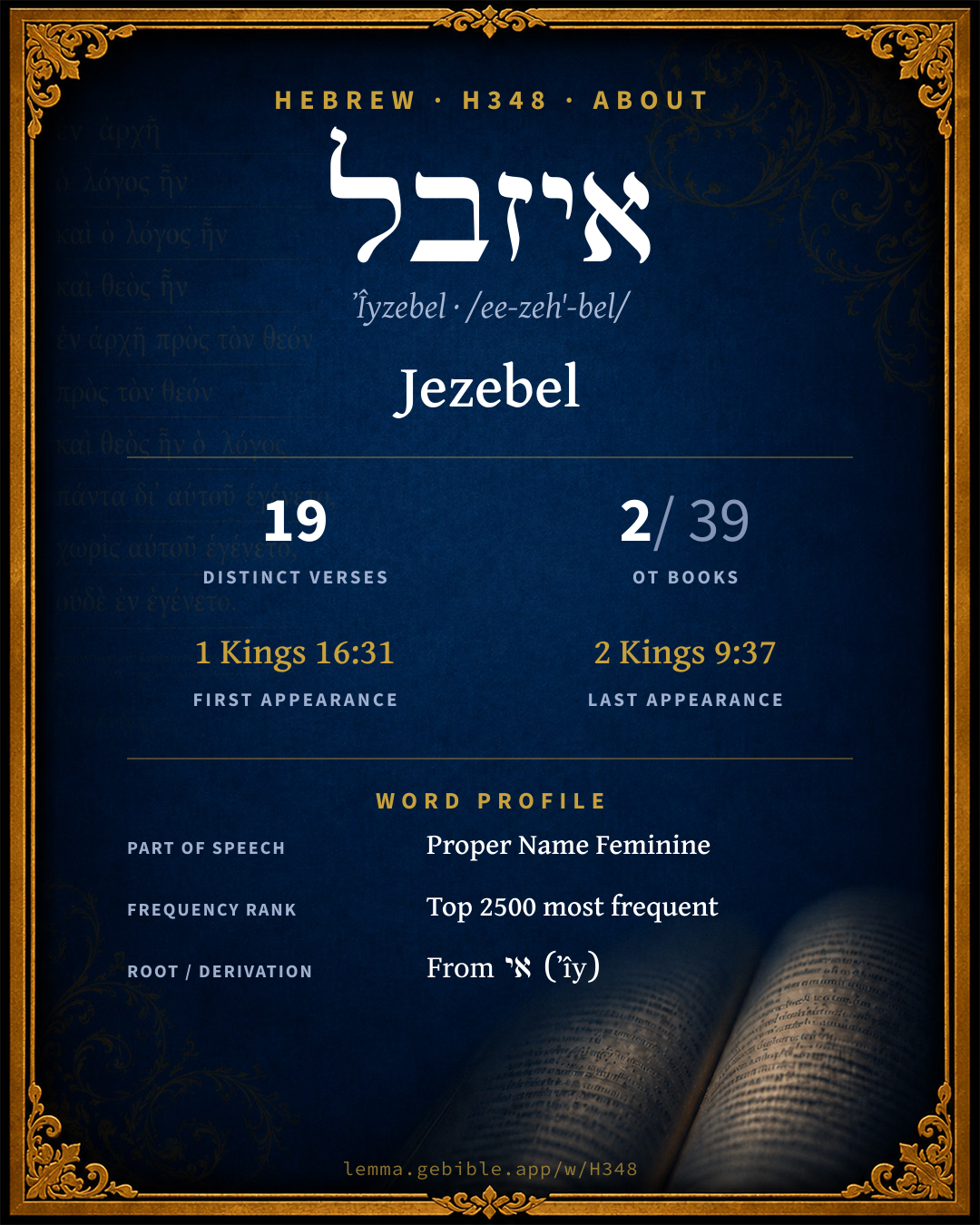
אִיזֶבֶל
Jezebel
BDB lists 2 entries for ‘Jezebel’ fuller range ↓
Full lexicon entry — Brown-Driver-Briggs (BDB)
From Brown-Driver-Briggs (BDB)
Where this word appears
Grammar key — what these labels mean
Part of speech
- Noun
- A naming word — a person, place, thing, or idea.
Noun type
- Proper
- A name of a specific person, place, or people (e.g. Abraham, Zion, Israel).
Every verse where H348 appears — 19 distinct verses across 2 books. Click any verse to open its interlinear word-by-word view. Verse text shown in the World English Bible for context — . Each verse’s Hebrew form is shown with its reference; the English is not keyword-highlighted, since the data carries no word-level English alignment. Use “Compare translations” on any verse to read it across multiple English versions. This concordance covers the Hebrew Bible; Septuagint (Greek Old Testament) occurrences are not indexed here.
1 Kings 13 verses
- 1 Kings 16:31 אִיזֶ֗בֶל n Proper It happened, as if it had been a light thing for him to walk in the sins of Jeroboam the son of Nebat, that he took as wife Jezebel the daughter of Ethbaal king of the Sidonians, and went and served Baal, and worshiped him.
- 1 Kings 18:4 אִיזֶ֔בֶל n Proper for it was so, when Jezebel cut off the prophets of Yahweh, that Obadiah took one hundred prophets, and hid them by fifty in a cave, and fed them with bread and water.)
- 1 Kings 18:13 אִיזֶ֔בֶל n Proper Wasn't it told my lord what I did when Jezebel killed the prophets of Yahweh, how I hid one hundred men of Yahweh's prophets by fifty in a cave, and fed them with bread and water?
- 1 Kings 18:19 אִיזָֽבֶל n Proper Now therefore send, and gather to me all Israel to Mount Carmel, and the prophets of Baal four hundred fifty, and the prophets of the Asherah four hundred, who eat at Jezebel's table.
- 1 Kings 19:1 לְ/אִיזֶ֔בֶל prep + n Proper Ahab told Jezebel all that Elijah had done, and withal how he had slain all the prophets with the sword.
- 1 Kings 19:2 אִיזֶ֨בֶל֙ n Proper Then Jezebel send a messenger to Elijah, saying, So let the gods do to me, and more also, if I don't make your life as the life of one of them by tomorrow about this time.
- 1 Kings 21:5 אִיזֶ֣בֶל n Proper But Jezebel his wife came to him, and said to him, Why is your spirit so sad, that you eat no bread?
- 1 Kings 21:7 אִיזֶ֣בֶל n Proper Jezebel his wife said to him, Do you now govern the kingdom of Israel? arise, and eat bread, and let your heart be merry: I will give you the vineyard of Naboth the Jezreelite.
- 1 Kings 21:11 אִיזָ֑בֶל n Proper The men of his city, even the elders and the nobles who lived in his city, did as Jezebel had sent to them, according as it was written in the letters which she had sent to them.
- 1 Kings 21:14 אִיזֶ֣בֶל n Proper Then they sent to Jezebel, saying, Naboth is stoned, and is dead.
- 1 Kings 21:15 אִיזֶ֔בֶל אִיזֶ֜בֶל n Proper n Proper It happened, when Jezebel heard that Naboth was stoned, and was dead, that Jezebel said to Ahab, Arise, take possession of the vineyard of Naboth the Jezreelite, which he refused to give you for money; for Naboth is not alive, but dead.
- 1 Kings 21:23 לְ/אִיזֶ֔בֶל אִיזֶ֖בֶל prep + n Proper n Proper Of Jezebel also spoke Yahweh, saying, The dogs shall eat Jezebel by the rampart of Jezreel.
- 1 Kings 21:25 אִיזֶ֥בֶל n Proper (But there was none like Ahab, who did sell himself to do that which was evil in the sight of Yahweh, whom Jezebel his wife stirred up.
2 Kings 6 verses
- 2 Kings 9:7 אִיזָֽבֶל n Proper You shall strike the house of Ahab your master, that I may avenge the blood of my servants the prophets, and the blood of all the servants of Yahweh, at the hand of Jezebel.
- 2 Kings 9:10 אִיזֶ֜בֶל n Proper The dogs shall eat Jezebel in the portion of Jezreel, and there shall be none to bury her. He opened the door, and fled.
- 2 Kings 9:22 אִיזֶ֧בֶל n Proper It happened, when Joram saw Jehu, that he said, Is it peace, Jehu? He answered, What peace, so long as the prostitution of your mother Jezebel and her witchcraft abound?
- 2 Kings 9:30 וְ/אִיזֶ֣בֶל conj + n Proper When Jehu was come to Jezreel, Jezebel heard of it; and she painted her eyes, and attired her head, and looked out at the window.
- 2 Kings 9:36 אִיזָֽבֶל n Proper Therefore they came back, and told him. He said, This is the word of Yahweh, which he spoke by his servant Elijah the Tishbite, saying, In the portion of Jezreel shall the dogs eat the flesh of Jezebel;
- 2 Kings 9:37 אִיזֶ֗בֶל אִיזָֽבֶל n Proper n Proper and the body of Jezebel shall be as dung on the face of the field in the portion of Jezreel, so that they shall not say, This is Jezebel.
About this entry
At a glance — auto-summarized from this page’s data, not written by a person. Every figure links to its source below. This summary describes the numbers; it doesn’t interpret them.
איזבל (ʼÎyzebel) is a Hebrew name most often rendered “Jezebel.” It clusters heavily in 1 Kings, which alone accounts for 68% of its uses. It turns up in 19 verses across 2 books, an uncommon footprint. It first appears in 1 Kings 16:31. For the data behind this summary, explore 19-verse concordance and the renderings breakdown below.
Gloss history
Strong's 1890 vs modern scholarship
About this word
Strong's H348 catalogs a Hebrew word from the Hebrew Old Testament.
These counts are not copied from any lexicon or concordance. They are computed here, from the morphology-tagged Hebrew Old Testament. What Lemma adds →
- 19
- distinct verses
- The word appears in 19 distinct verses.
- 2 / 39
- OT books
- The word appears in 2 of 39 Old Testament books.
- #1,412
- by frequency
- Top 2500 most frequent Hebrew words (rank 1,412 of 8,640 Hebrew words by occurrence).
View all 19 occurrences in the concordance →
By traditional corpus
Conventional, traditional groupings — biblical authorship is debated, so this is a traditional corpus grouping, not an authorship claim. Each share is this word’s portion of its verses in that division of the Hebrew canon. Each figure is a share of the word’s 19 distinct verses.
- Prophets (Nevi'im) 19 verses · 100%
How translations render this word
Counts come from each version’s own published word-to-Strong’s tagging or interlinear alignment — an approximate guide to how each version renders this word, not a word-level alignment the data otherwise carries. Because each total is that version’s own tagged count, the per-version totals vary from one another and need not match the appearance or distinct-verse counts above. These counts may also differ from a printed concordance because Lemma counts each distinctly tagged rendering and does not collapse phrase taggings into a single head-word total. This is a fixed set of word-tagged versions (KJV, ASV, BSB, ULT) and does not change with the reading translation you choose elsewhere. Each version’s license is shown beside its name below (and on Sources).
- King James Version: Jezebel 18×
- American Standard Version: Jezebel 19×
- Berean Standard Bible: Jezebel 16×, Jezebel’s 2×
- unfoldingWord Literal Text: Jezebel 21×
King James Version Public Domain
Renders H348 across 22 tagged occurrences — most commonly:
Plus 4 renderings that appear only once — usually multi-word phrases or single function words the recovered tagging swept in, not distinct renderings.
American Standard Version Public Domain
Renders H348 across 22 tagged occurrences — most commonly:
Plus 3 renderings that appear only once — usually multi-word phrases or single function words the recovered tagging swept in, not distinct renderings.
Berean Standard Bible Public Domain
Renders H348 across 21 tagged occurrences — most commonly:
Plus 3 renderings that appear only once — usually multi-word phrases or single function words the recovered tagging swept in, not distinct renderings. Not rendered by a distinct English word in 1 further occurrence.
unfoldingWord Literal Text CC BY-SA 4.0
Renders H348 across 22 tagged occurrences — most commonly:
Plus 1 rendering that appears only once — usually multi-word phrases or single function words the recovered tagging swept in, not distinct renderings.
Senses in BDB
The 2 senses BDB distinguishes for this word, in lexicon order (not ranked by frequency or importance). The full entry — with sub-senses — is in the Lexicon Entry tab.
- Jezebel = "Baal exalts" or " Baal is husband to" or " unchaste"
- queen of Israel, wife of Ahab, daughter of Ethbaal
Word origin
n.pr.f. (sense uncertain, CIS i. 158 there occurs the n.pr.f. בעלאזבל Baal exalts? or is husband to? [v. זָבַל], of which אִיזֶבֶל is conjectured by DHM to be an intentional alteration, made for the purpose of avoiding the name Baal. If so, א׳ perhaps suggested to the Hebrew ear the idea of un-exalted or un-husbanded), queen of Ahab, daughter of Ethbaal, king of Tyre 1 K 16:31; 18:4, 13, 19; 19:1, 2; 21:5 +; 2 K 9:7 +.
— Brown-Driver-Briggs (Oxford 1906, public domain), digitized via Sefaria, supplemented by the OpenScriptures HebrewLexicon (CC BY 4.0). See Sources.
Derived from אי (ʼîy) (H336) — not.
Forms in the corpus
The 12 distinct written forms H348 takes in the Hebrew Bible, most frequent first — each parse links to that state’s occurrences in the concordance. Hebrew forms include their vowel points and cantillation, so a single lemma takes many written forms.
| Form | Parsing | Example | Uses |
|---|---|---|---|
| אִיזָֽבֶל | Noun, Proper | 1 Kings 18:19 | 4 |
| אִיזֶ֔בֶל | Noun, Proper | 1 Kings 18:4 | 3 |
| אִיזֶ֣בֶל | Noun, Proper | 1 Kings 21:5 | 3 |
| אִיזֶ֗בֶל | Noun, Proper | 1 Kings 16:31 | 2 |
| אִיזֶ֜בֶל | Noun, Proper | 1 Kings 21:15 | 2 |
| לְ/אִיזֶ֔בֶל | Noun, Proper | 1 Kings 19:1 | 2 |
| אִיזֶ֖בֶל | Noun, Proper | 1 Kings 21:23 | 1 |
| אִיזֶ֥בֶל | Noun, Proper | 1 Kings 21:25 | 1 |
| אִיזֶ֧בֶל | Noun, Proper | 2 Kings 9:22 | 1 |
| אִיזֶ֨בֶל֙ | Noun, Proper | 1 Kings 19:2 | 1 |
| אִיזָ֑בֶל | Noun, Proper | 1 Kings 21:11 | 1 |
| וְ/אִיזֶ֣בֶל | Noun, Proper | 2 Kings 9:30 | 1 |
Same root — word family
Other BDB entries built from the same root as H348, grouped by Strong’s listed origin. These share a root / origin per the lexicon — not necessarily a shared meaning. Each links to that word’s own entry.
Derives from
Proper names from this root
People and places named from this root — a name, not an additional meaning of the word.
Compare all same-root words → Showing 4 of 5 — not the complete family. 3 of the same-root words are proper names (people or places). They share a root, not necessarily a meaning.
Bible dictionary
Public-domain dictionary articles matched to this entry by name (Jezebel). A biblical name can be shared by more than one person or place, so an article may treat several.
Easton's Bible Dictionary · M. G. Easton, 1897
Chaste, the daughter of Ethbaal, the king of the Zidonians, and the wife of Ahab, the king of Israel (1 Kings 16:31). This was the "first time that a king of Israel had allied himself by marriage with a heathen princess; and the alliance was in this case of a peculiarly disastrous kind. Jezebel has stamped her name on history as the representative of all that is designing, crafty, malicious, revengeful, and cruel. She is the first great instigator of persecution against the saints of God. Guided by no principle, restrained by no fear of either God or man, passionate in her attachment to her heathen worship, she spared no pains to maintain idolatry around her in all its splendour. Four hundred and fifty prophets ministered under her care to Baal, besides four hundred prophets of the groves [R.V., 'prophets of the Asherah'], which ate at her table (1 Kings 18:19). The idolatry, too, was of the most debased and sensual kind." Her conduct was in many respects very disastrous to the kingdom both of Israel and Judah (21:1-29). At length she came to an untimely end. As Jehu rode into the gates of Jezreel, she looked out at the window of the palace, and said, "Had Zimri peace, who slew his master?" He looked up and called to her chamberlains, who instantly threw her from the window, so that she was dashed in pieces on the street, and his horses trod her under their feet. She was immediately consumed by the dogs of the street (2 Kings 9:7-37), according to the word of Elijah the Tishbite (1 Kings 21:19).
Her name afterwards came to be used as the synonym for a wicked woman (Rev. 2: 20).
It may be noted that she is said to have been the grand-aunt of Dido, the founder of Carthage.
Smith's Bible Dictionary · William Smith, 1863
(chaste), wife of Ahab king of Israel. (B.C. 883.) She was a Phoenician princess, daughter of Ethbaal king of the Zidonians. In her hands her husband became a mere puppet. (1 Kings 21:25) The first effect of her influence was the immediate establishment of the Phoenician worship on a grand scale in the court of Ahab. At her table were supported no less than 450 prophets of Baal and 400 of Eastward. (1 Kings 16:31,21; 18:19) The prophets of Jehovah were attacked by her orders and put to the sword. (1 Kings 18:13; 2 Kings 9:7) At last the people, at the instigation of Elijah, rose against her ministers and slaughtered them at the foot of Carmel. When she found her husband east down by his disappointment at being thwarted by Naboth, (1 Kings 21:7) she wrote a warrant in Ahab's name, and sealed it with his seal. To her, and not to Ahab, was sent the announcement that the royal wishes were accomplished, (1 Kings 21:14) and on her accordingly fell the prophet's curse, as well as on her husband, (1 Kings 21:23) a curse fulfilled so literally by Jehu, whose chariot-horses trampled out her life. The body was left in that open space called in modern eastern language "the mounds," where offal is thrown from the city walls. (2 Kings 9:30-37)
Hitchcock's Bible Names Dictionary · Roswell D. Hitchcock, 1869
chaste
Classic public-domain reference works; full attribution on Sources.
Septuagint verse parallels
This word appears in 19 verses that also exist in the Greek Old Testament (Septuagint), out of the 19 Hebrew verses it occurs in. You can read those verses in Greek by switching the Old Testament edition to the Septuagint.
Read these verses in the Septuagint
This is a verse-level parallel only — the same verses exist in both the Hebrew and Greek Old Testaments. No word-level Hebrew↔Greek correspondence is claimed: the data carries no such alignment, so no Greek word is shown as this Hebrew word’s translation. Coverage is not total — the Septuagint omits the deuterocanon and renumbers the Psalms, so some Hebrew verses have no direct Greek parallel.